×

Tuvalu🇹🇻 | regionsNuiLagoon islets, sandy track, swamp taro gardens, Nui dance | things to do and best time to go

Explore NiutaoExplore Vaitupu

Backpacking in Nui
👌 Worth visitingregion ranked #4
By Johan Kruseman 🇳🇱 | Updated October 15, 2026

Nui is an outer island of Tuvalu, and getting there takes planning because outer-island travel here runs on the government ship, not on a fixed timetable. Nui sits in the central group of Tuvalu, roughly northwest of Funafuti, and its ring of islets around a lagoon is mostly low, narrow land with breadfruit, pandanus and coconut palms. Here is how it works: the ship schedule shifts with weather and cargo, so the smart move is to confirm sailing dates in Funafuti the week you travel and keep a few spare days on both ends. Homestays and guesthouses are small, so ask the island council or your host to arrange a bed and meals before you land. Evenings are quiet, with early nights, church singing and fishermen heading out on the lagoon. You will meet locals easily, other travelers rarely. Nui is also known for its distinctive Kiribati-influenced language and dance, and the villages sit along a single sandy track.

Discover everything you want to know in the 📖 Tuvalu Travel Guide.


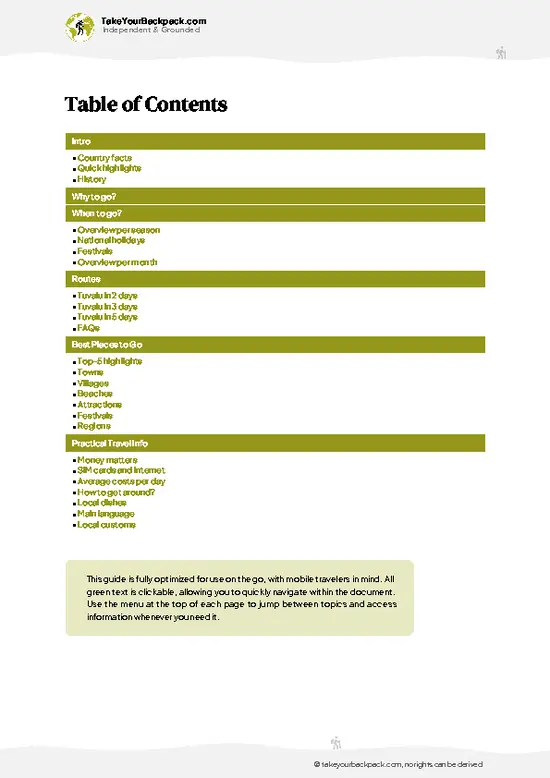
example page 0 from our offline Travel Guide for Tuvalu
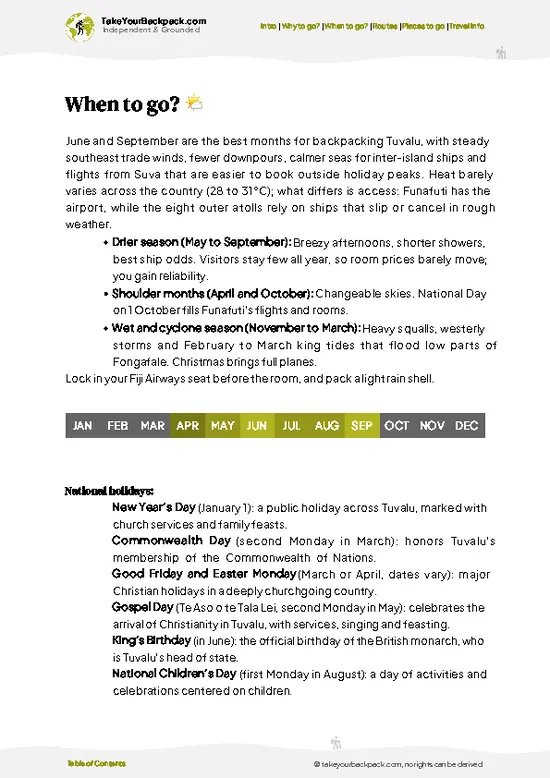
example page 1 from our offline Travel Guide for Tuvalu
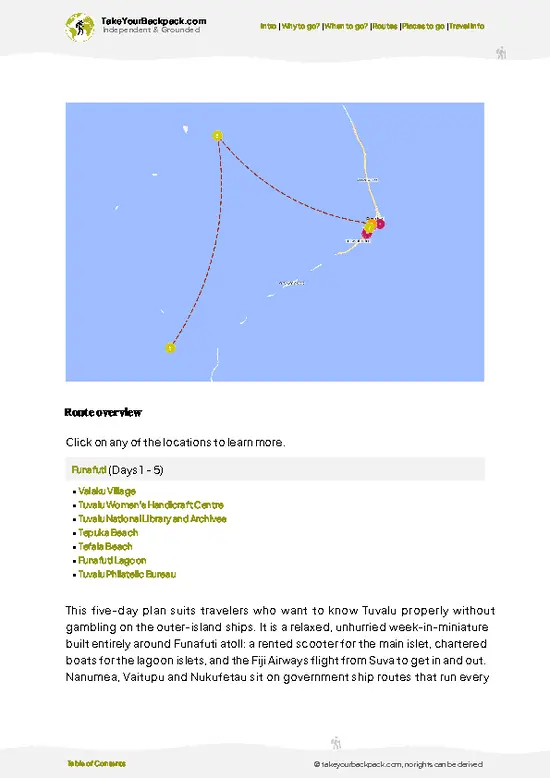
example page 2 from our offline Travel Guide for Tuvalu
example page 3 from our offline Travel Guide for Tuvalu
example page 4 from our offline Travel Guide for Tuvalu
example page 5 from our offline Travel Guide for Tuvalu
example page 6 from our offline Travel Guide for Tuvalu
example page 7 from our offline Travel Guide for Tuvalu
Loading the map 🌍
CLICK TO FILTER
towns
villages
beaches
attractions
festivals
regions
SHOW COUNTRY’S BESTSHOW ALL

✨ Why go?
Ranked #4 region in Tuvalu
What makes it a must-see region

Nui suits travelers who want to see how Tuvalu lives away from the airport strip. The draw is the lagoon and its scattered islets, where you can fish, paddle or wade at low tide, and the daily rhythm of a community that still farms pulaka pits and weaves its own mats. Nui also stands apart from the other islands because of its Gilbertese heritage, which you hear in the language and see in the dancing at community gatherings. Most people who come stay several days, since the ship timing makes a flying visit impractical. It is a poor fit for anyone wanting nightlife, tours or reliable shops. It works well for slow travelers, couples and solo visitors who like long walks, shared meals with a host family and quiet evenings. Treat it as a pause between Funafuti and wherever you head next, and bring cash, snacks and a good book.

💡 HighlightsKey sights and experiences for travelers

  1. The village islets and lagoon shoreline: Walk the sandy track between the main settlements and the water's edge, where houses, meeting halls and canoes sit side by side. Go early morning or late afternoon for cooler air. Free, allow 2 to 3 hours.
  2. Pulaka pits and traditional gardens: Local families dig deep pits to grow giant swamp taro in the thin soil. Ask your host to take you, and respect the owners' land. Usually free or a small gift, about 1 hour, best in the morning.
  3. The community meeting hall (maneapa) and church gatherings: Evening singing and Sunday services show the Nui voice and its distinctive dance tradition. Dress modestly and sit where invited. Free, allow 1 to 2 hours, and a small donation is welcome.
If time is short, skip the pulaka pit visit and keep the shoreline walk and evening singing.
Spotted a mistake or missing something? Contact us.

⌛️ 5 daysWhat you can realistically do in a week

Day 1: Fenua Tapu: Start where the people are. Most of Nui’s residents live on Fenua Tapu, and the village is the one stop you cannot skip: the meeting house, the church bell, the pigs and the shared kitchens explain the atoll faster than any walk elsewhere. Arrive with no schedule, because the boat from Funafuti sets the rhythm of everything. Tuvalu has no scheduled domestic flights, so the ship decides when you land and when you leave, and you plan around its sailing rather than the other way around.
Day 2: Village Lagoon Shore: Stay put and let the island come to you. Walk the lagoon side in the cool of early morning, when the water is flat and the fishing canoes are being readied. Nui’s lagoon is shallow and brackish, ringed by pandanus and mangrove. Ask your host about a visit to the taro … read more 👉
Day 1: Fenua Tapu: Start where the people are. Most of Nui’s residents live on Fenua Tapu, and the village is the one stop you cannot skip: the meeting house, the church bell, the pigs and the shared kitchens explain the atoll faster than any walk elsewhere. Arrive with no schedule, because the boat from Funafuti sets the rhythm of everything. Tuvalu has no scheduled domestic flights, so the ship decides when you land and when you leave, and you plan around its sailing rather than the other way around.
Day 2: Village Lagoon Shore: Stay put and let the island come to you. Walk the lagoon side in the cool of early morning, when the water is flat and the fishing canoes are being readied. Nui’s lagoon is shallow and brackish, ringed by pandanus and mangrove. Ask your host about a visit to the taro pits and the breadfruit trees, which are the soft center of local food.
Day 3: Islets Across the Lagoon: This is the detour. A boat ride to one of the quieter motu on the far side of the lagoon adds empty beach, birds and coconut crab country without costing you a night elsewhere. Go with a local who knows the channels, and be back before the afternoon wind builds. It fits the pace because the village remains your base.
Day 4: Outer Coast and Reef: Cross to the ocean side on foot and look at the reef edge, where the surf breaks white against the coral. Swimming is better in the lagoon, so treat this as a day for slow walking, photos and conversation with whoever is fishing the rocks.
Day 5: Back to the Boat: Keep the last day loose. Boats run late or early, so pack the night before, and spend the spare hours helping with the departure ritual of goodbyes and gifts.
If one day justifies the trip, make it Day 3, when the lagoon is calm and the islets are yours alone.

🌤️ When to go?Weather, crowds, and seasonal trade-offs

  • Dry Season (May to October): Trade winds keep the air at roughly 28 to 31°C (82 to 88°F), with less rain and calmer lagoon days for walking and swimming. This is the easiest window for the ship schedules that connect the island.
  • Wet Season (November to April): Expect heavy squalls, humid air around 28 to 32°C (82 to 90°F) and rougher seas. Cyclone risk is highest from about December to March, and cancelled boats can strand you for days.
  • Daylight: Sunrise and sunset shift by only about 30 minutes through the year, so you get roughly 12 hours of light in every month, with dark falling around 6 pm.
  • Festivals and Prices: Christmas and New Year bring feasting, singing and dancing in the maneaba (meeting hall), and many locals return home. Homestay prices stay flat all year, but beds are scarce then.
… read more 👉
  • Dry Season (May to October): Trade winds keep the air at roughly 28 to 31°C (82 to 88°F), with less rain and calmer lagoon days for walking and swimming. This is the easiest window for the ship schedules that connect the island.
  • Wet Season (November to April): Expect heavy squalls, humid air around 28 to 32°C (82 to 90°F) and rougher seas. Cyclone risk is highest from about December to March, and cancelled boats can strand you for days.
  • Daylight: Sunrise and sunset shift by only about 30 minutes through the year, so you get roughly 12 hours of light in every month, with dark falling around 6 pm.
  • Festivals and Prices: Christmas and New Year bring feasting, singing and dancing in the maneaba (meeting hall), and many locals return home. Homestay prices stay flat all year, but beds are scarce then.
Book around the supply ship timetable rather than the weather, since your return sailing matters more than the month.


source: climatestotravel.comJANJanuary: fair for travelingFEBFebruary: fair for travelingMARMarch: fair for travelingAPRApril: fair for travelingMAYMay: excellent for travelingJUNJune: excellent for travelingJULJuly: highly recommended for travelingAUGAugust: highly recommended for travelingSEPSeptember: highly recommended for travelingOCTOctober: highly recommended for travelingNOVNovember: fair for travelingDECDecember: fair for traveling
when-to-go

✈️ The backpacker research shortcutTuvalu Travel Guide

An offline-friendly backpacking guide with optimized travel routes, ranked highlights, transport advice, and the best areas to stay.
example page 0 from our offline Travel Guide for Tuvalu
example page 1 from our offline Travel Guide for Tuvalu
example page 2 from our offline Travel Guide for Tuvalu
example page 3 from our offline Travel Guide for Tuvalu
example page 4 from our offline Travel Guide for Tuvalu
example page 5 from our offline Travel Guide for Tuvalu
example page 6 from our offline Travel Guide for Tuvalu
example page 7 from our offline Travel Guide for Tuvalu
The digital guide (97 pages) contains:
✅ 20 highlights, ranked by travel appeal
✅ Optimized 2, 3 & 5-day travel routes
✅ Cities, national parks, landmarks, beaches
✅ How to get around
✅ Offline-friendly for travel without Wi-Fi
👉 Click to see all 30+ guide features

📅 Plan smarter in minutes, not weeks
✅ Month by month travel advice
✅ Festivals & national holidays
✅ Budget expectations

🗺️ Go to the right places, skip the overrated ones
✅ Honest pros & cons of destinations
✅ Top hikes, parks & viewpoints
✅ Lesser-known places most travelers miss
✅ Clear “worth it vs skip it” guidance

🛏️ Travel smoothly without rookie mistakes
✅ Best areas to stay
✅ Transport systems explained simply
✅ Common scams & safety advice
✅ SIM cards, money & practical tips

🌍 Understand the country, not just visit it
✅ Culture & traditions
✅ 52 Essential phrases & customs
✅ Festivals worth planning around
✅ Traveler-friendly historical context
✅ Insights that make places more meaningful

📱 Built for real travel conditions
✅ Fully downloadable PDF
✅ Works completely offline
✅ Optimized for phone use
✅ Useful in remote areas & buses
✅ Everything in one place
Stop searching, start planning
Get instant access to your full guide. 30‑day money-back guarantee.
+ Add another guide for just

By proceeding you agree to our terms.
Sent to your inbox immediately after payment • 100% Secure Checkout
Best Backpacking Travel Advisor 2025 tourism awardBest Backpacking
Travel Advisor
2025
What others say about Take Your Backpack Guides:
⭐⭐⭐⭐⭐
Fantastic, amazing amount of information!
⭐⭐⭐⭐⭐
My goodness this is amazing, it's what I've been looking for hats off too you!
⭐⭐⭐⭐⭐
I think this is absolutely BRILLIANT
⭐⭐⭐⭐
Very complete and informative. It's still missing places, but I gotta to commend you
⭐⭐⭐⭐⭐
This is truly amazing, thank you, can't wait to explore it with my kids!
⭐⭐⭐⭐⭐
Awesome resource, thank you!
⭐⭐⭐⭐⭐
This is amazing! Can't wait to explore the ones I haven't seen
⭐⭐⭐⭐
I love this! Well done, great idea.
⭐⭐⭐⭐⭐
Thanks for taking the time to make this gem!
⭐⭐⭐⭐⭐
This might be the best website I've ever seen.
⭐⭐⭐⭐⭐
Congratulations, and thank you so much for your work; it's incredibly valuable.
⭐⭐⭐⭐
In all seriousness I think you did a great job pointing out the important spots
⭐⭐⭐⭐⭐
10/10 very good
⭐⭐⭐⭐⭐
As someone who's only just starting to visit regularly this is awesome, thank you.
⭐⭐⭐⭐
Thank you very much! I'm going to visit my dad, it's going to be very useful!
⭐⭐⭐⭐⭐
This is really cool! We'll be travelling for the first time and this definitely come in handy.
⭐⭐⭐⭐⭐
You are now our minister of culture, congratulations 👨‍💼
⭐⭐⭐⭐⭐
Just wanted to tell you that this is a pearl! Going to follow your recommendations.
⭐⭐⭐⭐⭐
This is so cool. I'll definitely be using the resource for my travels soon.
⭐⭐⭐⭐⭐
This is very impressive! Good work.
⭐⭐⭐⭐⭐
This is an amazing and informative site. Very well done!

🛏️ Where to stay?Choosing the right base

Nui has no hotels, so you stay in a family homestay or a guesthouse arranged through the island council (kaupule), and expect to pay roughly US$25 to 50 a night with meals often included. Arrange it before you travel through the council office or a contact in Funafuti, because walk-in beds are not guaranteed and there is no booking site. Rooms are simple: a mattress or bed with a mosquito net, a fan if the solar or generator power allows, and a shared bathroom with a bucket shower. Rainwater tanks supply the water, so keep showers short, especially in the dry months. Most houses sit along the … read more 👉
Nui has no hotels, so you stay in a family homestay or a guesthouse arranged through the island council (kaupule), and expect to pay roughly US$25 to 50 a night with meals often included. Arrange it before you travel through the council office or a contact in Funafuti, because walk-in beds are not guaranteed and there is no booking site. Rooms are simple: a mattress or bed with a mosquito net, a fan if the solar or generator power allows, and a shared bathroom with a bucket shower. Rainwater tanks supply the water, so keep showers short, especially in the dry months. Most houses sit along the lagoon side of the main islets near the village, so everything is a short walk and nothing is far from the maneaba. Meals usually feature fish, coconut, pulaka (swamp taro) and breadfruit, and you eat what the household eats. Bring cash in Australian dollars, the currency used in Tuvalu, since there are no ATMs. Carry snacks, a headlamp and any medication you need. A small gift such as rice, tea or tinned goods is welcome and polite. Dress modestly in the village, with shoulders and knees covered.

🚌 Getting aroundGetting around like a local

A motorbike ride between Nui’s villages usually costs US$1 to 3, paid in cash in Australian dollars or Tuvaluan coins, and often the driver simply names a figure at the end, so keep small bills handy.
Getting around Nui is easy because the main islets are small and the walking is flat. Most backpackers walk or hitch a lift along the sandy and coral roads, and the one real journey is the one that gets you here: by sea from Funafuti, since Tuvalu has no scheduled domestic flights. Ships run on a loose schedule, so reliability is modest and you should hold your plans lightly.
  • Walking: This is free and gives you the most, because the settlement on Fenua Tapu is compact, shaded in patches by coconut palms, and you pass people who will wave you into a chat. Go early or after about 4 pm, when the heat
… read more 👉
A motorbike ride between Nui’s villages usually costs US$1 to 3, paid in cash in Australian dollars or Tuvaluan coins, and often the driver simply names a figure at the end, so keep small bills handy.
Getting around Nui is easy because the main islets are small and the walking is flat. Most backpackers walk or hitch a lift along the sandy and coral roads, and the one real journey is the one that gets you here: by sea from Funafuti, since Tuvalu has no scheduled domestic flights. Ships run on a loose schedule, so reliability is modest and you should hold your plans lightly.
  • Walking: This is free and gives you the most, because the settlement on Fenua Tapu is compact, shaded in patches by coconut palms, and you pass people who will wave you into a chat. Go early or after about 4 pm, when the heat eases, and carry a liter of water.
  • Motorbike or scooter lift: A quick hop costs about US$1 to 3 and saves your legs on the longer stretches between islets and the village. It is not comfortable on rough coral, but a lift at dusk beats a hot trudge. Ask your host to flag someone reliable.
  • Local boat or canoe: Crossing the lagoon to nearby islets by small boat costs roughly US$5 to 15 shared, depending on fuel and distance, and takes 15 to 40 minutes. Tides and wind decide the schedule, so agree the return time before you step in. It gives you the best views and the best stories for the money.
  • Inter-island ship from Funafuti: The passage is typically 1 to 2 days and costs around US$40 to 90 one way. Bunks are basic and the swell can be rough, so bring a sleeping mat, snacks and motion tablets. It is slow and tiring, but it is the only way to arrive, so the discomfort buys you the whole trip.
Book your ship berth through the shipping agent in Funafuti as soon as you know your dates, and ask a Nui family to confirm the actual departure the day before, since word of mouth beats any posted timetable.

🚌 Day tripsExploring the surroundings

Nui is a poor base for conventional day trips, since the atoll is small and boat transport is irregular, but the islets around the lagoon are easy to reach with a local fisherman. Expect to arrange everything the day before through your host.
Lagoon Islets by Boat:
A local boat takes you across the lagoon to the uninhabited motu (islets) on the far side, where you find empty beaches, coconut groves and good snorkeling. The ride is about 20 to 45 minutes each way, and a boat and fuel cost roughly A$30 to 60 split among the group. Go on a calm dry-season morning, and bring water and shade, because there is none on the sand.

Fishing with Locals:
Out past the reef at dawn, you can join a family trolling for tuna or reef fish for a half day. Many hosts accept a small fuel contribution of about … read more 👉
Nui is a poor base for conventional day trips, since the atoll is small and boat transport is irregular, but the islets around the lagoon are easy to reach with a local fisherman. Expect to arrange everything the day before through your host.
Lagoon Islets by Boat:
A local boat takes you across the lagoon to the uninhabited motu (islets) on the far side, where you find empty beaches, coconut groves and good snorkeling. The ride is about 20 to 45 minutes each way, and a boat and fuel cost roughly A$30 to 60 split among the group. Go on a calm dry-season morning, and bring water and shade, because there is none on the sand.

Fishing with Locals:
Out past the reef at dawn, you can join a family trolling for tuna or reef fish for a half day. Many hosts accept a small fuel contribution of about A$10 to 20 plus a share of the catch. First-timers often turn up late, but the boats leave before sunrise.

Village Walk on Fenua Tapu:
The village area spans several connected islets, and a walk along the sandy paths and causeways takes two to four hours with no cost. You pass pulaka pits, taro swamps and traditional houses, and the people you meet are glad to chat. Start early to avoid midday heat. Many visitors skip the quieter ends of the atoll and miss the best birdlife.

🍲 FoodLocal Cuisine & Drinks

Eating on Nui means fresh fish and coconut in every form. Tuna and reef fish arrive grilled over husks, smoky and sweet, or raw in coconut cream with lime. Pulaka, the giant swamp taro, gets baked or boiled into dense, earthy wedges, and breadfruit turns up roasted with a charred crust and soft, floury middle. Fekei, pulaka cooked in coconut cream, is rich and a little sweet, and worth asking for. For a drink, cracked green coconut water is the staple, and toddy (fermented palm sap) is sometimes offered, tangy and mildly sour.
There are no restaurant strips or street markets. You eat what your host family cooks, plus small shops stocked with rice, tinned fish and noodles when the ship has recently arrived, so carry a few snacks. Meals are often shared on mats on the floor, and feasts are communal … read more 👉
Eating on Nui means fresh fish and coconut in every form. Tuna and reef fish arrive grilled over husks, smoky and sweet, or raw in coconut cream with lime. Pulaka, the giant swamp taro, gets baked or boiled into dense, earthy wedges, and breadfruit turns up roasted with a charred crust and soft, floury middle. Fekei, pulaka cooked in coconut cream, is rich and a little sweet, and worth asking for. For a drink, cracked green coconut water is the staple, and toddy (fermented palm sap) is sometimes offered, tangy and mildly sour.
There are no restaurant strips or street markets. You eat what your host family cooks, plus small shops stocked with rice, tinned fish and noodles when the ship has recently arrived, so carry a few snacks. Meals are often shared on mats on the floor, and feasts are communal affairs with plenty of singing.
Wait to be invited to start, take modest portions of the best fish, and praise the cook. Offer to pay your host for food, since supplies are limited. Sundays are quiet, with cooking often done in advance.

FAQTraveler FAQ

Most visitors reach Nui from Funafuti by the passenger-cargo ship, which makes the trip about every few weeks and takes roughly 24 to 30 hours. Fares are low, around A$50 to 100 one way, but schedules shift with weather and cargo. Check the timetable with the Tuvalu shipping office in Funafuti, and book a cabin or deck space early.
Yes, if you want a quiet atoll where daily life revolves around fishing, pulaka gardens and the maneaba. Nui has no resorts and few visitors, so you swim, snorkel and share meals with a host family. Plan at least five to seven days because boat schedules are tight, and bring cash since there are no ATMs.
No, Nui is not realistic as a day trip because the ship from Funafuti takes about a day each way and runs only every few weeks. You need at least a few nights, and often more if sailings are delayed. Book a homestay in advance and keep a flexible return date.
⚠️ Things can change over time, so always validate details locally before you go.

Other Tuvaluan regions near Nui

Explore more nearby:

  • Niutao—Central brackish lake, pulaka pits, coastal loop, round island| 128 km away
  • Nukufetau—Motulalo bomber strip, thirty-islet lagoon, kaleve tapping, canoe line fishing| 159 km away
  • Vaitupu—Asau settlement, boarding school, reef flat, thatch maneapa| 170 km away

💡 Not sure where to go next?
Create a personalized itinerary for Tuvalu including Nui and the places that fit your trip.

Generate my itinerary

👉 Discover all regions

Or checkout all Tuvalu has to offer (think cities, towns, villages, national parks, hikes, beaches, festivals)
Country photo of Tuvalu

We 💚 feedbackKey takeaways before you go

Plan on four to five nights. One night just means you are watching the ship, and the island only starts to open up once you have shared a meal or two and been invited to an evening gathering. Bring extra snacks, small gifts for your hosts and patience, since the schedule will bend around you.

✍️ Help improve this page!
The information on this page is based on in-depth research, insights shared by experienced travelers, and feedback from the local travel community in Tuvalu. While every effort is made to keep the information accurate and current, conditions can change — so if you spot anything incorrect or outdated, please get in touch.


🙋‍♂️ Give feedback

👋 Meet the founderWho’s Behind Take Your Backpack?

Johan, backpacker and founder of TakeYourBackpackHi, I’m Johan (Netherlands 🇳🇱), the creator of TakeYourBackpack. Over the past 3 decades, I’ve backpacked through 90+ countries across six continents, gaining extensive experience with independent travel, long-term trips, and overland routes.

This site is built on a combination of firsthand travel experience and carefully curated insights from other backpackers. Many guides are based on places I’ve personally visited, while others bring together tips, observations, and practical advice shared by trusted travelers I’ve met along the way.

The goal is to provide realistic, experience-driven guidance — not generic itineraries — so you can explore destinations with better context, clearer expectations, and more confidence.