×

Tuvalu🇹🇻 | regionsVaitupuAsau settlement, boarding school, reef flat, thatch maneapa | things to do and best time to go

Explore NuiExplore Nanumea Atoll

Backpacking in Vaitupu
🏆 Top pickregion ranked #2
By Johan Kruseman 🇳🇱 | Updated October 15, 2026

Vaitupu is Tuvalu’s largest island by land area, yet you can walk its single main settlement, Asau, end to end in under half an hour. It sits in central Tuvalu, northwest of Funafuti, and it only gets a ship call every so often, so your return date is set by the timetable, not by your mood. That is the drawback. The upside is a place with no tourist infrastructure to speak of, where kids in school uniform and fishermen with scoops of silver bait set the rhythm. Meeting other backpackers is unlikely, meeting locals is guaranteed. Evenings are quiet: lamps on early, church singing, a game on the village green, then bed. Bring snacks from Funafuti and say yes when someone offers you a coconut. Mornings are when the reef flat is calm and everyone is out, so walk the shoreline road then. Wave first, and the greeting will come back warm.

Discover everything you want to know in the 📖 Tuvalu Travel Guide.


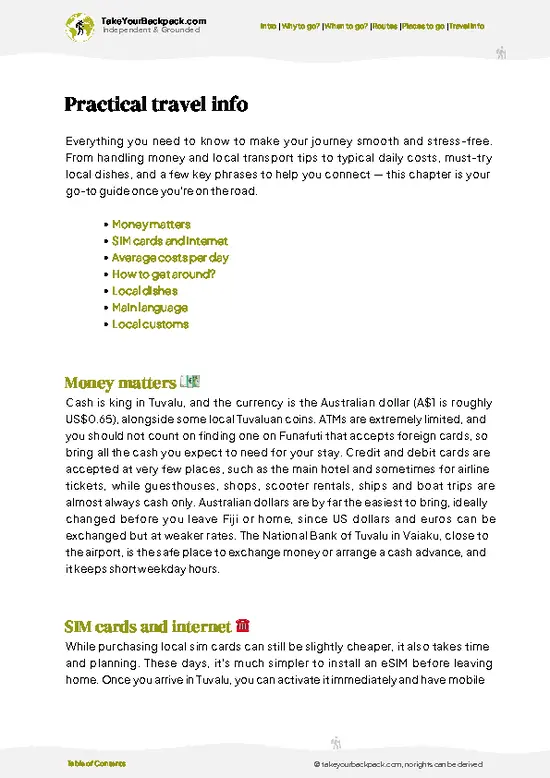
example page 0 from our offline Travel Guide for Tuvalu
example page 1 from our offline Travel Guide for Tuvalu
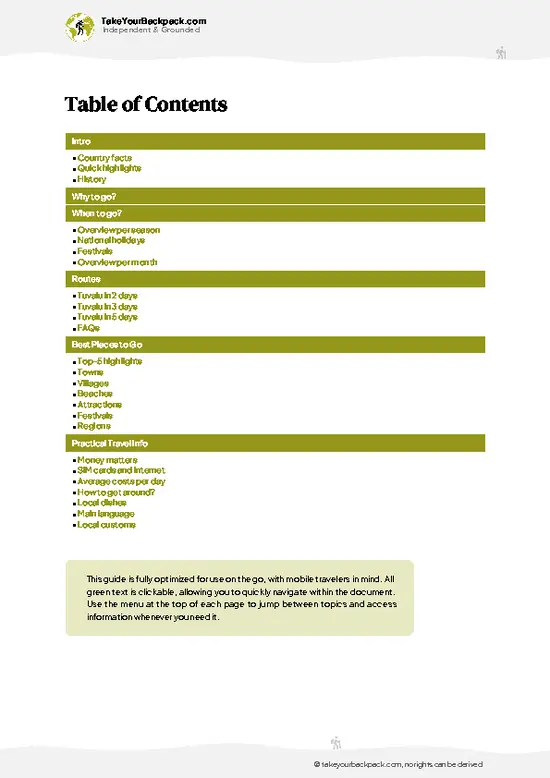
example page 2 from our offline Travel Guide for Tuvalu
example page 3 from our offline Travel Guide for Tuvalu
example page 4 from our offline Travel Guide for Tuvalu
example page 5 from our offline Travel Guide for Tuvalu
example page 6 from our offline Travel Guide for Tuvalu
example page 7 from our offline Travel Guide for Tuvalu
Loading the map 🌍
CLICK TO FILTER
towns
villages
beaches
attractions
festivals
regions
SHOW COUNTRY’S BESTSHOW ALL

✨ Why go?
Ranked #2 region in Tuvalu
Why visitors keep coming back

People come to Vaitupu for the village life of Asau that visitors to Funafuti rarely see. This is a place where the community hall still decides things, where fish gets shared along the lane, and where an outsider is a conversation, not a customer. It is also home to Motufoua Secondary School, the boarding school that has taught students from every Tuvaluan island since the early 1900s, so you meet people who know the whole country. Then there is the story of Kioa, the Fijian island that Vaitupu families bought with their own savings in the 1940s. Ask about it and elders will happily go on for an hour. Stays are usually dictated by the ship schedule, so expect to linger several days whether you planned to or not. It suits slow travelers, cultural nerds and solo people comfortable with silence. … read more 👉
People come to Vaitupu for the village life of Asau that visitors to Funafuti rarely see. This is a place where the community hall still decides things, where fish gets shared along the lane, and where an outsider is a conversation, not a customer. It is also home to Motufoua Secondary School, the boarding school that has taught students from every Tuvaluan island since the early 1900s, so you meet people who know the whole country. Then there is the story of Kioa, the Fijian island that Vaitupu families bought with their own savings in the 1940s. Ask about it and elders will happily go on for an hour. Stays are usually dictated by the ship schedule, so expect to linger several days whether you planned to or not. It suits slow travelers, cultural nerds and solo people comfortable with silence. If you need cafés, bars or a social hostel crowd, treat Funafuti as your base and skip this.

💡 HighlightsWhat this place is best known for

  1. Motufoua Secondary School: The institution Vaitupu is best known for, founded in 1905 and still the main boarding school for the country’s teenagers. Walk by on a weekday morning, when classes and assemblies are in session, and ask permission at the gate before going in. Entry is free and 30 to 45 minutes is plenty. Hearing the students sing in the evening from the dormitories is a small, memorable moment.
  2. Asau village and its maneapa: The community meeting hall is the social center of the settlement. Large, open-sided and roofed in thatch or iron, it is where decisions, feasts and dances take place. Visitors can look from outside at any time, and if an event is on, locals will usually invite you to sit. Free, 30 minutes to an hour, best in late afternoon when people gather. Dress modestly
… read more 👉
  1. Motufoua Secondary School: The institution Vaitupu is best known for, founded in 1905 and still the main boarding school for the country’s teenagers. Walk by on a weekday morning, when classes and assemblies are in session, and ask permission at the gate before going in. Entry is free and 30 to 45 minutes is plenty. Hearing the students sing in the evening from the dormitories is a small, memorable moment.
  2. Asau village and its maneapa: The community meeting hall is the social center of the settlement. Large, open-sided and roofed in thatch or iron, it is where decisions, feasts and dances take place. Visitors can look from outside at any time, and if an event is on, locals will usually invite you to sit. Free, 30 minutes to an hour, best in late afternoon when people gather. Dress modestly and ask before taking photos.
  3. The shoreline and reef-flat walk: Follow the coastal track around the village edge for views of the ocean reef, coconut groves and fishing canoes pulled up on the sand. Low tide shows the reef shelf and the small creatures on it; at high tide the swimming is better. Free, one to two hours, best at sunrise or the last hour before sunset when it is cool. Wear reef shoes, as the coral is sharp.
Nukufetau and Nui are the closest neighboring atolls and can sometimes be reached by inter-island ship or arranged boat, though schedules are unpredictable. Start with the shoreline walk at first light, since it shows you the layout of the island and where everyone gathers, and you will know whom to greet later in the day.
Spotted a mistake or missing something? Contact us.

⌛️ 5 daysSeeing the highlights in 5 days

Start at the Asau harbor at first light, because the supply ship lands there on its own schedule and the whole island turns out to meet it. Watching the unloading tells you more about Vaitupu than any walk will, and it puts you in front of the people who can arrange a bed and a guide.
Day 1: Asau: Ships from Funafuti set the rhythm of this island, so treat your arrival as a fixed point and everything else as flexible. Spend the first day on foot in the main village. Walk the lanes, find the maneapa (the meeting hall where decisions and feasts happen) and let people come to you. Nobody here is in a hurry, and you shouldn’t be either.
Day 2: Motufoua: Head up the island’s single road toward the secondary school, one of the best-known in the country and the reason many Tuvaluan families have a … read more 👉
Start at the Asau harbor at first light, because the supply ship lands there on its own schedule and the whole island turns out to meet it. Watching the unloading tells you more about Vaitupu than any walk will, and it puts you in front of the people who can arrange a bed and a guide.
Day 1: Asau: Ships from Funafuti set the rhythm of this island, so treat your arrival as a fixed point and everything else as flexible. Spend the first day on foot in the main village. Walk the lanes, find the maneapa (the meeting hall where decisions and feasts happen) and let people come to you. Nobody here is in a hurry, and you shouldn’t be either.
Day 2: Motufoua: Head up the island’s single road toward the secondary school, one of the best-known in the country and the reason many Tuvaluan families have a tie to Vaitupu. Walking or borrowing a bicycle is the only sensible transport, and it lets you stop at the taro pits and coconut groves along the way. Go early, then rest through the heat.
Day 3: The Lagoon Side: Spend a full day along the sheltered inner shore, where the water is calm enough for a relaxed swim. This is where you ask a fisherman to take you out in a small boat. The detour: a lagoon islet reached by boat that adds a different view of the island and costs you nothing in logistics, since you return to Asau by evening.
Day 4: The Ocean Coast: Cross to the exposed reef side, where the surf pounds the outer edge and the beach is empty. Take water and a hat, as there are no shops en route. Come back in the afternoon light to join a village gathering if one is under way.
Day 5: Asau Again: Stay close to the harbor so you can catch the ship out, since delays are normal and an early scramble is not worth it. Use the slack hours for a last fish lunch with your host family.
If you have only one day to justify the trip, make it Day 3. The lagoon, the boat and the quiet are what set Vaitupu apart.

🌤️ When to go?Choosing the right time of year

  • Dry Season (May to October): Vaitupu is steadiest from May to October, with trade winds, lower humidity and mostly clear days. Highs run 29 to 31°C (84 to 88°F) and nights drop to about 26°C (79°F). Ship crossings from Funafuti are calmer, so this is the easiest window to arrive.
  • Wet Season (November to April): Squalls and heavy downpours arrive, along with the cyclone risk from roughly November to April. Temperatures stay at 28 to 32°C (82 to 90°F) and the air is sticky. Ship schedules can slip by days when seas are rough.
  • Daylight: Close to the equator, the sun rises around 6 am and sets around 6 pm all year, so plan walks and reef-flat outings for the morning.
  • Crowds and Prices: Visitors are rare in any month, so there is no peak pricing. Costs follow ferry fares and what the island shop has
… read more 👉
  • Dry Season (May to October): Vaitupu is steadiest from May to October, with trade winds, lower humidity and mostly clear days. Highs run 29 to 31°C (84 to 88°F) and nights drop to about 26°C (79°F). Ship crossings from Funafuti are calmer, so this is the easiest window to arrive.
  • Wet Season (November to April): Squalls and heavy downpours arrive, along with the cyclone risk from roughly November to April. Temperatures stay at 28 to 32°C (82 to 90°F) and the air is sticky. Ship schedules can slip by days when seas are rough.
  • Daylight: Close to the equator, the sun rises around 6 am and sets around 6 pm all year, so plan walks and reef-flat outings for the morning.
  • Crowds and Prices: Visitors are rare in any month, so there is no peak pricing. Costs follow ferry fares and what the island shop has in stock.
  • Local Events: Christmas and New Year bring feasting, dancing and church gatherings, and returning families fill every spare bed.
Book your return ship before you leave Funafuti and allow a few spare days for delays.


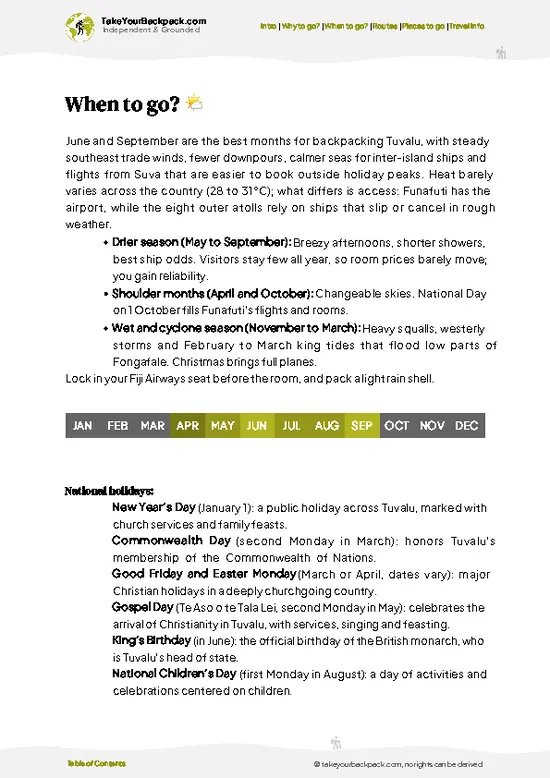
source: climatestotravel.comJANJanuary: fair for travelingFEBFebruary: fair for travelingMARMarch: fair for travelingAPRApril: fair for travelingMAYMay: highly recommended for travelingJUNJune: excellent for travelingJULJuly: excellent for travelingAUGAugust: excellent for travelingSEPSeptember: excellent for travelingOCTOctober: highly recommended for travelingNOVNovember: fair for travelingDECDecember: fair for traveling
tuvalu-region-vaitupu
© Google | Tamana Mike

✈️ The backpacker research shortcutTuvalu Travel Guide

An offline-friendly backpacking guide with optimized travel routes, ranked highlights, transport advice, and the best areas to stay.
example page 0 from our offline Travel Guide for Tuvalu
example page 1 from our offline Travel Guide for Tuvalu
example page 2 from our offline Travel Guide for Tuvalu
example page 3 from our offline Travel Guide for Tuvalu
example page 4 from our offline Travel Guide for Tuvalu
example page 5 from our offline Travel Guide for Tuvalu
example page 6 from our offline Travel Guide for Tuvalu
example page 7 from our offline Travel Guide for Tuvalu
The digital guide (97 pages) contains:
✅ 20 highlights, ranked by travel appeal
✅ Optimized 2, 3 & 5-day travel routes
✅ Cities, national parks, landmarks, beaches
✅ How to get around
✅ Offline-friendly for travel without Wi-Fi
👉 Click to see all 30+ guide features

📅 Plan smarter in minutes, not weeks
✅ Month by month travel advice
✅ Festivals & national holidays
✅ Budget expectations

🗺️ Go to the right places, skip the overrated ones
✅ Honest pros & cons of destinations
✅ Top hikes, parks & viewpoints
✅ Lesser-known places most travelers miss
✅ Clear “worth it vs skip it” guidance

🛏️ Travel smoothly without rookie mistakes
✅ Best areas to stay
✅ Transport systems explained simply
✅ Common scams & safety advice
✅ SIM cards, money & practical tips

🌍 Understand the country, not just visit it
✅ Culture & traditions
✅ 52 Essential phrases & customs
✅ Festivals worth planning around
✅ Traveler-friendly historical context
✅ Insights that make places more meaningful

📱 Built for real travel conditions
✅ Fully downloadable PDF
✅ Works completely offline
✅ Optimized for phone use
✅ Useful in remote areas & buses
✅ Everything in one place
Stop searching, start planning
Get instant access to your full guide. 30‑day money-back guarantee.
+ Add another guide for just

By proceeding you agree to our terms.
Sent to your inbox immediately after payment • 100% Secure Checkout
Best Backpacking Travel Advisor 2025 tourism awardBest Backpacking
Travel Advisor
2025
What others say about Take Your Backpack Guides:
⭐⭐⭐⭐⭐
Fantastic, amazing amount of information!
⭐⭐⭐⭐⭐
My goodness this is amazing, it's what I've been looking for hats off too you!
⭐⭐⭐⭐⭐
I think this is absolutely BRILLIANT
⭐⭐⭐⭐
Very complete and informative. It's still missing places, but I gotta to commend you
⭐⭐⭐⭐⭐
This is truly amazing, thank you, can't wait to explore it with my kids!
⭐⭐⭐⭐⭐
Awesome resource, thank you!
⭐⭐⭐⭐⭐
This is amazing! Can't wait to explore the ones I haven't seen
⭐⭐⭐⭐
I love this! Well done, great idea.
⭐⭐⭐⭐⭐
Thanks for taking the time to make this gem!
⭐⭐⭐⭐⭐
This might be the best website I've ever seen.
⭐⭐⭐⭐⭐
Congratulations, and thank you so much for your work; it's incredibly valuable.
⭐⭐⭐⭐
In all seriousness I think you did a great job pointing out the important spots
⭐⭐⭐⭐⭐
10/10 very good
⭐⭐⭐⭐⭐
As someone who's only just starting to visit regularly this is awesome, thank you.
⭐⭐⭐⭐
Thank you very much! I'm going to visit my dad, it's going to be very useful!
⭐⭐⭐⭐⭐
This is really cool! We'll be travelling for the first time and this definitely come in handy.
⭐⭐⭐⭐⭐
You are now our minister of culture, congratulations 👨‍💼
⭐⭐⭐⭐⭐
Just wanted to tell you that this is a pearl! Going to follow your recommendations.
⭐⭐⭐⭐⭐
This is so cool. I'll definitely be using the resource for my travels soon.
⭐⭐⭐⭐⭐
This is very impressive! Good work.
⭐⭐⭐⭐⭐
This is an amazing and informative site. Very well done!

🛏️ Where to stay?Choosing the right base

Vaitupu has no hostels, so a homestay or the island guesthouse arrangement is how you sleep here. Accommodation is clustered in and around Asau, the main village on the western side, and you reach it on foot or by short motorbike ride. Expect to pay roughly A$40 to 80 (US$26 to 52) a night for a simple room with a fan and shared bathroom. Meals are often included, usually rice, fresh fish, taro, pulaka and coconut.
Arrange your stay before you board the ship in Funafuti. The Vaitupu Kaupule (island council) office is the usual contact, and your Funafuti guesthouse host or the Tuvalu tourism office … read more 👉
Vaitupu has no hostels, so a homestay or the island guesthouse arrangement is how you sleep here. Accommodation is clustered in and around Asau, the main village on the western side, and you reach it on foot or by short motorbike ride. Expect to pay roughly A$40 to 80 (US$26 to 52) a night for a simple room with a fan and shared bathroom. Meals are often included, usually rice, fresh fish, taro, pulaka and coconut.
Arrange your stay before you board the ship in Funafuti. The Vaitupu Kaupule (island council) office is the usual contact, and your Funafuti guesthouse host or the Tuvalu tourism office can help you reach it. Arriving unannounced on the ship is possible but leaves you hunting for a bed with your bags still on the wharf.
Stay in Asau rather than on the outskirts. The shop, the church, the community hall and the wharf are all within a short walk, and you will meet neighbors quickly. Bring small Australian dollar notes, since there are no ATMs and change is scarce. Power can be intermittent, so pack a headlamp, a power bank and your own drinking water supplies as a backup. Dress modestly in the village, and on Sundays expect everything to close for church.

🚌 Getting aroundHow to get from A to B

Assuming you can fly in or out of Vaitupu on a whim is the mistake that burns the most time and money. Vaitupu has no airport, so the usual link is the inter-island ship from Funafuti, which runs on a loose schedule and sometimes sails late or changes its plan. Once you land, the island is small enough that the transport question mostly answers itself, and you will do most of it on your own feet.

  • Inter-island ship from Funafuti: Plan on roughly 20 to 30 hours aboard depending on the route, with fares in the range of US$40 to 80 for a deck or basic berth. Bring a mat, water and snacks, and expect a lagoon crossing that is slow, salty and sociable, with a night sky so thick with stars you will not want the cabin.
  • Walking: The main road runs along the lagoon side of the island, and you can cover
… read more 👉
Assuming you can fly in or out of Vaitupu on a whim is the mistake that burns the most time and money. Vaitupu has no airport, so the usual link is the inter-island ship from Funafuti, which runs on a loose schedule and sometimes sails late or changes its plan. Once you land, the island is small enough that the transport question mostly answers itself, and you will do most of it on your own feet.

  • Inter-island ship from Funafuti: Plan on roughly 20 to 30 hours aboard depending on the route, with fares in the range of US$40 to 80 for a deck or basic berth. Bring a mat, water and snacks, and expect a lagoon crossing that is slow, salty and sociable, with a night sky so thick with stars you will not want the cabin.
  • Walking: The main road runs along the lagoon side of the island, and you can cover the village end to end in under an hour. Go early, before the sun climbs, and you pass kids heading to school, pigs rooting under coconut palms and breadfruit trees dropping shade across the coral gravel. Free, and the best way to be waved at by everyone.
  • Bicycle: A few locals will lend or rent a bike for about US$3 to 6 a day if you ask around the village. The road is flat but sandy in patches, so keep your tires a little soft and ride the packed strip near the center. You get the breeze off the lagoon and a quick run to the far, quiet shoreline.
  • Motorbike ride from a local: Motorbikes are the island’s everyday vehicle, and a neighbor will often run you to the wharf or the far end of the island for US$2 to 5. Hop on behind, hold your pack, and you arrive with sandals dusty and a few new friends.

The tip I would give a friend: confirm the ship’s departure with the island office the day before, then check again the morning you sail, and keep a spare day or two in your plans so a delay costs you a beach afternoon instead of a missed flight home.

🚌 Day tripsBest day trips from Vaitupu

Vaitupu is a poor base for off-island day trips, because there are no scheduled boats to other atolls and the ship from Funafuti takes about a day each way. The real value is on the island itself, where a short ride or walk covers almost everything.Asau Village Circuit: Walk Asau in the cool of early morning, past the meeting hall, the church and the wharf, and expect invitations to chat. It takes two to three hours and costs nothing. First-timers often wander through yards without asking, so greet people first and ask before taking photos.
Motufoua Secondary School: Motufoua is the main boarding school for Tuvalu, which is why teenagers from across the nation live here. A visit takes an hour or so and works best if you ask the Kaupule beforehand. Go during term time, roughly February to November, … read more 👉
Vaitupu is a poor base for off-island day trips, because there are no scheduled boats to other atolls and the ship from Funafuti takes about a day each way. The real value is on the island itself, where a short ride or walk covers almost everything.Asau Village Circuit: Walk Asau in the cool of early morning, past the meeting hall, the church and the wharf, and expect invitations to chat. It takes two to three hours and costs nothing. First-timers often wander through yards without asking, so greet people first and ask before taking photos.
Motufoua Secondary School: Motufoua is the main boarding school for Tuvalu, which is why teenagers from across the nation live here. A visit takes an hour or so and works best if you ask the Kaupule beforehand. Go during term time, roughly February to November, when the school is active, and avoid the holidays.
Round-Island Coastal Ride: A track follows much of the shoreline, and you can cover it on a borrowed or rented motorbike in two to three hours, or walk it in a long morning. Expect to spend A$10 to 20 (US$6.50 to 13) on fuel and a small thank-you if someone lends a bike. Go at low tide, when reef flats and tide pools are easiest to see. The common mistake is carrying too little water, as there is no shop along the route.

🍲 FoodLocal Flavors for Backpackers

Eating in Vaitupu means living off coconut, fish and pulaka. Pulaka is a giant swamp taro grown in deep pits, and it comes boiled or baked, dense, earthy and faintly sweet. Tuna and reef fish arrive grilled over coconut husks or raw in coconut cream, the flesh silky and sharp with lime. Try fekei, a pudding of grated pulaka or breadfruit in thick coconut cream, and pandanus sweets with a toasty, honeyed chew. Local toddy, fresh from the coconut flower, is sweet and cloudy when new, and gets sour and lively after a day or two. Green drinking coconuts cost almost nothing and are cold from the shade.

There are no restaurant strips here. You eat at the small village shops that stock rice, tinned fish and noodles, from home kitchens that sometimes cook for guests if you ask, and at community feasts … read more 👉
Eating in Vaitupu means living off coconut, fish and pulaka. Pulaka is a giant swamp taro grown in deep pits, and it comes boiled or baked, dense, earthy and faintly sweet. Tuna and reef fish arrive grilled over coconut husks or raw in coconut cream, the flesh silky and sharp with lime. Try fekei, a pudding of grated pulaka or breadfruit in thick coconut cream, and pandanus sweets with a toasty, honeyed chew. Local toddy, fresh from the coconut flower, is sweet and cloudy when new, and gets sour and lively after a day or two. Green drinking coconuts cost almost nothing and are cold from the shade.

There are no restaurant strips here. You eat at the small village shops that stock rice, tinned fish and noodles, from home kitchens that sometimes cook for guests if you ask, and at community feasts where food comes out on woven mats. Expect to pay roughly US$3 to 8 for a plate.

If you are invited to a feast, wait to be served, accept what is offered and leave nothing wasted. Fresh produce is scarce on an atoll, so shared food carries real weight.

FAQFrequently asked questions about Vaitupu

Vaitupu is reached by sea from Funafuti, which has the only airport in Tuvalu. The government ship, the Nivaga III, makes the trip of roughly 130 km in about a day, with fares typically around A$40 to 80 (US$26 to 52) each way for basic passage. Sailings are infrequent and irregular, so confirm the schedule at the shipping office in Funafuti and allow spare days. Arrange your homestay through the Vaitupu Kaupule before you leave.
Vaitupu is worth the effort if you want daily village life in Tuvalu with almost no other visitors. Asau offers easy walks, a calm lagoon and the Motufoua Secondary School. Plan on three to five nights, since the ship and the slow pace make shorter stays pointless. If you need tours, restaurants and nightlife, stay on Funafuti instead.
A day trip is not realistic, because the sea crossing from Funafuti takes about a day each way and ships run only occasionally. You would need to stay at least a few nights to match the ship timetable. Once on the island, everything is within walking or short motorbike distance, so Asau, the lagoon and the coastal track fit into two or three easy days.
⚠️ Things can change over time, so always validate details locally before you go.

Other Tuvaluan regions near Vaitupu

Explore more nearby:

  • Nukufetau—Motulalo bomber strip, thirty-islet lagoon, kaleve tapping, canoe line fishing| 67 km away
  • Nui—Lagoon islets, sandy track, swamp taro gardens, Nui dance| 170 km away
  • Niutao—Central brackish lake, pulaka pits, coastal loop, round island| 212 km away

💡 Not sure where to go next?
Create a personalized itinerary for Tuvalu including Vaitupu and the places that fit your trip.

Generate my itinerary

👉 Discover all regions

Or checkout all Tuvalu has to offer (think cities, towns, villages, national parks, hikes, beaches, festivals)
Country photo of Tuvalu

We 💚 feedbackIs it worth it?

Plan three to five days. One is not enough for Asau to open up, and by day six you will have walked every lane twice. Pack extra food, cash in small notes and a book. If the ship timetable gives you a longer gap, take it and spend the extra evening at the maneapa.

✍️ Help improve this page!
The information on this page is based on in-depth research, insights shared by experienced travelers, and feedback from the local travel community in Tuvalu. While every effort is made to keep the information accurate and current, conditions can change — so if you spot anything incorrect or outdated, please get in touch.


🙋‍♂️ Give feedback

👋 Meet the founderWho’s Behind Take Your Backpack?

Johan, backpacker and founder of TakeYourBackpackHi, I’m Johan (Netherlands 🇳🇱), the creator of TakeYourBackpack. Over the past 3 decades, I’ve backpacked through 90+ countries across six continents, gaining extensive experience with independent travel, long-term trips, and overland routes.

This site is built on a combination of firsthand travel experience and carefully curated insights from other backpackers. Many guides are based on places I’ve personally visited, while others bring together tips, observations, and practical advice shared by trusted travelers I’ve met along the way.

The goal is to provide realistic, experience-driven guidance — not generic itineraries — so you can explore destinations with better context, clearer expectations, and more confidence.