×

Ukraine🇺🇦 | best citiesDiscover the 10 Best cities Across Ukraine

Cities in Ukraine are mostly old trading and administrative centers rebuilt in layers: medieval cores and Habsburg-era and Polish streets in the west, imperial grids and Soviet avenues further east. The west is compact and walkable and sits closest to the Polish border, so it is the easiest region to enter and the one most independent travelers choose. The center and capital region are larger, with a metro, wide boulevards and the densest museum and restaurant scene. The south and east have a different rhythm, shaped by ports, steppe and heavy industry, but access there depends on security conditions. Costs are low by European standards, usually US$30 to 50 a day, and crowds stay thin outside a few western streets in summer. For backpacking, the main variable is not price but access: trains are reliable, passenger flights are unavailable, and conditions differ sharply by region.

By Johan Kruseman 🇳🇱 | Updated October 18, 2026
Explore the best towns in Ukraine

Why go?What Makes Them Special

Ukraine sits on flat, fertile land crossed by the Dnipro and its tributaries, and that geography made it a corridor for trade and a prize for neighboring powers. Polish-Lithuanian, Habsburg, Ottoman, Russian and Soviet rule each left a physical mark, so a single country holds baroque squares, 19th-century grids and Soviet housing blocks, often within one day’s train ride. That layering is the main reason Ukrainian cities reward walking rather than ticking off sights.

Infrastructure is another distinguishing factor. The Soviet legacy left dense rail, tram and trolleybus networks and deep metro systems in the larger cities, all cheap and easy to use. Ukrzaliznytsia, the national railway, runs the long-distance backbone, with overnight sleepers linking regions. Cafe culture, specialty coffee, … read more 👉
Ukraine sits on flat, fertile land crossed by the Dnipro and its tributaries, and that geography made it a corridor for trade and a prize for neighboring powers. Polish-Lithuanian, Habsburg, Ottoman, Russian and Soviet rule each left a physical mark, so a single country holds baroque squares, 19th-century grids and Soviet housing blocks, often within one day’s train ride. That layering is the main reason Ukrainian cities reward walking rather than ticking off sights.

Infrastructure is another distinguishing factor. The Soviet legacy left dense rail, tram and trolleybus networks and deep metro systems in the larger cities, all cheap and easy to use. Ukrzaliznytsia, the national railway, runs the long-distance backbone, with overnight sleepers linking regions. Cafe culture, specialty coffee, craft cocktail bars and a strong restaurant scene mean daily life in the cities is comfortable and inexpensive, with prices well under western European levels.

Before choosing Ukraine for its cities, a traveler needs to understand the wartime context. Martial law is in force, airspace is closed to civilian flights, and air raid alerts are routine, with shelters in metro stations, basements and public buildings. Many governments advise against travel, particularly to the east and south, so insurance and official guidance need checking before booking. Entry is overland, most commonly by train or bus from Poland, with crossings also from Slovakia, Hungary, Romania and Moldova. Some museums are closed or partly reopened, and monuments in many cities are protected by sandbags or scaffolding.

A night curfew, typically from around midnight to 5 a.m., shapes evenings. The language of daily life is increasingly Ukrainian even in cities that were once mostly Russian-speaking, and a few words of Ukrainian are received warmly. Travelers who accept these constraints find cities that are resilient, welcoming and entirely lived-in rather than staged for visitors.
Evaluating the Top Choices
The list of best cities in Ukraine is created based on culture, vibe, attractions, transport ease, and local charm. If you feel a city is missing in this list, please let us know.

When to go?Optimal Periods for Travel

Best months for city travel: May to June and September to early October are the best months for cities in Ukraine, with daytime highs of about 15 to 25°C, long daylight and fewer weather disruptions than midsummer or winter. Streets, terraces and parks are in full use, and walking all day is comfortable. Spring has lilacs and chestnut blossom in the central regions from late April into May, while early autumn brings clear light and a harvest-season food scene.

Summer: July and August are warm to hot, commonly 25 to 30°C and occasionally above 35°C in the south and center. Thunderstorms are frequent, with June and July the wettest months across most of the country, and annual rainfall ranges from roughly 500 mm on the southern steppe to over 1,000 mm in the Carpathian foothills. The Black … read more 👉
Best months for city travel: May to June and September to early October are the best months for cities in Ukraine, with daytime highs of about 15 to 25°C, long daylight and fewer weather disruptions than midsummer or winter. Streets, terraces and parks are in full use, and walking all day is comfortable. Spring has lilacs and chestnut blossom in the central regions from late April into May, while early autumn brings clear light and a harvest-season food scene.

Summer: July and August are warm to hot, commonly 25 to 30°C and occasionally above 35°C in the south and center. Thunderstorms are frequent, with June and July the wettest months across most of the country, and annual rainfall ranges from roughly 500 mm on the southern steppe to over 1,000 mm in the Carpathian foothills. The Black Sea coast and western regions are busiest in summer, and hostel and hotel rates there can rise 20 to 30 percent over spring levels. Long-distance trains fill up on Fridays, Sundays and around public holidays, so book ahead.

Winter and shoulder periods: November to March is cold and gray. Daytime temperatures in the center and east sit between about -8 and 3°C, with snow and ice lasting for weeks, and the Carpathian west is colder and snowier. The south is milder, often just above freezing. Prices are lowest from January to March, apart from the Christmas and New Year period (Orthodox Christmas falls on December 25 by the revised calendar used by many churches since 2023, with some communities still marking January 7), when accommodation in the west is more expensive. Days are short, with sunset before 5 p.m. in December, and the evening curfew leaves little time after dark.

April and October are variable, with cool mornings near 3 to 8°C and mud after rain. They suit travelers who want low prices and empty museums, provided they pack a waterproof layer.

city hoppingOptimizing Your Multi-Stop Itinerary

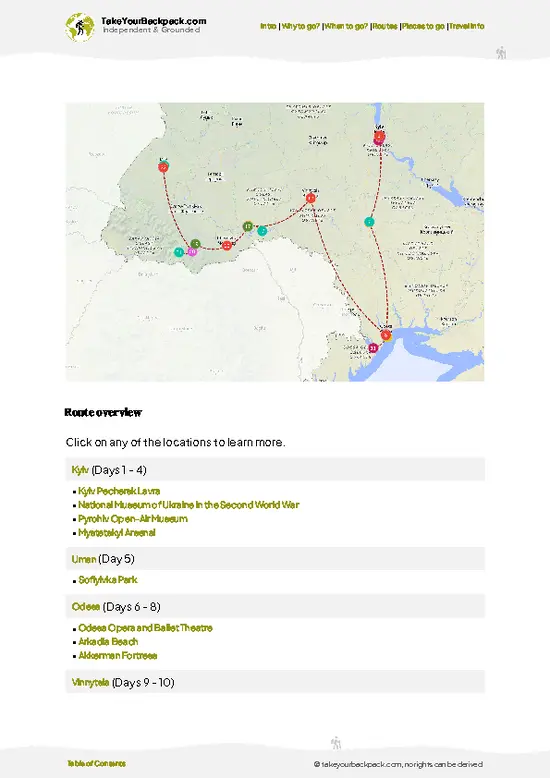
How many days to plan: A trip linking several cities in Ukraine needs 7 to 14 days, enough for three or four stops at a steady pace. Fewer than seven days works only for a single region, because rail distances are long and trains are slower than on most western European routes.

Which regions pair well: The west and the central Dnipro region form the natural core of any trip. Most travelers enter from Poland by train or bus, starting in the west and heading east toward the capital region, which is the main rail hub. Moving in this direction means the longest sleeper journey comes in the middle of the trip and replaces a hotel night. The south and east lie farther along the same line, but they depend on current security conditions, so they are best added only after checking official travel … read more 👉
How many days to plan: A trip linking several cities in Ukraine needs 7 to 14 days, enough for three or four stops at a steady pace. Fewer than seven days works only for a single region, because rail distances are long and trains are slower than on most western European routes.

Which regions pair well: The west and the central Dnipro region form the natural core of any trip. Most travelers enter from Poland by train or bus, starting in the west and heading east toward the capital region, which is the main rail hub. Moving in this direction means the longest sleeper journey comes in the middle of the trip and replaces a hotel night. The south and east lie farther along the same line, but they depend on current security conditions, so they are best added only after checking official travel guidance and railway timetables, and only for travelers comfortable with that risk.

Time per stop and between regions: Allow two to three nights per major city and one to two in smaller centers, which can be seen on foot in a day. Journeys within the west take about 1.5 to 4 hours by train or minibus. West to center usually takes 6 to 10 hours, much of it on overnight services. Center to south typically takes 7 to 10 hours. Intercity tickets generally cost UAH 300 to 1,000 (roughly US$7 to 24), depending on class and distance, and can be bought on the Ukrzaliznytsia app up to about 60 days ahead.

Common planning mistakes: The most frequent error is cramming in too many stops, which leaves each day dominated by stations and queues. Choose fewer places and add day trips instead. Another is arriving by train or bus close to curfew, when transport options are limited, so schedule arrivals before late evening. Travelers also assume flights can bridge long distances, but civilian airspace is closed, so every leg is by rail, bus or road. Finally, many leave tickets to the last minute. Popular sleepers sell out several days ahead, particularly on weekends, so book in advance and keep a bus option as backup.

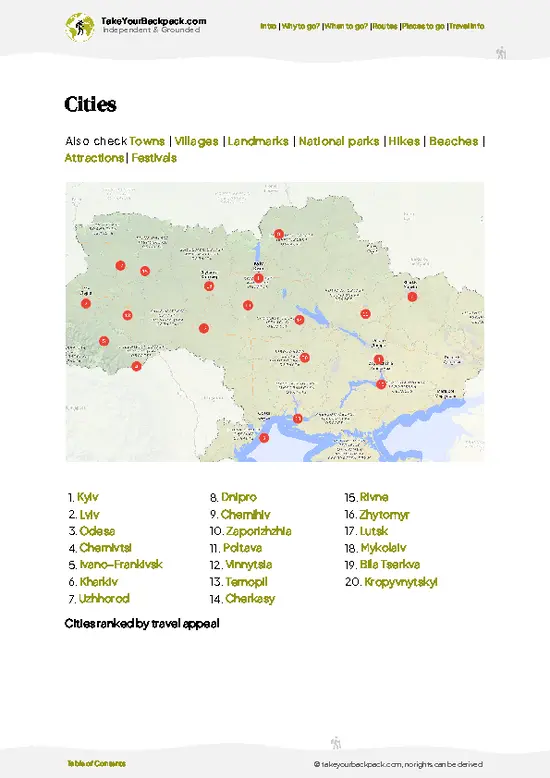
The ListMust-Visit cities in Ukraine

1 Kyiv

Golden domes, Dnipro hills, metro network

Climb river bluffs, explore layered neighborhoods, and move easily between eras in Ukraine’s capital of contrasts and scale.

ukraine-city-kyiv
© Google |

2 Lviv

Cobblestone lanes, coffeehouses, Habsburg facades

Lose yourself in a city where every block reveals traces of layered histories, literary traditions, and a strong sense of place.

ukraine-city-lviv
© Google |

3 Odesa

Black Sea port, grand stairway, eclectic courtyards

Descend to the waterfront, wander through shaded courtyards, and notice the city’s blend of maritime and cosmopolitan influences.

4 Chernivtsi

Austrian architecture, university complex, café-lined streets

Absorb the multicultural atmosphere in a city where ornate facades and student life create a distinct Central European flavor.

ukraine-city-chernivtsi
© Google |

5 Ivano-Frankivsk

Pedestrian center, Carpathian gateway, market squares

Start mountain journeys here, or linger in a city where outdoor adventure and urban life are closely connected.

ukraine-city-ivano-frankivsk
© Google |

6 Kharkiv

Constructivist landmarks, student districts, sprawling squares

Navigate a metropolis where academic life, monumental architecture, and a patchwork of neighborhoods shape the urban experience.

ukraine-city-kharkiv
© Google | Solo Soul

7 Uzhhorod

Castle hill, borderland culture, chestnut alleys

Cross bridges and explore a compact city where Central European and Carpathian influences meet in daily life and local customs.

8 Dnipro

Steel mills, riverside embankment, modern skyline

Experience a city where heavy industry meets contemporary development along one of Ukraine’s widest riverfronts.

9 Chernihiv

Ancient churches, burial mounds, quiet parks

Step into a city where medieval monuments and green spaces offer a sense of continuity and calm.

10 Zaporizhzhia

Dnipro hydro dam, Cossack island, Soviet avenues

Visit the birthplace of Cossack legend, see monumental engineering, and experience a city shaped by 20th-century ambition.

11 Poltava

Battlefield sites, round square, literary museums

Trace the city’s role in Ukrainian history and culture, from pivotal battles to the legacy of local writers.

ukraine-city-poltava
© Google |

12 Vinnytsia

Fountains, riverside promenade, interwar buildings

Walk along the river, catch evening light shows, and notice the mix of architectural styles from different eras.

13 Ternopil

Central lake, Soviet grid, local markets

Circle the city’s lake, explore residential districts, and sample regional produce in a setting shaped by postwar planning.

14 Cherkasy

Reservoir shore, leafy boulevards, Taras Shevchenko sites

Walk along the Dnipro’s edge and visit places tied to Ukraine’s national poet in a city with a relaxed, green core.

ukraine-city-cherkasy
© Google |

15 Rivne

Rail junction, WWII memorials, leafy boulevards

Pause in a city where transport links and 20th-century history are visible in both its layout and daily rhythms.

16 Zhytomyr

Space museum, granite cliffs, forested outskirts

Explore a city where rock outcrops and space exploration heritage set it apart from other regional centers.

17 Lutsk

Brick castle, winding river, old town gates

Wander through a compact center where medieval fortifications and riverside paths define the local landscape.

18 Mykolaiv

Shipyards, river confluence, grid streets

See how shipbuilding and waterways shape a city designed for industry and navigation, with broad avenues and working docks.

19 Bila Tserkva

Soviet-era blocks, Ros River, sprawling park

Stroll through a city defined by its vast arboretum, riverbank walks, and a lived-in feel away from major tourist routes.

20 Kropyvnytskyi

Theater heritage, central square, quiet avenues

Wander through leafy streets and discover a city known for its performing arts legacy and understated urban rhythm.

21 Sumy

River confluence, neoclassical facades, student life

Notice the influence of rivers and academia in a city with understated architecture and a youthful energy.

22 Kherson

Delta wetlands, ship canal, steppe edge

Travel to a southern city where the Dnipro meets the Black Sea, and wetlands and agriculture shape the local way of life.

23 Berdyansk

Azov Sea shore, sandy beaches, port town

Relax on shallow beaches, watch fishing boats come and go, and notice the easygoing pace of a classic Ukrainian seaside town.

24 Melitopol

Fruit markets, steppe crossroads, Crimean gateway

Sample local produce and experience a city shaped by its role as a southern transport hub and agricultural center.

25 Sloviansk

Salt lakes, ceramics workshops, railway junction

Visit a city where salt extraction and traditional crafts still influence the local economy and the landscape around town.

26 Horlivka

Coal mining, industrial outskirts, Soviet mosaics

See how industry shapes daily life, with stark contrasts between residential blocks and the remnants of mining infrastructure.

27 Donetsk

Steel industry, wide boulevards, botanical garden

Experience a city marked by heavy industry and green spaces, with a layout reflecting both ambition and practical needs.

Think you know Ukraine?

Prove you’re a true local — uncover 17 lesser-known cities in Ukraine that locals tend to keep to themselves.
Loading the map 🌍

Expert viewPro Tips for Exploring the Best

How many cities to choose: I advise three cities, four at the outside. Ukraine is the largest country wholly in Europe, and the distances between its main urban centers run to 6 to 12 hours by overnight train. Air raid alerts add delays and sometimes reroute services, so a plan with slack holds up and a packed one does not. Three stops leave time to sit in a café on a weekday morning, ride a tram to the end of the line and still absorb the pace, which is what a city is for.
Choosing between kinds of cities: The country offers roughly four types. The capital is a large metropolis with wide Soviet-era avenues, a deep metro, gilded church domes and the country’s best range of museums, restaurants and nightlife. It suits first-timers and anyone short on days, and you leave with a clear sense of … read more 👉
How many cities to choose: I advise three cities, four at the outside. Ukraine is the largest country wholly in Europe, and the distances between its main urban centers run to 6 to 12 hours by overnight train. Air raid alerts add delays and sometimes reroute services, so a plan with slack holds up and a packed one does not. Three stops leave time to sit in a café on a weekday morning, ride a tram to the end of the line and still absorb the pace, which is what a city is for.
Choosing between kinds of cities: The country offers roughly four types. The capital is a large metropolis with wide Soviet-era avenues, a deep metro, gilded church domes and the country’s best range of museums, restaurants and nightlife. It suits first-timers and anyone short on days, and you leave with a clear sense of how the country works. Western heritage cities have cobbled squares, Habsburg and Polish-era facades, coffee houses roasting on site and a slower, cheaper rhythm. They suit travelers who like walking with no agenda, and the reward is a table by an old market square for the price of a sandwich elsewhere in Europe. Black Sea and river cities lean on grand 19th-century architecture, courtyards and a dry humor the locals are proud of. They suit people who prefer atmosphere to ticking off sights. Industrial and eastern cities are the hardest to reach and often the least suited to a casual visit at present. Match the kind to your appetite: history and food point west, scale and variety point to the capital.
What it costs: A backpacker can live on US$30 to 55 a day, or about UAH 1,250 to 2,300, since prices are in hryvnia (UAH) and the exchange rate sits around UAH 41 to the dollar. A dorm bed runs US$9 to 20 a night, a private room in a guesthouse US$25 to 50. A full meal in a local canteen or a Ukrainian restaurant costs US$5 to 12, and a filter coffee US$1.50 to 3. City transit is cheap: metro, bus and tram rides are around UAH 8 to 20 (US$0.20 to 0.50) each. Museum and church-complex entry usually falls between UAH 50 and 250 (US$1.20 to 6), and a half-day guided walk costs US$25 to 60 per group or per person depending on the operator. Intercity travel is the main line item: overnight second-class train berths cost about US$8 to 25 per leg, and a ticket gets you a real bed and a few hours of window-watching. Budget around US$100 to 150 for a three-city trip in tickets alone if you add an upgraded compartment. Cards are accepted nearly everywhere, and a small amount of cash covers market stalls and tips.
Safety on the ground: Ukraine is under martial law, and most governments advise against travel to the country or to large parts of it. Check your own government’s advisory and your insurance terms before booking, because many standard policies exclude war zones. Regions near the front line and the border with Russia and Belarus are not places to visit. Cities farther west see fewer strikes but are not exempt.
Air raid alerts are part of daily life. Install the official Air Alert app, learn the location of the nearest shelter in each building you stay in, and follow staff instructions. Alerts can last minutes or hours, and a sensible traveler rests the next morning rather than pushing on. There is also a curfew, usually from around midnight to 5 a.m., which affects late nights out, and checkpoints may ask for your passport, so carry it at all times. Photographing military infrastructure, checkpoints or damage sites can lead to detention, so keep the camera down when in doubt.
Cultural considerations: Locals are direct, hospitable and tired of being asked to explain the war. Do not raise politics out of curiosity, and do not describe the conflict as anything but a Russian invasion. Speak Ukrainian where you can: a simple “dyakuyu” (thank you) lands well, since many people now avoid Russian by choice. Memorials and photo displays in squares are sites of grief, not backdrops. Dress modestly in active churches, with covered shoulders and, for women, a scarf in many cases. Tipping 10 percent is normal in restaurants, and a visit to a volunteer-run spot or a local business puts your money directly to use.

✈️ The backpacker research shortcutUkraine Travel Guide

An offline-friendly backpacking guide with optimized travel routes, ranked highlights, transport advice, and the best areas to stay.
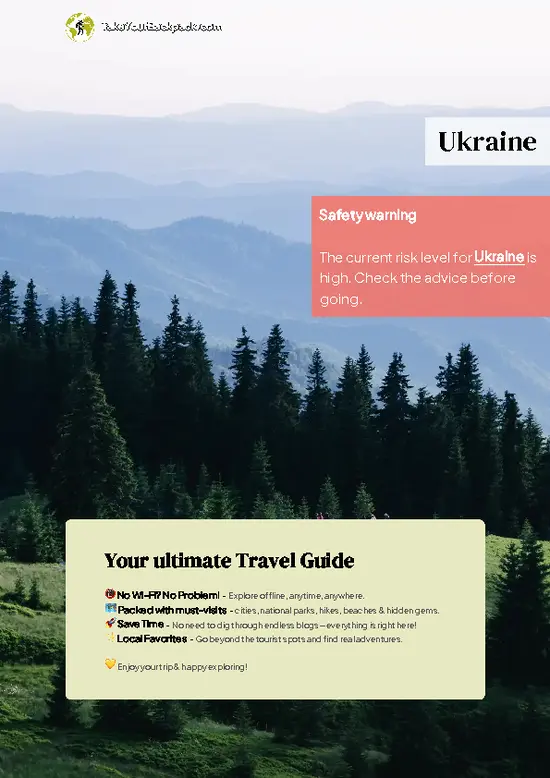
example page 0 from our offline Travel Guide for Ukraine
example page 1 from our offline Travel Guide for Ukraine
example page 2 from our offline Travel Guide for Ukraine
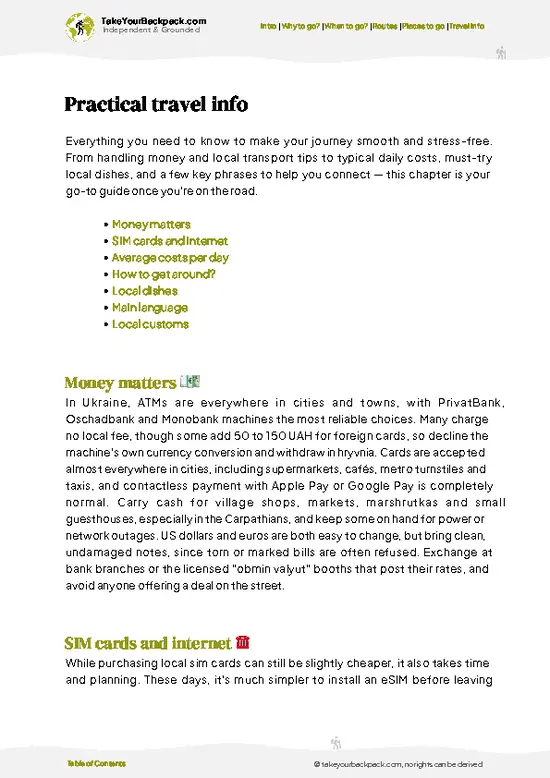
example page 3 from our offline Travel Guide for Ukraine
example page 4 from our offline Travel Guide for Ukraine
example page 5 from our offline Travel Guide for Ukraine
example page 6 from our offline Travel Guide for Ukraine
example page 7 from our offline Travel Guide for Ukraine
The digital guide (401 pages) contains:
✅ 107 highlights, ranked by travel appeal
✅ Optimized 7, 14 & 21-day travel routes
✅ Cities, national parks, landmarks, beaches
✅ How to get around
✅ Offline-friendly for travel without Wi-Fi
👉 Click to see all 30+ guide features

📅 Plan smarter in minutes, not weeks
✅ Month by month travel advice
✅ Festivals & national holidays
✅ Budget expectations

🗺️ Go to the right places, skip the overrated ones
✅ Honest pros & cons of destinations
✅ Top hikes, parks & viewpoints
✅ Lesser-known places most travelers miss
✅ Clear “worth it vs skip it” guidance

🛏️ Travel smoothly without rookie mistakes
✅ Best areas to stay
✅ Transport systems explained simply
✅ Common scams & safety advice
✅ SIM cards, money & practical tips

🌍 Understand the country, not just visit it
✅ Culture & traditions
✅ 52 Essential phrases & customs
✅ Festivals worth planning around
✅ Traveler-friendly historical context
✅ Insights that make places more meaningful

📱 Built for real travel conditions
✅ Fully downloadable PDF
✅ Works completely offline
✅ Optimized for phone use
✅ Useful in remote areas & buses
✅ Everything in one place
Stop searching, start planning
Get instant access to your full guide. 30‑day money-back guarantee.
+ Add another guide for just

By proceeding you agree to our terms.
Sent to your inbox immediately after payment • 100% Secure Checkout
Best Backpacking Travel Advisor 2025 tourism awardBest Backpacking
Travel Advisor
2025
What others say about Take Your Backpack Guides:
⭐⭐⭐⭐⭐
Fantastic, amazing amount of information!
⭐⭐⭐⭐⭐
My goodness this is amazing, it's what I've been looking for hats off too you!
⭐⭐⭐⭐⭐
I think this is absolutely BRILLIANT
⭐⭐⭐⭐
Very complete and informative. It's still missing places, but I gotta to commend you
⭐⭐⭐⭐⭐
This is truly amazing, thank you, can't wait to explore it with my kids!
⭐⭐⭐⭐⭐
Awesome resource, thank you!
⭐⭐⭐⭐⭐
This is amazing! Can't wait to explore the ones I haven't seen
⭐⭐⭐⭐
I love this! Well done, great idea.
⭐⭐⭐⭐⭐
Thanks for taking the time to make this gem!
⭐⭐⭐⭐⭐
This might be the best website I've ever seen.
⭐⭐⭐⭐⭐
Congratulations, and thank you so much for your work; it's incredibly valuable.
⭐⭐⭐⭐
In all seriousness I think you did a great job pointing out the important spots
⭐⭐⭐⭐⭐
10/10 very good
⭐⭐⭐⭐⭐
As someone who's only just starting to visit regularly this is awesome, thank you.
⭐⭐⭐⭐
Thank you very much! I'm going to visit my dad, it's going to be very useful!
⭐⭐⭐⭐⭐
This is really cool! We'll be travelling for the first time and this definitely come in handy.
⭐⭐⭐⭐⭐
You are now our minister of culture, congratulations 👨‍💼
⭐⭐⭐⭐⭐
Just wanted to tell you that this is a pearl! Going to follow your recommendations.
⭐⭐⭐⭐⭐
This is so cool. I'll definitely be using the resource for my travels soon.
⭐⭐⭐⭐⭐
This is very impressive! Good work.
⭐⭐⭐⭐⭐
This is an amazing and informative site. Very well done!

🛏️ Where to stay?Top Areas to Stay

Ukraine has plenty of hostels and budget guesthouses, with dorm beds typically running UAH 350 to 600 (about US$8 to 15) and private rooms in family-run guesthouses or rented apartments from around UAH 900 (US$22). In Kyiv, Podil puts you among riverside bars and cafes with a younger crowd, while the streets around Khreshchatyk and Old Kyiv keep the main sights and metro lines within walking distance but cost more and feel busier. Lviv’s compact Old Town around the market square has the densest choice of hostels in the country and a lively evening scene that can mean noisy nights, and in Odesa the grid of streets near Deribasivska puts you close to the restaurants and the walk to the sea, with … read more 👉
Ukraine has plenty of hostels and budget guesthouses, with dorm beds typically running UAH 350 to 600 (about US$8 to 15) and private rooms in family-run guesthouses or rented apartments from around UAH 900 (US$22). In Kyiv, Podil puts you among riverside bars and cafes with a younger crowd, while the streets around Khreshchatyk and Old Kyiv keep the main sights and metro lines within walking distance but cost more and feel busier. Lviv’s compact Old Town around the market square has the densest choice of hostels in the country and a lively evening scene that can mean noisy nights, and in Odesa the grid of streets near Deribasivska puts you close to the restaurants and the walk to the sea, with calmer, cheaper rooms a few blocks inland.

If you enjoy meeting fellow travelers, consider choosing hostels with high ratings for atmosphere. On the other hand, if you prefer having your own space, a hotel might be a better option.

UkraineDiscover the Country

👋 Meet the founderWho’s Behind Take Your Backpack?

Johan, backpacker and founder of TakeYourBackpackHi, I’m Johan (Netherlands 🇳🇱), the creator of TakeYourBackpack. Over the past 3 decades, I’ve backpacked through 90+ countries across six continents, gaining extensive experience with independent travel, long-term trips, and overland routes.

This site is built on a combination of firsthand travel experience and carefully curated insights from other backpackers. Many guides are based on places I’ve personally visited, while others bring together tips, observations, and practical advice shared by trusted travelers I’ve met along the way.

The goal is to provide realistic, experience-driven guidance — not generic itineraries — so you can explore destinations with better context, clearer expectations, and more confidence.