×

Ukraine🇺🇦 | best townsDiscover the 10 Best towns Across Ukraine

Towns in Ukraine fall into three broad types. In the west, Austro-Hungarian and Polish-era centers survive as compact grids of cobbled squares, churches and cafés, with the most visitors and the easiest rail links from Poland, Slovakia, Romania and Moldova. In the center and north, Cossack-era market towns and river settlements sit among villages and monasteries, quieter and cheaper, reached mostly by regional trains and minibuses. The east and south have Soviet-planned industrial and port towns, but areas near the front line are not open to ordinary travel. For a backpacker, western and central Ukraine is where independent travel works best: dorm beds usually cost 400 to 700 UAH (US$10 to 17), meals are inexpensive, and crowds stay thin outside summer weekends. Expect air-raid alerts, curfews and changing transport schedules to shape every plan.

By Johan Kruseman 🇳🇱 | Updated October 18, 2026
Explore the best villages in Ukraine

Why go?What Makes Them Special

Ukraine’s towns carry the marks of whoever ruled the land beneath them. The Polish-Lithuanian Commonwealth, the Habsburg Empire, the Russian Empire, interwar Poland, Romania and the Soviet Union each left a different street plan, building style and church tradition, so a few hours by train can mean a different architectural world. That layering is the main reason the country suits town-based travel: the differences are visible without a guide.

Geography helps. Most of the country is flat or gently rolling, and towns developed along rivers such as the Dnipro, Dniester, Southern Buh and Prut, or at trade crossroads. The Carpathians in the southwest add mountain towns with wooden churches and a distinct Hutsul and Boyko culture. Distances are large, though. Ukraine is the biggest country entirely … read more 👉
Ukraine’s towns carry the marks of whoever ruled the land beneath them. The Polish-Lithuanian Commonwealth, the Habsburg Empire, the Russian Empire, interwar Poland, Romania and the Soviet Union each left a different street plan, building style and church tradition, so a few hours by train can mean a different architectural world. That layering is the main reason the country suits town-based travel: the differences are visible without a guide.

Geography helps. Most of the country is flat or gently rolling, and towns developed along rivers such as the Dnipro, Dniester, Southern Buh and Prut, or at trade crossroads. The Carpathians in the southwest add mountain towns with wooden churches and a distinct Hutsul and Boyko culture. Distances are large, though. Ukraine is the biggest country entirely within Europe, and a rail map shows long, slow corridors rather than a dense network of short hops.

Infrastructure is workable. Ukrzaliznytsia, the national railway, runs reliable, inexpensive trains with sleeper options, tickets can be bought in its app, and regional minibuses fill the gaps. English is common among younger people in larger towns and patchy elsewhere, so a few Ukrainian phrases and an offline translation app are useful.

Before choosing Ukraine for its towns, travelers should know that the country is under martial law. Government travel advisories in most countries warn against travel to all or parts of Ukraine, insurance is hard to obtain, and areas in the east and south, and sometimes the north, are closed or unsafe. Even in the west, air-raid alerts can pause trains, museums and shops, and heritage buildings are being protected with sandbags or scaffolding. Check advisories, carry local and offline maps, and treat the schedule as flexible.
Behind the Scenes of Selection
The list of best towns in Ukraine is created based on charm, local culture, atmosphere, hidden gems, and visitor appeal. If you feel a town is missing in this list, please let us know.

When to go?Optimal Periods for Travel

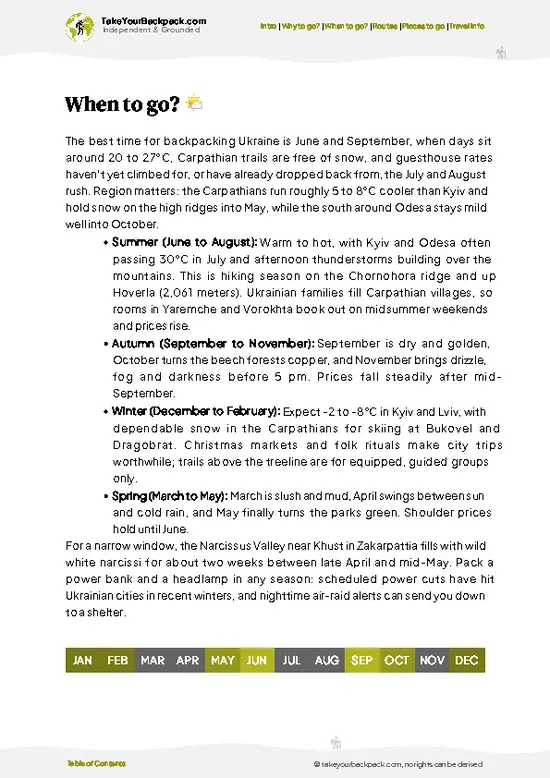
Best months and seasons: The best months for towns in Ukraine are May, June, September and early October, when daytime highs sit around 15 to 25°C, trees are in leaf or turning, and café terraces and outdoor markets are in full use.

Summer: July and August bring highs of 25 to 30°C across central and western Ukraine, and 30°C or more in the south and southeast. Thunderstorms are common in the afternoons, especially in the Carpathian foothills, where annual rainfall runs about 700 to 1,000 mm, the heaviest in the country. Summer is also the busiest period in the western towns and in the Carpathians, with accommodation in mountain areas costing 20 to 40 percent more at weekends and in August.

Autumn and spring: September is warm and dry in most regions, with highs around 18 to 23°C. By late … read more 👉
Best months and seasons: The best months for towns in Ukraine are May, June, September and early October, when daytime highs sit around 15 to 25°C, trees are in leaf or turning, and café terraces and outdoor markets are in full use.

Summer: July and August bring highs of 25 to 30°C across central and western Ukraine, and 30°C or more in the south and southeast. Thunderstorms are common in the afternoons, especially in the Carpathian foothills, where annual rainfall runs about 700 to 1,000 mm, the heaviest in the country. Summer is also the busiest period in the western towns and in the Carpathians, with accommodation in mountain areas costing 20 to 40 percent more at weekends and in August.

Autumn and spring: September is warm and dry in most regions, with highs around 18 to 23°C. By late October temperatures fall to 8 to 12°C, rain becomes steadier and daylight shortens. Spring starts slowly. March and early April bring thaw, mud and highs of 3 to 10°C, and many outdoor attractions have not yet opened. Real warmth arrives in late April and May, when orchards bloom in the central and western regions.

Winter: From December to February, daily highs sit around -4 to 2°C in the west and center, with lows to -10°C or colder during cold snaps, and snow lies on the ground for weeks. Daylight lasts only about eight hours. The Christmas and New Year period gives western towns lit squares and markets, and Carpathian ski areas are at their busiest and most expensive. Outside those weeks, winter is the cheapest season, with dorm beds and hotels often 15 to 30 percent below summer rates.

Opening hours and disruptions: Many museums close on Mondays or Tuesdays and shut early in winter. Air-raid alerts can halt visits for an hour or more, and nighttime curfews, often from about 11 pm to 5 am, limit evening plans in many places. Ukraine’s regions respond differently to the war, so schedules are best checked locally.

town hoppingOptimizing Your Multi-Stop Itinerary

Trip length and structure: A trip combining several towns in Ukraine needs 7 to 14 days, because travel between regions takes most of a day and the rail network favors a few long corridors over short links.

Which regions go together: The west groups most easily: the Lviv region, the Carpathian foothills around Ivano-Frankivsk, and Bukovina around Chernivtsi lie within 2.5 to 6 hours of each other by train or bus. Central Ukraine, with Kyiv as the main hub and the Dnipro towns and Podillia within a few hours, forms a second cluster. Trips are easier when entering from Poland through Lviv and moving east and southeast toward Kyiv, because the border trains and buses from Poland deliver travelers to the west first, and a gradual move toward the larger capital eases the transport logistics. Lviv … read more 👉
Trip length and structure: A trip combining several towns in Ukraine needs 7 to 14 days, because travel between regions takes most of a day and the rail network favors a few long corridors over short links.

Which regions go together: The west groups most easily: the Lviv region, the Carpathian foothills around Ivano-Frankivsk, and Bukovina around Chernivtsi lie within 2.5 to 6 hours of each other by train or bus. Central Ukraine, with Kyiv as the main hub and the Dnipro towns and Podillia within a few hours, forms a second cluster. Trips are easier when entering from Poland through Lviv and moving east and southeast toward Kyiv, because the border trains and buses from Poland deliver travelers to the west first, and a gradual move toward the larger capital eases the transport logistics. Lviv to Kyiv takes about 5 to 8 hours by train, with several daily departures and overnight options.

Time per stop: One to two nights suits most small and mid-sized towns, which can be walked in half a day to a day. Larger regional centers deserve two to three nights, especially if day trips to castles, monasteries or villages are planned. Carpathian mountain bases need at least two nights because transfers from rail stations take 1 to 3 hours on minibuses.

Planning mistakes: The most common error is packing in too many stops. Seven towns in ten days usually means half the time on trains and little time to see anything. Four to six stops is a more realistic target. A second mistake is treating distances as short because the map looks compact; regional buses run slowly, and rural roads can add hours. Choose trains where possible, and use overnight services to save a hotel night. A third is arriving without a buffer. Alerts, delayed trains and curfews can strand travelers, so leave a spare day before any onward flight or border crossing and buy flexible tickets. Finally, bus and minibus timetables change often, so confirm departures at the station a day ahead.

The ListMust-Visit towns in Ukraine

1 Kamianets-Podilskyi

Stone fortress, canyon views, medieval bridges

Walk ancient ramparts and cross dramatic gorges in a city where natural defenses and history are inseparable.

2 Yaremche

Mountain trails, waterfall, wooden railway bridge

Hike forested slopes, watch the river cascade below a historic viaduct, and find mountain food in rustic roadside stalls.

3 Mukachevo

Palanok Castle, Hungarian influence, riverside promenades

Tour a hilltop fortress, sample local wines, and explore a town where Central European culture meets Transcarpathian landscapes.

ukraine-city-mukachevo
© Google |

4 Truskavets

Mineral springs, sanatoriums, spa gardens

Relax in a town built around therapeutic waters, where wellness resorts and leafy parks attract visitors seeking restorative stays.

ukraine-city-truskavets
© Google |

5 Bakhchysarai

Khan’s Palace, cave monasteries, Crimean Tatar culture

Walk through a valley of limestone cliffs, visit ornate palaces, and sample local cuisine shaped by centuries of Tatar influence.

6 Uman

Sofiyivka Park, Hasidic pilgrimage, artificial lakes

Walk landscaped gardens, encounter pilgrims during Rosh Hashanah, and explore a town shaped by both nature and faith.

7 Drohobych

Saltworks, wooden churches, Jewish heritage

Trace centuries of trade and faith through salt production sites, preserved synagogues, and unique wooden architecture scattered across the city.

ukraine-city-drohobych
© Google |

8 Kolomyia

Pysanka Museum, Hutsul traditions, market squares

Experience daily life in a town where folk art, regional crafts, and a lively central bazaar shape the local rhythm.

ukraine-city-kolomyia
© Google |

9 Skhidnytsia

Mineral water springs, pine forests, health resorts

Stay in a mountain village known for its clean air, therapeutic waters, and easy access to hiking trails through dense woodland.

10 Nizhyn

Cucumber festival, Greek quarter, baroque churches

Sample pickled specialties, wander among merchant mansions, and explore religious sites reflecting a blend of cultures.

11 Stryi

Riverbank park, interwar architecture, railway junction

Stroll leafy boulevards, spot Austro-Hungarian facades, and use the town as a practical base for regional train connections.

12 Kovel

Rail hub, lakes, WWII memorials

Navigate a crossroads town with easy access to northern lakes, wartime history, and a busy train station serving multiple routes.

13 Fastiv

Railway museum, Catholic cathedral, riverside park

Visit a transport-focused town with a striking cathedral, green riverbanks, and a museum dedicated to Ukraine’s rail history.

ukraine-city-fastiv
© Google |

14 Konotop

Steam locomotives, aviation museum, steppe landscapes

Discover a town where railway heritage meets open plains, and aviation relics offer a glimpse into Soviet-era engineering.

15 Perechyn

Lemko heritage, forested hills, local distilleries

Taste regional spirits, hike wooded slopes, and learn about Lemko customs in a compact settlement near the Slovak border.

16 Krasnoilsk

Romanian community, Orthodox churches, borderland markets

Experience cross-border culture in a town where Romanian traditions, religious festivals, and lively markets define daily life.

Think you know Ukraine?

Prove you’re a true local — uncover 6 lesser-known towns in Ukraine that locals tend to keep to themselves.
Loading the map 🌍

Expert viewPro Tips for Exploring the Best

How many towns to visit: Four to six towns is the number I advise for a trip of one to two weeks. Ukrainian distances are long, trains are slow compared with Western Europe, and a safety pause such as an air-raid alert can take a morning. With that many stops you spend most days walking rather than commuting, and you still have room to follow a recommendation from a local over breakfast.

Choosing between kinds of towns: Travelers who want architecture, coffee culture and easy logistics should prioritize western towns, where cobbled squares, Baroque churches and cellar bars are within a ten-minute walk of the station. You sit in a café with a strong coffee and a poppy-seed pastry and watch the whole square work. Hikers and people who like quiet should pick Carpathian foothill and mountain … read more 👉
How many towns to visit: Four to six towns is the number I advise for a trip of one to two weeks. Ukrainian distances are long, trains are slow compared with Western Europe, and a safety pause such as an air-raid alert can take a morning. With that many stops you spend most days walking rather than commuting, and you still have room to follow a recommendation from a local over breakfast.

Choosing between kinds of towns: Travelers who want architecture, coffee culture and easy logistics should prioritize western towns, where cobbled squares, Baroque churches and cellar bars are within a ten-minute walk of the station. You sit in a café with a strong coffee and a poppy-seed pastry and watch the whole square work. Hikers and people who like quiet should pick Carpathian foothill and mountain towns, where wooden churches stand above wooden houses, trails start at the edge of town, and a bowl of banosh with sheep cheese costs about 150 to 250 UAH (US$4 to 6). Culture-minded travelers who prefer fewer foreigners should add central river and market towns, where monasteries, fortress ruins and weekend farmers’ markets are spread across flat farmland and the pace is local. Industrial and port towns in the east and south are not suitable for ordinary visits at present.

What it costs: A realistic budget is US$25 to 45 a day, or roughly 1,000 to 1,900 UAH. Dorm beds cost 400 to 700 UAH (US$10 to 17), private rooms in guesthouses 900 to 1,800 UAH (US$22 to 45), a sit-down lunch 200 to 400 UAH (US$5 to 10), and a cappuccino 70 to 110 UAH (US$2 to 3). Museum and castle entry usually runs 50 to 250 UAH (US$1 to 6), so a day of sightseeing in a town seldom passes 400 UAH (US$10) in fees. A local guide for a two-hour walk costs around 800 to 1,500 UAH (US$20 to 37) and is worth paying for in towns where the layered history is not signposted: you leave knowing which building was a Greek Catholic church, which a synagogue, and which a Soviet cinema. Regional train tickets of 2 to 6 hours generally cost 150 to 600 UAH (US$4 to 15), and minibuses less. Cards work in most towns, but keep 500 to 1,000 UAH in cash for markets and rural buses.

Safety and local conduct: Check your government’s travel advisory and carry travel insurance that does not exclude Ukraine before booking. Download an air-raid alert app and follow the instructions of hotel staff: when sirens sound, shelters in basements and metro stations are the standard response, and trains and shops may stop for the duration. You get a clear sense of how locals carry on, and you lose nothing by following the same routine. Avoid photographing military positions, checkpoints, infrastructure or damage sites, and do not post real-time locations online. Curfews commonly run overnight, so plan to be inside by about 11 pm. Expect document checks, and carry your passport at all times.

Cultural considerations: Ukrainian is the language to start with. Using it for greetings and thanks (“dobryi den” and “dyakuyu”) is received warmly, and speaking Russian by default can cause discomfort, particularly in the west. Conversations about the war are often open, but let locals set the tone and avoid asking for personal stories. Churches expect covered shoulders and knees, and photographing inside services is frowned on. Memorials to soldiers are common in town centers, where candles and flags are kept fresh, and quiet respect there is the norm. Tipping of 10 percent in restaurants is standard. Accept a plate of dumplings offered by a host, and you will be repaid with the best table in the house.

✈️ The backpacker research shortcutUkraine Travel Guide

An offline-friendly backpacking guide with optimized travel routes, ranked highlights, transport advice, and the best areas to stay.
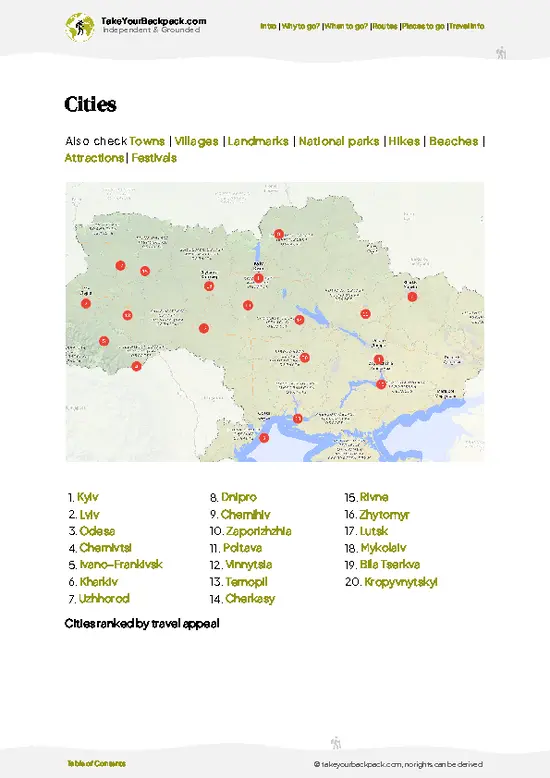
example page 0 from our offline Travel Guide for Ukraine
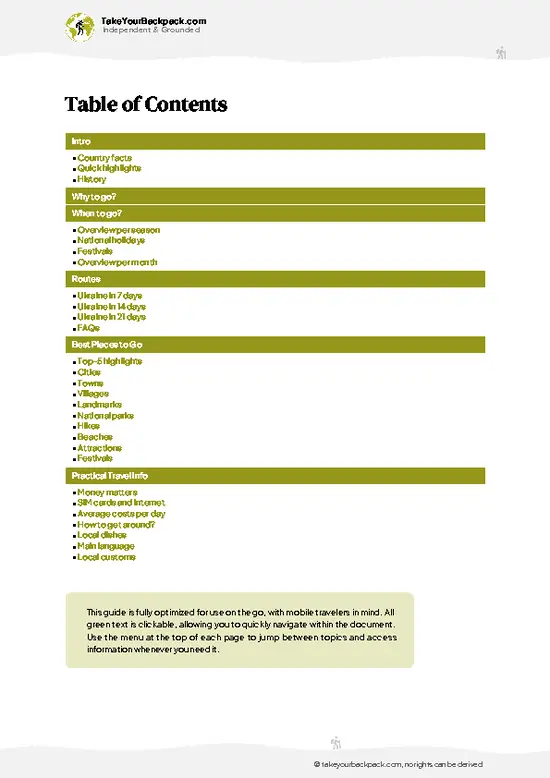
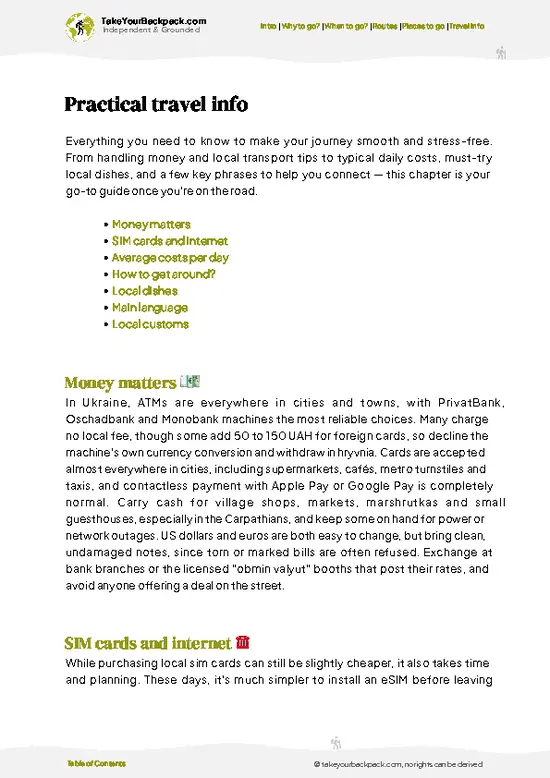
example page 1 from our offline Travel Guide for Ukraine
example page 2 from our offline Travel Guide for Ukraine
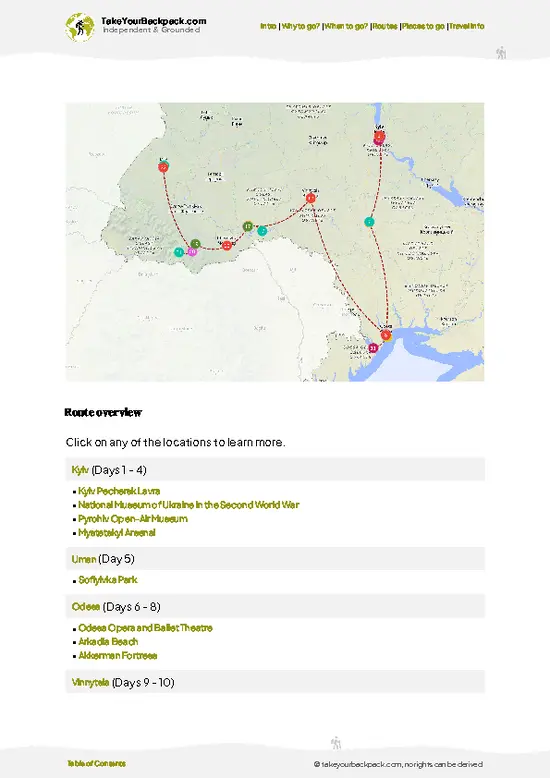
example page 3 from our offline Travel Guide for Ukraine
example page 4 from our offline Travel Guide for Ukraine
example page 5 from our offline Travel Guide for Ukraine
example page 6 from our offline Travel Guide for Ukraine
example page 7 from our offline Travel Guide for Ukraine
The digital guide (401 pages) contains:
✅ 107 highlights, ranked by travel appeal
✅ Optimized 7, 14 & 21-day travel routes
✅ Cities, national parks, landmarks, beaches
✅ How to get around
✅ Offline-friendly for travel without Wi-Fi
👉 Click to see all 30+ guide features

📅 Plan smarter in minutes, not weeks
✅ Month by month travel advice
✅ Festivals & national holidays
✅ Budget expectations

🗺️ Go to the right places, skip the overrated ones
✅ Honest pros & cons of destinations
✅ Top hikes, parks & viewpoints
✅ Lesser-known places most travelers miss
✅ Clear “worth it vs skip it” guidance

🛏️ Travel smoothly without rookie mistakes
✅ Best areas to stay
✅ Transport systems explained simply
✅ Common scams & safety advice
✅ SIM cards, money & practical tips

🌍 Understand the country, not just visit it
✅ Culture & traditions
✅ 52 Essential phrases & customs
✅ Festivals worth planning around
✅ Traveler-friendly historical context
✅ Insights that make places more meaningful

📱 Built for real travel conditions
✅ Fully downloadable PDF
✅ Works completely offline
✅ Optimized for phone use
✅ Useful in remote areas & buses
✅ Everything in one place
Stop searching, start planning
Get instant access to your full guide. 30‑day money-back guarantee.
+ Add another guide for just

By proceeding you agree to our terms.
Sent to your inbox immediately after payment • 100% Secure Checkout
Best Backpacking Travel Advisor 2025 tourism awardBest Backpacking
Travel Advisor
2025
What others say about Take Your Backpack Guides:
⭐⭐⭐⭐⭐
Fantastic, amazing amount of information!
⭐⭐⭐⭐⭐
My goodness this is amazing, it's what I've been looking for hats off too you!
⭐⭐⭐⭐⭐
I think this is absolutely BRILLIANT
⭐⭐⭐⭐
Very complete and informative. It's still missing places, but I gotta to commend you
⭐⭐⭐⭐⭐
This is truly amazing, thank you, can't wait to explore it with my kids!
⭐⭐⭐⭐⭐
Awesome resource, thank you!
⭐⭐⭐⭐⭐
This is amazing! Can't wait to explore the ones I haven't seen
⭐⭐⭐⭐
I love this! Well done, great idea.
⭐⭐⭐⭐⭐
Thanks for taking the time to make this gem!
⭐⭐⭐⭐⭐
This might be the best website I've ever seen.
⭐⭐⭐⭐⭐
Congratulations, and thank you so much for your work; it's incredibly valuable.
⭐⭐⭐⭐
In all seriousness I think you did a great job pointing out the important spots
⭐⭐⭐⭐⭐
10/10 very good
⭐⭐⭐⭐⭐
As someone who's only just starting to visit regularly this is awesome, thank you.
⭐⭐⭐⭐
Thank you very much! I'm going to visit my dad, it's going to be very useful!
⭐⭐⭐⭐⭐
This is really cool! We'll be travelling for the first time and this definitely come in handy.
⭐⭐⭐⭐⭐
You are now our minister of culture, congratulations 👨‍💼
⭐⭐⭐⭐⭐
Just wanted to tell you that this is a pearl! Going to follow your recommendations.
⭐⭐⭐⭐⭐
This is so cool. I'll definitely be using the resource for my travels soon.
⭐⭐⭐⭐⭐
This is very impressive! Good work.
⭐⭐⭐⭐⭐
This is an amazing and informative site. Very well done!

🛏️ Where to stay?Top Areas to Stay

Ukraine has plenty of hostels and budget guesthouses, with dorm beds typically running UAH 350 to 600 (about US$8 to 15) and private rooms in family-run guesthouses or rented apartments from around UAH 900 (US$22). In Kyiv, Podil puts you among riverside bars and cafes with a younger crowd, while the streets around Khreshchatyk and Old Kyiv keep the main sights and metro lines within walking distance but cost more and feel busier. Lviv’s compact Old Town around the market square has the densest choice of hostels in the country and a lively evening scene that can mean noisy nights, and in Odesa the grid of streets near Deribasivska puts you close to the restaurants and the walk to the sea, with … read more 👉
Ukraine has plenty of hostels and budget guesthouses, with dorm beds typically running UAH 350 to 600 (about US$8 to 15) and private rooms in family-run guesthouses or rented apartments from around UAH 900 (US$22). In Kyiv, Podil puts you among riverside bars and cafes with a younger crowd, while the streets around Khreshchatyk and Old Kyiv keep the main sights and metro lines within walking distance but cost more and feel busier. Lviv’s compact Old Town around the market square has the densest choice of hostels in the country and a lively evening scene that can mean noisy nights, and in Odesa the grid of streets near Deribasivska puts you close to the restaurants and the walk to the sea, with calmer, cheaper rooms a few blocks inland.

If you enjoy meeting fellow travelers, consider choosing hostels with high ratings for atmosphere. On the other hand, if you prefer having your own space, a hotel might be a better option.

UkraineDiscover the Country

👋 Meet the founderWho’s Behind Take Your Backpack?

Johan, backpacker and founder of TakeYourBackpackHi, I’m Johan (Netherlands 🇳🇱), the creator of TakeYourBackpack. Over the past 3 decades, I’ve backpacked through 90+ countries across six continents, gaining extensive experience with independent travel, long-term trips, and overland routes.

This site is built on a combination of firsthand travel experience and carefully curated insights from other backpackers. Many guides are based on places I’ve personally visited, while others bring together tips, observations, and practical advice shared by trusted travelers I’ve met along the way.

The goal is to provide realistic, experience-driven guidance — not generic itineraries — so you can explore destinations with better context, clearer expectations, and more confidence.