×

United Arab Emirates🇦🇪 | best hikesTop-Rated 7 hikes in UAE

Hiking in the United Arab Emirates (UAE) means rock, wadis and sand rather than forest trails. The Hajar Mountains in Ras Al Khaimah, Fujairah and Sharjah hold the best terrain, with gravel tracks, dry stream beds and peaks above 1,500 meters. Dunes near Liwa and the Dubai desert suit sunrise walks. Most trailheads are free and need a car or taxi, so independent travelers should budget for rides. Go on weekday mornings and you will often have a ridge to yourself, while Fridays fill with local families. Start before dawn and carry more water than feels sensible.

By Johan Kruseman 🇳🇱 | Updated October 19, 2026
Explore the best beaches in UAE

Why go?What Makes Them Special

The UAE is a hiking country with an asterisk. Its geography is desert and mountain in tight reach: the Hajar range runs along the eastern edge and shares ground with Oman, so you can sleep in a city and be on a rocky ridge within an hour or two. That compact layout is the real draw, since you rarely need a long transfer to change landscape.

The climate is the major filter. Summer heat pushes past 40°C (104°F) and makes midday walking dangerous, so the hiking year is short and the timing matters more than fitness. Water is rarely available on the trail, so you carry everything.

The infrastructure is uneven. Roads are excellent and fuel is cheap, but public transport rarely reaches trailheads, and waymarking is thin compared with Europe. Hiking culture is young, built around expats, local … read more 👉
The UAE is a hiking country with an asterisk. Its geography is desert and mountain in tight reach: the Hajar range runs along the eastern edge and shares ground with Oman, so you can sleep in a city and be on a rocky ridge within an hour or two. That compact layout is the real draw, since you rarely need a long transfer to change landscape.

The climate is the major filter. Summer heat pushes past 40°C (104°F) and makes midday walking dangerous, so the hiking year is short and the timing matters more than fitness. Water is rarely available on the trail, so you carry everything.

The infrastructure is uneven. Roads are excellent and fuel is cheap, but public transport rarely reaches trailheads, and waymarking is thin compared with Europe. Hiking culture is young, built around expats, local clubs and a few tour operators rather than hut networks or long-distance paths. Expect day hikes, not multi-day treks, and plan on camping only in permitted areas.

Before choosing the UAE, know that drones, photography of people and some border-area mountains carry rules, and that a rental car makes the whole country easier. Pack a power bank, offline maps and electrolytes.
Our Approach to Ranking
The list of best hikes in UAE is created based on scenery, challenge, trail quality, landmarks, and overall enjoyment. If you feel a hike is missing in this list, please let us know.

When to go?Timing Your Visit for the Best Experience

Best months: The best months for hiking in the UAE are November to March, when daytime highs run about 22 to 30°C (72 to 86°F) instead of the 40 to 48°C (104 to 118°F) of summer. Mountain mornings can drop to 8 to 15°C, so a light layer helps at sunrise.

Shoulder seasons: October and April are workable if you start at first light and finish by 9 or 10 a.m. By May the mountains already feel like an oven by midmorning. Rain is rare and falls mostly from December to March, usually under 100 mm for the whole year in most places, but the Hajar can see short, heavy storms that flash-flood wadis. Check the forecast and avoid dry stream beds when clouds build over the peaks.

Peak periods and prices: Hotel prices peak from December to February, especially around Christmas and New Year in Dubai, when … read more 👉
Best months: The best months for hiking in the UAE are November to March, when daytime highs run about 22 to 30°C (72 to 86°F) instead of the 40 to 48°C (104 to 118°F) of summer. Mountain mornings can drop to 8 to 15°C, so a light layer helps at sunrise.

Shoulder seasons: October and April are workable if you start at first light and finish by 9 or 10 a.m. By May the mountains already feel like an oven by midmorning. Rain is rare and falls mostly from December to March, usually under 100 mm for the whole year in most places, but the Hajar can see short, heavy storms that flash-flood wadis. Check the forecast and avoid dry stream beds when clouds build over the peaks.

Peak periods and prices: Hotel prices peak from December to February, especially around Christmas and New Year in Dubai, when rooms can cost double the summer rate. Fujairah and Ras Al Khaimah stay calmer and cheaper than Dubai. Weekends here are Saturday and Sunday, though Friday midday is still busy with prayers and family outings, so hit popular trails on a Monday to Thursday morning. Ramadan shifts the rhythm: tour operators trim hours, daytime food options shrink, and you should drink water discreetly away from public view.

Summer: June to September is for desert sunrise walks only, and even then it is tough. Hotel rates drop 40 to 60 percent, but trail time shrinks to the hour after dawn.

hike hoppingPlanning Your Route Efficiently

How long you need: A trip combining several hikes in the UAE needs 5 to 7 days, and the country is small enough that you can see much of it with one base per region. Dubai to Ras Al Khaimah takes roughly 1 to 1.5 hours by road, and Dubai to Fujairah around 1.5 to 2 hours.

Which regions group well: The northern emirates and the east coast cluster neatly: Ras Al Khaimah, Sharjah and Fujairah all sit along the Hajar. A sensible direction is to arrive in Dubai, drive north to Ras Al Khaimah first, cross the mountains to Fujairah, then loop back via Sharjah. Allow a half day to a full day per hike, since trailheads can be 30 to 60 minutes from town on rough road. Abu Dhabi and the Liwa dunes sit 2 to 3.5 hours from the north, so treat them as a separate leg or a short side trip.

Mistakes to avoid: … read more 👉
How long you need: A trip combining several hikes in the UAE needs 5 to 7 days, and the country is small enough that you can see much of it with one base per region. Dubai to Ras Al Khaimah takes roughly 1 to 1.5 hours by road, and Dubai to Fujairah around 1.5 to 2 hours.

Which regions group well: The northern emirates and the east coast cluster neatly: Ras Al Khaimah, Sharjah and Fujairah all sit along the Hajar. A sensible direction is to arrive in Dubai, drive north to Ras Al Khaimah first, cross the mountains to Fujairah, then loop back via Sharjah. Allow a half day to a full day per hike, since trailheads can be 30 to 60 minutes from town on rough road. Abu Dhabi and the Liwa dunes sit 2 to 3.5 hours from the north, so treat them as a separate leg or a short side trip.

Mistakes to avoid: The common error is stacking two hikes in one day, which runs into midday heat. Do one dawn hike, rest, and move on in the afternoon. Another is relying on buses: intercity buses reach the cities, but not the trailheads, so book a rental car or arrange a driver for at least the mountain days. Travelers also base themselves in Dubai for everything, then lose 3 to 4 hours daily in traffic. Sleep near the mountains instead.

The ListMust-Visit hikes in UAE

1 Jebel Jais

highest peak, steep switchbacks, exposed cliffs

Climb the UAE’s tallest mountain on trails that traverse sharp ridgelines, offering dramatic elevation changes and distant views into Oman.

2 Al Rabi Mountain Trail

coastal views, military lookout, marked ascent

Gain elevation quickly on a well-signed route, with the Gulf and cityscape unfolding below as you approach a historic hilltop fort.

3 Jebel Hafeet

limestone summit, desert escarpment, hot springs

Ascend a prominent peak above Al Ain, where exposed rock faces and sweeping desert views meet the cool air of elevated plateaus.

united-arab-emirates-hike-jebel-hafeet
© Google |

4 Fossil Rock Trail

ancient seabed, red sand dunes, marine fossils

Traverse a landscape marked by fossilized remains and shifting sands, where geological history is visible in every exposed rock and ridge.

5 Wadi Shawka

seasonal pools, terraced farms, gravel tracks

Follow winding wadis past occasional waterholes and cultivated terraces, with gentle gradients making this route accessible for most hikers.

united-arab-emirates-hike-wadi-shawka
© Google |

6 Wadi Abadilah

lush plantations, shaded gorges, freshwater streams

Walk through a rare green corridor where banana groves and palm trees line the valley floor, with shallow streams underfoot for much of the year.

united-arab-emirates-hike-wadi-abadilah
© Google |

7 Masafi Mountains Trail

boulder fields, remote villages, rugged valleys

Venture into less-traveled highlands, crossing rocky outcrops and passing isolated settlements that reveal the area’s traditional mountain life.

united-arab-emirates-hike-masafi-mountains-trail
© Google |
Loading the map 🌍

Expert viewWhat You Should Know

How many hikes: I would advise 4 to 6 hikes in the UAE. That is enough to cover the main terrain types without repeating yourself, and the dawn-only window means you realistically get one good outing per day. More than that and you are filling days with traffic and heat.

Which kind to prioritize: Choose mountain ridge and wadi walks in the Hajar if you want the most varied and rewarding terrain, and these suit most fit travelers. Pick desert dunes if you want a short sunrise outing or are traveling with a mixed-ability group. Budget travelers should lean on free, public trailheads, while those who dislike navigating should book one guided outing for the harder routes, where tracks are faint and junctions unmarked.

What it costs: Plan on US$70 to 130 a day (about AED 260 to 480) for a comfortable … read more 👉
How many hikes: I would advise 4 to 6 hikes in the UAE. That is enough to cover the main terrain types without repeating yourself, and the dawn-only window means you realistically get one good outing per day. More than that and you are filling days with traffic and heat.

Which kind to prioritize: Choose mountain ridge and wadi walks in the Hajar if you want the most varied and rewarding terrain, and these suit most fit travelers. Pick desert dunes if you want a short sunrise outing or are traveling with a mixed-ability group. Budget travelers should lean on free, public trailheads, while those who dislike navigating should book one guided outing for the harder routes, where tracks are faint and junctions unmarked.

What it costs: Plan on US$70 to 130 a day (about AED 260 to 480) for a comfortable independent trip, or US$45 to 70 if you use hostels and share a car. Rental cars run roughly AED 100 to 200 a day, fuel is cheap, and a full tank usually costs under AED 150. Most trailheads are free. Guided hikes typically cost US$50 to 120 per person depending on group size and transport. A 5 to 7 day trip lands around US$400 to 900 excluding flights, with the spread driven by lodging in Dubai versus Fujairah or Ras Al Khaimah.

Safety: Heat is the main danger. Carry at least 3 liters of water per person for a half-day walk, add electrolytes, wear a hat, and be off the trail by 9 or 10 a.m. outside winter. Flash floods can run down wadis even when your sky is clear, so skip dry stream beds after rain upstream. Download offline maps, since signal fades in valleys, and tell your hotel your route. Some mountain roads and border zones with Oman are restricted, so stay on signed public routes and turn around at military checkpoints.

Cultural considerations: Dress modestly in villages and on the way to trailheads: cover shoulders and knees when you stop in towns. Do not fly drones without a permit, and avoid photographing people, military sites or local homes. Camping is allowed only in designated areas, and alcohol and loud music are inappropriate on trails and in rural areas. During Ramadan, avoid eating or drinking openly in public during daylight, though you should still hydrate on the trail. Leave no trace; litter on remote ledges is a real issue and it is easy to carry your own out.

✈️ The backpacker research shortcutUAE Travel Guide

An offline-friendly backpacking guide with optimized travel routes, ranked highlights, transport advice, and the best areas to stay.
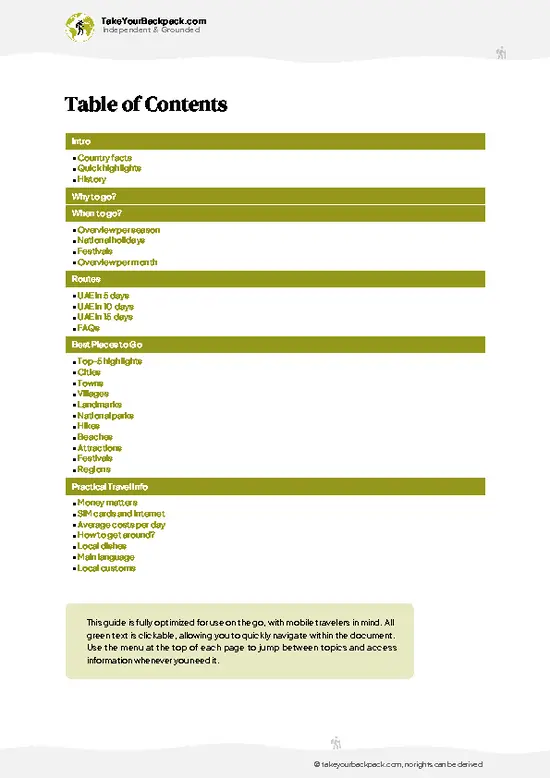
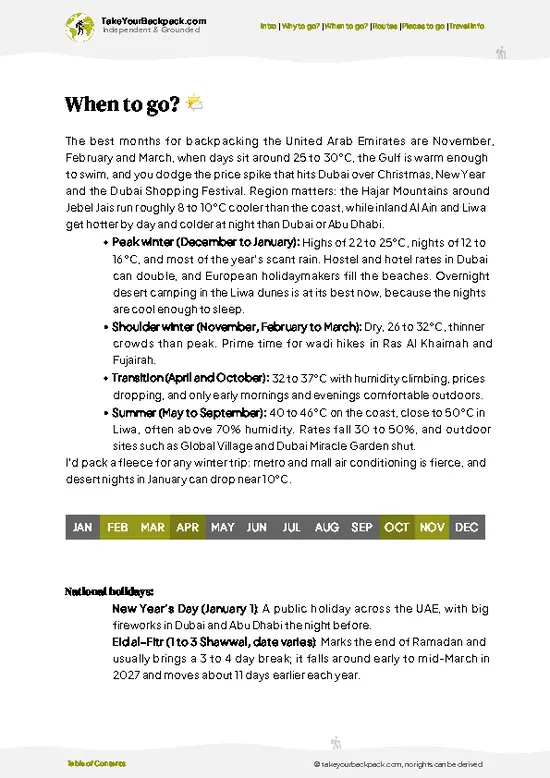
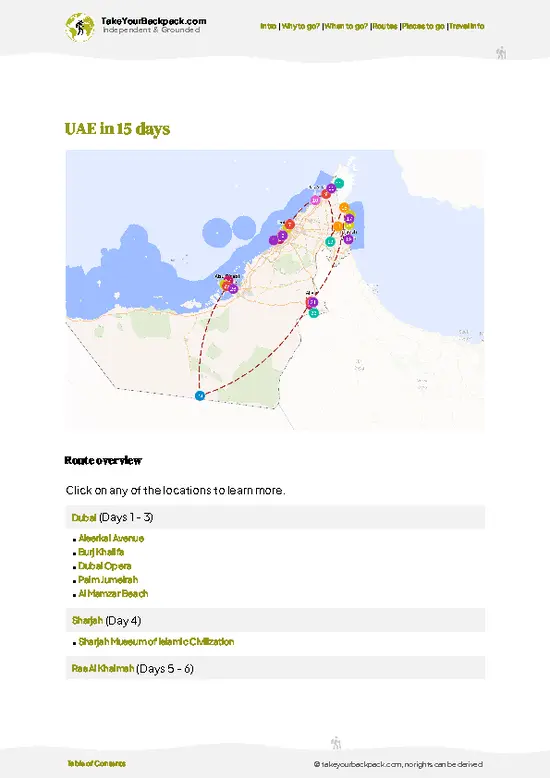
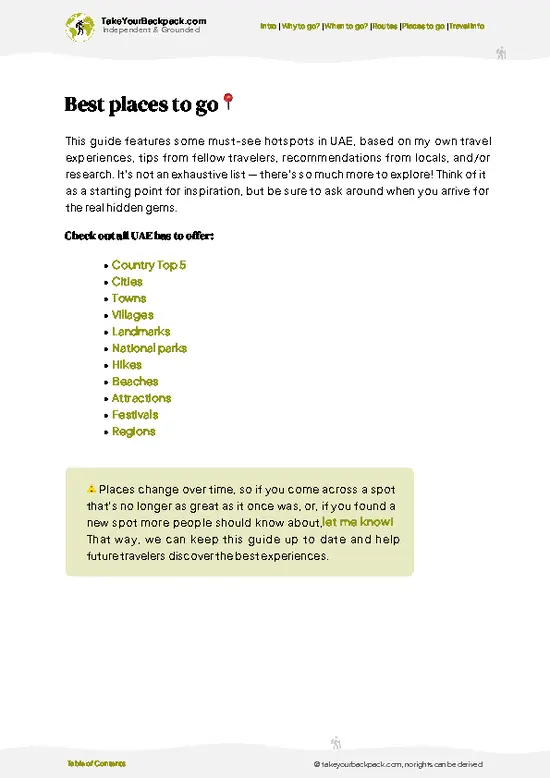
example page 0 from our offline Travel Guide for United Arab Emirates
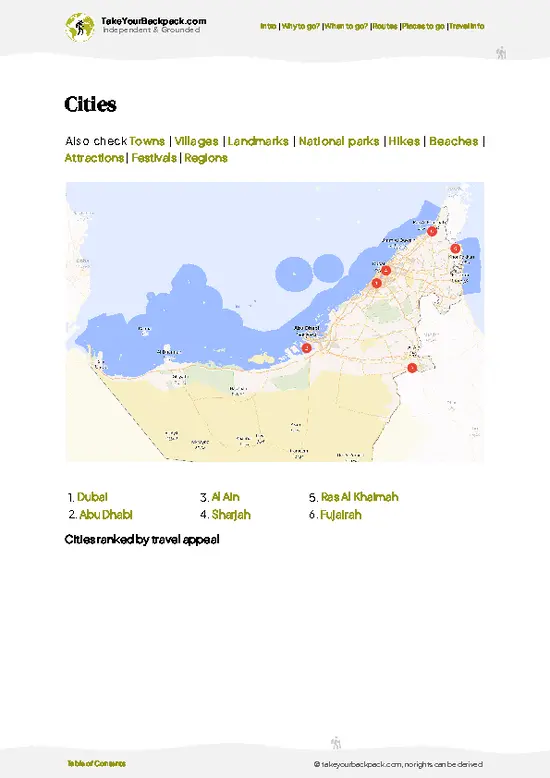
example page 1 from our offline Travel Guide for United Arab Emirates
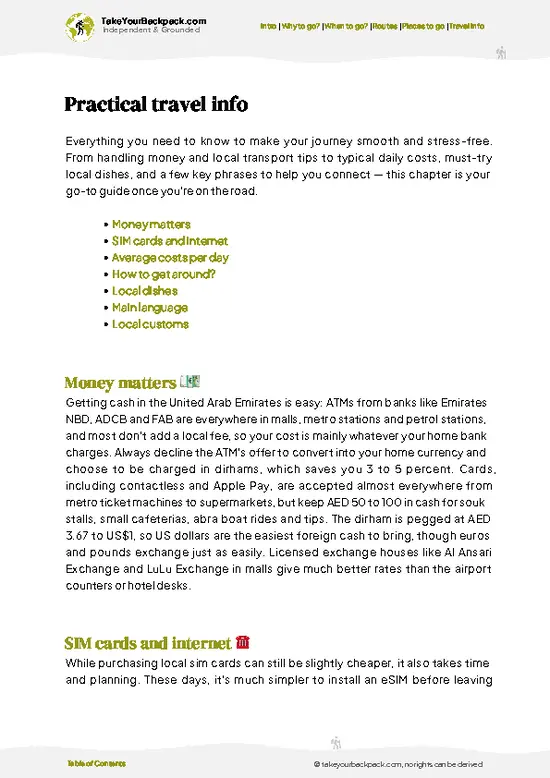
example page 2 from our offline Travel Guide for United Arab Emirates
example page 3 from our offline Travel Guide for United Arab Emirates
example page 4 from our offline Travel Guide for United Arab Emirates
example page 5 from our offline Travel Guide for United Arab Emirates
example page 6 from our offline Travel Guide for United Arab Emirates
example page 7 from our offline Travel Guide for United Arab Emirates
The digital guide (263 pages) contains:
✅ 71 highlights, ranked by travel appeal
✅ Optimized 5, 10 & 15-day travel routes
✅ Cities, national parks, landmarks, beaches
✅ How to get around
✅ Offline-friendly for travel without Wi-Fi
👉 Click to see all 30+ guide features

📅 Plan smarter in minutes, not weeks
✅ Month by month travel advice
✅ Festivals & national holidays
✅ Budget expectations

🗺️ Go to the right places, skip the overrated ones
✅ Honest pros & cons of destinations
✅ Top hikes, parks & viewpoints
✅ Lesser-known places most travelers miss
✅ Clear “worth it vs skip it” guidance

🛏️ Travel smoothly without rookie mistakes
✅ Best areas to stay
✅ Transport systems explained simply
✅ Common scams & safety advice
✅ SIM cards, money & practical tips

🌍 Understand the country, not just visit it
✅ Culture & traditions
✅ 52 Essential phrases & customs
✅ Festivals worth planning around
✅ Traveler-friendly historical context
✅ Insights that make places more meaningful

📱 Built for real travel conditions
✅ Fully downloadable PDF
✅ Works completely offline
✅ Optimized for phone use
✅ Useful in remote areas & buses
✅ Everything in one place
Stop searching, start planning
Get instant access to your full guide. 30‑day money-back guarantee.
+ Add another guide for just

By proceeding you agree to our terms.
Sent to your inbox immediately after payment • 100% Secure Checkout
Best Backpacking Travel Advisor 2025 tourism awardBest Backpacking
Travel Advisor
2025
What others say about Take Your Backpack Guides:
⭐⭐⭐⭐⭐
Fantastic, amazing amount of information!
⭐⭐⭐⭐⭐
My goodness this is amazing, it's what I've been looking for hats off too you!
⭐⭐⭐⭐⭐
I think this is absolutely BRILLIANT
⭐⭐⭐⭐
Very complete and informative. It's still missing places, but I gotta to commend you
⭐⭐⭐⭐⭐
This is truly amazing, thank you, can't wait to explore it with my kids!
⭐⭐⭐⭐⭐
Awesome resource, thank you!
⭐⭐⭐⭐⭐
This is amazing! Can't wait to explore the ones I haven't seen
⭐⭐⭐⭐
I love this! Well done, great idea.
⭐⭐⭐⭐⭐
Thanks for taking the time to make this gem!
⭐⭐⭐⭐⭐
This might be the best website I've ever seen.
⭐⭐⭐⭐⭐
Congratulations, and thank you so much for your work; it's incredibly valuable.
⭐⭐⭐⭐
In all seriousness I think you did a great job pointing out the important spots
⭐⭐⭐⭐⭐
10/10 very good
⭐⭐⭐⭐⭐
As someone who's only just starting to visit regularly this is awesome, thank you.
⭐⭐⭐⭐
Thank you very much! I'm going to visit my dad, it's going to be very useful!
⭐⭐⭐⭐⭐
This is really cool! We'll be travelling for the first time and this definitely come in handy.
⭐⭐⭐⭐⭐
You are now our minister of culture, congratulations 👨‍💼
⭐⭐⭐⭐⭐
Just wanted to tell you that this is a pearl! Going to follow your recommendations.
⭐⭐⭐⭐⭐
This is so cool. I'll definitely be using the resource for my travels soon.
⭐⭐⭐⭐⭐
This is very impressive! Good work.
⭐⭐⭐⭐⭐
This is an amazing and informative site. Very well done!

🛏️ Where to stay?Best Places to Stay in UAE

The United Arab Emirates has a small but growing hostel scene, with dorm beds typically running AED 60 to 120 (US$16 to 33) a night and basic private rooms in budget hotels from roughly AED 150 to 250 (US$40 to 70). In Dubai, the old districts of Deira and Bur Dubai hold the most cheap beds, close to the creek, the souks and the metro, safe and lively until late but noisy and a bit dated. Al Barsha and Dubai Marina put you nearer the beach, malls and nightlife at higher prices, while in Abu Dhabi the downtown grid around Al Zahiyah and Al Markaziyah is quiet and very safe, though most big sights there need a bus or taxi ride.

If you enjoy meeting fellow travelers, consider choosing hostels with … read more 👉
The United Arab Emirates has a small but growing hostel scene, with dorm beds typically running AED 60 to 120 (US$16 to 33) a night and basic private rooms in budget hotels from roughly AED 150 to 250 (US$40 to 70). In Dubai, the old districts of Deira and Bur Dubai hold the most cheap beds, close to the creek, the souks and the metro, safe and lively until late but noisy and a bit dated. Al Barsha and Dubai Marina put you nearer the beach, malls and nightlife at higher prices, while in Abu Dhabi the downtown grid around Al Zahiyah and Al Markaziyah is quiet and very safe, though most big sights there need a bus or taxi ride.

If you enjoy meeting fellow travelers, consider choosing hostels with high ratings for atmosphere. On the other hand, if you prefer having your own space, a hotel might be a better option.

UAEExplore UAE

👋 Meet the founderWho’s Behind Take Your Backpack?

Johan, backpacker and founder of TakeYourBackpackHi, I’m Johan (Netherlands 🇳🇱), the creator of TakeYourBackpack. Over the past 3 decades, I’ve backpacked through 90+ countries across six continents, gaining extensive experience with independent travel, long-term trips, and overland routes.

This site is built on a combination of firsthand travel experience and carefully curated insights from other backpackers. Many guides are based on places I’ve personally visited, while others bring together tips, observations, and practical advice shared by trusted travelers I’ve met along the way.

The goal is to provide realistic, experience-driven guidance — not generic itineraries — so you can explore destinations with better context, clearer expectations, and more confidence.