×

United Arab Emirates🇦🇪 | best national parksTop-Rated 10 national parks in UAE

Pull up a chair, because national parks in United Arab Emirates (UAE) are not what the phrase usually suggests. There are no ranger huts or multi-day trails. Most protected areas are desert reserves, mangrove lagoons, wadis and mountain zones run by emirate-level authorities, so rules and fees change when you cross a border between emirates. Dubai and Abu Dhabi sites are polished, with set visiting hours and sometimes booking. Ras Al Khaimah, Fujairah and Sharjah feel looser and cheaper. For independent travel, a rental car is the key to access, and sunrise or late afternoon visits beat midday crowds and heat.

By Johan Kruseman 🇳🇱 | Updated October 19, 2026
Explore the best hikes in UAE

Why go?What Makes Them Special

The UAE is an unusual place to chase protected nature, and the reasons are mostly geographic and climatic. Roughly 80 percent of the country is desert, and the rest is a thin strip of coast, salt flats, mangroves, and the Hajar Mountains rising along the Oman border, so protected areas here are built around arid ecosystems rather than forests or alpine trails. Oil wealth has also shaped conservation: reserves tend to be government-managed and fenced, with a strong focus on breeding and reintroducing desert wildlife such as Arabian oryx, gazelles, and flamingos on coastal wetlands.

Before choosing the UAE for its parks, know that the model is different from the Americas or Africa. Many reserves have limited or permit-based access, some are reached only by guided or vehicle-based visits, and … read more 👉
The UAE is an unusual place to chase protected nature, and the reasons are mostly geographic and climatic. Roughly 80 percent of the country is desert, and the rest is a thin strip of coast, salt flats, mangroves, and the Hajar Mountains rising along the Oman border, so protected areas here are built around arid ecosystems rather than forests or alpine trails. Oil wealth has also shaped conservation: reserves tend to be government-managed and fenced, with a strong focus on breeding and reintroducing desert wildlife such as Arabian oryx, gazelles, and flamingos on coastal wetlands.

Before choosing the UAE for its parks, know that the model is different from the Americas or Africa. Many reserves have limited or permit-based access, some are reached only by guided or vehicle-based visits, and a car makes a huge difference because public transport rarely reaches them. Distances are short, though, and roads are excellent, so a rental car turns long drives into easy half-days.

The summer heat, which regularly climbs above 40°C (104°F) with heavy humidity on the coast, shuts down most hiking from June to September. Plan outdoor time for early morning or just before sunset, when the light is soft and animals actually move. Respect local norms too: dress modestly away from beaches, and ask before photographing people. Do that, and the UAE offers a compact, surprisingly varied introduction to Arabian nature.
Evaluating the Top Choices
The list of best national parks in UAE is created based on landscapes, wildlife, adventure opportunities, facilities, and overall experience. If you feel a national park is missing in this list, please let us know.

When to go?Timing Your Visit for the Best Experience

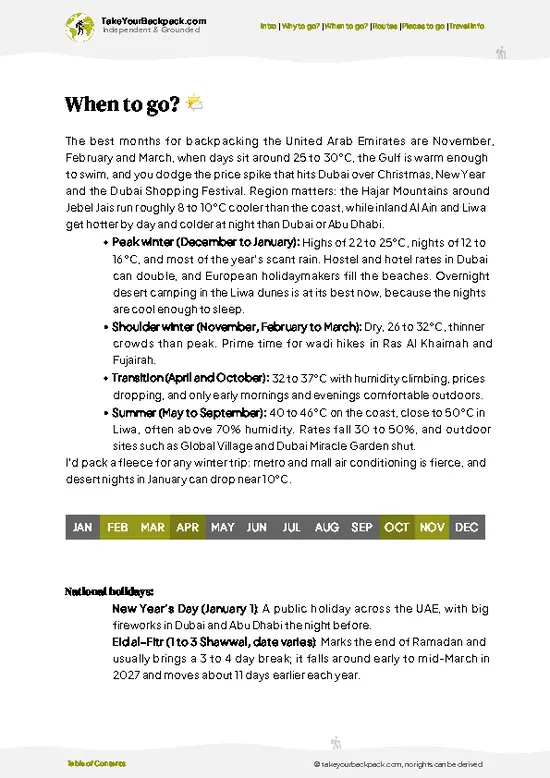
Best months: November to March: Daytime highs of 22 to 30°C make November to March the clear window for national parks in the UAE, because you can walk, hike and drive reserves without heat risk. Nights in the desert and mountains drop to 8 to 15°C, so pack a warm layer for dawn starts. Rain is rare, roughly 100 mm a year nationally, and falls mostly December to March, usually in short bursts.
Shoulder seasons: October and April: These months run 32 to 38°C by day. They work if you start at sunrise and finish by 10:30 or 11:00. Mountain areas in the northeast and east stay several degrees cooler than the coast and inland desert, so they hold up longest into spring. Humidity on the coast is already sticky by April.
Summer: May to September: Highs of 40 to 48°C make most outdoor visits impractical, … read more 👉
Best months: November to March: Daytime highs of 22 to 30°C make November to March the clear window for national parks in the UAE, because you can walk, hike and drive reserves without heat risk. Nights in the desert and mountains drop to 8 to 15°C, so pack a warm layer for dawn starts. Rain is rare, roughly 100 mm a year nationally, and falls mostly December to March, usually in short bursts.
Shoulder seasons: October and April: These months run 32 to 38°C by day. They work if you start at sunrise and finish by 10:30 or 11:00. Mountain areas in the northeast and east stay several degrees cooler than the coast and inland desert, so they hold up longest into spring. Humidity on the coast is already sticky by April.
Summer: May to September: Highs of 40 to 48°C make most outdoor visits impractical, and some reserves reduce hours or close to visitors. Hotel prices fall, often by 30 to 50 percent, which tempts budget travelers, but the savings are not worth heat exhaustion.
Peak periods: Rates and crowds peak in December and early January, plus national holidays like Eid and National Day on December 2 and 3. Book transport and any tour slots early, and visit midweek, since Friday and Saturday weekends draw local families.

national park hoppingPlanning Your Route Efficiently

How many days to allow: A trip linking several national parks in the UAE needs 4 to 7 days, and the country is small enough that you can see a good spread without rushing. The easiest base is Dubai or Abu Dhabi, both with airports, rental cars and tours. Then cluster by geography: the desert and wetland areas of Dubai and Abu Dhabi sit together, and the northern emirates and Hajar Mountains (Ras Al Khaimah, Sharjah, Fujairah) form a second group.
Direction and timing: Start in the west, then move northeast and finish on the east coast, or reverse it to end near your flight. Allow half a day to a full day per stop, with sunrise or late afternoon the best slots. Typical drives are 1 to 2 hours between Dubai and Ras Al Khaimah, and about 1.5 to 2.5 hours from Dubai to Fujairah. Abu Dhabi to Dubai … read more 👉
How many days to allow: A trip linking several national parks in the UAE needs 4 to 7 days, and the country is small enough that you can see a good spread without rushing. The easiest base is Dubai or Abu Dhabi, both with airports, rental cars and tours. Then cluster by geography: the desert and wetland areas of Dubai and Abu Dhabi sit together, and the northern emirates and Hajar Mountains (Ras Al Khaimah, Sharjah, Fujairah) form a second group.
Direction and timing: Start in the west, then move northeast and finish on the east coast, or reverse it to end near your flight. Allow half a day to a full day per stop, with sunrise or late afternoon the best slots. Typical drives are 1 to 2 hours between Dubai and Ras Al Khaimah, and about 1.5 to 2.5 hours from Dubai to Fujairah. Abu Dhabi to Dubai takes 1 to 1.5 hours without traffic.
Common planning mistakes: Travelers often cram three stops into one day and arrive during midday heat, or ignore the heavy traffic on Dubai and Sharjah roads at weekday rush hours. Instead, pair one reserve per half day and build in a late lunch break. Another mistake is skipping reservations, as some areas limit daily entry. Book ahead, carry water, and confirm opening days, as many close one weekday.

The ListMust-Visit national parks in UAE

1 Dubai Desert Conservation Reserve

acacia groves, Arabian oryx, guided safaris

Join conservation-focused tours to spot rare desert species and learn about fragile ecosystems thriving just beyond Dubai’s city limits.

2 Sir Bani Yas Island

savannah plains, free-roaming gazelles, archaeological ruins

Travel across open landscapes where herds of antelope graze and ancient sites reveal the island’s layered human and natural history.

united-arab-emirates-national-park-sir-bani-yas-island
© Google |

3 Ras Al Khor Wildlife Sanctuary

mudflats, bird hides, urban skyline views

Watch thousands of waterbirds feeding against a city backdrop, with easy access to observation points for close-up wildlife encounters.

united-arab-emirates-national-park-ras-al-khor-wildlife-sanctuary
© Google |

4 Mangrove National Park

urban mangroves, canoe routes, crab colonies

Drift quietly among tangled roots and discover a thriving ecosystem just minutes from Abu Dhabi’s city center.

5 Wadi Wurayah National Park

rock pools, waterfalls, rugged canyons

Hike through dramatic gorges and discover freshwater springs supporting rare plants and animals in the Hajar Mountains.

united-arab-emirates-national-park-wadi-wurayah-national-park
© Google |

6 Hatta Mountain Conservation Area

rocky trails, mountain biking, turquoise reservoirs

Navigate steep tracks and cool off in clear waters, with outdoor activities set against the dramatic backdrop of the Hajar range.

united-arab-emirates-national-park-hatta-mountain-conservation-area
© Google |

7 Al Marmoom Desert Conservation Reserve

dune landscapes, camel herds, Bedouin camps

Experience shifting sands and traditional desert life, where wildlife sightings and cultural encounters shape every journey through the reserve.

united-arab-emirates-national-park-al-marmoom-desert-conservation-reserve
© Google |

8 Khor Kalba Conservation Reserve

coastal mangroves, kingfisher habitat, tidal creeks

Paddle through winding waterways and spot rare birds in a tranquil reserve where the mountains meet the Gulf of Oman.

9 Al Wathba Wetland Reserve

salt flats, flamingo flocks, seasonal lagoons

Walk boardwalks past shallow pools and observe migratory birds gathering in a protected wetland that changes with the seasons.

united-arab-emirates-national-park-al-wathba-wetland-reserve
© Google |

10 Al Zorah Nature Reserve

tidal lagoons, mangrove forests, egret colonies

Glide by kayak through calm channels, observing diverse birdlife and dense mangroves that shelter the shoreline near Ajman.

Loading the map 🌍

Expert viewWhat You Should Know

How many to visit: Aim for three to four national parks on one trip. The UAE is compact, but each reserve involves a long, hot, often guided visit, and more than that blurs together while adding transfer costs. Pick one desert, one mountain or wadi area, and one coastal wetland, and your trip covers the country’s range.
Prioritizing by travel style: Wildlife lovers should lean toward managed desert and wetland reserves, where sightings are dependable. Hikers should favor the Hajar Mountains, the closest thing to real trail walking. Budget travelers will find the northern emirates cheaper and less formal than Dubai or Abu Dhabi. Photographers should plan for the 90 minutes after sunrise and before sunset.
What it costs: Expect US$60 to 110 a day (about AED 220 to 400) for an independent traveler … read more 👉
How many to visit: Aim for three to four national parks on one trip. The UAE is compact, but each reserve involves a long, hot, often guided visit, and more than that blurs together while adding transfer costs. Pick one desert, one mountain or wadi area, and one coastal wetland, and your trip covers the country’s range.
Prioritizing by travel style: Wildlife lovers should lean toward managed desert and wetland reserves, where sightings are dependable. Hikers should favor the Hajar Mountains, the closest thing to real trail walking. Budget travelers will find the northern emirates cheaper and less formal than Dubai or Abu Dhabi. Photographers should plan for the 90 minutes after sunrise and before sunset.
What it costs: Expect US$60 to 110 a day (about AED 220 to 400) for an independent traveler including a hostel or budget hotel, food and a shared car. Entry fees are often small, around AED 10 to 50 (US$3 to 14), but premium reserves with guided drives or desert camps run AED 300 to 900 (US$80 to 245) per person. Car rental runs AED 100 to 200 a day (US$27 to 55), plus fuel, and guides or 4x4 transfers add AED 150 to 400 (US$40 to 110) per visit. Taxis between emirates get expensive fast, so split costs with other travelers.
Safety: Heat is the real danger. Carry at least 3 liters of water per person, wear a hat and start early. Do not drive on dunes without training or a proper vehicle, because getting stuck far from help is common. Check weather for flash floods in wadis, since even distant rain can fill a dry channel quickly. Keep to marked tracks and respect fenced zones, which protect fragile habitats and carry fines.
Cultural considerations: The UAE is a conservative Muslim country, so dress modestly in towns and at reserve entrances, with shoulders and knees covered. Do not photograph locals, especially women, without asking. Drones need permits, and littering, wildlife feeding and unauthorized camping carry fines. Public drinking is restricted outside licensed venues. During Ramadan, avoid eating or drinking openly in public during daylight, and expect shortened hours at some sites.

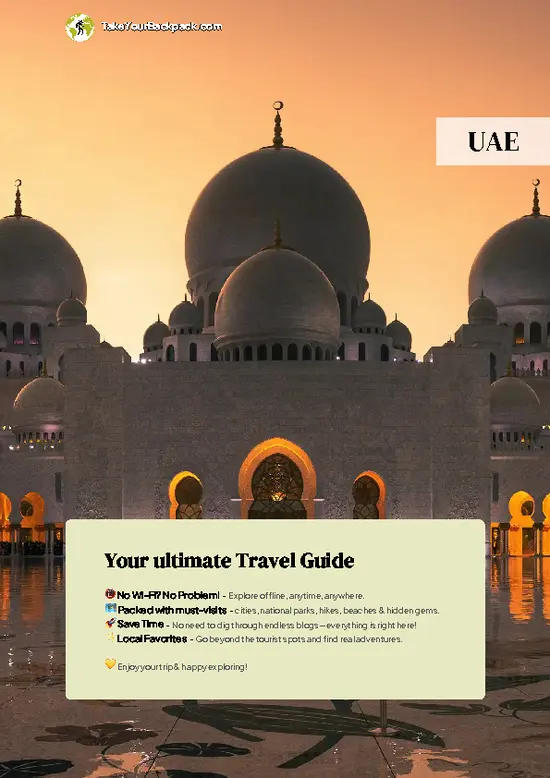
✈️ The backpacker research shortcutUAE Travel Guide

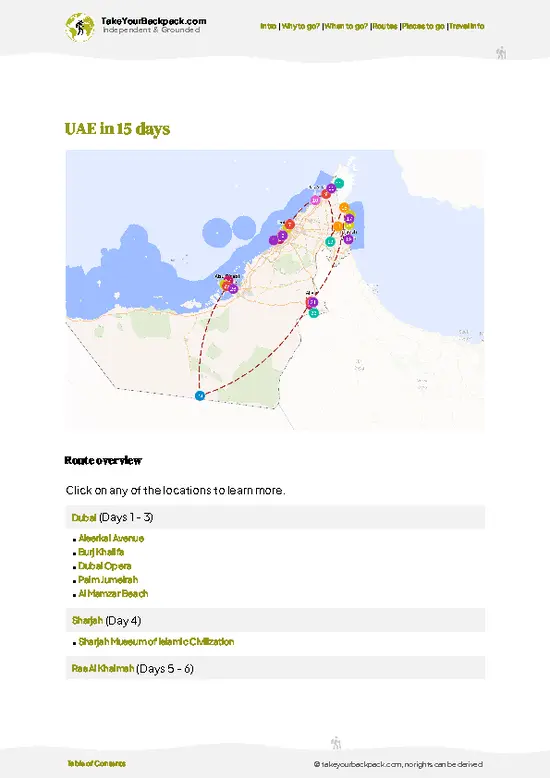
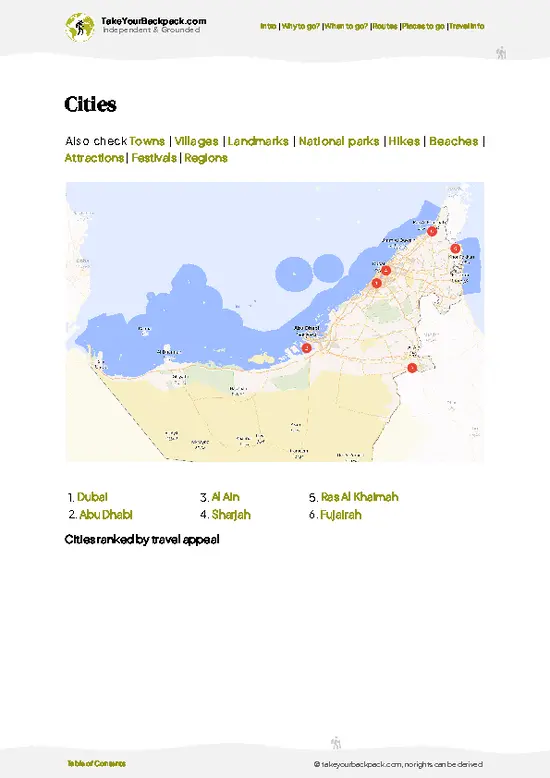
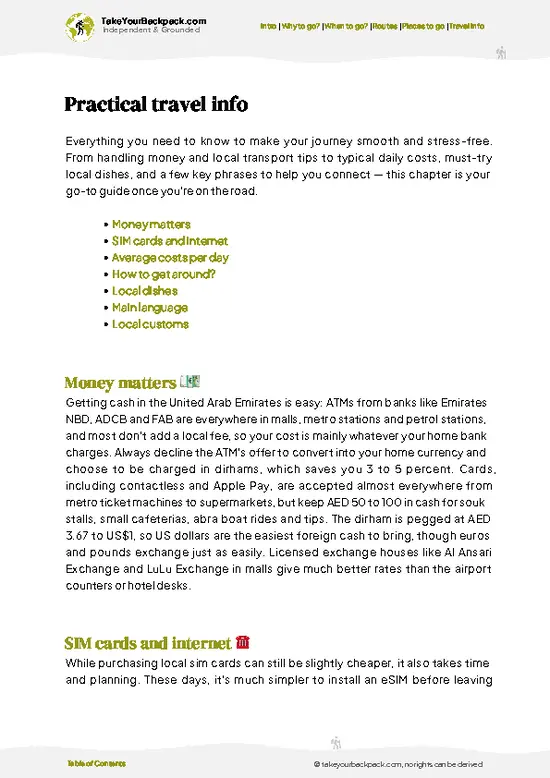
An offline-friendly backpacking guide with optimized travel routes, ranked highlights, transport advice, and the best areas to stay.
example page 0 from our offline Travel Guide for United Arab Emirates
example page 1 from our offline Travel Guide for United Arab Emirates
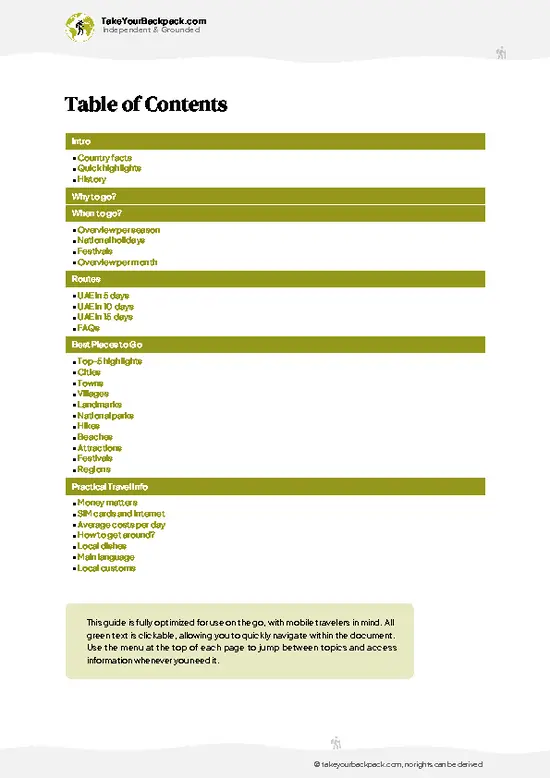
example page 2 from our offline Travel Guide for United Arab Emirates
example page 3 from our offline Travel Guide for United Arab Emirates
example page 4 from our offline Travel Guide for United Arab Emirates
example page 5 from our offline Travel Guide for United Arab Emirates
example page 6 from our offline Travel Guide for United Arab Emirates
example page 7 from our offline Travel Guide for United Arab Emirates
The digital guide (263 pages) contains:
✅ 71 highlights, ranked by travel appeal
✅ Optimized 5, 10 & 15-day travel routes
✅ Cities, national parks, landmarks, beaches
✅ How to get around
✅ Offline-friendly for travel without Wi-Fi
👉 Click to see all 30+ guide features

📅 Plan smarter in minutes, not weeks
✅ Month by month travel advice
✅ Festivals & national holidays
✅ Budget expectations

🗺️ Go to the right places, skip the overrated ones
✅ Honest pros & cons of destinations
✅ Top hikes, parks & viewpoints
✅ Lesser-known places most travelers miss
✅ Clear “worth it vs skip it” guidance

🛏️ Travel smoothly without rookie mistakes
✅ Best areas to stay
✅ Transport systems explained simply
✅ Common scams & safety advice
✅ SIM cards, money & practical tips

🌍 Understand the country, not just visit it
✅ Culture & traditions
✅ 52 Essential phrases & customs
✅ Festivals worth planning around
✅ Traveler-friendly historical context
✅ Insights that make places more meaningful

📱 Built for real travel conditions
✅ Fully downloadable PDF
✅ Works completely offline
✅ Optimized for phone use
✅ Useful in remote areas & buses
✅ Everything in one place
Stop searching, start planning
Get instant access to your full guide. 30‑day money-back guarantee.
+ Add another guide for just

By proceeding you agree to our terms.
Sent to your inbox immediately after payment • 100% Secure Checkout
Best Backpacking Travel Advisor 2025 tourism awardBest Backpacking
Travel Advisor
2025
What others say about Take Your Backpack Guides:
⭐⭐⭐⭐⭐
Fantastic, amazing amount of information!
⭐⭐⭐⭐⭐
My goodness this is amazing, it's what I've been looking for hats off too you!
⭐⭐⭐⭐⭐
I think this is absolutely BRILLIANT
⭐⭐⭐⭐
Very complete and informative. It's still missing places, but I gotta to commend you
⭐⭐⭐⭐⭐
This is truly amazing, thank you, can't wait to explore it with my kids!
⭐⭐⭐⭐⭐
Awesome resource, thank you!
⭐⭐⭐⭐⭐
This is amazing! Can't wait to explore the ones I haven't seen
⭐⭐⭐⭐
I love this! Well done, great idea.
⭐⭐⭐⭐⭐
Thanks for taking the time to make this gem!
⭐⭐⭐⭐⭐
This might be the best website I've ever seen.
⭐⭐⭐⭐⭐
Congratulations, and thank you so much for your work; it's incredibly valuable.
⭐⭐⭐⭐
In all seriousness I think you did a great job pointing out the important spots
⭐⭐⭐⭐⭐
10/10 very good
⭐⭐⭐⭐⭐
As someone who's only just starting to visit regularly this is awesome, thank you.
⭐⭐⭐⭐
Thank you very much! I'm going to visit my dad, it's going to be very useful!
⭐⭐⭐⭐⭐
This is really cool! We'll be travelling for the first time and this definitely come in handy.
⭐⭐⭐⭐⭐
You are now our minister of culture, congratulations 👨‍💼
⭐⭐⭐⭐⭐
Just wanted to tell you that this is a pearl! Going to follow your recommendations.
⭐⭐⭐⭐⭐
This is so cool. I'll definitely be using the resource for my travels soon.
⭐⭐⭐⭐⭐
This is very impressive! Good work.
⭐⭐⭐⭐⭐
This is an amazing and informative site. Very well done!

🛏️ Where to stay?Accommodation Highlights

The United Arab Emirates has a small but growing hostel scene, with dorm beds typically running AED 60 to 120 (US$16 to 33) a night and basic private rooms in budget hotels from roughly AED 150 to 250 (US$40 to 70). In Dubai, the old districts of Deira and Bur Dubai hold the most cheap beds, close to the creek, the souks and the metro, safe and lively until late but noisy and a bit dated. Al Barsha and Dubai Marina put you nearer the beach, malls and nightlife at higher prices, while in Abu Dhabi the downtown grid around Al Zahiyah and Al Markaziyah is quiet and very safe, though most big sights there need a bus or taxi ride.

If you enjoy meeting fellow travelers, consider choosing hostels with … read more 👉
The United Arab Emirates has a small but growing hostel scene, with dorm beds typically running AED 60 to 120 (US$16 to 33) a night and basic private rooms in budget hotels from roughly AED 150 to 250 (US$40 to 70). In Dubai, the old districts of Deira and Bur Dubai hold the most cheap beds, close to the creek, the souks and the metro, safe and lively until late but noisy and a bit dated. Al Barsha and Dubai Marina put you nearer the beach, malls and nightlife at higher prices, while in Abu Dhabi the downtown grid around Al Zahiyah and Al Markaziyah is quiet and very safe, though most big sights there need a bus or taxi ride.

If you enjoy meeting fellow travelers, consider choosing hostels with high ratings for atmosphere. On the other hand, if you prefer having your own space, a hotel might be a better option.

UAESee More of UAE

👋 Meet the founderWho’s Behind Take Your Backpack?

Johan, backpacker and founder of TakeYourBackpackHi, I’m Johan (Netherlands 🇳🇱), the creator of TakeYourBackpack. Over the past 3 decades, I’ve backpacked through 90+ countries across six continents, gaining extensive experience with independent travel, long-term trips, and overland routes.

This site is built on a combination of firsthand travel experience and carefully curated insights from other backpackers. Many guides are based on places I’ve personally visited, while others bring together tips, observations, and practical advice shared by trusted travelers I’ve met along the way.

The goal is to provide realistic, experience-driven guidance — not generic itineraries — so you can explore destinations with better context, clearer expectations, and more confidence.