×

United States Virgin Islands🇻🇮 | best landmarksYour Guide to the 3 Best landmarks in United States Virgin Islands

Landmarks in the United States Virgin Islands are mostly layered Danish colonial sites, sugar estate ruins, forts and national park land, spread over three islands. St. Thomas has the busiest, cruise-driven sites, St. John is largely national park with quiet trails, and St. Croix is the least crowded and most historical. Independent travelers need to plan around ferries, rental cars and left-side driving.

By Johan Kruseman 🇳🇱 | Updated October 23, 2026
Explore the best national parks in United States Virgin Islands

Why go?Key Factors That Shape the Experience

The territory’s landmarks reflect Danish rule from the 1600s to 1917, followed by American administration, and plantation slavery sits at the center of that history. The built heritage of forts, warehouses and sugar mill towers survives because the islands are small and the dry, hot climate preserved masonry well. Much of St. John is protected as national park, so natural and archaeological sites are kept in good order.

Before choosing the islands for landmarks, know that the range is compact rather than vast. Each island has its own character, and getting between them takes ferries or short flights. Public transport is limited, taxis are shared and priced per person, and many sites are best reached by rental car. Expect US dollar prices, which run higher than in most of the Caribbean.
Our Approach to Ranking
The list of best unique sites in United States Virgin Islands is created based on history or culture, wow factor, atmosphere, quirks, and memorability. If you feel a unique site is missing in this list, please let us know.

When to go?Best Time to Visit United States Virgin Islands for landmarks

Best months and weather: The best months are December to April, when it is dry, with daytime highs around 82 to 86°F (28 to 30°C) and lower humidity, which makes walking to ruins and forts comfortable.
Shoulder and low season: May to June and November are shoulder months, with more rain and fewer visitors. Lodging often drops 20 to 40 percent from winter rates. From August to October, hurricane season peaks, with highs of 88 to 91°F (31 to 33°C), heavy humidity and the greatest chance of storms. Some restaurants, guesthouses and smaller attractions close for part of September and October.
Peak periods: Christmas through New Year’s and February to March are the most expensive and crowded. On St. Thomas, cruise ship days put heavy crowds in the main town, so go early in the morning.

unique site hoppingOptimizing Your Multi-Stop Itinerary

Time needed: A trip combining several landmarks needs 5 to 8 days, enough for two or three islands without constant ferry transfers.
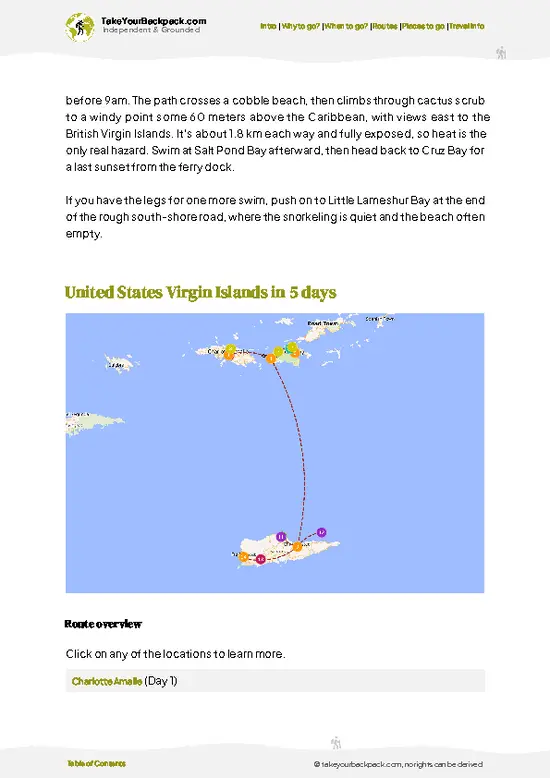
Grouping and direction: St. Thomas and St. John pair easily. The Red Hook to Cruz Bay ferry takes about 15 to 20 minutes and runs roughly hourly. St. Croix is a separate leg, reached by a seaplane or short flight of about 20 to 30 minutes from St. Thomas. Starting on St. Thomas, then St. John, then flying to St. Croix works well for onward flights.
Pacing and common mistakes: Allow half a day for most stops and a full day for national park trails. Many travelers cram all three islands into three days and spend much of it in transit. Others skip the rental car on St. Croix, where sites are spread out and taxis are costly. Book the car early in winter, and check … read more 👉
Time needed: A trip combining several landmarks needs 5 to 8 days, enough for two or three islands without constant ferry transfers.
Grouping and direction: St. Thomas and St. John pair easily. The Red Hook to Cruz Bay ferry takes about 15 to 20 minutes and runs roughly hourly. St. Croix is a separate leg, reached by a seaplane or short flight of about 20 to 30 minutes from St. Thomas. Starting on St. Thomas, then St. John, then flying to St. Croix works well for onward flights.
Pacing and common mistakes: Allow half a day for most stops and a full day for national park trails. Many travelers cram all three islands into three days and spend much of it in transit. Others skip the rental car on St. Croix, where sites are spread out and taxis are costly. Book the car early in winter, and check ferry times, since the last boats leave in the evening.

The ListThe Best landmarks of United States Virgin Islands

1 Buck Island Reef

Marked underwater trail, barrier reef, turtle sightings, crescent beach

Follow a plaque-marked snorkel route along a semi-circular reef, then climb a short trail for a view over the coral and the calm lagoon beach.

united-states-virgin-islands-unique-site-buck-island-reef
© Google |

2 Bioluminescent Bays of St. Croix

Night kayaking, mangrove channels, glowing wake, moon-phase timing

Paddle through sheltered mangrove channels after dark and watch every stroke and trailing fingertip light up blue, guided by local operators who time visits to the moon.

3 Caneel Bay

Calm coves, reef off the sand, west-facing sunsets, Rockefeller-era ruins

Wade into quiet crescent beaches to snorkel beside turtles, then wander past weathered resort remains and watch the sun drop behind St. Thomas.

Loading the map 🌍

Expert viewTips and Advice from Travelers

How many to visit: Plan on four to six landmarks over a week. The islands are small, but each stop needs travel time, and heat after midday makes more than two sites in a day tiring. Fewer, longer visits teach more than a checklist.
Prioritizing by travel style: History-minded travelers should favor Danish colonial and plantation sites, particularly on St. Croix and in St. Thomas’s town. Hikers and budget travelers get the most from national park ruins and trails on St. John. Those short on time can do the town forts and warehouses on foot.
Budget: Expect US$80 to 150 a day for a frugal independent traveler, excluding lodging, which is the main cost. Entry fees are modest: fort sites typically run US$5 to 10, and the national park charges about US$5 per person for some sites, plus beach fees. … read more 👉
How many to visit: Plan on four to six landmarks over a week. The islands are small, but each stop needs travel time, and heat after midday makes more than two sites in a day tiring. Fewer, longer visits teach more than a checklist.
Prioritizing by travel style: History-minded travelers should favor Danish colonial and plantation sites, particularly on St. Croix and in St. Thomas’s town. Hikers and budget travelers get the most from national park ruins and trails on St. John. Those short on time can do the town forts and warehouses on foot.
Budget: Expect US$80 to 150 a day for a frugal independent traveler, excluding lodging, which is the main cost. Entry fees are modest: fort sites typically run US$5 to 10, and the national park charges about US$5 per person for some sites, plus beach fees. Guided tours run US$30 to 100. Rental cars cost US$60 to 100 a day, and fuel is pricey. Ferries cost about US$8 to 15 one way. Shared taxis charge per person, so agree the fare before getting in.
Costs and delays that catch people out: Parking at national park sites fills early, so arrive before 9 a.m. or lose time and pay for a taxi. Cruise days on St. Thomas inflate taxi prices and queues, so check the port schedule. Opening hours are short, often closing by 4 or 5 p.m., and some sites shut on Sundays or holidays, so confirm before driving across an island. Ferries stop in the evening, and a missed boat means an expensive overnight stay.
Safety and culture: Drive on the left in American cars, and take hairpin roads slowly, especially after rain. Keep valuables out of parked cars at trailheads. Many sites mark places of enslavement and forced labor, so speak quietly, do not climb on ruins, and ask before photographing local guides or residents. Carry water and sun protection, since shade is limited.

✈️ The backpacker research shortcutUnited States Virgin Islands Travel Guide

An offline-friendly backpacking guide with optimized travel routes, ranked highlights, transport advice, and the best areas to stay.
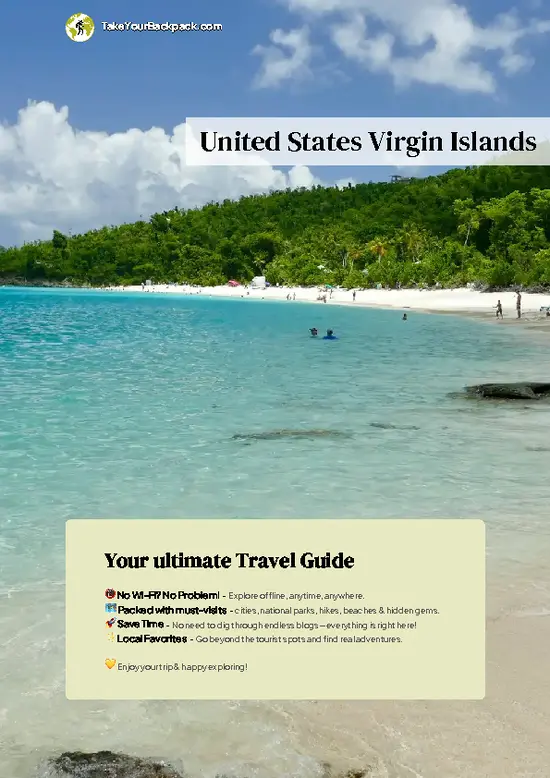
example page 0 from our offline Travel Guide for United States Virgin Islands
example page 1 from our offline Travel Guide for United States Virgin Islands
example page 2 from our offline Travel Guide for United States Virgin Islands
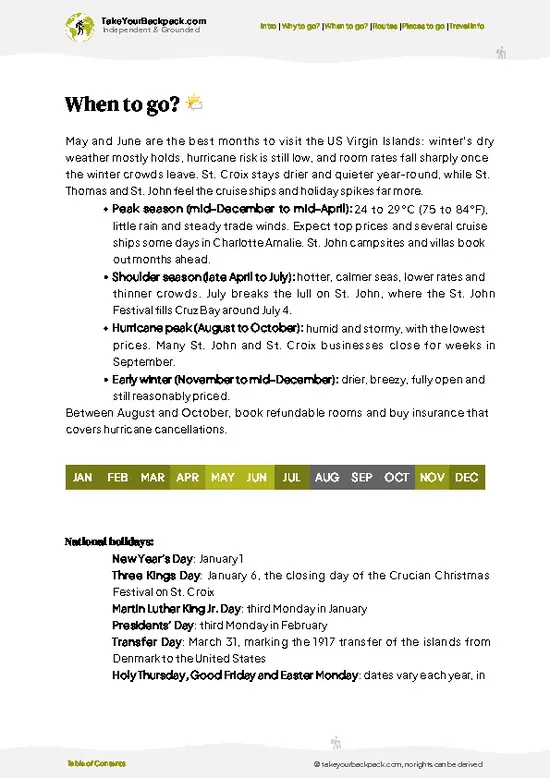
example page 3 from our offline Travel Guide for United States Virgin Islands
example page 4 from our offline Travel Guide for United States Virgin Islands
example page 5 from our offline Travel Guide for United States Virgin Islands
example page 6 from our offline Travel Guide for United States Virgin Islands
example page 7 from our offline Travel Guide for United States Virgin Islands
The digital guide (144 pages) contains:
✅ 35 highlights, ranked by travel appeal
✅ Optimized 2, 3 & 5-day travel routes
✅ Cities, national parks, landmarks, beaches
✅ How to get around
✅ Offline-friendly for travel without Wi-Fi
👉 Click to see all 30+ guide features

📅 Plan smarter in minutes, not weeks
✅ Month by month travel advice
✅ Festivals & national holidays
✅ Budget expectations

🗺️ Go to the right places, skip the overrated ones
✅ Honest pros & cons of destinations
✅ Top hikes, parks & viewpoints
✅ Lesser-known places most travelers miss
✅ Clear “worth it vs skip it” guidance

🛏️ Travel smoothly without rookie mistakes
✅ Best areas to stay
✅ Transport systems explained simply
✅ Common scams & safety advice
✅ SIM cards, money & practical tips

🌍 Understand the country, not just visit it
✅ Culture & traditions
✅ Local customs
✅ Festivals worth planning around
✅ Traveler-friendly historical context
✅ Insights that make places more meaningful

📱 Built for real travel conditions
✅ Fully downloadable PDF
✅ Works completely offline
✅ Optimized for phone use
✅ Useful in remote areas & buses
✅ Everything in one place
Stop searching, start planning
Get instant access to your full guide. 30‑day money-back guarantee.
+ Add another guide for just

By proceeding you agree to our terms.
Sent to your inbox immediately after payment • 100% Secure Checkout
Best Backpacking Travel Advisor 2025 tourism awardBest Backpacking
Travel Advisor
2025
What others say about Take Your Backpack Guides:
⭐⭐⭐⭐⭐
Fantastic, amazing amount of information!
⭐⭐⭐⭐⭐
My goodness this is amazing, it's what I've been looking for hats off too you!
⭐⭐⭐⭐⭐
I think this is absolutely BRILLIANT
⭐⭐⭐⭐
Very complete and informative. It's still missing places, but I gotta to commend you
⭐⭐⭐⭐⭐
This is truly amazing, thank you, can't wait to explore it with my kids!
⭐⭐⭐⭐⭐
Awesome resource, thank you!
⭐⭐⭐⭐⭐
This is amazing! Can't wait to explore the ones I haven't seen
⭐⭐⭐⭐
I love this! Well done, great idea.
⭐⭐⭐⭐⭐
Thanks for taking the time to make this gem!
⭐⭐⭐⭐⭐
This might be the best website I've ever seen.
⭐⭐⭐⭐⭐
Congratulations, and thank you so much for your work; it's incredibly valuable.
⭐⭐⭐⭐
In all seriousness I think you did a great job pointing out the important spots
⭐⭐⭐⭐⭐
10/10 very good
⭐⭐⭐⭐⭐
As someone who's only just starting to visit regularly this is awesome, thank you.
⭐⭐⭐⭐
Thank you very much! I'm going to visit my dad, it's going to be very useful!
⭐⭐⭐⭐⭐
This is really cool! We'll be travelling for the first time and this definitely come in handy.
⭐⭐⭐⭐⭐
You are now our minister of culture, congratulations 👨‍💼
⭐⭐⭐⭐⭐
Just wanted to tell you that this is a pearl! Going to follow your recommendations.
⭐⭐⭐⭐⭐
This is so cool. I'll definitely be using the resource for my travels soon.
⭐⭐⭐⭐⭐
This is very impressive! Good work.
⭐⭐⭐⭐⭐
This is an amazing and informative site. Very well done!

🛏️ Where to stay?Where to Stay: United States Virgin Islands Edition

True dorm hostels are almost nonexistent in the United States Virgin Islands, so budget travelers here rely on small guesthouses, rooms above shops and campground tents, with private rooms rarely dipping below US$120 to 180 a night in high season. On St. Thomas, Charlotte Amalie and neighboring Frenchtown have the cheapest beds and the best restaurant and bar scene within walking distance (though some downtown backstreets feel deserted and sketchy after dark), while Red Hook on the East End costs more but puts you beside the St. John ferry and a lively marina bar strip. St. John, with Cruz Bay as its small, walkable hub, offers campground tents and eco-cabins close to the national park beaches, … read more 👉
True dorm hostels are almost nonexistent in the United States Virgin Islands, so budget travelers here rely on small guesthouses, rooms above shops and campground tents, with private rooms rarely dipping below US$120 to 180 a night in high season. On St. Thomas, Charlotte Amalie and neighboring Frenchtown have the cheapest beds and the best restaurant and bar scene within walking distance (though some downtown backstreets feel deserted and sketchy after dark), while Red Hook on the East End costs more but puts you beside the St. John ferry and a lively marina bar strip. St. John, with Cruz Bay as its small, walkable hub, offers campground tents and eco-cabins close to the national park beaches, and on St. Croix, Christiansted has the widest choice of mid-priced inns and nightlife, whereas Frederiksted is quieter, cheaper and better for sunset swims than going out.

If you enjoy meeting fellow travelers, consider choosing hostels with high ratings for atmosphere. On the other hand, if you prefer having your own space, a hotel might be a better option.

United States Virgin IslandsExplore Beyond This Category

👋 Meet the founderWho’s Behind Take Your Backpack?

Johan, backpacker and founder of TakeYourBackpackHi, I’m Johan (Netherlands 🇳🇱), the creator of TakeYourBackpack. Over the past 3 decades, I’ve backpacked through 90+ countries across six continents, gaining extensive experience with independent travel, long-term trips, and overland routes.

This site is built on a combination of firsthand travel experience and carefully curated insights from other backpackers. Many guides are based on places I’ve personally visited, while others bring together tips, observations, and practical advice shared by trusted travelers I’ve met along the way.

The goal is to provide realistic, experience-driven guidance — not generic itineraries — so you can explore destinations with better context, clearer expectations, and more confidence.