×

the USA🇺🇸 | national parksGlacier National ParkGoing-to-the-Sun Road, Logan Pass, red-pebble lakes, grizzly country | things to do and best time to go

Explore Everglades National ParkExplore Grand Canyon National Park

Backpacking in Glacier
🏆 Top picknational park ranked #5
By Johan Kruseman 🇳🇱 | Updated October 22, 2026

The red jammer buses on Going-to-the-Sun Road are 1930s White Motor Company touring cars, named for the gear-jamming of their original manual transmissions, which were replaced long ago. Glacier National Park sits in the northwest corner of Montana, in the north of the United States, hard against the Canadian border. The road itself is the main event: 50 miles of switchbacks over Logan Pass, with mountain goats on the cliffs and a view at every bend. Hiking is superb, from easy lakeside strolls to multi-day Highline routes, and grizzlies are a real possibility. Crowds in July are another matter, and parking lots fill by mid-morning, so you spend a surprising amount of the trip circling. What I carry away is the sound of bear bells clinking down a trail in the Many Glacier valley, a tinny, optimistic chorus. Compared with Yellowstone, Glacier has far fewer geysers and far more empty-feeling backcountry.

Discover everything you want to know in the 📖 the USA Travel Guide.


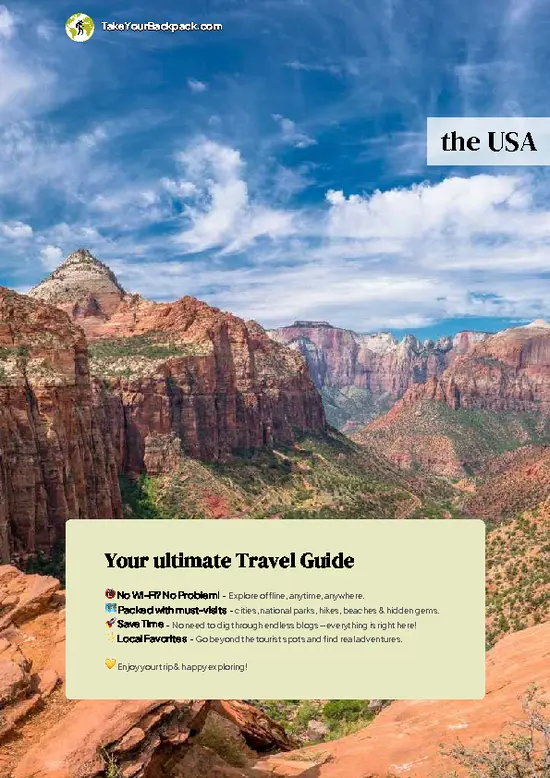
example page 0 from our offline Travel Guide for United States
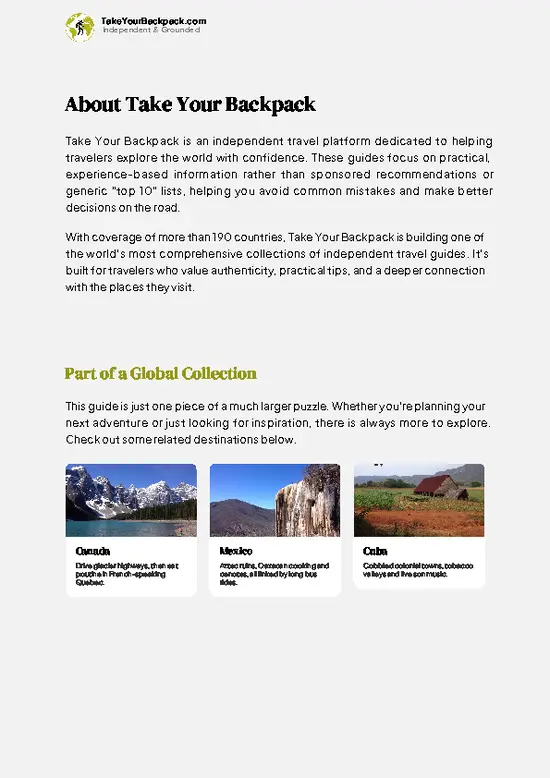
example page 1 from our offline Travel Guide for United States
example page 2 from our offline Travel Guide for United States
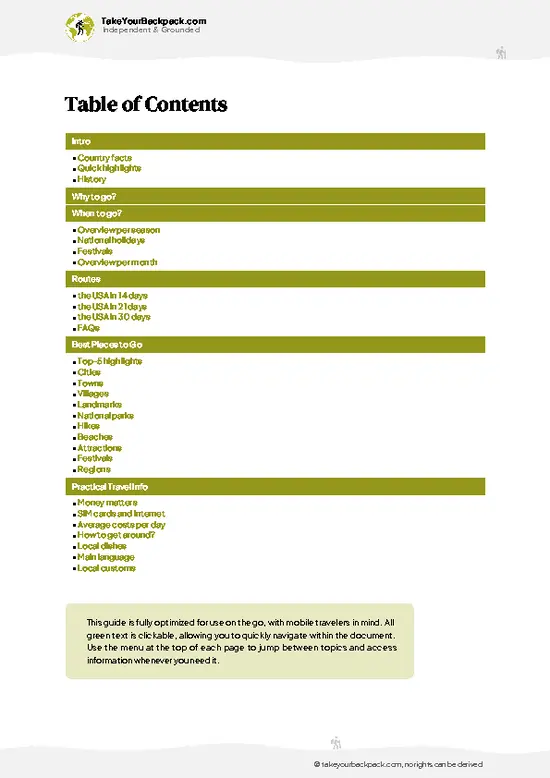
example page 3 from our offline Travel Guide for United States
example page 4 from our offline Travel Guide for United States
example page 5 from our offline Travel Guide for United States
example page 6 from our offline Travel Guide for United States
example page 7 from our offline Travel Guide for United States
Loading the map 🌍
CLICK TO FILTER
cities
towns
villages
landmarks
national parks
hikes
beaches
attractions
festivals
regions
SHOW COUNTRY’S BESTSHOW ALL

✨ Why go?
Ranked #5 national park in the USA
What makes this national park worth exploring

Glacier National Park rewards people who like to point at a map and walk toward it. The park holds more than 700 miles of trail, so you can pick a short lakeside stroll or a multi-day traverse and rarely feel herded. Backcountry campsites, bookable by permit, let you sleep beside lakes that day-trippers only see from a shuttle window, and the Highline Trail shows what a ledge cut into a cliff face does for your photo roll. Self-guided travel works well here: the free shuttle on the Going-to-the-Sun Road corridor, trailheads with clear signs, and ranger stations that hand out current bear and snow reports. Tours exist, but they mostly repeat what the red historic buses and your own boots already cover. The Many Glacier valley adds a quieter, wilder alternative to the busy west side, with moose in the ponds and big views from the trailhead.

💡 HighlightsThe experiences that define the visit

  1. Going-to-the-Sun Road: The 50-mile road across the Continental Divide hugs cliffs, passes waterfalls and climbs to Logan Pass. It is the park's signature drive, usually fully open only from around late June to October.
  2. Logan Pass and Hidden Lake Overlook: An easy boardwalk climb leads to a basin view of Bearhat Mountain, with mountain goats and marmots common near the trail.
  3. Lake McDonald: The park's largest lake, lined with polished red and green pebbles that glow under clear water. Paddle, skip stones or watch dusk from Apgar.
  4. Avalanche Lake: A forest hike along a gorge ends in a cirque with waterfalls spilling off the cliffs.
  5. Grinnell Glacier: A long, rewarding climb in Many Glacier to one of the park's remaining glaciers and a glacial lake.
  6. Highline Trail: A ledge-hugging traverse from Logan
… read more 👉
  1. Going-to-the-Sun Road: The 50-mile road across the Continental Divide hugs cliffs, passes waterfalls and climbs to Logan Pass. It is the park's signature drive, usually fully open only from around late June to October.
  2. Logan Pass and Hidden Lake Overlook: An easy boardwalk climb leads to a basin view of Bearhat Mountain, with mountain goats and marmots common near the trail.
  3. Lake McDonald: The park's largest lake, lined with polished red and green pebbles that glow under clear water. Paddle, skip stones or watch dusk from Apgar.
  4. Avalanche Lake: A forest hike along a gorge ends in a cirque with waterfalls spilling off the cliffs.
  5. Grinnell Glacier: A long, rewarding climb in Many Glacier to one of the park's remaining glaciers and a glacial lake.
  6. Highline Trail: A ledge-hugging traverse from Logan Pass with broad alpine meadows, wildflowers and frequent wildlife.
  7. Two Medicine: A quieter southeastern corner with Running Eagle Falls and boat access to the head of the lake.
  8. Iceberg Lake: A steady walk through grizzly country to a cold lake where chunks of ice float well into summer.
Vehicle reservation rules for Going-to-the-Sun Road change from year to year (none were required in 2026), and Glacier National Park also asks for permits for backcountry camping, which are worth booking early.
Spotted a mistake or missing something? Contact us.

Things to do around Glacier National Park

Ratings based on Tripadvisor reviews. When you book through this link, you support our work at no extra cost to you.

🌤️ When to go?Weather, crowds, and seasonal trade-offs

  • Peak Summer (July to Labor Day): Going-to-the-Sun Road is fully open, usually from early July, and highs run 22 to 29°C (72 to 84°F) with nights near 4 to 7°C (39 to 45°F). Daylight lasts about 16 hours. Crowds and lodging prices peak, and in 2026 the Logan Pass shuttle ran on tickets booked through recreation.gov.
  • Early Fall (September): Larch and aspen turn gold, highs sit at 13 to 20°C (55 to 68°F), and crowds thin sharply. Lodges start closing by mid-month.
  • Spring (April to June): Lower trails are muddy and high passes hold snow into July. Highs are 7 to 18°C (45 to 64°F). Rooms are cheaper but the road is only partly open.
  • Winter (November to March): Highs hover at -7 to 0°C (20 to 32°F) with about 8 hours of daylight. Snowshoeing and skiing replace backpacking, and most services close.
Book … read more 👉
  • Peak Summer (July to Labor Day): Going-to-the-Sun Road is fully open, usually from early July, and highs run 22 to 29°C (72 to 84°F) with nights near 4 to 7°C (39 to 45°F). Daylight lasts about 16 hours. Crowds and lodging prices peak, and in 2026 the Logan Pass shuttle ran on tickets booked through recreation.gov.
  • Early Fall (September): Larch and aspen turn gold, highs sit at 13 to 20°C (55 to 68°F), and crowds thin sharply. Lodges start closing by mid-month.
  • Spring (April to June): Lower trails are muddy and high passes hold snow into July. Highs are 7 to 18°C (45 to 64°F). Rooms are cheaper but the road is only partly open.
  • Winter (November to March): Highs hover at -7 to 0°C (20 to 32°F) with about 8 hours of daylight. Snowshoeing and skiing replace backpacking, and most services close.
Book backcountry campsites the moment the reservation window opens, since July and August itineraries fill first.


source: climatestotravel.comJANJanuary: below average for travelingFEBFebruary: below average for travelingMARMarch: below average for travelingAPRApril: fair for travelingMAYMay: fair for travelingJUNJune: highly recommended for travelingJULJuly: excellent for travelingAUGAugust: excellent for travelingSEPSeptember: highly recommended for travelingOCTOctober: fair for travelingNOVNovember: below average for travelingDECDecember: below average for traveling
united-states-national-park-glacier-national-park
© Google | Aure05 Sapparys

✈️ The backpacker research shortcutthe USA Travel Guide

An offline-friendly backpacking guide with optimized travel routes, ranked highlights, transport advice, and the best areas to stay.
example page 0 from our offline Travel Guide for United States
example page 1 from our offline Travel Guide for United States
example page 2 from our offline Travel Guide for United States
example page 3 from our offline Travel Guide for United States
example page 4 from our offline Travel Guide for United States
example page 5 from our offline Travel Guide for United States
example page 6 from our offline Travel Guide for United States
example page 7 from our offline Travel Guide for United States
The digital guide (451 pages) contains:
✅ 159 highlights, ranked by travel appeal
✅ Optimized 14, 21 & 30-day travel routes
✅ Cities, national parks, landmarks, beaches
✅ How to get around
✅ Offline-friendly for travel without Wi-Fi
👉 Click to see all 30+ guide features

📅 Plan smarter in minutes, not weeks
✅ Month by month travel advice
✅ Festivals & national holidays
✅ Budget expectations

🗺️ Go to the right places, skip the overrated ones
✅ Honest pros & cons of destinations
✅ Top hikes, parks & viewpoints
✅ Lesser-known places most travelers miss
✅ Clear “worth it vs skip it” guidance

🛏️ Travel smoothly without rookie mistakes
✅ Best areas to stay
✅ Transport systems explained simply
✅ Common scams & safety advice
✅ SIM cards, money & practical tips

🌍 Understand the country, not just visit it
✅ Culture & traditions
✅ Local customs
✅ Festivals worth planning around
✅ Traveler-friendly historical context
✅ Insights that make places more meaningful

📱 Built for real travel conditions
✅ Fully downloadable PDF
✅ Works completely offline
✅ Optimized for phone use
✅ Useful in remote areas & buses
✅ Everything in one place
Stop searching, start planning
Get instant access to your full guide. 30‑day money-back guarantee.
+ Add another guide for just

By proceeding you agree to our terms.
Sent to your inbox immediately after payment • 100% Secure Checkout
Best Backpacking Travel Advisor 2025 tourism awardBest Backpacking
Travel Advisor
2025
What others say about Take Your Backpack Guides:
⭐⭐⭐⭐⭐
Fantastic, amazing amount of information!
⭐⭐⭐⭐⭐
My goodness this is amazing, it's what I've been looking for hats off too you!
⭐⭐⭐⭐⭐
I think this is absolutely BRILLIANT
⭐⭐⭐⭐
Very complete and informative. It's still missing places, but I gotta to commend you
⭐⭐⭐⭐⭐
This is truly amazing, thank you, can't wait to explore it with my kids!
⭐⭐⭐⭐⭐
Awesome resource, thank you!
⭐⭐⭐⭐⭐
This is amazing! Can't wait to explore the ones I haven't seen
⭐⭐⭐⭐
I love this! Well done, great idea.
⭐⭐⭐⭐⭐
Thanks for taking the time to make this gem!
⭐⭐⭐⭐⭐
This might be the best website I've ever seen.
⭐⭐⭐⭐⭐
Congratulations, and thank you so much for your work; it's incredibly valuable.
⭐⭐⭐⭐
In all seriousness I think you did a great job pointing out the important spots
⭐⭐⭐⭐⭐
10/10 very good
⭐⭐⭐⭐⭐
As someone who's only just starting to visit regularly this is awesome, thank you.
⭐⭐⭐⭐
Thank you very much! I'm going to visit my dad, it's going to be very useful!
⭐⭐⭐⭐⭐
This is really cool! We'll be travelling for the first time and this definitely come in handy.
⭐⭐⭐⭐⭐
You are now our minister of culture, congratulations 👨‍💼
⭐⭐⭐⭐⭐
Just wanted to tell you that this is a pearl! Going to follow your recommendations.
⭐⭐⭐⭐⭐
This is so cool. I'll definitely be using the resource for my travels soon.
⭐⭐⭐⭐⭐
This is very impressive! Good work.
⭐⭐⭐⭐⭐
This is an amazing and informative site. Very well done!

🛏️ Where to stay?Best areas to stay in the USA

Inside Glacier National Park, the cheapest beds are frontcountry campgrounds such as Apgar, Many Glacier, Two Medicine and Fish Creek (about US$23 to 30 a night), with backcountry sites needing a permit. Many Glacier Hotel, Lake McDonald Lodge, Village Inn at Apgar and Rising Sun Motor Inn run from roughly US$150 to 350 and book up a year ahead. The two backcountry chalets, Sperry and Granite Park, offer bunks at around US$130 to 200 with meals extra, and sell out quickly.

Outside the park, West Glacier on the west side has cabins, hostel-style rooms and campgrounds a few minutes from the entrance. … read more 👉
Inside Glacier National Park, the cheapest beds are frontcountry campgrounds such as Apgar, Many Glacier, Two Medicine and Fish Creek (about US$23 to 30 a night), with backcountry sites needing a permit. Many Glacier Hotel, Lake McDonald Lodge, Village Inn at Apgar and Rising Sun Motor Inn run from roughly US$150 to 350 and book up a year ahead. The two backcountry chalets, Sperry and Granite Park, offer bunks at around US$130 to 200 with meals extra, and sell out quickly.

Outside the park, West Glacier on the west side has cabins, hostel-style rooms and campgrounds a few minutes from the entrance. Columbia Falls, about 25 minutes away, has cheaper motels at US$100 to 180. Whitefish, roughly 40 minutes from the west entrance, has the best food, a hostel with dorms from about US$40 to 60, and a train station. On the east side, St. Mary and Babb sit at the park edge, while Browning and East Glacier Park Village are cheaper and quieter. For backpackers, I would use West Glacier or Whitefish as a base and camp for the trail nights.

👛 Costs (as of 22 October 2026)How expensive it really is

Glacier National Park costs most backpackers about US$95 a day in high season, mostly for lodging and food. The table shows typical per-person figures.
CategoryBudget RangeLocal Reality
Entrance feeUS$8 to 12 per day (US$35 per vehicle, US$20 per person on foot or bike, valid 7 days)Visitors who are not US residents pay an extra US$100 each from age 16. The America the Beautiful annual pass (US$80 for US residents, US$250 for nonresidents) covers all U.S. national parks.
Backcountry permitUS$7 per person per nightAdvance reservations carry a small extra fee, and sites sell out for July and August.
Accommodation (high season)US$23 to 60Campgrounds run US$23 to 30, while a Whitefish hostel dorm costs more. Park lodges start around US$150.
Local transportUS$0 to 20The park shuttle to Logan Pass costs
… read more 👉
Glacier National Park costs most backpackers about US$95 a day in high season, mostly for lodging and food. The table shows typical per-person figures.
CategoryBudget RangeLocal Reality
Entrance feeUS$8 to 12 per day (US$35 per vehicle, US$20 per person on foot or bike, valid 7 days)Visitors who are not US residents pay an extra US$100 each from age 16. The America the Beautiful annual pass (US$80 for US residents, US$250 for nonresidents) covers all U.S. national parks.
Backcountry permitUS$7 per person per nightAdvance reservations carry a small extra fee, and sites sell out for July and August.
Accommodation (high season)US$23 to 60Campgrounds run US$23 to 30, while a Whitefish hostel dorm costs more. Park lodges start around US$150.
Local transportUS$0 to 20The park shuttle to Logan Pass costs only a US$1 recreation.gov ticket fee (2026). Hiker shuttles cost US$10 to 25.
Food and suppliesUS$25 to 40Groceries come from Columbia Falls or Whitefish, and freeze-dried meals cost US$10 to 15. Park restaurants charge US$15 to 30 a plate.
Bear sprayUS$0 to 50It costs about US$45 to 50 to buy and US$10 to 12 a week to rent.
Total Daily BudgetUS$63 to 182About US$95 is realistic for camping and self-catering.


source: nps.gov
⚠️ Prices can change and everyone travels differently, so take this as a rough guide. Hope it helps you plan your adventure!

🥾 TrailsScenic routes and wildlife spotting in Glacier

Glacier National Park offers trails for nearly every ability, from boardwalk strolls to multi-day treks along the Continental Divide.
  • Hidden Lake Overlook Trail: About 2.7 miles round trip, 1.5 to 2 hours, moderate. Boardwalk and steps from Logan Pass to a view over a basin lake, with goats and marmots.
  • Trail of the Cedars: 0.7 miles, 30 minutes, easy. A flat boardwalk loop through old cedar and hemlock, wheelchair accessible.
  • Avalanche Lake: About 4.5 miles round trip, 2 to 3 hours, moderate. Forest path with a creek gorge and a waterfall-fed lake.
  • Highline Trail: About 11.8 miles one way to the
… read more 👉
Glacier National Park offers trails for nearly every ability, from boardwalk strolls to multi-day treks along the Continental Divide.
  • Hidden Lake Overlook Trail: About 2.7 miles round trip, 1.5 to 2 hours, moderate. Boardwalk and steps from Logan Pass to a view over a basin lake, with goats and marmots.
  • Trail of the Cedars: 0.7 miles, 30 minutes, easy. A flat boardwalk loop through old cedar and hemlock, wheelchair accessible.
  • Avalanche Lake: About 4.5 miles round trip, 2 to 3 hours, moderate. Forest path with a creek gorge and a waterfall-fed lake.
  • Highline Trail: About 11.8 miles one way to the Loop, 5 to 7 hours, moderate to strenuous. Exposed ledge with a cable handhold, then alpine meadows and a steep descent.
  • Grinnell Glacier: About 10.6 miles round trip, 6 to 8 hours, strenuous. Climbs about 1,600 feet past lakes to the glacier.
  • Iceberg Lake: About 9.7 miles round trip, 5 to 6 hours, moderate. Wildflower meadows, with frequent bear activity.
Wildlife includes grizzlies and black bears, so carry bear spray and hike in groups, making noise. Snow can linger on high routes into July. Glacier National Park is reached by Amtrak's Empire Builder, which stops at West Glacier and East Glacier Park, and by road from Kalispell. A free summer shuttle serves the Going-to-the-Sun Road corridor, though service and vehicle reservation rules change. Crowds peak from July to August, and the entrance fee is a per-vehicle or per-person charge of roughly US$20 to 35, valid for several days.
⚠️ Hiking info can sometimes be outdated or inaccurate. Before you hit the trail, check the latest conditions with locals. If you do spot anything that's off, I'd love to hear from you, so I can update it for fellow travelers.

🛡️ SafetyTraveler Safety Guide

Glacier National Park is well managed, and the main risks are bears, weather and snow. This is dense grizzly and black bear country, so carry bear spray on your hip (not in your pack), hike in groups, make noise in thick brush, and store all food in lockers or hang it at designated sites. Weather swings fast: snow can fall in any month at elevation, and afternoon thunderstorms are common in summer. Pack layers, a rain shell and a warm hat even in August. Snowfields linger on high passes such as Highline Trail sections and Siyeh Pass into July, so check ranger conditions and consider microspikes early in the season. Stream crossings run high in June. Cell service is patchy, so carry a paper map. Moose and mountain goats also deserve distance, so stay at least 25 yards (23 m) from them and 100 yards (91 m) from bears.

FAQTraveler FAQ

Plan on 3 to 5 days for Glacier National Park. Three days cover Going-to-the-Sun Road, Logan Pass and Many Glacier day hikes, while 5 to 7 days let you add a backcountry trek such as the Highline Trail or the Gunsight Pass route (about 32 km, 20 miles).
Yes, Glacier National Park works without a car in summer. Amtrak’s Empire Builder stops at West Glacier and East Glacier Park, free park shuttles run along Going-to-the-Sun Road in the season, and paid hiker shuttles reach Many Glacier and Two Medicine. Glacier Park International Airport, about 6 miles northeast of Kalispell, is the nearest airport to the west entrance.
Yes, Glacier National Park charges US$35 per vehicle or US$20 per person on foot or bike, valid for 7 days. Nonresidents aged 16 and over also pay a US$100 nonresident fee each unless they hold an annual pass, and the America the Beautiful pass costs US$80 for US residents and US$250 for nonresidents. Backcountry camping needs a permit at about US$7 per person per night, and no vehicle reservation was required on Going-to-the-Sun Road in 2026. Advance permits go on sale in spring and popular sites fill within days.
⚠️ Things can change over time, so always validate details locally before you go.

Other American national parks near Glacier

Explore more nearby:


💡 Not sure where to go next?
Create a personalized itinerary for the USA including Glacier and the places that fit your trip.

Generate my itinerary

👉 Discover all national parks

Or checkout all the USA has to offer (think cities, towns, villages, national parks, hikes, beaches, festivals)
Country photo of the USA

We 💚 feedbackKey takeaways before you go

Glacier National Park saves its best light for the edges of the day, when the lots are empty and goats outnumber people. Many first-timers overlook the east side, where Two Medicine and Many Glacier feel far calmer. I would skip a second road-trip photo stop and walk one extra mile on any trail.

✈️ When did I visit the USA?
In January 2023 I visited New York. Many years before, before digital cameras existed, I discovered most of the national parks in the West.

✍️ Help improve this page!
The information on this page is based on my own backpacking experience in the USA, supplemented with up-to-date research and feedback from other travelers. Travel details can change, so if you notice anything outdated or incomplete, feel free to let me know.


🙋‍♂️ Give feedback

👋 Meet the founderWho’s Behind Take Your Backpack?

Johan, backpacker and founder of TakeYourBackpackHi, I’m Johan (Netherlands 🇳🇱), the creator of TakeYourBackpack. Over the past 3 decades, I’ve backpacked through 90+ countries across six continents, gaining extensive experience with independent travel, long-term trips, and overland routes.

This site is built on a combination of firsthand travel experience and carefully curated insights from other backpackers. Many guides are based on places I’ve personally visited, while others bring together tips, observations, and practical advice shared by trusted travelers I’ve met along the way.

The goal is to provide realistic, experience-driven guidance — not generic itineraries — so you can explore destinations with better context, clearer expectations, and more confidence.