×

Uruguay🇺🇾 | townsArtigasAmethyst and agate country, Río Cuareim promenade, Quaraí border walk, flat quiet streets | things to do and best time to go

Explore MeloExplore Atlántida

Backpacking in Artigas
👌 Worth visitingtown ranked #8
By Johan Kruseman 🇳🇱 | Updated October 19, 2026

Artigas is often filed as a sleepy border stop, yet it is the capital of the department of the same name and the center of Uruguay’s amethyst and agate mining. It sits in the far north of Uruguay, on the Brazilian border opposite Quaraí. Streets are flat, quiet and lined with low houses, so you walk to the main plaza and the riverside in minutes and end up with a cold drink under old trees. Buses arrive from Salto and Montevideo, and the town is easy to reach. Hostels are few and evenings are slow, so meeting other backpackers takes luck. Compared with busier Rivera, which fuses with Brazil’s Santana do Livramento, Artigas is calmer and far less commercial.

Discover everything you want to know in the 📖 Uruguay Travel Guide.


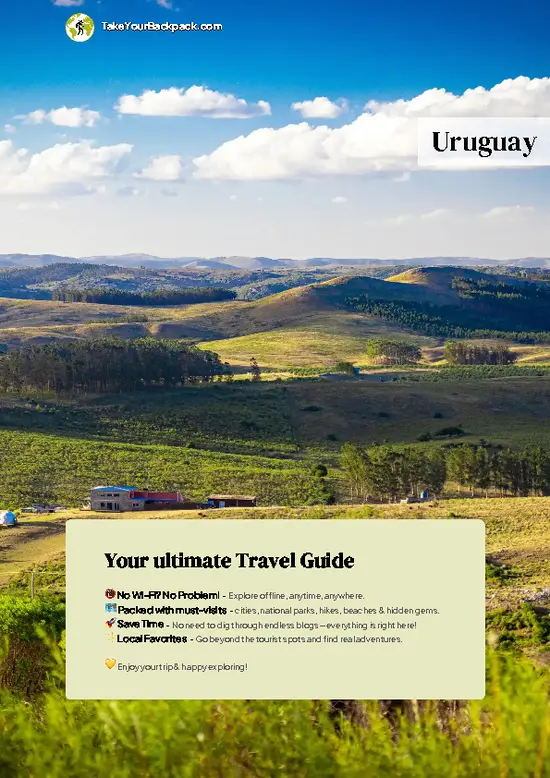
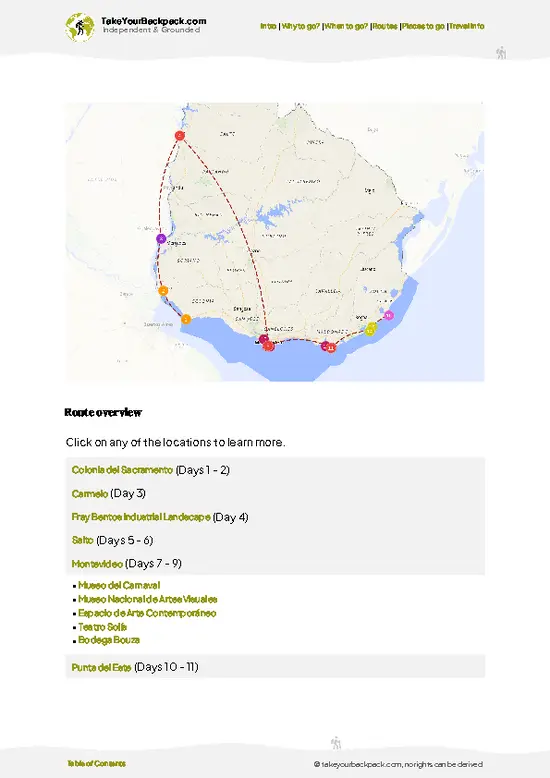
example page 0 from our offline Travel Guide for Uruguay
example page 1 from our offline Travel Guide for Uruguay
example page 2 from our offline Travel Guide for Uruguay
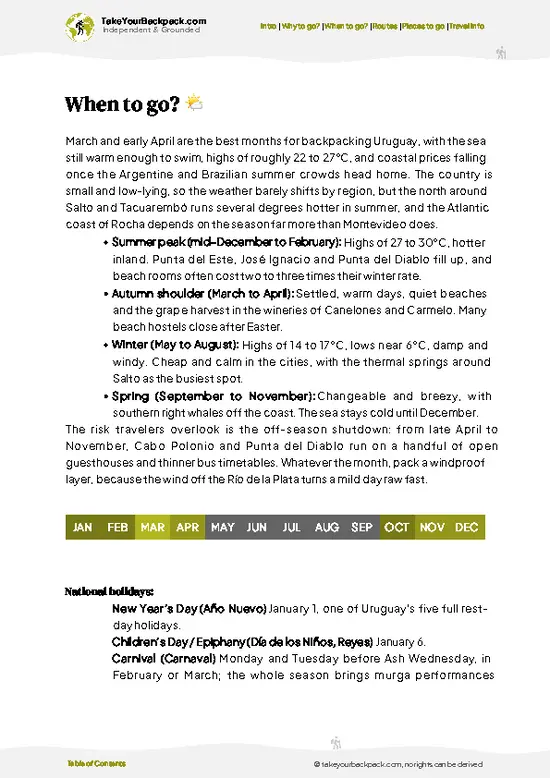
example page 3 from our offline Travel Guide for Uruguay
example page 4 from our offline Travel Guide for Uruguay
example page 5 from our offline Travel Guide for Uruguay
example page 6 from our offline Travel Guide for Uruguay
example page 7 from our offline Travel Guide for Uruguay
Loading the map 🌍
CLICK TO FILTER
cities
towns
villages
landmarks
national parks
hikes
beaches
attractions
festivals
SHOW COUNTRY’S BESTSHOW ALL

✨ Why go?
Ranked #8 town in Uruguay
The unique appeal for travelers

Artigas works for slow travelers who want a quiet northern stop with a clear theme: stone. The region is known for amethyst and agate, and you can see raw geodes, polished pieces and the workshops behind them without leaving the center. The town also honors José Gervasio Artigas, Uruguay’s national hero, with a large monument and a plaza that still serves as the social heart. Add the Río Cuareim border crossing into Quaraí, and you get an easy taste of Brazil on foot. Most people stay one night, a few linger two to use it as a base for the countryside. It suits solo travelers, rock collectors and anyone tired of beach crowds. Nightlife is minimal, so bring a book and appetite for grilled meat.

💡 HighlightsTop highlights of Artigas

  1. Plaza Artigas and the Monument to General José Gervasio Artigas: The city’s namesake is honored with a large statue of the national hero on the central Plaza Artigas, ringed by old jacaranda and palm trees. Come in the early evening when families gather and the stone cools. Free, 20 to 30 minutes.
  2. Centro Cultural Museo de la Piedra Preciosa: The city’s gem museum explains the regional geology and mining history, with a particular focus on the amethyst and agate that put this part of Uruguay on the mineral map. Go in the morning, when it is quiet and cool. Allow about 45 minutes.
  3. Iglesia San Eugenio: The city’s oldest church, inaugurated in 1880 and a national historic monument, has a calm interior that is a good place to get out of the midday sun. Visit at midday or late afternoon when the doors
… read more 👉
  1. Plaza Artigas and the Monument to General José Gervasio Artigas: The city’s namesake is honored with a large statue of the national hero on the central Plaza Artigas, ringed by old jacaranda and palm trees. Come in the early evening when families gather and the stone cools. Free, 20 to 30 minutes.
  2. Centro Cultural Museo de la Piedra Preciosa: The city’s gem museum explains the regional geology and mining history, with a particular focus on the amethyst and agate that put this part of Uruguay on the mineral map. Go in the morning, when it is quiet and cool. Allow about 45 minutes.
  3. Iglesia San Eugenio: The city’s oldest church, inaugurated in 1880 and a national historic monument, has a calm interior that is a good place to get out of the midday sun. Visit at midday or late afternoon when the doors are usually open. Free, 20 to 30 minutes.
  4. Costanera on the Río Cuareim: A riverside promenade on the Brazilian border where you can watch Quaraí across the water and see how easily life here crosses the line. Late afternoon is best for mate-sipping locals and softer light. Free, 45 minutes to an hour.
  5. Frontier crossing into Quaraí, Brazil: The Puente Internacional de la Concordia links the two cities, and walking over is a quick way to hear the Portuñol spoken in the streets and try Brazilian-style pastries and coffee. Go on a weekday morning when shops are open. Free to walk across with ID, 1 to 2 hours.
Outside the city, amethyst mines near Catalán and the Salto Grande dam region are the natural day trips, as are the Arapey thermal springs near Salto.
Spotted a mistake or missing something? Contact us.

🏘️ NeighborhoodsKey areas and districts to know

Artigas is small and flat, and almost everything a visitor wants sits within a dozen blocks of the main square.
  • Centro and Plaza Artigas: Shaded by old trees, the square is ringed by municipal buildings and cafés where locals drink mate on benches. Streets run in a tidy grid, so you can cover it on foot in an hour and finish with a chivito at a corner parrilla.
  • Avenida Lecueder and the commercial strip: Shops, pharmacies, exchange houses and bakeries line this stretch, busiest in the morning and quiet by siesta. It is the place for empanadas and a coffee before the afternoon lull.
  • Costanera on the Cuareim/Quaraí River: A short walk or ride from the center, the riverside is where families gather at dusk. It is calm, with views toward Brazil and a cold beer from a nearby kiosk.
  • Border zone with
… read more 👉
Artigas is small and flat, and almost everything a visitor wants sits within a dozen blocks of the main square.
  • Centro and Plaza Artigas: Shaded by old trees, the square is ringed by municipal buildings and cafés where locals drink mate on benches. Streets run in a tidy grid, so you can cover it on foot in an hour and finish with a chivito at a corner parrilla.
  • Avenida Lecueder and the commercial strip: Shops, pharmacies, exchange houses and bakeries line this stretch, busiest in the morning and quiet by siesta. It is the place for empanadas and a coffee before the afternoon lull.
  • Costanera on the Cuareim/Quaraí River: A short walk or ride from the center, the riverside is where families gather at dusk. It is calm, with views toward Brazil and a cold beer from a nearby kiosk.
  • Border zone with Quaraí: A few minutes toward Brazil, the streets turn louder, with duty-free shops and Portuguese signage. Crossing is informal on foot, and you get cheap electronics browsing and a different lunch menu.
  • Barrio Samuel: Residential and quiet, with low houses and little nightlife. It suits an evening walk and a look at everyday life.

⌛️ 1 dayHow to make the most of one day

This is a stone-and-border day, slow and walkable. 8:30 AM: Plaza Artigas. Start with coffee near the monument while shops open, then stroll two blocks to the next stop.
10:00 AM: Museo de la Piedra Preciosa. See how geodes form and how local amethyst is cut. Take your time, then walk to the main avenue.
12:00 PM: Stone shops and lunch. Browse jewelers for small polished pieces, then eat a parrilla plate at a local grill. It is hearty and filling.
2:30 PM: Walk across to Quaraí. Cross the bridge with your passport, wander the Brazilian side for an hour and sample a pastry or coffee before returning.
5:00 PM: Riverside on the Río Cuareim. Away from the standard route, this shaded bank is where locals fish and drink mate. Sit, watch the border drift by and let the heat fade.
7:30 PM: Dinner in the … read more 👉
This is a stone-and-border day, slow and walkable. 8:30 AM: Plaza Artigas. Start with coffee near the monument while shops open, then stroll two blocks to the next stop.
10:00 AM: Museo de la Piedra Preciosa. See how geodes form and how local amethyst is cut. Take your time, then walk to the main avenue.
12:00 PM: Stone shops and lunch. Browse jewelers for small polished pieces, then eat a parrilla plate at a local grill. It is hearty and filling.
2:30 PM: Walk across to Quaraí. Cross the bridge with your passport, wander the Brazilian side for an hour and sample a pastry or coffee before returning.
5:00 PM: Riverside on the Río Cuareim. Away from the standard route, this shaded bank is where locals fish and drink mate. Sit, watch the border drift by and let the heat fade.
7:30 PM: Dinner in the center. Finish with a simple meal back near the plaza, then an easy walk to your bed.

🌤️ When to go?Choosing the right time of year

Late March to May and September to November are the easiest months for Artigas, with mild days and cool evenings.
  • Summer (Dec to Feb): Hot and humid, highs of 30 to 36°C (86 to 97°F), with long daylight and sudden thunderstorms. Rooms cost most around January holidays.
  • Autumn (Mar to May): Highs of 20 to 28°C (68 to 82°F), clear skies and quiet streets.
  • Winter (Jun to Aug): Days of 14 to 18°C (57 to 64°F), nights near 3 to 8°C (37 to 46°F), with occasional frost. Daylight is short, and prices are lowest.
  • Spring (Sep to Nov): Highs of 20 to 29°C (68 to 84°F), blooming trees and some rain.
Check the amethyst mine schedule, since rain can slow access in summer.

source: climatestotravel.comJANJanuary: highly recommended for travelingFEBFebruary: highly recommended for travelingMARMarch: excellent for travelingAPRApril: excellent for travelingMAYMay: excellent for travelingJUNJune: good for travelingJULJuly: good for travelingAUGAugust: good for travelingSEPSeptember: excellent for travelingOCTOctober: excellent for travelingNOVNovember: excellent for travelingDECDecember: highly recommended for traveling
when-to-go

✈️ The backpacker research shortcutUruguay Travel Guide

An offline-friendly backpacking guide with optimized travel routes, ranked highlights, transport advice, and the best areas to stay.
example page 0 from our offline Travel Guide for Uruguay
example page 1 from our offline Travel Guide for Uruguay
example page 2 from our offline Travel Guide for Uruguay
example page 3 from our offline Travel Guide for Uruguay
example page 4 from our offline Travel Guide for Uruguay
example page 5 from our offline Travel Guide for Uruguay
example page 6 from our offline Travel Guide for Uruguay
example page 7 from our offline Travel Guide for Uruguay
The digital guide (198 pages) contains:
✅ 56 highlights, ranked by travel appeal
✅ Optimized 5, 10 & 15-day travel routes
✅ Cities, national parks, landmarks, beaches
✅ How to get around
✅ Offline-friendly for travel without Wi-Fi
👉 Click to see all 30+ guide features

📅 Plan smarter in minutes, not weeks
✅ Month by month travel advice
✅ Festivals & national holidays
✅ Budget expectations

🗺️ Go to the right places, skip the overrated ones
✅ Honest pros & cons of destinations
✅ Top hikes, parks & viewpoints
✅ Lesser-known places most travelers miss
✅ Clear “worth it vs skip it” guidance

🛏️ Travel smoothly without rookie mistakes
✅ Best areas to stay
✅ Transport systems explained simply
✅ Common scams & safety advice
✅ SIM cards, money & practical tips

🌍 Understand the country, not just visit it
✅ Culture & traditions
✅ 52 Essential phrases & customs
✅ Festivals worth planning around
✅ Traveler-friendly historical context
✅ Insights that make places more meaningful

📱 Built for real travel conditions
✅ Fully downloadable PDF
✅ Works completely offline
✅ Optimized for phone use
✅ Useful in remote areas & buses
✅ Everything in one place
Stop searching, start planning
Get instant access to your full guide. 30‑day money-back guarantee.
+ Add another guide for just

By proceeding you agree to our terms.
Sent to your inbox immediately after payment • 100% Secure Checkout
Best Backpacking Travel Advisor 2025 tourism awardBest Backpacking
Travel Advisor
2025
What others say about Take Your Backpack Guides:
⭐⭐⭐⭐⭐
Fantastic, amazing amount of information!
⭐⭐⭐⭐⭐
My goodness this is amazing, it's what I've been looking for hats off too you!
⭐⭐⭐⭐⭐
I think this is absolutely BRILLIANT
⭐⭐⭐⭐
Very complete and informative. It's still missing places, but I gotta to commend you
⭐⭐⭐⭐⭐
This is truly amazing, thank you, can't wait to explore it with my kids!
⭐⭐⭐⭐⭐
Awesome resource, thank you!
⭐⭐⭐⭐⭐
This is amazing! Can't wait to explore the ones I haven't seen
⭐⭐⭐⭐
I love this! Well done, great idea.
⭐⭐⭐⭐⭐
Thanks for taking the time to make this gem!
⭐⭐⭐⭐⭐
This might be the best website I've ever seen.
⭐⭐⭐⭐⭐
Congratulations, and thank you so much for your work; it's incredibly valuable.
⭐⭐⭐⭐
In all seriousness I think you did a great job pointing out the important spots
⭐⭐⭐⭐⭐
10/10 very good
⭐⭐⭐⭐⭐
As someone who's only just starting to visit regularly this is awesome, thank you.
⭐⭐⭐⭐
Thank you very much! I'm going to visit my dad, it's going to be very useful!
⭐⭐⭐⭐⭐
This is really cool! We'll be travelling for the first time and this definitely come in handy.
⭐⭐⭐⭐⭐
You are now our minister of culture, congratulations 👨‍💼
⭐⭐⭐⭐⭐
Just wanted to tell you that this is a pearl! Going to follow your recommendations.
⭐⭐⭐⭐⭐
This is so cool. I'll definitely be using the resource for my travels soon.
⭐⭐⭐⭐⭐
This is very impressive! Good work.
⭐⭐⭐⭐⭐
This is an amazing and informative site. Very well done!

🛏️ Where to stay?Best areas and accommodation options

The center around Plaza Artigas is the best area for a budget bed, because it puts the terminal, food and money exchange within a 15-minute walk. Budget options here are limited to a few small hostels, guesthouses and simple hotels, so book ahead on weekends and in January. Expect dorm beds or basic private rooms at about US$15 to 35. Streets are quiet at night, with lighting and regular foot traffic until late, and noise mostly comes from passing motorbikes. Everything you need on arrival is close, and taxis are quick to find.
The streets near the bus terminal are a second choice, useful for early … read more 👉
The center around Plaza Artigas is the best area for a budget bed, because it puts the terminal, food and money exchange within a 15-minute walk. Budget options here are limited to a few small hostels, guesthouses and simple hotels, so book ahead on weekends and in January. Expect dorm beds or basic private rooms at about US$15 to 35. Streets are quiet at night, with lighting and regular foot traffic until late, and noise mostly comes from passing motorbikes. Everything you need on arrival is close, and taxis are quick to find.
The streets near the bus terminal are a second choice, useful for early departures. They are a bit plainer, with fewer cafés, but you can pull your bag to the platform in minutes. The riverside Costanera is pleasant by day but has almost no budget beds, so it works better for an evening stroll than a base.

🚌 Getting aroundTransportation options and practical tips

Walking is the easiest way around Artigas, because the grid is flat and the center is only a dozen blocks across. Traffic is light, motorbikes outnumber cars, and sidewalks are uneven in spots. Public transport is limited, so you rely on your feet, taxis and intercity buses.
  • Walking: Free, and it takes you from the bus terminal to the main square in about 10 to 15 minutes. You pass bakeries, shaded sidewalks and a few murals along the way.
  • Taxi: Rides within town cost roughly US$2 to 5, and rides to the river or the border are at the lower end. Drivers know every address, and you can phone or flag one at the square.
  • Local bus: A few city lines run from early morning until early evening, at around US$0.70 to 1 per ride. Frequency is low, so they suit outlying neighborhoods more than sightseeing.
… read more 👉
Walking is the easiest way around Artigas, because the grid is flat and the center is only a dozen blocks across. Traffic is light, motorbikes outnumber cars, and sidewalks are uneven in spots. Public transport is limited, so you rely on your feet, taxis and intercity buses.
  • Walking: Free, and it takes you from the bus terminal to the main square in about 10 to 15 minutes. You pass bakeries, shaded sidewalks and a few murals along the way.
  • Taxi: Rides within town cost roughly US$2 to 5, and rides to the river or the border are at the lower end. Drivers know every address, and you can phone or flag one at the square.
  • Local bus: A few city lines run from early morning until early evening, at around US$0.70 to 1 per ride. Frequency is low, so they suit outlying neighborhoods more than sightseeing.
  • Intercity bus: Services from the terminal reach Salto in about 2.5 to 3 hours and Montevideo in 8 to 9 hours, with tickets around US$10 to 15 for Salto and US$30 to 40 for the capital. Buses are comfortable and run mostly through the day, and an overnight service is available.
  • Bike or moto rental: Informal rentals exist, about US$10 to 20 a day. The wide, quiet roads let you ride out to the river and countryside at your own pace.

👛 Costs (as of 19 October 2026)Typical daily expenses

Backpacking in Artigas costs about US$48 to 76 per day, and the total in high season comes to US$62.
CategoryBudget RangeLocal Reality
Dorm accommodationUS$15 to 30Few hostels, so a basic guesthouse room often costs US$25 to 35. High-season figure used: US$22.
MealsUS$14 to 22A chivito or milanesa costs US$6 to 9, and bakery snacks are cheaper. High-season figure used: US$18.
Local transportUS$2 to 8Short taxi rides cost US$2 to 5, and city buses are under US$1. Figure used: US$5.
Basic activities/entry feesUS$5 to 20Border visits are free, and mine or thermal visits cost more. Figure used: US$10.
Miscellaneous expensesUS$4 to 8Water, SIM data and laundry. Figure used: US$7.
Total Daily BudgetUS$48 to 76US$62 in high season
Eat the daily set lunch, called a “menú del día”, at local cafés, since it is often the cheapest full meal.
⚠️ Prices can change and everyone travels differently, so take this as a rough guide. Hope it helps you plan your adventure!

🚌 Day tripsShort trips worth adding

Artigas works as a base for short outings, mainly mining sites and border visits, though public transport is thin so a taxi or rental often helps.
Quaraí, Brazil:
The Brazilian twin town sits across the river, minutes away on foot or a taxi at about US$3 to 5. Go for a different menu, shops and Portuguese. Carry your passport, and a common mistake is arriving late when shops are closing. Weekday mornings are best.

Amethyst mines of Los Catalanes:
The region is known for amethyst and agate, and you can visit a working mine near Catalán Grande to see geodes in the rock. A taxi round trip with waiting costs about US$40 to 70, and the drive takes roughly 45 minutes each way. Dry months are best because dirt roads can turn muddy. Confirm that the mine is open before you set out.

Salto Termas: … read more 👉
Artigas works as a base for short outings, mainly mining sites and border visits, though public transport is thin so a taxi or rental often helps.
Quaraí, Brazil:
The Brazilian twin town sits across the river, minutes away on foot or a taxi at about US$3 to 5. Go for a different menu, shops and Portuguese. Carry your passport, and a common mistake is arriving late when shops are closing. Weekday mornings are best.

Amethyst mines of Los Catalanes:
The region is known for amethyst and agate, and you can visit a working mine near Catalán Grande to see geodes in the rock. A taxi round trip with waiting costs about US$40 to 70, and the drive takes roughly 45 minutes each way. Dry months are best because dirt roads can turn muddy. Confirm that the mine is open before you set out.

Salto Termas:
Salto is about 2.5 to 3 hours by bus, and thermal pools nearby make a relaxing day. Buses cost US$10 to 15 each way, and entry to thermal parks runs about US$8 to 15. Winter is ideal, when hot water feels best. Check the last return bus, since it is easy to miss.
👉 Explore Salto
Cuareim River beaches:
Sandy riverbanks around Artigas fill up in summer with locals, and the trip takes minutes by taxi for US$3 to 6. Bring water and shade, and avoid midday heat in January.

🛡️ SafetyTraveler Safety Guide

Artigas is broadly safe, and most visitors have an uneventful stay. Petty theft is the main issue, so keep your phone and wallet out of sight in busy areas and near the border crossing. Walk the center after dark without much worry, but avoid empty riverside stretches and poorly lit side streets late at night. Solo travelers, including women, generally report few problems, though a taxi home is sensible after midnight. Smuggling and price games exist near the border, so use official exchange houses, count your change and never carry goods for strangers. Keep your passport handy when crossing to Brazil. Mosquitoes can be annoying near the river, so bring repellent.

FAQFrequently asked questions about Artigas

Artigas is worth a short visit if you like quiet border towns and gemstones. The amethyst and agate mines near Catalán Grande are the main draw, and Quaraí in Brazil is a few minutes away. Most travelers combine it with Salto, about 2.5 to 3 hours south by bus, rather than treating it as a long stay.
Artigas needs one to two days. One day covers the main square, the riverfront and a hop to Quaraí. A second day lets you hire a taxi to the mines, which costs roughly US$40 to 70 for a round trip with waiting.
Artigas is a long day trip from Salto, about 2.5 to 3 hours each way by bus at US$10 to 15, so a night is more comfortable. Montevideo is 8 to 9 hours away, which rules out a round trip in one day. Quaraí in Brazil, however, is an easy half-day crossing from Artigas.
⚠️ Things can change over time, so always validate details locally before you go.

Other Uruguayan towns near Artigas

Explore more nearby:

  • Tacuarembó—Gardel claim, gaucho museum, plane-tree plaza, Patria Gaucha fiesta| 153 km away
  • San Javier—Russian settler village, Cyrillic gravestones, immigrants museum, Uruguay River banks| 297 km away
  • Melo—Cattle-town grid, Plaza Constitución, leather shops, Cerro Largo frontier history| 309 km away

💡 Not sure where to go next?
Create a personalized itinerary for Uruguay including Artigas and the places that fit your trip.

Generate my itinerary

👉 Discover all towns

Or checkout all Uruguay has to offer (think cities, towns, villages, national parks, hikes, beaches, festivals)
Country photo of Uruguay

We 💚 feedbackSumming up the experience

Artigas suits rock lovers, border-curious wanderers and slow solo travelers who like small towns without a script. I would buy one modest amethyst piece from a local workshop rather than a flashy souvenir, and bring a passport for the easy walk into Brazil.

✍️ Help improve this page!
The information on this page is based on in-depth research, insights shared by experienced travelers, and feedback from the local travel community in Uruguay. While every effort is made to keep the information accurate and current, conditions can change — so if you spot anything incorrect or outdated, please get in touch.


🙋‍♂️ Give feedback

👋 Meet the founderWho’s Behind Take Your Backpack?

Johan, backpacker and founder of TakeYourBackpackHi, I’m Johan (Netherlands 🇳🇱), the creator of TakeYourBackpack. Over the past 3 decades, I’ve backpacked through 90+ countries across six continents, gaining extensive experience with independent travel, long-term trips, and overland routes.

This site is built on a combination of firsthand travel experience and carefully curated insights from other backpackers. Many guides are based on places I’ve personally visited, while others bring together tips, observations, and practical advice shared by trusted travelers I’ve met along the way.

The goal is to provide realistic, experience-driven guidance — not generic itineraries — so you can explore destinations with better context, clearer expectations, and more confidence.