×

Uruguay🇺🇾 | townsRochaRemedios church, 25 de Mayo theater, early bakeries, coastal gateway | things to do and best time to go

Explore TacuarembóExplore Melo

Backpacking in Rocha
👍 Recommendedtown ranked #5
By Johan Kruseman 🇳🇱 | Updated October 19, 2026

Plaza Independencia in Rocha holds a monument to José Artigas and faces the church of Nuestra Señora de los Remedios, whose first chapel dates from 1794. Rocha sits in the southeast of Uruguay, a departmental capital of roughly 25,000 people, about 200 kilometers east of Montevideo. Be clear on the trade: the town itself is quiet, flat and low on sights, and an afternoon covers it. Its value is as a working inland base for the coast, with the lagoons, wetlands and beaches of the department within reach. Buses arrive easily from the capital and the coast. Hostels are few and evenings are slow, so meeting other backpackers happens more on the coast than here. The bakeries around the plaza open early, and the Sunday plaza crowd drinks mate on the benches.

Discover everything you want to know in the 📖 Uruguay Travel Guide.


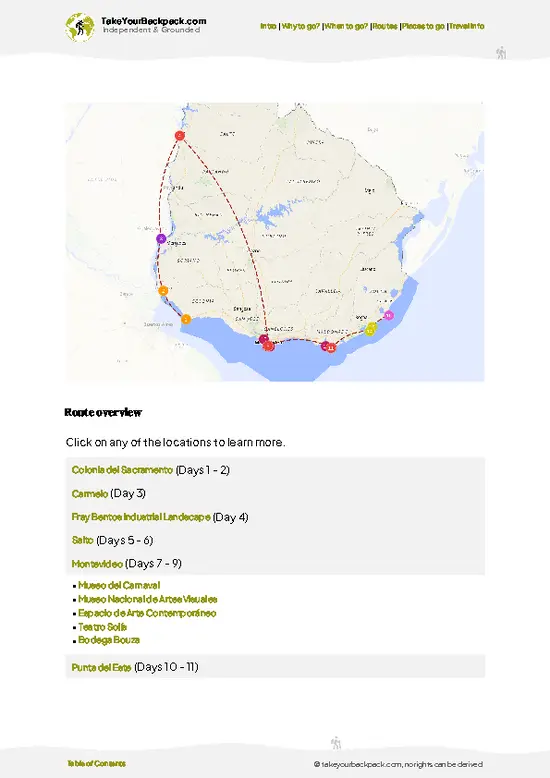
example page 0 from our offline Travel Guide for Uruguay
example page 1 from our offline Travel Guide for Uruguay
example page 2 from our offline Travel Guide for Uruguay
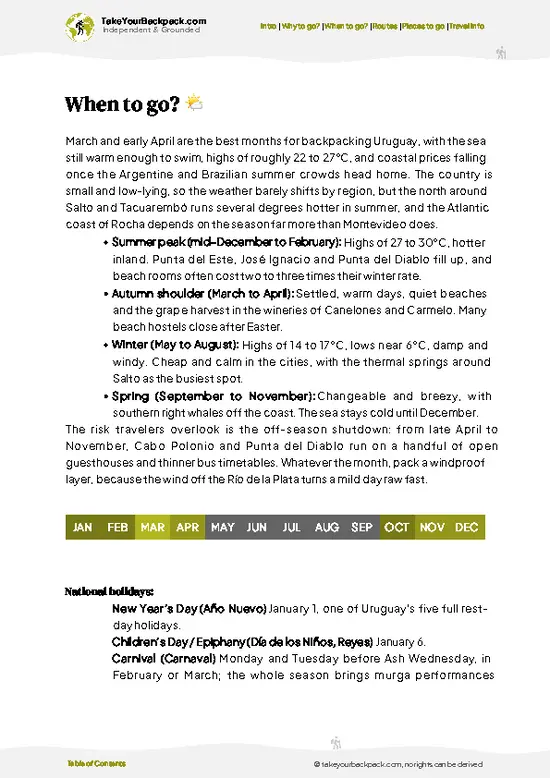
example page 3 from our offline Travel Guide for Uruguay
example page 4 from our offline Travel Guide for Uruguay
example page 5 from our offline Travel Guide for Uruguay
example page 6 from our offline Travel Guide for Uruguay
example page 7 from our offline Travel Guide for Uruguay
Loading the map 🌍
CLICK TO FILTER
cities
towns
villages
landmarks
national parks
hikes
beaches
attractions
festivals
SHOW COUNTRY’S BESTSHOW ALL

✨ Why go?
Ranked #5 town in Uruguay
Why visitors keep coming back

Rocha makes sense if you want a practical, unhurried stop rather than a scene. Most travelers pass through in a night or two, using the town as a transport hub and supply point before heading to the Atlantic coast, the Laguna de Rocha wetland reserve or the surfing beaches of the department. It works well for slow travelers, birdwatchers and solo backpackers who like a place where nobody is selling anything. The streets are flat and walkable, and the Plaza Independencia area holds the cafés, bakeries and parrillas where locals eat, so prices and manners are ordinary Uruguayan rather than resort-style. Do not expect nightlife; evenings mean a late dinner and an early bed. Small guesthouses and a handful of hostels keep things low-key, and conversation with other guests tends to happen over … read more 👉
Rocha makes sense if you want a practical, unhurried stop rather than a scene. Most travelers pass through in a night or two, using the town as a transport hub and supply point before heading to the Atlantic coast, the Laguna de Rocha wetland reserve or the surfing beaches of the department. It works well for slow travelers, birdwatchers and solo backpackers who like a place where nobody is selling anything. The streets are flat and walkable, and the Plaza Independencia area holds the cafés, bakeries and parrillas where locals eat, so prices and manners are ordinary Uruguayan rather than resort-style. Do not expect nightlife; evenings mean a late dinner and an early bed. Small guesthouses and a handful of hostels keep things low-key, and conversation with other guests tends to happen over breakfast. If you want beach parties, go straight to the coast. If you want to see a real provincial Uruguayan town, give it a night.

💡 HighlightsPlaces and moments you shouldn't skip

  1. Plaza Independencia and the Church of Nuestra Señora de los Remedios. The main square is the center of town life, with the Remedios church and a monument to Artigas and shaded benches where locals drink mate. Go in the late afternoon when the square fills. Free, 30 to 45 minutes.
  2. Museo Regional Rocha. A small regional museum covering local history, archaeology and the cultural life of the department. Check opening hours on the day, as they are limited. Entry is free or very low, around US$1, and a visit takes about an hour.
  3. Teatro 25 de Mayo. The nineteenth-century theater is a handsome civic building and the town’s cultural anchor. See the façade any time; go inside if there is an evening performance, where tickets are usually US$5 to 15. Allow 30 minutes outside, 1 to 2 hours for a show.
  4. Local
… read more 👉
  1. Plaza Independencia and the Church of Nuestra Señora de los Remedios. The main square is the center of town life, with the Remedios church and a monument to Artigas and shaded benches where locals drink mate. Go in the late afternoon when the square fills. Free, 30 to 45 minutes.
  2. Museo Regional Rocha. A small regional museum covering local history, archaeology and the cultural life of the department. Check opening hours on the day, as they are limited. Entry is free or very low, around US$1, and a visit takes about an hour.
  3. Teatro 25 de Mayo. The nineteenth-century theater is a handsome civic building and the town’s cultural anchor. See the façade any time; go inside if there is an evening performance, where tickets are usually US$5 to 15. Allow 30 minutes outside, 1 to 2 hours for a show.
  4. Local bakeries and parrillas around the center. Try chivitos, empanadas and medialunas where Rocha residents actually eat. A meal costs around US$6 to 12. Lunchtime is the busiest and best time, and it takes about an hour.
Start with Plaza Independencia, because it orients you and shows how the town works before you decide how to spend the rest of the day. For day trips, head to the Laguna de Rocha wetlands, the beaches of La Paloma and La Pedrera, and the Cabo Polonio dunes and sea lion colony.
Spotted a mistake or missing something? Contact us.

Things to do near Rocha

Ratings based on Tripadvisor reviews. When you book through this link, you support our work at no extra cost to you.

🏘️ NeighborhoodsUnderstanding the local layout

Rocha is a small departmental capital of roughly 25,000 people, and everything worth seeing in town sits within a flat 15-minute walk of the main square.
  • Plaza Independencia and the center: The arcaded square, the church of Nuestra Señora de los Remedios and the Teatro 25 de Mayo are the whole historic core. Cafés and bakeries serve medialunas and chivitos at modest prices. Give it two hours, not more. Evenings are very quiet.
  • Avenida Agraciada and the bus terminal: A practical strip of supermarkets, pharmacies, ATMs and cheap parrillas. Nothing to sightsee, but it is where you eat a plain lunch and sort out onward buses.
  • Laguna de Rocha edges: A short drive south, the lagoon is a birding area with flamingos, black-necked swans and fishing boats. It is far more rewarding than the town itself,
… read more 👉
Rocha is a small departmental capital of roughly 25,000 people, and everything worth seeing in town sits within a flat 15-minute walk of the main square.
  • Plaza Independencia and the center: The arcaded square, the church of Nuestra Señora de los Remedios and the Teatro 25 de Mayo are the whole historic core. Cafés and bakeries serve medialunas and chivitos at modest prices. Give it two hours, not more. Evenings are very quiet.
  • Avenida Agraciada and the bus terminal: A practical strip of supermarkets, pharmacies, ATMs and cheap parrillas. Nothing to sightsee, but it is where you eat a plain lunch and sort out onward buses.
  • Laguna de Rocha edges: A short drive south, the lagoon is a birding area with flamingos, black-necked swans and fishing boats. It is far more rewarding than the town itself, though you need a vehicle or a bus to reach it.
  • Barrio Parque del Lago and the Parque Rodó area: Residential and green, good for an easy stroll on a sunny afternoon. There is little to eat or do here, so skip it if time is short.
Rocha works best as a practical base. The real attractions are the coast and lagoons around it.

⌛️ 1 day1-day itinerary for Rocha

8:30 AM, Plaza Independencia: Start at the main square with coffee and medialunas from a nearby bakery, then look inside the Remedios church. The square is at its calmest in the morning, and you can see locals starting the day. Walk five minutes to the next stop.
10:00 AM, Museo Regional Rocha: Spend an hour on local history and archaeology, which gives context for the fortresses and coast you may visit later. Then stroll to the theater.
11:30 AM, Teatro 25 de Mayo: Admire the façade and check the program for evening events. It is a short walk to lunch.
1:00 PM, Parrilla lunch: Order a chivito or grilled meat at a local grill and eat the way Rocha does, slowly. Rest through the early afternoon heat.
3:30 PM, Side streets: Wander the residential blocks past low houses, saddle shops and small neighborhood … read more 👉
8:30 AM, Plaza Independencia: Start at the main square with coffee and medialunas from a nearby bakery, then look inside the Remedios church. The square is at its calmest in the morning, and you can see locals starting the day. Walk five minutes to the next stop.
10:00 AM, Museo Regional Rocha: Spend an hour on local history and archaeology, which gives context for the fortresses and coast you may visit later. Then stroll to the theater.
11:30 AM, Teatro 25 de Mayo: Admire the façade and check the program for evening events. It is a short walk to lunch.
1:00 PM, Parrilla lunch: Order a chivito or grilled meat at a local grill and eat the way Rocha does, slowly. Rest through the early afternoon heat.
3:30 PM, Side streets: Wander the residential blocks past low houses, saddle shops and small neighborhood stores. This area is not on the usual route, but it shows the town as residents live in it.
5:30 PM, Back on Plaza Independencia: Sit with a mate or a beer as the square fills with families and teenagers. Finish with dinner nearby, or catch a performance if the theater has one.

🌤️ When to go?Choosing the right time of year

December to March is the warmest and busiest stretch, while the shoulder months bring the best balance for backpackers.
  • Summer (Dec to Feb): Highs of 27 to 30°C (81 to 86°F), long evenings and beach crowds on the nearby coast. Beds and rentals cost the most, and January is the peak.
  • Autumn (Mar to May): Days of 17 to 24°C (63 to 75°F), calm seas, thin crowds and falling prices. Excellent for lagoon birdwatching.
  • Winter (Jun to Aug): Highs of 12 to 16°C (54 to 61°F), nights near 5°C (41°F), damp wind and early dusk. Coastal businesses largely close, but whale watching starts around July.
  • Spring (Sep to Nov): Mild at 16 to 23°C (61 to 73°F), with showers and cheap rooms until November.
Aim for March or early November to get warm days without summer prices.

source: climatestotravel.comJANJanuary: good for travelingFEBFebruary: good for travelingMARMarch: highly recommended for travelingAPRApril: highly recommended for travelingMAYMay: fair for travelingJUNJune: fair for travelingJULJuly: fair for travelingAUGAugust: fair for travelingSEPSeptember: good for travelingOCTOctober: highly recommended for travelingNOVNovember: highly recommended for travelingDECDecember: good for traveling
when-to-go

✈️ The backpacker research shortcutUruguay Travel Guide

An offline-friendly backpacking guide with optimized travel routes, ranked highlights, transport advice, and the best areas to stay.
example page 0 from our offline Travel Guide for Uruguay
example page 1 from our offline Travel Guide for Uruguay
example page 2 from our offline Travel Guide for Uruguay
example page 3 from our offline Travel Guide for Uruguay
example page 4 from our offline Travel Guide for Uruguay
example page 5 from our offline Travel Guide for Uruguay
example page 6 from our offline Travel Guide for Uruguay
example page 7 from our offline Travel Guide for Uruguay
The digital guide (198 pages) contains:
✅ 56 highlights, ranked by travel appeal
✅ Optimized 5, 10 & 15-day travel routes
✅ Cities, national parks, landmarks, beaches
✅ How to get around
✅ Offline-friendly for travel without Wi-Fi
👉 Click to see all 30+ guide features

📅 Plan smarter in minutes, not weeks
✅ Month by month travel advice
✅ Festivals & national holidays
✅ Budget expectations

🗺️ Go to the right places, skip the overrated ones
✅ Honest pros & cons of destinations
✅ Top hikes, parks & viewpoints
✅ Lesser-known places most travelers miss
✅ Clear “worth it vs skip it” guidance

🛏️ Travel smoothly without rookie mistakes
✅ Best areas to stay
✅ Transport systems explained simply
✅ Common scams & safety advice
✅ SIM cards, money & practical tips

🌍 Understand the country, not just visit it
✅ Culture & traditions
✅ 52 Essential phrases & customs
✅ Festivals worth planning around
✅ Traveler-friendly historical context
✅ Insights that make places more meaningful

📱 Built for real travel conditions
✅ Fully downloadable PDF
✅ Works completely offline
✅ Optimized for phone use
✅ Useful in remote areas & buses
✅ Everything in one place
Stop searching, start planning
Get instant access to your full guide. 30‑day money-back guarantee.
+ Add another guide for just

By proceeding you agree to our terms.
Sent to your inbox immediately after payment • 100% Secure Checkout
Best Backpacking Travel Advisor 2025 tourism awardBest Backpacking
Travel Advisor
2025
What others say about Take Your Backpack Guides:
⭐⭐⭐⭐⭐
Fantastic, amazing amount of information!
⭐⭐⭐⭐⭐
My goodness this is amazing, it's what I've been looking for hats off too you!
⭐⭐⭐⭐⭐
I think this is absolutely BRILLIANT
⭐⭐⭐⭐
Very complete and informative. It's still missing places, but I gotta to commend you
⭐⭐⭐⭐⭐
This is truly amazing, thank you, can't wait to explore it with my kids!
⭐⭐⭐⭐⭐
Awesome resource, thank you!
⭐⭐⭐⭐⭐
This is amazing! Can't wait to explore the ones I haven't seen
⭐⭐⭐⭐
I love this! Well done, great idea.
⭐⭐⭐⭐⭐
Thanks for taking the time to make this gem!
⭐⭐⭐⭐⭐
This might be the best website I've ever seen.
⭐⭐⭐⭐⭐
Congratulations, and thank you so much for your work; it's incredibly valuable.
⭐⭐⭐⭐
In all seriousness I think you did a great job pointing out the important spots
⭐⭐⭐⭐⭐
10/10 very good
⭐⭐⭐⭐⭐
As someone who's only just starting to visit regularly this is awesome, thank you.
⭐⭐⭐⭐
Thank you very much! I'm going to visit my dad, it's going to be very useful!
⭐⭐⭐⭐⭐
This is really cool! We'll be travelling for the first time and this definitely come in handy.
⭐⭐⭐⭐⭐
You are now our minister of culture, congratulations 👨‍💼
⭐⭐⭐⭐⭐
Just wanted to tell you that this is a pearl! Going to follow your recommendations.
⭐⭐⭐⭐⭐
This is so cool. I'll definitely be using the resource for my travels soon.
⭐⭐⭐⭐⭐
This is very impressive! Good work.
⭐⭐⭐⭐⭐
This is an amazing and informative site. Very well done!

🛏️ Where to stay?Choosing the right base

Stay in the center near Plaza Independencia if you want to be in Rocha itself, or in La Paloma if you want the sea. The center has only a handful of budget options, mostly simple hotels and guesthouses with private rooms at US$30 to 50, and almost no dorms. It is quiet and safe after dark, and the bus terminal is a 10-minute walk, which makes early departures easy. The drawback is that nights are dead and restaurants close early.
La Paloma, about 30 kilometers south, has the real concentration of hostels, with dorm beds from roughly US$15 to 30 in summer. Most close or drop service between April … read more 👉
Stay in the center near Plaza Independencia if you want to be in Rocha itself, or in La Paloma if you want the sea. The center has only a handful of budget options, mostly simple hotels and guesthouses with private rooms at US$30 to 50, and almost no dorms. It is quiet and safe after dark, and the bus terminal is a 10-minute walk, which makes early departures easy. The drawback is that nights are dead and restaurants close early.
La Paloma, about 30 kilometers south, has the real concentration of hostels, with dorm beds from roughly US$15 to 30 in summer. Most close or drop service between April and October, so book ahead for January and February. The town is small and walkable, buses from Rocha run frequently in season, and noise is limited to a few bars near the main beach. Solo travelers will find it easy to meet people. In winter, return to Rocha for reliable year-round beds.

🚌 Getting aroundMoving around without the hassle

The center of Rocha is flat and compact, so you can walk from the bus terminal to the plaza in about 10 minutes, but walking stops making sense once you head for the lagoon or the beaches, which lie 25 to 40 kilometers away. Traffic is light and nobody hurries. Buses run reliably between towns, yet local services to the coast thin out sharply outside summer.
  • Walking: Free and the best way to cover the center. Sidewalks are decent and distances short, so a taxi inside town is rarely needed.
  • Intercity buses: The terminal on the main avenue connects Rocha with Montevideo (about 3 hours, US$12 to 16), Punta del Este (roughly 1.5 hours, US$6 to 9) and Chuy near the Brazilian border (about 1.5 hours, US$7 to 10). Services run from early morning to around 9 pm, with fewer on Sundays.
  • Local buses to
… read more 👉
The center of Rocha is flat and compact, so you can walk from the bus terminal to the plaza in about 10 minutes, but walking stops making sense once you head for the lagoon or the beaches, which lie 25 to 40 kilometers away. Traffic is light and nobody hurries. Buses run reliably between towns, yet local services to the coast thin out sharply outside summer.
  • Walking: Free and the best way to cover the center. Sidewalks are decent and distances short, so a taxi inside town is rarely needed.
  • Intercity buses: The terminal on the main avenue connects Rocha with Montevideo (about 3 hours, US$12 to 16), Punta del Este (roughly 1.5 hours, US$6 to 9) and Chuy near the Brazilian border (about 1.5 hours, US$7 to 10). Services run from early morning to around 9 pm, with fewer on Sundays.
  • Local buses to the coast: Routes to La Paloma and La Pedrera cost about US$2 to 4 and take 40 to 60 minutes. Summer frequency is good. In winter expect only a few departures a day, so check the schedule at the terminal the day before.
  • Taxis and remises: A ride in town costs US$2 to 4. A trip to La Paloma runs US$30 to 40, which only makes sense when split among three or four people.
  • Rental car or scooter: Cars start around US$40 to 60 a day. For the lagoon, Cabo Polonio access and the quiet beaches, this is worth the money, since gravel roads and sparse buses limit what you can see otherwise.
Hitchhiking is common among Uruguayan beachgoers on the coastal road in summer, but buses are the more predictable choice.

👛 Costs (as of 19 October 2026)How expensive it really is

Expect to spend about US$68 a day backpacking around Rocha in high season.
CategoryBudget RangeLocal Reality
Dorm accommodationUS$15 to 30Dorms are mainly in La Paloma in summer. In Rocha itself, a private room costs US$30 to 50. Budget uses US$25.
MealsUS$12 to 25A chivito or milanesa with a drink is US$7 to 10. Supermarket picnic food is cheaper. Budget uses US$18.
Local transportUS$2 to 10Local buses to the coast run US$2 to 4 each way. Budget uses US$6.
Basic activities/entry feesUS$0 to 12Lagoon and beaches are free. Santa Teresa park entry is free and the Cabo Polonio truck US$10 to 12. Budget uses US$10.
Miscellaneous expensesUS$5 to 12Water, sunscreen, coffee and a beer. Budget uses US$9.
Total Daily BudgetUS$68High-season total, paid in Uruguayan pesos.
Cook in a hostel kitchen and buy bread, … read more 👉
Expect to spend about US$68 a day backpacking around Rocha in high season.
CategoryBudget RangeLocal Reality
Dorm accommodationUS$15 to 30Dorms are mainly in La Paloma in summer. In Rocha itself, a private room costs US$30 to 50. Budget uses US$25.
MealsUS$12 to 25A chivito or milanesa with a drink is US$7 to 10. Supermarket picnic food is cheaper. Budget uses US$18.
Local transportUS$2 to 10Local buses to the coast run US$2 to 4 each way. Budget uses US$6.
Basic activities/entry feesUS$0 to 12Lagoon and beaches are free. Santa Teresa park entry is free and the Cabo Polonio truck US$10 to 12. Budget uses US$10.
Miscellaneous expensesUS$5 to 12Water, sunscreen, coffee and a beer. Budget uses US$9.
Total Daily BudgetUS$68High-season total, paid in Uruguayan pesos.
Cook in a hostel kitchen and buy bread, cheese and fruit at the supermarkets on the main avenue to cut meal costs by about a third.
⚠️ Prices can change and everyone travels differently, so take this as a rough guide. Hope it helps you plan your adventure!

🚌 Day tripsExploring the surroundings

Rocha sits close to some of Uruguay's wildest coast, and with a bus terminal and a lagoon on the doorstep, day trips are straightforward if you plan around the schedule.
Laguna de Rocha:
The lagoon is a protected landscape of reeds and sandbars, with flamingos, swans and sometimes capybaras. Getting there takes about 30 minutes by taxi (US$20 to 30 each way) or a local bus toward La Paloma and a walk. Go early in the day, and bring binoculars. First-timers often arrive without water or food, and there are no shops.
👉 Explore Laguna de Rocha
La Paloma:
A relaxed beach town with a lighthouse and calm bays, 40 to 60 minutes by bus for US$2 to 4. Visit December to March for open cafés and the sea warm enough to swim. Return buses thin out by evening, so check the last departure before you settle … read more 👉
Rocha sits close to some of Uruguay's wildest coast, and with a bus terminal and a lagoon on the doorstep, day trips are straightforward if you plan around the schedule.
Laguna de Rocha:
The lagoon is a protected landscape of reeds and sandbars, with flamingos, swans and sometimes capybaras. Getting there takes about 30 minutes by taxi (US$20 to 30 each way) or a local bus toward La Paloma and a walk. Go early in the day, and bring binoculars. First-timers often arrive without water or food, and there are no shops.
👉 Explore Laguna de Rocha
La Paloma:
A relaxed beach town with a lighthouse and calm bays, 40 to 60 minutes by bus for US$2 to 4. Visit December to March for open cafés and the sea warm enough to swim. Return buses thin out by evening, so check the last departure before you settle on a beach.
👉 Explore La Paloma
Cabo Polonio:
A roadless village with sea lions and dunes. Reach the access point at the national highway, then ride a 4x4 truck over the dunes for about US$10 to 12 return, or walk 7 kilometers. Allow 2.5 hours each way and about US$30 in total. Go in summer or on a clear spring day, and bring cash, since many places do not take cards.
👉 Explore Cabo Polonio
Santa Teresa National Park:
Forest, a stone fortress and long beaches, about 1.5 hours by bus toward Chuy. Entry to the park is free. Aim for shoulder season when the park is calm.

🛡️ SafetyScams, Hazards, and Annoyances

Rocha is a calm, low-crime provincial town where the main risks are small ones. Petty theft is uncommon, but keep phones and bags out of sight on the terminal avenue and when you leave things on a beach in La Paloma or La Pedrera. Walking around the center after dark is comfortable for solo travelers, including women, though streets empty early and a few side blocks are poorly lit, so use a taxi after late dinners. Don't leave valuables in a parked car, especially near the lagoon and beach car parks. Scams are rare. The everyday nuisances are the strong sun, rip currents on unguarded beaches and mosquitoes near the lagoon in summer. Swim where a lifeguard flag is up, carry sunscreen and repellent, and keep some cash, since smaller coastal businesses often do not accept cards.

FAQFrequently asked questions about Rocha

Rocha works better as a base than as a destination, since the town itself needs only a couple of hours. What makes it worthwhile is the surrounding coast: Laguna de Rocha is 30 minutes away, La Paloma is about an hour by bus for US$2 to 4, and Cabo Polonio is roughly 2.5 hours. Travelers who want beaches and birdlife should stay; those chasing nightlife should look elsewhere.
Two to four days is realistic for Rocha and its surroundings. Spend half a day in town and at the lagoon, then add a day each for La Paloma and Cabo Polonio, or a day for Santa Teresa National Park. In summer a fourth day on the beaches is easy to fill.
Rocha can be done as a day trip from Punta del Este, which is about 1.5 hours by bus for US$6 to 9, but the day gets short. Montevideo is closer to 3 hours each way for US$12 to 16, so a round trip leaves little time. Staying one night lets you reach the lagoon and La Paloma without rushing for the last bus.
⚠️ Things can change over time, so always validate details locally before you go.

Other Uruguayan towns near Rocha

Explore more nearby:

  • Piriápolis—Piria's pink hotel, Cerro San Antonio chairlift, fishing port, sea lions| 97 km away
  • Atlántida—Dieste brick church, Costa de Oro rambla, pine-shaded chalets, Calle 18 chivitos| 135 km away
  • Melo—Cattle-town grid, Plaza Constitución, leather shops, Cerro Largo frontier history| 235 km away

💡 Not sure where to go next?
Create a personalized itinerary for Uruguay including Rocha and the places that fit your trip.

Generate my itinerary

👉 Discover all towns

Or checkout all Uruguay has to offer (think cities, towns, villages, national parks, hikes, beaches, festivals)
Country photo of Uruguay

We 💚 feedbackWhat to keep in mind

Rocha is best in the late afternoon, when the plaza fills and the day cools, and best of all in the shoulder months outside the January rush, when the coast is calm and the town is simply itself. I would stay one night, eat at a neighborhood parrilla, and leave early for the lagoons.

✍️ Help improve this page!
The information on this page is based on in-depth research, insights shared by experienced travelers, and feedback from the local travel community in Uruguay. While every effort is made to keep the information accurate and current, conditions can change — so if you spot anything incorrect or outdated, please get in touch.


🙋‍♂️ Give feedback

👋 Meet the founderWho’s Behind Take Your Backpack?

Johan, backpacker and founder of TakeYourBackpackHi, I’m Johan (Netherlands 🇳🇱), the creator of TakeYourBackpack. Over the past 3 decades, I’ve backpacked through 90+ countries across six continents, gaining extensive experience with independent travel, long-term trips, and overland routes.

This site is built on a combination of firsthand travel experience and carefully curated insights from other backpackers. Many guides are based on places I’ve personally visited, while others bring together tips, observations, and practical advice shared by trusted travelers I’ve met along the way.

The goal is to provide realistic, experience-driven guidance — not generic itineraries — so you can explore destinations with better context, clearer expectations, and more confidence.