
×

Uruguay🇺🇾 | townsPiriápolisPiria's pink hotel, Cerro San Antonio chairlift, fishing port, sea lions | things to do and best time to go

Explore Colonia del SacramentoExplore San Javier

Backpacking in Piriápolis
By Johan Kruseman 🇳🇱 | Updated October 19, 2026

Piriápolis is best known for Argentino Hotel, the pink-and-cream pile on the waterfront that Francisco Piria built in the 1930s, and for the long sandy rambla that curves around the bay beneath Cerro del Toro. It sits in the south of Uruguay, in Maldonado department, on the Río de la Plata coast. The walk along the rambla takes you past fishermen cleaning catch at the port, with sea lions occasionally barking from the breakwater. The town is easy to reach from Montevideo and Punta del Este. It is quiet and family-oriented, so nightlife is thin and most hostels are small, which suits slow travelers more than party seekers. Off-season, many cafés close early and the beach is almost empty, though the hills behind town stay open for hiking. You can meet other backpackers, mostly at hostel kitchens and on the Cerro Pan de Azúcar trail. The last stretch of that trail ends at a granite summit with a cross and a wide view over eucalyptus woods to the sea.

Discover everything you want to know in the 📖 Uruguay Travel Guide.


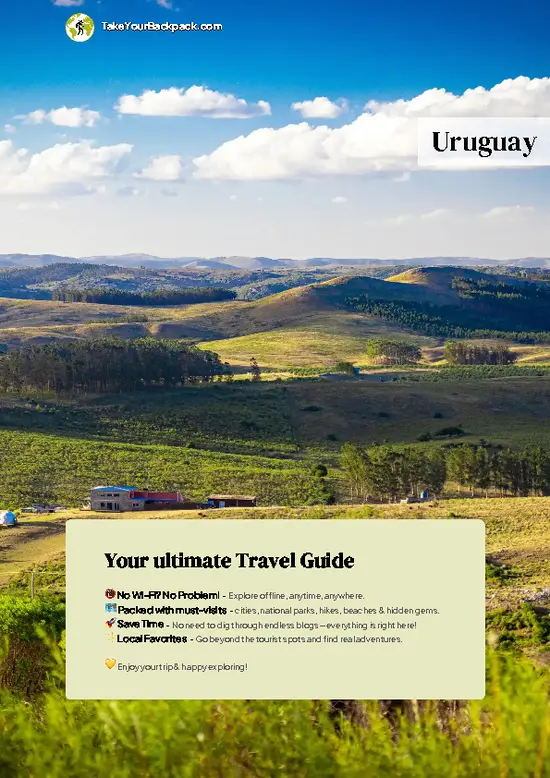
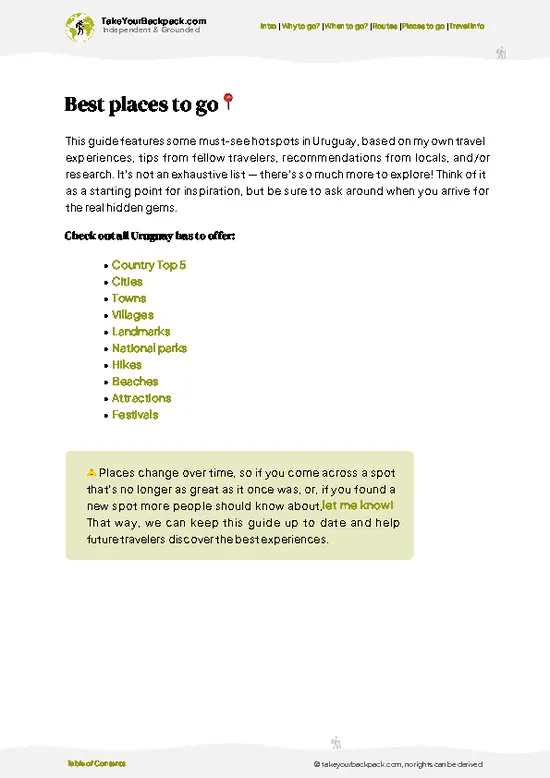
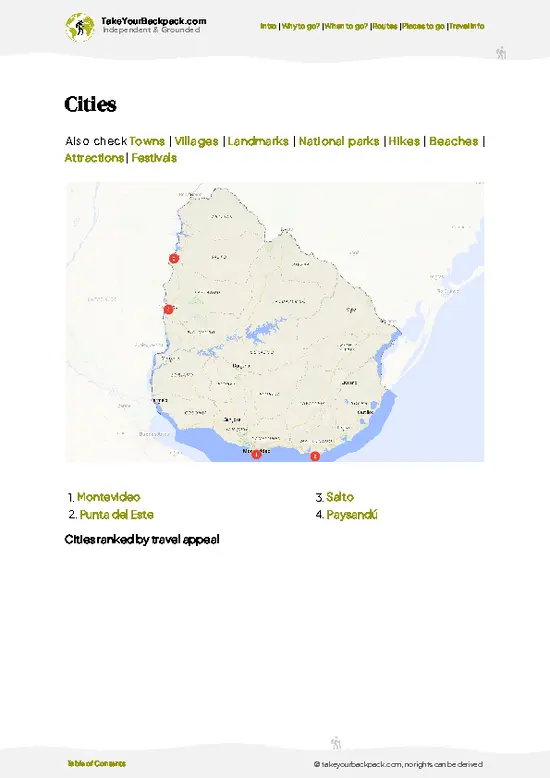
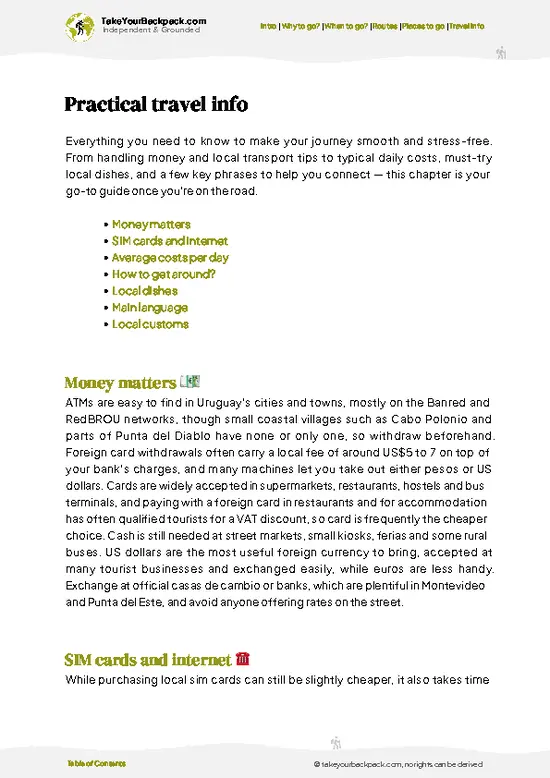
example page 0 from our offline Travel Guide for Uruguay
example page 1 from our offline Travel Guide for Uruguay
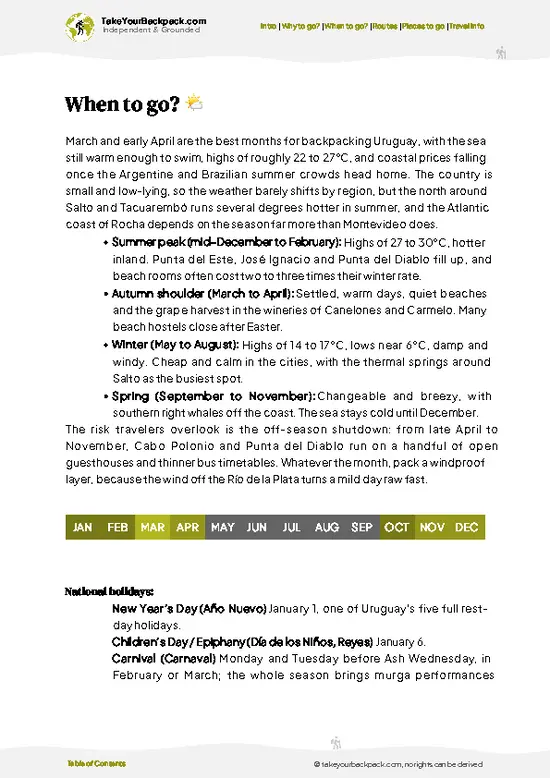
example page 2 from our offline Travel Guide for Uruguay
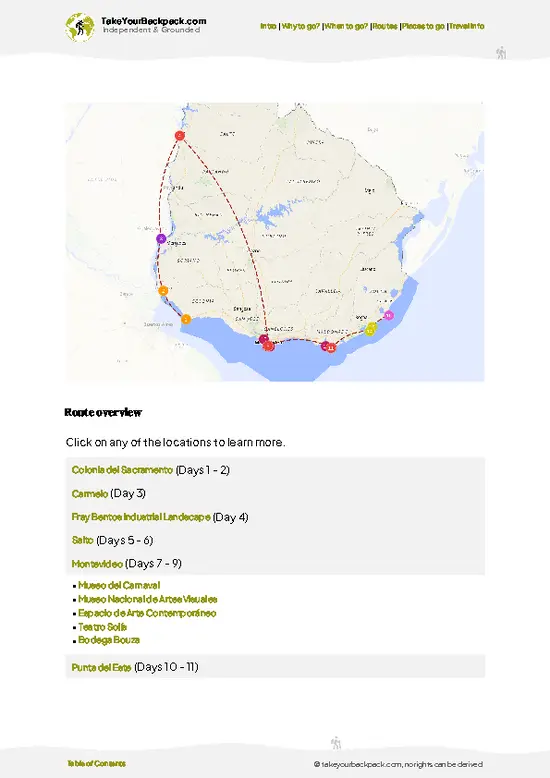
example page 3 from our offline Travel Guide for Uruguay
example page 4 from our offline Travel Guide for Uruguay
example page 5 from our offline Travel Guide for Uruguay
example page 6 from our offline Travel Guide for Uruguay
example page 7 from our offline Travel Guide for Uruguay
Loading the map 🌍
CLICK TO FILTER
cities
towns
villages
landmarks
national parks
hikes
beaches
attractions
festivals
SHOW COUNTRY’S BESTSHOW ALL

✨ Why go?
Ranked #2 town in Uruguay
What makes it a must-see town

Piriápolis works for backpackers who want a calm coastal base with real hills behind it, and it is the easiest place on this coast to combine beach mornings with proper hiking. The trail up Cerro Pan de Azúcar, one of the highest hills in Uruguay, starts a short ride from town, and the climb is steady rather than technical. Closer in, Cerro del Toro and the Cerro San Antonio chairlift give quick viewpoints without a full day commitment. Most travelers stay two or three nights, longer in summer when the beach is lively and hostels fill. Out of season the place is slow and cheap, with a few open restaurants serving fresh fish and chivito. It suits solo travelers, hikers and couples who like a walkable center, a flat rambla for evening strolls and little pressure to do anything. Party-minded … read more 👉
Piriápolis works for backpackers who want a calm coastal base with real hills behind it, and it is the easiest place on this coast to combine beach mornings with proper hiking. The trail up Cerro Pan de Azúcar, one of the highest hills in Uruguay, starts a short ride from town, and the climb is steady rather than technical. Closer in, Cerro del Toro and the Cerro San Antonio chairlift give quick viewpoints without a full day commitment. Most travelers stay two or three nights, longer in summer when the beach is lively and hostels fill. Out of season the place is slow and cheap, with a few open restaurants serving fresh fish and chivito. It suits solo travelers, hikers and couples who like a walkable center, a flat rambla for evening strolls and little pressure to do anything. Party-minded backpackers will find Punta del Este or Montevideo more fitting, and anyone needing big-city culture should treat Piriápolis as a short stop between the two.

💡 HighlightsMust-see experiences and standout moments

  1. Argentino Hotel: The grand 1930s hotel built by Francisco Piria, still a working hotel with a ballroom and a casino, and the town’s signature building. You can walk through the lobby and terrace for free, and a coffee in the café costs about US$3 to 5. Allow 30 to 45 minutes. Late afternoon light on the facade is best.
  2. Rambla de los Argentinos: The waterfront promenade stretches along the main beach, with fishermen, mate drinkers and ice cream stands. Free, and an hour is enough for a slow walk. Evenings in summer are busiest, while early mornings are calm and good for swimming.
  3. Cerro San Antonio chairlift: A chairlift climbs to a hilltop with a view of the bay, the port and the town grid. Expect roughly US$5 to 8 return and about 1 to 1.5 hours including time at the top. Clear mornings give
… read more 👉
  1. Argentino Hotel: The grand 1930s hotel built by Francisco Piria, still a working hotel with a ballroom and a casino, and the town’s signature building. You can walk through the lobby and terrace for free, and a coffee in the café costs about US$3 to 5. Allow 30 to 45 minutes. Late afternoon light on the facade is best.
  2. Rambla de los Argentinos: The waterfront promenade stretches along the main beach, with fishermen, mate drinkers and ice cream stands. Free, and an hour is enough for a slow walk. Evenings in summer are busiest, while early mornings are calm and good for swimming.
  3. Cerro San Antonio chairlift: A chairlift climbs to a hilltop with a view of the bay, the port and the town grid. Expect roughly US$5 to 8 return and about 1 to 1.5 hours including time at the top. Clear mornings give the best visibility.
  4. Cerro del Toro: A short hill on the edge of town topped by a big statue of a bull-like figure and pine woods. Free to visit, around 1 to 2 hours depending on how you get up. Go early or late to avoid heat.
  5. Puerto de Piriápolis: The small fishing and yacht port at the western end of the rambla, where boats unload and sea lions sometimes loiter near the breakwater. Free, about an hour with a seafood lunch at one of the portside restaurants, where mains run roughly US$10 to 18.
Just outside town, you can hike Cerro Pan de Azúcar, visit the Castillo de Piria, or head to Punta Colorada and Punta Ballena for a quieter beach day. If time is short, skip the chairlift and take in the same views from Cerro del Toro for free.
Spotted a mistake or missing something? Contact us.

Things to do near Piriápolis

Ratings based on Tripadvisor reviews. When you book through this link, you support our work at no extra cost to you.

🏘️ NeighborhoodsUnderstanding the local layout

Piriápolis is small enough to read in an afternoon, and its areas differ mostly in how far they sit from the water or the hills.
  • The Rambla and beachfront runs along Playa Piriápolis, a wide curve of pale sand with the old Argentino Hotel at its western end. Cafés serve chivitos and fried fish, and the promenade is flat and fully walkable. You get the long sea view and a seat at sunset.
  • Centro sits a few blocks inland around Calle Rambla de los Argentinos and Avenida Artigas. Bakeries, supermarkets, ice cream counters and the bus terminal are here, and it is quiet after about 10 pm outside summer. You get cheap empanadas and a quick errand run.
  • Puerto de Piriápolis lies east of the beach, with fishing boats, a yacht club and seafood restaurants along the quay. Walking from the center takes 15
… read more 👉
Piriápolis is small enough to read in an afternoon, and its areas differ mostly in how far they sit from the water or the hills.
  • The Rambla and beachfront runs along Playa Piriápolis, a wide curve of pale sand with the old Argentino Hotel at its western end. Cafés serve chivitos and fried fish, and the promenade is flat and fully walkable. You get the long sea view and a seat at sunset.
  • Centro sits a few blocks inland around Calle Rambla de los Argentinos and Avenida Artigas. Bakeries, supermarkets, ice cream counters and the bus terminal are here, and it is quiet after about 10 pm outside summer. You get cheap empanadas and a quick errand run.
  • Puerto de Piriápolis lies east of the beach, with fishing boats, a yacht club and seafood restaurants along the quay. Walking from the center takes 15 to 20 minutes on the flat. You get a plate of fresh corvina or calamari beside the boats.
  • Cerro del Toro and Cerro Pan de Azúcar rise behind town. The road up to the cross and the Virgin on Pan de Azúcar is steep and best done early, ideally with a taxi or bike for the approach. You get a view over the coast and inland hills.
  • Punta Fría is the residential headland west of the center, reached by a pleasant seafront walk of about 30 minutes. Villas, a small beach and calm water. You get a quiet swim away from the main strip.

⌛️ 1 dayHow to make the most of one day

8:00 AM: Rambla de los Argentinos
Start with coffee and medialunas at a café along the seafront promenade, then walk west toward the harbor. The long curve of beach is calm and almost empty at this hour, with only a few early fishers and joggers on the sand.

9:30 AM: Castillo de Piria
Walk inland a few blocks to the turreted castle that Francisco Piria built as his home. The tour takes about an hour and shows the odd mix of rooms and the tiled details he loved. Entry is cheap, around US$2 to 4, and closed days vary, so check the door.

11:00 AM: Hotel Piriápolis and the Fuente de Venus
Stroll the short distance to the grand 1930s hotel and the fountain near it. You do not need to be a guest to look at the facade and the gardens, and the shaded avenues make a good slow walk before midday.

12:30 … read more 👉
8:00 AM: Rambla de los Argentinos
Start with coffee and medialunas at a café along the seafront promenade, then walk west toward the harbor. The long curve of beach is calm and almost empty at this hour, with only a few early fishers and joggers on the sand.

9:30 AM: Castillo de Piria
Walk inland a few blocks to the turreted castle that Francisco Piria built as his home. The tour takes about an hour and shows the odd mix of rooms and the tiled details he loved. Entry is cheap, around US$2 to 4, and closed days vary, so check the door.

11:00 AM: Hotel Piriápolis and the Fuente de Venus
Stroll the short distance to the grand 1930s hotel and the fountain near it. You do not need to be a guest to look at the facade and the gardens, and the shaded avenues make a good slow walk before midday.

12:30 PM: Lunch at the Puerto
Head to the marina, where small restaurants fry up fresh fish. Order a plate of rabas (fried squid) or a grilled catch of the day and watch the boats rock at their moorings. Expect to spend roughly US$10 to 18.

2:30 PM: Cerro del Toro
This is the quieter option away from the usual beach routine. Walk or take a short taxi ride to the hillside on the edge of town, where a stone statue of a bull sits above the trees. The path is short and shady, and on a clear day you look over the rooftops and out to the water.

4:30 PM: Cerro San Antonio
Cross town to the hill with the chairlift, or climb the path up through the pines if your legs feel good. At the top there is the Capilla de San Antonio and a wide view over the bay and the islands offshore. The lift costs about US$5 to 8 round trip.

7:00 PM: Sunset on the Rambla
Back on the promenade, pick up a chivito or a plate of pasta at one of the cafés, and take a seat facing the water. Locals gather here with their mate thermoses, and the evening settles into a slow, easy rhythm before you turn in.

🌤️ When to go?Seasonal considerations and timing

January and February are the warmest and busiest months, while the sea is only comfortable for swimming from December to March.
  • Summer (December to February): Highs reach 26 to 30°C (79 to 86°F), with nights near 17 to 20°C (63 to 68°F). Daylight lasts about 14 hours. Beaches fill with Uruguayans and Argentines, and beds can cost double.
  • Autumn (March to May): Highs of 17 to 25°C (63 to 77°F), calm sea early on and thinner crowds. Most services stay open.
  • Winter (June to August): Highs of 11 to 16°C (52 to 61°F), lows near 5°C (41°F), with wind off the Río de la Plata and about 10 hours of light. Many cafés close early, but hill walks are clear and cheap.
  • Spring (September to November): Highs of 16 to 23°C (61 to 73°F), with changeable weather and low prices. The hills turn green.
Aim for the first … read more 👉
January and February are the warmest and busiest months, while the sea is only comfortable for swimming from December to March.
  • Summer (December to February): Highs reach 26 to 30°C (79 to 86°F), with nights near 17 to 20°C (63 to 68°F). Daylight lasts about 14 hours. Beaches fill with Uruguayans and Argentines, and beds can cost double.
  • Autumn (March to May): Highs of 17 to 25°C (63 to 77°F), calm sea early on and thinner crowds. Most services stay open.
  • Winter (June to August): Highs of 11 to 16°C (52 to 61°F), lows near 5°C (41°F), with wind off the Río de la Plata and about 10 hours of light. Many cafés close early, but hill walks are clear and cheap.
  • Spring (September to November): Highs of 16 to 23°C (61 to 73°F), with changeable weather and low prices. The hills turn green.
Aim for the first half of December or late March for warm days without summer prices.


source: climatestotravel.comJANJanuary: highly recommended for travelingFEBFebruary: highly recommended for travelingMARMarch: good for travelingAPRApril: highly recommended for travelingMAYMay: good for travelingJUNJune: fair for travelingJULJuly: fair for travelingAUGAugust: fair for travelingSEPSeptember: good for travelingOCTOctober: highly recommended for travelingNOVNovember: highly recommended for travelingDECDecember: highly recommended for traveling
when-to-go

✈️ The backpacker research shortcutUruguay Travel Guide

An offline-friendly backpacking guide with optimized travel routes, ranked highlights, transport advice, and the best areas to stay.
example page 0 from our offline Travel Guide for Uruguay
example page 1 from our offline Travel Guide for Uruguay
example page 2 from our offline Travel Guide for Uruguay
example page 3 from our offline Travel Guide for Uruguay
example page 4 from our offline Travel Guide for Uruguay
example page 5 from our offline Travel Guide for Uruguay
example page 6 from our offline Travel Guide for Uruguay
example page 7 from our offline Travel Guide for Uruguay
The digital guide (198 pages) contains:
✅ 56 highlights, ranked by travel appeal
✅ Optimized 5, 10 & 15-day travel routes
✅ Cities, national parks, landmarks, beaches
✅ How to get around
✅ Offline-friendly for travel without Wi-Fi
👉 Click to see all 30+ guide features

📅 Plan smarter in minutes, not weeks
✅ Month by month travel advice
✅ Festivals & national holidays
✅ Budget expectations

🗺️ Go to the right places, skip the overrated ones
✅ Honest pros & cons of destinations
✅ Top hikes, parks & viewpoints
✅ Lesser-known places most travelers miss
✅ Clear “worth it vs skip it” guidance

🛏️ Travel smoothly without rookie mistakes
✅ Best areas to stay
✅ Transport systems explained simply
✅ Common scams & safety advice
✅ SIM cards, money & practical tips

🌍 Understand the country, not just visit it
✅ Culture & traditions
✅ 52 Essential phrases & customs
✅ Festivals worth planning around
✅ Traveler-friendly historical context
✅ Insights that make places more meaningful

📱 Built for real travel conditions
✅ Fully downloadable PDF
✅ Works completely offline
✅ Optimized for phone use
✅ Useful in remote areas & buses
✅ Everything in one place
Stop searching, start planning
Get instant access to your full guide. 30‑day money-back guarantee.
+ Add another guide for just

By proceeding you agree to our terms.
Sent to your inbox immediately after payment • 100% Secure Checkout
Best Backpacking Travel Advisor 2025 tourism awardBest Backpacking
Travel Advisor
2025
What others say about Take Your Backpack Guides:
⭐⭐⭐⭐⭐
Fantastic, amazing amount of information!
⭐⭐⭐⭐⭐
My goodness this is amazing, it's what I've been looking for hats off too you!
⭐⭐⭐⭐⭐
I think this is absolutely BRILLIANT
⭐⭐⭐⭐
Very complete and informative. It's still missing places, but I gotta to commend you
⭐⭐⭐⭐⭐
This is truly amazing, thank you, can't wait to explore it with my kids!
⭐⭐⭐⭐⭐
Awesome resource, thank you!
⭐⭐⭐⭐⭐
This is amazing! Can't wait to explore the ones I haven't seen
⭐⭐⭐⭐
I love this! Well done, great idea.
⭐⭐⭐⭐⭐
Thanks for taking the time to make this gem!
⭐⭐⭐⭐⭐
This might be the best website I've ever seen.
⭐⭐⭐⭐⭐
Congratulations, and thank you so much for your work; it's incredibly valuable.
⭐⭐⭐⭐
In all seriousness I think you did a great job pointing out the important spots
⭐⭐⭐⭐⭐
10/10 very good
⭐⭐⭐⭐⭐
As someone who's only just starting to visit regularly this is awesome, thank you.
⭐⭐⭐⭐
Thank you very much! I'm going to visit my dad, it's going to be very useful!
⭐⭐⭐⭐⭐
This is really cool! We'll be travelling for the first time and this definitely come in handy.
⭐⭐⭐⭐⭐
You are now our minister of culture, congratulations 👨‍💼
⭐⭐⭐⭐⭐
Just wanted to tell you that this is a pearl! Going to follow your recommendations.
⭐⭐⭐⭐⭐
This is so cool. I'll definitely be using the resource for my travels soon.
⭐⭐⭐⭐⭐
This is very impressive! Good work.
⭐⭐⭐⭐⭐
This is an amazing and informative site. Very well done!

🛏️ Where to stay?Where staying makes the most sense

Centro is the most practical area for a budget bed, because the bus terminal, supermarkets and cheap eateries are all within a few blocks. Dorm beds and simple guesthouse rooms cluster here, and the streets are calm and walkable after dark. In summer expect dorm beds around US$20 to 35, and a few places fill up on weekends in January and February, so book ahead then.
The streets one or two blocks back from the beachfront are the second choice. You are near the sand and the Rambla cafés, with a short walk to the terminal. Some noise comes from late dinners and bars in high season, but it is rarely … read more 👉
Centro is the most practical area for a budget bed, because the bus terminal, supermarkets and cheap eateries are all within a few blocks. Dorm beds and simple guesthouse rooms cluster here, and the streets are calm and walkable after dark. In summer expect dorm beds around US$20 to 35, and a few places fill up on weekends in January and February, so book ahead then.
The streets one or two blocks back from the beachfront are the second choice. You are near the sand and the Rambla cafés, with a short walk to the terminal. Some noise comes from late dinners and bars in high season, but it is rarely rowdy. Winter prices drop considerably, and some hostels close from May to September, so check availability before arriving.
Staying near the port suits travelers who prefer quiet evenings, though options are fewer and you will walk 15 to 20 minutes to the bus terminal. Piriápolis has no large nightlife district, so staying central rarely means being kept awake. Late arrivals by bus are straightforward because the terminal sits close to most budget beds.

🚌 Getting aroundTransportation options and practical tips

The center and the seafront can be crossed on foot in 20 minutes, and walking only stops making sense when you head for the hills or the next town. Streets are flat and narrow, traffic is light outside January and February, and buses from Montevideo and Maldonado stop at the terminal near the center. Expect to walk most of the day.
  • Walking covers the beach, the Rambla, Centro and the port in 15 to 20 minutes each way. It is free, and you end up at the fishing quay with a plate of fried fish in front of you.
  • Bicycle rentals run about US$5 to 10 a day in season, and the flat coastal road to Punta Fría and Playa Hermosa is easy riding. You get a breeze and a swim stop at each beach.
  • Local taxi fares within town are roughly US$3 to 6, and a ride to the base of Cerro Pan de Azúcar costs about US$8
… read more 👉
The center and the seafront can be crossed on foot in 20 minutes, and walking only stops making sense when you head for the hills or the next town. Streets are flat and narrow, traffic is light outside January and February, and buses from Montevideo and Maldonado stop at the terminal near the center. Expect to walk most of the day.
  • Walking covers the beach, the Rambla, Centro and the port in 15 to 20 minutes each way. It is free, and you end up at the fishing quay with a plate of fried fish in front of you.
  • Bicycle rentals run about US$5 to 10 a day in season, and the flat coastal road to Punta Fría and Playa Hermosa is easy riding. You get a breeze and a swim stop at each beach.
  • Local taxi fares within town are roughly US$3 to 6, and a ride to the base of Cerro Pan de Azúcar costs about US$8 to 12. It saves a hot climb of several kilometers and puts you on the summit trail fresh.
  • Intercity bus from Montevideo’s Tres Cruces terminal takes about 1.5 to 2 hours and costs US$5 to 8, with services roughly every hour or two from early morning until evening. Buses to Maldonado and Punta del Este take around 45 to 60 minutes for US$2 to 4. The windows show flat farmland, then the first hills near the coast.
  • Local buses serve nearby villages like Pan de Azúcar town for about US$1 to 2, with frequencies that thin out on weekends and in winter. Check the last departure before heading out.

👛 Costs (as of 19 October 2026)What things cost and how to budget

Backpacking in Piriápolis costs about US$48 to 93 a day in high season, with prices dropping sharply in winter. Travelers pay in Uruguayan pesos, and card payments are widely accepted.
CategoryBudget RangeLocal Reality
Dorm accommodationUS$20 to 35Beds are scarce and pricier in January and February. Winter rates can fall to around US$12 to 20.
MealsUS$15 to 25Bakery snacks and empanadas cost US$1 to 3, a chivito or set lunch US$8 to 12. Self-catering from supermarkets saves a lot.
Local transportUS$3 to 8Most of the town is walkable. Taxis cost US$3 to 6 within town, and buses to Maldonado US$2 to 4.
Basic activities/entry feesUS$5 to 15Beaches and the hill hikes are free. Museums and Casapueblo run about US$10 to 15.
Miscellaneous expensesUS$5 to 10Sunscreen, drinks, laundry and the occasional
… read more 👉
Backpacking in Piriápolis costs about US$48 to 93 a day in high season, with prices dropping sharply in winter. Travelers pay in Uruguayan pesos, and card payments are widely accepted.
CategoryBudget RangeLocal Reality
Dorm accommodationUS$20 to 35Beds are scarce and pricier in January and February. Winter rates can fall to around US$12 to 20.
MealsUS$15 to 25Bakery snacks and empanadas cost US$1 to 3, a chivito or set lunch US$8 to 12. Self-catering from supermarkets saves a lot.
Local transportUS$3 to 8Most of the town is walkable. Taxis cost US$3 to 6 within town, and buses to Maldonado US$2 to 4.
Basic activities/entry feesUS$5 to 15Beaches and the hill hikes are free. Museums and Casapueblo run about US$10 to 15.
Miscellaneous expensesUS$5 to 10Sunscreen, drinks, laundry and the occasional ice cream.
Total Daily BudgetUS$48 to 93About US$75 for a typical high-season day.
Buy groceries at the supermarkets in Centro and cook at your hostel, since a restaurant meal costs two to three times as much.
⚠️ Prices can change and everyone travels differently, so take this as a rough guide. Hope it helps you plan your adventure!

🚌 Day tripsBest day trips from Piriápolis

Piriápolis works well as a base for day trips because buses to Maldonado, Punta del Este and the surrounding hills run frequently and most sights sit within 1.5 hours.Cerro Pan de Azúcar: The 389 meter summit has a cross and a Virgin statue, and the climb takes about 1.5 to 2 hours up. Go early in the day between March and November, since summer midday heat is punishing. Taxis to the trailhead cost about US$8 to 12, and entry is free or very low. First-timers often start late and run out of water.
👉 Explore Cerro Pan de AzúcarPunta del Este: Buses take around 45 to 60 minutes and cost US$2 to 4 each way. The peninsula has beaches, the Mano en la Arena sculpture and a harbor with sea lions. It is pricey, so bring lunch from Piriápolis. Visit in December or March to avoid summer crowds. Plan … read more 👉
Piriápolis works well as a base for day trips because buses to Maldonado, Punta del Este and the surrounding hills run frequently and most sights sit within 1.5 hours.Cerro Pan de Azúcar: The 389 meter summit has a cross and a Virgin statue, and the climb takes about 1.5 to 2 hours up. Go early in the day between March and November, since summer midday heat is punishing. Taxis to the trailhead cost about US$8 to 12, and entry is free or very low. First-timers often start late and run out of water.
👉 Explore Cerro Pan de AzúcarPunta del Este: Buses take around 45 to 60 minutes and cost US$2 to 4 each way. The peninsula has beaches, the Mano en la Arena sculpture and a harbor with sea lions. It is pricey, so bring lunch from Piriápolis. Visit in December or March to avoid summer crowds. Plan on US$15 to 25 for the day.
👉 Explore Punta del EsteMaldonado: About 40 minutes by bus for US$2 to 3. The old center has a cathedral, plaza and the Museo San Fernando. It is calmer than Punta del Este and cheaper for food, around US$8 to 12 for a meal. Avoid arriving after 1 pm on Sunday when much is closed.
Casapueblo and Punta Ballena: Reached by bus toward Punta del Este and a short taxi or walk, about 1 hour in total and US$4 to 6 plus entry of roughly US$10 to 15. The white cliffside building holds a museum and a terrace view. Go in the late afternoon for the best light and plan for a taxi back if buses are sparse.
👉 Explore Casapueblo

🛡️ SafetySafety Tips and Common Scams in Piriápolis

Piriápolis is a calm resort town where violent crime is rare, and most problems are petty theft. Leave nothing visible on the beach while you swim, and keep phones and cameras close at the Rambla in January and February when crowds are thickest. Bags left in cars or on bicycle racks are the usual loss.
Solo travelers, including women, generally find the center and seafront comfortable at night, as restaurants and families stay out until late in summer. In winter the streets empty early, and the dark stretch near the port and the quieter residential blocks are better covered by taxi. Dogs wander loose in some neighborhoods but are rarely aggressive.
No major scams are common. Check the taxi fare or meter before setting off, and confirm bus times at the terminal. Strong sun and rip currents are … read more 👉
Piriápolis is a calm resort town where violent crime is rare, and most problems are petty theft. Leave nothing visible on the beach while you swim, and keep phones and cameras close at the Rambla in January and February when crowds are thickest. Bags left in cars or on bicycle racks are the usual loss.
Solo travelers, including women, generally find the center and seafront comfortable at night, as restaurants and families stay out until late in summer. In winter the streets empty early, and the dark stretch near the port and the quieter residential blocks are better covered by taxi. Dogs wander loose in some neighborhoods but are rarely aggressive.
No major scams are common. Check the taxi fare or meter before setting off, and confirm bus times at the terminal. Strong sun and rip currents are bigger risks than people: swim where lifeguards are posted, carry water and sunscreen for the Cerro Pan de Azúcar climb, and treat the sea with respect when winds rise.

FAQFrequently asked questions about Piriápolis

Piriápolis is worth a visit of its own rather than a stopover, thanks to its long beach, the old seafront hotels and the climb up Cerro Pan de Azúcar. The hills and the port offer cheap seafood and walking, and prices stay lower than in nearby Punta del Este. Winter is quiet, while December and March give warm weather with room on the sand.
Piriápolis suits two to three days, which covers the beach, the port, the Cerro Pan de Azúcar hike of about 2 hours and an evening on the Rambla. Add one more day for trips to Maldonado or Punta del Este, each around 45 to 60 minutes by bus. A beach-focused summer stay can stretch to four or five days.
Piriápolis works as a day trip from Montevideo, though it makes for a long day. Buses leave Tres Cruces terminal about every hour or two and take 1.5 to 2 hours, costing roughly US$5 to 8 each way. That leaves time for the beach, lunch at the port and perhaps a taxi up to the foot of Cerro Pan de Azúcar before the last bus back in the evening.
⚠️ Things can change over time, so always validate details locally before you go.

Other Uruguayan towns near Piriápolis

Explore more nearby:

  • Atlántida—Dieste brick church, Costa de Oro rambla, pine-shaded chalets, Calle 18 chivitos| 45 km away
  • Rocha—Remedios church, 25 de Mayo theater, early bakeries, coastal gateway| 97 km away
  • Colonia del Sacramento—Cobbled Portuguese quarter, lighthouse view, Calle de los Suspiros, sunset rambla| 238 km away

💡 Not sure where to go next?
Create a personalized itinerary for Uruguay including Piriápolis and the places that fit your trip.

Generate my itinerary

👉 Discover all towns

Or checkout all Uruguay has to offer (think cities, towns, villages, national parks, hikes, beaches, festivals)
Country photo of Uruguay

We 💚 feedbackFinal thoughts on visiting Piriápolis

Piriápolis pairs well with Punta del Este for a livelier stretch and Montevideo for city time, with the hills near Pan de Azúcar as the natural middle stop. I would visit outside peak summer, when the beach is quiet and rooms are easy to find. Bring sturdy shoes for the summit trail.

✍️ Help improve this page!
The information on this page is based on in-depth research, insights shared by experienced travelers, and feedback from the local travel community in Uruguay. While every effort is made to keep the information accurate and current, conditions can change — so if you spot anything incorrect or outdated, please get in touch.


🙋‍♂️ Give feedback

👋 Meet the founderWho’s Behind Take Your Backpack?

Johan, backpacker and founder of TakeYourBackpackHi, I’m Johan (Netherlands 🇳🇱), the creator of TakeYourBackpack. Over the past 3 decades, I’ve backpacked through 90+ countries across six continents, gaining extensive experience with independent travel, long-term trips, and overland routes.

This site is built on a combination of firsthand travel experience and carefully curated insights from other backpackers. Many guides are based on places I’ve personally visited, while others bring together tips, observations, and practical advice shared by trusted travelers I’ve met along the way.

The goal is to provide realistic, experience-driven guidance — not generic itineraries — so you can explore destinations with better context, clearer expectations, and more confidence.