v2.webp)
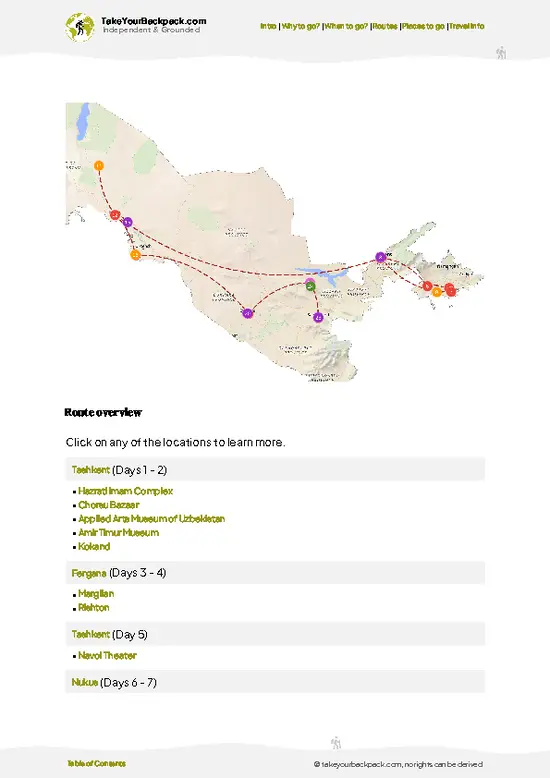
- Savitsky Museum, Nukus: The reason most people come. Thousands of avant-garde paintings, smuggled out of Soviet censorship, hang in a quiet provincial museum, alongside Karakalpak textiles and jewelry. Allow two to three hours.
- Moynaq Ship Graveyard: Rusting fishing boats lie on dry sand where the Aral Sea used to be. A small museum in town tells the story, and the sunset light here is something to see. In most years since 2018 the dry seabed by the ships has also hosted Stihia, an electronic music, art and science festival.
- Ayaz-Kala: Three fortresses sit on a hill and plain near the Kyzylkum desert. Climb the main fortress at first light and look out over a vast empty landscape.
- Toprak-Kala: A third-century palace complex with rooms still readable in the brick plan. Few visitors come, so you
- Savitsky Museum, Nukus: The reason most people come. Thousands of avant-garde paintings, smuggled out of Soviet censorship, hang in a quiet provincial museum, alongside Karakalpak textiles and jewelry. Allow two to three hours.
- Moynaq Ship Graveyard: Rusting fishing boats lie on dry sand where the Aral Sea used to be. A small museum in town tells the story, and the sunset light here is something to see. In most years since 2018 the dry seabed by the ships has also hosted Stihia, an electronic music, art and science festival.
- Ayaz-Kala: Three fortresses sit on a hill and plain near the Kyzylkum desert. Climb the main fortress at first light and look out over a vast empty landscape.
- Toprak-Kala: A third-century palace complex with rooms still readable in the brick plan. Few visitors come, so you wander the mud walls in silence.
- Kyzyl-Kala: A red-brick fortress with a sturdy, almost modern profile, easy to reach from the other Ellikqala sites.
- Mizdakhan Necropolis, Khodjeyli: A hilltop cemetery of mausoleums and graves spanning centuries, still used by locals today. Few foreigners stop here, but the view over town is excellent.
- Chilpik Dakhma: A circular Zoroastrian tower of silence on a rocky hill, once used for funeral rites. Small, strange and rarely visited.
- Ustyurt Plateau and Sudochye Lake: White chalk cliffs rise from the flat desert, and the lake sits like a mirage. Camp here under a very clear night sky.
- Aral Sea shore: A long 4x4 drive across the dry seabed north of Moynaq reaches today’s shoreline, with wide salt flats that show how far the water has retreated. Only possible with a guide and a sturdy vehicle.
- Nukus Bazaar: A local market where women sell dried fruit, bread and fabrics. Come for a cheap lunch and everyday life.
Spotted a mistake or missing something? Contact us.

Discover The Aral Sea With Ayimtour

Nukus to Khiva: Transfer with Top 4 Fortresses & Akchakul Lake

2 Days Private Tour To Aral Sea from Nukus.

Karakalpak Heritage Tour to Chimbay and Khalkabad Villages

Experience a Breathtaking Sunset at Aral Sea with Friendly People

2 Day Aral Sea Eco Tour with Yurt Stay from Nukus

Aral Sea - Lost Paradise

Photo Tour to Aral Sea from Khiva or Nukus

Eco Tour to the Aral Sea


 Best Backpacking
.jpg) Hi, I’m Johan (Netherlands 🇳🇱), the creator of TakeYourBackpack. Over the past 3 decades, I’ve backpacked through 90+ countries across six continents, gaining extensive experience with independent travel, long-term trips, and overland routes.
Hi, I’m Johan (Netherlands 🇳🇱), the creator of TakeYourBackpack. Over the past 3 decades, I’ve backpacked through 90+ countries across six continents, gaining extensive experience with independent travel, long-term trips, and overland routes.