×

Vanuatu🇻🇺 | regionsPentecost IslandNaghol towers, Saturday jumps, kastom villages, Pangi bungalows | things to do and best time to go

Explore Havannah HarbourExplore Rugged Coastline of Santo

Backpacking in Pentecost Island
🌟 Highlightregion ranked #4
By Johan Kruseman 🇳🇱 | Updated October 7, 2026

Pentecost is the birthplace of land diving, the Naghol, where men leap from wooden towers with only vines tied to their ankles. It also happens to be one of the few places in Vanuatu where village life runs on kastom rather than on a tourist timetable. The island lies in the north of Vanuatu, a long, narrow ridge of forest, gardens and black-sand coves. The jumps happen only on Saturdays in roughly April to June, when the vines are supple and the yams are ripening, so a visit outside that window shows you a quieter island, not a lesser one. Pay the village fee at the tower and arrive early, since the best leaps come late in the afternoon. Roads are rough, so hire a local truck and driver. Ask for a bungalow in Pangi or Wali, and you’ll hear drumming by dusk.

Discover everything you want to know in the 📖 Vanuatu Travel Guide.


Loading the map 🌍
CLICK TO FILTER
towns
villages
landmarks
national parks
hikes
beaches
attractions
festivals
regions
SHOW COUNTRY’S BESTSHOW ALL

✨ Why go?
Ranked #4 region in Vanuatu
Why Pentecost Island should be on your travel list

Pentecost rewards travelers who like to move slowly and stay put long enough to be invited in. The Naghol land diving in the south is the headline, but the island is long and thin, so one coastal road links villages, waterfalls and beaches without any need for ferries or flights between stops. That gives you real variety from a single base. Stay in a family-run bungalow, and your hosts will often explain the garden work, the weaving and the customs of their own village, which you rarely get on busier islands. The Wali Beach and Pangi coast offer swimming and quiet evenings, while the interior hosts hikes through forest and gardens. There is also the Sunday rest: most villages stop work, which means music from the churches and a slow day by design. If you want authenticity without crowds, this is the place.

💡 HighlightsWhat this place is best known for

  1. Naghol Land Diving Towers (Bunlap and Wali area): Men dive from towers up to about 30 meters high with vines tied to their ankles, in a ritual said to inspire bungee jumping. The season runs roughly April to June, on Saturdays.
  2. Bunlap Village: A traditional southern village where kastom stays visible in daily dress and routine, and the jump towers are close to hand.
  3. Pangi Beach: A quiet stretch on the west coast with simple bungalows, easy swimming and sunsets.
  4. Wali Beach: A calm bay with a sandy shore and village guesthouses, good for lazy snorkeling days.
  5. Baie Barrier: A sheltered bay where locals fish and kids swim, rarely visited by tourists.
  6. Waterfall near Ranwas: A forest cascade that locals use for bathing, reached by a short walk through gardens.
  7. Loltong Village: A friendly village with
… read more 👉
  1. Naghol Land Diving Towers (Bunlap and Wali area): Men dive from towers up to about 30 meters high with vines tied to their ankles, in a ritual said to inspire bungee jumping. The season runs roughly April to June, on Saturdays.
  2. Bunlap Village: A traditional southern village where kastom stays visible in daily dress and routine, and the jump towers are close to hand.
  3. Pangi Beach: A quiet stretch on the west coast with simple bungalows, easy swimming and sunsets.
  4. Wali Beach: A calm bay with a sandy shore and village guesthouses, good for lazy snorkeling days.
  5. Baie Barrier: A sheltered bay where locals fish and kids swim, rarely visited by tourists.
  6. Waterfall near Ranwas: A forest cascade that locals use for bathing, reached by a short walk through gardens.
  7. Loltong Village: A friendly village with a lively community feel and a welcoming market on trade days.
  8. Lonorore Airstrip: The main arrival point on the island, where you can watch life pass at the edge of the runway and arrange a truck south.
  9. Garden walks near Panas: Guided walks through yam and taro plots show how families farm, and hosts explain their tools and seasons.
  10. Sunday church singing in a village: Services fill the valleys with hymns in local voices, and visitors are welcomed quietly at the back.
Combine Wali Beach with a morning garden walk near Panas for an easy day that mixes swimming and local life.
Spotted a mistake or missing something? Contact us.
⌛️ 5 daysSeeing the highlights in 5 days

Day 1: Lonorore: Fly in and sort out transport first, because trucks are scarce and drivers set the pace of the whole island. Book a seat south the same afternoon so you reach your bungalow before dark.
Day 2: Pangi: Settle on the west coast, swim, and ask your hosts about local customs. This gives you a rest day after the flight and builds contact before you travel further.
Day 3: Bunlap: Head to the land diving area on a Saturday in season. Arrive early, as the road is slow and the jumps happen in the afternoon. The towers are the reason the journey exists, so give them your full day.
Day 4: Wali: Move to the beach and keep the day easy. Snorkel in the calm bay, then walk to a nearby village garden for a guided look at yam farming. A detour to the waterfall near Ranwas adds a cool forest swim … read more 👉
Day 1: Lonorore: Fly in and sort out transport first, because trucks are scarce and drivers set the pace of the whole island. Book a seat south the same afternoon so you reach your bungalow before dark.
Day 2: Pangi: Settle on the west coast, swim, and ask your hosts about local customs. This gives you a rest day after the flight and builds contact before you travel further.
Day 3: Bunlap: Head to the land diving area on a Saturday in season. Arrive early, as the road is slow and the jumps happen in the afternoon. The towers are the reason the journey exists, so give them your full day.
Day 4: Wali: Move to the beach and keep the day easy. Snorkel in the calm bay, then walk to a nearby village garden for a guided look at yam farming. A detour to the waterfall near Ranwas adds a cool forest swim and costs only a short walk.
Day 5: Loltong: Spend the last day around the market and the village, then return to the airstrip with time in hand, since flights rely on weather and trucks run late.
If you only have one day, make it Day 3, the dive itself.

🌤️ When to go?Choosing the right time of year

May to October is the dry, cooler stretch, and the Land Diving (Nagol) season falls inside it, from April to June.
  • Land Diving Season (April to June): Men leap from towers of lashed timber at Pentecost’s south end on Saturdays, with vines tied to their ankles. Highs run 27 to 30°C (81 to 86°F), and the yam harvest brings the biggest crowds the island sees. Book lodging weeks ahead.
  • Cool Dry Season (July to October): Humidity eases, nights drop to 19 to 21°C (66 to 70°F), and trails dry out for hiking. Days run about 11 hours of light.
  • Wet Season (November to March): Expect heat of 28 to 32°C (82 to 90°F), heavy downpours, muddy tracks and cyclone risk, especially January to March. Flights get canceled and rivers swell, but prices and crowds drop.
Arrive a week before the first dive so you can settle in and confirm which Saturday is running.

source: climatestotravel.comJANJanuary: below average for travelingFEBFebruary: below average for travelingMARMarch: below average for travelingAPRApril: fair for travelingMAYMay: excellent for travelingJUNJune: excellent for travelingJULJuly: excellent for travelingAUGAugust: excellent for travelingSEPSeptember: excellent for travelingOCTOctober: excellent for travelingNOVNovember: fair for travelingDECDecember: fair for traveling
when-to-go

✈️ The backpacker research shortcutVanuatu Travel Guide

An offline-friendly backpacking guide with optimized travel routes, ranked highlights, transport advice, and the best areas to stay.
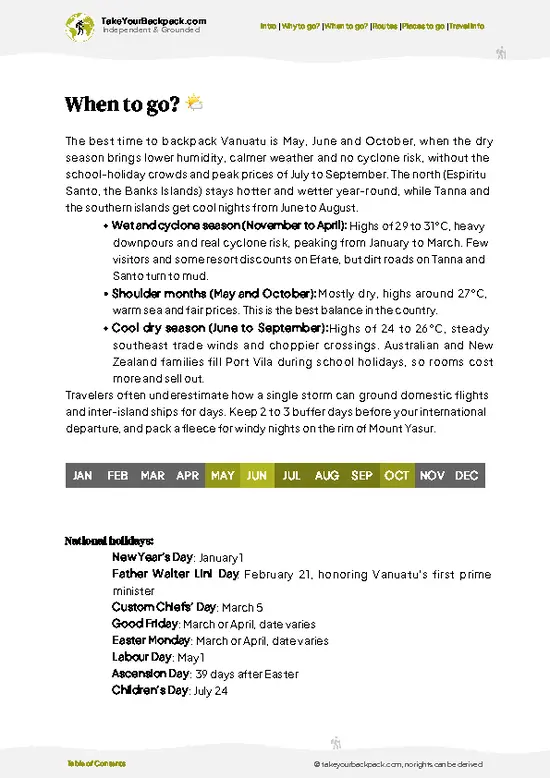
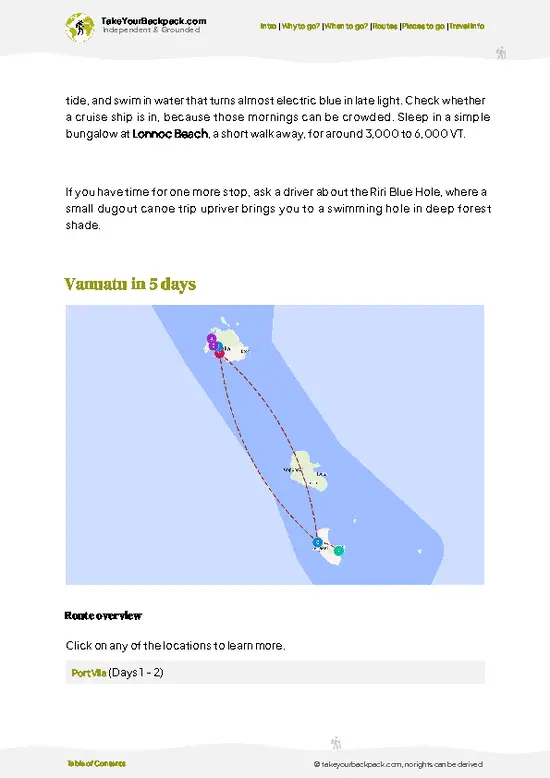
example page 0 from our offline Travel Guide for Vanuatu
example page 1 from our offline Travel Guide for Vanuatu
example page 2 from our offline Travel Guide for Vanuatu
example page 3 from our offline Travel Guide for Vanuatu
example page 4 from our offline Travel Guide for Vanuatu
example page 5 from our offline Travel Guide for Vanuatu
example page 6 from our offline Travel Guide for Vanuatu
example page 7 from our offline Travel Guide for Vanuatu
The digital guide (149 pages) contains:
✅ 41 highlights, ranked by travel appeal
✅ Optimized 2, 3 & 5-day travel routes
✅ Cities, national parks, landmarks, beaches
✅ How to get around
✅ Offline-friendly for travel without Wi-Fi
👉 Click to see all 30+ guide features

📅 Plan smarter in minutes, not weeks
✅ Month by month travel advice
✅ Festivals & national holidays
✅ Budget expectations

🗺️ Go to the right places, skip the overrated ones
✅ Honest pros & cons of destinations
✅ Top hikes, parks & viewpoints
✅ Lesser-known places most travelers miss
✅ Clear “worth it vs skip it” guidance

🛏️ Travel smoothly without rookie mistakes
✅ Best areas to stay
✅ Transport systems explained simply
✅ Common scams & safety advice
✅ SIM cards, money & practical tips

🌍 Understand the country, not just visit it
✅ Culture & traditions
✅ 52 Essential phrases & customs
✅ Festivals worth planning around
✅ Traveler-friendly historical context
✅ Insights that make places more meaningful

📱 Built for real travel conditions
✅ Fully downloadable PDF
✅ Works completely offline
✅ Optimized for phone use
✅ Useful in remote areas & buses
✅ Everything in one place
Save weeks of stressful planning
Get instant access to your full guide. 30‑day money-back guarantee.
+ Add another guide for just

By proceeding you agree to our terms.
Sent to your inbox immediately after payment • 100% Secure Checkout
Best Backpacking Travel Advisor 2025 tourism awardBest Backpacking
Travel Advisor
2025
What others say about Take Your Backpack Guides:
⭐⭐⭐⭐⭐
Fantastic, amazing amount of information!
⭐⭐⭐⭐⭐
My goodness this is amazing, it's what I've been looking for hats off too you!
⭐⭐⭐⭐⭐
I think this is absolutely BRILLIANT
⭐⭐⭐⭐
Very complete and informative. It's still missing places, but I gotta to commend you
⭐⭐⭐⭐⭐
This is truly amazing, thank you, can't wait to explore it with my kids!
⭐⭐⭐⭐⭐
Awesome resource, thank you!
⭐⭐⭐⭐⭐
This is amazing! Can't wait to explore the ones I haven't seen
⭐⭐⭐⭐
I love this! Well done, great idea.
⭐⭐⭐⭐⭐
Thanks for taking the time to make this gem!
⭐⭐⭐⭐⭐
This might be the best website I've ever seen.
⭐⭐⭐⭐⭐
Congratulations, and thank you so much for your work; it's incredibly valuable.
⭐⭐⭐⭐
In all seriousness I think you did a great job pointing out the important spots
⭐⭐⭐⭐⭐
10/10 very good
⭐⭐⭐⭐⭐
As someone who's only just starting to visit regularly this is awesome, thank you.
⭐⭐⭐⭐
Thank you very much! I'm going to visit my dad, it's going to be very useful!
⭐⭐⭐⭐⭐
This is really cool! We'll be travelling for the first time and this definitely come in handy.
⭐⭐⭐⭐⭐
You are now our minister of culture, congratulations 👨‍💼
⭐⭐⭐⭐⭐
Just wanted to tell you that this is a pearl! Going to follow your recommendations.
⭐⭐⭐⭐⭐
This is so cool. I'll definitely be using the resource for my travels soon.
⭐⭐⭐⭐⭐
This is very impressive! Good work.
⭐⭐⭐⭐⭐
This is an amazing and informative site. Very well done!

🛏️ Where to stay?Where staying makes the most sense

Base yourself in the southern villages around Wali and Bunlap if the land dive is your goal, and in the north near Lonorore and Melsisi for beaches and easy airstrip access. Southern stays are village guesthouses and bungalows, usually run by local families, with meals included and shared bucket showers. You sleep within walking distance of the Nagol towers, hear the dive preparations, and join evening kava or string-band sessions if invited. It is quiet and social in a very local way, with no nightlife beyond conversation. The north has a bit more road traffic, good black-sand and reef swimming, … read more 👉
Base yourself in the southern villages around Wali and Bunlap if the land dive is your goal, and in the north near Lonorore and Melsisi for beaches and easy airstrip access. Southern stays are village guesthouses and bungalows, usually run by local families, with meals included and shared bucket showers. You sleep within walking distance of the Nagol towers, hear the dive preparations, and join evening kava or string-band sessions if invited. It is quiet and social in a very local way, with no nightlife beyond conversation. The north has a bit more road traffic, good black-sand and reef swimming, hot springs near Baie Barrier, and more guesthouse choice. Both areas feel safe, with visitors known by name across the village by the second day. Solo travelers do well here because meals are communal and hosts often introduce you to guides for hikes. Electricity is limited and mobile signal comes and goes, so plan to switch off. Book ahead in the diving season, April to June, when beds fill. Arrange village visits through your host so fees reach the community, as customs and landowners differ from one village to the next.

🚌 Getting aroundGetting around like a local

The villages here are strung out along a coast, so walking works inside a village or between close neighbors, but it stops making sense past a few kilometers where the road turns to rough track and steep ridges. Most backpackers fly in, then ride shared trucks along the one main road. It is slow and unscheduled, but it works if you plan around it.
  • Domestic flights: Air Vanuatu and partner carriers link Port Vila and Luganville to airstrips at Lonorore (north-central) and Ra Lava; fares run roughly US$100 to 180 each way. Flights run only a few times a week and cancel in bad weather, so keep a spare day before an international departure.
  • Pickup trucks: Shared 4WD trucks serve the road between Lonorore, Melsisi and the southern villages. Rides cost about 500 to 3,000 vatu (US$4 to 25) depending
… read more 👉
The villages here are strung out along a coast, so walking works inside a village or between close neighbors, but it stops making sense past a few kilometers where the road turns to rough track and steep ridges. Most backpackers fly in, then ride shared trucks along the one main road. It is slow and unscheduled, but it works if you plan around it.
  • Domestic flights: Air Vanuatu and partner carriers link Port Vila and Luganville to airstrips at Lonorore (north-central) and Ra Lava; fares run roughly US$100 to 180 each way. Flights run only a few times a week and cancel in bad weather, so keep a spare day before an international departure.
  • Pickup trucks: Shared 4WD trucks serve the road between Lonorore, Melsisi and the southern villages. Rides cost about 500 to 3,000 vatu (US$4 to 25) depending on distance. Departures follow demand, not a timetable, so ask your host the night before to line up a seat.
  • Charter trucks: Hiring a whole truck costs far more, often 8,000 to 20,000 vatu (US$65 to 165), and suits groups headed to the Nagol site. Split it with other travelers at your guesthouse.
  • Boats: Inter-island cargo boats from Luganville take 8 to 14 hours and cost around US$30 to 60. Schedules shift constantly, so treat them as a bonus, not a plan.
  • Walking: Coastal paths between villages take 1 to 3 hours and are the best way to meet people. Bring water, since shops are scarce.
Roads wash out in heavy rain, so message your guesthouse a day ahead, carry cash in small vatu notes, and let your host arrange transport because they know which truck is actually running.

🍲 FoodWhat to Eat & Drink

Eating on Pentecost means laplap, grated yam or manioc pounded into paste, topped with coconut cream and pork or chicken, then baked in an earth oven until smoky and dense. Yam is the island’s pride, and in season it appears in every form, roasted, boiled, or mashed with coconut milk. Fresh reef fish, grilled over open coals, comes with island cabbage (aelan kabis) that tastes like mild spinach, and sweet tropical fruit including papaya, pomelo and bananas.

There are few restaurants. Most meals happen at your guesthouse, where hosts cook over a fire and serve family-style on the porch. Small village canteens sell packaged biscuits, tinned fish, rice and instant noodles, and weekly produce stalls appear on market days. Bring snacks from Luganville or Port Vila for hiking days.

The drink to … read more 👉
Eating on Pentecost means laplap, grated yam or manioc pounded into paste, topped with coconut cream and pork or chicken, then baked in an earth oven until smoky and dense. Yam is the island’s pride, and in season it appears in every form, roasted, boiled, or mashed with coconut milk. Fresh reef fish, grilled over open coals, comes with island cabbage (aelan kabis) that tastes like mild spinach, and sweet tropical fruit including papaya, pomelo and bananas.

There are few restaurants. Most meals happen at your guesthouse, where hosts cook over a fire and serve family-style on the porch. Small village canteens sell packaged biscuits, tinned fish, rice and instant noodles, and weekly produce stalls appear on market days. Bring snacks from Luganville or Port Vila for hiking days.

The drink to know is kava, brewed from pounded root, earthy and numbing on the tongue. It is traditionally a men’s evening ritual, so ask your host before joining. Drink it in one gulp, then spit, and stay quiet afterward. Cool coconut water is everywhere. Always accept shared food, because refusing can offend, and wash your hands before eating from communal dishes. Tap water is not reliable, so carry purification tablets or a filter.

FAQTraveler FAQ

Three to five days works well for Pentecost Island. Day one is typically spent traveling in, since flights to Lonorore only operate a few days each week. Add a day for beaches and hot springs in the north, and one or two for the southern villages like Wali and Bunlap, especially if a Saturday Nagol land dive is scheduled between April and June.
Without a car, you rely on flights, shared pickup trucks and your own feet. Small planes reach the island’s airstrips from Port Vila and Luganville for roughly US$100 to 180 one way. On the island, shared trucks cost about 500 to 3,000 vatu (US$4 to 25) per ride, and your guesthouse can arrange seats or a charter for larger groups.
Pentecost is known as the birthplace of land diving, called Nagol, which inspired modern bungee jumping. Men leap headfirst from wooden towers up to about 30 meters tall with vines tied to their ankles, every Saturday from April to June during the yam harvest. Beyond the dives, the island offers black-sand beaches, village homestays, hot springs and strong kastom traditions.
⚠️ Things can change over time, so always validate details locally before you go.

Other Ni-Vanuatu regions near Pentecost Island

Explore more nearby:

  • Bokissa Island—Adults-only resort islet, house reef, western sunsets, one-night splurge| 79 km away
  • Rugged Coastline of Santo—Blue holes, Champagne Beach, Port Olry, east coast truck road| 107 km away
  • Aore Island—President Coolidge wreck, Segond Channel, plantation lanes, five-minute boat hop| 110 km away

💡 Not sure where to go next?
Create a personalized itinerary for Vanuatu including Pentecost Island and the places that fit your trip.

Generate my itinerary

👉 Discover all regions

Or checkout all Vanuatu has to offer (think cities, towns, villages, national parks, hikes, beaches, festivals)
Country photo of Vanuatu

We 💚 feedbackSumming up the experience

The classic mistake is flying in on a random day and expecting to see the dive. It only happens on Saturdays in season, so time your arrival around it and confirm with your host first. Also bring cash in small notes, since there are no ATMs, and pack a rain jacket for the road.

✍️ Help improve this page!
The information on this page is based on in-depth research, insights shared by experienced travelers, and feedback from the local travel community in Vanuatu. While every effort is made to keep the information accurate and current, conditions can change — so if you spot anything incorrect or outdated, please get in touch.


🙋‍♂️ Give feedback

👋 Meet the founderWho’s Behind Take Your Backpack?

Johan, backpacker and founder of TakeYourBackpackHi, I’m Johan (Netherlands 🇳🇱), the creator of TakeYourBackpack. Over the past 3 decades, I’ve backpacked through 90+ countries across six continents, gaining extensive experience with independent travel, long-term trips, and overland routes.

This site is built on a combination of firsthand travel experience and carefully curated insights from other backpackers. Many guides are based on places I’ve personally visited, while others bring together tips, observations, and practical advice shared by trusted travelers I’ve met along the way.

The goal is to provide realistic, experience-driven guidance — not generic itineraries — so you can explore destinations with better context, clearer expectations, and more confidence.