×

Algeria🇩🇿 | citiesConstantineGorge bridges, Ahmed Bey palace, copper lanes, cable car | things to do and best time to go

Explore AnnabaExplore Ghardaïa

Backpacking in Constantine
🏆 Top pickcity ranked #3
By Johan Kruseman 🇳🇱 | Updated October 22, 2026

Constantine is famous for its bridges, seven of them stitched across a limestone gorge where swifts and pigeons wheel two hundred meters above the Rhumel river. What gets overlooked is the gradient: the old city is a steep, stair-cut rock, so taxis are cheap and walking is a leg workout. Experienced travelers wear grippy shoes, because the polished stone steps turn slick after rain, and they ride the cable car up rather than climb. Constantine sits in the northeast of Algeria, inland from the Mediterranean coast. It suits curious, patient travelers who like old cities with grit, and it frustrates anyone wanting hostels, nightlife or English signs. Expect traffic horns, diesel haze and sweet honey-and-almond pastry smells, with very little tourist infrastructure. Most mornings, the call to prayer rolls down the gorge walls and comes back as an echo.

Discover everything you want to know in the 📖 Algeria Travel Guide.


example page 0 from our offline Travel Guide for Algeria
example page 1 from our offline Travel Guide for Algeria
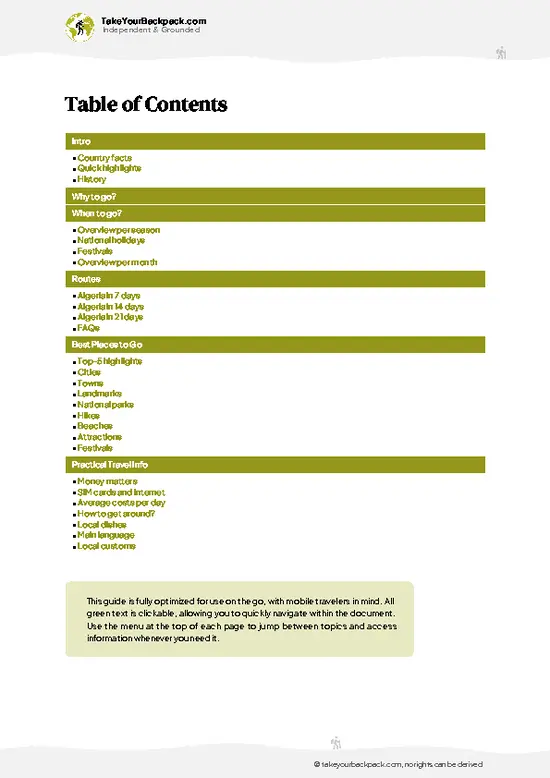
example page 2 from our offline Travel Guide for Algeria
example page 3 from our offline Travel Guide for Algeria
example page 4 from our offline Travel Guide for Algeria
example page 5 from our offline Travel Guide for Algeria
example page 6 from our offline Travel Guide for Algeria
example page 7 from our offline Travel Guide for Algeria
Loading the map 🌍
CLICK TO FILTER
cities
towns
landmarks
national parks
hikes
beaches
attractions
festivals
SHOW COUNTRY’S BESTSHOW ALL

✨ Why go?
Ranked #3 city in Algeria
Why Constantine should be on your travel list

Constantine earns its place on an Algerian route because it packs more sights per square kilometer than almost any other inland city in the country, and nearly all of them sit on one rocky plateau. You can see the main gorge bridges in a day on foot, then spend a second day on the museums and the old Souika quarter. Food is the other draw: this is the home of tlitli, a hand-rolled pasta dish, and of sticky jawzia nougat sold from small shops in the center. The city also works as a transport hinge, with a rail line toward the coast and an airport that links to Algiers and abroad, so you can arrive overland and leave by air or the reverse. Be realistic about comfort. Budget hotels are few, evenings are quiet and foreign visitors are still a novelty, which means long, friendly conversations but … read more 👉
Constantine earns its place on an Algerian route because it packs more sights per square kilometer than almost any other inland city in the country, and nearly all of them sit on one rocky plateau. You can see the main gorge bridges in a day on foot, then spend a second day on the museums and the old Souika quarter. Food is the other draw: this is the home of tlitli, a hand-rolled pasta dish, and of sticky jawzia nougat sold from small shops in the center. The city also works as a transport hinge, with a rail line toward the coast and an airport that links to Algiers and abroad, so you can arrive overland and leave by air or the reverse. Be realistic about comfort. Budget hotels are few, evenings are quiet and foreign visitors are still a novelty, which means long, friendly conversations but also plenty of curious stares. Two nights is the right dose.

💡 HighlightsWhat this place is best known for

  1. Sidi M’Cid Bridge and the gorge viewpoints: A suspension bridge from the early twentieth century hangs roughly 175 meters over the Rhumel, and the views down the cliff face are the image everyone associates with the city. Go in the morning when the light hits the rock face. It is free to walk across, and 30 to 45 minutes is plenty.
  2. Salah Bey Footbridge: A modern pedestrian bridge linking the old town with the hospital hill, with long views both ways along the canyon. Late afternoon is best for photos. It costs nothing and takes about 20 to 30 minutes with stops.
  3. Ahmed Bey Palace: The Ottoman governor’s residence from the nineteenth century, with painted arcades, tiled courtyards and orange-tree gardens. The murals of imagined cities are the highlight. Entry is roughly US$1 to 2, and 1 to 1.5
… read more 👉
  1. Sidi M’Cid Bridge and the gorge viewpoints: A suspension bridge from the early twentieth century hangs roughly 175 meters over the Rhumel, and the views down the cliff face are the image everyone associates with the city. Go in the morning when the light hits the rock face. It is free to walk across, and 30 to 45 minutes is plenty.
  2. Salah Bey Footbridge: A modern pedestrian bridge linking the old town with the hospital hill, with long views both ways along the canyon. Late afternoon is best for photos. It costs nothing and takes about 20 to 30 minutes with stops.
  3. Ahmed Bey Palace: The Ottoman governor’s residence from the nineteenth century, with painted arcades, tiled courtyards and orange-tree gardens. The murals of imagined cities are the highlight. Entry is roughly US$1 to 2, and 1 to 1.5 hours is enough. Go early before school groups arrive.
  4. Emir Abdelkader Mosque: One of the largest mosques in Africa, with two tall minarets and a huge prayer hall. Visit outside prayer times and dress modestly. Entry is usually free to the public, and a visit takes about 45 minutes.
  5. Cirta National Museum: Numidian, Roman and Islamic-era artifacts, including funerary steles and bronze statuary from the region. Good for understanding why this rock mattered for two thousand years. Tickets are around US$1 to 2, and 1 to 1.5 hours works.
  6. Constantine Cable Car: A short ride that lifts you from the lower town up toward the hilltop, passing over rooftops and the gorge edge. Fares are well under US$1, and the ride is about 10 minutes each way. Mornings are less crowded.
  7. Monument aux Morts: A hilltop war memorial with a panoramic terrace over the whole city and the plains beyond. Best late afternoon, when the stone turns warm. Free, and 30 to 40 minutes is enough.
  8. Souika Quarter and the old copper lanes: Narrow alleys with pastry shops, tailors and metalworkers beating trays and pots. Go before noon, when workshops are busy. Walking costs nothing and takes 1 to 2 hours; buying a small copper piece runs about US$5 to 20.
From Constantine, the Roman hill town of Tiddis, the great ruins at Djemila and the coastal city of Skikda can all be reached as day trips. The cheapest sights in the city are the bridges, the Monument aux Morts terrace and the Souika lanes, which cost nothing at all.
Spotted a mistake or missing something? Contact us.

🏘️ NeighborhoodsNeighborhood guide to Constantine

Constantine sits on a rock split by the Rhumel gorge, so the areas are defined by bridges and slopes, not by a grid. Wear shoes with grip, because the old stone streets are polished smooth and steep.
  • Old City (Souk El Asser and the Medina): Narrow lanes smell of fried dough, copper polish and fresh bread. Craft stalls sell brass trays and embroidered velvet, and the din of hammering starts by mid-morning. It is compact and walkable, but the stairs are relentless, so go early before the lanes clog and shops shut for the midday lull.
  • Rue Larbi Ben M’hidi (the old Rue Nationale) and Place du 1er Novembre: The main promenade of the center runs along Ottoman and French-era facades, with bakeries, pastry counters and cafés filled with men over small coffees. It is flat enough to stroll and the best
… read more 👉
Constantine sits on a rock split by the Rhumel gorge, so the areas are defined by bridges and slopes, not by a grid. Wear shoes with grip, because the old stone streets are polished smooth and steep.
  • Old City (Souk El Asser and the Medina): Narrow lanes smell of fried dough, copper polish and fresh bread. Craft stalls sell brass trays and embroidered velvet, and the din of hammering starts by mid-morning. It is compact and walkable, but the stairs are relentless, so go early before the lanes clog and shops shut for the midday lull.
  • Rue Larbi Ben M’hidi (the old Rue Nationale) and Place du 1er Novembre: The main promenade of the center runs along Ottoman and French-era facades, with bakeries, pastry counters and cafés filled with men over small coffees. It is flat enough to stroll and the best place to people-watch in the evening. Nightlife means tea, ice cream and talk, not clubs, because alcohol venues are scarce and discreet.
  • Sidi M’Cid and the bridge area: Here the gorge opens beneath the suspension bridge and the cable car, with wind whistling through the cables and swifts wheeling below. Views are the point. The walk from the center is uphill, so take a short taxi up and walk down.
  • Bab El Kantara and the Rhumel riverside: Arched bridges frame the drop to the river, and the air turns cool and damp in the shade. Cafés cluster at the station end. Walkable in daylight, but footpaths along the gorge are rough and best done with a local guide.
  • Zouaghi and the modern outskirts: Wide boulevards, malls and the huge Emir Abdelkader mosque with its tall minarets. Distances are long and hot, so use a taxi.

⌛️ 1 dayWhat you can realistically do in a day

8:30 AM: Sidi M’Cid Bridge and the Rhumel Gorge
Start here, because the light on the limestone is soft and the traffic is thin. Walk across the suspension bridge, which hangs about 175 meters above the river, and look down into the gorge. Wind makes the deck hum a little, and pigeons clatter out of the cliff face. Then walk or take a short taxi ride toward the old city.

10:00 AM: Palais d’Ahmed Bey
This early 19th-century palace has painted garden walls, tiled courtyards and carved wooden ceilings. Allow about 90 minutes and bring small cash for the entry fee, which is only a couple of dollars. The murals of imagined cities are the detail to study slowly. Afterward, drop down through the lanes to the medina.

12:00 PM: Rue Abane Ramdane and the Souk
The old commercial streets are narrow, loud … read more 👉
8:30 AM: Sidi M’Cid Bridge and the Rhumel Gorge
Start here, because the light on the limestone is soft and the traffic is thin. Walk across the suspension bridge, which hangs about 175 meters above the river, and look down into the gorge. Wind makes the deck hum a little, and pigeons clatter out of the cliff face. Then walk or take a short taxi ride toward the old city.

10:00 AM: Palais d’Ahmed Bey
This early 19th-century palace has painted garden walls, tiled courtyards and carved wooden ceilings. Allow about 90 minutes and bring small cash for the entry fee, which is only a couple of dollars. The murals of imagined cities are the detail to study slowly. Afterward, drop down through the lanes to the medina.

12:00 PM: Rue Abane Ramdane and the Souk
The old commercial streets are narrow, loud and smell of frying dough, coffee and leather. Look for copper workers and sellers of traditional sweets. I would eat a quick lunch of chorba or a grilled sandwich at a simple counter here, then keep moving, since the crowds get dense by 1 PM.

2:00 PM: Rue des Frères Bouchama and the Rahbat Essouf quarter
Most visitors skip this quieter stretch of the old town, where traditional doors, worn stairs and small workshops sit above the gorge. Wander without a plan for an hour, and keep your phone tucked away when the alleys narrow. Residents are generally curious and polite if you greet them first.

3:30 PM: Cirta National Museum
The collection covers Numidian, Roman and Islamic Constantine, including steles and mosaics from the ancient city of Cirta. Plan for an hour. It is a short taxi ride from the old town, and the air-conditioned rooms are a welcome break after a long walk.

5:30 PM: Emir Abdelkader Mosque
Finish at the huge mosque and university, with its tall minarets and calm courtyards. Go in the late afternoon, when the stone glows warmly and the call to prayer carries across the city. Dress modestly and ask politely before entering the prayer areas. Then cross to the cafés nearby for mint tea and a sweet pastry as the lights come on over the gorge.

🌤️ When to go?Weather, crowds, and seasonal trade-offs

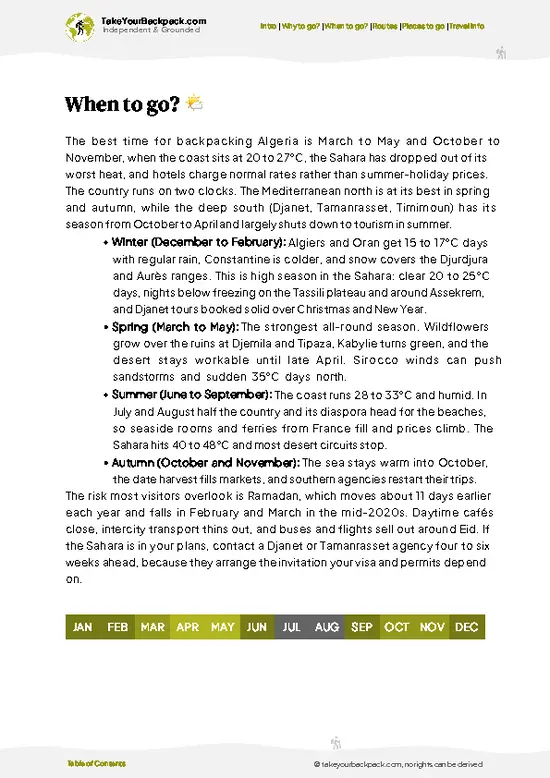
Constantine is best in spring and autumn, when days are mild and the gorge walks are pleasant. It has a Mediterranean-influenced climate with real winters at around 650 meters of altitude.
  • Spring (April to June): Highs of 18 to 28°C (64 to 82°F), green hills and long daylight. Crowds stay light and prices steady.
  • Summer (July to August): Hot and dry, with highs of 32 to 38°C (90 to 100°F) and occasional hotter spells. Streets empty at midday. Domestic visitors and returning expatriates push up accommodation prices.
  • Autumn (September to November): Highs of 20 to 30°C (68 to 86°F), cooler evenings and occasional heavy rain late in the season. Good for hiking and photography.
  • Winter (December to March): Highs of 8 to 14°C (46 to 57°F), nights near freezing, frequent rain and occasional snow. Daylight
… read more 👉
Constantine is best in spring and autumn, when days are mild and the gorge walks are pleasant. It has a Mediterranean-influenced climate with real winters at around 650 meters of altitude.
  • Spring (April to June): Highs of 18 to 28°C (64 to 82°F), green hills and long daylight. Crowds stay light and prices steady.
  • Summer (July to August): Hot and dry, with highs of 32 to 38°C (90 to 100°F) and occasional hotter spells. Streets empty at midday. Domestic visitors and returning expatriates push up accommodation prices.
  • Autumn (September to November): Highs of 20 to 30°C (68 to 86°F), cooler evenings and occasional heavy rain late in the season. Good for hiking and photography.
  • Winter (December to March): Highs of 8 to 14°C (46 to 57°F), nights near freezing, frequent rain and occasional snow. Daylight is short, sites are quiet and rooms are cheapest.
Book ahead around Eid holidays, when transport and rooms fill with visiting families.


source: climatestotravel.comJANJanuary: fair for travelingFEBFebruary: fair for travelingMARMarch: good for travelingAPRApril: excellent for travelingMAYMay: excellent for travelingJUNJune: excellent for travelingJULJuly: fair for travelingAUGAugust: below average for travelingSEPSeptember: highly recommended for travelingOCTOctober: highly recommended for travelingNOVNovember: good for travelingDECDecember: fair for traveling
when-to-go

✈️ The backpacker research shortcutAlgeria Travel Guide

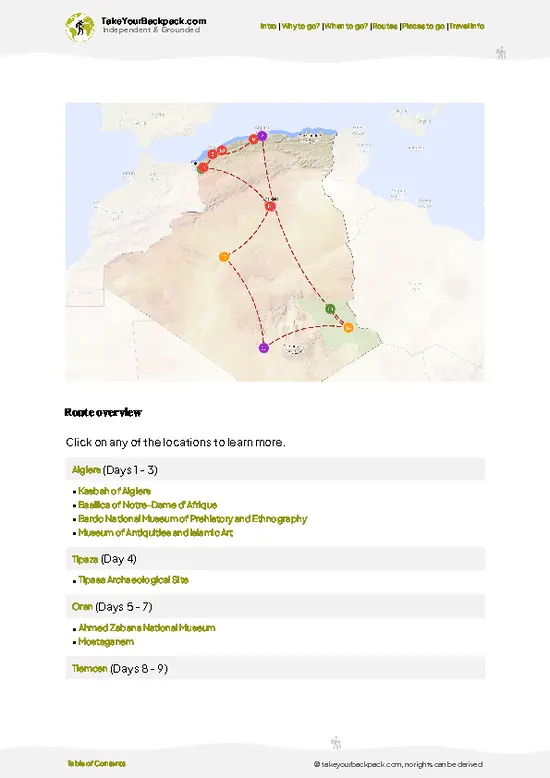
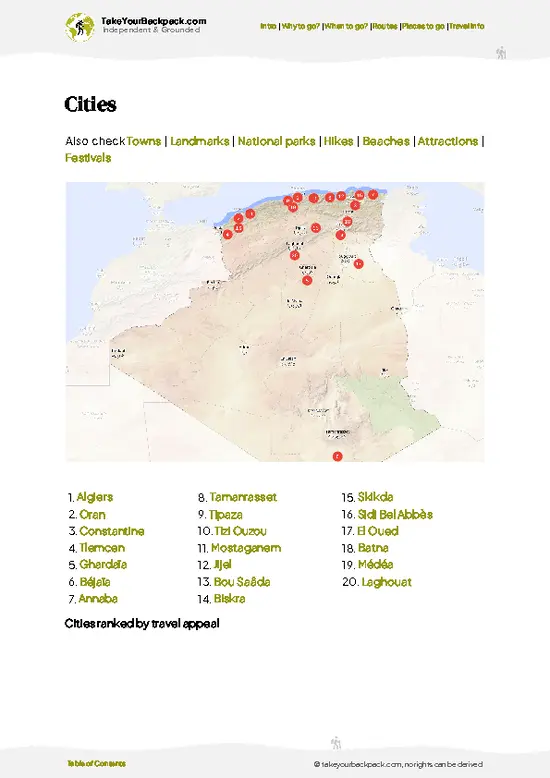
An offline-friendly backpacking guide with optimized travel routes, ranked highlights, transport advice, and the best areas to stay.
example page 0 from our offline Travel Guide for Algeria
example page 1 from our offline Travel Guide for Algeria
example page 2 from our offline Travel Guide for Algeria
example page 3 from our offline Travel Guide for Algeria
example page 4 from our offline Travel Guide for Algeria
example page 5 from our offline Travel Guide for Algeria
example page 6 from our offline Travel Guide for Algeria
example page 7 from our offline Travel Guide for Algeria
The digital guide (314 pages) contains:
✅ 79 highlights, ranked by travel appeal
✅ Optimized 7, 14 & 21-day travel routes
✅ Cities, national parks, landmarks, beaches
✅ How to get around
✅ Offline-friendly for travel without Wi-Fi
👉 Click to see all 30+ guide features

📅 Plan smarter in minutes, not weeks
✅ Month by month travel advice
✅ Festivals & national holidays
✅ Budget expectations

🗺️ Go to the right places, skip the overrated ones
✅ Honest pros & cons of destinations
✅ Top hikes, parks & viewpoints
✅ Lesser-known places most travelers miss
✅ Clear “worth it vs skip it” guidance

🛏️ Travel smoothly without rookie mistakes
✅ Best areas to stay
✅ Transport systems explained simply
✅ Common scams & safety advice
✅ SIM cards, money & practical tips

🌍 Understand the country, not just visit it
✅ Culture & traditions
✅ 52 Essential phrases & customs
✅ Festivals worth planning around
✅ Traveler-friendly historical context
✅ Insights that make places more meaningful

📱 Built for real travel conditions
✅ Fully downloadable PDF
✅ Works completely offline
✅ Optimized for phone use
✅ Useful in remote areas & buses
✅ Everything in one place
Stop searching, start planning
Get instant access to your full guide. 30‑day money-back guarantee.
+ Add another guide for just

By proceeding you agree to our terms.
Sent to your inbox immediately after payment • 100% Secure Checkout
Best Backpacking Travel Advisor 2025 tourism awardBest Backpacking
Travel Advisor
2025
What others say about Take Your Backpack Guides:
⭐⭐⭐⭐⭐
Fantastic, amazing amount of information!
⭐⭐⭐⭐⭐
My goodness this is amazing, it's what I've been looking for hats off too you!
⭐⭐⭐⭐⭐
I think this is absolutely BRILLIANT
⭐⭐⭐⭐
Very complete and informative. It's still missing places, but I gotta to commend you
⭐⭐⭐⭐⭐
This is truly amazing, thank you, can't wait to explore it with my kids!
⭐⭐⭐⭐⭐
Awesome resource, thank you!
⭐⭐⭐⭐⭐
This is amazing! Can't wait to explore the ones I haven't seen
⭐⭐⭐⭐
I love this! Well done, great idea.
⭐⭐⭐⭐⭐
Thanks for taking the time to make this gem!
⭐⭐⭐⭐⭐
This might be the best website I've ever seen.
⭐⭐⭐⭐⭐
Congratulations, and thank you so much for your work; it's incredibly valuable.
⭐⭐⭐⭐
In all seriousness I think you did a great job pointing out the important spots
⭐⭐⭐⭐⭐
10/10 very good
⭐⭐⭐⭐⭐
As someone who's only just starting to visit regularly this is awesome, thank you.
⭐⭐⭐⭐
Thank you very much! I'm going to visit my dad, it's going to be very useful!
⭐⭐⭐⭐⭐
This is really cool! We'll be travelling for the first time and this definitely come in handy.
⭐⭐⭐⭐⭐
You are now our minister of culture, congratulations 👨‍💼
⭐⭐⭐⭐⭐
Just wanted to tell you that this is a pearl! Going to follow your recommendations.
⭐⭐⭐⭐⭐
This is so cool. I'll definitely be using the resource for my travels soon.
⭐⭐⭐⭐⭐
This is very impressive! Good work.
⭐⭐⭐⭐⭐
This is an amazing and informative site. Very well done!

🛏️ Where to stay?Best areas and accommodation options

The city center around Rue Larbi Ben M’hidi and the old city edge is the best area for a budget stay in Constantine. Hostels are almost nonexistent, so expect small hotels and guesthouses, usually US$20 to 45 a night for a private room, with the cheapest options near the station. Staying centrally lets you walk to cafés, the medina and bus stops, and street life keeps the area comfortable after dark.
Noise is the main downside. Traffic and late-evening café chatter carry through thin windows, so ask for a room facing the back or an upper floor. The tram area toward the university district is a … read more 👉
The city center around Rue Larbi Ben M’hidi and the old city edge is the best area for a budget stay in Constantine. Hostels are almost nonexistent, so expect small hotels and guesthouses, usually US$20 to 45 a night for a private room, with the cheapest options near the station. Staying centrally lets you walk to cafés, the medina and bus stops, and street life keeps the area comfortable after dark.
Noise is the main downside. Traffic and late-evening café chatter carry through thin windows, so ask for a room facing the back or an upper floor. The tram area toward the university district is a good second choice, since it has quieter streets, modern apartments and rooms, and a quick tram link to the center. Taxis are harder to catch late at night there, so plan your return before dark. Book ahead during Eid and summer, when families visit.

🚌 Getting aroundGetting around like a local

Constantine punishes anyone who tries to cross the city on foot in a straight line, because the gorge, bridges and steep slopes turn a short distance on the map into a long, hilly detour. Walk the old city and downtown, then use wheels for everything else. The city is crowded and traffic is thick, especially at rush hour, when horns echo up the gorge walls.
  • Walking: Free and the best way to see the medina, the bridges and Rue Larbi Ben M’hidi. Stone steps are slick after rain, and slopes tire legs fast, so pace yourself and carry water in warm months.
  • Taxis: The practical choice for hills and the outskirts. Rides inside the city usually cost US$1 to 4, and drivers expect you to agree the price first if there is no working meter. Taxis are plentiful on main streets until late evening, and ride-hailing
… read more 👉
Constantine punishes anyone who tries to cross the city on foot in a straight line, because the gorge, bridges and steep slopes turn a short distance on the map into a long, hilly detour. Walk the old city and downtown, then use wheels for everything else. The city is crowded and traffic is thick, especially at rush hour, when horns echo up the gorge walls.
  • Walking: Free and the best way to see the medina, the bridges and Rue Larbi Ben M’hidi. Stone steps are slick after rain, and slopes tire legs fast, so pace yourself and carry water in warm months.
  • Taxis: The practical choice for hills and the outskirts. Rides inside the city usually cost US$1 to 4, and drivers expect you to agree the price first if there is no working meter. Taxis are plentiful on main streets until late evening, and ride-hailing apps operate in Algeria too.
  • City buses and minibuses: Cheap at roughly US$0.20 to 0.50 a ride, they cover the center and the suburbs but are packed at peak times, with no clear maps. Ask the driver or a fellow passenger for the right line before boarding. Most stop running in the evening.
  • Tram: A modern line links the center with the university area and the southern suburbs for about US$0.25 to 0.40 a ticket. It is clean, quiet, and runs from early morning to evening, so it is the easiest way to escape the traffic.
  • Cable car (téléphérique): Several lines cross the gorge, and the ride gives wide views of the cliffs for about US$0.30 to 0.60. Hours can be affected by wind or maintenance, so check locally before planning around it.
Carry small change, since drivers rarely break large notes.

👛 Costs (as of 22 October 2026)Typical daily expenses

Constantine costs about US$31 to 65 a day for a backpacker, and the table below uses US$51 as a typical total. Prices are low by European standards, and you pay in cash in the local currency.
CategoryBudget RangeLocal Reality
Dorm accommodation (high season)US$15 to 25Real hostels are rare, so this is a cheap room or shared guesthouse space in summer and holidays.
Dorm accommodation (off-season)US$10 to 18Winter rooms are easier to negotiate.
MealsUS$8 to 14Sandwiches, grilled meat and pastries are cheap, while sit-down meals cost more.
Local transportUS$2 to 5Short taxi rides and buses.
City transport passUS$1 to 3No tourist pass, so this is the cost of tram and cable car tickets.
Basic activities and entry feesUS$2 to 6Museums and sites charge small entry fees.
MiscellaneousUS$3 to 8Coffee, water,
… read more 👉
Constantine costs about US$31 to 65 a day for a backpacker, and the table below uses US$51 as a typical total. Prices are low by European standards, and you pay in cash in the local currency.
CategoryBudget RangeLocal Reality
Dorm accommodation (high season)US$15 to 25Real hostels are rare, so this is a cheap room or shared guesthouse space in summer and holidays.
Dorm accommodation (off-season)US$10 to 18Winter rooms are easier to negotiate.
MealsUS$8 to 14Sandwiches, grilled meat and pastries are cheap, while sit-down meals cost more.
Local transportUS$2 to 5Short taxi rides and buses.
City transport passUS$1 to 3No tourist pass, so this is the cost of tram and cable car tickets.
Basic activities and entry feesUS$2 to 6Museums and sites charge small entry fees.
MiscellaneousUS$3 to 8Coffee, water, SIM data and souvenirs.
Total Daily BudgetUS$31 to 65Per person, per day, in high season.
Save money by eating bakery snacks and grilled sandwiches for lunch, and agree taxi fares before you get in.


source: algeria.com
⚠️ Prices can change and everyone travels differently, so take this as a rough guide. Hope it helps you plan your adventure!

🚌 Day tripsExploring the surroundings

Constantine works well as a base because shared taxis and buses reach several major Roman sites in under two hours, and every trip returns the same day.Tiddis: Perched on a rocky ridge, this Roman and Berber hill settlement has houses, a mill and a forum-like area with views over wild countryside. It is about 30 to 40 kilometers away and takes roughly an hour by taxi. Costs for a budget traveler are around US$10 to 25 for the round trip, including a negotiated taxi wait. Go in spring or autumn, and wear sturdy shoes because the paths are uneven and shadeless.
Djémila: The well-preserved Roman town of Cuicul has a forum, temples and mosaics set among green hills, and it is UNESCO-listed. Allow 2 to 3 hours each way via Sétif by bus or shared taxi, so start before dawn. Total costs run about … read more 👉
Constantine works well as a base because shared taxis and buses reach several major Roman sites in under two hours, and every trip returns the same day.Tiddis: Perched on a rocky ridge, this Roman and Berber hill settlement has houses, a mill and a forum-like area with views over wild countryside. It is about 30 to 40 kilometers away and takes roughly an hour by taxi. Costs for a budget traveler are around US$10 to 25 for the round trip, including a negotiated taxi wait. Go in spring or autumn, and wear sturdy shoes because the paths are uneven and shadeless.
Djémila: The well-preserved Roman town of Cuicul has a forum, temples and mosaics set among green hills, and it is UNESCO-listed. Allow 2 to 3 hours each way via Sétif by bus or shared taxi, so start before dawn. Total costs run about US$15 to 30 with entry. Many first-timers underestimate the road time and arrive too late to see the whole site.
👉 Explore DjémilaGuelma: A relaxed provincial town with a well-restored Roman theater and hot springs nearby at Hammam Debagh. It is about two hours away by bus or shared taxi, with costs of roughly US$10 to 20. Visit in spring when the countryside is green.
👉 Explore GuelmaKhemissa: Roman Thubursicum Numidarum has a theater, baths and a forum on a high plain. It is farther afield, so hire a taxi for the day, at about US$40 to 70 split between travelers. Winter can be cold and wet.

🍲 FoodLocal Flavors for Backpackers

Constantine has its own table, and the food here leans toward Ottoman-influenced sweets and slow-cooked stews. Try chakhchoukha constantinoise, torn flatbread in a spiced tomato and meat sauce, and jawzia, a rich lamb and nut dish often served at celebrations. The local tlitli is fine pasta in a cinnamon-scented sauce with chicken and chickpeas, quite different from the couscous served elsewhere.
For sweets, the city is known for makroud and baklava style pastries soaked in honey, and mhalbi, a milky rice pudding. Buy them from pastry counters along Rue Larbi Ben M’hidi, still warm and sticky. Bakeries also sell crisp mhadjeb stuffed flatbreads, a cheap snack.
For casual meals, look for small grill shops and sandwich counters in the center, plus café terraces for strong coffee and mint tea. … read more 👉
Constantine has its own table, and the food here leans toward Ottoman-influenced sweets and slow-cooked stews. Try chakhchoukha constantinoise, torn flatbread in a spiced tomato and meat sauce, and jawzia, a rich lamb and nut dish often served at celebrations. The local tlitli is fine pasta in a cinnamon-scented sauce with chicken and chickpeas, quite different from the couscous served elsewhere.
For sweets, the city is known for makroud and baklava style pastries soaked in honey, and mhalbi, a milky rice pudding. Buy them from pastry counters along Rue Larbi Ben M’hidi, still warm and sticky. Bakeries also sell crisp mhadjeb stuffed flatbreads, a cheap snack.
For casual meals, look for small grill shops and sandwich counters in the center, plus café terraces for strong coffee and mint tea. The old city markets smell of roasting spices, fresh bread and orange blossom water. Alcohol is hard to find, so tea and coffee are the social drinks. Eating is usually with the right hand, and sharing a dish is common.

🛡️ SafetyStaying Safe: What Travelers Should Know

Constantine is broadly safe for travelers, and the usual problems are small ones. Pickpocketing happens in crowded places such as the medina lanes, markets, buses and the tram at rush hour, so carry your phone and wallet in front pockets and keep a bag zipped. Women traveling alone will often attract stares and calls, which are best ignored with a firm, polite no. After dark, stay on lit main streets and take a taxi home instead of walking the steep, empty alleys of the old city. Gorge paths and bridge edges are uneven, and cliff-side railings can be low, so take care when taking photos. Taxi drivers may quote inflated prices to foreigners, so agree the fare before getting in. Carry a photocopy of your passport, since police checkpoints and ID checks do happen. Photographing government buildings … read more 👉
Constantine is broadly safe for travelers, and the usual problems are small ones. Pickpocketing happens in crowded places such as the medina lanes, markets, buses and the tram at rush hour, so carry your phone and wallet in front pockets and keep a bag zipped. Women traveling alone will often attract stares and calls, which are best ignored with a firm, polite no. After dark, stay on lit main streets and take a taxi home instead of walking the steep, empty alleys of the old city. Gorge paths and bridge edges are uneven, and cliff-side railings can be low, so take care when taking photos. Taxi drivers may quote inflated prices to foreigners, so agree the fare before getting in. Carry a photocopy of your passport, since police checkpoints and ID checks do happen. Photographing government buildings or officials can cause trouble, so ask first.

FAQFrequently asked questions about Constantine

Two days cover Constantine itself: one for the old city, the bridges and the cable car, and one for the museums and the Emir Abdelkader mosque. Add one or two more days for day trips to Tiddis (about an hour away) or Djémila (2 to 3 hours each way). Most visitors spend 2 to 3 days in total.
Constantine is considered fairly safe for solo backpackers, with petty theft in crowded markets and on buses as the main concern. Keep valuables in front pockets, avoid empty old city alleys after dark, and agree taxi fares before riding, which typically cost US$1 to 4. Women traveling alone may get stares, but a firm, polite response usually ends it.
Constantine is known as the City of Bridges because of the Rhumel gorge, which is crossed by several bridges including the Sidi M’Cid suspension bridge. It is also famous for its old city, Ottoman-era streets, the huge Emir Abdelkader mosque and its sweet pastries such as makroud. The Roman sites of Tiddis and Djémila are a short trip away.
⚠️ Things can change over time, so always validate details locally before you go.

Other Algerian cities near Constantine

Explore more nearby:

  • Mila—Sidi Ghanem mosque, Byzantine walls, Milevum finds, Beni Haroun dam| 36 km away
  • Skikda—Rusicade theater, colonial arcades, Stora sand, harbor dusk| 61 km away
  • Guelma—Roman theater, Calama walls, Hammam Debagh cascades, valley farmland| 72 km away

💡 Not sure where to go next?
Create a personalized itinerary for Algeria including Constantine and the places that fit your trip.

Generate my itinerary

👉 Discover all cities

Or checkout all Algeria has to offer (think cities, towns, villages, national parks, hikes, beaches, festivals)
Country photo of Algeria

We 💚 feedbackIs it worth it?

Constantine suits travelers who like climbing stairs, striking up conversations with strangers and eating whatever the pastry seller recommends. If you need polished tourism infrastructure, skip it. I would bring sturdy shoes, carry small bills for taxis and cafés, and start every day early, before the heat and traffic make the steep streets harder work.

✍️ Help improve this page!
The information on this page is based on in-depth research, insights shared by experienced travelers, and feedback from the local travel community in Algeria. While every effort is made to keep the information accurate and current, conditions can change — so if you spot anything incorrect or outdated, please get in touch.


🙋‍♂️ Give feedback

👋 Meet the founderWho’s Behind Take Your Backpack?

Johan, backpacker and founder of TakeYourBackpackHi, I’m Johan (Netherlands 🇳🇱), the creator of TakeYourBackpack. Over the past 3 decades, I’ve backpacked through 90+ countries across six continents, gaining extensive experience with independent travel, long-term trips, and overland routes.

This site is built on a combination of firsthand travel experience and carefully curated insights from other backpackers. Many guides are based on places I’ve personally visited, while others bring together tips, observations, and practical advice shared by trusted travelers I’ve met along the way.

The goal is to provide realistic, experience-driven guidance — not generic itineraries — so you can explore destinations with better context, clearer expectations, and more confidence.