×

Algeria🇩🇿 | attractionsMuseum of Antiquities and Islamic ArtRoman sculptures, Islamic ceramics, archaeological finds | things to do and best time to go

Explore Ketchaoua MosqueExplore National Museum of Fine Arts of Algiers

Backpacking in Museum of Antiquities and Islamic Art
👌 Worth visitingattraction ranked #14
By Johan Kruseman 🇳🇱 | Updated May 11, 2026

Forget the Instagram fantasy of wandering alone through echoing marble halls—Algiers’ Museum of Antiquities and Islamic Art is no secret sanctuary. It’s right in the heart of the capital, perched on the edge of the Jardin de la Liberté, and yes, you’ll share the space with school groups, local families, and the occasional tour bus. But here’s the real hook: this isn’t some sterile, over-curated mausoleum. The museum’s collection is a wild, sometimes chaotic, deep-dive into Algeria’s layered soul—Roman mosaics with chipped edges, Berber jewelry that looks ready to be worn out the door, Islamic calligraphy that hums with centuries of devotion. The entry fee is laughably low, especially compared to the sticker shock of European museums, but don’t expect slick signage or air-conditioned comfort. You come here for the raw, unvarnished history—less polished than the Casbah, but more intimate. It’s not adrenaline, it’s awe, and it’s absolutely worth the detour for anyone craving the real story behind Algeria’s crossroads.

Discover everything you want to know in the 📖 Algeria Travel Guide.


Get your Algeria guide
91 ranked highlights, routes & tips, works offline (356 pages)
Loading the map 🌍
CLICK TO FILTER
cities
towns
landmarks
national parks
hikes
beaches
attractions
festivals
SHOW COUNTRY’S BESTSHOW ALL

✨ Why go?
Ranked #14 attraction in Algeria
The unique appeal for travelers

The Museum of Antiquities and Islamic Art in Algeria isn’t just another stop on the tourist checklist—it’s a heavyweight in the country’s cultural ring. Sure, it’s not tucked away in some quiet corner; expect crowds, especially during peak hours. But here’s the kicker: this place packs a punch that justifies every minute you spend navigating through the throng. It’s a crucial milestone for anyone serious about understanding Algeria beyond the surface. The museum’s collection spans millennia, showcasing artifacts that trace the country’s complex history from ancient Numidian kingdoms to the golden age of Islamic civilization. This isn’t just about pretty pottery or dusty relics; it’s a living narrative of Algeria’s identity, told through exquisite mosaics, intricate calligraphy, and monumental … read more 👉
The Museum of Antiquities and Islamic Art in Algeria isn’t just another stop on the tourist checklist—it’s a heavyweight in the country’s cultural ring. Sure, it’s not tucked away in some quiet corner; expect crowds, especially during peak hours. But here’s the kicker: this place packs a punch that justifies every minute you spend navigating through the throng. It’s a crucial milestone for anyone serious about understanding Algeria beyond the surface. The museum’s collection spans millennia, showcasing artifacts that trace the country’s complex history from ancient Numidian kingdoms to the golden age of Islamic civilization. This isn’t just about pretty pottery or dusty relics; it’s a living narrative of Algeria’s identity, told through exquisite mosaics, intricate calligraphy, and monumental sculptures. The adrenaline rush here comes from peeling back layers of history that textbooks barely touch, feeling the weight of empires rise and fall in one room. For backpackers threading through Algeria’s vast landscapes, this museum is a cultural anchor—a place where the country’s past and present collide, offering context that transforms every step of your journey into something richer and more meaningful. Skip it, and you’re missing the backbone of Algeria’s story.
Want to include Museum of Antiquities and Islamic Art in your Algeria route?
Create a personalized Algeria itinerary that includes Museum of Antiquities and Islamic Art and the places that fit your trip — based on your travel style, budget, and available time. Get your route in seconds.

Generate my trip

💡 HighlightsDon't-miss highlights and experiences

Roman Mosaics That Outclass Your Screensaver
Forget the pixel-perfect Instagram edits—these ancient mosaics are the real deal. Pulled from Roman sites across Algeria, the floors here are so detailed you’ll catch yourself squinting at the tiny tesserae, tracing out mythological scenes and wild animals. The colors haven’t faded into polite museum pastels; they’re still bold, still telling stories of gladiators, gods, and everyday life. You’re not just looking at art—you’re standing on the same ground as Roman aristocrats and Berber craftsmen. No filter needed.


The Islamic Calligraphy Hall: Script as Power
This isn’t a room of dusty scrolls. The calligraphy here is kinetic—swooping, looping, and sometimes downright aggressive in its beauty. You’ll see Qur’anic verses carved into marble, painted … read more 👉
Roman Mosaics That Outclass Your Screensaver
Forget the pixel-perfect Instagram edits—these ancient mosaics are the real deal. Pulled from Roman sites across Algeria, the floors here are so detailed you’ll catch yourself squinting at the tiny tesserae, tracing out mythological scenes and wild animals. The colors haven’t faded into polite museum pastels; they’re still bold, still telling stories of gladiators, gods, and everyday life. You’re not just looking at art—you’re standing on the same ground as Roman aristocrats and Berber craftsmen. No filter needed.


The Islamic Calligraphy Hall: Script as Power
This isn’t a room of dusty scrolls. The calligraphy here is kinetic—swooping, looping, and sometimes downright aggressive in its beauty. You’ll see Qur’anic verses carved into marble, painted on wood, and even stitched into textiles. The artistry is a flex: a reminder that in the Islamic world, the written word was both a spiritual tool and a status symbol. If you think handwriting is a lost art, this hall will make you want to pick up a pen again.


Numidian and Berber Artifacts: The Pre-Roman Powerhouses
Most museums in North Africa skip straight to the Romans, but here, the indigenous Numidian and Berber collections get their due. Weapons, jewelry, and pottery that predate the empire by centuries—each piece a reminder that Algeria’s story didn’t start with a toga. The craftsmanship is raw and direct, with geometric patterns and bold metalwork that feel surprisingly modern. You’ll leave with a new respect for the cultures that shaped the Maghreb long before Caesar’s legions showed up.


Ottoman Ceramics: Color, Chaos, and Everyday Luxury
The Ottoman ceramics section is a riot of color and pattern, with tiles and dishes that once brightened up palaces and ordinary homes alike. These aren’t precious objects locked behind glass—they’re the kind of plates you’d want to eat off if you weren’t worried about a security guard tackling you. The glazes are thick, the blues and greens almost electric, and the designs are a mash-up of Turkish, Arab, and local Algerian influences. It’s a crash course in how empires blend, clash, and leave their mark on the dinner table.


The Building Itself: Colonial Grandeur with a North African Soul
Here’s the part the travel brochures skip: the museum is housed in a French colonial-era palace, all marble staircases and sunlit courtyards. But look closer and you’ll spot the mash-up—Andalusian arches, North African tilework, and a layout that feels more like a labyrinth than a gallery. It’s a living artifact, proof that Algeria’s history is layered, complicated, and impossible to flatten into a single narrative. The building is as much a part of the experience as anything inside.
Spotted a mistake or missing something? Contact us.

Things to do around Museum of Antiquities and Islamic Art

Ratings based on Tripadvisor reviews. When you book through this link, you support our work at no extra cost to you.

🌤️ When to go?When to go for the best experience


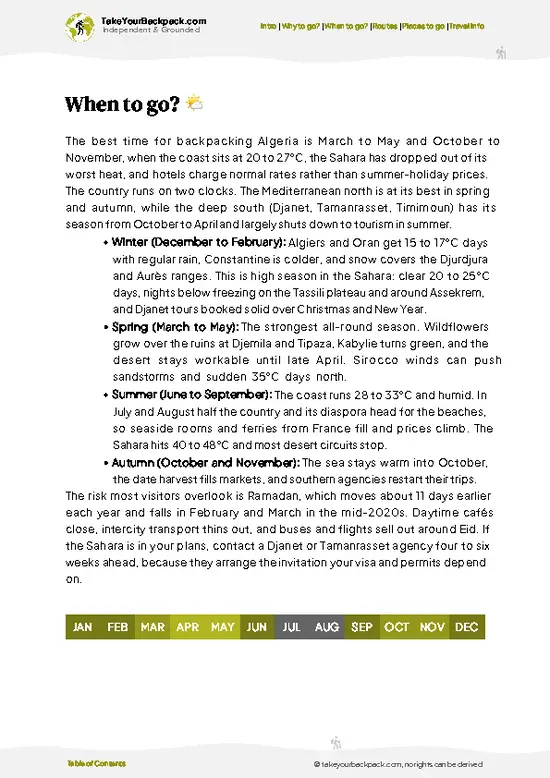
  • Topic: Weather and Temperature – The best time to visit the Museum of Antiquities and Islamic Art in Algiers is during spring (April to June) and autumn (September to October). Expect mild temperatures ranging from 15°C to 25°C (59°F to 77°F), perfect for wandering without sweating through your shirt or shivering in a jacket. Summers can scorch you with highs above 30°C (86°F), while winters dip to around 10°C (50°F), which is fine but less comfortable for exploring.

  • Topic: Daylight Hours – From April to October, daylight stretches from about 12 to 14 hours, giving you ample time to soak in the museum’s rich collections and stroll nearby without rushing. Winter months shrink daylight to roughly 10 hours, which can cramp your sightseeing plans if you’re on a tight schedule.

  • Topic: Crowds
read more 👉

  • Topic: Weather and Temperature – The best time to visit the Museum of Antiquities and Islamic Art in Algiers is during spring (April to June) and autumn (September to October). Expect mild temperatures ranging from 15°C to 25°C (59°F to 77°F), perfect for wandering without sweating through your shirt or shivering in a jacket. Summers can scorch you with highs above 30°C (86°F), while winters dip to around 10°C (50°F), which is fine but less comfortable for exploring.

  • Topic: Daylight Hours – From April to October, daylight stretches from about 12 to 14 hours, giving you ample time to soak in the museum’s rich collections and stroll nearby without rushing. Winter months shrink daylight to roughly 10 hours, which can cramp your sightseeing plans if you’re on a tight schedule.

  • Topic: Crowds – The museum isn’t a tourist magnet like the pyramids, but summer (July and August) sees more local families and school groups, making it less peaceful. Visiting in shoulder seasons (spring and autumn) means fewer crowds, letting you appreciate the artifacts without elbowing through selfie sticks.

  • Topic: Seasonal Activities – Spring and autumn often host cultural events and temporary exhibitions that add layers to your visit. Winter is quieter, with fewer special programs, while summer’s heat can limit outdoor activities around the museum.

  • Topic: Price Fluctuations – Entry fees remain stable year-round, but accommodation and flights spike in summer due to holiday travel. Booking in spring or autumn can save you money and stress, letting you invest more in local experiences rather than inflated prices.


Pro-tip: Aim for late April or early October—cool weather, manageable crowds, and a richer cultural calendar make these months the sweet spot for a genuine, hassle-free visit.


source: climatestotravel.comJANJanuary: fair for travelingFEBFebruary: fair for travelingMARMarch: good for travelingAPRApril: excellent for travelingMAYMay: excellent for travelingJUNJune: excellent for travelingJULJuly: good for travelingAUGAugust: good for travelingSEPSeptember: excellent for travelingOCTOctober: excellent for travelingNOVNovember: good for travelingDECDecember: fair for traveling
when-to-go

✈️ The backpacker research shortcutAlgeria Travel Guide

An offline-friendly backpacking guide with optimized travel routes, ranked highlights, transport advice, and the best areas to stay.
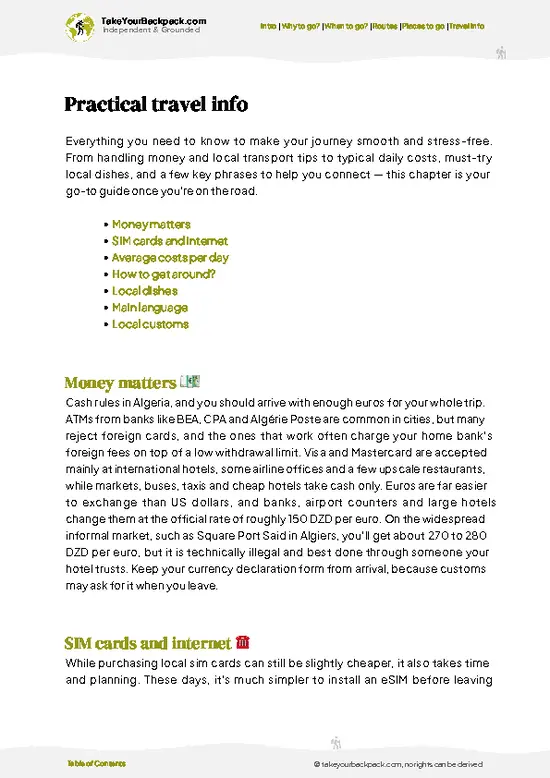
example page 0 from our offline Travel Guide for Algeria
example page 1 from our offline Travel Guide for Algeria
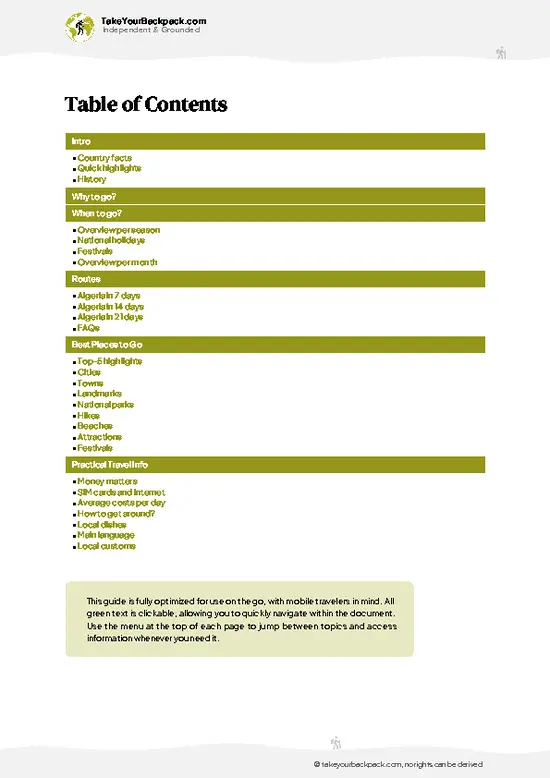
example page 2 from our offline Travel Guide for Algeria
example page 3 from our offline Travel Guide for Algeria
example page 4 from our offline Travel Guide for Algeria
example page 5 from our offline Travel Guide for Algeria
example page 6 from our offline Travel Guide for Algeria
example page 7 from our offline Travel Guide for Algeria
The digital guide (356 pages) contains:
91 highlights, ranked by travel appeal
Optimized 7, 14 & 21-day travel routes
Cities, national parks, landmarks, beaches
How to get around
Offline-friendly for travel without Wi-Fi
👉 Click to see all 30+ guide features

📅 Plan smarter in minutes, not weeks
Month by month travel advice
Festivals & national holidays
Budget expectations

🗺️ Go to the right places, skip the overrated ones
Honest pros & cons of destinations
Top hikes, parks & viewpoints
Lesser-known places most travelers miss
Clear “worth it vs skip it” guidance

🛏️ Travel smoothly without rookie mistakes
Best areas to stay
Transport systems explained simply
Common scams & safety advice
SIM cards, money & practical tips

🌍 Understand the country, not just visit it
Culture & traditions
52 Essential phrases & customs
Festivals worth planning around
Traveler-friendly historical context
Insights that make places more meaningful

📱 Built for real travel conditions
Fully downloadable PDF
Works completely offline
Optimized for phone use
Useful in remote areas & buses
Everything in one place
Save weeks of stressful planning
Get instant access to your full guide. 30‑day money-back guarantee.


By proceeding you agree to our terms.
Sent to your inbox immediately after payment • 100% Secure Checkout
Best Backpacking Travel Advisor 2025 tourism awardBest Backpacking
Travel Advisor
2025
What others say about Take Your Backpack Guides:
⭐⭐⭐⭐⭐
Fantastic, amazing amount of information!
⭐⭐⭐⭐⭐
My goodness this is amazing, it's what I've been looking for hats off too you!
⭐⭐⭐⭐⭐
I think this is absolutely BRILLIANT
⭐⭐⭐⭐
Very complete and informative. It's still missing places, but I gotta to commend you
⭐⭐⭐⭐⭐
This is truly amazing, thank you, can't wait to explore it with my kids!
⭐⭐⭐⭐⭐
Awesome resource, thank you!
⭐⭐⭐⭐⭐
This is amazing! Can't wait to explore the ones I haven't seen
⭐⭐⭐⭐
I love this! Well done, great idea.
⭐⭐⭐⭐⭐
Thanks for taking the time to make this gem!
⭐⭐⭐⭐⭐
This might be the best website I've ever seen.
⭐⭐⭐⭐⭐
Congratulations, and thank you so much for your work; it's incredibly valuable.
⭐⭐⭐⭐
In all seriousness I think you did a great job pointing out the important spots
⭐⭐⭐⭐⭐
10/10 very good
⭐⭐⭐⭐⭐
As someone who's only just starting to visit regularly this is awesome, thank you.
⭐⭐⭐⭐
Thank you very much! I'm going to visit my dad, it's going to be very useful!
⭐⭐⭐⭐⭐
This is really cool! We'll be travelling for the first time and this definitely come in handy.
⭐⭐⭐⭐⭐
You are now our minister of culture, congratulations 👨‍💼
⭐⭐⭐⭐⭐
Just wanted to tell you that this is a pearl! Going to follow your recommendations.
⭐⭐⭐⭐⭐
This is so cool. I'll definitely be using the resource for my travels soon.
⭐⭐⭐⭐⭐
This is very impressive! Good work.
⭐⭐⭐⭐⭐
This is an amazing and informative site. Very well done!

🛏️ Where to stay?Choosing the right base

If you’re backpacking to see the Museum of Antiquities and Islamic Art in Algiers, brace yourself: the city center is a mixed bag. It’s not a polished tourist playground, and the crowds aren’t like the ones you’d dodge in Paris or Rome. Instead, you’ll find a gritty, real urban pulse that’s both a challenge and a reward. The immediate area around the museum is safe enough during the day but can feel a bit deserted or sketchy after dark, especially if you’re solo and unfamiliar with local rhythms.

For backpackers who want to be close but not stuck in a tourist bubble, the best bet is to base yourself … read more 👉
If you’re backpacking to see the Museum of Antiquities and Islamic Art in Algiers, brace yourself: the city center is a mixed bag. It’s not a polished tourist playground, and the crowds aren’t like the ones you’d dodge in Paris or Rome. Instead, you’ll find a gritty, real urban pulse that’s both a challenge and a reward. The immediate area around the museum is safe enough during the day but can feel a bit deserted or sketchy after dark, especially if you’re solo and unfamiliar with local rhythms.

For backpackers who want to be close but not stuck in a tourist bubble, the best bet is to base yourself in the neighborhoods of Kasbah or El Madania. Kasbah is where the city’s soul lives—narrow alleys, street vendors, and a social vibe that’s raw and authentic. It’s a place where you can meet locals and fellow travelers alike, but you’ll need to keep your wits about you. El Madania offers a slightly calmer, more residential feel with cafes and small eateries where you can unwind and connect without the constant hustle.

Both areas are budget-friendly and popular with solo travelers who want to dive into Algiers’ complex character rather than just skim the surface. You won’t find polished hostels with Instagram-ready lobbies here, but you will find places where the real stories of the city unfold. That’s the trade-off—and the real magic.

👛 Costs (as of 14 March 2025)Typical daily expenses

As of the most recent estimates, the National Museum of Antiquities and Islamic Art in Algiers charges an entrance fee of approximately 200 Algerian Dinars (DZD), which is about €1 to €2. ([alger.mta.gov.dz](https://alger.mta.gov.dz/en/national-museum-of-antiquities-and-islamic-arts/?utm_source=openai)) This fee grants access to both the Antiquities and Islamic Art sections. Additional costs may include photography fees or guided tours, but specific details are not provided in the available sources.
⚠️ Prices can change and everyone travels differently, so take this as a rough guide. Hope it helps you plan your adventure!

Other Algerian attractions near Museum of Antiquities and Islamic Art

Explore more nearby:


💡 Not sure where to go next?
Create a personalized itinerary for Algeria including Museum of Antiquities and Islamic Art and the places that fit your trip.

Generate my itinerary

👉 Discover all attractions

Or checkout all Algeria has to offer (think cities, towns, villages, national parks, hikes, beaches, festivals)
Country photo of Algeria

We 💚 feedbackParting advice and final tips

The Museum of Antiquities and Islamic Art in Algiers isn’t going to wow you with crowds or flashy displays—it’s quiet, a bit dusty, and feels like stepping into a scholar’s private collection. The real magic is in the details: ancient mosaics that whisper stories, intricate calligraphy that demands a closer look. Don’t expect polished tourist traps here; expect to slow down and soak in history that’s raw and real. If you’re after Instagram moments, look elsewhere. But if you want to feel the pulse of Algeria’s past, this place hits deep.

✍️ Help improve this page!
The information on this page is based on in-depth research, insights shared by experienced travelers, and feedback from the local travel community in Algeria. While every effort is made to keep the information accurate and current, conditions can change — so if you spot anything incorrect or outdated, please get in touch.


🙋‍♂️ Give feedback

👋 Meet the founderWho’s Behind Take Your Backpack?

Johan, backpacker and founder of TakeYourBackpackHi, I’m Johan (Netherlands 🇳🇱), the creator of TakeYourBackpack. Over the past decade, I’ve backpacked through 80+ countries across six continents, gaining extensive experience with independent travel, long-term trips, and overland routes.

This site is built on a combination of firsthand travel experience and carefully curated insights from other backpackers. Many guides are based on places I’ve personally visited, while others bring together tips, observations, and practical advice shared by trusted travelers I’ve met along the way.

The goal is to provide realistic, experience-driven guidance — not generic itineraries — so you can explore destinations with better context, clearer expectations, and more confidence.

Get full Algeria guide •
Instant download • 91 highlights • Full Offline guide