

×

Argentina🇦🇷 | villagesEl ChalténFitz Roy views, trailheads from town, craft beer pubs, hostel dinners | things to do and best time to go

Explore Mar de AnsenuzaExplore La Cumbrecita

Backpacking in El Chaltén
🏆 Top pickvillage ranked #1
By Johan Kruseman 🇳🇱 | Updated October 19, 2026

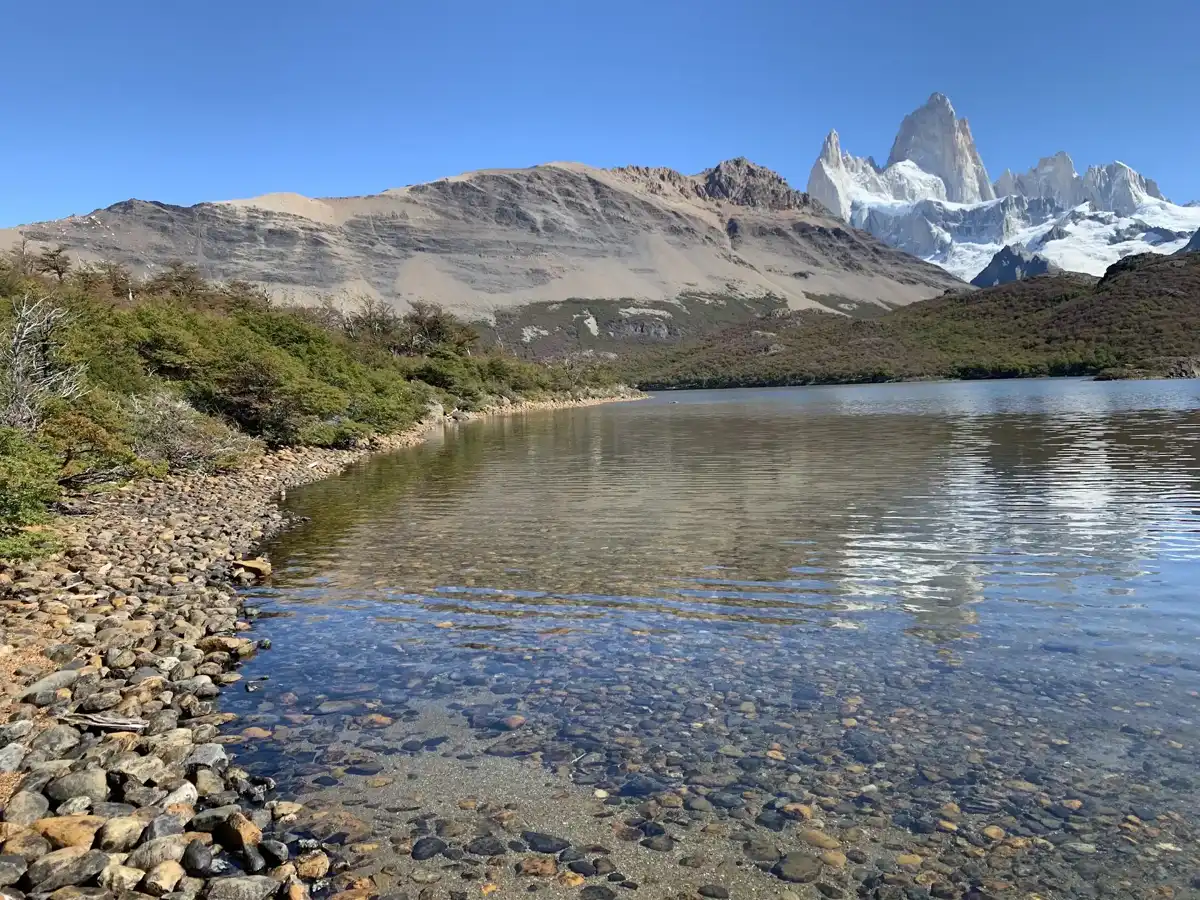
The wind hits you the second you step off the bus, a steady shove against your shoulders that never really stops the whole time you're in town. El Chaltén sits in Santa Cruz province, deep in Argentine Patagonia, at the northern edge of Los Glaciares National Park. It's less a village than a trailhead with beds attached, built in the 1980s and still feeling raw around the edges. Backpackers stop here for one reason: Fitz Roy and Cerro Torre are visible from the main street, and world-class hikes start literally from town, no shuttle required. Evenings are quiet, communal, early. Hostels cook big shared dinners, and you'll know half the common room by name after one night. I remember sitting outside a hostel kitchen at 9pm, still light out, eating pasta while Fitz Roy turned pink behind steam rising off my mate. Quieter and more hiker-focused than El Calafate, less polished, more purposeful.

Discover everything you want to know in the 📖 Argentina Travel Guide.


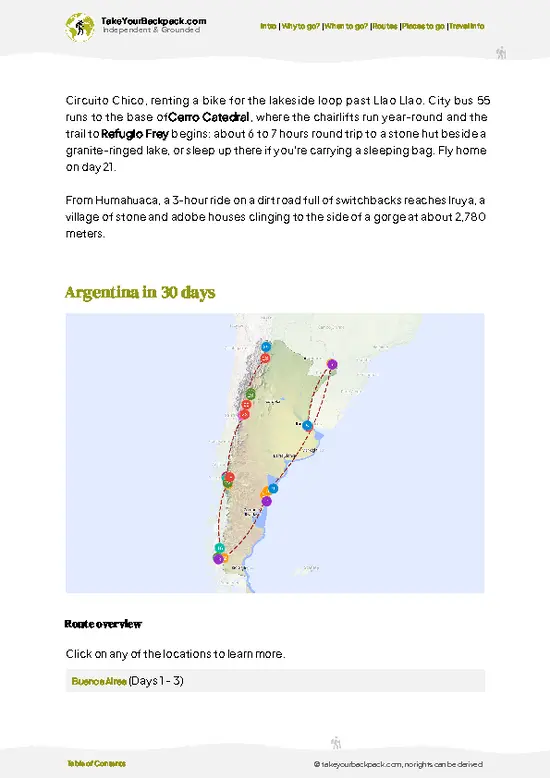
example page 0 from our offline Travel Guide for Argentina
example page 1 from our offline Travel Guide for Argentina
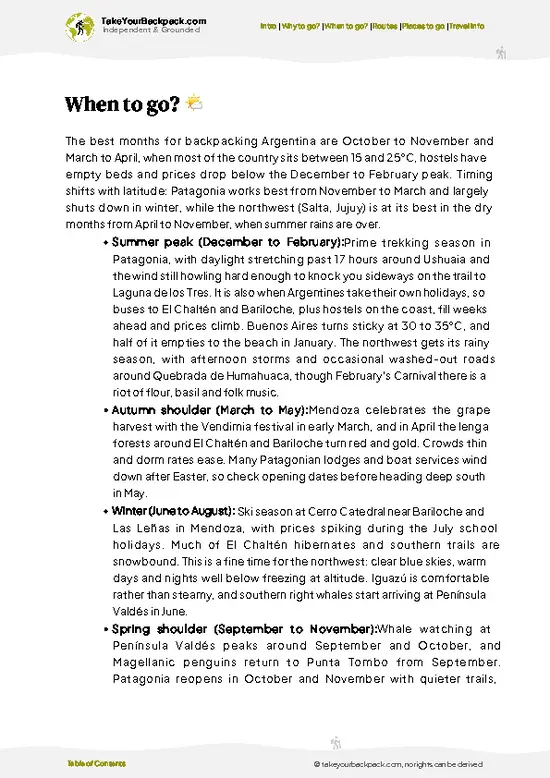
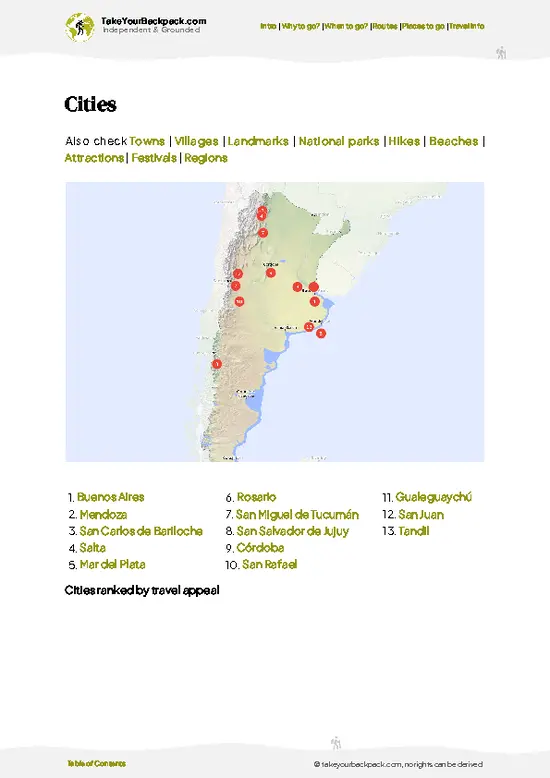
example page 2 from our offline Travel Guide for Argentina
example page 3 from our offline Travel Guide for Argentina
example page 4 from our offline Travel Guide for Argentina
example page 5 from our offline Travel Guide for Argentina
example page 6 from our offline Travel Guide for Argentina
example page 7 from our offline Travel Guide for Argentina
Loading the map 🌍
CLICK TO FILTER
cities
towns
villages
landmarks
national parks
hikes
beaches
attractions
festivals
regions
SHOW COUNTRY’S BESTSHOW ALL

✨ Why go?
Ranked #1 village in Argentina
What makes it a must-see village

Backpackers choose El Chaltén because it delivers serious hiking without the logistics headache of remote wilderness travel. The trails to Laguna de los Tres and Laguna Torre begin right at the edge of town, so there's no bus, no permit office, no early wake-up call to reach a trailhead. The village itself is small and walkable, with a slower rhythm that rewards travelers who want a pause between bigger, busier stops like El Calafate or Ushuaia. It suits hikers, solo travelers, and couples who don't need nightlife or polish, just good trails, good light, and a bed that doesn't cost a fortune. Most backpackers stay three to five nights, enough time for two or three big hikes and a rest day when the wind gets ugly. The social scene runs through hostel common rooms and communal dinners rather … read more 👉
Backpackers choose El Chaltén because it delivers serious hiking without the logistics headache of remote wilderness travel. The trails to Laguna de los Tres and Laguna Torre begin right at the edge of town, so there's no bus, no permit office, no early wake-up call to reach a trailhead. The village itself is small and walkable, with a slower rhythm that rewards travelers who want a pause between bigger, busier stops like El Calafate or Ushuaia. It suits hikers, solo travelers, and couples who don't need nightlife or polish, just good trails, good light, and a bed that doesn't cost a fortune. Most backpackers stay three to five nights, enough time for two or three big hikes and a rest day when the wind gets ugly. The social scene runs through hostel common rooms and communal dinners rather than bars, so it's easy to meet people even solo. It's not a place for sightseeing between hikes, there isn't much else to do, which is exactly the point. If you want a village that earns its keep through scenery and trail access rather than charm or amenities, this is it.

💡 HighlightsEssential experiences to have while visiting El Chaltén

  1. Mirador de los Cóndores: A short, steep 30-40 minute climb right from the edge of town, this viewpoint gives you a sweeping look over the Río de las Vueltas valley and the whole village layout below. It's free, takes under an hour round trip, and works well as a sunset spot or a leg-stretcher after a bus arrival. Best visited in late afternoon when the light rakes across the valley.
  2. Local craft beer circuit: El Chaltén has a small but genuine brewing scene, with a couple of pubs pouring their own beer brewed with glacial meltwater. It's not a tourist gimmick, the beer is actually good, malty and full-bodied to counter the cold. Best done in the evening after a long trail day, expect to pay the equivalent of a mid-range beer price per pint, and budget an hour or two for a proper sit-down.
Just … read more 👉
  1. Mirador de los Cóndores: A short, steep 30-40 minute climb right from the edge of town, this viewpoint gives you a sweeping look over the Río de las Vueltas valley and the whole village layout below. It's free, takes under an hour round trip, and works well as a sunset spot or a leg-stretcher after a bus arrival. Best visited in late afternoon when the light rakes across the valley.
  2. Local craft beer circuit: El Chaltén has a small but genuine brewing scene, with a couple of pubs pouring their own beer brewed with glacial meltwater. It's not a tourist gimmick, the beer is actually good, malty and full-bodied to counter the cold. Best done in the evening after a long trail day, expect to pay the equivalent of a mid-range beer price per pint, and budget an hour or two for a proper sit-down.
Just outside the village, Laguna de los Tres and Laguna Torre are the two trekking day trips everyone talks about, both reachable on foot directly from town without any transport needed, and both genuinely live up to the hype. Laguna Torre is my personal favorite: the trail is flatter and less crowded than the Fitz Roy route, and the glacier calving into the lake at the end is a payoff that never gets old.
Spotted a mistake or missing something? Contact us.

Things to do around El Chaltén

Ratings based on Tripadvisor reviews. When you book through this link, you support our work at no extra cost to you.

🌤️ When to go?Weather, crowds, and seasonal trade-offs

  • Peak Season (November to March): Summer in Patagonia, daytime highs around 15-20°C (59-68°F), up to 16 hours of daylight, trails fully open, but hostels fill fast and prices peak.
  • Shoulder Season (October, April): Cooler, around 8-13°C (46-55°F), fewer crowds, some services reduced, weather more unpredictable but still hikeable on clear days.
  • Winter (May to September): Cold, often below freezing at night, many hostels and trekking operators close entirely, snow can block key trails, and the village feels near-empty.
  • Wind Factor: Strong year-round but especially brutal in spring (October-November), sometimes strong enough to knock you sideways on exposed ridges.
I always aim for the first half of March: crowds thin out after the summer rush, but daylight and weather still hold up well for the big hikes.

source: climatestotravel.comJANJanuary: excellent for travelingFEBFebruary: excellent for travelingMARMarch: highly recommended for travelingAPRApril: good for travelingMAYMay: fair for travelingJUNJune: below average for travelingJULJuly: below average for travelingAUGAugust: below average for travelingSEPSeptember: fair for travelingOCTOctober: good for travelingNOVNovember: highly recommended for travelingDECDecember: excellent for traveling
argentina-city-el-chalten
© Google | Guadalupe Sosa

✈️ The backpacker research shortcutArgentina Travel Guide

An offline-friendly backpacking guide with optimized travel routes, ranked highlights, transport advice, and the best areas to stay.
example page 0 from our offline Travel Guide for Argentina
example page 1 from our offline Travel Guide for Argentina
example page 2 from our offline Travel Guide for Argentina
example page 3 from our offline Travel Guide for Argentina
example page 4 from our offline Travel Guide for Argentina
example page 5 from our offline Travel Guide for Argentina
example page 6 from our offline Travel Guide for Argentina
example page 7 from our offline Travel Guide for Argentina
The digital guide (393 pages) contains:
✅ 131 highlights, ranked by travel appeal
✅ Optimized 14, 21 & 30-day travel routes
✅ Cities, national parks, landmarks, beaches
✅ How to get around
✅ Offline-friendly for travel without Wi-Fi
👉 Click to see all 30+ guide features

📅 Plan smarter in minutes, not weeks
✅ Month by month travel advice
✅ Festivals & national holidays
✅ Budget expectations

🗺️ Go to the right places, skip the overrated ones
✅ Honest pros & cons of destinations
✅ Top hikes, parks & viewpoints
✅ Lesser-known places most travelers miss
✅ Clear “worth it vs skip it” guidance

🛏️ Travel smoothly without rookie mistakes
✅ Best areas to stay
✅ Transport systems explained simply
✅ Common scams & safety advice
✅ SIM cards, money & practical tips

🌍 Understand the country, not just visit it
✅ Culture & traditions
✅ 52 Essential phrases & customs
✅ Festivals worth planning around
✅ Traveler-friendly historical context
✅ Insights that make places more meaningful

📱 Built for real travel conditions
✅ Fully downloadable PDF
✅ Works completely offline
✅ Optimized for phone use
✅ Useful in remote areas & buses
✅ Everything in one place
Stop searching, start planning
Get instant access to your full guide. 30‑day money-back guarantee.
+ Add another guide for just

By proceeding you agree to our terms.
Sent to your inbox immediately after payment • 100% Secure Checkout
Best Backpacking Travel Advisor 2025 tourism awardBest Backpacking
Travel Advisor
2025
What others say about Take Your Backpack Guides:
⭐⭐⭐⭐⭐
Fantastic, amazing amount of information!
⭐⭐⭐⭐⭐
My goodness this is amazing, it's what I've been looking for hats off too you!
⭐⭐⭐⭐⭐
I think this is absolutely BRILLIANT
⭐⭐⭐⭐
Very complete and informative. It's still missing places, but I gotta to commend you
⭐⭐⭐⭐⭐
This is truly amazing, thank you, can't wait to explore it with my kids!
⭐⭐⭐⭐⭐
Awesome resource, thank you!
⭐⭐⭐⭐⭐
This is amazing! Can't wait to explore the ones I haven't seen
⭐⭐⭐⭐
I love this! Well done, great idea.
⭐⭐⭐⭐⭐
Thanks for taking the time to make this gem!
⭐⭐⭐⭐⭐
This might be the best website I've ever seen.
⭐⭐⭐⭐⭐
Congratulations, and thank you so much for your work; it's incredibly valuable.
⭐⭐⭐⭐
In all seriousness I think you did a great job pointing out the important spots
⭐⭐⭐⭐⭐
10/10 very good
⭐⭐⭐⭐⭐
As someone who's only just starting to visit regularly this is awesome, thank you.
⭐⭐⭐⭐
Thank you very much! I'm going to visit my dad, it's going to be very useful!
⭐⭐⭐⭐⭐
This is really cool! We'll be travelling for the first time and this definitely come in handy.
⭐⭐⭐⭐⭐
You are now our minister of culture, congratulations 👨‍💼
⭐⭐⭐⭐⭐
Just wanted to tell you that this is a pearl! Going to follow your recommendations.
⭐⭐⭐⭐⭐
This is so cool. I'll definitely be using the resource for my travels soon.
⭐⭐⭐⭐⭐
This is very impressive! Good work.
⭐⭐⭐⭐⭐
This is an amazing and informative site. Very well done!

🛏️ Where to stay?Best areas to stay in Argentina

Most backpackers base themselves along or near the main street, Avenida San Martín, where you'll find the highest concentration of hostels within easy walking distance of both the bus terminal and the trailheads. Dorm beds typically run in the range of USD 15-25 a night depending on season, with private rooms costing more. Look for hostels with a shared kitchen and a common area with a wood stove, since evenings get cold fast and communal cooking is how most travelers eat here to save money. A few well-known backpacker spots have their own bars or nightly asado nights, which are worth seeking … read more 👉
Most backpackers base themselves along or near the main street, Avenida San Martín, where you'll find the highest concentration of hostels within easy walking distance of both the bus terminal and the trailheads. Dorm beds typically run in the range of USD 15-25 a night depending on season, with private rooms costing more. Look for hostels with a shared kitchen and a common area with a wood stove, since evenings get cold fast and communal cooking is how most travelers eat here to save money. A few well-known backpacker spots have their own bars or nightly asado nights, which are worth seeking out if you want the social side without extra effort. Booking a night or two ahead in peak season (December to February) is smart, since good hostels fill up fast, but shoulder season usually allows walk-ins. Staying central matters more here than in most towns, since you'll want quick access to trailheads for early starts, and a five or ten minute walk difference actually matters when you're leaving before sunrise with a full pack.

🚌 Day tripsEasy escapes and nearby places

El Chaltén works as a near-perfect day-trip base, because the main trailheads start at the edge of town or within a 20-minute ride, so you need no tour, no car and no overnight gear.
Laguna de los Tres and Mount Fitz Roy:
This is the headline hike, 20 km round trip with about 750 m of climbing, and the last hour up the moraine is a steep scramble that hits hard. Allow 8 to 10 hours from the trailhead at the north end of town. It costs nothing, and you only need food and water. Start at first light for clear views of the granite spires, which often cloud over by midday. First-timers underestimate the final stretch and show up with too little water or no wind layer. Best from November to March.
👉 Explore Laguna de los Tres
Laguna Torre and Cerro Torre:
A gentler 18 km round trip with only about … read more 👉
El Chaltén works as a near-perfect day-trip base, because the main trailheads start at the edge of town or within a 20-minute ride, so you need no tour, no car and no overnight gear.
Laguna de los Tres and Mount Fitz Roy:
This is the headline hike, 20 km round trip with about 750 m of climbing, and the last hour up the moraine is a steep scramble that hits hard. Allow 8 to 10 hours from the trailhead at the north end of town. It costs nothing, and you only need food and water. Start at first light for clear views of the granite spires, which often cloud over by midday. First-timers underestimate the final stretch and show up with too little water or no wind layer. Best from November to March.
👉 Explore Laguna de los Tres
Laguna Torre and Cerro Torre:
A gentler 18 km round trip with only about 200 m of gain, this path follows the Fitz Roy river valley to a glacial lake full of icebergs, with Cerro Torre behind. Plan 6 to 7 hours. It is free to walk and the trailhead is in town. Many hikers turn back at the lake, but the viewpoint just beyond Mirador Maestri gives a better look at the glacier. Go early in the day, since the summit is usually clear at dawn and wrapped in cloud by afternoon.
👉 Explore Laguna Torre
Chorrillo del Salto Waterfall:
A flat 3 km walk each way (about 1.5 hours round trip) gets you to a 20 m waterfall in lenga forest. It is an easy fill for a rest day or a bad-weather window, and the trail starts a short walk from the center. The entry is free. It also suits late afternoon, when the big hikes are done. Skip it if the wind is howling, as the forest section gets noisy and cold.

Lago del Desierto:
A dirt road runs about 37 km north from town to this lake, and shuttles take roughly 1 hour each way. Expect to pay around US$20 to 30 for the round-trip transfer, plus about US$10 to 15 for the short boat or walking options at the lake. Paths along the shore lead to views of the Huemul glacier. Go from December to March, when the road is reliably open. Many first-timers book no return seat, so reserve the afternoon pickup with your driver before you leave town.

FAQTraveler FAQ

Most travelers reach El Chaltén by long-distance bus from El Calafate, a roughly 3-hour ride, or from Ushuaia, which takes considerably longer with a transfer through El Calafate. There is no train, and the nearest airport is in El Calafate, about 220 km away, from which buses run several times daily in high season. Flying into El Calafate and connecting by bus is the standard route most backpackers use.
Yes, for hikers especially, since Fitz Roy and Cerro Torre are visible right from town and the trailheads start without any additional transport. It's less rewarding if you're not up for at least one full-day hike, since the village itself has limited standalone attractions. Budget travelers who enjoy trekking consistently rank it among the highlights of a Patagonia trip.
It's possible but tight, since most bus connections from El Calafate take around 3 hours each way, leaving limited hiking time if done as a same-day round trip. Staying at least one or two nights is strongly recommended to actually get onto the trails and account for Patagonia's unpredictable weather. A rushed day trip risks arriving to high winds or rain with no buffer day to try again.
⚠️ Things can change over time, so always validate details locally before you go.

Other Argentine villages near El Chaltén

Explore more nearby:

  • Villa Pehuenia—Lago Aluminé, araucaria forest, Mapuche crafts, kayaking| 1170 km away
  • Potrerillos—Turquoise reservoir, kayak rentals, Cerro Cocodrilo, Andean foothills| 1847 km away
  • La Cumbrecita—Car-free lanes, wooden footbridges, Cascada Grande, pine forest| 2053 km away

💡 Not sure where to go next?
Create a personalized itinerary for Argentina including El Chaltén and the places that fit your trip.

Generate my itinerary

👉 Discover all villages

Or checkout all Argentina has to offer (think cities, towns, villages, national parks, hikes, beaches, festivals)
Country photo of Argentina

We 💚 feedbackKey takeaways before you go

El Chaltén earns its reputation: waking up, stepping outside, and seeing Fitz Roy lit up gold never stops feeling like a reward. The catch is the wind and weather, days can turn from clear to whiteout fast, so build in extra time and don't plan a tight schedule around one perfect hiking day. Flexibility here isn't optional, it's survival.

✈️ When did I visit Argentina?
I have visited Argentina, together with Chile, in September 2012.

✍️ Help improve this page!
The information on this page is based on my own backpacking experience in Argentina, supplemented with up-to-date research and feedback from other travelers. Travel details can change, so if you notice anything outdated or incomplete, feel free to let me know.


🙋‍♂️ Give feedback

👋 Meet the founderWho’s Behind Take Your Backpack?

Johan, backpacker and founder of TakeYourBackpackHi, I’m Johan (Netherlands 🇳🇱), the creator of TakeYourBackpack. Over the past 3 decades, I’ve backpacked through 90+ countries across six continents, gaining extensive experience with independent travel, long-term trips, and overland routes.

This site is built on a combination of firsthand travel experience and carefully curated insights from other backpackers. Many guides are based on places I’ve personally visited, while others bring together tips, observations, and practical advice shared by trusted travelers I’ve met along the way.

The goal is to provide realistic, experience-driven guidance — not generic itineraries — so you can explore destinations with better context, clearer expectations, and more confidence.