×

Bangladesh🇧🇩 | best festivalsWhere to Find the 10 Best festivals in Bangladesh

Festivals in Bangladesh are loud, crowded, free to enter and rooted in the delta's rhythms. Expect drums, loudspeakers, frying oil, incense, marigold garlands and clay underfoot after rain. Most events belong to the Bengali calendar or to Muslim, Hindu and Buddhist observances, so they happen in streets, riverbanks and village fields rather than ticketed venues. Regions differ sharply. Dhaka is intense, with huge crowds, gridlock and the easiest transport and beds. The Chittagong Hill Tracts offer smaller Indigenous gatherings, but travel permits, slower roads and fewer guesthouses apply. Rural Bengal and the Sylhet and Khulna areas feel intimate, yet public transport thins out and English fades fast. Independent travelers spend little, often US$15 to 30 a day, but should plan for heat, crush and limited privacy. Choose by how much chaos you can enjoy.

By Johan Kruseman 🇳🇱 | Updated October 18, 2026
Explore the best regions in Bangladesh

Why go?What Makes Them Special

Bangladesh is a river delta with about 170 million people packed into an area roughly the size of Iowa, and that density shapes everything. Celebrations spill into lanes, bridges and rice fields because there is little space to keep them contained. Agriculture drives much of the calendar, so harvest, monsoon and new-year moments matter, and you can smell wet earth, smoke and sweets in the same breath.

The country's history adds layers. Language and independence movements gave Bengali identity a strong public voice, so national days feel emotional and communal. A Muslim majority sits beside large Hindu communities and smaller Buddhist and Christian groups, including Indigenous peoples in the hills and the southeast. That means religious events overlap with folk traditions of boats, music and … read more 👉
Bangladesh is a river delta with about 170 million people packed into an area roughly the size of Iowa, and that density shapes everything. Celebrations spill into lanes, bridges and rice fields because there is little space to keep them contained. Agriculture drives much of the calendar, so harvest, monsoon and new-year moments matter, and you can smell wet earth, smoke and sweets in the same breath.

The country's history adds layers. Language and independence movements gave Bengali identity a strong public voice, so national days feel emotional and communal. A Muslim majority sits beside large Hindu communities and smaller Buddhist and Christian groups, including Indigenous peoples in the hills and the southeast. That means religious events overlap with folk traditions of boats, music and fairs, often with Sufi and Baul songs drifting across the crowd.

Before choosing Bangladesh for its festivals, know the limits. Dates move with lunar calendars, so Islamic and Hindu events shift roughly 11 days earlier each year in the Gregorian calendar. Foreign visitors are still few outside Dhaka, which means curiosity, selfies and warm invitations, but also stares. Tourist infrastructure is thin. Intercity roads are slow, ferries and trains sell out, and during major holidays millions leave Dhaka at once. Dress modestly, carry small notes, and accept that heat, noise and delays are part of the experience. The reward is access to celebrations where you are a guest, not an audience.
Our Approach to Ranking
The list of best festivals in Bangladesh is created based on energy, traditions, crowd experience, activities, and overall excitement. If you feel a festival is missing in this list, please let us know.

When to go?Timing Your Visit for the Best Experience

Best months for festivals in Bangladesh: The best months are October to March, when the dry, cooler season brings clear skies, 12 to 28°C days and far fewer washed-out roads. Mornings are hazy and smoky, with a cool bite in the north, while afternoons are sunny enough for long hours outdoors. Many harvest, cultural and religious gatherings fall in this window, and travel is simpler because trains, buses and riverboats run predictably.

Shoulder seasons and monsoon: March to April turns hot fast, with Dhaka often reaching 33 to 38°C and humidity that soaks a shirt in minutes. Evenings bring sudden thunderstorms called nor'westers, with dust, wind and brief downpours. April is still workable if you move early, drink often and avoid midday. May to September is monsoon. Rain totals vary by region, … read more 👉
Best months for festivals in Bangladesh: The best months are October to March, when the dry, cooler season brings clear skies, 12 to 28°C days and far fewer washed-out roads. Mornings are hazy and smoky, with a cool bite in the north, while afternoons are sunny enough for long hours outdoors. Many harvest, cultural and religious gatherings fall in this window, and travel is simpler because trains, buses and riverboats run predictably.

Shoulder seasons and monsoon: March to April turns hot fast, with Dhaka often reaching 33 to 38°C and humidity that soaks a shirt in minutes. Evenings bring sudden thunderstorms called nor'westers, with dust, wind and brief downpours. April is still workable if you move early, drink often and avoid midday. May to September is monsoon. Rain totals vary by region, but Sylhet and the northeast can receive well over 3,000 mm a year, much of it in these months, and Chittagong and Cox's Bazar are also very wet. Fields are brilliant green, rivers brown and swollen, and rural lanes turn to slick mud. Some boat services slow or stop in storms, and hill roads can slide.

Crowds and prices: Peak pressure comes around the two Eid holidays and the Bengali New Year in mid-April, when millions travel at once. Buses and trains can sell out days ahead, and fares on popular routes can rise 20 to 50 percent. Hotels in cities may fill, while villages often have no formal rooms at all. In winter, tourist hot spots such as Cox's Bazar and Sylhet tea areas see higher demand, with room prices up perhaps 30 to 100 percent on weekends. Book moving parts early, then keep the rest flexible.

festival hoppingOptimizing Your Multi-Stop Itinerary

How many days to plan: A trip combining several festivals in Bangladesh needs 10 to 16 days, because even short hops eat hours and the country rewards slack in the schedule. Roads are crowded, ferries run on their own clocks, and a 150 km transfer can take 5 to 7 hours.

Which regions group well: Start in Dhaka, the transport hub, where the airport, Kamalapur rail station and Gabtoli, Sayedabad and Mohakhali bus terminals connect everything. From there, three clusters work. One is the central delta and southwest around Dhaka, Barisal and Khulna, linked by launches, buses and the Padma Bridge route. Another is the northeast, Sylhet and Srimangal, reached by train in roughly 6 to 8 hours or by bus in 5 to 7. The third is the southeast, Chittagong, Cox's Bazar and the hills, about 6 to 9 hours … read more 👉
How many days to plan: A trip combining several festivals in Bangladesh needs 10 to 16 days, because even short hops eat hours and the country rewards slack in the schedule. Roads are crowded, ferries run on their own clocks, and a 150 km transfer can take 5 to 7 hours.

Which regions group well: Start in Dhaka, the transport hub, where the airport, Kamalapur rail station and Gabtoli, Sayedabad and Mohakhali bus terminals connect everything. From there, three clusters work. One is the central delta and southwest around Dhaka, Barisal and Khulna, linked by launches, buses and the Padma Bridge route. Another is the northeast, Sylhet and Srimangal, reached by train in roughly 6 to 8 hours or by bus in 5 to 7. The third is the southeast, Chittagong, Cox's Bazar and the hills, about 6 to 9 hours from Dhaka by road or rail, with a short flight as the faster option.

A sensible direction is Dhaka, then the northeast, back through Dhaka, then south to Chittagong and the coast, so you finish somewhere with sea air instead of exhaust. Give each stop 2 to 4 days, which covers arrival, the main event and a recovery day. Between regions, expect 4 to 9 hours, plus time lost leaving Dhaka, where traffic can add 1 to 3 hours before the road opens up.

Common planning mistakes: The biggest mistake is scheduling two festivals on consecutive days in different regions. Delays, fog in winter, and closed roads during processions can wreck it, so leave one buffer day. Another is arriving on the day itself, when beds are gone and the streets are packed. Reach town the day before. Travelers also underestimate holiday travel, and trains vanish when millions go home. Buy tickets early through official channels, take overnight trains where sensible, and keep cash for rickshaws, ferries and small fares.

The ListThe Best festivals of Bangladesh

1 Pohela Boishakh

new year fairs, traditional music, folk art

Celebrate the Bengali calendar’s first day with open-air concerts, craft stalls, and local delicacies in towns and villages.

2 Bishwa Ijtema

mass prayer, Tongi riverside, global Muslim gathering

Witness one of the world’s largest Islamic congregations, where millions gather for prayer, sermons, and spiritual unity along the Turag River.

3 Durga Puja

pandals, clay idols, community feasts

See intricately decorated shrines and join in communal meals as neighborhoods honor the goddess Durga with rituals and performances.

4 Dhaka Art Summit

contemporary art, South Asian artists, curated exhibitions

Explore cutting-edge installations and thought-provoking works by emerging and established artists in a dynamic, multi-venue setting.

5 Dhaka Lit Fest

literary talks, author meetups, book launches

Engage with writers, thinkers, and readers through interactive sessions, readings, and debates on literature and current affairs.

6 Dhaka International Film Festival

independent cinema, global directors, city screenings

Attend film premieres, panel discussions, and cross-cultural exchanges as Dhaka hosts filmmakers and cinephiles from around the world.

7 Boisabi

ethnic dances, bamboo crafts, hill cuisine

Discover diverse indigenous cultures through vibrant parades, handmade textiles, and traditional foods unique to the hill communities.

8 Victory Day

national parades, war memorials, flag displays

Observe ceremonies and public gatherings honoring Bangladesh’s independence, with patriotic songs and tributes at historic sites.

9 International Mother Language Day

Shaheed Minar, language martyrs, floral tributes

Pay respects at memorials and join processions commemorating the struggle for linguistic rights, a defining moment in Bangladesh’s history.

10 Lalon Smaran Utshab

Kushtia shrine, Baul mystics, spiritual songs

Immerse yourself in days of music and reflection as devotees celebrate Lalon’s legacy with all-night singing and philosophical gatherings.

11 Dublar Char Rash Mela

Dublar Char island, Hindu rituals, coastal fairs

Experience a remote island festival blending religious observance, folk performances, and bustling markets at the edge of the Sundarbans.

12 Pohela Falgun

spring colors, flower crowns, campus festivities

Mark the start of spring as students and locals dress in yellow, exchange flowers, and gather for music and dance outdoors.

13 Cox’s Bazar Kite Festival

sea breeze, colorful kites, beach crowds

Watch the sky fill with kites of every shape as locals and visitors compete and celebrate along the world’s longest natural beach.

14 Langalbandh Mela

Brahmaputra bathing, Hindu pilgrimage, riverside rituals

Observe thousands of pilgrims taking ritual dips and offering prayers along the riverbank during this auspicious Hindu festival.

15 Nabanna

new rice harvest, rural feasts, folk music

Join villagers as they mark the arrival of freshly harvested rice with communal meals, traditional songs, and seasonal sweets in the countryside.

16 Eid al-Fitr

mosque prayers, family gatherings, sweet dishes

Share in the end of Ramadan as families dress up, visit relatives, and exchange homemade treats after morning prayers.

Think you know Bangladesh?

Prove you’re a true local — uncover 6 lesser-known festivals in Bangladesh that locals tend to keep to themselves.
Loading the map 🌍

Expert viewInsights from Locals and Experts

How many festivals to chase: I would advise three to five festivals on a trip of two to three weeks. That number leaves room for the delays that define Bangladesh, such as ferry queues, jammed highways and sudden rain. Each event takes a full day to enjoy and half a day to recover from, because heat, noise and crowd pressure wear you down. You walk away with time to sit at a roadside stall over milk tea and watch the tail end of a procession instead of sprinting to the next stop.

Choosing between kinds: Pick by what kind of day you want. Large city and national gatherings suit first-timers who want easy beds, restaurants and a sense of national mood, but they are packed, hot and often loud from dawn. Religious and Sufi events suit travelers who like music, incense and long evenings, and they … read more 👉
How many festivals to chase: I would advise three to five festivals on a trip of two to three weeks. That number leaves room for the delays that define Bangladesh, such as ferry queues, jammed highways and sudden rain. Each event takes a full day to enjoy and half a day to recover from, because heat, noise and crowd pressure wear you down. You walk away with time to sit at a roadside stall over milk tea and watch the tail end of a procession instead of sprinting to the next stop.

Choosing between kinds: Pick by what kind of day you want. Large city and national gatherings suit first-timers who want easy beds, restaurants and a sense of national mood, but they are packed, hot and often loud from dawn. Religious and Sufi events suit travelers who like music, incense and long evenings, and they ask for quiet respect and modest dress. Rural fairs and harvest celebrations suit slow travelers who want mud, folk songs and handmade toys, with little English and few facilities. Indigenous hill festivals suit those with time and flexibility, because permits, transport and lodging take more planning. If you have only one choice, take a rural or smaller regional event, where hospitality is warmest and you get closest to ordinary life.

What it costs: Most festivals have no entry fee. Budget travelers can manage on US$15 to 30 a day, about 1,800 to 3,600 taka, covering a basic room at 800 to 1,800 taka, street meals at 100 to 250 taka and local transport. Add a modest festival allowance of US$5 to 15 per visit for rickshaws, snacks, small donations and the odd boat ride. A local guide or fixer, useful in remote areas or the hills, costs roughly US$25 to 60 a day. Long-distance buses run about 500 to 1,500 taka depending on class and distance, and train seats vary widely. Book rooms ahead near major holidays, because prices can jump sharply and bargaining becomes harder.

Safety on the ground: The main risk is the crowd itself. Pushing, heat and narrow lanes can turn tiring fast, so stay near edges, keep bags in front and avoid the dense center at peak hours. Pickpocketing happens, so carry only what you need. Drink bottled or filtered water, eat food cooked in front of you and pack rehydration salts. After dark, stick to well-lit areas and arrange a ride back, as rickshaws thin out. Political rallies and strikes sometimes close roads, so check local news and give them a wide berth.

Cultural manners: Dress modestly, with shoulders and knees covered, and women may find a light scarf useful at religious sites. Remove shoes where asked, accept tea with your right hand, and ask before photographing people, especially women and worshippers. Alcohol is hard to find and unwelcome at many events. Public displays of affection draw attention. Expect questions about your country and family, and answer them with a smile. In return, a stranger may hand you a plate of sweets and refuse payment, which is a moment you will remember long after the crowd noise fades.

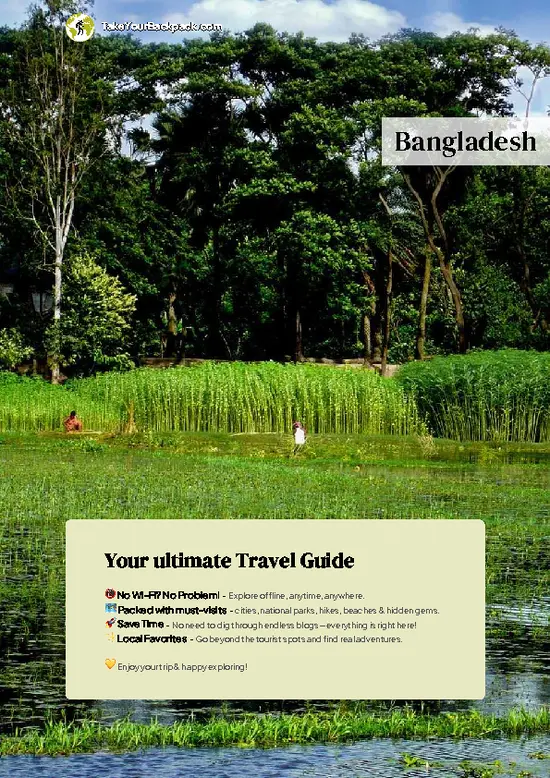
✈️ The backpacker research shortcutBangladesh Travel Guide

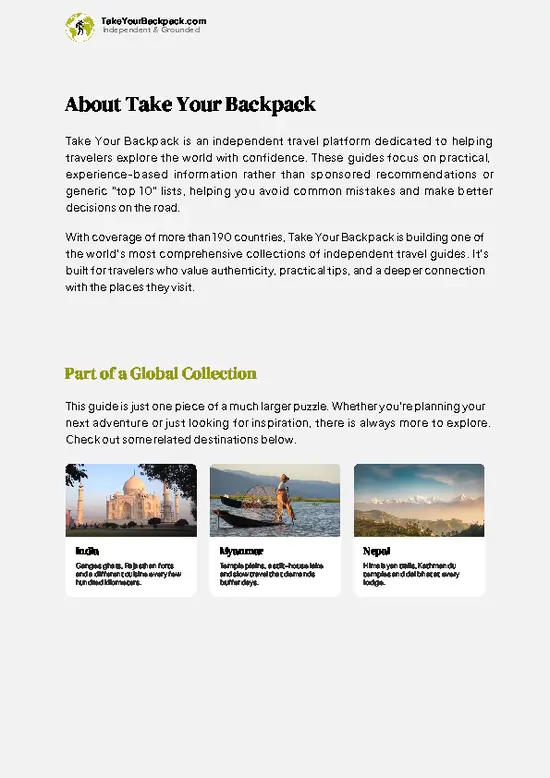
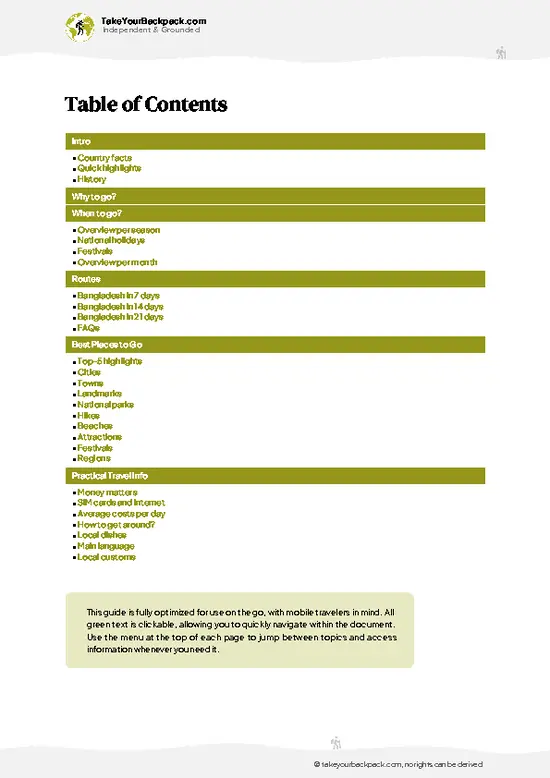
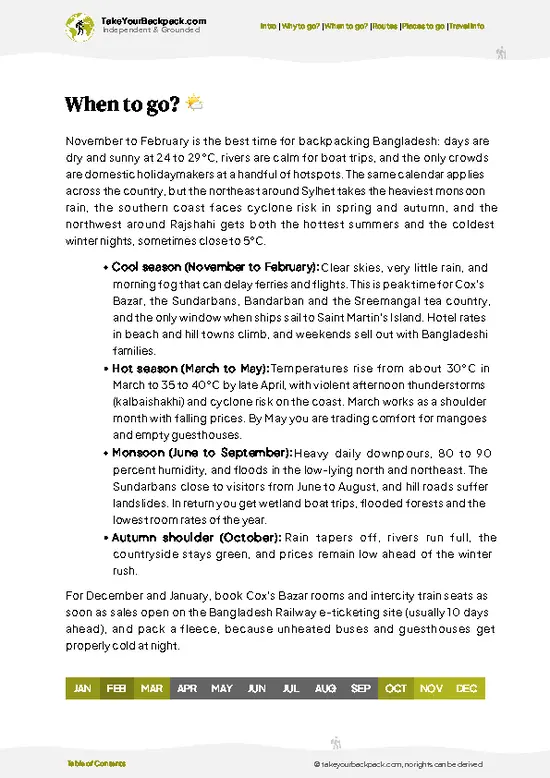
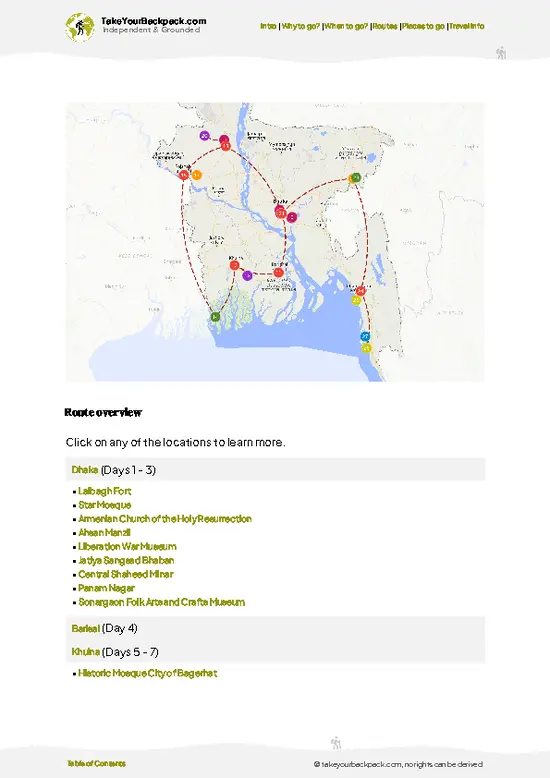
An offline-friendly backpacking guide with optimized travel routes, ranked highlights, transport advice, and the best areas to stay.
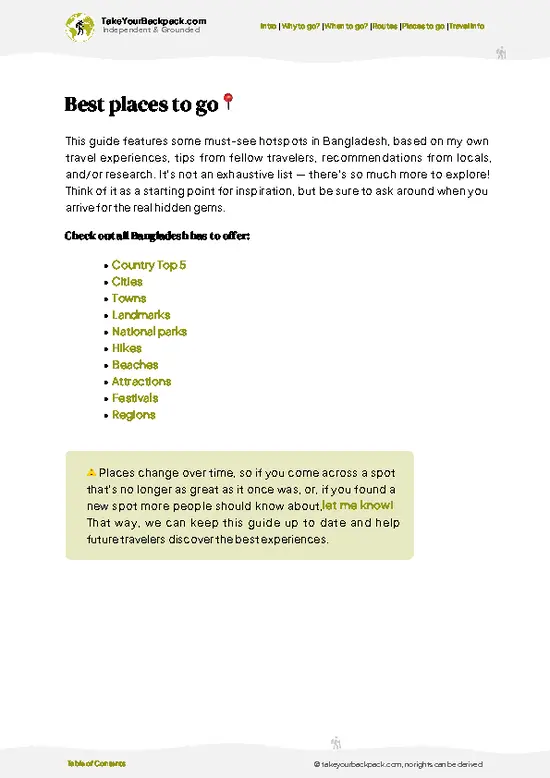
example page 0 from our offline Travel Guide for Bangladesh
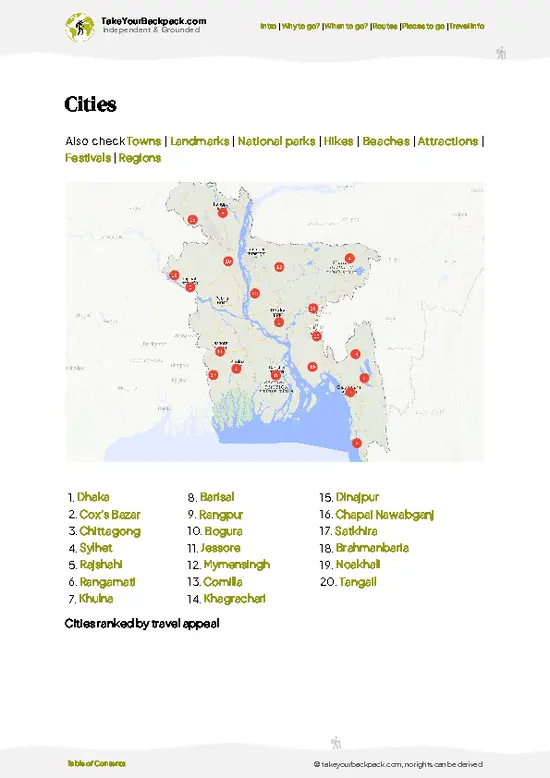
example page 1 from our offline Travel Guide for Bangladesh
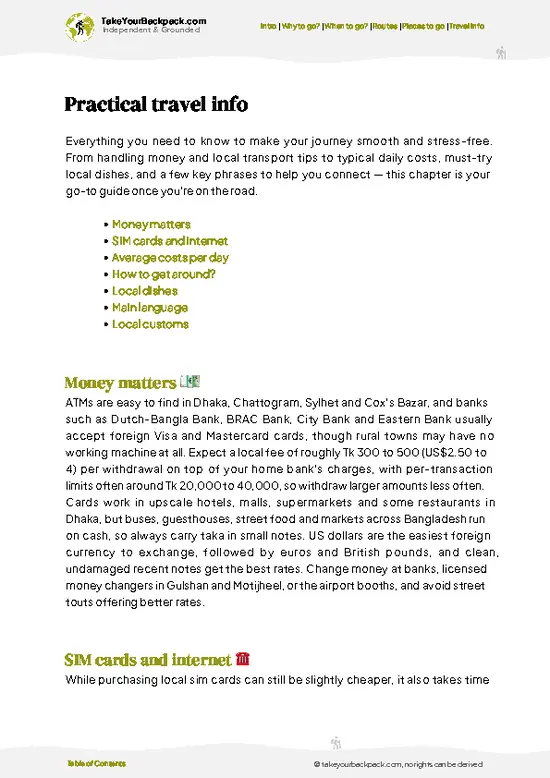
example page 2 from our offline Travel Guide for Bangladesh
example page 3 from our offline Travel Guide for Bangladesh
example page 4 from our offline Travel Guide for Bangladesh
example page 5 from our offline Travel Guide for Bangladesh
example page 6 from our offline Travel Guide for Bangladesh
example page 7 from our offline Travel Guide for Bangladesh
The digital guide (355 pages) contains:
✅ 102 highlights, ranked by travel appeal
✅ Optimized 7, 14 & 21-day travel routes
✅ Cities, national parks, landmarks, beaches
✅ How to get around
✅ Offline-friendly for travel without Wi-Fi
👉 Click to see all 30+ guide features

📅 Plan smarter in minutes, not weeks
✅ Month by month travel advice
✅ Festivals & national holidays
✅ Budget expectations

🗺️ Go to the right places, skip the overrated ones
✅ Honest pros & cons of destinations
✅ Top hikes, parks & viewpoints
✅ Lesser-known places most travelers miss
✅ Clear “worth it vs skip it” guidance

🛏️ Travel smoothly without rookie mistakes
✅ Best areas to stay
✅ Transport systems explained simply
✅ Common scams & safety advice
✅ SIM cards, money & practical tips

🌍 Understand the country, not just visit it
✅ Culture & traditions
✅ 52 Essential phrases & customs
✅ Festivals worth planning around
✅ Traveler-friendly historical context
✅ Insights that make places more meaningful

📱 Built for real travel conditions
✅ Fully downloadable PDF
✅ Works completely offline
✅ Optimized for phone use
✅ Useful in remote areas & buses
✅ Everything in one place
Stop searching, start planning
Get instant access to your full guide. 30‑day money-back guarantee.
+ Add another guide for just

By proceeding you agree to our terms.
Sent to your inbox immediately after payment • 100% Secure Checkout
Best Backpacking Travel Advisor 2025 tourism awardBest Backpacking
Travel Advisor
2025
What others say about Take Your Backpack Guides:
⭐⭐⭐⭐⭐
Fantastic, amazing amount of information!
⭐⭐⭐⭐⭐
My goodness this is amazing, it's what I've been looking for hats off too you!
⭐⭐⭐⭐⭐
I think this is absolutely BRILLIANT
⭐⭐⭐⭐
Very complete and informative. It's still missing places, but I gotta to commend you
⭐⭐⭐⭐⭐
This is truly amazing, thank you, can't wait to explore it with my kids!
⭐⭐⭐⭐⭐
Awesome resource, thank you!
⭐⭐⭐⭐⭐
This is amazing! Can't wait to explore the ones I haven't seen
⭐⭐⭐⭐
I love this! Well done, great idea.
⭐⭐⭐⭐⭐
Thanks for taking the time to make this gem!
⭐⭐⭐⭐⭐
This might be the best website I've ever seen.
⭐⭐⭐⭐⭐
Congratulations, and thank you so much for your work; it's incredibly valuable.
⭐⭐⭐⭐
In all seriousness I think you did a great job pointing out the important spots
⭐⭐⭐⭐⭐
10/10 very good
⭐⭐⭐⭐⭐
As someone who's only just starting to visit regularly this is awesome, thank you.
⭐⭐⭐⭐
Thank you very much! I'm going to visit my dad, it's going to be very useful!
⭐⭐⭐⭐⭐
This is really cool! We'll be travelling for the first time and this definitely come in handy.
⭐⭐⭐⭐⭐
You are now our minister of culture, congratulations 👨‍💼
⭐⭐⭐⭐⭐
Just wanted to tell you that this is a pearl! Going to follow your recommendations.
⭐⭐⭐⭐⭐
This is so cool. I'll definitely be using the resource for my travels soon.
⭐⭐⭐⭐⭐
This is very impressive! Good work.
⭐⭐⭐⭐⭐
This is an amazing and informative site. Very well done!

🛏️ Where to stay?Accommodation Highlights

True backpacker hostels are rare in Bangladesh, with only a handful of dorm-style places in Dhaka, but budget guesthouses and basic hotels with private rooms for roughly Tk 1,200 to 3,000 (US$10 to 25) are easy to find in every city. In Dhaka, Gulshan and Banani are the safest and quietest bases, with the best cafes and the few hostels, though they cost more and sit an hour or more in traffic from Old Dhaka; Paltan and Motijheel have the cheapest hotels close to Old Dhaka, Sadarghat and Kamalapur station, at the price of round-the-clock noise and rougher rooms. Outside the capital, look at Kolatoli in Cox’s Bazar for beachfront budget hotels (packed on holiday weekends), Zindabazar in Sylhet … read more 👉
True backpacker hostels are rare in Bangladesh, with only a handful of dorm-style places in Dhaka, but budget guesthouses and basic hotels with private rooms for roughly Tk 1,200 to 3,000 (US$10 to 25) are easy to find in every city. In Dhaka, Gulshan and Banani are the safest and quietest bases, with the best cafes and the few hostels, though they cost more and sit an hour or more in traffic from Old Dhaka; Paltan and Motijheel have the cheapest hotels close to Old Dhaka, Sadarghat and Kamalapur station, at the price of round-the-clock noise and rougher rooms. Outside the capital, look at Kolatoli in Cox’s Bazar for beachfront budget hotels (packed on holiday weekends), Zindabazar in Sylhet for central, walkable options, and the town center of Sreemangal for cheap guesthouses near the tea estates, keeping in mind that nightlife anywhere in the country is close to nonexistent.

If you enjoy meeting fellow travelers, consider choosing hostels with high ratings for atmosphere. On the other hand, if you prefer having your own space, a hotel might be a better option.

BangladeshSee More of Bangladesh

👋 Meet the founderWho’s Behind Take Your Backpack?

Johan, backpacker and founder of TakeYourBackpackHi, I’m Johan (Netherlands 🇳🇱), the creator of TakeYourBackpack. Over the past 3 decades, I’ve backpacked through 90+ countries across six continents, gaining extensive experience with independent travel, long-term trips, and overland routes.

This site is built on a combination of firsthand travel experience and carefully curated insights from other backpackers. Many guides are based on places I’ve personally visited, while others bring together tips, observations, and practical advice shared by trusted travelers I’ve met along the way.

The goal is to provide realistic, experience-driven guidance — not generic itineraries — so you can explore destinations with better context, clearer expectations, and more confidence.