×

Bangladesh🇧🇩 | best regionsWhere to Find the 5 Best regions in Bangladesh

Bangladesh is a delta country, and its regions differ by water, not by altitude. In the north-east, tea estates roll over low hills, the air smells of wet leaf and woodsmoke, and the pace slows to a walk. The south-west is mangrove and mud, where you move by launch and engine-throb on brown tidal channels. The southeast has the only real hills and the sea, with salt wind and fish-drying racks. Dhaka sits in the middle, loud, humid and rewarding in a rough way.

Costs stay low everywhere, but access varies: the cities have buses and trains, while the delta needs boats and patience. Crowds are mostly local, and foreigners are rare outside Dhaka, so expect curious stares and tea offered by strangers. Independent backpacking works well here if you accept slow, sweaty, unpolished travel, and each region suits a different appetite for it.

By Johan Kruseman 🇳🇱 | Updated October 18, 2026
Explore the best cities in Bangladesh

Why go?What Makes Them Special

Bangladesh is one of the few countries where geography is the whole story. It sits on the world’s largest delta, where the Ganges, Brahmaputra and Meghna rivers meet, so roughly 700 rivers divide the land into pieces you cross by ferry, launch or rickety wooden boat. That is why regions here feel so distinct from each other: soil, water and weather shape how people farm, build, cook and travel. Air is thick with silt, diesel and frying mustard oil, and the light often arrives soft and hazy through humidity.

The cultural layers add to it. Bengali language and customs hold the country together, with a Muslim majority and Hindu, Buddhist and Christian communities, plus indigenous groups in the hills. Old Mughal and colonial buildings stand beside river ports and village markets. Because few … read more 👉
Bangladesh is one of the few countries where geography is the whole story. It sits on the world’s largest delta, where the Ganges, Brahmaputra and Meghna rivers meet, so roughly 700 rivers divide the land into pieces you cross by ferry, launch or rickety wooden boat. That is why regions here feel so distinct from each other: soil, water and weather shape how people farm, build, cook and travel. Air is thick with silt, diesel and frying mustard oil, and the light often arrives soft and hazy through humidity.

The cultural layers add to it. Bengali language and customs hold the country together, with a Muslim majority and Hindu, Buddhist and Christian communities, plus indigenous groups in the hills. Old Mughal and colonial buildings stand beside river ports and village markets. Because few tourists come, hospitality is direct and unfiltered. People will talk to you, feed you and ask where you are from before you have put your bag down.

Before choosing Bangladesh you should know the infrastructure is stretched. Roads are crowded and slow, a 200 km journey can take six or more hours, and traffic noise is constant. Trains are cheap but sell out, and many river routes run on loose schedules. English is limited outside cities and tourism services are thin, so you plan and improvise more than in neighboring countries. The climate is the other constant: monsoon rain, cyclone risk on the coast and heavy humidity shape every plan. In return you get a country with real daily life, low prices and almost no queues for anything.
How the List Was Created
The list of best regions in Bangladesh is created based on landscapes, local culture, attractions, vibes, and overall appeal. If you feel a region is missing in this list, please let us know.

When to go?Timing Your Visit for the Best Experience

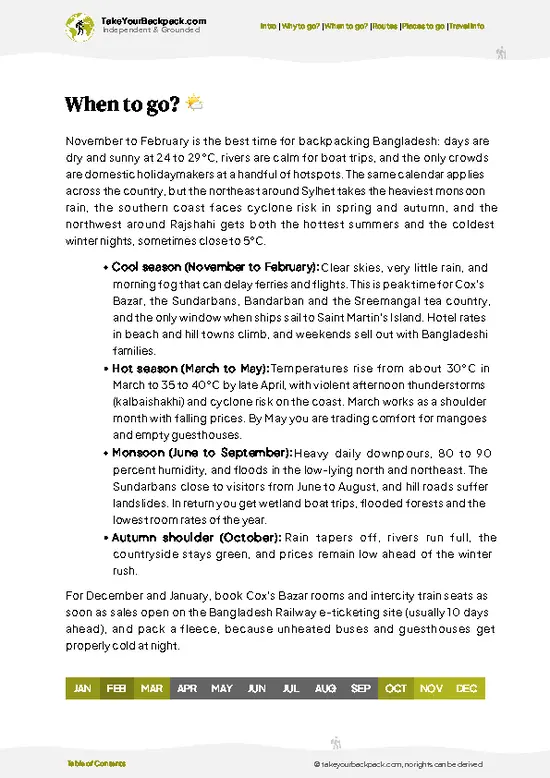
Best months and the cool dry season: The best months for visiting regions in Bangladesh are November to February, when daytime temperatures sit around 20 to 29°C, humidity drops, skies turn clear and roads and rivers are easy to use. Mornings bring fog over the rivers and smoke from cooking fires, and evenings are cool enough for a light jacket in the north. Rainfall in these months is minimal, often under 30 mm monthly, which makes boat travel and walking far more comfortable.

Shoulder seasons: March and April are hot and getting sticky, with temperatures of 30 to 36°C and afternoon thunderstorms known as nor’westers arriving suddenly with strong wind. October is a decent shoulder month as the rains fade, though some roads may still be soft and muddy. These shoulder weeks suit travelers … read more 👉
Best months and the cool dry season: The best months for visiting regions in Bangladesh are November to February, when daytime temperatures sit around 20 to 29°C, humidity drops, skies turn clear and roads and rivers are easy to use. Mornings bring fog over the rivers and smoke from cooking fires, and evenings are cool enough for a light jacket in the north. Rainfall in these months is minimal, often under 30 mm monthly, which makes boat travel and walking far more comfortable.

Shoulder seasons: March and April are hot and getting sticky, with temperatures of 30 to 36°C and afternoon thunderstorms known as nor’westers arriving suddenly with strong wind. October is a decent shoulder month as the rains fade, though some roads may still be soft and muddy. These shoulder weeks suit travelers who tolerate heat and want fewer people around, and prices barely change anyway.

Monsoon and cyclones: From June to September, the monsoon delivers 250 to 600 mm of rain a month depending on the area, with the north-east among the wettest places on earth. Fields turn bright green and rivers swell, which is beautiful, but flooding can cut roads and slow ferries. Humidity stays above 80 percent and heat feels heavy, around 30 to 34°C. The coastal south-west and south-east face cyclone risk mainly in May to June and again in October to November, so check forecasts before booking launches or island trips.

Crowds and prices: Tourist crowds hardly exist, but local holidays change travel. During the two Eid festivals, buses and trains fill weeks ahead, fares rise and Dhaka empties. In winter, hotel rates in popular beach and hill spots may go up by 20 to 50 percent on weekends and holidays, so book ahead then.

region hoppingOptimizing Your Multi-Stop Itinerary

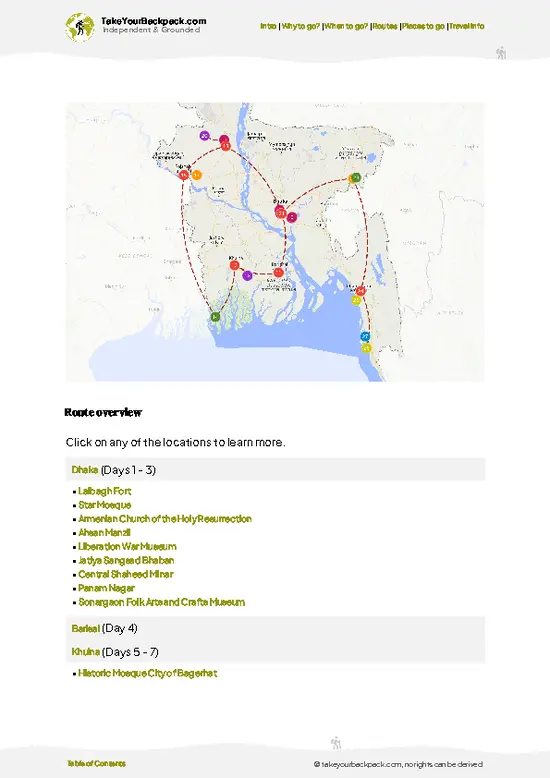
How many days to plan: A trip combining several regions in Bangladesh needs 10 to 14 days, because even short distances eat whole mornings. Allow at least two nights per stop, three if the place involves boats, and expect a stop to need 2 to 4 days to feel properly explored rather than ticked off.

Grouping and direction: Regions cluster around Dhaka, which is the transport hub for trains, buses and the few domestic flights. A loop works best: start in Dhaka, go north-east toward Sylhet by train (about 6 to 7 hours on the faster services), then drop south to Chittagong and the hill and coastal areas (6 to 8 hours by bus or train, with hill roads slower still). Return to Dhaka, then head south-west by road and river launch toward Khulna, which takes 7 to 10 hours by bus, or overnight on a launch … read more 👉
How many days to plan: A trip combining several regions in Bangladesh needs 10 to 14 days, because even short distances eat whole mornings. Allow at least two nights per stop, three if the place involves boats, and expect a stop to need 2 to 4 days to feel properly explored rather than ticked off.

Grouping and direction: Regions cluster around Dhaka, which is the transport hub for trains, buses and the few domestic flights. A loop works best: start in Dhaka, go north-east toward Sylhet by train (about 6 to 7 hours on the faster services), then drop south to Chittagong and the hill and coastal areas (6 to 8 hours by bus or train, with hill roads slower still). Return to Dhaka, then head south-west by road and river launch toward Khulna, which takes 7 to 10 hours by bus, or overnight on a launch from Dhaka’s Sadarghat terminal toward Barisal. Keeping to one side of the country at a time stops you backtracking across the delta.

Common planning mistakes: The first mistake is underestimating travel time. Google may say four hours, but traffic, ferry queues and breakdowns often double it. Build in buffer days and avoid booking a flight the day after a long road leg. The second is trying to see every corner in a week, which leaves you sitting in buses breathing exhaust and dust. Choose two or three areas and go slowly instead. The third is leaving train tickets until the last minute: popular intercity routes sell out days ahead, so buy early online or at the station. Finally, avoid crossing the country during Eid or at monsoon peak, when delays pile up and the roads are jammed.

The ListThe Best regions of Bangladesh

1 Bandarban

hill tribes, forested ridges, remote villages

Hike through misty hills, visit indigenous communities, and discover landscapes where steep trails connect isolated settlements and hidden waterfalls.

2 St Martin’s Island

coral beaches, fishing villages, tidal flats

Experience quiet mornings with fishing boats, clear water for snorkeling, and evenings shaped by the rhythms of a small island community.

3 Moulvibazar

tea estates, rolling valleys, tribal markets

Walk among tea gardens, meet local traders at weekly bazaars, and follow winding roads through green valleys dotted with small villages.

4 Maheshkhali

salt pans, mangrove creeks, temple hills

Wander through salt fields, explore tidal mangroves by boat, and climb to hilltop shrines overlooking the Bay of Bengal.

5 Sajek Valley

hilltop villages, sunrise views, winding roads

Wake early for misty dawns and distant horizons, then wander through villages perched above deep green valleys.

Loading the map 🌍

Expert viewInsights from Locals and Experts

How many regions to visit: I advise three regions in a trip of two to three weeks, and two if you have ten days. Bangladesh travel is slow by design: roads clog, ferries wait for tides and a single day can vanish in one crossing. Three gives you contrast, say a city, a green hill area and a river or coast stretch, without turning the trip into a series of bus seats. You get time to sit in a tea stall, hear the rickshaw bells and actually talk to people.

Choosing by travel style: First-timers and culture seekers should put Dhaka and a nearby river or old-town area first, since there is the most infrastructure and the most to see: markets thick with spice and fish smell, call-to-prayer echoing off tight lanes. Nature lovers should prioritize the hills and tea country or the mangrove delta, … read more 👉
How many regions to visit: I advise three regions in a trip of two to three weeks, and two if you have ten days. Bangladesh travel is slow by design: roads clog, ferries wait for tides and a single day can vanish in one crossing. Three gives you contrast, say a city, a green hill area and a river or coast stretch, without turning the trip into a series of bus seats. You get time to sit in a tea stall, hear the rickshaw bells and actually talk to people.

Choosing by travel style: First-timers and culture seekers should put Dhaka and a nearby river or old-town area first, since there is the most infrastructure and the most to see: markets thick with spice and fish smell, call-to-prayer echoing off tight lanes. Nature lovers should prioritize the hills and tea country or the mangrove delta, where you trade comforts for birdsong, mist and the sound of a boat engine at dawn. Beach and relaxation seekers can pick the south-east coast, though its sea is brown and busy with local holidaymakers rather than empty and turquoise. Slow travelers who like water should pick one delta stop and stay longer.

What it costs: Bangladesh is cheap. Budget US$15 to 25 a day if you travel by bus, eat at local restaurants and stay in simple hotels at about 1,500 to 3,000 taka (US$12 to 25). A mid-range day with air-conditioned rooms, private cars and better meals runs US$35 to 60. Typical costs: intercity buses 400 to 1,500 taka (US$3 to 12), trains 300 to 1,500 taka, local guides 1,500 to 4,000 taka a day (US$12 to 33), boat hire 1,500 to 6,000 taka for a day trip, and entry fees to sites usually 20 to 100 taka for locals but 200 to 500 taka for foreigners. For a typical visit to one region, plan US$60 to 150 total including transport, a guide and fees. A good meal of rice, dal and fish costs 150 to 350 taka, and the sweet milky tea at roadside stalls is 10 to 20 taka.

Safety and etiquette: Violent crime against travelers is uncommon, but petty theft in crowded stations and buses happens, so keep your phone and wallet in front pockets. Traffic is the biggest physical risk: take the train over the night bus when you can. Political demonstrations and strikes can shut roads abruptly, so check local news and follow your hotel’s advice. Women should dress modestly, covering shoulders and knees, and a light scarf works well in mosques and villages. Expect attention and persistent questions; a smile and short answer usually settles it. Use your right hand for eating and passing things, remove shoes at mosques and homes, and ask before photographing women or religious ceremonies.

Permits, health and money: Some hill areas in the south-east require permits or local approval, and checkpoints can ask for ID, so carry passport copies. Drink only bottled or filtered water, since tap water causes problems, and carry rehydration salts and mosquito repellent because dengue circulates in the wet season. Cash is king outside Dhaka: ATMs are common in cities but rare in villages, so carry small taka notes for rickshaws and tea. A local SIM from Grameenphone or Robi costs little and keeps maps and ride apps working, and you get the reward of being able to bargain calmly before a long boat ride.

✈️ The backpacker research shortcutBangladesh Travel Guide

An offline-friendly backpacking guide with optimized travel routes, ranked highlights, transport advice, and the best areas to stay.
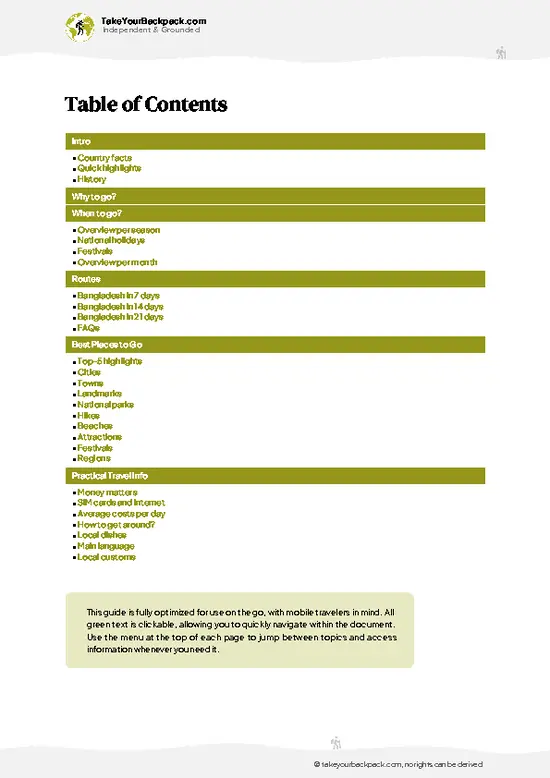
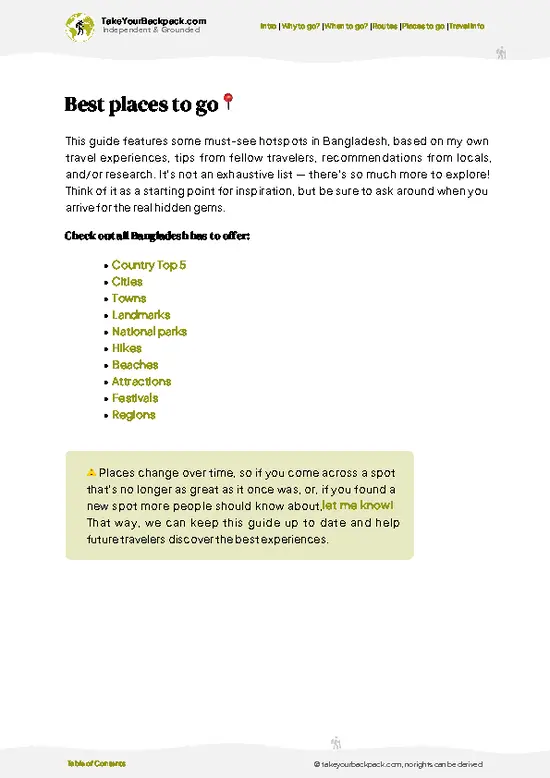
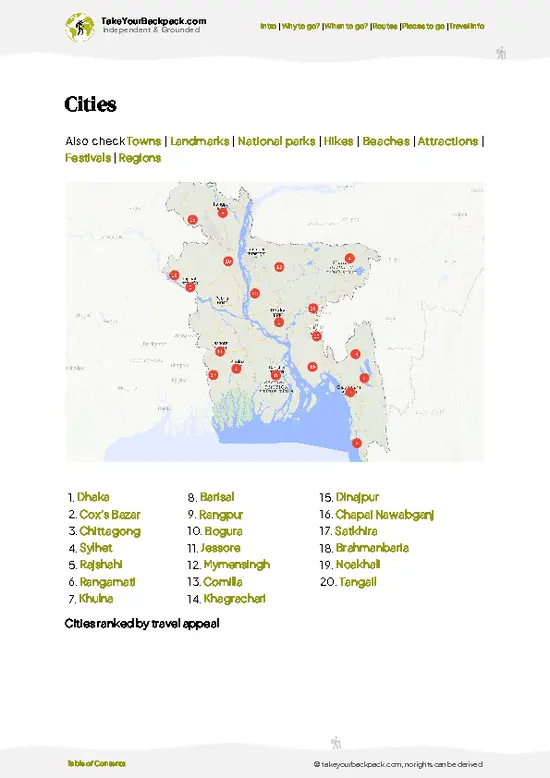
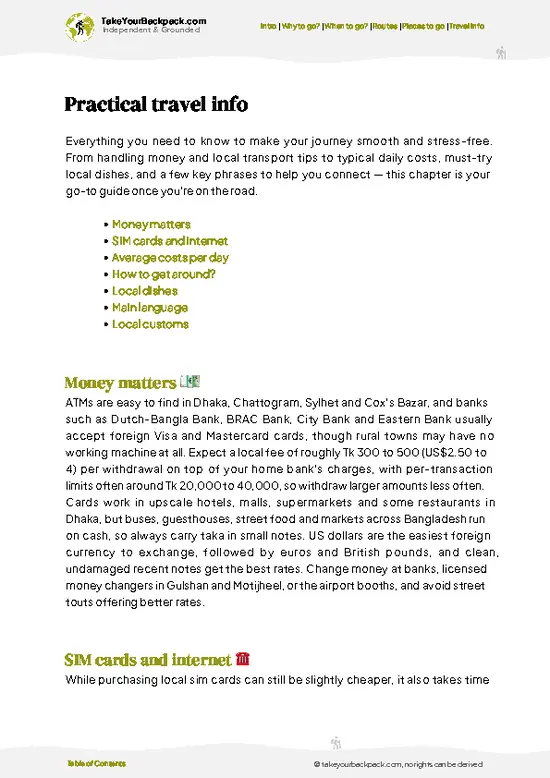
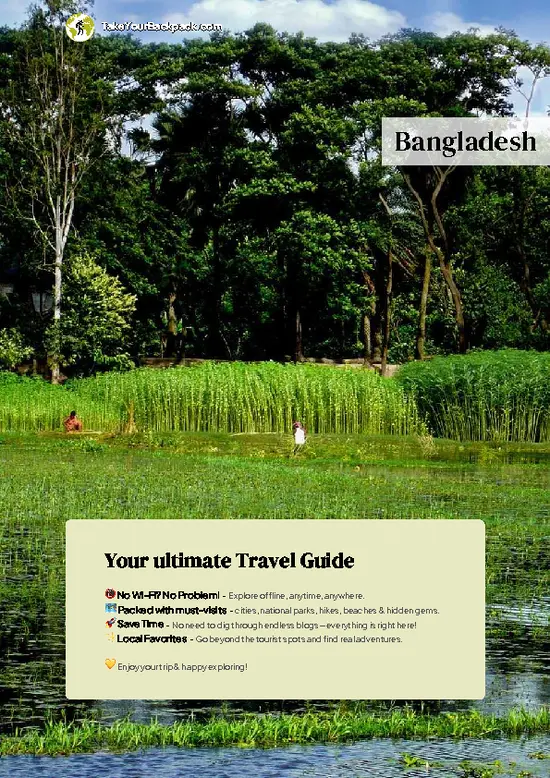
example page 0 from our offline Travel Guide for Bangladesh
example page 1 from our offline Travel Guide for Bangladesh
example page 2 from our offline Travel Guide for Bangladesh
example page 3 from our offline Travel Guide for Bangladesh
example page 4 from our offline Travel Guide for Bangladesh
example page 5 from our offline Travel Guide for Bangladesh
example page 6 from our offline Travel Guide for Bangladesh
example page 7 from our offline Travel Guide for Bangladesh
The digital guide (355 pages) contains:
✅ 102 highlights, ranked by travel appeal
✅ Optimized 7, 14 & 21-day travel routes
✅ Cities, national parks, landmarks, beaches
✅ How to get around
✅ Offline-friendly for travel without Wi-Fi
👉 Click to see all 30+ guide features

📅 Plan smarter in minutes, not weeks
✅ Month by month travel advice
✅ Festivals & national holidays
✅ Budget expectations

🗺️ Go to the right places, skip the overrated ones
✅ Honest pros & cons of destinations
✅ Top hikes, parks & viewpoints
✅ Lesser-known places most travelers miss
✅ Clear “worth it vs skip it” guidance

🛏️ Travel smoothly without rookie mistakes
✅ Best areas to stay
✅ Transport systems explained simply
✅ Common scams & safety advice
✅ SIM cards, money & practical tips

🌍 Understand the country, not just visit it
✅ Culture & traditions
✅ 52 Essential phrases & customs
✅ Festivals worth planning around
✅ Traveler-friendly historical context
✅ Insights that make places more meaningful

📱 Built for real travel conditions
✅ Fully downloadable PDF
✅ Works completely offline
✅ Optimized for phone use
✅ Useful in remote areas & buses
✅ Everything in one place
Stop searching, start planning
Get instant access to your full guide. 30‑day money-back guarantee.
+ Add another guide for just

By proceeding you agree to our terms.
Sent to your inbox immediately after payment • 100% Secure Checkout
Best Backpacking Travel Advisor 2025 tourism awardBest Backpacking
Travel Advisor
2025
What others say about Take Your Backpack Guides:
⭐⭐⭐⭐⭐
Fantastic, amazing amount of information!
⭐⭐⭐⭐⭐
My goodness this is amazing, it's what I've been looking for hats off too you!
⭐⭐⭐⭐⭐
I think this is absolutely BRILLIANT
⭐⭐⭐⭐
Very complete and informative. It's still missing places, but I gotta to commend you
⭐⭐⭐⭐⭐
This is truly amazing, thank you, can't wait to explore it with my kids!
⭐⭐⭐⭐⭐
Awesome resource, thank you!
⭐⭐⭐⭐⭐
This is amazing! Can't wait to explore the ones I haven't seen
⭐⭐⭐⭐
I love this! Well done, great idea.
⭐⭐⭐⭐⭐
Thanks for taking the time to make this gem!
⭐⭐⭐⭐⭐
This might be the best website I've ever seen.
⭐⭐⭐⭐⭐
Congratulations, and thank you so much for your work; it's incredibly valuable.
⭐⭐⭐⭐
In all seriousness I think you did a great job pointing out the important spots
⭐⭐⭐⭐⭐
10/10 very good
⭐⭐⭐⭐⭐
As someone who's only just starting to visit regularly this is awesome, thank you.
⭐⭐⭐⭐
Thank you very much! I'm going to visit my dad, it's going to be very useful!
⭐⭐⭐⭐⭐
This is really cool! We'll be travelling for the first time and this definitely come in handy.
⭐⭐⭐⭐⭐
You are now our minister of culture, congratulations 👨‍💼
⭐⭐⭐⭐⭐
Just wanted to tell you that this is a pearl! Going to follow your recommendations.
⭐⭐⭐⭐⭐
This is so cool. I'll definitely be using the resource for my travels soon.
⭐⭐⭐⭐⭐
This is very impressive! Good work.
⭐⭐⭐⭐⭐
This is an amazing and informative site. Very well done!

🛏️ Where to stay?Best Stay Options in Bangladesh

True backpacker hostels are rare in Bangladesh, with only a handful of dorm-style places in Dhaka, but budget guesthouses and basic hotels with private rooms for roughly Tk 1,200 to 3,000 (US$10 to 25) are easy to find in every city. In Dhaka, Gulshan and Banani are the safest and quietest bases, with the best cafes and the few hostels, though they cost more and sit an hour or more in traffic from Old Dhaka; Paltan and Motijheel have the cheapest hotels close to Old Dhaka, Sadarghat and Kamalapur station, at the price of round-the-clock noise and rougher rooms. Outside the capital, look at Kolatoli in Cox’s Bazar for beachfront budget hotels (packed on holiday weekends), Zindabazar in Sylhet … read more 👉
True backpacker hostels are rare in Bangladesh, with only a handful of dorm-style places in Dhaka, but budget guesthouses and basic hotels with private rooms for roughly Tk 1,200 to 3,000 (US$10 to 25) are easy to find in every city. In Dhaka, Gulshan and Banani are the safest and quietest bases, with the best cafes and the few hostels, though they cost more and sit an hour or more in traffic from Old Dhaka; Paltan and Motijheel have the cheapest hotels close to Old Dhaka, Sadarghat and Kamalapur station, at the price of round-the-clock noise and rougher rooms. Outside the capital, look at Kolatoli in Cox’s Bazar for beachfront budget hotels (packed on holiday weekends), Zindabazar in Sylhet for central, walkable options, and the town center of Sreemangal for cheap guesthouses near the tea estates, keeping in mind that nightlife anywhere in the country is close to nonexistent.

If you enjoy meeting fellow travelers, consider choosing hostels with high ratings for atmosphere. On the other hand, if you prefer having your own space, a hotel might be a better option.

BangladeshWhere to Go Next

👋 Meet the founderWho’s Behind Take Your Backpack?

Johan, backpacker and founder of TakeYourBackpackHi, I’m Johan (Netherlands 🇳🇱), the creator of TakeYourBackpack. Over the past 3 decades, I’ve backpacked through 90+ countries across six continents, gaining extensive experience with independent travel, long-term trips, and overland routes.

This site is built on a combination of firsthand travel experience and carefully curated insights from other backpackers. Many guides are based on places I’ve personally visited, while others bring together tips, observations, and practical advice shared by trusted travelers I’ve met along the way.

The goal is to provide realistic, experience-driven guidance — not generic itineraries — so you can explore destinations with better context, clearer expectations, and more confidence.