×

Belarus🇧🇾 | best regionsTop-Rated regions in Belarus

Belarus is organized around six oblasts, each named for its administrative center, and the differences between them are subtle rather than dramatic. The landscape is mostly flat, so character comes from history and land use: forest and lake country in the north, marshland in the south, Soviet-planned industry in the center, and former borderlands in the west. Minsk concentrates the infrastructure, the best rail links and the highest prices. Outside it, costs drop, English becomes rarer, and distances between towns grow. Crowds are thin everywhere. For backpacking or independent travel, the real choice is between convenient and urban or slower and rural.

By Johan Kruseman 🇳🇱 | Updated October 19, 2026
Explore the best cities in Belarus

Why go?Why Travelers Love These Spots

Belarus suits regional travel because its geography is gentle and its transport is cheap and orderly. The country is largely lowland, with few mountains and a dense network of trains and minibuses (marshrutkas) linking oblast centers. Its position between Poland, Lithuania, Latvia, Russia and Ukraine left a layered heritage: Orthodox and Catholic churches, Jewish and Tatar history, noble estates and castles, and heavy wartime destruction that shaped what survives. Large stretches of forest, including primeval woodland on the Polish border, give the countryside an unhurried feel.

Before choosing Belarus, a traveler should understand the practical limits. Entry rules change often, and visa-free arrangements depend on nationality, length of stay and the airport used, so they should be checked … read more 👉
Belarus suits regional travel because its geography is gentle and its transport is cheap and orderly. The country is largely lowland, with few mountains and a dense network of trains and minibuses (marshrutkas) linking oblast centers. Its position between Poland, Lithuania, Latvia, Russia and Ukraine left a layered heritage: Orthodox and Catholic churches, Jewish and Tatar history, noble estates and castles, and heavy wartime destruction that shaped what survives. Large stretches of forest, including primeval woodland on the Polish border, give the countryside an unhurried feel.

Before choosing Belarus, a traveler should understand the practical limits. Entry rules change often, and visa-free arrangements depend on nationality, length of stay and the airport used, so they should be checked with official sources shortly before departure. Travel insurance valid in Belarus is mandatory for most foreigners. The Cyrillic alphabet dominates signage, and Belarusian and Russian are the working languages, with English mainly in Minsk. Many Western bank cards do not work, so cash in rubles or a reliable payment plan matters. Border zones with Ukraine, Poland and Lithuania are restricted or sensitive, and some countries advise against travel altogether. Visitors who accept these conditions find a quiet, tidy and inexpensive country.
Why These Made the Cut
The list of best regions in Belarus is created based on landscapes, local culture, attractions, vibes, and overall appeal. If you feel a region is missing in this list, please let us know.

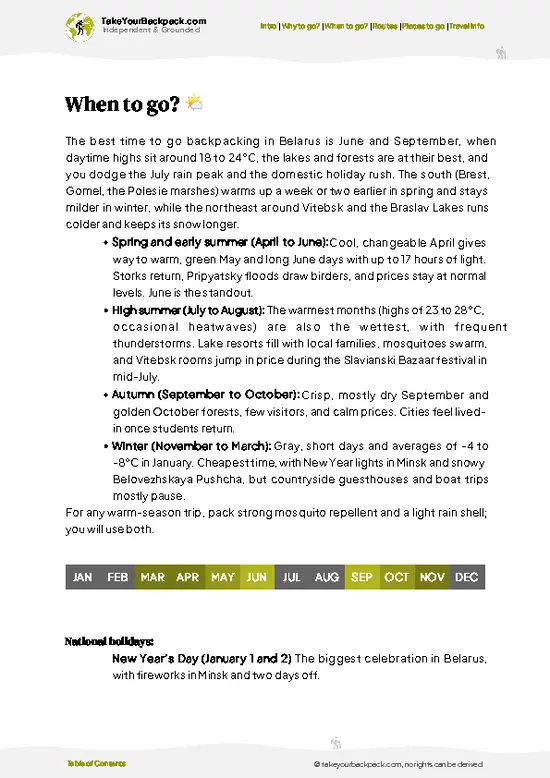
When to go?Optimal Periods for Travel

Best months and why: The best months are May to September, when daytime highs run about 17 to 25°C, forests and lakes are accessible and daylight lasts up to 17 hours in June. July is the warmest month, averaging near 18 to 19°C, with occasional spells above 30°C and short thunderstorms. Rainfall is moderate year-round, roughly 550 to 700 mm a year, with the wettest weather in summer.
Shoulder seasons: Late April to May and September to early October are quieter and cheaper. May brings blossom and temperatures of 12 to 20°C, though nights can be cold. September is mild and dry, and autumn color in the forests peaks around late September to mid-October. Hotel prices in Minsk can run 10 to 25 percent lower outside July and August, and rural guesthouses change little.
Winter and regional differences: … read more 👉
Best months and why: The best months are May to September, when daytime highs run about 17 to 25°C, forests and lakes are accessible and daylight lasts up to 17 hours in June. July is the warmest month, averaging near 18 to 19°C, with occasional spells above 30°C and short thunderstorms. Rainfall is moderate year-round, roughly 550 to 700 mm a year, with the wettest weather in summer.
Shoulder seasons: Late April to May and September to early October are quieter and cheaper. May brings blossom and temperatures of 12 to 20°C, though nights can be cold. September is mild and dry, and autumn color in the forests peaks around late September to mid-October. Hotel prices in Minsk can run 10 to 25 percent lower outside July and August, and rural guesthouses change little.
Winter and regional differences: From December to February, temperatures typically sit between -8 and 0°C, and cold snaps can reach -20°C. Snow cover is steady in the north, especially around Vitebsk Oblast, and lasts longer than in the south. Brest Oblast has a milder, earlier spring. Southern wetlands in Gomel Oblast can be muddy in March and April during the thaw. Daylight in December falls to about 7 hours. Winter suits museums and cities, while some seasonal rural sites and boat services reduce hours or close.

region hoppingHow to Combine regions Into One Trip

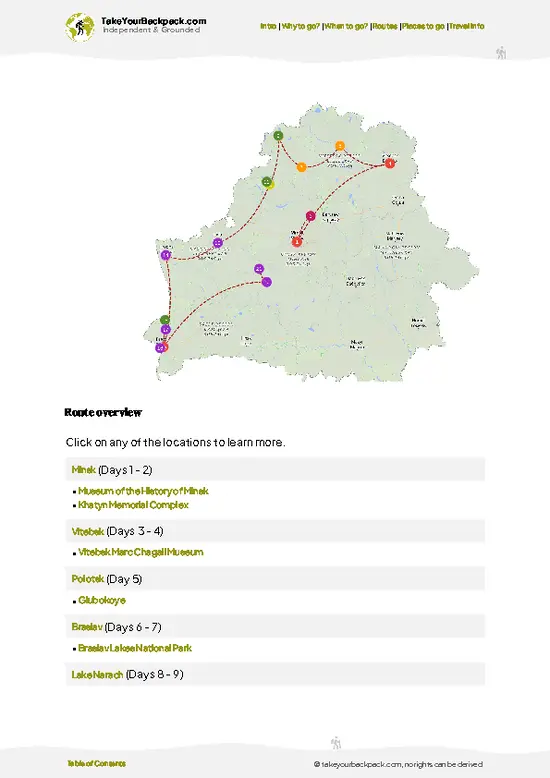
How many days to plan: A trip combining several regions in Belarus works best in 7 to 12 days, which allows three or four stops without constant transfers. The country is compact, but trains and buses are slower than distances suggest.
Grouping and direction: The western and central regions pair well, with Brest and Grodno on one side and Minsk as the hub between them. Vitebsk and Mogilev group naturally to the north and east, and Gomel sits apart in the southeast. A sensible direction runs from Brest east through Minsk, then onward to Vitebsk or Mogilev, finishing at the Minsk airport. Each stop needs 2 to 3 days in a major oblast center with day trips, and 1 to 2 days for a smaller town or nature area.
Transfers and common mistakes: Typical travel times are about 3.5 to 4 hours by train from … read more 👉
How many days to plan: A trip combining several regions in Belarus works best in 7 to 12 days, which allows three or four stops without constant transfers. The country is compact, but trains and buses are slower than distances suggest.
Grouping and direction: The western and central regions pair well, with Brest and Grodno on one side and Minsk as the hub between them. Vitebsk and Mogilev group naturally to the north and east, and Gomel sits apart in the southeast. A sensible direction runs from Brest east through Minsk, then onward to Vitebsk or Mogilev, finishing at the Minsk airport. Each stop needs 2 to 3 days in a major oblast center with day trips, and 1 to 2 days for a smaller town or nature area.
Transfers and common mistakes: Typical travel times are about 3.5 to 4 hours by train from Brest to Minsk, 4 to 5 hours from Minsk to Grodno by train or bus, and 4 to 5 hours from Minsk to Vitebsk. Gomel is around 4.5 to 5.5 hours from Minsk. Many travelers overpack the itinerary and treat each oblast as a single stop, ignoring that rural sights need local buses with few departures. Choose fewer bases and use day trips. Another error is backtracking through Minsk; route in a loop instead. Rural services thin out on weekends, so book intercity tickets a day ahead on busy routes.

The ListThe Best regions of Belarus

1 Pinsk Marshes

peat bogs, migratory bird habitats, winding waterways, remote villages

Navigate a landscape of shifting wetlands where seasonal floods, rare wildlife, and isolated communities create a sense of quiet remoteness.

Loading the map 🌍

Expert viewTips and Advice from Travelers

How many regions to visit: Three regions is the practical number for most backpackers, four if you have two weeks. Belarus has long gaps between services outside the oblast centers, and each region deserves at least two full days to reach its smaller sights. Beyond four, you spend more time on buses than looking at anything.
Choosing by travel style: Anyone who likes museums, architecture and cafes should favor urban and historic regions, where hostels and English speakers are easier to find. Hikers, birdwatchers and cyclists do better in forest and lake regions, where guesthouses (agrousadbas) replace hotels and a basic grasp of Russian helps. History-focused travelers should weigh regions with castles and wartime memorials, which are spread out and often need a taxi for the last stretch.
What … read more 👉
How many regions to visit: Three regions is the practical number for most backpackers, four if you have two weeks. Belarus has long gaps between services outside the oblast centers, and each region deserves at least two full days to reach its smaller sights. Beyond four, you spend more time on buses than looking at anything.
Choosing by travel style: Anyone who likes museums, architecture and cafes should favor urban and historic regions, where hostels and English speakers are easier to find. Hikers, birdwatchers and cyclists do better in forest and lake regions, where guesthouses (agrousadbas) replace hotels and a basic grasp of Russian helps. History-focused travelers should weigh regions with castles and wartime memorials, which are spread out and often need a taxi for the last stretch.
What it costs: Budget US$30 to 50 a day for hostel or guesthouse beds, local meals and public transport, or US$60 to 90 with private rooms and the occasional taxi. Hostel dorms run about US$10 to 18, and guesthouses US$20 to 45 a room. Museum and castle entry is usually US$2 to 6, and a local guide costs roughly US$25 to 60 for a half day. Taxis between small towns run US$15 to 40 and are worth it where buses run twice a day. Over a ten-day visit, expect US$350 to 600 excluding flights. Prices in rubles are low, but foreign cards often fail, so carry enough euros or dollars in clean, undamaged notes to exchange at banks and exchange offices.
Delays and costs that catch people out: Mandatory medical insurance is checked on arrival, and buying it late at the airport costs more and wastes time. Prepare it in advance with proof printed. Rural buses may not run on public holidays or Sundays, so check the return before you leave a town. Unregistered stays can cause trouble, so keep the registration slip hotels give you and carry it with your passport. Pay attention to the border zones near Poland, Lithuania, Latvia and Ukraine, where permits or restrictions can apply, and never wander near military areas.
Safety and cultural considerations: Crime against visitors is low, but politics is a sensitive subject, and photography near government buildings, police and military sites can draw attention. Avoid demonstrations and political talk with strangers. Check your government’s travel advice and entry rules before booking, as these change. Belarusians tend to be reserved but helpful, and a few words of Russian or Belarusian go a long way. Dress modestly in churches, remove hats indoors, and bring a small gift when visiting a home. Tap water is generally drinkable in cities, though many locals filter it. In forest areas, check for ticks from spring to autumn.

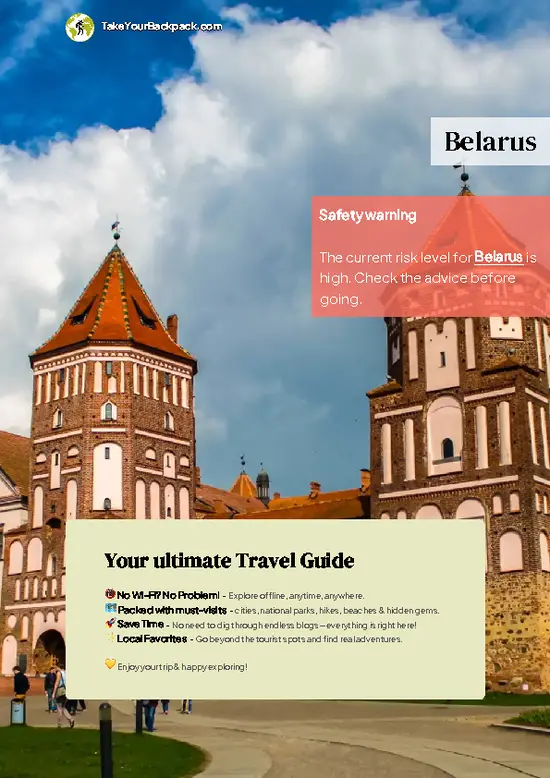
✈️ The backpacker research shortcutBelarus Travel Guide

An offline-friendly backpacking guide with optimized travel routes, ranked highlights, transport advice, and the best areas to stay.
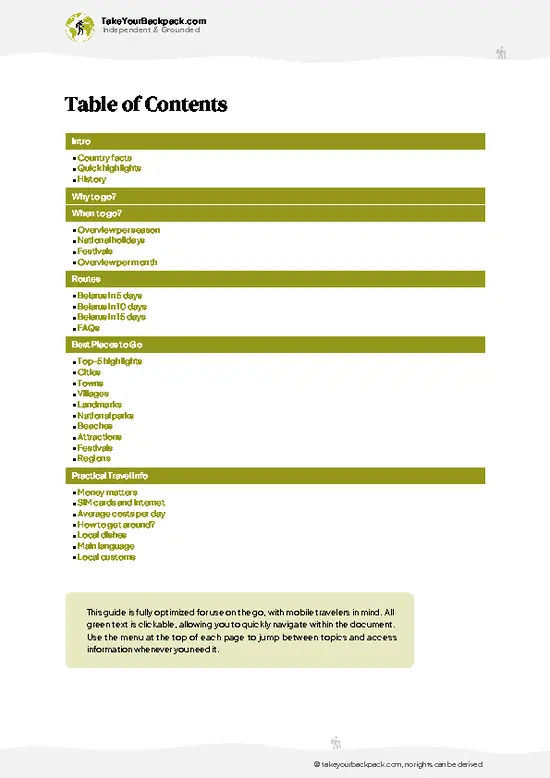
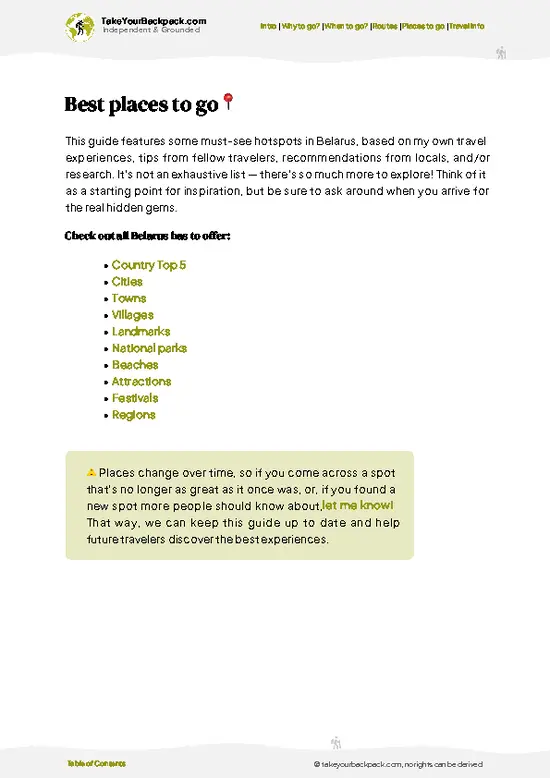
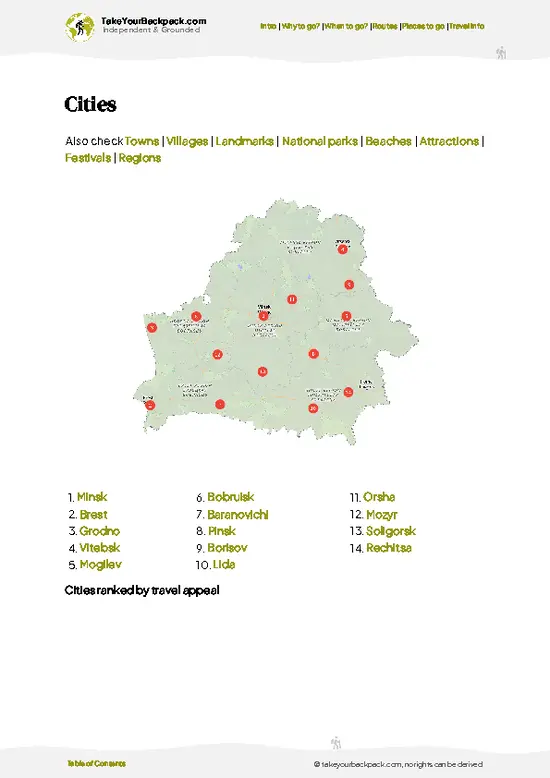
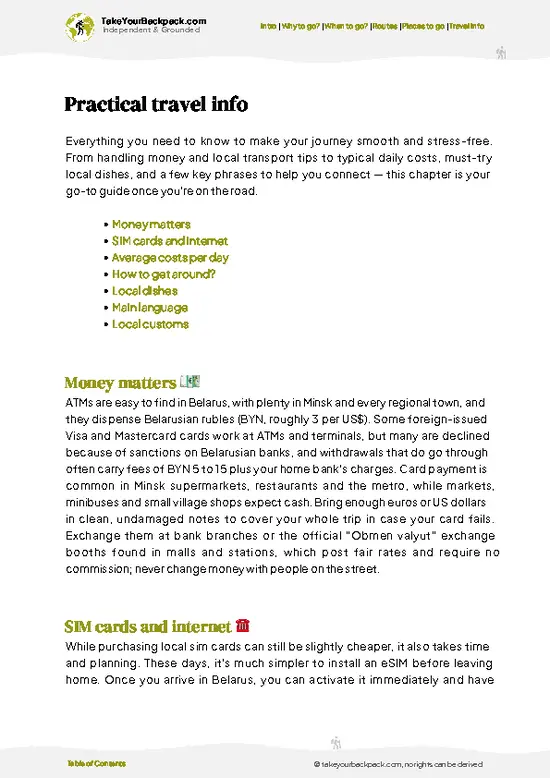
example page 0 from our offline Travel Guide for Belarus
example page 1 from our offline Travel Guide for Belarus
example page 2 from our offline Travel Guide for Belarus
example page 3 from our offline Travel Guide for Belarus
example page 4 from our offline Travel Guide for Belarus
example page 5 from our offline Travel Guide for Belarus
example page 6 from our offline Travel Guide for Belarus
example page 7 from our offline Travel Guide for Belarus
The digital guide (288 pages) contains:
✅ 67 highlights, ranked by travel appeal
✅ Optimized 5, 10 & 15-day travel routes
✅ Cities, national parks, landmarks, beaches
✅ How to get around
✅ Offline-friendly for travel without Wi-Fi
👉 Click to see all 30+ guide features

📅 Plan smarter in minutes, not weeks
✅ Month by month travel advice
✅ Festivals & national holidays
✅ Budget expectations

🗺️ Go to the right places, skip the overrated ones
✅ Honest pros & cons of destinations
✅ Top hikes, parks & viewpoints
✅ Lesser-known places most travelers miss
✅ Clear “worth it vs skip it” guidance

🛏️ Travel smoothly without rookie mistakes
✅ Best areas to stay
✅ Transport systems explained simply
✅ Common scams & safety advice
✅ SIM cards, money & practical tips

🌍 Understand the country, not just visit it
✅ Culture & traditions
✅ 52 Essential phrases & customs
✅ Festivals worth planning around
✅ Traveler-friendly historical context
✅ Insights that make places more meaningful

📱 Built for real travel conditions
✅ Fully downloadable PDF
✅ Works completely offline
✅ Optimized for phone use
✅ Useful in remote areas & buses
✅ Everything in one place
Stop searching, start planning
Get instant access to your full guide. 30‑day money-back guarantee.
+ Add another guide for just

By proceeding you agree to our terms.
Sent to your inbox immediately after payment • 100% Secure Checkout
Best Backpacking Travel Advisor 2025 tourism awardBest Backpacking
Travel Advisor
2025
What others say about Take Your Backpack Guides:
⭐⭐⭐⭐⭐
Fantastic, amazing amount of information!
⭐⭐⭐⭐⭐
My goodness this is amazing, it's what I've been looking for hats off too you!
⭐⭐⭐⭐⭐
I think this is absolutely BRILLIANT
⭐⭐⭐⭐
Very complete and informative. It's still missing places, but I gotta to commend you
⭐⭐⭐⭐⭐
This is truly amazing, thank you, can't wait to explore it with my kids!
⭐⭐⭐⭐⭐
Awesome resource, thank you!
⭐⭐⭐⭐⭐
This is amazing! Can't wait to explore the ones I haven't seen
⭐⭐⭐⭐
I love this! Well done, great idea.
⭐⭐⭐⭐⭐
Thanks for taking the time to make this gem!
⭐⭐⭐⭐⭐
This might be the best website I've ever seen.
⭐⭐⭐⭐⭐
Congratulations, and thank you so much for your work; it's incredibly valuable.
⭐⭐⭐⭐
In all seriousness I think you did a great job pointing out the important spots
⭐⭐⭐⭐⭐
10/10 very good
⭐⭐⭐⭐⭐
As someone who's only just starting to visit regularly this is awesome, thank you.
⭐⭐⭐⭐
Thank you very much! I'm going to visit my dad, it's going to be very useful!
⭐⭐⭐⭐⭐
This is really cool! We'll be travelling for the first time and this definitely come in handy.
⭐⭐⭐⭐⭐
You are now our minister of culture, congratulations 👨‍💼
⭐⭐⭐⭐⭐
Just wanted to tell you that this is a pearl! Going to follow your recommendations.
⭐⭐⭐⭐⭐
This is so cool. I'll definitely be using the resource for my travels soon.
⭐⭐⭐⭐⭐
This is very impressive! Good work.
⭐⭐⭐⭐⭐
This is an amazing and informative site. Very well done!

🛏️ Where to stay?Where to Stay: Belarus Edition

Belarus has a small but solid hostel scene, with dorm beds typically at 25 to 50 BYN (US$8 to 15) and simple private rooms or rented apartments from about 80 BYN (US$25), concentrated mostly in Minsk and, in smaller numbers, in Brest, Grodno and Vitebsk. In Minsk, the area around Nemiga and the Upper Town puts you closest to the bars and riverside walks but can be noisy on weekends, while Independence Avenue and the streets near the railway station are more central for transport and quieter at night, with easy metro links. Elsewhere, staying in the pedestrian old centers of Grodno or near Sovetskaya Street in Brest keeps the sights walkable, and the whole country is very safe for walking back … read more 👉
Belarus has a small but solid hostel scene, with dorm beds typically at 25 to 50 BYN (US$8 to 15) and simple private rooms or rented apartments from about 80 BYN (US$25), concentrated mostly in Minsk and, in smaller numbers, in Brest, Grodno and Vitebsk. In Minsk, the area around Nemiga and the Upper Town puts you closest to the bars and riverside walks but can be noisy on weekends, while Independence Avenue and the streets near the railway station are more central for transport and quieter at night, with easy metro links. Elsewhere, staying in the pedestrian old centers of Grodno or near Sovetskaya Street in Brest keeps the sights walkable, and the whole country is very safe for walking back late, even if nightlife outside Minsk winds down early.

If you enjoy meeting fellow travelers, consider choosing hostels with high ratings for atmosphere. On the other hand, if you prefer having your own space, a hotel might be a better option.

BelarusExplore Beyond This Category

👋 Meet the founderWho’s Behind Take Your Backpack?

Johan, backpacker and founder of TakeYourBackpackHi, I’m Johan (Netherlands 🇳🇱), the creator of TakeYourBackpack. Over the past 3 decades, I’ve backpacked through 90+ countries across six continents, gaining extensive experience with independent travel, long-term trips, and overland routes.

This site is built on a combination of firsthand travel experience and carefully curated insights from other backpackers. Many guides are based on places I’ve personally visited, while others bring together tips, observations, and practical advice shared by trusted travelers I’ve met along the way.

The goal is to provide realistic, experience-driven guidance — not generic itineraries — so you can explore destinations with better context, clearer expectations, and more confidence.