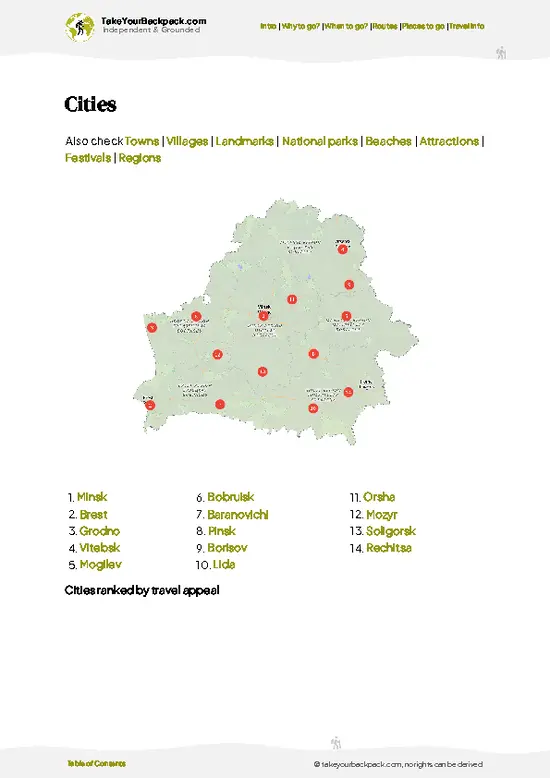
How many cities to visit: Three to four cities is the sensible number for a trip of a week to ten days. Distances between regional centers are 3 to 5 hours each way, services are infrequent, and old centers are small, so each place needs only a day or a day and a half. Adding a fifth stop usually means more time on buses than in the streets. For a trip under five days, two cities is enough.
Choosing between kinds of cities: First-time visitors to Belarus should anchor the trip on the
capital, where hostels, English menus, a metro and card-friendly shops are easiest to find. Travelers drawn to older architecture and quieter streets should add one or two
western or border-region cities, which have more pre-war buildings. Those interested in Soviet urban design and the lowest prices will find …
read more 👉 How many cities to visit: Three to four cities is the sensible number for a trip of a week to ten days. Distances between regional centers are 3 to 5 hours each way, services are infrequent, and old centers are small, so each place needs only a day or a day and a half. Adding a fifth stop usually means more time on buses than in the streets. For a trip under five days, two cities is enough.
Choosing between kinds of cities: First-time visitors to Belarus should anchor the trip on the
capital, where hostels, English menus, a metro and card-friendly shops are easiest to find. Travelers drawn to older architecture and quieter streets should add one or two
western or border-region cities, which have more pre-war buildings. Those interested in Soviet urban design and the lowest prices will find them in the
eastern and southeastern cities, though English is rarer and services thinner there.
Budget: A backpacker can manage on
US$30 to 50 a day (about BYN 95 to 160): a hostel bed or basic room at BYN 40 to 90 (US$13 to 28), meals at BYN 20 to 45 (US$6 to 14), and local transport at BYN 1.5 to 5 a ride. Mid-range travelers should expect US$60 to 90. Per-visit costs are modest: museums run BYN 5 to 15 (US$2 to 5), large castle or palace complexes BYN 20 to 40 (US$7 to 13), and intercity buses or trains BYN 10 to 30 (US$3 to 10). A private guide for a half day costs roughly US$25 to 50, and is worth booking only where signage is Russian-only and the history is dense.
Costs and mistakes that catch travelers out: Foreign bank cards usually do not work, so bring enough
clean, undamaged cash in euros or US dollars and exchange it at banks or exchange offices, not at airport kiosks with poor rates. Ruble ATMs cannot be relied on for foreign cards.
Medical insurance valid in Belarus is required at entry, and border purchases take time, so arrange it beforehand. Withdraw or exchange before heading to smaller towns, where exchange points are few. Buy intercity tickets at stations or through official sites a day ahead in summer, because popular departures sell out. Download offline maps and a Russian translation tool, since English is limited outside the capital.
Safety and cultural points: Street crime is low and cities are calm at night, but the main risk is
legal and political. Do not photograph police, military sites or government buildings, avoid political discussion and protest-related topics, and keep your passport and registration slip with you. Hotels register foreign guests automatically, but private rentals can require separate registration, so confirm with the host. Check your own government’s travel advice before booking. Dress is conventional, taking shoes off in private homes is expected, and a polite greeting in Russian is appreciated.
v2.webp)


 Best Backpacking
.jpg) Hi, I’m Johan (Netherlands 🇳🇱), the creator of TakeYourBackpack. Over the past 3 decades, I’ve backpacked through 90+ countries across six continents, gaining extensive experience with independent travel, long-term trips, and overland routes.
Hi, I’m Johan (Netherlands 🇳🇱), the creator of TakeYourBackpack. Over the past 3 decades, I’ve backpacked through 90+ countries across six continents, gaining extensive experience with independent travel, long-term trips, and overland routes.