×

Belize🇧🇿 | best townsTop-Rated 10 towns in Belize

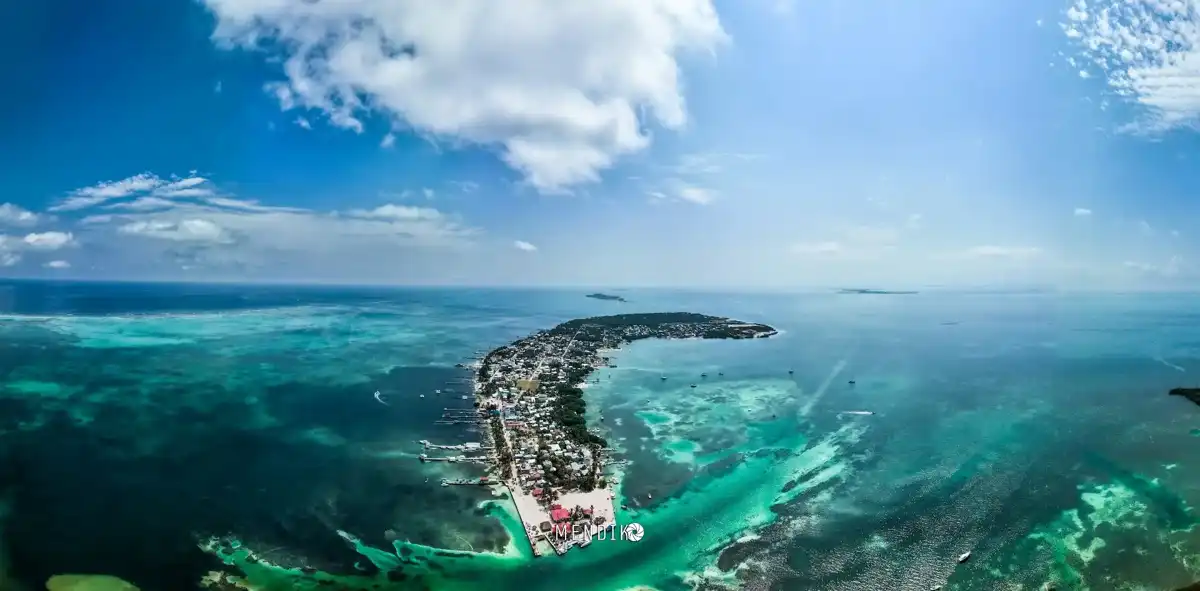
Towns in Belize are small, low-slung and loud in ways you don’t expect: Kriol chatter from verandas, diesel from old school buses, and the smell of fry jacks and coconut oil by 7 a.m. The cayes run on sand streets, golf carts and ferry schedules, with higher prices and sunburned crowds. The Cayo district inland is greener, cooler at night and cheaper, with Maya ruins and caves close by. The south is slower, rougher and far less visited. Independent travel here is easy because everything sits within a few hours of a bus road, but your choice of region sets your budget and your pace.

By Johan Kruseman 🇳🇱 | Updated October 23, 2026
Explore the best villages in Belize

Why go?Key Factors That Shape the Experience

Belize has roughly 400,000 people spread across a country about the size of Massachusetts, so towns are small, English-speaking and tied to a single purpose: reef, river, border crossing or farm road. That shapes everything. A British colonial past left English as the official language, driving on the right, and a Kriol-Garifuna-Maya-Mestizo-Mennonite mix you hear in the market within one block. Spanish drifts in from the west and north, Garifuna drumming from the south coast.

Geography decides how you live in these places. The Caribbean coast is flat, humid and salty, with mangrove, sandflies at dusk and sea breezes that make midday tolerable. The interior climbs into pine ridge and rainforest, where evenings smell of woodsmoke and wet leaves. Only a few main highways connect it all, so … read more 👉
Belize has roughly 400,000 people spread across a country about the size of Massachusetts, so towns are small, English-speaking and tied to a single purpose: reef, river, border crossing or farm road. That shapes everything. A British colonial past left English as the official language, driving on the right, and a Kriol-Garifuna-Maya-Mestizo-Mennonite mix you hear in the market within one block. Spanish drifts in from the west and north, Garifuna drumming from the south coast.

Geography decides how you live in these places. The Caribbean coast is flat, humid and salty, with mangrove, sandflies at dusk and sea breezes that make midday tolerable. The interior climbs into pine ridge and rainforest, where evenings smell of woodsmoke and wet leaves. Only a few main highways connect it all, so a washed-out bridge or a flooded road can reshape a day.

Before choosing Belize for its towns, know that prices are high for Central America, because most food and goods are imported and the Belize dollar is pegged at BZ$2 to US$1. Towns are compact and walkable, but nightlife is modest, and quality varies sharply between a tourist strip and a working street. Come for access to reef, jungle and ruins rather than big-city sights.
How the List Was Created
The list of best towns in Belize is created based on charm, local culture, atmosphere, hidden gems, and visitor appeal. If you feel a town is missing in this list, please let us know.

When to go?Timing Your Visit for the Best Experience

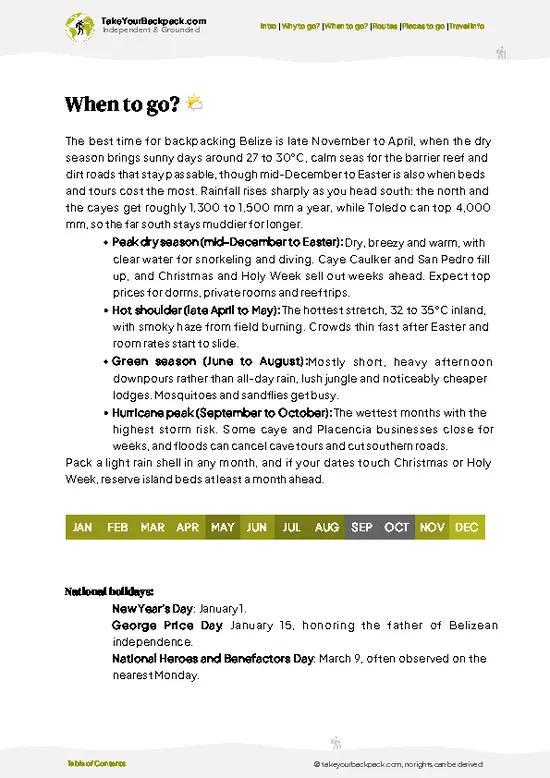
Best months for towns: The best months for towns in Belize are late November to April, when the dry season brings clear blue skies, daytime highs of 27 to 31°C (81 to 88°F) and far fewer mosquitoes. Humidity drops enough that you can walk a sandy street at noon without feeling poached. The driest stretch is March to May, though inland heat can push past 35°C (95°F) by late April.
Shoulder and wet seasons: The wet season runs June to November. Expect warm, heavy afternoon downpours, with the south getting the most, often 3,000 to 4,000 mm a year against about 1,500 to 2,000 mm in the north. Dirt roads turn to red-brown mud, and rivers in Cayo and the south rise fast. May and early December are good shoulder months, with lower rates and mostly dry mornings.
Peak periods and prices: Peak demand … read more 👉
Best months for towns: The best months for towns in Belize are late November to April, when the dry season brings clear blue skies, daytime highs of 27 to 31°C (81 to 88°F) and far fewer mosquitoes. Humidity drops enough that you can walk a sandy street at noon without feeling poached. The driest stretch is March to May, though inland heat can push past 35°C (95°F) by late April.
Shoulder and wet seasons: The wet season runs June to November. Expect warm, heavy afternoon downpours, with the south getting the most, often 3,000 to 4,000 mm a year against about 1,500 to 2,000 mm in the north. Dirt roads turn to red-brown mud, and rivers in Cayo and the south rise fast. May and early December are good shoulder months, with lower rates and mostly dry mornings.
Peak periods and prices: Peak demand hits mid-December to Easter, especially the cayes and Placencia, where guesthouse rooms can run 20 to 40 percent above low-season rates and sell out ahead of Christmas and Holy Week. Hurricane season officially runs June to November, with the highest risk in September and October. Some boat operators and small guesthouses reduce hours or close in September and October, so confirm before you travel.

town hoppingHow to Combine towns Into One Trip

How many days to plan: A trip combining several towns in Belize needs 10 to 14 days, and 7 days is enough for two regions. Belize is small, but roads are slow, buses stop constantly and boats run on fixed schedules.
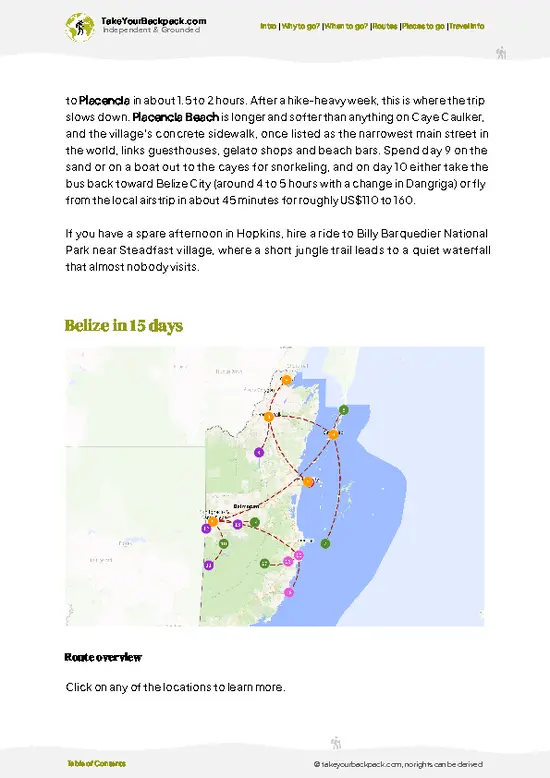
Regions and direction: The country clusters into three zones: the cayes and coast reached from Belize City, the western Cayo district near the Guatemala border, and the south around Dangriga, Placencia and Punta Gorda. A sensible loop starts in the west, then moves through Belize City or Belmopan to the cayes, then south by boat or bus. Flying in at Belize City and out of Punta Gorda or back through the city saves backtracking. The Western Highway from Belize City to San Ignacio takes about 2 to 2.5 hours by bus, the Hummingbird Highway south to Dangriga about 2 to 3 hours, and … read more 👉
How many days to plan: A trip combining several towns in Belize needs 10 to 14 days, and 7 days is enough for two regions. Belize is small, but roads are slow, buses stop constantly and boats run on fixed schedules.
Regions and direction: The country clusters into three zones: the cayes and coast reached from Belize City, the western Cayo district near the Guatemala border, and the south around Dangriga, Placencia and Punta Gorda. A sensible loop starts in the west, then moves through Belize City or Belmopan to the cayes, then south by boat or bus. Flying in at Belize City and out of Punta Gorda or back through the city saves backtracking. The Western Highway from Belize City to San Ignacio takes about 2 to 2.5 hours by bus, the Hummingbird Highway south to Dangriga about 2 to 3 hours, and water taxis to the cayes run 45 to 90 minutes.
Pacing and planning errors: Allow 2 to 4 nights per stop; one night means a day spent in vans and a salty wet bag. The usual mistake is packing in too many regions, trusting a printed timetable, or forgetting that a bus into the south can add 5 to 6 hours. Build in a buffer day before any international flight, and leave afternoons free, since rain and mud change schedules without warning. Book morning departures, as buses thin out after mid-afternoon.

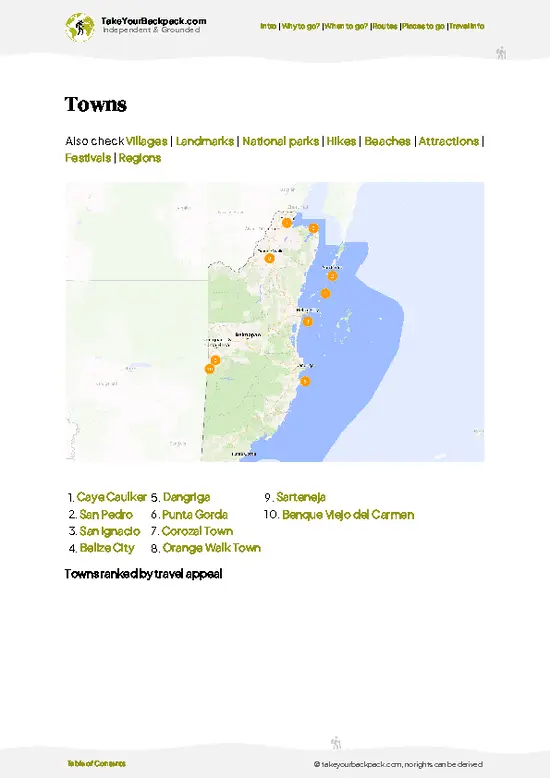
The ListThe Best towns of Belize

1 Caye Caulker

Car-free island, The Split, reef tours, sunset rum punch

Cycle sandy streets to a channel that cuts the island in two, then book snorkeling trips to Hol Chan and Shark Ray Alley.

2 San Pedro

Hol Chan reef cut, Front Street, golf carts, lagoon sunsets

Snorkel with nurse sharks and rays at Hol Chan, then ride a cart to a shallow lagoon beach where bars sit on the sand.

3 San Ignacio

Burns Avenue, Cahal Pech, Macal River, Saturday market

Climb to a hilltop Maya complex, swim in the Macal River and stroll a pedestrian street lined with cafés and tour offices.

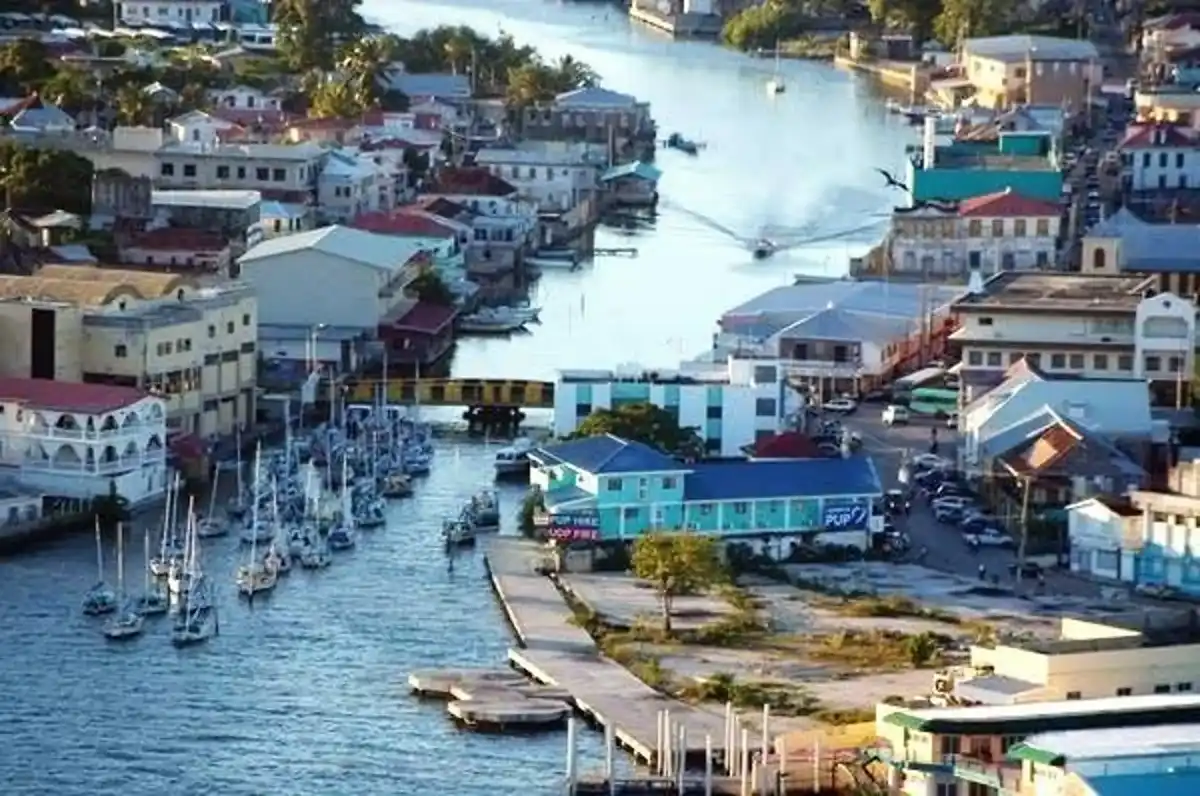
4 Belize City

Swing Bridge, colonial wooden houses, transport switching point, daylight arrivals

Pass through a working port where the hand-cranked swing bridge, a converted prison museum and bus and boat terminals sit within a short walk.

belize-city-belize-city
© Google | Mama Africa

5 Dangriga

Garifuna drumming, hudut, cassava bread, Gulisi museum

Learn Garifuna history at the museum, try a drum lesson with a local maker and eat fish in coconut broth with mashed plantain.

6 Punta Gorda

Toledo District, cacao farms, Maya villages, Guatemala ferry

Tour small cacao producers, line up village homestays and watch boats to Guatemala leave from a pier in the far south.

belize-city-punta-gorda
© Google |

7 Corozal Town

Bay of Chetumal, seawall breeze, Mexican border, Santa Rita mounds

Walk the breezy bayfront seawall at dusk, climb the Santa Rita mounds above the rooftops and eat cheap tacos before crossing into Mexico.

8 Orange Walk Town

New River, Lamanai boat trips, Mennonite market, cane country

Book a boat up the New River to the Lamanai temples, then browse a market where Mennonite farmers sell cheese, fruit and tortillas.

9 Sarteneja

Wooden sloop boatyards, Shipstern reserve, Corozal Bay sunsets, fishing village

Watch builders shape wooden sloops by hand, then head into Shipstern Nature Reserve for birds, butterflies and a canopy tower.

belize-city-sarteneja
© Google |

10 Benque Viejo del Carmen

Border stop, Spanish-speaking, Xunantunich access, local buses

Use this quiet Spanish-speaking town near the Guatemalan border as a base for the Xunantunich ruins, reached by a hand-cranked cable ferry.

Loading the map 🌍

Expert viewWhat You Should Know

How many towns to visit: I advise three or four towns on a 10 to 14 day trip. Belize rewards time in each place, whether that means a day on the water, a morning in a cave or an evening on a plastic chair with a cold Belikin. More stops mean more time on the road, and buses in Belize can crawl through villages for hours. You get a real sense of one place instead of a blur of bus windows.
Which kind of town suits you: Choose by travel style. Caye towns suit divers and snorkelers, with warm water, wind in your hair and the smell of sunscreen and grilled fish. Inland towns suit you if you want caves, ruins, river tubing and cooler nights. Southern towns suit slower travelers seeking Garifuna culture, cacao farms and quiet villages, with fewer other backpackers and fewer facilities. Most first-timers … read more 👉
How many towns to visit: I advise three or four towns on a 10 to 14 day trip. Belize rewards time in each place, whether that means a day on the water, a morning in a cave or an evening on a plastic chair with a cold Belikin. More stops mean more time on the road, and buses in Belize can crawl through villages for hours. You get a real sense of one place instead of a blur of bus windows.
Which kind of town suits you: Choose by travel style. Caye towns suit divers and snorkelers, with warm water, wind in your hair and the smell of sunscreen and grilled fish. Inland towns suit you if you want caves, ruins, river tubing and cooler nights. Southern towns suit slower travelers seeking Garifuna culture, cacao farms and quiet villages, with fewer other backpackers and fewer facilities. Most first-timers do well mixing one island, one inland base and one southern stop.
What it costs: Budget US$50 to 90 a day if you use dorms or basic guesthouses and eat local food, with a room around US$15 to 40 in many towns and more on the cayes. Rice and beans or a stew chicken plate costs US$4 to 8. Costs add up fast on top of that. A reef snorkel tour runs about US$50 to 100, a cave tubing or ruin visit often US$25 to 75 with a guide, and a water taxi US$10 to 20 each way. Some sites require licensed guides. Carry small Belize dollars or US bills; both are widely accepted, but cards add fees at smaller places.
Safety and cultural notes: Belize City has a reputation for street crime, and some southside neighborhoods are best avoided even by day. In most tourist towns, take the usual care after dark, use licensed taxis, and keep valuables off the beach. Greetings matter: a “morning” or “good afternoon” before any request goes a long way, and you’ll get an easy smile back. Dress modestly away from the beach, ask before photographing people, and treat reef and cave rules seriously, since protected-area fees and fines are real. Bring sandfly repellent for the coast, and watch for strong sun, which can burn you in under 30 minutes.

✈️ The backpacker research shortcutBelize Travel Guide

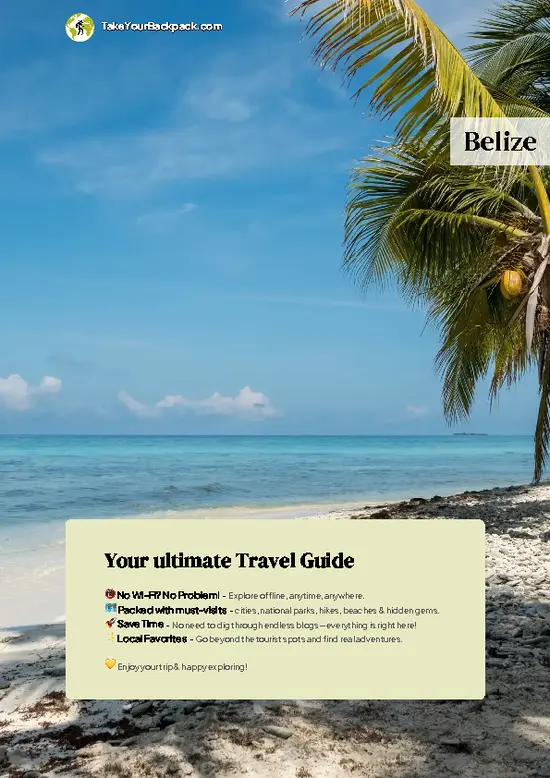
An offline-friendly backpacking guide with optimized travel routes, ranked highlights, transport advice, and the best areas to stay.
example page 0 from our offline Travel Guide for Belize
example page 1 from our offline Travel Guide for Belize
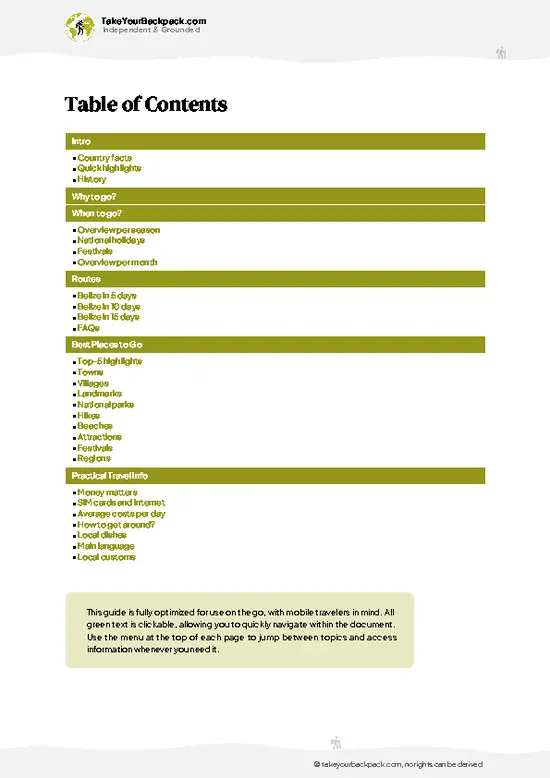
example page 2 from our offline Travel Guide for Belize
example page 3 from our offline Travel Guide for Belize
example page 4 from our offline Travel Guide for Belize
example page 5 from our offline Travel Guide for Belize
example page 6 from our offline Travel Guide for Belize
example page 7 from our offline Travel Guide for Belize
The digital guide (168 pages) contains:
✅ 44 highlights, ranked by travel appeal
✅ Optimized 5, 10 & 15-day travel routes
✅ Cities, national parks, landmarks, beaches
✅ How to get around
✅ Offline-friendly for travel without Wi-Fi
👉 Click to see all 30+ guide features

📅 Plan smarter in minutes, not weeks
✅ Month by month travel advice
✅ Festivals & national holidays
✅ Budget expectations

🗺️ Go to the right places, skip the overrated ones
✅ Honest pros & cons of destinations
✅ Top hikes, parks & viewpoints
✅ Lesser-known places most travelers miss
✅ Clear “worth it vs skip it” guidance

🛏️ Travel smoothly without rookie mistakes
✅ Best areas to stay
✅ Transport systems explained simply
✅ Common scams & safety advice
✅ SIM cards, money & practical tips

🌍 Understand the country, not just visit it
✅ Culture & traditions
✅ 52 Essential phrases & customs
✅ Festivals worth planning around
✅ Traveler-friendly historical context
✅ Insights that make places more meaningful

📱 Built for real travel conditions
✅ Fully downloadable PDF
✅ Works completely offline
✅ Optimized for phone use
✅ Useful in remote areas & buses
✅ Everything in one place
Stop searching, start planning
Get instant access to your full guide. 30‑day money-back guarantee.
+ Add another guide for just

By proceeding you agree to our terms.
Sent to your inbox immediately after payment • 100% Secure Checkout
Best Backpacking Travel Advisor 2025 tourism awardBest Backpacking
Travel Advisor
2025
What others say about Take Your Backpack Guides:
⭐⭐⭐⭐⭐
Fantastic, amazing amount of information!
⭐⭐⭐⭐⭐
My goodness this is amazing, it's what I've been looking for hats off too you!
⭐⭐⭐⭐⭐
I think this is absolutely BRILLIANT
⭐⭐⭐⭐
Very complete and informative. It's still missing places, but I gotta to commend you
⭐⭐⭐⭐⭐
This is truly amazing, thank you, can't wait to explore it with my kids!
⭐⭐⭐⭐⭐
Awesome resource, thank you!
⭐⭐⭐⭐⭐
This is amazing! Can't wait to explore the ones I haven't seen
⭐⭐⭐⭐
I love this! Well done, great idea.
⭐⭐⭐⭐⭐
Thanks for taking the time to make this gem!
⭐⭐⭐⭐⭐
This might be the best website I've ever seen.
⭐⭐⭐⭐⭐
Congratulations, and thank you so much for your work; it's incredibly valuable.
⭐⭐⭐⭐
In all seriousness I think you did a great job pointing out the important spots
⭐⭐⭐⭐⭐
10/10 very good
⭐⭐⭐⭐⭐
As someone who's only just starting to visit regularly this is awesome, thank you.
⭐⭐⭐⭐
Thank you very much! I'm going to visit my dad, it's going to be very useful!
⭐⭐⭐⭐⭐
This is really cool! We'll be travelling for the first time and this definitely come in handy.
⭐⭐⭐⭐⭐
You are now our minister of culture, congratulations 👨‍💼
⭐⭐⭐⭐⭐
Just wanted to tell you that this is a pearl! Going to follow your recommendations.
⭐⭐⭐⭐⭐
This is so cool. I'll definitely be using the resource for my travels soon.
⭐⭐⭐⭐⭐
This is very impressive! Good work.
⭐⭐⭐⭐⭐
This is an amazing and informative site. Very well done!

🛏️ Where to stay?Best Places to Stay in Belize

Belize has hostels and budget guesthouses, with dorm beds usually around BZ$40 to 70 (US$20 to 35) and simple private rooms from roughly BZ$80 to 140 (US$40 to 70), though prices run higher than in neighboring Guatemala or Mexico. Caye Caulker has the densest cluster of backpacker beds, a walkable island with easy snorkel trips and a lively bar scene around the Split, while San Ignacio in the Cayo District is quieter, cheaper and close to Maya ruins and caves, and Placencia and Hopkins on the south coast offer calmer beach stays with fewer dorm options. Belize City has some budget rooms near the water taxi terminal, but most travelers treat it as a one-night transit stop because several neighborhoods … read more 👉
Belize has hostels and budget guesthouses, with dorm beds usually around BZ$40 to 70 (US$20 to 35) and simple private rooms from roughly BZ$80 to 140 (US$40 to 70), though prices run higher than in neighboring Guatemala or Mexico. Caye Caulker has the densest cluster of backpacker beds, a walkable island with easy snorkel trips and a lively bar scene around the Split, while San Ignacio in the Cayo District is quieter, cheaper and close to Maya ruins and caves, and Placencia and Hopkins on the south coast offer calmer beach stays with fewer dorm options. Belize City has some budget rooms near the water taxi terminal, but most travelers treat it as a one-night transit stop because several neighborhoods there are unsafe after dark.

If you enjoy meeting fellow travelers, consider choosing hostels with high ratings for atmosphere. On the other hand, if you prefer having your own space, a hotel might be a better option.

BelizeExplore Belize

👋 Meet the founderWho’s Behind Take Your Backpack?

Johan, backpacker and founder of TakeYourBackpackHi, I’m Johan (Netherlands 🇳🇱), the creator of TakeYourBackpack. Over the past 3 decades, I’ve backpacked through 90+ countries across six continents, gaining extensive experience with independent travel, long-term trips, and overland routes.

This site is built on a combination of firsthand travel experience and carefully curated insights from other backpackers. Many guides are based on places I’ve personally visited, while others bring together tips, observations, and practical advice shared by trusted travelers I’ve met along the way.

The goal is to provide realistic, experience-driven guidance — not generic itineraries — so you can explore destinations with better context, clearer expectations, and more confidence.