×

Bhutan🇧🇹 | best citiesThe Must-See cities in Bhutan

Cities in Bhutan are small by any regional standard. The capital holds roughly 115,000 people, and most other towns have only a few thousand, built around a dzong in a river valley. The west (Thimphu, Paro, Punakha) is the easiest to reach, with the only international airport, the best roads and the most visitors. Central Bhutan is cooler and quieter, and the east is remote, with long road days and few other travelers. Costs are set by the national daily fee, so geography changes comfort more than price. Independent travelers choose by how much road time they accept.

By Johan Kruseman 🇳🇱 | Updated October 19, 2026
Explore the best towns in Bhutan

Why go?What Makes Them Special

Bhutan has no large urban tradition. Settlement followed narrow river valleys between steep Himalayan ridges, and flat land is scarce, so towns stay compact and are organized around a fortress-monastery that still houses both the monastic body and the district administration. Until the 1960s there were no roads. The capital was only fixed in its present place in 1961, and modern urban planning has been slow and deliberate.

Government policy shapes what you see. Building heights, façade styles and signage follow traditional architectural rules, so even new districts look uniform. Tourism is run on a high-value, low-volume model: visitors pay a Sustainable Development Fee of US$100 per adult per night, on top of the cost of arranging the trip, and a visa is required before arrival. That means … read more 👉
Bhutan has no large urban tradition. Settlement followed narrow river valleys between steep Himalayan ridges, and flat land is scarce, so towns stay compact and are organized around a fortress-monastery that still houses both the monastic body and the district administration. Until the 1960s there were no roads. The capital was only fixed in its present place in 1961, and modern urban planning has been slow and deliberate.

Government policy shapes what you see. Building heights, façade styles and signage follow traditional architectural rules, so even new districts look uniform. Tourism is run on a high-value, low-volume model: visitors pay a Sustainable Development Fee of US$100 per adult per night, on top of the cost of arranging the trip, and a visa is required before arrival. That means orderly towns with little backpacker infrastructure, few hostels and almost no nightlife.

Before choosing Bhutan for its cities, know that altitude (most towns sit between 1,200 and 2,800 meters), winding single-lane roads and limited domestic flights set the pace. The reasons to come are festivals, dzongs, markets and daily religious life, not urban sprawl or variety.
How the List Was Created
The list of best cities in Bhutan is created based on culture, vibe, attractions, transport ease, and local charm. If you feel a city is missing in this list, please let us know.

When to go?When to Plan Your Trip

Best months: March to May and September to November: Spring and autumn give the clearest skies, dry roads and daytime highs of roughly 15 to 25°C in the western valleys, which makes dzong visits and town walks comfortable. Spring brings blooming rhododendrons and warm afternoons. Autumn has the sharpest mountain views and the largest festivals, including the Thimphu Tshechu, held in September or October according to the lunar calendar.

Shoulder and low seasons: December to February is cold and dry. In Thimphu and Paro (about 2,200 to 2,300 meters) nights fall to between -5 and 0°C and many hotels have limited heating, but days are often sunny at 10 to 15°C. Lower valleys such as Punakha stay milder, around 15 to 20°C by day. Higher central towns around 2,600 meters or more can see snow, and … read more 👉
Best months: March to May and September to November: Spring and autumn give the clearest skies, dry roads and daytime highs of roughly 15 to 25°C in the western valleys, which makes dzong visits and town walks comfortable. Spring brings blooming rhododendrons and warm afternoons. Autumn has the sharpest mountain views and the largest festivals, including the Thimphu Tshechu, held in September or October according to the lunar calendar.

Shoulder and low seasons: December to February is cold and dry. In Thimphu and Paro (about 2,200 to 2,300 meters) nights fall to between -5 and 0°C and many hotels have limited heating, but days are often sunny at 10 to 15°C. Lower valleys such as Punakha stay milder, around 15 to 20°C by day. Higher central towns around 2,600 meters or more can see snow, and passes such as Dochula (3,100 meters) are sometimes slick.

June to August is monsoon. Most of the country’s 600 to 1,000 mm of annual rainfall in the west falls then, and the south and east receive considerably more. Landslides can close sections of the East-West Highway for hours or a full day, so long transfers become unreliable.

Peak periods and fees: March to April and October to November fill hotels and domestic seats, especially around the Paro Tshechu in spring. The daily fee stays the same all year, so the savings in low season come from accommodation and operator rates, not from the fee. Book festival-week rooms and flights several months ahead.

city hoppingSuggested Travel Strategies

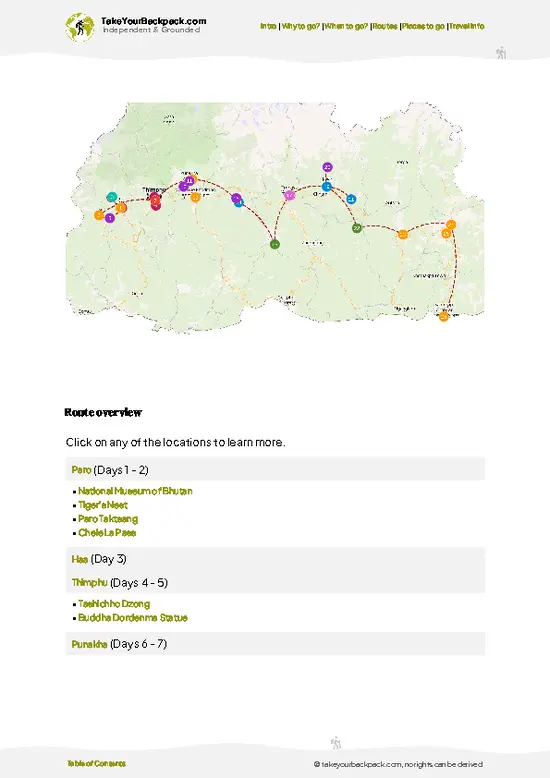
Plan 7 to 12 days for several stops: A trip linking multiple towns needs 7 to 12 days, because road distances are short on the map but slow on the ground. Western Bhutan clusters naturally around the Paro airport, Thimphu and Punakha, with 1 to 1.5 hours between Paro and Thimphu and about 3 hours from Thimphu to Punakha over the Dochula pass. Central Bhutan (Trongsa and Bumthang) lies a further 4 to 5 hours beyond Punakha, then 2.5 to 3 hours onward. The east adds 6 to 8 hours per leg between towns such as Bumthang, Mongar and Trashigang.

Direction and time per stop: Flying into Paro and moving east, then returning by road or by domestic flight, avoids doubling back on one highway. Allow 1 to 2 nights in each western stop and 2 to 3 nights in central towns, so the long drive is paid back by … read more 👉
Plan 7 to 12 days for several stops: A trip linking multiple towns needs 7 to 12 days, because road distances are short on the map but slow on the ground. Western Bhutan clusters naturally around the Paro airport, Thimphu and Punakha, with 1 to 1.5 hours between Paro and Thimphu and about 3 hours from Thimphu to Punakha over the Dochula pass. Central Bhutan (Trongsa and Bumthang) lies a further 4 to 5 hours beyond Punakha, then 2.5 to 3 hours onward. The east adds 6 to 8 hours per leg between towns such as Bumthang, Mongar and Trashigang.

Direction and time per stop: Flying into Paro and moving east, then returning by road or by domestic flight, avoids doubling back on one highway. Allow 1 to 2 nights in each western stop and 2 to 3 nights in central towns, so the long drive is paid back by time on the ground. Western and central Bhutan fit a week to ten days, and the east needs 12 days or more.

Common planning mistakes: Travelers often count driving hours as if roads were open highways, then schedule a flight home with no buffer. Allow a spare day before any international departure. Many also try too many one-night stops. Fewer bases, with day trips from each, work better. Monsoon and winter road closures make eastern legs unsuitable for fixed schedules, so keep that part flexible or fly between regions.

The ListThe Best cities of Bhutan

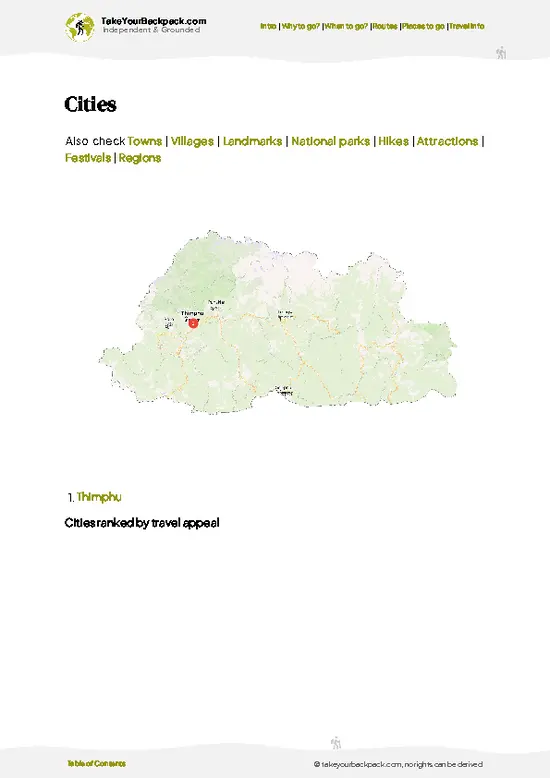
1 Thimphu

mountain backdrop, Buddhist monuments, weekend market

Navigate a capital where hillside monasteries overlook busy streets, and daily life blends tradition with modern Bhutanese influences at every turn.

Loading the map 🌍

Expert viewPro Tips for Exploring the Best

How many cities to visit: Three or four bases is the practical limit for a first trip. Each daily fee of US$100 per adult applies whether you are on the road or standing still, and road days of 3 to 8 hours leave little time for the towns themselves. Fewer bases mean more spent on the places you came for, and lower transport costs.

Choosing between kinds of cities: The western valleys suit first-timers, short trips and anyone on a tight schedule, because they have the airport, the widest choice of guesthouses, markets and the main dzongs. Central towns suit travelers who want quieter streets, cooler weather and farmland in view. The east suits those with 12 or more days who accept slow roads and few facilities. Festival-focused travelers should choose by calendar first and town second, since … read more 👉
How many cities to visit: Three or four bases is the practical limit for a first trip. Each daily fee of US$100 per adult applies whether you are on the road or standing still, and road days of 3 to 8 hours leave little time for the towns themselves. Fewer bases mean more spent on the places you came for, and lower transport costs.

Choosing between kinds of cities: The western valleys suit first-timers, short trips and anyone on a tight schedule, because they have the airport, the widest choice of guesthouses, markets and the main dzongs. Central towns suit travelers who want quieter streets, cooler weather and farmland in view. The east suits those with 12 or more days who accept slow roads and few facilities. Festival-focused travelers should choose by calendar first and town second, since dates move each year with the lunar calendar.

What it costs: Expect roughly US$180 to 300 per person per day all in. That covers the US$100 fee plus the operator’s share for a licensed guide, driver, vehicle, lodging and meals. The fee is a fixed government charge, so the bargain approach used elsewhere does not work. Cheaper packages generally mean simpler hotels and shared vehicles. Group size matters: two or more people split the vehicle and guide costs and bring the per-person figure down.

Entry to major dzongs and museums runs about Nu 500 to 1,000 (US$6 to 12), though some temples are free. Meals in local restaurants cost Nu 250 to 500 (US$3 to 6), and short taxi rides in the capital run Nu 100 to 300 (US$1 to 4). Carry some cash, because card machines and ATMs are patchy outside the west. Ngultrum is pegged to the Indian rupee.

Safety and culture: Crime is very low and towns are safe to walk at night, though poorly lit streets and stray dogs call for a small flashlight. The real health risks are altitude and motion sickness on mountain roads, so travel with medication and allow a gentle first day. Dress modestly in dzongs and temples: long sleeves and trousers, no hats, shoes off before entering shrines. Photography inside temples is not allowed, so ask before raising a camera. Walk clockwise around chortens and prayer wheels. Tobacco sales are banned and personal imports carry duty, so keep receipts if you bring cigarettes. Sanitation is reliable in towns, but drink bottled or filtered water.

✈️ The backpacker research shortcutBhutan Travel Guide

An offline-friendly backpacking guide with optimized travel routes, ranked highlights, transport advice, and the best areas to stay.
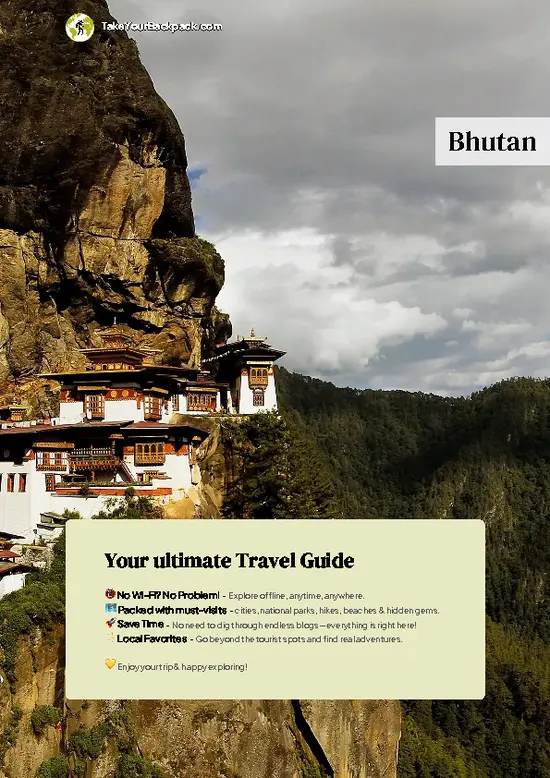
example page 0 from our offline Travel Guide for Bhutan
example page 1 from our offline Travel Guide for Bhutan
example page 2 from our offline Travel Guide for Bhutan
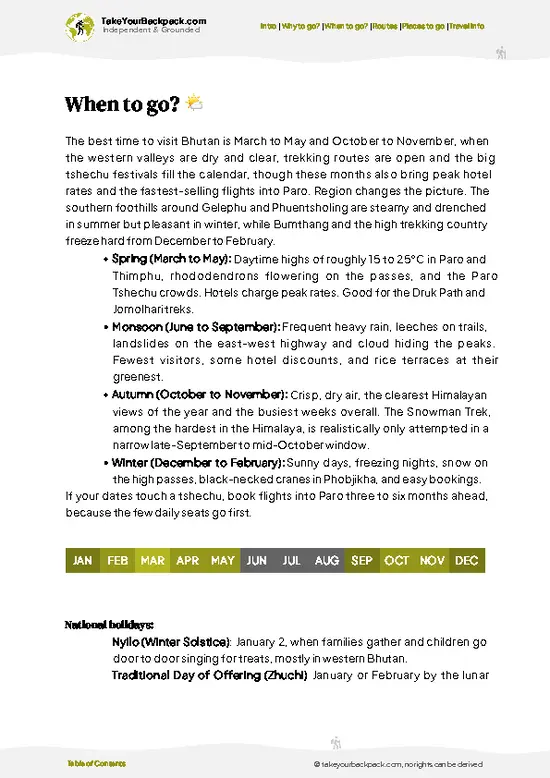
example page 3 from our offline Travel Guide for Bhutan
example page 4 from our offline Travel Guide for Bhutan
example page 5 from our offline Travel Guide for Bhutan
example page 6 from our offline Travel Guide for Bhutan
example page 7 from our offline Travel Guide for Bhutan
The digital guide (210 pages) contains:
✅ 52 highlights, ranked by travel appeal
✅ Optimized 5, 10 & 15-day travel routes
✅ Cities, national parks, landmarks, beaches
✅ How to get around
✅ Offline-friendly for travel without Wi-Fi
👉 Click to see all 30+ guide features

📅 Plan smarter in minutes, not weeks
✅ Month by month travel advice
✅ Festivals & national holidays
✅ Budget expectations

🗺️ Go to the right places, skip the overrated ones
✅ Honest pros & cons of destinations
✅ Top hikes, parks & viewpoints
✅ Lesser-known places most travelers miss
✅ Clear “worth it vs skip it” guidance

🛏️ Travel smoothly without rookie mistakes
✅ Best areas to stay
✅ Transport systems explained simply
✅ Common scams & safety advice
✅ SIM cards, money & practical tips

🌍 Understand the country, not just visit it
✅ Culture & traditions
✅ 52 Essential phrases & customs
✅ Festivals worth planning around
✅ Traveler-friendly historical context
✅ Insights that make places more meaningful

📱 Built for real travel conditions
✅ Fully downloadable PDF
✅ Works completely offline
✅ Optimized for phone use
✅ Useful in remote areas & buses
✅ Everything in one place
Stop searching, start planning
Get instant access to your full guide. 30‑day money-back guarantee.
+ Add another guide for just

By proceeding you agree to our terms.
Sent to your inbox immediately after payment • 100% Secure Checkout
Best Backpacking Travel Advisor 2025 tourism awardBest Backpacking
Travel Advisor
2025
What others say about Take Your Backpack Guides:
⭐⭐⭐⭐⭐
Fantastic, amazing amount of information!
⭐⭐⭐⭐⭐
My goodness this is amazing, it's what I've been looking for hats off too you!
⭐⭐⭐⭐⭐
I think this is absolutely BRILLIANT
⭐⭐⭐⭐
Very complete and informative. It's still missing places, but I gotta to commend you
⭐⭐⭐⭐⭐
This is truly amazing, thank you, can't wait to explore it with my kids!
⭐⭐⭐⭐⭐
Awesome resource, thank you!
⭐⭐⭐⭐⭐
This is amazing! Can't wait to explore the ones I haven't seen
⭐⭐⭐⭐
I love this! Well done, great idea.
⭐⭐⭐⭐⭐
Thanks for taking the time to make this gem!
⭐⭐⭐⭐⭐
This might be the best website I've ever seen.
⭐⭐⭐⭐⭐
Congratulations, and thank you so much for your work; it's incredibly valuable.
⭐⭐⭐⭐
In all seriousness I think you did a great job pointing out the important spots
⭐⭐⭐⭐⭐
10/10 very good
⭐⭐⭐⭐⭐
As someone who's only just starting to visit regularly this is awesome, thank you.
⭐⭐⭐⭐
Thank you very much! I'm going to visit my dad, it's going to be very useful!
⭐⭐⭐⭐⭐
This is really cool! We'll be travelling for the first time and this definitely come in handy.
⭐⭐⭐⭐⭐
You are now our minister of culture, congratulations 👨‍💼
⭐⭐⭐⭐⭐
Just wanted to tell you that this is a pearl! Going to follow your recommendations.
⭐⭐⭐⭐⭐
This is so cool. I'll definitely be using the resource for my travels soon.
⭐⭐⭐⭐⭐
This is very impressive! Good work.
⭐⭐⭐⭐⭐
This is an amazing and informative site. Very well done!

🛏️ Where to stay?Best Places to Stay in Bhutan

Bhutan has no backpacker hostels in the usual sense, because every visitor must stay in government-certified tourist accommodation, so budget options mean simple 2- and 3-star hotels and registered farmhouse homestays at roughly US$30 to 80 a night for a double. In Thimphu, the blocks around Norzin Lam and the Clock Tower Square put you within walking distance of cafés, craft shops and the capital’s small weekend bar and karaoke scene, while Motithang on the hill above is quieter and greener but a steep walk from town. In Paro, rooms in the compact town center are cheapest and handiest for restaurants, whereas guesthouses and homestays scattered across the Paro valley are calmer, closer to the … read more 👉
Bhutan has no backpacker hostels in the usual sense, because every visitor must stay in government-certified tourist accommodation, so budget options mean simple 2- and 3-star hotels and registered farmhouse homestays at roughly US$30 to 80 a night for a double. In Thimphu, the blocks around Norzin Lam and the Clock Tower Square put you within walking distance of cafés, craft shops and the capital’s small weekend bar and karaoke scene, while Motithang on the hill above is quieter and greener but a steep walk from town. In Paro, rooms in the compact town center are cheapest and handiest for restaurants, whereas guesthouses and homestays scattered across the Paro valley are calmer, closer to the trailheads and the whole country is very safe at night wherever you sleep.

If you enjoy meeting fellow travelers, consider choosing hostels with high ratings for atmosphere. On the other hand, if you prefer having your own space, a hotel might be a better option.

BhutanExplore Bhutan

👋 Meet the founderWho’s Behind Take Your Backpack?

Johan, backpacker and founder of TakeYourBackpackHi, I’m Johan (Netherlands 🇳🇱), the creator of TakeYourBackpack. Over the past 3 decades, I’ve backpacked through 90+ countries across six continents, gaining extensive experience with independent travel, long-term trips, and overland routes.

This site is built on a combination of firsthand travel experience and carefully curated insights from other backpackers. Many guides are based on places I’ve personally visited, while others bring together tips, observations, and practical advice shared by trusted travelers I’ve met along the way.

The goal is to provide realistic, experience-driven guidance — not generic itineraries — so you can explore destinations with better context, clearer expectations, and more confidence.