×

Bhutan🇧🇹 | best attractionsThe Must-See 6 attractions in Bhutan

Attractions in Bhutan are mostly living religious and civic sites: fortress-monasteries called dzongs, hillside temples, mountain passes strung with prayer flags and festival grounds, rather than ruins or museums. The western valleys of Paro, Thimphu and Punakha hold the densest cluster, with the best roads and the most visitors. Central Bumthang is quieter and spread over longer drives, while the east sees few travelers, has slower roads and demands days of transit. Costs follow a fixed system: a daily Sustainable Development Fee applies everywhere, and individual entry fees are small. Backpacking here means independent-minded choices inside a booked framework, so choose a region by how much road you can accept.

By Johan Kruseman 🇳🇱 | Updated October 19, 2026
Explore the best festivals in Bhutan

Why go?What Makes Them Special

Bhutan’s attractions are shaped by a deliberate national policy of low-volume, higher-value tourism. Most sites are still working monasteries, administrative centers and village temples, so visits follow the rhythm of monastic life, with closed prayer halls at certain hours, ceremonies that take priority and dress rules that are enforced. Buddhism is the state religion, and that shapes how sites are built, used and protected.

Geography sets the pace. The country is a tangle of steep Himalayan valleys, with passes of 3,000 to 3,800 meters between them, and one main east-west road that twists through all of them. Distances look short on a map but take hours, so a Bhutan trip delivers depth in a few regions rather than breadth. Forest covers over 70 percent of the land, and the constitution requires … read more 👉
Bhutan’s attractions are shaped by a deliberate national policy of low-volume, higher-value tourism. Most sites are still working monasteries, administrative centers and village temples, so visits follow the rhythm of monastic life, with closed prayer halls at certain hours, ceremonies that take priority and dress rules that are enforced. Buddhism is the state religion, and that shapes how sites are built, used and protected.

Geography sets the pace. The country is a tangle of steep Himalayan valleys, with passes of 3,000 to 3,800 meters between them, and one main east-west road that twists through all of them. Distances look short on a map but take hours, so a Bhutan trip delivers depth in a few regions rather than breadth. Forest covers over 70 percent of the land, and the constitution requires it to stay above 60 percent, which keeps the roadsides green and the development light.

Before choosing Bhutan, know the rules. Most foreign visitors pay a Sustainable Development Fee of US$100 per night (Indian nationals pay a reduced rate in rupees), must book through a licensed operator or approved arrangement, and travel with a licensed guide. Spontaneous independent wandering is not possible. Tourist infrastructure is good in the west and thin in the east. In return, the sites are intact, uncrowded and well kept.
How the List Was Created
The list of best attractions in Bhutan is created based on cultural significance or entertainment value. If you feel a attraction is missing in this list, please let us know.

When to go?When to Plan Your Trip

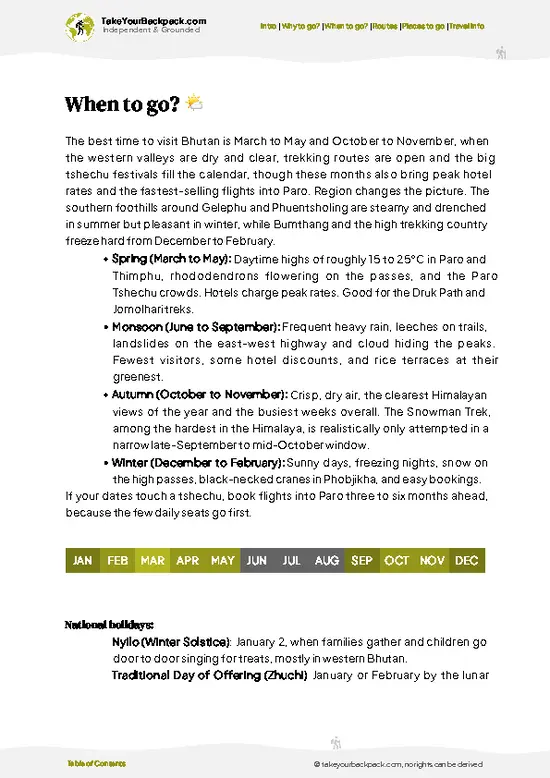
Best months for Bhutan’s attractions: March to May and September to November are the best months, because skies are clearest, rain is limited and the high passes are open. Spring brings daytime highs of roughly 15 to 22°C in Paro, Thimphu and Punakha, with rhododendrons blooming on the higher slopes. Autumn is drier and gives the sharpest mountain views, with similar daytime temperatures and cold nights at altitude.

Peak periods and festivals: The main tsechu festivals, such as those in Paro (spring) and Thimphu (autumn), fill hotels and flights months ahead. Book early if you plan around them, since room choice narrows quickly. Fees do not change by season, as the daily fee is fixed, but internal flights and better hotels cost more in peak weeks.

Shoulder and low seasons: Winter (December to … read more 👉
Best months for Bhutan’s attractions: March to May and September to November are the best months, because skies are clearest, rain is limited and the high passes are open. Spring brings daytime highs of roughly 15 to 22°C in Paro, Thimphu and Punakha, with rhododendrons blooming on the higher slopes. Autumn is drier and gives the sharpest mountain views, with similar daytime temperatures and cold nights at altitude.

Peak periods and festivals: The main tsechu festivals, such as those in Paro (spring) and Thimphu (autumn), fill hotels and flights months ahead. Book early if you plan around them, since room choice narrows quickly. Fees do not change by season, as the daily fee is fixed, but internal flights and better hotels cost more in peak weeks.

Shoulder and low seasons: Winter (December to February) is dry and sunny in the west, with highs of 8 to 12°C in Paro and Thimphu and nights below freezing. Bumthang is colder, and snow can close the Dochula and other passes briefly. Punakha and the low valleys stay milder. Monsoon (June to August) brings heavy rain, landslides on the main road and leeches on trails, especially in the south and east. The far south, around Phuentsholing and Samdrup Jongkhar, is hot and humid from April to September, so it is best visited in winter.

attraction hoppingSuggested Travel Strategies

How many days to plan: A trip combining several attractions in Bhutan needs 7 to 12 days, and 8 to 10 covers the west and center without rushing. The usual axis is east-west along one main road, so the direction matters less than the discipline of limiting the number of bases.

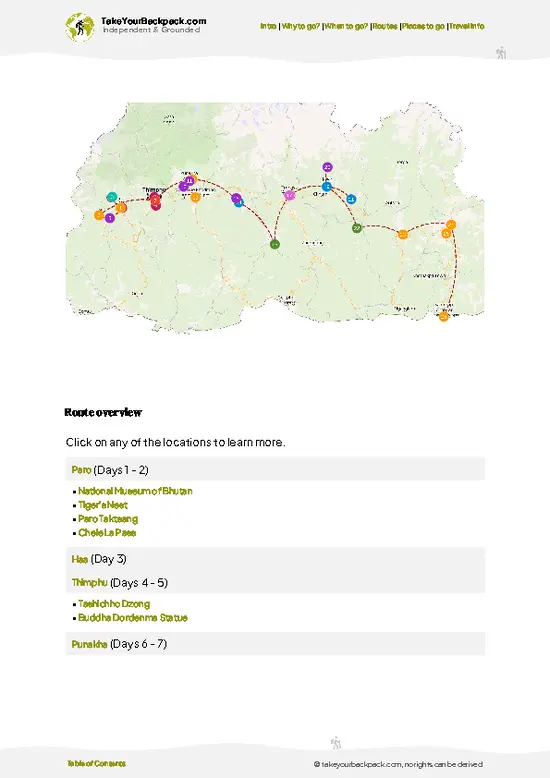
Which regions cluster together: Paro, Thimphu, Punakha and Phobjikha form the western cluster. Most people arrive by air at Paro, so starting there and moving east makes sense. Paro to Thimphu takes 1 to 1.5 hours, Thimphu to Punakha 2.5 to 3 hours over the Dochula pass, and Punakha to Phobjikha about 2 hours. Trongsa is 3 to 4 hours beyond Phobjikha, and Bumthang another 2.5 to 3 hours. Bumthang to Mongar is a 6 to 7 hour drive over the Thrumshingla pass, and Mongar to Trashigang another 3 to 4 hours. The east exits … read more 👉
How many days to plan: A trip combining several attractions in Bhutan needs 7 to 12 days, and 8 to 10 covers the west and center without rushing. The usual axis is east-west along one main road, so the direction matters less than the discipline of limiting the number of bases.

Which regions cluster together: Paro, Thimphu, Punakha and Phobjikha form the western cluster. Most people arrive by air at Paro, so starting there and moving east makes sense. Paro to Thimphu takes 1 to 1.5 hours, Thimphu to Punakha 2.5 to 3 hours over the Dochula pass, and Punakha to Phobjikha about 2 hours. Trongsa is 3 to 4 hours beyond Phobjikha, and Bumthang another 2.5 to 3 hours. Bumthang to Mongar is a 6 to 7 hour drive over the Thrumshingla pass, and Mongar to Trashigang another 3 to 4 hours. The east exits overland through Samdrup Jongkhar into Assam, which takes 6 to 7 hours from Trashigang.

Time per stop and common mistakes: Allow one night in a village base and two in Paro, Thimphu or Bumthang, where there is more to see. Most visits take half a day, and a long hike takes a full day. The common mistake is underestimating the roads: 150 kilometers can mean 5 hours. Stack no more than one major drive a day, and do not push into the east on a 6-day trip. Leave a buffer day before an international flight, because weather can delay departures from Paro.

The ListThe Best attractions of Bhutan

1 Paro Taktsang

cliffside monastery, sacred pilgrimage, forested ascent

Climb a pine-shaded trail to reach a monastery perched on a sheer cliff, where incense mingles with mountain air and prayer flags flutter.

2 Buddha Dordenma Statue

hilltop monument, panoramic valley views, giant bronze Buddha

Stand beneath a towering Buddha and take in sweeping mountain vistas while observing locals offering prayers at this modern spiritual site.

3 Tashichho Dzong

riverbank fortress, administrative seat, monastic quarters

Visit the seat of Bhutan’s government and monastic body, where whitewashed walls and golden roofs frame formal gardens and ceremonial courtyards.

4 Trongsa Dzong

ridge-top stronghold, central Bhutan, royal heritage

Traverse labyrinthine corridors and courtyards in a fortress that once controlled east-west trade and remains central to Bhutanese royal tradition.

5 National Museum of Bhutan

circular fortress, ancient relics, Himalayan art

Trace Bhutan’s history through displays of ritual objects, weaponry, and religious paintings inside a former watchtower overlooking Paro valley.

6 National Folk Heritage Museum

traditional farmhouse, rural artifacts, Bhutanese daily life

Wander through a preserved farmhouse and examine tools, textiles, and household items that reveal Bhutan’s agricultural roots and village customs.

Loading the map 🌍

Expert viewPro Tips for Exploring the Best

How many attractions to visit: I advise 8 to 12 attractions on a 7 to 10 day trip, which means one major site and one smaller stop per day at most. The reason is the road. Bhutan’s valleys are connected by slow, curving routes, and the drive itself takes much of the day. Travelers who try for three sites daily end up seeing parking lots and rushing through temples with a guide who wants to leave. An experienced traveler chooses fewer places and stays longer at each.

Which kinds to prioritize: Choose by travel style. If you like culture and architecture, put the dzongs and temples first, since they are the heart of the country and are mostly in the west. If you like walking, choose one full-day hike and one or two shorter ones, and do the long hike after two or three days at altitude, since … read more 👉
How many attractions to visit: I advise 8 to 12 attractions on a 7 to 10 day trip, which means one major site and one smaller stop per day at most. The reason is the road. Bhutan’s valleys are connected by slow, curving routes, and the drive itself takes much of the day. Travelers who try for three sites daily end up seeing parking lots and rushing through temples with a guide who wants to leave. An experienced traveler chooses fewer places and stays longer at each.

Which kinds to prioritize: Choose by travel style. If you like culture and architecture, put the dzongs and temples first, since they are the heart of the country and are mostly in the west. If you like walking, choose one full-day hike and one or two shorter ones, and do the long hike after two or three days at altitude, since most of Bhutan sits above 2,200 meters. If you want fewer people, spend more days in Bumthang and the east, where you will often be alone in a courtyard. Festival-goers should accept crowds and book far in advance. Markets and museums are quick stops and fill the gaps.

What it costs: The structure is simple. The Sustainable Development Fee is US$100 per person per night (children aged 6 to 12 pay half, under 6 free), and it is charged on top of the cost of lodging, guide, driver and meals. Operator packages for budget-minded international travelers typically come to US$180 to 300 a day all-in. The fee is the main fixed cost, so staying longer in fewer places lowers the cost per attraction rather than raising it. Entry tickets are small, usually Nu 500 to 1,000 (about US$6 to 12) per site, and some sites are free. Bring cash in ngultrum for tickets, snacks and tips, as small places do not take cards. Guides and drivers are customarily tipped, and US$5 to 10 a day each is a common range. A Bhutanese guide is also required for most travelers, so what you pay for is local knowledge, which is worth it at temples where the practice matters more than the building.

Safety and cultural conduct: Dress modestly at every dzong and temple: long sleeves, long trousers or skirts, and no hats inside. Remove shoes before prayer halls and do not photograph interiors or statues, where signs forbid it. Walk clockwise around stupas, prayer wheels and temples. Do not point your feet at altars or touch religious objects. Drones need a permit and are usually refused near sacred sites. Do not buy antiques or religious items, as export is restricted.

On the physical side, altitude sickness is possible above 3,000 meters, so take the first day easy and drink water. Winding roads cause motion sickness, so sit in front and carry tablets. In the monsoon, landslides can close the road for hours, so leave slack in your schedule. Street dogs are common and can be noisy at night, so a pair of earplugs helps. The country is safe in terms of crime, but weather and roads are the real risks.

✈️ The backpacker research shortcutBhutan Travel Guide

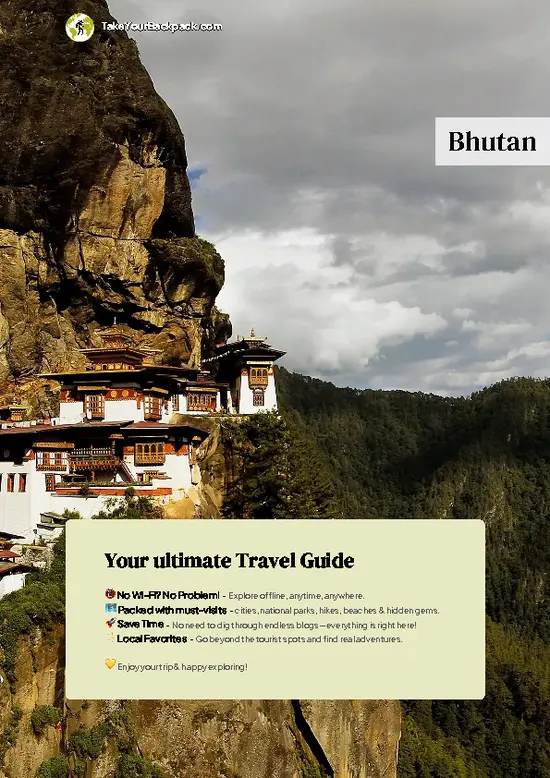
An offline-friendly backpacking guide with optimized travel routes, ranked highlights, transport advice, and the best areas to stay.
example page 0 from our offline Travel Guide for Bhutan
example page 1 from our offline Travel Guide for Bhutan
example page 2 from our offline Travel Guide for Bhutan
example page 3 from our offline Travel Guide for Bhutan
example page 4 from our offline Travel Guide for Bhutan
example page 5 from our offline Travel Guide for Bhutan
example page 6 from our offline Travel Guide for Bhutan
example page 7 from our offline Travel Guide for Bhutan
The digital guide (210 pages) contains:
✅ 52 highlights, ranked by travel appeal
✅ Optimized 5, 10 & 15-day travel routes
✅ Cities, national parks, landmarks, beaches
✅ How to get around
✅ Offline-friendly for travel without Wi-Fi
👉 Click to see all 30+ guide features

📅 Plan smarter in minutes, not weeks
✅ Month by month travel advice
✅ Festivals & national holidays
✅ Budget expectations

🗺️ Go to the right places, skip the overrated ones
✅ Honest pros & cons of destinations
✅ Top hikes, parks & viewpoints
✅ Lesser-known places most travelers miss
✅ Clear “worth it vs skip it” guidance

🛏️ Travel smoothly without rookie mistakes
✅ Best areas to stay
✅ Transport systems explained simply
✅ Common scams & safety advice
✅ SIM cards, money & practical tips

🌍 Understand the country, not just visit it
✅ Culture & traditions
✅ 52 Essential phrases & customs
✅ Festivals worth planning around
✅ Traveler-friendly historical context
✅ Insights that make places more meaningful

📱 Built for real travel conditions
✅ Fully downloadable PDF
✅ Works completely offline
✅ Optimized for phone use
✅ Useful in remote areas & buses
✅ Everything in one place
Stop searching, start planning
Get instant access to your full guide. 30‑day money-back guarantee.
+ Add another guide for just

By proceeding you agree to our terms.
Sent to your inbox immediately after payment • 100% Secure Checkout
Best Backpacking Travel Advisor 2025 tourism awardBest Backpacking
Travel Advisor
2025
What others say about Take Your Backpack Guides:
⭐⭐⭐⭐⭐
Fantastic, amazing amount of information!
⭐⭐⭐⭐⭐
My goodness this is amazing, it's what I've been looking for hats off too you!
⭐⭐⭐⭐⭐
I think this is absolutely BRILLIANT
⭐⭐⭐⭐
Very complete and informative. It's still missing places, but I gotta to commend you
⭐⭐⭐⭐⭐
This is truly amazing, thank you, can't wait to explore it with my kids!
⭐⭐⭐⭐⭐
Awesome resource, thank you!
⭐⭐⭐⭐⭐
This is amazing! Can't wait to explore the ones I haven't seen
⭐⭐⭐⭐
I love this! Well done, great idea.
⭐⭐⭐⭐⭐
Thanks for taking the time to make this gem!
⭐⭐⭐⭐⭐
This might be the best website I've ever seen.
⭐⭐⭐⭐⭐
Congratulations, and thank you so much for your work; it's incredibly valuable.
⭐⭐⭐⭐
In all seriousness I think you did a great job pointing out the important spots
⭐⭐⭐⭐⭐
10/10 very good
⭐⭐⭐⭐⭐
As someone who's only just starting to visit regularly this is awesome, thank you.
⭐⭐⭐⭐
Thank you very much! I'm going to visit my dad, it's going to be very useful!
⭐⭐⭐⭐⭐
This is really cool! We'll be travelling for the first time and this definitely come in handy.
⭐⭐⭐⭐⭐
You are now our minister of culture, congratulations 👨‍💼
⭐⭐⭐⭐⭐
Just wanted to tell you that this is a pearl! Going to follow your recommendations.
⭐⭐⭐⭐⭐
This is so cool. I'll definitely be using the resource for my travels soon.
⭐⭐⭐⭐⭐
This is very impressive! Good work.
⭐⭐⭐⭐⭐
This is an amazing and informative site. Very well done!

🛏️ Where to stay?Where to Base Yourself

Bhutan has no backpacker hostels in the usual sense, because every visitor must stay in government-certified tourist accommodation, so budget options mean simple 2- and 3-star hotels and registered farmhouse homestays at roughly US$30 to 80 a night for a double. In Thimphu, the blocks around Norzin Lam and the Clock Tower Square put you within walking distance of cafés, craft shops and the capital’s small weekend bar and karaoke scene, while Motithang on the hill above is quieter and greener but a steep walk from town. In Paro, rooms in the compact town center are cheapest and handiest for restaurants, whereas guesthouses and homestays scattered across the Paro valley are calmer, closer to the … read more 👉
Bhutan has no backpacker hostels in the usual sense, because every visitor must stay in government-certified tourist accommodation, so budget options mean simple 2- and 3-star hotels and registered farmhouse homestays at roughly US$30 to 80 a night for a double. In Thimphu, the blocks around Norzin Lam and the Clock Tower Square put you within walking distance of cafés, craft shops and the capital’s small weekend bar and karaoke scene, while Motithang on the hill above is quieter and greener but a steep walk from town. In Paro, rooms in the compact town center are cheapest and handiest for restaurants, whereas guesthouses and homestays scattered across the Paro valley are calmer, closer to the trailheads and the whole country is very safe at night wherever you sleep.

If you enjoy meeting fellow travelers, consider choosing hostels with high ratings for atmosphere. On the other hand, if you prefer having your own space, a hotel might be a better option.

BhutanExpand Your Journey

👋 Meet the founderWho’s Behind Take Your Backpack?

Johan, backpacker and founder of TakeYourBackpackHi, I’m Johan (Netherlands 🇳🇱), the creator of TakeYourBackpack. Over the past 3 decades, I’ve backpacked through 90+ countries across six continents, gaining extensive experience with independent travel, long-term trips, and overland routes.

This site is built on a combination of firsthand travel experience and carefully curated insights from other backpackers. Many guides are based on places I’ve personally visited, while others bring together tips, observations, and practical advice shared by trusted travelers I’ve met along the way.

The goal is to provide realistic, experience-driven guidance — not generic itineraries — so you can explore destinations with better context, clearer expectations, and more confidence.