×

Bhutan🇧🇹 | best hikesThe Must-See 7 hikes in Bhutan

Hikes in Bhutan are regulated, guided and priced accordingly, which sets them apart from most Himalayan countries. Foreign visitors pay a daily Sustainable Development Fee and walk with a licensed operator, so independent travel here means choosing your own pace within a booked framework. The west (Paro, Thimphu, Punakha) has the easiest access, short day walks to hilltop monasteries and the most visitors. Central Bhutan around Bumthang offers quieter valley trails. The east is the least visited and the most remote, with long road transfers. Multi-day treks cross 4,000 to 5,000 meter passes and cost far more than day walks.

By Johan Kruseman 🇳🇱 | Updated October 19, 2026
Explore the best attractions in Bhutan

Why go?What Makes Them Special

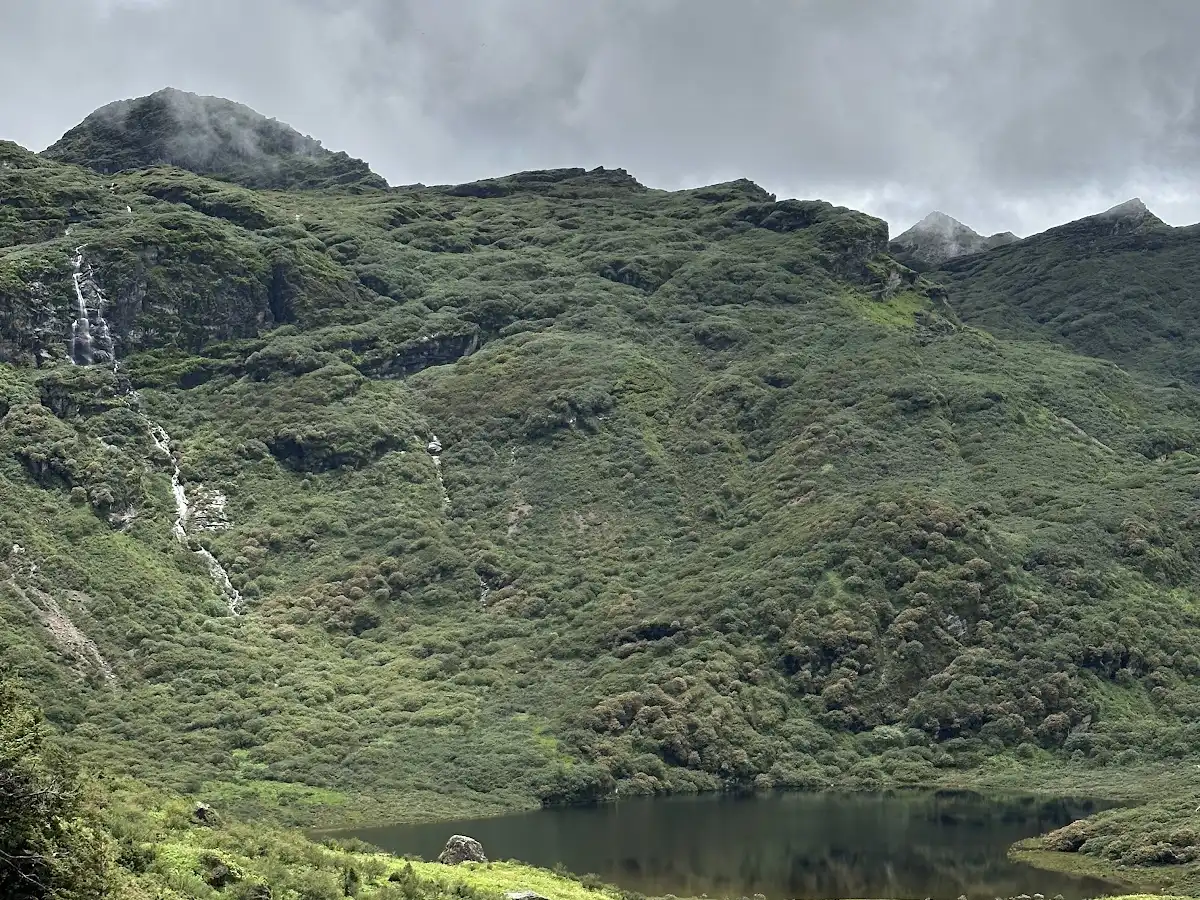
Bhutan’s hiking is shaped by policy as much as terrain. The country limits visitor numbers through a daily Sustainable Development Fee and requires foreigners to travel with a licensed operator, so trails stay uncrowded and the paths, campsites and yak herder routes are lightly worn. Over 70 percent of the land remains forested, and constitutional protection of forest cover keeps lower trails shaded and intact.

Geography does the rest. The land climbs from subtropical foothills near the Indian border to snow peaks above 7,000 meters in the north, so a single trip can cover rhododendron forest, alpine meadow and high passes. Many trails follow old pilgrimage and trade routes, and they lead to dzongs, temples and prayer flag ridges that are still in daily use. Etiquette matters as much as fitness. … read more 👉
Bhutan’s hiking is shaped by policy as much as terrain. The country limits visitor numbers through a daily Sustainable Development Fee and requires foreigners to travel with a licensed operator, so trails stay uncrowded and the paths, campsites and yak herder routes are lightly worn. Over 70 percent of the land remains forested, and constitutional protection of forest cover keeps lower trails shaded and intact.

Geography does the rest. The land climbs from subtropical foothills near the Indian border to snow peaks above 7,000 meters in the north, so a single trip can cover rhododendron forest, alpine meadow and high passes. Many trails follow old pilgrimage and trade routes, and they lead to dzongs, temples and prayer flag ridges that are still in daily use. Etiquette matters as much as fitness.

Travelers should know what Bhutan is not. It is not a place for improvised, low-cost trekking, since there are no independent permits for foreigners and no hostel network on the trails. Roads are narrow and winding, so even short distances take hours. Altitude is a factor from the first day, because the main valleys already sit at 2,200 to 2,800 meters. Those who accept the structure get well-maintained routes, knowledgeable guides and very few other walkers.
Why These Made the Cut
The list of best hikes in Bhutan is created based on scenery, challenge, trail quality, landmarks, and overall enjoyment. If you feel a hike is missing in this list, please let us know.

When to go?When to Plan Your Trip

Best months for hiking in Bhutan: October and November, and again March to May, give the clearest skies and the safest conditions for hiking in Bhutan, with stable weather and passes mostly free of snow. October to mid-November brings dry air, crisp mountain views and daytime highs of roughly 15 to 20°C in Paro and Thimphu, dropping to near freezing at night. Spring runs from late March to May, with rhododendrons flowering between April and May. Higher camps stay cold, often below 0°C overnight, and afternoon cloud builds toward May.Shoulder seasons and winter: December to February is cold and dry. Passes above 4,000 meters can be blocked by snow, so high treks are generally not run, but low valley walks around Paro, Punakha and the warmer lower east remain pleasant. Thimphu and Paro can reach … read more 👉
Best months for hiking in Bhutan: October and November, and again March to May, give the clearest skies and the safest conditions for hiking in Bhutan, with stable weather and passes mostly free of snow. October to mid-November brings dry air, crisp mountain views and daytime highs of roughly 15 to 20°C in Paro and Thimphu, dropping to near freezing at night. Spring runs from late March to May, with rhododendrons flowering between April and May. Higher camps stay cold, often below 0°C overnight, and afternoon cloud builds toward May.Shoulder seasons and winter: December to February is cold and dry. Passes above 4,000 meters can be blocked by snow, so high treks are generally not run, but low valley walks around Paro, Punakha and the warmer lower east remain pleasant. Thimphu and Paro can reach minus 5°C at night. Bumthang is colder still.Monsoon and prices: June to early September is monsoon season. Rain falls most days, trails are muddy, leeches appear below 3,000 meters and landslides can close roads, particularly in the south and east. Rainfall is far heavier along the southern foothills than in the drier western valleys.

The Sustainable Development Fee of US$100 per night does not change by season, but flights and hotels cost more in October and March to April, when festivals draw visitors. Book Paro flights and a trekking operator several months ahead for those windows.

hike hoppingSuggested Travel Strategies

How many days a multi-hike trip takes: A trip combining several hikes in Bhutan needs 10 to 14 days, since road transfers consume more time than most visitors expect. Western Bhutan clusters easily: Paro, Thimphu and Punakha sit within 1 to 3 hours of each other by road (Paro to Thimphu about 1 hour, Thimphu to Punakha about 3 hours over the 3,100 meter Dochula pass). Central Bhutan around Bumthang lies a full day beyond, roughly 8 to 10 hours from Thimphu with a stop at Trongsa. The east, toward Trashigang, adds another one to two days of driving.

Most itineraries run from Paro airport eastward and return the same way, or fly out of Bumthang on the limited domestic service. A west-to-east direction works well because it begins at lower altitude and adds height gradually. Allow 2 to 3 days … read more 👉
How many days a multi-hike trip takes: A trip combining several hikes in Bhutan needs 10 to 14 days, since road transfers consume more time than most visitors expect. Western Bhutan clusters easily: Paro, Thimphu and Punakha sit within 1 to 3 hours of each other by road (Paro to Thimphu about 1 hour, Thimphu to Punakha about 3 hours over the 3,100 meter Dochula pass). Central Bhutan around Bumthang lies a full day beyond, roughly 8 to 10 hours from Thimphu with a stop at Trongsa. The east, toward Trashigang, adds another one to two days of driving.

Most itineraries run from Paro airport eastward and return the same way, or fly out of Bumthang on the limited domestic service. A west-to-east direction works well because it begins at lower altitude and adds height gradually. Allow 2 to 3 days at the start for acclimatization and shorter walks, 4 to 8 days for a multi-day trek, and a day of rest after it.

Common mistakes are scheduling a high-pass trek in the first days, planning one region per day and assuming driving times match distances. Mountain roads average 25 to 40 km/h. Instead, keep a buffer day before international flights, limit the itinerary to two or three regions, and add the east only with at least 14 days available. Monsoon landslides can add hours, so leave slack.

The ListThe Best hikes of Bhutan

1 Tiger’s Nest

cliffside monastery, pine forest, prayer flags

Hike a steep, well-trodden path through fragrant woods to reach a monastery clinging to sheer rock, with sweeping views over the Paro valley.

bhutan-hike-tigers-nest
© Google |

2 Druk Path

ancient trade route, blue pine forests, ridge-top dzongs

Follow a historic trail linking Paro and Thimphu, moving between forested slopes, open ridges, and centuries-old fortresses perched above deep valleys.

bhutan-hike-druk-path
© Google |

3 Jomolhari Trek

glacial rivers, sacred peaks, remote yak pastures

Climb steadily toward the base of Bhutan’s revered mountain, crossing wild rivers and camping beneath snow-capped summits far from settlements.

bhutan-hike-jomolhari-trek
© Google |

4 Bumthang Owl Trek

dense forest, mountain hamlets, birdlife

Ascend through thick woodland and scattered villages, listening for rare calls and glimpsing panoramic views over the spiritual heartland of Bhutan.

bhutan-hike-bumthang-owl-trek
© Google |

5 Dagala Thousand Lakes Trek

alpine lakes, yak herders, high meadows

Traverse open ridges and remote valleys, passing clusters of pristine lakes and encountering nomadic camps set against sweeping Himalayan backdrops.

bhutan-hike-dagala-thousand-lakes-trek
© Google |

6 Snowman Trek

high passes, isolated villages, rugged wilderness

Endure long days over challenging terrain, entering seldom-visited valleys where small communities live amid some of the Himalaya’s most demanding landscapes.

Bhutan - Snowman Trek

7 Nabji-Korphu Trek

village homestays, subtropical forests, cultural immersion

Trek between remote villages, sleep in family homes, and cross lush forests where rural life and ancient customs remain unchanged.

Loading the map 🌍

Expert viewPro Tips for Exploring the Best

How many hikes to plan: Three to four hikes is the number I advise: one or two day walks to acclimatize, one longer outing of 2 to 3 days or a short trek, and optionally one high-altitude effort. The reason is practical. Altitude, long road days and a fixed daily fee mean extra hikes cost money and energy, and a fourth adds little over a third. Experienced travelers choose fewer, better-timed walks rather than filling every day.Which kind to prioritize: Budget-minded travelers and first-timers get the best value from day hikes near Paro and Thimphu, because they need no camping gear, little extra cost and carry modest altitude risk. Those drawn to wilderness should pick one multi-day trek and accept the cost, since it is the only way to reach high lakes, yak pastures and remote villages. Culture-focused … read more 👉
How many hikes to plan: Three to four hikes is the number I advise: one or two day walks to acclimatize, one longer outing of 2 to 3 days or a short trek, and optionally one high-altitude effort. The reason is practical. Altitude, long road days and a fixed daily fee mean extra hikes cost money and energy, and a fourth adds little over a third. Experienced travelers choose fewer, better-timed walks rather than filling every day.Which kind to prioritize: Budget-minded travelers and first-timers get the best value from day hikes near Paro and Thimphu, because they need no camping gear, little extra cost and carry modest altitude risk. Those drawn to wilderness should pick one multi-day trek and accept the cost, since it is the only way to reach high lakes, yak pastures and remote villages. Culture-focused visitors do better with pilgrimage-style walks to monasteries and temple ridges. Bhutan’s long treks suit trekkers with prior high-altitude experience, since passes reach 4,000 to 5,000 meters and rescue is slow.What it costs: Foreigners pay a Sustainable Development Fee of US$100 per adult per night (reduced rates apply to children), plus a visa fee of about US$40. The fee exists to fund free health care, education and conservation, and it applies on trek days too. Operators charge separately for guide, cook, pack animals, camping gear, food and transport, commonly US$120 to 250 per person per day, so a trek day often totals US$220 to 350. A week with day hikes and some hotel nights typically lands at US$250 to 400 per day all in. Smaller group sizes are costlier per person, so joining a group departure is how experienced travelers lower the bill. Domestic flights and park permits add further costs, so request a written itemized quote.Safety: Altitude sickness is the main medical risk. Main valleys sit above 2,200 meters, and trek camps frequently exceed 3,500 meters. Sleeping height should rise by no more than about 300 to 500 meters a night above 3,000 meters. Experienced hikers carry acetazolamide only after advice from a doctor, and they tell the guide about headaches early. Weather turns fast above the tree line, snow can fall in any month at high camps and leeches are common in warm wet months. Insurance should cover helicopter evacuation, because help may be a day away on foot.Cultural considerations: Many trails pass chortens, mani walls and prayer flags. Walk clockwise around them, never step over or take down flags, and keep voices low near monasteries. Remove shoes and hats inside temples and ask before photographing people or inside sanctuaries. Mountains are considered sacred, and some peaks are closed to climbing, so stay on marked routes. Carry out all litter. Herders’ dogs and yaks should be given a wide berth, and your guide will explain local customs.

✈️ The backpacker research shortcutBhutan Travel Guide

An offline-friendly backpacking guide with optimized travel routes, ranked highlights, transport advice, and the best areas to stay.
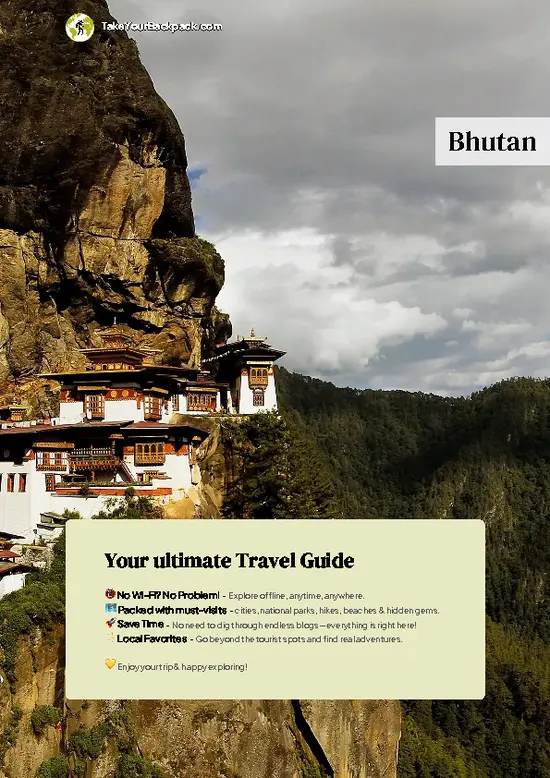
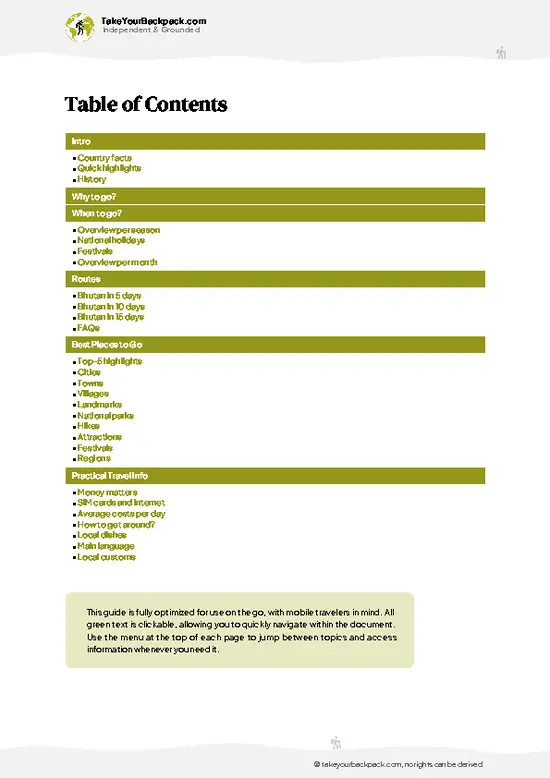
example page 0 from our offline Travel Guide for Bhutan
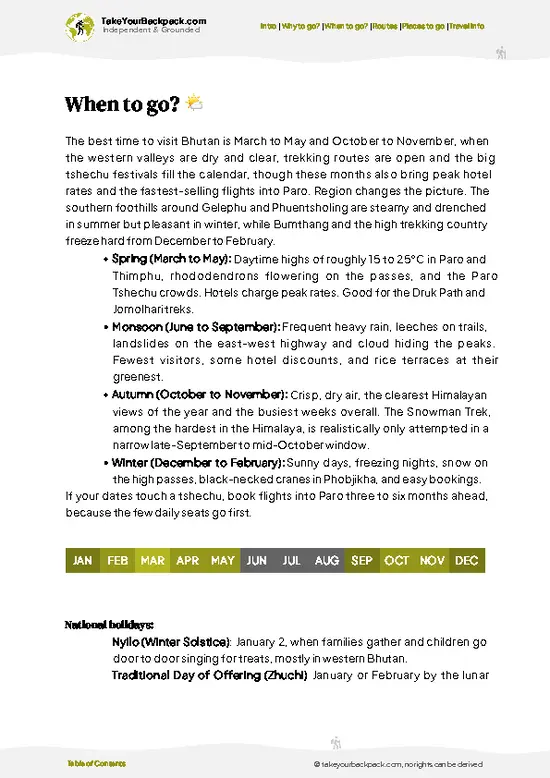
example page 1 from our offline Travel Guide for Bhutan
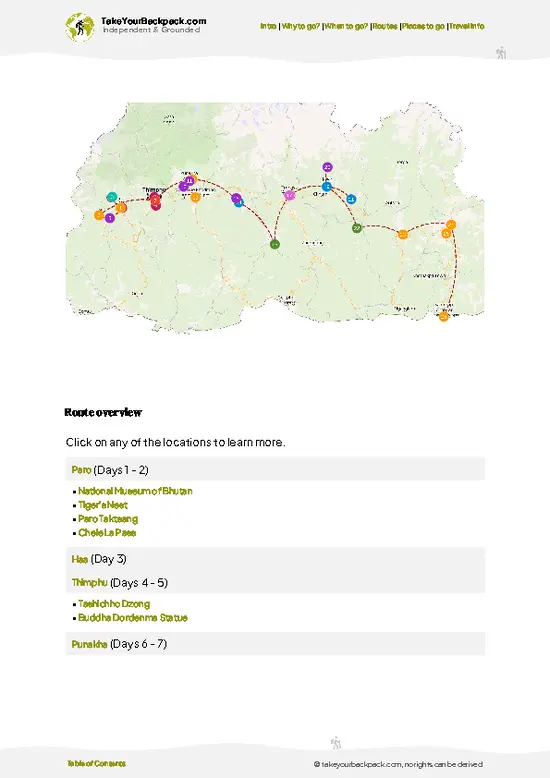
example page 2 from our offline Travel Guide for Bhutan
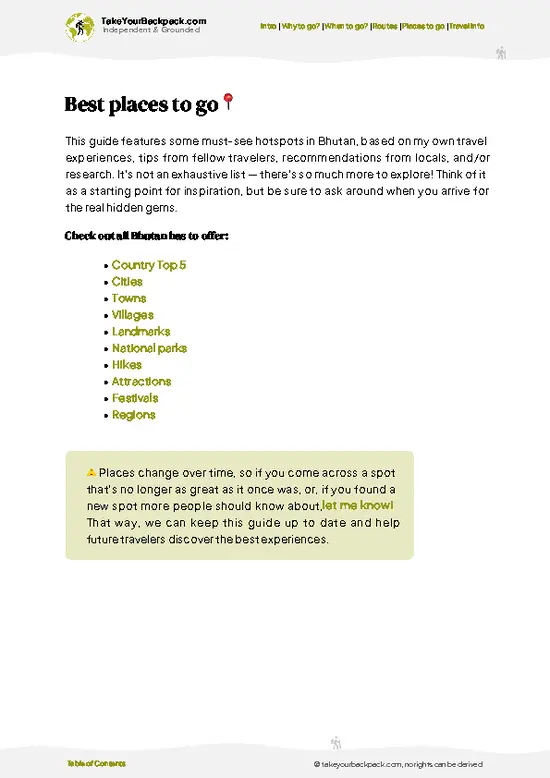
example page 3 from our offline Travel Guide for Bhutan
example page 4 from our offline Travel Guide for Bhutan
example page 5 from our offline Travel Guide for Bhutan
example page 6 from our offline Travel Guide for Bhutan
example page 7 from our offline Travel Guide for Bhutan
The digital guide (210 pages) contains:
✅ 52 highlights, ranked by travel appeal
✅ Optimized 5, 10 & 15-day travel routes
✅ Cities, national parks, landmarks, beaches
✅ How to get around
✅ Offline-friendly for travel without Wi-Fi
👉 Click to see all 30+ guide features

📅 Plan smarter in minutes, not weeks
✅ Month by month travel advice
✅ Festivals & national holidays
✅ Budget expectations

🗺️ Go to the right places, skip the overrated ones
✅ Honest pros & cons of destinations
✅ Top hikes, parks & viewpoints
✅ Lesser-known places most travelers miss
✅ Clear “worth it vs skip it” guidance

🛏️ Travel smoothly without rookie mistakes
✅ Best areas to stay
✅ Transport systems explained simply
✅ Common scams & safety advice
✅ SIM cards, money & practical tips

🌍 Understand the country, not just visit it
✅ Culture & traditions
✅ 52 Essential phrases & customs
✅ Festivals worth planning around
✅ Traveler-friendly historical context
✅ Insights that make places more meaningful

📱 Built for real travel conditions
✅ Fully downloadable PDF
✅ Works completely offline
✅ Optimized for phone use
✅ Useful in remote areas & buses
✅ Everything in one place
Stop searching, start planning
Get instant access to your full guide. 30‑day money-back guarantee.
+ Add another guide for just

By proceeding you agree to our terms.
Sent to your inbox immediately after payment • 100% Secure Checkout
Best Backpacking Travel Advisor 2025 tourism awardBest Backpacking
Travel Advisor
2025
What others say about Take Your Backpack Guides:
⭐⭐⭐⭐⭐
Fantastic, amazing amount of information!
⭐⭐⭐⭐⭐
My goodness this is amazing, it's what I've been looking for hats off too you!
⭐⭐⭐⭐⭐
I think this is absolutely BRILLIANT
⭐⭐⭐⭐
Very complete and informative. It's still missing places, but I gotta to commend you
⭐⭐⭐⭐⭐
This is truly amazing, thank you, can't wait to explore it with my kids!
⭐⭐⭐⭐⭐
Awesome resource, thank you!
⭐⭐⭐⭐⭐
This is amazing! Can't wait to explore the ones I haven't seen
⭐⭐⭐⭐
I love this! Well done, great idea.
⭐⭐⭐⭐⭐
Thanks for taking the time to make this gem!
⭐⭐⭐⭐⭐
This might be the best website I've ever seen.
⭐⭐⭐⭐⭐
Congratulations, and thank you so much for your work; it's incredibly valuable.
⭐⭐⭐⭐
In all seriousness I think you did a great job pointing out the important spots
⭐⭐⭐⭐⭐
10/10 very good
⭐⭐⭐⭐⭐
As someone who's only just starting to visit regularly this is awesome, thank you.
⭐⭐⭐⭐
Thank you very much! I'm going to visit my dad, it's going to be very useful!
⭐⭐⭐⭐⭐
This is really cool! We'll be travelling for the first time and this definitely come in handy.
⭐⭐⭐⭐⭐
You are now our minister of culture, congratulations 👨‍💼
⭐⭐⭐⭐⭐
Just wanted to tell you that this is a pearl! Going to follow your recommendations.
⭐⭐⭐⭐⭐
This is so cool. I'll definitely be using the resource for my travels soon.
⭐⭐⭐⭐⭐
This is very impressive! Good work.
⭐⭐⭐⭐⭐
This is an amazing and informative site. Very well done!

🛏️ Where to stay?Best Places to Stay in Bhutan

Bhutan has no backpacker hostels in the usual sense, because every visitor must stay in government-certified tourist accommodation, so budget options mean simple 2- and 3-star hotels and registered farmhouse homestays at roughly US$30 to 80 a night for a double. In Thimphu, the blocks around Norzin Lam and the Clock Tower Square put you within walking distance of cafés, craft shops and the capital’s small weekend bar and karaoke scene, while Motithang on the hill above is quieter and greener but a steep walk from town. In Paro, rooms in the compact town center are cheapest and handiest for restaurants, whereas guesthouses and homestays scattered across the Paro valley are calmer, closer to the … read more 👉
Bhutan has no backpacker hostels in the usual sense, because every visitor must stay in government-certified tourist accommodation, so budget options mean simple 2- and 3-star hotels and registered farmhouse homestays at roughly US$30 to 80 a night for a double. In Thimphu, the blocks around Norzin Lam and the Clock Tower Square put you within walking distance of cafés, craft shops and the capital’s small weekend bar and karaoke scene, while Motithang on the hill above is quieter and greener but a steep walk from town. In Paro, rooms in the compact town center are cheapest and handiest for restaurants, whereas guesthouses and homestays scattered across the Paro valley are calmer, closer to the trailheads and the whole country is very safe at night wherever you sleep.

If you enjoy meeting fellow travelers, consider choosing hostels with high ratings for atmosphere. On the other hand, if you prefer having your own space, a hotel might be a better option.

BhutanExplore Bhutan

👋 Meet the founderWho’s Behind Take Your Backpack?

Johan, backpacker and founder of TakeYourBackpackHi, I’m Johan (Netherlands 🇳🇱), the creator of TakeYourBackpack. Over the past 3 decades, I’ve backpacked through 90+ countries across six continents, gaining extensive experience with independent travel, long-term trips, and overland routes.

This site is built on a combination of firsthand travel experience and carefully curated insights from other backpackers. Many guides are based on places I’ve personally visited, while others bring together tips, observations, and practical advice shared by trusted travelers I’ve met along the way.

The goal is to provide realistic, experience-driven guidance — not generic itineraries — so you can explore destinations with better context, clearer expectations, and more confidence.