×

Bolivia🇧🇴 | national parksKaa-Iya del Gran Chaco National ParkJaguar tracks, thorn forest, Chacoan peccary, star-filled nights | things to do and best time to go

Explore Carrasco National ParkExplore Isiboro Sécure National Park

Backpacking in Kaa-Iya del Gran Chaco
🌟 Highlightnational park ranked #7
By Johan Kruseman 🇳🇱 | Updated October 19, 2026

I crouched at a dusty track beside our truck, pressing my thumb into a fresh jaguar print the size of my palm while our ranger guide grinned. That is Kaa-Iya del Gran Chaco National Park, in the dry thorn forest of southeastern Bolivia, east of the Andes and running toward the Paraguayan border. It is one of the largest protected areas in South America, with jaguars, pumas, tapirs and peccaries, plus the Chaco’s unique wildlife. Expect almost no marked trails, no crowds and long, rough access. Delays are the usual trap, so arrange guides and fuel in Santa Cruz or Villamontes before you leave, and carry far more water than seems sensible. Adventurous, self-sufficient travelers will love it. Anyone wanting easy paths and cafes will not.

Discover everything you want to know in the 📖 Bolivia Travel Guide.


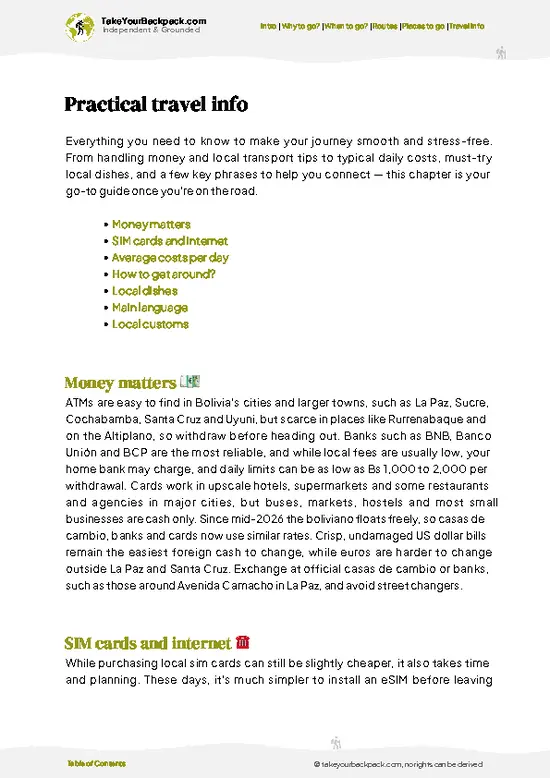
example page 0 from our offline Travel Guide for Bolivia
example page 1 from our offline Travel Guide for Bolivia
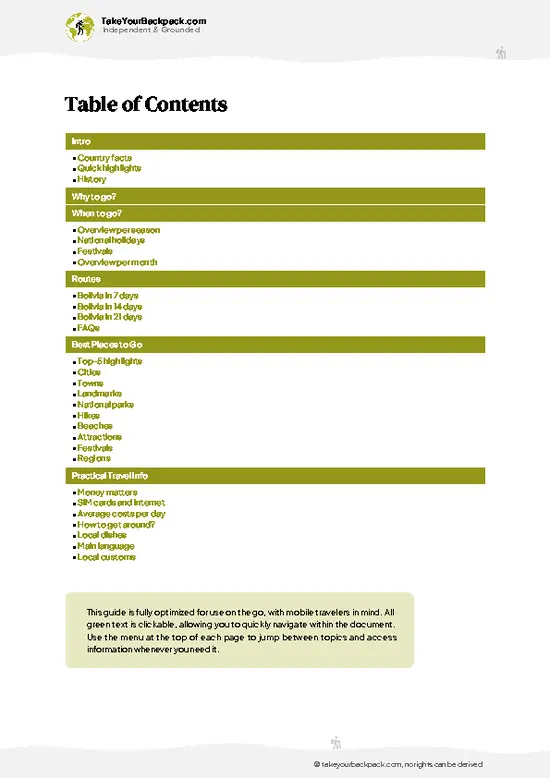
example page 2 from our offline Travel Guide for Bolivia
example page 3 from our offline Travel Guide for Bolivia
example page 4 from our offline Travel Guide for Bolivia
example page 5 from our offline Travel Guide for Bolivia
example page 6 from our offline Travel Guide for Bolivia
example page 7 from our offline Travel Guide for Bolivia
Loading the map 🌍
CLICK TO FILTER
cities
towns
landmarks
national parks
hikes
beaches
attractions
festivals
regions
SHOW COUNTRY’S BESTSHOW ALL

✨ Why go?
Ranked #7 national park in Bolivia
What makes it a must-see national park

Kaa-Iya del Gran Chaco National Park attracts backpackers who want wilderness that most of South America lost long ago. It covers roughly 34,000 square kilometers of dry Chaco forest, so you are not sharing a trailhead with a hundred people. Jaguars, pumas, tapirs and the rare Chacoan peccary live here, and the park is also home to the Ayoreo and Guaraní-Izoceño communities who manage parts of it. Independent exploring is possible only with preparation. Go through local guides, community contacts or park staff, since the terrain is remote and signage is minimal. Self-guided travelers should be comfortable with navigation, basic mechanics and carrying their own supplies. That effort filters out casual visitors and leaves a landscape that feels truly wild. It suits people who value solitude … read more 👉
Kaa-Iya del Gran Chaco National Park attracts backpackers who want wilderness that most of South America lost long ago. It covers roughly 34,000 square kilometers of dry Chaco forest, so you are not sharing a trailhead with a hundred people. Jaguars, pumas, tapirs and the rare Chacoan peccary live here, and the park is also home to the Ayoreo and Guaraní-Izoceño communities who manage parts of it. Independent exploring is possible only with preparation. Go through local guides, community contacts or park staff, since the terrain is remote and signage is minimal. Self-guided travelers should be comfortable with navigation, basic mechanics and carrying their own supplies. That effort filters out casual visitors and leaves a landscape that feels truly wild. It suits people who value solitude over comfort, and who like turning logistics into part of the adventure.

💡 HighlightsEssential experiences to have while exploring Kaa-Iya del Gran Chaco

  1. Jaguar and puma tracking: The park’s best-known draw. Sandy tracks and dry waterholes give you fresh prints, and sightings are rare but possible.
  2. Chacoan peccary habitat: This large peccary was once thought extinct and still lives in the thorn forest here. Guides know where to look.
  3. Tapir and giant armadillo country: Quiet dawn and dusk walks along forest edges can turn up tapir tracks and armadillo burrows.
  4. Dry Chaco thorn forest: Quebracho, cactus and bottle trees form a harsh, spiky landscape that looks nothing like the Amazon.
  5. Birdwatching: Chaco species such as rheas, parrots and the crested caracara show up along tracks and waterholes.
  6. Ayoreo and Guaraní-Izoceño communities: Communities around the park take part in managing it, and visits can be arranged through local organizations.
  7. Night
… read more 👉
  1. Jaguar and puma tracking: The park’s best-known draw. Sandy tracks and dry waterholes give you fresh prints, and sightings are rare but possible.
  2. Chacoan peccary habitat: This large peccary was once thought extinct and still lives in the thorn forest here. Guides know where to look.
  3. Tapir and giant armadillo country: Quiet dawn and dusk walks along forest edges can turn up tapir tracks and armadillo burrows.
  4. Dry Chaco thorn forest: Quebracho, cactus and bottle trees form a harsh, spiky landscape that looks nothing like the Amazon.
  5. Birdwatching: Chaco species such as rheas, parrots and the crested caracara show up along tracks and waterholes.
  6. Ayoreo and Guaraní-Izoceño communities: Communities around the park take part in managing it, and visits can be arranged through local organizations.
  7. Night drives and camping: With almost no light pollution, the sky is dense with stars and the forest sounds carry far.
For a first visit, put jaguar and puma tracking at the top, because following fresh prints with a local guide shows you how this park really works.
Spotted a mistake or missing something? Contact us.

🌤️ When to go?Seasonal considerations and timing

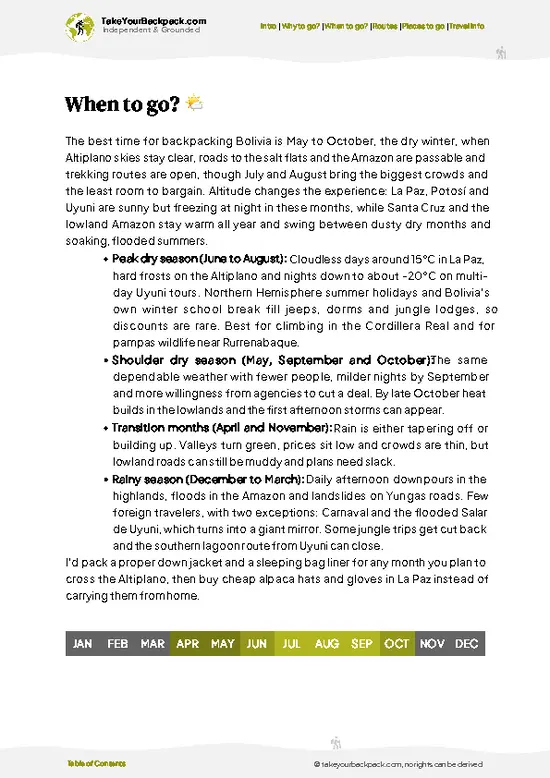
  • Dry Season (May to September): Roads and tracks are passable, and days run about 24 to 32°C (75 to 90°F). Winter cold fronts (surazos) can drop nights to 8 to 12°C (46 to 54°F) for a few days. Daylight lasts about 11 hours. Water points are scarce, so wildlife gathers around them.
  • Hot Transition (October to November): Heat climbs to 35 to 42°C (95 to 108°F), and the first storms arrive late in the period. Tours are fewer and prices stay flat.
  • Wet Season (December to March): Temperatures of 30 to 38°C (86 to 100°F) come with heavy humidity. Clay tracks turn impassable, insects peak, and most access is cut off. Daylight stretches to about 13.5 hours.
  • Crowds and Prices: Visitors are very few year-round. Guided trips from Santa Cruz cost the same across the dry months.
Book a guided trip for June … read more 👉
  • Dry Season (May to September): Roads and tracks are passable, and days run about 24 to 32°C (75 to 90°F). Winter cold fronts (surazos) can drop nights to 8 to 12°C (46 to 54°F) for a few days. Daylight lasts about 11 hours. Water points are scarce, so wildlife gathers around them.
  • Hot Transition (October to November): Heat climbs to 35 to 42°C (95 to 108°F), and the first storms arrive late in the period. Tours are fewer and prices stay flat.
  • Wet Season (December to March): Temperatures of 30 to 38°C (86 to 100°F) come with heavy humidity. Clay tracks turn impassable, insects peak, and most access is cut off. Daylight stretches to about 13.5 hours.
  • Crowds and Prices: Visitors are very few year-round. Guided trips from Santa Cruz cost the same across the dry months.
Book a guided trip for June to August and confirm road conditions a few days before departure.


source: climatestotravel.comJANJanuary: fair for travelingFEBFebruary: fair for travelingMARMarch: fair for travelingAPRApril: fair for travelingMAYMay: highly recommended for travelingJUNJune: excellent for travelingJULJuly: excellent for travelingAUGAugust: excellent for travelingSEPSeptember: excellent for travelingOCTOctober: highly recommended for travelingNOVNovember: fair for travelingDECDecember: fair for traveling
when-to-go

✈️ The backpacker research shortcutBolivia Travel Guide

An offline-friendly backpacking guide with optimized travel routes, ranked highlights, transport advice, and the best areas to stay.
example page 0 from our offline Travel Guide for Bolivia
example page 1 from our offline Travel Guide for Bolivia
example page 2 from our offline Travel Guide for Bolivia
example page 3 from our offline Travel Guide for Bolivia
example page 4 from our offline Travel Guide for Bolivia
example page 5 from our offline Travel Guide for Bolivia
example page 6 from our offline Travel Guide for Bolivia
example page 7 from our offline Travel Guide for Bolivia
The digital guide (262 pages) contains:
✅ 76 highlights, ranked by travel appeal
✅ Optimized 7, 14 & 21-day travel routes
✅ Cities, national parks, landmarks, beaches
✅ How to get around
✅ Offline-friendly for travel without Wi-Fi
👉 Click to see all 30+ guide features

📅 Plan smarter in minutes, not weeks
✅ Month by month travel advice
✅ Festivals & national holidays
✅ Budget expectations

🗺️ Go to the right places, skip the overrated ones
✅ Honest pros & cons of destinations
✅ Top hikes, parks & viewpoints
✅ Lesser-known places most travelers miss
✅ Clear “worth it vs skip it” guidance

🛏️ Travel smoothly without rookie mistakes
✅ Best areas to stay
✅ Transport systems explained simply
✅ Common scams & safety advice
✅ SIM cards, money & practical tips

🌍 Understand the country, not just visit it
✅ Culture & traditions
✅ 52 Essential phrases & customs
✅ Festivals worth planning around
✅ Traveler-friendly historical context
✅ Insights that make places more meaningful

📱 Built for real travel conditions
✅ Fully downloadable PDF
✅ Works completely offline
✅ Optimized for phone use
✅ Useful in remote areas & buses
✅ Everything in one place
Stop searching, start planning
Get instant access to your full guide. 30‑day money-back guarantee.
+ Add another guide for just

By proceeding you agree to our terms.
Sent to your inbox immediately after payment • 100% Secure Checkout
Best Backpacking Travel Advisor 2025 tourism awardBest Backpacking
Travel Advisor
2025
What others say about Take Your Backpack Guides:
⭐⭐⭐⭐⭐
Fantastic, amazing amount of information!
⭐⭐⭐⭐⭐
My goodness this is amazing, it's what I've been looking for hats off too you!
⭐⭐⭐⭐⭐
I think this is absolutely BRILLIANT
⭐⭐⭐⭐
Very complete and informative. It's still missing places, but I gotta to commend you
⭐⭐⭐⭐⭐
This is truly amazing, thank you, can't wait to explore it with my kids!
⭐⭐⭐⭐⭐
Awesome resource, thank you!
⭐⭐⭐⭐⭐
This is amazing! Can't wait to explore the ones I haven't seen
⭐⭐⭐⭐
I love this! Well done, great idea.
⭐⭐⭐⭐⭐
Thanks for taking the time to make this gem!
⭐⭐⭐⭐⭐
This might be the best website I've ever seen.
⭐⭐⭐⭐⭐
Congratulations, and thank you so much for your work; it's incredibly valuable.
⭐⭐⭐⭐
In all seriousness I think you did a great job pointing out the important spots
⭐⭐⭐⭐⭐
10/10 very good
⭐⭐⭐⭐⭐
As someone who's only just starting to visit regularly this is awesome, thank you.
⭐⭐⭐⭐
Thank you very much! I'm going to visit my dad, it's going to be very useful!
⭐⭐⭐⭐⭐
This is really cool! We'll be travelling for the first time and this definitely come in handy.
⭐⭐⭐⭐⭐
You are now our minister of culture, congratulations 👨‍💼
⭐⭐⭐⭐⭐
Just wanted to tell you that this is a pearl! Going to follow your recommendations.
⭐⭐⭐⭐⭐
This is so cool. I'll definitely be using the resource for my travels soon.
⭐⭐⭐⭐⭐
This is very impressive! Good work.
⭐⭐⭐⭐⭐
This is an amazing and informative site. Very well done!

🛏️ Where to stay?Best areas and accommodation options

No hotels or hostels exist inside Kaa-Iya del Gran Chaco National Park, so you will sleep in the nearby towns or in basic ranger posts and community camps arranged through a guide. Most backpackers stay in Santa Cruz de la Sierra, where hostels charge US$8 to 15 for a dorm bed and simple hotels US$20 to 40 for a private room. Santa Cruz is also where you hire a 4x4 and book permits. Closer to the park, Charagua and Cuevo on the Chaco road have a few basic residenciales for about US$10 to 20 a night. Villa Montes, to the south near the Argentine border, offers similar simple lodging and is a practical … read more 👉
No hotels or hostels exist inside Kaa-Iya del Gran Chaco National Park, so you will sleep in the nearby towns or in basic ranger posts and community camps arranged through a guide. Most backpackers stay in Santa Cruz de la Sierra, where hostels charge US$8 to 15 for a dorm bed and simple hotels US$20 to 40 for a private room. Santa Cruz is also where you hire a 4x4 and book permits. Closer to the park, Charagua and Cuevo on the Chaco road have a few basic residenciales for about US$10 to 20 a night. Villa Montes, to the south near the Argentine border, offers similar simple lodging and is a practical entry on the southern side. Park staff and the Guaraní organization CABI (Capitanía del Alto y Bajo Isoso) in the Isoso communities can arrange camping or a bed in a community house. Bring a tent, a mosquito net and your own water, since services in the Chaco are minimal.

👛 Costs (as of 19 October 2026)What things cost and how to budget

A realistic budget for Kaa-Iya del Gran Chaco National Park is about US$86 to 165 per day, driven mostly by the guide and vehicle you need to reach it.
CategoryBudget RangeLocal Reality
Entrance feeUS$3 to 15Fees and permits are set by the park authority (SERNAP) and local communities, and are paid in bolivianos.
Guide and 4x4 (shared)US$60 to 90Independent travel is impractical, so a guided vehicle from Santa Cruz is shared among several people.
Accommodation (high season)US$8 to 25Camping or a community bed near the park, and a hostel dorm or simple hotel in Santa Cruz.
Local transportUS$5 to 15Buses to Charagua or Villa Montes cost a few dollars, and fuel is a cost for self-driven trips.
Food and suppliesUS$10 to 20Bring water, canned food and snacks because the Chaco has few shops, and meals
… read more 👉
A realistic budget for Kaa-Iya del Gran Chaco National Park is about US$86 to 165 per day, driven mostly by the guide and vehicle you need to reach it.
CategoryBudget RangeLocal Reality
Entrance feeUS$3 to 15Fees and permits are set by the park authority (SERNAP) and local communities, and are paid in bolivianos.
Guide and 4x4 (shared)US$60 to 90Independent travel is impractical, so a guided vehicle from Santa Cruz is shared among several people.
Accommodation (high season)US$8 to 25Camping or a community bed near the park, and a hostel dorm or simple hotel in Santa Cruz.
Local transportUS$5 to 15Buses to Charagua or Villa Montes cost a few dollars, and fuel is a cost for self-driven trips.
Food and suppliesUS$10 to 20Bring water, canned food and snacks because the Chaco has few shops, and meals in towns cost US$3 to 6.
Total Daily BudgetUS$86 to 165Midpoint of about US$125 with a shared guide.
⚠️ Prices can change and everyone travels differently, so take this as a rough guide. Hope it helps you plan your adventure!

🥾 TrailsDiscover Kaa-Iya del Gran Chaco's top trails and natural wonders

Kaa-Iya del Gran Chaco National Park has no developed hiking network, so walks here are guided outings on sandy tracks, dry creek beds and forest edges rather than marked trails.
  • Track-following walks: Short walks of one to three hours from camp or a ranger post follow animal prints along sandy tracks. Terrain is flat and easy, but thorns and heat make it tiring.
  • Waterhole watches: Guides lead you to seasonal ponds at first or last light, where you wait quietly for tapir, peccary and birds. Usually one to two hours, easy.
  • Longer forest treks: Full-day routes through dense thorn scrub are possible
… read more 👉
Kaa-Iya del Gran Chaco National Park has no developed hiking network, so walks here are guided outings on sandy tracks, dry creek beds and forest edges rather than marked trails.
  • Track-following walks: Short walks of one to three hours from camp or a ranger post follow animal prints along sandy tracks. Terrain is flat and easy, but thorns and heat make it tiring.
  • Waterhole watches: Guides lead you to seasonal ponds at first or last light, where you wait quietly for tapir, peccary and birds. Usually one to two hours, easy.
  • Longer forest treks: Full-day routes through dense thorn scrub are possible with experienced guides. They are moderate to hard, with no shade, little water and tricky navigation.
  • Night walks: Short loops near camp reveal frogs, insects and sometimes eyeshine from nocturnal mammals. Easy, but bring a strong headlamp.
Wildlife is the main attraction, though sightings are never guaranteed. Wear long trousers and sturdy boots against thorns and ticks, and carry all the water you need.
Access is the hard part. Public transport does not reach the interior, so most visitors join arranged trips from Santa Cruz or Villamontes by 4x4. Roads become impassable after heavy rain. Crowds are essentially nonexistent. Check current entry requirements and permits with park authorities (SERNAP) or local operators before you go, since access is usually coordinated through them.
⚠️ Hiking info can sometimes be outdated or inaccurate. Before you hit the trail, check the latest conditions with locals. If you do spot anything that's off, I'd love to hear from you, so I can update it for fellow travelers.

🛡️ SafetyTraveler Safety Guide

Kaa-Iya is remote and dry, so the main hazards are heat, isolation and vehicle trouble rather than crime. Temperatures above 38°C (100°F) are common outside winter, so carry at least 5 to 6 liters of water per person per day and move at dawn and dusk. Tracks are sandy or clay, with no cell signal for long stretches. Travel with a guide, two spare tires, extra fuel and a satellite messenger. Wildlife includes jaguars, pumas, peccaries and the Chacoan peccary, but encounters are rare and animals avoid people. Snakes, ticks and biting insects are more likely problems, so wear closed boots, long trousers and repellent. Cold fronts can drop temperatures quickly in winter, so pack a warm layer. Register your route with the park office before leaving.

FAQTraveler FAQ

Plan on 3 to 5 days for Kaa-Iya del Gran Chaco National Park, because the park is huge and remote. The drive from Santa Cruz to the park edge takes roughly 6 to 10 hours depending on the entry point and track conditions. A short trip of 3 days leaves little time for wildlife viewing, while 5 days lets you visit the Isoso communities and watering holes.
Visiting Kaa-Iya del Gran Chaco National Park without a car is possible only partly, since public transport stops at towns such as Charagua, Cuevo and Villa Montes. Buses from Santa Cruz reach them in about 6 to 9 hours. From there you need a hired 4x4 with a driver or a tour, usually US$60 to 90 a day shared. Walking in the park itself is impractical because of distances and heat.
Yes, Kaa-Iya del Gran Chaco National Park needs permission arranged through the park authority SERNAP and the local Guaraní organization CABI. Fees are small, roughly US$3 to 15 per person, and are paid in bolivianos. Most travelers have a Santa Cruz tour operator handle the paperwork, and you should carry your passport for checkpoints along the Chaco road.
⚠️ Things can change over time, so always validate details locally before you go.

Other Bolivian national parks near Kaa-Iya del Gran Chaco

Explore more nearby:


💡 Not sure where to go next?
Create a personalized itinerary for Bolivia including Kaa-Iya del Gran Chaco and the places that fit your trip.

Generate my itinerary

👉 Discover all national parks

Or checkout all Bolivia has to offer (think cities, towns, villages, national parks, hikes, beaches, festivals)
Country photo of Bolivia

We 💚 feedbackKey takeaways before you go

Give Kaa-Iya del Gran Chaco National Park at least three or four days. The first day goes to getting there, and you need the rest for dawn and dusk watches, when animals actually move. A one-night dash will leave you with dust and thorns but few sightings. I would bring a spare day as a buffer for road delays.

✈️ When did I visit Bolivia?
Bolivia I visited during my half year trip through South and Central America back in 2003

✍️ Help improve this page!
The information on this page is based on my own backpacking experience in Bolivia, supplemented with up-to-date research and feedback from other travelers. Travel details can change, so if you notice anything outdated or incomplete, feel free to let me know.


🙋‍♂️ Give feedback

👋 Meet the founderWho’s Behind Take Your Backpack?

Johan, backpacker and founder of TakeYourBackpackHi, I’m Johan (Netherlands 🇳🇱), the creator of TakeYourBackpack. Over the past 3 decades, I’ve backpacked through 90+ countries across six continents, gaining extensive experience with independent travel, long-term trips, and overland routes.

This site is built on a combination of firsthand travel experience and carefully curated insights from other backpackers. Many guides are based on places I’ve personally visited, while others bring together tips, observations, and practical advice shared by trusted travelers I’ve met along the way.

The goal is to provide realistic, experience-driven guidance — not generic itineraries — so you can explore destinations with better context, clearer expectations, and more confidence.