×

Bolivia🇧🇴 | citiesSanta CruzLowland hub, ring roads, Los Pozos market, sand dunes | things to do and best time to go

Explore PotosíExplore Sucre

Backpacking in Santa Cruz
🌟 Highlightcity ranked #3
By Johan Kruseman 🇳🇱 | Updated October 19, 2026

Santa Cruz is the cheapest place in Bolivia to line up a jungle trip, a Jesuit mission loop or a flight to the Amazon. It sits in the eastern lowlands of Bolivia, a flat, hot, fast-growing city built in rings around a leafy central plaza. Buses and flights fan out from the city, and the main bus terminal sits a taxi ride from the center, so experienced travelers sleep near the plaza and book onward tickets a day ahead instead of hauling bags around. I learned to start mornings at a market stall with a salteña, a juicy baked pastry, and a fresh juice for about US$2. Eat it before 10 a.m., because the good ones sell out, and pick a stall with a line. The city is spread out, so use app taxis rather than hunting for buses. It suits food lovers and route planners; it will disappoint anyone who wants a compact colonial old town or high-altitude drama.

Discover everything you want to know in the 📖 Bolivia Travel Guide.


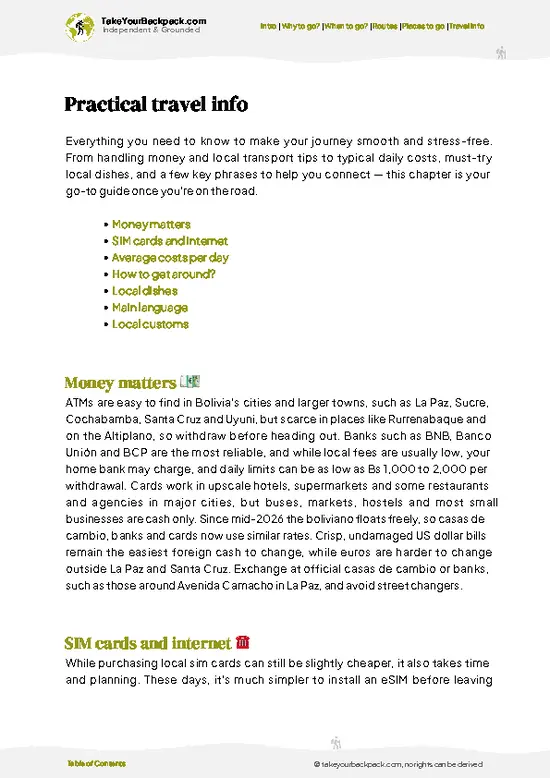
example page 0 from our offline Travel Guide for Bolivia
example page 1 from our offline Travel Guide for Bolivia
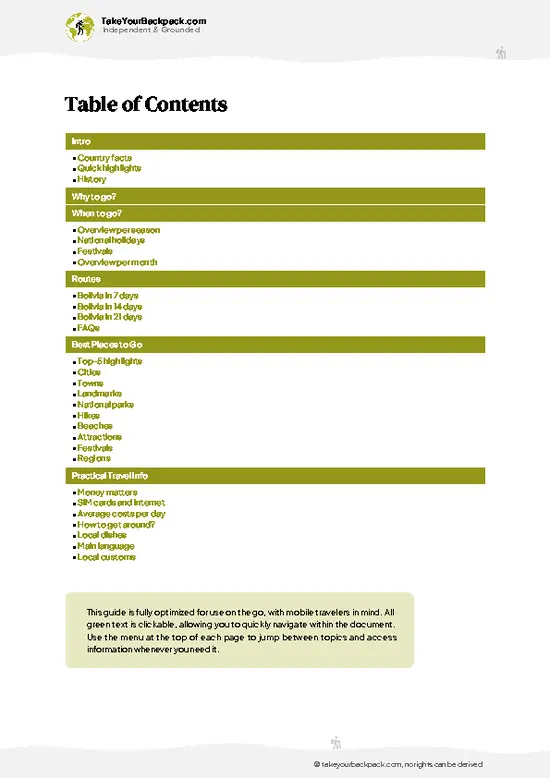
example page 2 from our offline Travel Guide for Bolivia
example page 3 from our offline Travel Guide for Bolivia
example page 4 from our offline Travel Guide for Bolivia
example page 5 from our offline Travel Guide for Bolivia
example page 6 from our offline Travel Guide for Bolivia
example page 7 from our offline Travel Guide for Bolivia
Loading the map 🌍
CLICK TO FILTER
cities
towns
landmarks
national parks
hikes
beaches
attractions
festivals
regions
SHOW COUNTRY’S BESTSHOW ALL

✨ Why go?
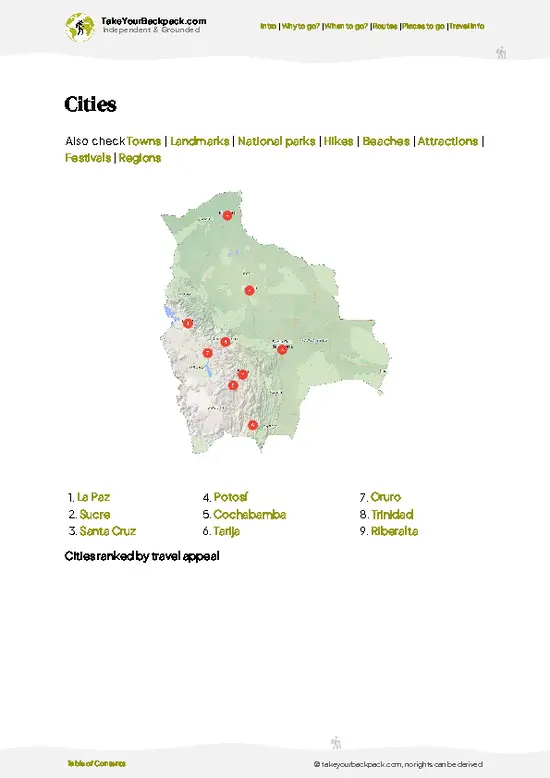
Ranked #3 city in Bolivia
What makes this city worth visiting

Santa Cruz earns its place on a route because it is the lowlands hub that Bolivia’s mountain-focused circuits skip, and that makes it useful. Flights and long-distance buses leave for the Chiquitania, the Brazilian border and the Andean cities, so you can connect a highland trip with the east without backtracking. The center holds the Plaza 24 de Septiembre and a tight cluster of hostels, cafes and bars within walking distance, while the outer ring roads (anillos) are where the real city lives, with big markets and restaurants that locals pick. Food is a draw by itself. Expect cuñapé cheese bread, grilled meats and rich lowland stews, all easier to find here than in the highlands. Nightlife runs late, particularly on weekends. The heat and sprawl mean a day or two is plenty for the city, but … read more 👉
Santa Cruz earns its place on a route because it is the lowlands hub that Bolivia’s mountain-focused circuits skip, and that makes it useful. Flights and long-distance buses leave for the Chiquitania, the Brazilian border and the Andean cities, so you can connect a highland trip with the east without backtracking. The center holds the Plaza 24 de Septiembre and a tight cluster of hostels, cafes and bars within walking distance, while the outer ring roads (anillos) are where the real city lives, with big markets and restaurants that locals pick. Food is a draw by itself. Expect cuñapé cheese bread, grilled meats and rich lowland stews, all easier to find here than in the highlands. Nightlife runs late, particularly on weekends. The heat and sprawl mean a day or two is plenty for the city, but it works well as a recovery stop with real air conditioning and decent coffee. Treat it as a gateway more than a destination, and you will use it well.

💡 HighlightsKey sights and experiences for travelers

  1. Plaza 24 de Septiembre and the Cathedral Basilica of San Lorenzo: The shaded main square is where the city gathers, with sloths often spotted in the trees. The cathedral’s bell tower and museum give you a view over the rooftops. Go in the late afternoon when the heat eases. Plaza is free, museum and tower roughly US$1 to 2, allow 1 to 1.5 hours.
  2. Museo de Historia y Archivo Histórico Regional: A compact museum on the plaza covering the region’s indigenous peoples and the colonial era. Go in the morning, tickets about US$1 to 2, allow 45 minutes.
  3. Mercado Los Pozos: A large, loud market where you can try local snacks, fresh juices and cheap lunches. Go before noon. Entry is free, meals cost US$2 to 4, allow 1 to 2 hours.
  4. Parque Urbano Arenal and Cambódromo: A lakeside park near the center where
… read more 👉
  1. Plaza 24 de Septiembre and the Cathedral Basilica of San Lorenzo: The shaded main square is where the city gathers, with sloths often spotted in the trees. The cathedral’s bell tower and museum give you a view over the rooftops. Go in the late afternoon when the heat eases. Plaza is free, museum and tower roughly US$1 to 2, allow 1 to 1.5 hours.
  2. Museo de Historia y Archivo Histórico Regional: A compact museum on the plaza covering the region’s indigenous peoples and the colonial era. Go in the morning, tickets about US$1 to 2, allow 45 minutes.
  3. Mercado Los Pozos: A large, loud market where you can try local snacks, fresh juices and cheap lunches. Go before noon. Entry is free, meals cost US$2 to 4, allow 1 to 2 hours.
  4. Parque Urbano Arenal and Cambódromo: A lakeside park near the center where locals walk and exercise, good for an easy evening stroll. Free, allow an hour.
  5. Museo de Arte Contemporáneo (MACC): A modest gallery of Bolivian contemporary art in a calm setting, best on a hot afternoon. Entry is about US$1 to 3, allow 1 hour.
  6. Jardín Botánico: A large green area on the eastern edge, on the road to Cotoca, with trails, birds and shade, best in the morning. Entry is roughly US$1 to 2, allow 2 to 3 hours, and a taxi is the easiest way to reach it.
  7. Parque Lomas de Arena: A sand dune reserve that feels unexpected so near a city, with a short walk across dunes and a small lagoon. Best at the cooler ends of the day. Entry about US$3 to 5, allow 2 to 3 hours, and go by taxi.
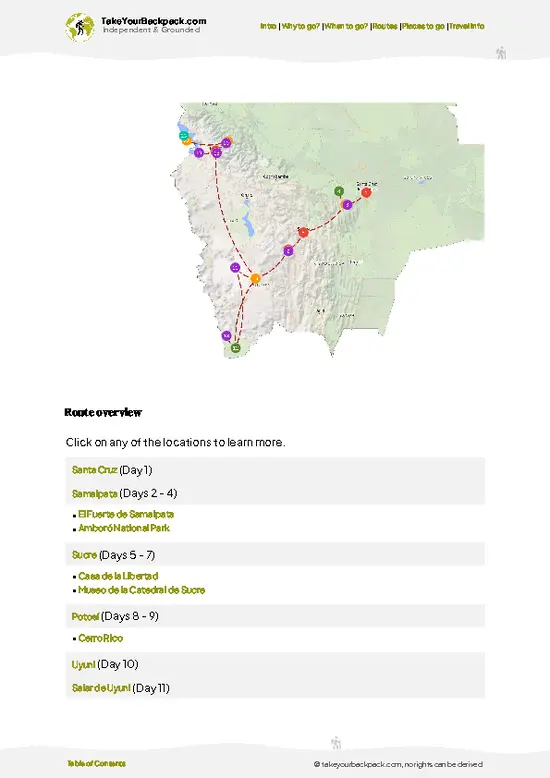
Day trips from here include the Jesuit mission towns of San José de Chiquitos and Concepción, the village of Samaipata with its pre-Inca El Fuerte site, and Amboró National Park near Buena Vista. If time is short, skip the contemporary art museum and spend that hour in the plaza and market instead.
Spotted a mistake or missing something? Contact us.

🏘️ NeighborhoodsUnderstanding the local layout

Santa Cruz grows in rings (anillos) around the central plaza, and that layout is the key to reading the city. Numbered rings circle outward, crossed by radial avenues, so once you know which ring you are on, you can find your way anywhere. Experienced travelers navigate by ring and radial instead of street names.
  • Casco Viejo (Centro): Start here, inside the First Ring. Plaza 24 de Septiembre, the cathedral (its bell tower has a view over the plaza) and low colonial-style arcades make it the most walkable zone. Cafés fill the plaza by evening. Go early, because many shops shut for a long midday break and the streets quiet down.
  • Equipetrol: Northwest of the center, this is the nightlife and upscale dining district. Bars, clubs and restaurants line its avenues, and it spreads out enough that you
… read more 👉
Santa Cruz grows in rings (anillos) around the central plaza, and that layout is the key to reading the city. Numbered rings circle outward, crossed by radial avenues, so once you know which ring you are on, you can find your way anywhere. Experienced travelers navigate by ring and radial instead of street names.
  • Casco Viejo (Centro): Start here, inside the First Ring. Plaza 24 de Septiembre, the cathedral (its bell tower has a view over the plaza) and low colonial-style arcades make it the most walkable zone. Cafés fill the plaza by evening. Go early, because many shops shut for a long midday break and the streets quiet down.
  • Equipetrol: Northwest of the center, this is the nightlife and upscale dining district. Bars, clubs and restaurants line its avenues, and it spreads out enough that you should take a taxi between spots rather than walk. Weeknights are calm, Thursday to Saturday is loud.
  • Barrio Urbarí and the Second Ring: Pleasant parkland sits toward the south and southeast. Walk the shaded paths in the morning, when sloths and birds are most active and the heat is mild.
  • La Ramada and the Mercado Los Pozos area: Packed local markets just beyond the First Ring sell fruit, empanadas, juices and cheap lunches. Arrive before noon for the best selection, hold your bag in front, and bargain lightly.
  • Bus terminal zone (Bimodal): Functional and busy, useful mainly for departures. Do not wander here at night; grab a taxi instead.

⌛️ 1 daySeeing the highlights in 24 hours

Take this day slowly: walk the center in the morning, take a taxi to the far spots, and hide from the midday sun indoors.
8:00 AM: Market breakfast near the center Start with a salteña and fresh juice at a local stall. Eat early because the best ones sell out, and it sets the tone for the day.
9:30 AM: Plaza 24 de Septiembre and the Cathedral Walk to the plaza, look for sloths in the trees, then climb the cathedral tower for a view over the grid of streets. It is a short, easy stroll.
11:00 AM: Museo de Historia Regional Step across the plaza to see the regional exhibits. It gives context for the lowland cultures you will see later on the road.
12:30 PM: Lunch and a break indoors Order a plate of grilled meat or a local stew in a restaurant off the plaza, and stay in the shade or a cafe until … read more 👉
Take this day slowly: walk the center in the morning, take a taxi to the far spots, and hide from the midday sun indoors.
8:00 AM: Market breakfast near the center Start with a salteña and fresh juice at a local stall. Eat early because the best ones sell out, and it sets the tone for the day.
9:30 AM: Plaza 24 de Septiembre and the Cathedral Walk to the plaza, look for sloths in the trees, then climb the cathedral tower for a view over the grid of streets. It is a short, easy stroll.
11:00 AM: Museo de Historia Regional Step across the plaza to see the regional exhibits. It gives context for the lowland cultures you will see later on the road.
12:30 PM: Lunch and a break indoors Order a plate of grilled meat or a local stew in a restaurant off the plaza, and stay in the shade or a cafe until the heat drops.
3:00 PM: Mercado Los Pozos Take a taxi to this working market, where locals shop for produce, snacks and household goods. Browse the stalls, try a fruit juice, and skip anything you do not want to eat.
4:30 PM: Parque Lomas de Arena This is the off-the-usual-route stop. Take a taxi to the sand dunes on the edge of the city and walk the soft ridges as the light softens. Arrange the return ride with your driver or use an app.
7:00 PM: Dinner back at the plaza Finish with dinner at a plaza-side restaurant and a cold local beer while the square fills with families and street musicians.

🌤️ When to go?Choosing the right time of year

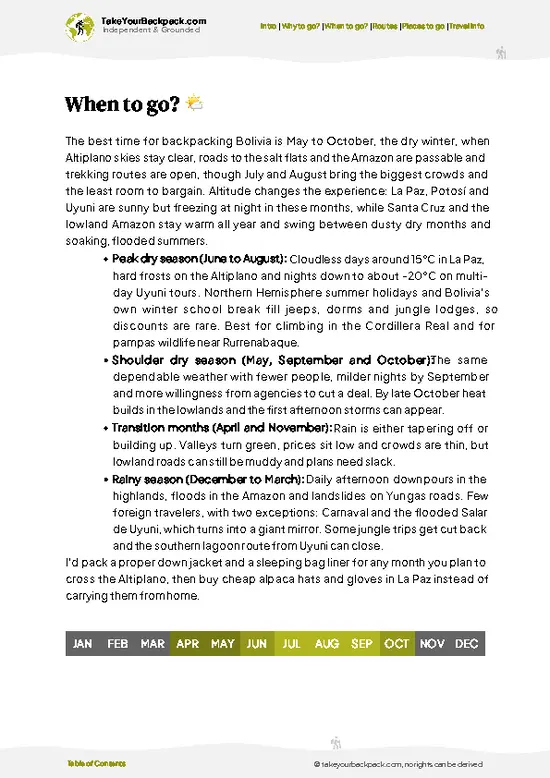
May to September is the easiest window for Santa Cruz, with dry, sunny days and lower humidity.
  • Dry Season (May to September): Highs reach 24 to 30°C (75 to 86°F), lows 14 to 18°C (57 to 64°F). Daylight lasts roughly 11 hours in June. Crowds are moderate, and prices for beds rise a little during school holidays in July.
  • Surazo Cold Fronts (May to August): Cold southern winds can drop temperatures to 8 to 12°C (46 to 54°F) for two or three days. Bring a warm layer, since locals and cafés are not geared to the cold.
  • Hot, Wet Season (November to March): Expect 30 to 36°C (86 to 97°F), heavy humidity and sudden afternoon downpours that flood streets. Daylight stretches to about 13 hours. Rooms and flights are often cheaper.
  • Shoulder Months (April, October): Warm, with fewer visitors and fair weather.
… read more 👉
May to September is the easiest window for Santa Cruz, with dry, sunny days and lower humidity.
  • Dry Season (May to September): Highs reach 24 to 30°C (75 to 86°F), lows 14 to 18°C (57 to 64°F). Daylight lasts roughly 11 hours in June. Crowds are moderate, and prices for beds rise a little during school holidays in July.
  • Surazo Cold Fronts (May to August): Cold southern winds can drop temperatures to 8 to 12°C (46 to 54°F) for two or three days. Bring a warm layer, since locals and cafés are not geared to the cold.
  • Hot, Wet Season (November to March): Expect 30 to 36°C (86 to 97°F), heavy humidity and sudden afternoon downpours that flood streets. Daylight stretches to about 13 hours. Rooms and flights are often cheaper.
  • Shoulder Months (April, October): Warm, with fewer visitors and fair weather. Carnaval in February or March brings parties, water balloons and higher prices.
Book Carnaval beds weeks ahead, or avoid those dates if you want quiet streets.


source: climatestotravel.comJANJanuary: fair for travelingFEBFebruary: fair for travelingMARMarch: fair for travelingAPRApril: fair for travelingMAYMay: highly recommended for travelingJUNJune: excellent for travelingJULJuly: excellent for travelingAUGAugust: excellent for travelingSEPSeptember: highly recommended for travelingOCTOctober: fair for travelingNOVNovember: fair for travelingDECDecember: fair for traveling
when-to-go

✈️ The backpacker research shortcutBolivia Travel Guide

An offline-friendly backpacking guide with optimized travel routes, ranked highlights, transport advice, and the best areas to stay.
example page 0 from our offline Travel Guide for Bolivia
example page 1 from our offline Travel Guide for Bolivia
example page 2 from our offline Travel Guide for Bolivia
example page 3 from our offline Travel Guide for Bolivia
example page 4 from our offline Travel Guide for Bolivia
example page 5 from our offline Travel Guide for Bolivia
example page 6 from our offline Travel Guide for Bolivia
example page 7 from our offline Travel Guide for Bolivia
The digital guide (262 pages) contains:
✅ 76 highlights, ranked by travel appeal
✅ Optimized 7, 14 & 21-day travel routes
✅ Cities, national parks, landmarks, beaches
✅ How to get around
✅ Offline-friendly for travel without Wi-Fi
👉 Click to see all 30+ guide features

📅 Plan smarter in minutes, not weeks
✅ Month by month travel advice
✅ Festivals & national holidays
✅ Budget expectations

🗺️ Go to the right places, skip the overrated ones
✅ Honest pros & cons of destinations
✅ Top hikes, parks & viewpoints
✅ Lesser-known places most travelers miss
✅ Clear “worth it vs skip it” guidance

🛏️ Travel smoothly without rookie mistakes
✅ Best areas to stay
✅ Transport systems explained simply
✅ Common scams & safety advice
✅ SIM cards, money & practical tips

🌍 Understand the country, not just visit it
✅ Culture & traditions
✅ 52 Essential phrases & customs
✅ Festivals worth planning around
✅ Traveler-friendly historical context
✅ Insights that make places more meaningful

📱 Built for real travel conditions
✅ Fully downloadable PDF
✅ Works completely offline
✅ Optimized for phone use
✅ Useful in remote areas & buses
✅ Everything in one place
Stop searching, start planning
Get instant access to your full guide. 30‑day money-back guarantee.
+ Add another guide for just

By proceeding you agree to our terms.
Sent to your inbox immediately after payment • 100% Secure Checkout
Best Backpacking Travel Advisor 2025 tourism awardBest Backpacking
Travel Advisor
2025
What others say about Take Your Backpack Guides:
⭐⭐⭐⭐⭐
Fantastic, amazing amount of information!
⭐⭐⭐⭐⭐
My goodness this is amazing, it's what I've been looking for hats off too you!
⭐⭐⭐⭐⭐
I think this is absolutely BRILLIANT
⭐⭐⭐⭐
Very complete and informative. It's still missing places, but I gotta to commend you
⭐⭐⭐⭐⭐
This is truly amazing, thank you, can't wait to explore it with my kids!
⭐⭐⭐⭐⭐
Awesome resource, thank you!
⭐⭐⭐⭐⭐
This is amazing! Can't wait to explore the ones I haven't seen
⭐⭐⭐⭐
I love this! Well done, great idea.
⭐⭐⭐⭐⭐
Thanks for taking the time to make this gem!
⭐⭐⭐⭐⭐
This might be the best website I've ever seen.
⭐⭐⭐⭐⭐
Congratulations, and thank you so much for your work; it's incredibly valuable.
⭐⭐⭐⭐
In all seriousness I think you did a great job pointing out the important spots
⭐⭐⭐⭐⭐
10/10 very good
⭐⭐⭐⭐⭐
As someone who's only just starting to visit regularly this is awesome, thank you.
⭐⭐⭐⭐
Thank you very much! I'm going to visit my dad, it's going to be very useful!
⭐⭐⭐⭐⭐
This is really cool! We'll be travelling for the first time and this definitely come in handy.
⭐⭐⭐⭐⭐
You are now our minister of culture, congratulations 👨‍💼
⭐⭐⭐⭐⭐
Just wanted to tell you that this is a pearl! Going to follow your recommendations.
⭐⭐⭐⭐⭐
This is so cool. I'll definitely be using the resource for my travels soon.
⭐⭐⭐⭐⭐
This is very impressive! Good work.
⭐⭐⭐⭐⭐
This is an amazing and informative site. Very well done!

🛏️ Where to stay?Best areas and accommodation options

The best budget base is the area in and around the Casco Viejo, inside or just beyond the First Ring. Most hostels and cheap guesthouses cluster here, with dorm beds typically US$8 to 14. Walking at night is comfortable on the main streets around the plaza, and the area has the densest choice of cafés and pharmacies. Micros and taxis leave from here to almost everywhere, and the bus terminal is a short taxi ride away.

Noise can be an issue on weekends near bars on the plaza, so ask for a back room or bring earplugs. Streets get quiet after about 10 pm and a few side streets are poorly lit, so … read more 👉
The best budget base is the area in and around the Casco Viejo, inside or just beyond the First Ring. Most hostels and cheap guesthouses cluster here, with dorm beds typically US$8 to 14. Walking at night is comfortable on the main streets around the plaza, and the area has the densest choice of cafés and pharmacies. Micros and taxis leave from here to almost everywhere, and the bus terminal is a short taxi ride away.

Noise can be an issue on weekends near bars on the plaza, so ask for a back room or bring earplugs. Streets get quiet after about 10 pm and a few side streets are poorly lit, so use a taxi for the last stretch if you come back late.

The second option is Equipetrol, which suits those who want nightlife on the doorstep and do not mind paying more. Beds are fewer and a bit pricier, from about US$12 to 18, but the area is safer after dark, with security guards and well-lit avenues. It is spread out, so you will rely on taxis to get to the center and sights. It makes sense only if going out is your priority.

Book ahead for Carnaval and July holidays, when the better budget places fill. Air conditioning is worth paying a little extra for from November to March.

🚌 Getting aroundGetting around like a local

Micros (city minibuses) and app taxis cover almost everything, and the radial-ring street grid makes both easy to use. The center is walkable, but the city sprawls in all directions, and heat, traffic and uneven sidewalks make longer distances tiring. Public transport works but has no maps or timetables, so experienced travelers rely on taxi apps for evenings.
  • Walking: Free, and the best way around the Casco Viejo inside the First Ring. Start early, because midday sun is fierce and sidewalks are cracked. Carry water and cross wide avenues carefully, as drivers rarely yield.
  • Micros and minibuses: Fares run about US$0.30 to 0.50 per ride, paid in cash to the driver or his assistant. Routes are marked by number and letter on a placard in the windshield, with the destination often painted on the
… read more 👉
Micros (city minibuses) and app taxis cover almost everything, and the radial-ring street grid makes both easy to use. The center is walkable, but the city sprawls in all directions, and heat, traffic and uneven sidewalks make longer distances tiring. Public transport works but has no maps or timetables, so experienced travelers rely on taxi apps for evenings.
  • Walking: Free, and the best way around the Casco Viejo inside the First Ring. Start early, because midday sun is fierce and sidewalks are cracked. Carry water and cross wide avenues carefully, as drivers rarely yield.
  • Micros and minibuses: Fares run about US$0.30 to 0.50 per ride, paid in cash to the driver or his assistant. Routes are marked by number and letter on a placard in the windshield, with the destination often painted on the side. Ask a local or your hostel which line to take. Most run from about 6 am to 10 pm. They are slow in rush hour, so skip them if you are short on time.
  • Taxis: Short trips cost around US$1.50 to 3, while Equipetrol to the center is roughly US$3 to 5. Hail only licensed cabs with a roof sign, or use apps such as Yango or inDrive, which fix a price before you get in. That removes haggling and is safer at night.
  • Trufis (shared taxis): Fixed routes along main avenues for about US$0.40 to 0.70 a seat. Quicker than micros on some stretches. Learn the route number by watching where they stop and ask the driver before boarding.
  • Bus terminal link: Taxis to the Bimodal terminal take 15 to 25 minutes from the center and cost about US$2 to 4. Leave extra time for traffic, particularly if you have a long-distance bus to catch.
Carry small bills, since drivers rarely change large notes, and keep your phone out of sight while waiting at stops.

👛 Costs (as of 19 October 2026)What things cost and how to budget

Backpacking in Santa Cruz costs about US$28 to 51 a day, and a high-season total of roughly US$43 covers a dorm bed, local meals and simple activities. Prices are low by regional standards, but Equipetrol and tourist spots push costs up. Pay in cash, since small vendors and micros accept nothing else.
CategoryBudget RangeLocal Reality
Dorm (high season)US$10 to 15May to September and school holidays, often with breakfast and fans or AC.
Dorm (off-season)US$8 to 12November to March, with some discounts for longer stays.
MealsUS$10 to 16Lunch menus at markets about US$2 to 4, with dinner at casual grills or cafés.
Local transportUS$2 to 6Micros about US$0.30 to 0.50 a ride, and short taxis US$1.50 to 3.
City transport passNot availableNo pass exists, so pay each ride in cash with small coins.
Basic
… read more 👉
Backpacking in Santa Cruz costs about US$28 to 51 a day, and a high-season total of roughly US$43 covers a dorm bed, local meals and simple activities. Prices are low by regional standards, but Equipetrol and tourist spots push costs up. Pay in cash, since small vendors and micros accept nothing else.
CategoryBudget RangeLocal Reality
Dorm (high season)US$10 to 15May to September and school holidays, often with breakfast and fans or AC.
Dorm (off-season)US$8 to 12November to March, with some discounts for longer stays.
MealsUS$10 to 16Lunch menus at markets about US$2 to 4, with dinner at casual grills or cafés.
Local transportUS$2 to 6Micros about US$0.30 to 0.50 a ride, and short taxis US$1.50 to 3.
City transport passNot availableNo pass exists, so pay each ride in cash with small coins.
Basic activities and entry feesUS$3 to 8Botanical garden, Lomas de Arena and cathedral tower cost a few dollars each.
MiscellaneousUS$3 to 6Water, snacks, laundry and SIM data.
Total Daily BudgetUS$28 to 51High-season estimate of about US$43 with a mid-range mix.
Eat your main meal at lunch, when set menus cost half of dinner prices.
⚠️ Prices can change and everyone travels differently, so take this as a rough guide. Hope it helps you plan your adventure!

🚌 Day tripsWhere to go beyond the main area

Santa Cruz is an easy base for day trips, because the surrounding lowlands and foothills are connected by regular buses and shared taxis.
Lomas de Arena:
A field of shifting dunes with small lagoons about 20 to 30 minutes south of the city, popular for sandboarding and a swim in the freshwater pools. Get there by taxi (about US$5 to 8 each way) or a trufi to the entrance. Entry costs around US$2 to 3. Go early, since midday sand burns bare feet, and take sunscreen.

Cotoca:
A pilgrimage town about 40 minutes east, home to a famous basilica and local sweet shops. Micros leave from the city for around US$0.70 to 1. Visit in early December during the main religious festivities if you like crowds and processions. Otherwise it is calm, and a half day is enough.

Buena Vista:
A small town about two … read more 👉
Santa Cruz is an easy base for day trips, because the surrounding lowlands and foothills are connected by regular buses and shared taxis.
Lomas de Arena:
A field of shifting dunes with small lagoons about 20 to 30 minutes south of the city, popular for sandboarding and a swim in the freshwater pools. Get there by taxi (about US$5 to 8 each way) or a trufi to the entrance. Entry costs around US$2 to 3. Go early, since midday sand burns bare feet, and take sunscreen.

Cotoca:
A pilgrimage town about 40 minutes east, home to a famous basilica and local sweet shops. Micros leave from the city for around US$0.70 to 1. Visit in early December during the main religious festivities if you like crowds and processions. Otherwise it is calm, and a half day is enough.

Buena Vista:
A small town about two hours northwest, entry point to the Amboró National Park and a calm base for walking in cloud forest and river valleys. Shared transport costs roughly US$3 to 5 each way, and guides cost extra. The common mistake is leaving late and getting stuck, so take an early bus and check the last return.

Samaipata:
A mountain town about three hours west, with the pre-Inca site El Fuerte and cooler air. The round trip is long but possible. Shared taxis cost about US$5 to 8 each way and entry to the site is around US$4 to 6. Start at dawn and arrange the return in advance.
👉 Explore Samaipata

🍲 FoodEating & Drinking in Santa Cruz

Santa Cruz leans on its lowland, cattle-country kitchen, and that sets it apart from highland Bolivia. Try majadito, rice cooked with dried charque beef and topped with a fried egg, and locro, a thick rice and chicken stew. Sopa de maní is different here, and cuñapé, small cheesy yucca bread rolls, come warm from street vendors and bakeries, chewy and stretchy. Sip mocochinchi in the highlands, but here the staple is tojori or fresh fruit juices from the markets.

For cheap meals, head to Mercado Los Pozos and La Ramada, where lunch plates (almuerzos) of rice, meat and salad cost around US$2 to 4. Early mornings bring salteñas to stalls before noon, usually the juicy kind that sells out early. Evenings suit churrascos at casual grill spots and beer in plaza cafés, with a cold Paceña or Huari … read more 👉
Santa Cruz leans on its lowland, cattle-country kitchen, and that sets it apart from highland Bolivia. Try majadito, rice cooked with dried charque beef and topped with a fried egg, and locro, a thick rice and chicken stew. Sopa de maní is different here, and cuñapé, small cheesy yucca bread rolls, come warm from street vendors and bakeries, chewy and stretchy. Sip mocochinchi in the highlands, but here the staple is tojori or fresh fruit juices from the markets.

For cheap meals, head to Mercado Los Pozos and La Ramada, where lunch plates (almuerzos) of rice, meat and salad cost around US$2 to 4. Early mornings bring salteñas to stalls before noon, usually the juicy kind that sells out early. Evenings suit churrascos at casual grill spots and beer in plaza cafés, with a cold Paceña or Huari for around US$1.50 to 3.

In the hot months, a juice of tumbo or cupuazú gets you through the afternoon. Eat the big meal at lunch, when set menus are cheapest, and keep dinner light.

🛡️ SafetySafety Tips and Common Scams in Santa Cruz

Santa Cruz is relatively safe for travelers who use ordinary care, and most problems are petty. Phone snatching and bag theft happen around markets, the bus terminal and the plaza, so keep your phone in your pocket and your bag in front of you in crowds. Late at night, outside Equipetrol and the central streets, use a taxi booked by app instead of hailing one off the street; this avoids overcharging and the rare fake cab. Solo travelers, women included, move around comfortably in daylight and evenings in busy areas, but should avoid dark side streets and empty parks after dark.

A few annoyances are real: drivers may quote inflated fares to foreigners, and small bills disappear fast. Agree the price first or use meters or apps. Drink spiking is uncommon but possible in clubs, so watch your … read more 👉
Santa Cruz is relatively safe for travelers who use ordinary care, and most problems are petty. Phone snatching and bag theft happen around markets, the bus terminal and the plaza, so keep your phone in your pocket and your bag in front of you in crowds. Late at night, outside Equipetrol and the central streets, use a taxi booked by app instead of hailing one off the street; this avoids overcharging and the rare fake cab. Solo travelers, women included, move around comfortably in daylight and evenings in busy areas, but should avoid dark side streets and empty parks after dark.

A few annoyances are real: drivers may quote inflated fares to foreigners, and small bills disappear fast. Agree the price first or use meters or apps. Drink spiking is uncommon but possible in clubs, so watch your glass. Use only bottled or filtered water, and use mosquito repellent in the wet season, when dengue cases rise.

FAQTraveler FAQ

Two to three days is enough for Santa Cruz itself, giving you time for the plaza and cathedral, the botanical garden and the markets. Add one or two days for trips to Lomas de Arena (about 30 minutes by taxi) or Buena Vista and Amboró (around two hours). Most backpackers pass through on their way to Samaipata or the Chiquitania, so a short stay works fine.
Santa Cruz is reasonably safe for solo backpackers who use common sense. Petty theft near markets, the bus terminal and the plaza is the main concern, so keep your phone out of sight and your bag in front. After dark, take an app taxi (about US$1.50 to 5 for most rides) rather than walking through unlit streets, and stay in the center or Equipetrol.
Santa Cruz is known as Bolivia’s largest and fastest-growing city, a warm lowland hub with an easygoing culture quite different from the Andes. Its Casco Viejo plaza and cathedral, lively Equipetrol nightlife and lowland food such as majadito and cuñapé draw visitors. It is also the gateway to Amboró National Park, Lomas de Arena and Samaipata, plus the Jesuit Missions circuit.
⚠️ Things can change over time, so always validate details locally before you go.

Other Bolivian cities near Santa Cruz

Explore more nearby:

  • Sucre—Whitewashed center, independence hall, dinosaur tracks, Spanish schools| 258 km away
  • Cochabamba—Regional plates, La Cancha market, hilltop Christ, lower altitude| 318 km away
  • Potosí—Cerro Rico tunnels, colonial mint, silver legacy, thin air| 334 km away

💡 Not sure where to go next?
Create a personalized itinerary for Bolivia including Santa Cruz and the places that fit your trip.

Generate my itinerary

👉 Discover all cities

Or checkout all Bolivia has to offer (think cities, towns, villages, national parks, hikes, beaches, festivals)
Country photo of Bolivia

We 💚 feedbackSumming up the experience

Santa Cruz will suit travelers who like food, practical logistics and a break from the Andes, and it will frustrate anyone chasing colonial charm or cool air. I would give it two nights, eat at the markets, and use the city mainly to launch into the Chiquitania or Amboró.

✈️ When did I visit Bolivia?
Bolivia I visited during my half year trip through South and Central America back in 2003

✍️ Help improve this page!
The information on this page is based on my own backpacking experience in Bolivia, supplemented with up-to-date research and feedback from other travelers. Travel details can change, so if you notice anything outdated or incomplete, feel free to let me know.


🙋‍♂️ Give feedback

👋 Meet the founderWho’s Behind Take Your Backpack?

Johan, backpacker and founder of TakeYourBackpackHi, I’m Johan (Netherlands 🇳🇱), the creator of TakeYourBackpack. Over the past 3 decades, I’ve backpacked through 90+ countries across six continents, gaining extensive experience with independent travel, long-term trips, and overland routes.

This site is built on a combination of firsthand travel experience and carefully curated insights from other backpackers. Many guides are based on places I’ve personally visited, while others bring together tips, observations, and practical advice shared by trusted travelers I’ve met along the way.

The goal is to provide realistic, experience-driven guidance — not generic itineraries — so you can explore destinations with better context, clearer expectations, and more confidence.