v2.webp)
- Santiago de Chiquitos Mission Church: The 18th-century Jesuit church on the plaza has painted wooden columns and a carved interior. Go in the morning when the light comes through the doors. Entry is by small donation, around US$1 to 2, and 30 minutes is enough.
- Mirador de Santiago: A steady climb above the village leads to a cliff edge over the forest and plains. Go early for cooler air. Plan 2 to 3 hours round trip. A local guide costs roughly US$10 to 20 and keeps you on the right path.
- The rock pools: Natural swimming pools in the rocks below a waterfall, reached by walking from the village. Visit in the warm afternoon for a swim. Allow 2 to 4 hours round trip. A small community fee of about US$1 to 3 may apply.
- Plaza Principal: The shaded square is where village life happens, with kids playing
- Santiago de Chiquitos Mission Church: The 18th-century Jesuit church on the plaza has painted wooden columns and a carved interior. Go in the morning when the light comes through the doors. Entry is by small donation, around US$1 to 2, and 30 minutes is enough.
- Mirador de Santiago: A steady climb above the village leads to a cliff edge over the forest and plains. Go early for cooler air. Plan 2 to 3 hours round trip. A local guide costs roughly US$10 to 20 and keeps you on the right path.
- The rock pools: Natural swimming pools in the rocks below a waterfall, reached by walking from the village. Visit in the warm afternoon for a swim. Allow 2 to 4 hours round trip. A small community fee of about US$1 to 3 may apply.
- Plaza Principal: The shaded square is where village life happens, with kids playing and neighbors chatting at dusk. Free, and 20 to 30 minutes is plenty. Late afternoon is best.
- Chiquitano Music Evenings: Local residents sometimes play baroque-influenced Chiquitano music, a living tradition from the missions. Ask at your guesthouse. Costs are usually a small tip, and it takes an hour or so.
Spotted a mistake or missing something? Contact us.

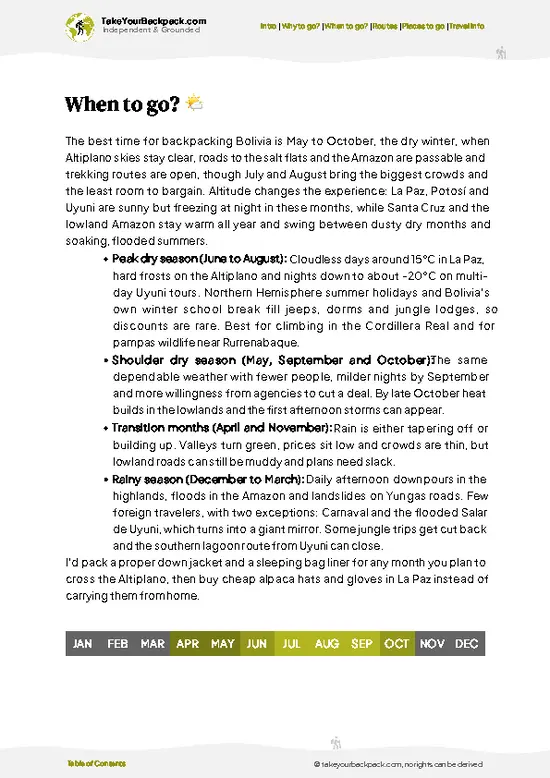
 Best Backpacking
.jpg) Hi, I’m Johan (Netherlands 🇳🇱), the creator of TakeYourBackpack. Over the past 3 decades, I’ve backpacked through 90+ countries across six continents, gaining extensive experience with independent travel, long-term trips, and overland routes.
Hi, I’m Johan (Netherlands 🇳🇱), the creator of TakeYourBackpack. Over the past 3 decades, I’ve backpacked through 90+ countries across six continents, gaining extensive experience with independent travel, long-term trips, and overland routes.