×

Brazil🇧🇷 | citiesBrasíliaModernist plan, concrete cathedral, Monumental Axis, wide plazas | things to do and best time to go

Explore SantarémExplore Carnival of Rio de Janeiro

Backpacking in Brasília
🌟 Highlightcity ranked #8
By Johan Kruseman 🇳🇱 | Updated October 19, 2026

The Metropolitan Cathedral’s four bronze evangelist statues stand outside the entrance, and the glass nave inside is ringed by hanging angels you can see from the plaza. Brasília is Brazil’s capital, planned from scratch in the central plateau and built in the late 1950s. I once bought a pastel and a sugarcane juice at a stall near the Rodoviária for about US$3, and it was the best-value meal of my stay. The city suits architecture fans and anyone who likes wide, strange spaces. It does not suit people who want old streets, easy walking or loud nightlife. The Monumental Axis deserves a full morning, while the residential superblocks are mostly skippable. Unlike Rio or Salvador, Brasília has no beach scene or colonial center, so go for design.

Discover everything you want to know in the 📖 Brazil Travel Guide.


example page 0 from our offline Travel Guide for Brazil
example page 1 from our offline Travel Guide for Brazil
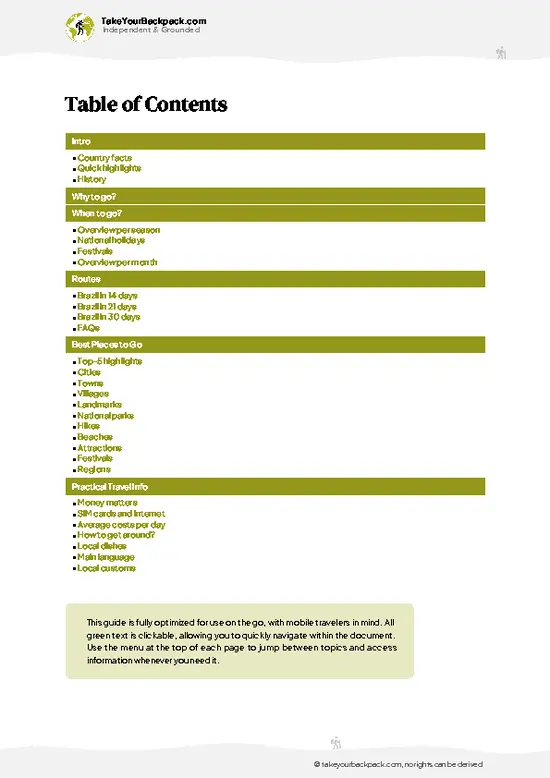
example page 2 from our offline Travel Guide for Brazil
example page 3 from our offline Travel Guide for Brazil
example page 4 from our offline Travel Guide for Brazil
example page 5 from our offline Travel Guide for Brazil
example page 6 from our offline Travel Guide for Brazil
example page 7 from our offline Travel Guide for Brazil
Loading the map 🌍
CLICK TO FILTER
cities
towns
villages
landmarks
national parks
hikes
beaches
attractions
festivals
regions
SHOW COUNTRY’S BESTSHOW ALL

✨ Why go?
Ranked #8 city in Brazil
What makes it a must-see city

Brasília works for backpackers who want a different kind of Brazilian stop, one built around Oscar Niemeyer’s modernist buildings and a layout planned for cars rather than strollers. The big draws sit along the Eixo Monumental, a wide axis of ministries, cathedral and museums that you can cover in a day or two, so a long stay is rarely needed. Distances are large and shade is scarce, which means you will lean on buses, the metro or ride-hailing between sights. Hostels cluster near the central bus station and in Asa Sul and Asa Norte, and they make a practical base for meeting other travelers heading to Chapada dos Veadeiros or Goiás. Food is better than the concrete suggests, with superquadra neighborhoods hiding good lunch counters and bars. Nightlife is real but spread out and weekday-quiet, … read more 👉
Brasília works for backpackers who want a different kind of Brazilian stop, one built around Oscar Niemeyer’s modernist buildings and a layout planned for cars rather than strollers. The big draws sit along the Eixo Monumental, a wide axis of ministries, cathedral and museums that you can cover in a day or two, so a long stay is rarely needed. Distances are large and shade is scarce, which means you will lean on buses, the metro or ride-hailing between sights. Hostels cluster near the central bus station and in Asa Sul and Asa Norte, and they make a practical base for meeting other travelers heading to Chapada dos Veadeiros or Goiás. Food is better than the concrete suggests, with superquadra neighborhoods hiding good lunch counters and bars. Nightlife is real but spread out and weekday-quiet, since the city empties of politicians and civil servants on weekends. Fit it between Rio, Salvador or the Pantanal as a two-night architecture stop. If you want old colonial streets or beaches, skip it.

💡 HighlightsMust-see experiences and standout moments

  1. Praça dos Três Poderes: The plaza joining the Planalto Palace, the Supreme Court and Congress is the postcard shot. Free, 1 to 1.5 hours, best in the morning light.
  2. Congresso Nacional: The twin towers and two domes are the city’s symbol. Free guided tours run on set days, about 45 minutes, and you need photo ID.
  3. Catedral Metropolitana: Sixteen curved concrete columns open into stained glass in blue, green and white. Free, 30 to 45 minutes, and the light is best late morning.
  4. Palácio do Itamaraty: The foreign ministry has a reflecting pool, a spiral staircase and a strong art collection. Free guided visits, about 1 hour, check the schedule first.
  5. Santuário Dom Bosco: A small church lined with deep blue glass and a huge chandelier. Free, 30 minutes, and late afternoon is best when the sun hits the
… read more 👉
  1. Praça dos Três Poderes: The plaza joining the Planalto Palace, the Supreme Court and Congress is the postcard shot. Free, 1 to 1.5 hours, best in the morning light.
  2. Congresso Nacional: The twin towers and two domes are the city’s symbol. Free guided tours run on set days, about 45 minutes, and you need photo ID.
  3. Catedral Metropolitana: Sixteen curved concrete columns open into stained glass in blue, green and white. Free, 30 to 45 minutes, and the light is best late morning.
  4. Palácio do Itamaraty: The foreign ministry has a reflecting pool, a spiral staircase and a strong art collection. Free guided visits, about 1 hour, check the schedule first.
  5. Santuário Dom Bosco: A small church lined with deep blue glass and a huge chandelier. Free, 30 minutes, and late afternoon is best when the sun hits the windows.
  6. Memorial JK: The tomb and museum of Juscelino Kubitschek, the president who founded the city. Entry is around US$2, 45 minutes to 1 hour.
  7. Torre de TV: The observation deck gives you the plane-shaped layout of the city. Free, 30 to 45 minutes, and go before sunset. A craft fair sets up here on weekends.
  8. Parque da Cidade Sarah Kubitschek: One of the largest urban parks in the world, popular for cycling and for watching locals on weekends. Free, 1 to 2 hours, bike rental about US$3 to 5 an hour.
Day trips from the city include Pirenópolis, Cidade de Goiás and the waterfalls near Alto Paraíso in the Chapada dos Veadeiros. If time is short, skip the Parque da Cidade and spend it on the Esplanada buildings.
Spotted a mistake or missing something? Contact us.

🏘️ NeighborhoodsWhere things are and how it's laid out

Brasília is planned in sectors, not neighborhoods, and distances between them are built for cars. Spend your time in a few of them.
  • Eixo Monumental and Esplanada: This is the reason to come. Congress, the Cathedral, the Palácio do Planalto and the Itamaraty sit along a huge open axis. Worth a half day, but there is no shade and the walking is long, so start early.
  • Asa Sul and Asa Norte: The residential “wings” are where locals live, eat and drink. Asa Sul has the older, leafier superquadras with bakeries and bars; Asa Norte is younger and louder around the university. Walkable inside a block, not between them.
  • Setor Bancário and Setor Comercial Sul: Office towers and lunch counters. Fine for a cheap weekday meal, dead and a bit sketchy on weekends and at night. Skip it otherwise.
  • Lago Sul and
… read more 👉
Brasília is planned in sectors, not neighborhoods, and distances between them are built for cars. Spend your time in a few of them.
  • Eixo Monumental and Esplanada: This is the reason to come. Congress, the Cathedral, the Palácio do Planalto and the Itamaraty sit along a huge open axis. Worth a half day, but there is no shade and the walking is long, so start early.
  • Asa Sul and Asa Norte: The residential “wings” are where locals live, eat and drink. Asa Sul has the older, leafier superquadras with bakeries and bars; Asa Norte is younger and louder around the university. Walkable inside a block, not between them.
  • Setor Bancário and Setor Comercial Sul: Office towers and lunch counters. Fine for a cheap weekday meal, dead and a bit sketchy on weekends and at night. Skip it otherwise.
  • Lago Sul and Lago Norte: Wealthy lakeside suburbs. Come only for a sunset at Ponte JK area or the lake bars; there is little else to see and you need a ride.
  • Cruzeiro and Octogonal: Quieter, local and cheaper, with little for visitors. Not worth a trip.

⌛️ 1 dayA smart one-day plan

This is an architecture day, mostly along one long axis, with a late finish at a park.
8:30 AM, Catedral Metropolitana: Start at the cathedral while the nave is quiet. The stained glass is best in the morning, and the plaza outside is a short walk from the Esplanada.
10:00 AM, Esplanada dos Ministérios and Congresso Nacional: Walk along the grassy mall past the ministry blocks to Congress. Join a free tour if one is running, and bring ID.
11:30 AM, Praça dos Três Poderes: Cross to the plaza for the Supreme Court, the Planalto Palace and the Panteão da Pátria. It is open and exposed, so keep water close.
1:00 PM, Lunch in Asa Sul: Take a rideshare or bus to a por quilo restaurant in the superblocks, where you pay by weight and the food is simple and filling.
2:30 PM, Santuário Dom Bosco: This blue-glass … read more 👉
This is an architecture day, mostly along one long axis, with a late finish at a park.
8:30 AM, Catedral Metropolitana: Start at the cathedral while the nave is quiet. The stained glass is best in the morning, and the plaza outside is a short walk from the Esplanada.
10:00 AM, Esplanada dos Ministérios and Congresso Nacional: Walk along the grassy mall past the ministry blocks to Congress. Join a free tour if one is running, and bring ID.
11:30 AM, Praça dos Três Poderes: Cross to the plaza for the Supreme Court, the Planalto Palace and the Panteão da Pátria. It is open and exposed, so keep water close.
1:00 PM, Lunch in Asa Sul: Take a rideshare or bus to a por quilo restaurant in the superblocks, where you pay by weight and the food is simple and filling.
2:30 PM, Santuário Dom Bosco: This blue-glass church is often missed by travelers who stay along the Axis. Sit inside for ten minutes as the light shifts.
4:30 PM, Torre de TV: Go up the tower for the layout of the Pilot Plan, then browse the craft stalls at the base if it is a weekend.
6:00 PM, Parque da Cidade: Finish with a slow loop through the park as the locals jog, cycle and drink coconut water. Then head back by rideshare.

🌤️ When to go?When to go for the best experience

The dry months of May to September are the easiest time to see Brasília on foot, though the air gets very dry.
  • Dry Season (May to September): Almost no rain, days of 27 to 29°C (81 to 84°F), cool nights of 13 to 16°C (55 to 61°F). Daylight lasts about 11 to 12 hours. August and September get dusty and parched, with humidity sometimes below 20 percent.
  • Rainy Season (November to March): Afternoon downpours, 22 to 28°C (72 to 82°F), lush green lawns and dramatic skies. Rain is heavy but short, so mornings work well for sightseeing.
  • Transition Months (April and October): Mild and less predictable; October is often the hottest, with storms building.
  • Crowds and Prices: Brasília is a government city, so hotels are busiest and priciest midweek and cheaper on weekends. July school holidays and Carnival
… read more 👉
The dry months of May to September are the easiest time to see Brasília on foot, though the air gets very dry.
  • Dry Season (May to September): Almost no rain, days of 27 to 29°C (81 to 84°F), cool nights of 13 to 16°C (55 to 61°F). Daylight lasts about 11 to 12 hours. August and September get dusty and parched, with humidity sometimes below 20 percent.
  • Rainy Season (November to March): Afternoon downpours, 22 to 28°C (72 to 82°F), lush green lawns and dramatic skies. Rain is heavy but short, so mornings work well for sightseeing.
  • Transition Months (April and October): Mild and less predictable; October is often the hottest, with storms building.
  • Crowds and Prices: Brasília is a government city, so hotels are busiest and priciest midweek and cheaper on weekends. July school holidays and Carnival bring modest bumps.
Book a weekend stay for the lowest bed prices.


source: climatestotravel.comJANJanuary: fair for travelingFEBFebruary: fair for travelingMARMarch: fair for travelingAPRApril: fair for travelingMAYMay: highly recommended for travelingJUNJune: good for travelingJULJuly: excellent for travelingAUGAugust: highly recommended for travelingSEPSeptember: highly recommended for travelingOCTOctober: fair for travelingNOVNovember: fair for travelingDECDecember: fair for traveling
when-to-go

✈️ The backpacker research shortcutBrazil Travel Guide

An offline-friendly backpacking guide with optimized travel routes, ranked highlights, transport advice, and the best areas to stay.
example page 0 from our offline Travel Guide for Brazil
example page 1 from our offline Travel Guide for Brazil
example page 2 from our offline Travel Guide for Brazil
example page 3 from our offline Travel Guide for Brazil
example page 4 from our offline Travel Guide for Brazil
example page 5 from our offline Travel Guide for Brazil
example page 6 from our offline Travel Guide for Brazil
example page 7 from our offline Travel Guide for Brazil
The digital guide (410 pages) contains:
✅ 146 highlights, ranked by travel appeal
✅ Optimized 14, 21 & 30-day travel routes
✅ Cities, national parks, landmarks, beaches
✅ How to get around
✅ Offline-friendly for travel without Wi-Fi
👉 Click to see all 30+ guide features

📅 Plan smarter in minutes, not weeks
✅ Month by month travel advice
✅ Festivals & national holidays
✅ Budget expectations

🗺️ Go to the right places, skip the overrated ones
✅ Honest pros & cons of destinations
✅ Top hikes, parks & viewpoints
✅ Lesser-known places most travelers miss
✅ Clear “worth it vs skip it” guidance

🛏️ Travel smoothly without rookie mistakes
✅ Best areas to stay
✅ Transport systems explained simply
✅ Common scams & safety advice
✅ SIM cards, money & practical tips

🌍 Understand the country, not just visit it
✅ Culture & traditions
✅ 52 Essential phrases & customs
✅ Festivals worth planning around
✅ Traveler-friendly historical context
✅ Insights that make places more meaningful

📱 Built for real travel conditions
✅ Fully downloadable PDF
✅ Works completely offline
✅ Optimized for phone use
✅ Useful in remote areas & buses
✅ Everything in one place
Stop searching, start planning
Get instant access to your full guide. 30‑day money-back guarantee.
+ Add another guide for just

By proceeding you agree to our terms.
Sent to your inbox immediately after payment • 100% Secure Checkout
Best Backpacking Travel Advisor 2025 tourism awardBest Backpacking
Travel Advisor
2025
What others say about Take Your Backpack Guides:
⭐⭐⭐⭐⭐
Fantastic, amazing amount of information!
⭐⭐⭐⭐⭐
My goodness this is amazing, it's what I've been looking for hats off too you!
⭐⭐⭐⭐⭐
I think this is absolutely BRILLIANT
⭐⭐⭐⭐
Very complete and informative. It's still missing places, but I gotta to commend you
⭐⭐⭐⭐⭐
This is truly amazing, thank you, can't wait to explore it with my kids!
⭐⭐⭐⭐⭐
Awesome resource, thank you!
⭐⭐⭐⭐⭐
This is amazing! Can't wait to explore the ones I haven't seen
⭐⭐⭐⭐
I love this! Well done, great idea.
⭐⭐⭐⭐⭐
Thanks for taking the time to make this gem!
⭐⭐⭐⭐⭐
This might be the best website I've ever seen.
⭐⭐⭐⭐⭐
Congratulations, and thank you so much for your work; it's incredibly valuable.
⭐⭐⭐⭐
In all seriousness I think you did a great job pointing out the important spots
⭐⭐⭐⭐⭐
10/10 very good
⭐⭐⭐⭐⭐
As someone who's only just starting to visit regularly this is awesome, thank you.
⭐⭐⭐⭐
Thank you very much! I'm going to visit my dad, it's going to be very useful!
⭐⭐⭐⭐⭐
This is really cool! We'll be travelling for the first time and this definitely come in handy.
⭐⭐⭐⭐⭐
You are now our minister of culture, congratulations 👨‍💼
⭐⭐⭐⭐⭐
Just wanted to tell you that this is a pearl! Going to follow your recommendations.
⭐⭐⭐⭐⭐
This is so cool. I'll definitely be using the resource for my travels soon.
⭐⭐⭐⭐⭐
This is very impressive! Good work.
⭐⭐⭐⭐⭐
This is an amazing and informative site. Very well done!

🛏️ Where to stay?Best areas to stay in Brazil

Asa Sul is the best base, with Asa Norte a close second. Both put you near the metro, the rodoviária and plenty of cheap bakeries and bars in the superquadras. Dorm beds cost roughly US$12 to 25 a night, and private budget rooms start around US$30. Hostels are few compared with other Brazilian cities, so book ahead, especially midweek when government travelers fill rooms.
Asa Sul is greener, calm after dark and easy to walk inside the blocks. Streets between blocks are quiet but poorly lit in places, so take a ride-hail home late. Buses and ride-hails reach the Esplanada in 10 to 20 minutes.
Asa … read more 👉
Asa Sul is the best base, with Asa Norte a close second. Both put you near the metro, the rodoviária and plenty of cheap bakeries and bars in the superquadras. Dorm beds cost roughly US$12 to 25 a night, and private budget rooms start around US$30. Hostels are few compared with other Brazilian cities, so book ahead, especially midweek when government travelers fill rooms.
Asa Sul is greener, calm after dark and easy to walk inside the blocks. Streets between blocks are quiet but poorly lit in places, so take a ride-hail home late. Buses and ride-hails reach the Esplanada in 10 to 20 minutes.
Asa Norte is livelier, with student bars close to the university and more evening activity, so it is noisier on weekends. It is also well linked by bus to the center.
Avoid sleeping in the commercial and banking sectors; they empty out at night and offer little life.

🚌 Getting aroundMoving around without the hassle

From the Rodoviária do Plano Piloto, the central bus station, you can reach most of the central sectors by city bus, metro or a short ride-hail of about US$2 to 4. Brasília is built around highways, so walking between sectors is rarely practical. Public transport works but is thin in the evenings.
  • Ride-hailing (Uber, 99): The best choice for most travelers. Rides across the Plano Piloto cost about US$3 to 8 and run all night, which matters because buses thin out and sights are far apart.
  • Metro: Two lines, Green and Orange, share a trunk from the center through Asa Sul and Águas Claras to the satellite cities of Ceilândia and Samambaia, fares around US$1.20 to 1.60. Useful for Asa Sul, but it misses most sights and does not reach the airport. Service runs roughly 6am to 10pm, shorter on Sundays.
… read more 👉
From the Rodoviária do Plano Piloto, the central bus station, you can reach most of the central sectors by city bus, metro or a short ride-hail of about US$2 to 4. Brasília is built around highways, so walking between sectors is rarely practical. Public transport works but is thin in the evenings.
  • Ride-hailing (Uber, 99): The best choice for most travelers. Rides across the Plano Piloto cost about US$3 to 8 and run all night, which matters because buses thin out and sights are far apart.
  • Metro: Two lines, Green and Orange, share a trunk from the center through Asa Sul and Águas Claras to the satellite cities of Ceilândia and Samambaia, fares around US$1.20 to 1.60. Useful for Asa Sul, but it misses most sights and does not reach the airport. Service runs roughly 6am to 10pm, shorter on Sundays.
  • Buses: Cheap at about US$1 to 1.60 and they reach everywhere, but routes are confusing and slow. Worth it only for the Esplanada and between the rodoviária and the wings. Skip them at night.
  • Walking: Good inside a superquadra and along the Esplanada, pleasant on cool mornings. The distances between monuments are deceptively long, with heat and little shade, so do not plan a full sightseeing day on foot.
  • Bike rental: Shared bikes and a network of paths along the wings and lake make cycling pleasant, about US$1 to 3 an hour. Go in the morning or late afternoon.
The airport is about 12 km (7 miles) from the center, and a ride takes 20 to 30 minutes by car or bus line 102 for around US$1.50.

👛 Costs (as of 19 October 2026)Typical daily expenses

Brasília costs a backpacker about US$50 to 65 a day, and the total below is US$62 with a high-season dorm bed. The city is spread out along highways, so transport eats more of the budget than in most Brazilian cities. Prices are paid in reais.
CategoryBudget RangeLocal Reality
Dorm bed (high season)US$14 to 22Peaks in July and during congress weeks; expect US$18 as a typical price. Budget beds are limited, so book ahead.
Dorm bed (off-season)US$10 to 16February to May and October to November are quieter, with some rates dropping.
MealsUS$12 to 20Self-service lunch by weight (por quilo) costs US$6 to 9. Bakery breakfast about US$2 to 3.
Local transportUS$3 to 8Bus and metro fares are about US$1 each. Ride-hailing for short hops across the Monumental Axis runs US$3 to 6.
City transport passUS$4 to
… read more 👉
Brasília costs a backpacker about US$50 to 65 a day, and the total below is US$62 with a high-season dorm bed. The city is spread out along highways, so transport eats more of the budget than in most Brazilian cities. Prices are paid in reais.
CategoryBudget RangeLocal Reality
Dorm bed (high season)US$14 to 22Peaks in July and during congress weeks; expect US$18 as a typical price. Budget beds are limited, so book ahead.
Dorm bed (off-season)US$10 to 16February to May and October to November are quieter, with some rates dropping.
MealsUS$12 to 20Self-service lunch by weight (por quilo) costs US$6 to 9. Bakery breakfast about US$2 to 3.
Local transportUS$3 to 8Bus and metro fares are about US$1 each. Ride-hailing for short hops across the Monumental Axis runs US$3 to 6.
City transport passUS$4 to 6A rechargeable card is the practical way to pay for buses and the metro. Fares are not discounted much by passes, so top it up as needed.
Activities and entry feesUS$0 to 8Most landmarks, including the Cathedral, the Esplanade of Ministries and Three Powers Plaza, are free. The TV Tower deck is free; some museums charge US$2 to 5.
MiscellaneousUS$3 to 6Water, snacks, sunscreen and the odd coffee or beer at US$2 to 4.
Total Daily BudgetUS$62Based on US$18 dorm, US$16 meals, US$6 transport, US$5 pass, US$7 activities, US$10 miscellaneous.
Eat your main meal at a por quilo lunch spot in the commercial blocks, then keep dinner light with bakery snacks to cut food costs by a third.


source: numbeo.com
⚠️ Prices can change and everyone travels differently, so take this as a rough guide. Hope it helps you plan your adventure!

🚌 Day tripsEasy escapes and nearby places

Brasília works well for day trips if you can share a ride or rent a car, since public transport to the surroundings is limited.
Chapada dos Veadeiros:
This is a long day, roughly 3.5 to 4 hours each way, so most travelers overnight. A shorter stop is the Alto Paraíso area for waterfalls. Tours cost about US$70 to 120. Go in the dry season and don’t underestimate the drive.

Pirenópolis:
A colonial town of cobbled streets, cachoeiras and craft shops about 2.5 hours away by road. Buses run for roughly US$15 to 25 each way; total with lunch and a waterfall entry of US$3 to 8 comes to about US$50. Weekends are busy, so go midweek.
👉 Explore Pirenópolis
Cachoeira do Itiquira:
Near Formosa, roughly 1.5 hours northeast, a tall waterfall with natural pools. Budget US$25 to 40 with transport sharing. … read more 👉
Brasília works well for day trips if you can share a ride or rent a car, since public transport to the surroundings is limited.
Chapada dos Veadeiros:
This is a long day, roughly 3.5 to 4 hours each way, so most travelers overnight. A shorter stop is the Alto Paraíso area for waterfalls. Tours cost about US$70 to 120. Go in the dry season and don’t underestimate the drive.

Pirenópolis:
A colonial town of cobbled streets, cachoeiras and craft shops about 2.5 hours away by road. Buses run for roughly US$15 to 25 each way; total with lunch and a waterfall entry of US$3 to 8 comes to about US$50. Weekends are busy, so go midweek.
👉 Explore Pirenópolis
Cachoeira do Itiquira:
Near Formosa, roughly 1.5 hours northeast, a tall waterfall with natural pools. Budget US$25 to 40 with transport sharing. Visit after the rains for more water.

Parque Nacional de Brasília:
Just 15 minutes from the center, with natural spring pools and trails. Entry is about US$3 to 5, and a ride-hail costs US$5 to 8. Arrive early and bring your own water and swimwear; it closes in the late afternoon.

🍲 FoodEating & Drinking in Brasília

Brasília’s food leans on the cerrado and the central-west: pequi, a pungent fruit cooked in rice and chicken, is the local obsession, along with galinhada (chicken and rice) and pamonha, sweet corn paste steamed in husks. Try tapioca crepes at stalls and the guaraná soft drink from the Amazon, easily found. Cheap lunch comes from por quilo buffets, usually US$6 to 10 a plate, especially in the sectors around the rodoviária and Asa Sul. For snacks, head to the superquadra bakeries and the feiras, such as the Feira da Torre and the Feira do Guará, for pastel and fresh sugarcane juice (caldo de cana) at US$1.50 to 3. For drinks, the Asa Sul and Asa Norte bars serve cold chopp, draft beer, and live choro and rock on weekends. The social life is based around the blocks, with people eating on terraces after work.

🛡️ SafetySafety Tips and Common Scams in Brasília

Brasília is one of Brazil’s calmer big cities, and most problems are petty. Phone snatching happens around the rodoviária, the Setor Comercial and Conic area, especially at night, so keep your phone away in crowds and stay out of those spots after dark. The Esplanada is quiet and empty on weekends, and the long distances make walking at night unwise; take a ride-hail instead. Solo travelers, including women, generally do fine in the wings and lake areas with usual care. Scams are uncommon. Occasional unlicensed taxi drivers overcharge, so use apps. Drivers rarely yield to pedestrians on wide roads, so cross only at marked crossings.

FAQTraveler FAQ

Two days is enough for Brasília’s main sights. One day covers the Esplanada, Cathedral and Congress, and another adds the Parque Nacional or the lake at sunset. Add a third day if you want a trip to Pirenópolis, about 2.5 hours away.
Brasília is considered fairly safe for solo backpackers, with petty theft the main issue. Avoid the rodoviária and Setor Comercial area after dark, use ride-hails costing US$3 to 8 at night, and keep your phone out of sight. Staying in Asa Sul or Asa Norte keeps you near food and transport.
Brasília is known for its modernist design, planned by Lucio Costa with buildings by Oscar Niemeyer, and a UNESCO World Heritage listing since 1987. Highlights include the Cathedral, Congress and the Palácio da Alvorada, mostly free to see. It is also the capital of Brazil, founded in 1960.
⚠️ Things can change over time, so always validate details locally before you go.

Other Brazilian cities near Brasília

Explore more nearby:

  • Cidade de Goiás—Colonial Goiás, poet's kitchen, whitewashed palace, stone bridge| 241 km away
  • Belo Horizonte—Cheese stalls, Niemeyer chapel, Savassi evenings, mountain-ringed capital| 620 km away
  • São Paulo—Paulista museums, pastel stalls, mural lanes, rooftop grid views| 873 km away

💡 Not sure where to go next?
Create a personalized itinerary for Brazil including Brasília and the places that fit your trip.

Generate my itinerary

👉 Discover all cities

Or checkout all Brazil has to offer (think cities, towns, villages, national parks, hikes, beaches, festivals)
Country photo of Brazil

We 💚 feedbackKey takeaways before you go

Brasília deserves two nights, three if you want a day trip into the cerrado. One night is rushed because the sights are spread out, and a week is too long unless you work remotely. I would book a hostel near the center, spend one full morning on the Esplanada and leave the rest of the time open.

✈️ When did I visit Brazil?
Call it good timing or luck, but I was able to celebrate Carnaval in Rio de Janeiro in February 2022, after a round trip in the north and east coast.

✍️ Help improve this page!
The information on this page is based on my own backpacking experience in Brazil, supplemented with up-to-date research and feedback from other travelers. Travel details can change, so if you notice anything outdated or incomplete, feel free to let me know.


🙋‍♂️ Give feedback

👋 Meet the founderWho’s Behind Take Your Backpack?

Johan, backpacker and founder of TakeYourBackpackHi, I’m Johan (Netherlands 🇳🇱), the creator of TakeYourBackpack. Over the past 3 decades, I’ve backpacked through 90+ countries across six continents, gaining extensive experience with independent travel, long-term trips, and overland routes.

This site is built on a combination of firsthand travel experience and carefully curated insights from other backpackers. Many guides are based on places I’ve personally visited, while others bring together tips, observations, and practical advice shared by trusted travelers I’ve met along the way.

The goal is to provide realistic, experience-driven guidance — not generic itineraries — so you can explore destinations with better context, clearer expectations, and more confidence.