×

Burkina Faso🇧🇫 | best hikesDiscover the 4 Best hikes Across Burkina Faso

Hiking in Burkina Faso means short, low-altitude walks over sandstone and granite, not long treks. The country is flat, and its highest point is only about 749 meters. The best walking sits in the green southwest, around Banfora and the Lobi lands near Gaoua, where rock formations, waterfalls and farming villages share the same day. Access is easy there, costs are low and you will often be the only visitor. The Sahel north has dramatic terrain but is not worth planning around, because travel there is restricted. Independent travel works well in the southwest, with local guides handling the trails.

By Johan Kruseman 🇳🇱 | Updated October 23, 2026
Explore the best attractions in Burkina Faso

Why go?Why Travelers Love These Spots

Burkina Faso is a cultural walking destination, not a summit-bagging one. With no real mountains, the appeal comes from sandstone cliffs, granite domes and rivers in the wetter southwest, where peoples such as the Senufo, Lobi and Gourounsi still farm and build in traditional ways. A walk here often passes granaries, shrines and fields, and a local guide explains them. That is the draw, and it is a good one.

Anyone expecting alpine routes, marked long-distance trails or hut systems should pick another country. There is almost no trail signage, no printed trail network and no mountain-hut infrastructure. Hikes are short, usually 2 to 5 hours, and guides are needed to find the paths and to explain local customs.

The bigger issue is security. Large parts of the north, east and the Boucle du Mouhoun … read more 👉
Burkina Faso is a cultural walking destination, not a summit-bagging one. With no real mountains, the appeal comes from sandstone cliffs, granite domes and rivers in the wetter southwest, where peoples such as the Senufo, Lobi and Gourounsi still farm and build in traditional ways. A walk here often passes granaries, shrines and fields, and a local guide explains them. That is the draw, and it is a good one.

Anyone expecting alpine routes, marked long-distance trails or hut systems should pick another country. There is almost no trail signage, no printed trail network and no mountain-hut infrastructure. Hikes are short, usually 2 to 5 hours, and guides are needed to find the paths and to explain local customs.

The bigger issue is security. Large parts of the north, east and the Boucle du Mouhoun have seen jihadist violence, and many governments advise against travel to most of the country. The southwest has been calmer, but conditions change, so check current official advisories before booking anything. Roads are paved between major cities and rough beyond them. French helps enormously, and cash in CFA francs is essential, since cards and ATMs are unreliable outside Ouagadougou and Bobo-Dioulasso.
Evaluating the Top Choices
The list of best hikes in Burkina Faso is created based on scenery, challenge, trail quality, landmarks, and overall enjoyment. If you feel a hike is missing in this list, please let us know.

When to go?Seasonal Guide to Visiting

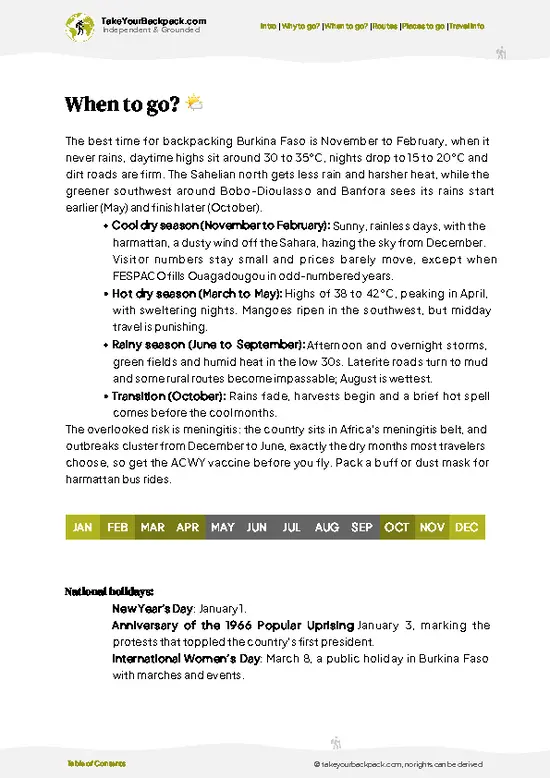
Best months: November to February is the best window for hiking in Burkina Faso, because the rains have ended, the landscape is still green and daytime temperatures sit around 30 to 35°C with cooler nights of 18 to 22°C. Walk early, between 6 and 10 a.m., and the heat is manageable. From December to February the Harmattan wind brings dusty haze that flattens views and irritates the throat, so photographers should favor November.

Shoulder and hot seasons: March to May is worth skipping for hiking. Temperatures reach 38 to 43°C, rock surfaces hold the heat and shade is scarce, so even a two-hour walk becomes a drain. October is a usable shoulder month in the southwest, with lingering humidity but fewer rain days and very green fields.

Rainy season: June to September brings most of the rain. The … read more 👉
Best months: November to February is the best window for hiking in Burkina Faso, because the rains have ended, the landscape is still green and daytime temperatures sit around 30 to 35°C with cooler nights of 18 to 22°C. Walk early, between 6 and 10 a.m., and the heat is manageable. From December to February the Harmattan wind brings dusty haze that flattens views and irritates the throat, so photographers should favor November.

Shoulder and hot seasons: March to May is worth skipping for hiking. Temperatures reach 38 to 43°C, rock surfaces hold the heat and shade is scarce, so even a two-hour walk becomes a drain. October is a usable shoulder month in the southwest, with lingering humidity but fewer rain days and very green fields.

Rainy season: June to September brings most of the rain. The southwest around Banfora and Gaoua receives roughly 900 to 1,200 mm a year, far more than the Sahel in the north, which gets about 300 to 600 mm. Tracks turn to mud, streams swell and rock faces get slippery. The waterfalls are at their fullest, but access roads can be cut off, so the season suits flexible travelers only.

Crowds and prices: Crowds are minimal all year, so booking is rarely needed. Guesthouse and guide prices barely shift between seasons. Festivals and national holidays can fill rooms in Bobo-Dioulasso, but hiking areas stay quiet.

hike hoppingSuggested Travel Strategies

How long to allow: A trip combining several hikes in Burkina Faso needs 7 to 10 days, and the best use of that time is staying within the southwest. Fly or bus into Ouagadougou, then head west rather than trying to loop the whole country.

Grouping and direction: Move from the capital to Bobo-Dioulasso (about 5 to 6 hours by bus), then on to Banfora (roughly 1.5 hours), which makes the best hiking base. From there, day trips of 1 to 2 hours by moto-taxi or hired car cover most of the surrounding rock and waterfall areas. If time allows, continue toward Gaoua and the Lobi villages, a 3 to 5 hour journey on mixed road surfaces. Going west first and returning east means the longest bus ride is at the start, while you are fresh.

Time per stop: Give each hiking area one full day, or two if you want … read more 👉
How long to allow: A trip combining several hikes in Burkina Faso needs 7 to 10 days, and the best use of that time is staying within the southwest. Fly or bus into Ouagadougou, then head west rather than trying to loop the whole country.

Grouping and direction: Move from the capital to Bobo-Dioulasso (about 5 to 6 hours by bus), then on to Banfora (roughly 1.5 hours), which makes the best hiking base. From there, day trips of 1 to 2 hours by moto-taxi or hired car cover most of the surrounding rock and waterfall areas. If time allows, continue toward Gaoua and the Lobi villages, a 3 to 5 hour journey on mixed road surfaces. Going west first and returning east means the longest bus ride is at the start, while you are fresh.

Time per stop: Give each hiking area one full day, or two if you want an early start and a slow afternoon. Banfora deserves 3 to 4 nights, Gaoua 2.

Planning mistakes: The most common error is packing in too many stops. Buses leave when full, delays of an hour or two are normal, and unpaved roads add time, so leave a buffer day before any flight. Another mistake is trying to add the Sahel or the east for variety. The extra distance is long, the security risk is high and the payoff is not there. Instead, spend the days saved on a second morning in the southwest, when light and temperature are best.

The ListThe Best hikes of Burkina Faso

1 Sindou Peaks

Jagged spires, guided corridors, plateau lookout, shea woodland

Follow a local guide through narrow passages between vertical sandstone blades, then scramble up to a shelf overlooking the whole spire field.

2 Banfora Cascades

Sandstone ledges, rainy-season curtain, mango shade, swimming basins

Walk an easy 2 to 3 hour loop over pale rock slabs, past tiered falls and mango trees, then cool off in the shallow pools.

3 Dômes de Fabédougou

Wind-carved towers, dawn ride, rock ledges, farm village

Ride out early from Banfora to scramble between ochre and rust sandstone walls, then climb a low shelf for views over savanna.

4 Tengrela Lake Trail

Hippo pirogue, reed birdlife, fishing shore, flat lakeside path

Board a wooden canoe at first light to watch hippos surface in open water, then stroll the flat shore past herons and fishermen.

burkina-faso-hike-tengrela-lake-trail
© Google |
Loading the map 🌍

Expert viewExpert Commentary on hikes

How many hikes to plan: Plan on 3 to 5 hikes in total. Hikes here are short, so one per morning leaves the afternoon for rest during the heat. Squeezing in more means rushing between bad roads and burning guide fees on locations that look alike. Fewer than three and the trip to the southwest barely justifies the transport cost.

Choosing the kind: Rock formations and viewpoints suit travelers who want photography and a physical walk. Waterfall and lake walks are easier and fit families or anyone who dislikes heat. Village-based walks through Lobi or Senufo farmland suit people interested in culture, and they only work with a guide who can translate and introduce you. If you can only do one kind, I would pick the village walk. The scenery elsewhere in West Africa is easy to match, but this sort … read more 👉
How many hikes to plan: Plan on 3 to 5 hikes in total. Hikes here are short, so one per morning leaves the afternoon for rest during the heat. Squeezing in more means rushing between bad roads and burning guide fees on locations that look alike. Fewer than three and the trip to the southwest barely justifies the transport cost.

Choosing the kind: Rock formations and viewpoints suit travelers who want photography and a physical walk. Waterfall and lake walks are easier and fit families or anyone who dislikes heat. Village-based walks through Lobi or Senufo farmland suit people interested in culture, and they only work with a guide who can translate and introduce you. If you can only do one kind, I would pick the village walk. The scenery elsewhere in West Africa is easy to match, but this sort of access is harder to find.

What it costs: Budget US$25 to 45 a day (about XOF 15,000 to 27,000) including a basic room, meals and local transport. Entry fees at the main sites are usually XOF 1,000 to 3,000 (US$2 to 5). Local guides typically ask XOF 5,000 to 15,000 (US$8 to 25) per half day, and the price rises with group size and distance. A moto-taxi for a day costs roughly XOF 10,000 to 20,000 (US$17 to 33), and a hired car with driver is more. A realistic cost per hike, all in, is US$15 to 40.

Costs and delays that catch people out: Agree the guide fee and its length before leaving, and confirm whether the entry fee is included. Unclear pricing is the usual source of arguments. Carry small CFA notes, because change for large bills is rare in villages. Cash machines often run dry outside the big cities, so withdraw before heading west. Mobile data is patchy, so download maps in advance. Buses leave when full, which can add hours, so never schedule a hike on the day of a long transfer.

Safety: Security is the main risk. Check the latest advisories from your government and local contacts before you travel, and stay within the southwest. Avoid the Sahel, the east and the border areas. Do not hike alone, and ask your guesthouse about current conditions. In the heat, carry at least 2 liters of water per person and walk early. Malaria is present all year, so prophylaxis is advised, and a yellow fever certificate is required for entry.

Cultural care: Many sites are sacred to local communities. Ask your guide before photographing people, shrines or compounds, and expect to pay a small fee or leave a gift for some. Dress modestly with covered shoulders and knees in villages. Greet people properly before asking anything, since a handshake and a few words of French or Dioula change the mood completely. Do not hand out sweets or coins to children.

✈️ The backpacker research shortcutBurkina Faso Travel Guide

An offline-friendly backpacking guide with optimized travel routes, ranked highlights, transport advice, and the best areas to stay.
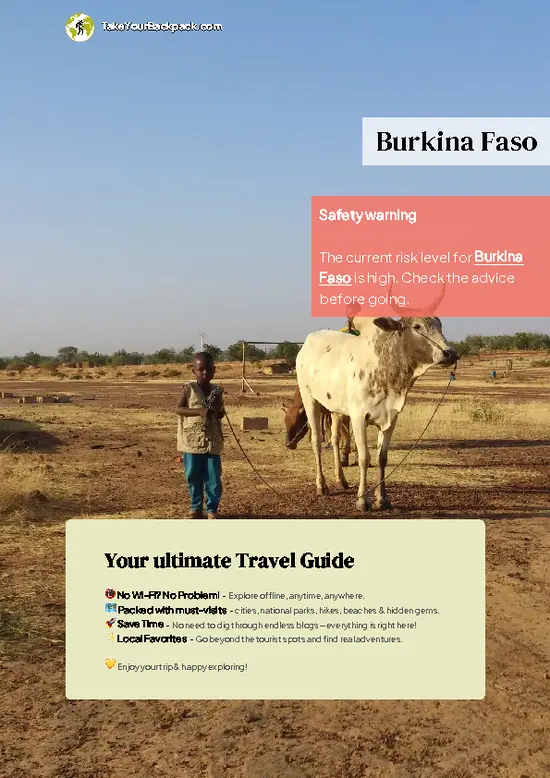
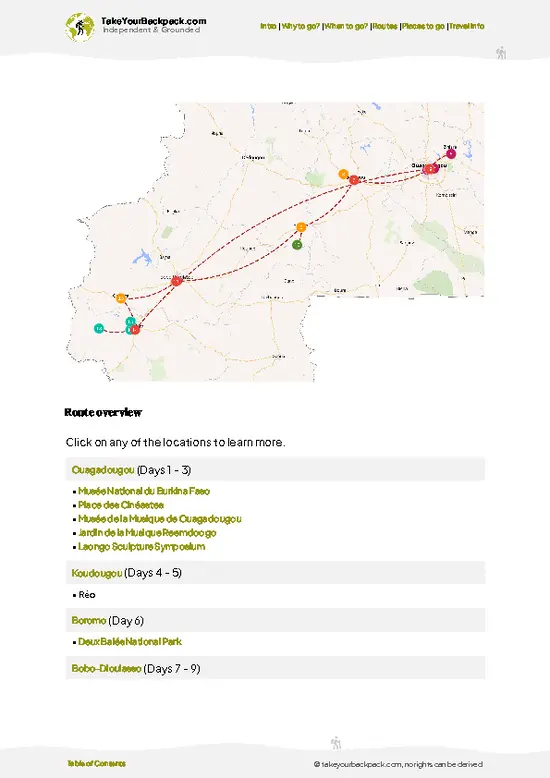
example page 0 from our offline Travel Guide for Burkina Faso
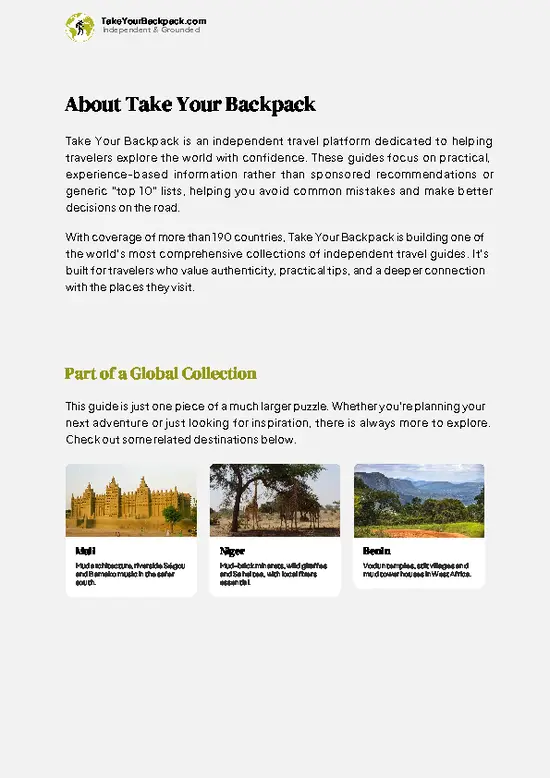
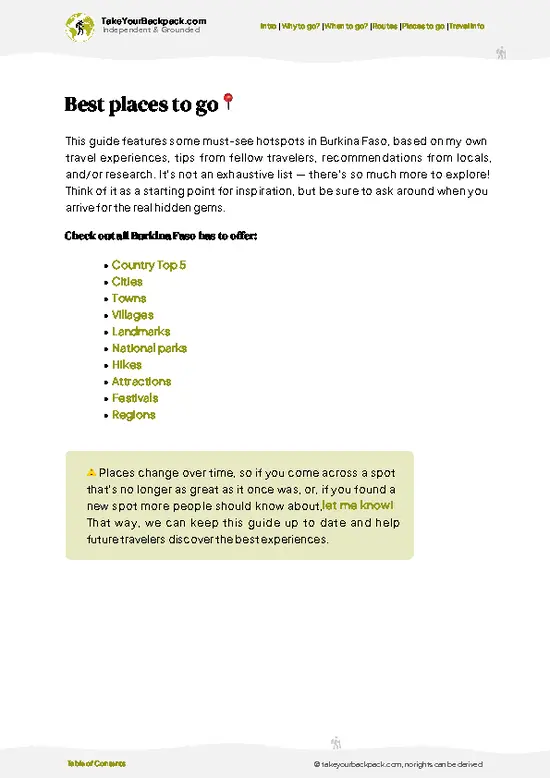
example page 1 from our offline Travel Guide for Burkina Faso
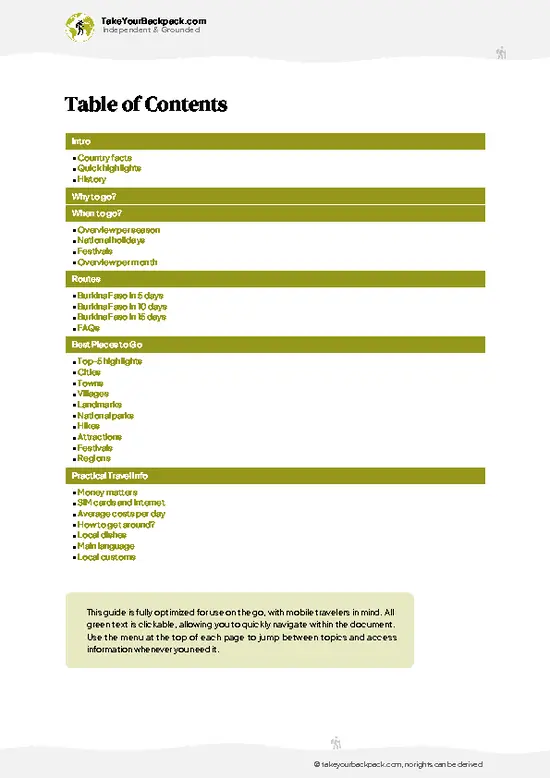
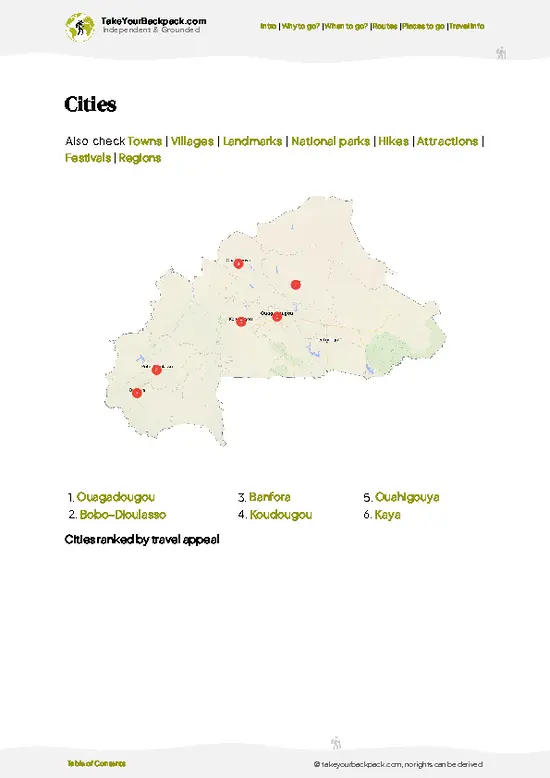
example page 2 from our offline Travel Guide for Burkina Faso
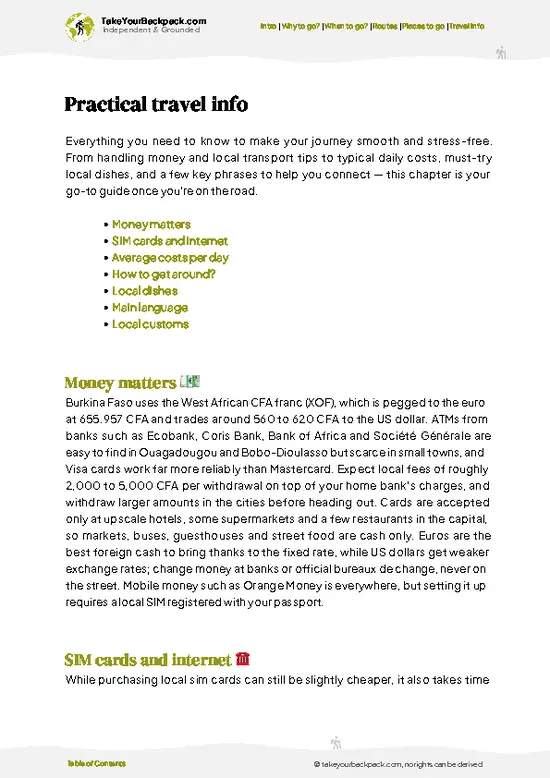
example page 3 from our offline Travel Guide for Burkina Faso
example page 4 from our offline Travel Guide for Burkina Faso
example page 5 from our offline Travel Guide for Burkina Faso
example page 6 from our offline Travel Guide for Burkina Faso
example page 7 from our offline Travel Guide for Burkina Faso
The digital guide (273 pages) contains:
✅ 63 highlights, ranked by travel appeal
✅ Optimized 5, 10 & 15-day travel routes
✅ Cities, national parks, landmarks, beaches
✅ How to get around
✅ Offline-friendly for travel without Wi-Fi
👉 Click to see all 30+ guide features

📅 Plan smarter in minutes, not weeks
✅ Month by month travel advice
✅ Festivals & national holidays
✅ Budget expectations

🗺️ Go to the right places, skip the overrated ones
✅ Honest pros & cons of destinations
✅ Top hikes, parks & viewpoints
✅ Lesser-known places most travelers miss
✅ Clear “worth it vs skip it” guidance

🛏️ Travel smoothly without rookie mistakes
✅ Best areas to stay
✅ Transport systems explained simply
✅ Common scams & safety advice
✅ SIM cards, money & practical tips

🌍 Understand the country, not just visit it
✅ Culture & traditions
✅ 52 Essential phrases & customs
✅ Festivals worth planning around
✅ Traveler-friendly historical context
✅ Insights that make places more meaningful

📱 Built for real travel conditions
✅ Fully downloadable PDF
✅ Works completely offline
✅ Optimized for phone use
✅ Useful in remote areas & buses
✅ Everything in one place
Stop searching, start planning
Get instant access to your full guide. 30‑day money-back guarantee.
+ Add another guide for just

By proceeding you agree to our terms.
Sent to your inbox immediately after payment • 100% Secure Checkout
Best Backpacking Travel Advisor 2025 tourism awardBest Backpacking
Travel Advisor
2025
What others say about Take Your Backpack Guides:
⭐⭐⭐⭐⭐
Fantastic, amazing amount of information!
⭐⭐⭐⭐⭐
My goodness this is amazing, it's what I've been looking for hats off too you!
⭐⭐⭐⭐⭐
I think this is absolutely BRILLIANT
⭐⭐⭐⭐
Very complete and informative. It's still missing places, but I gotta to commend you
⭐⭐⭐⭐⭐
This is truly amazing, thank you, can't wait to explore it with my kids!
⭐⭐⭐⭐⭐
Awesome resource, thank you!
⭐⭐⭐⭐⭐
This is amazing! Can't wait to explore the ones I haven't seen
⭐⭐⭐⭐
I love this! Well done, great idea.
⭐⭐⭐⭐⭐
Thanks for taking the time to make this gem!
⭐⭐⭐⭐⭐
This might be the best website I've ever seen.
⭐⭐⭐⭐⭐
Congratulations, and thank you so much for your work; it's incredibly valuable.
⭐⭐⭐⭐
In all seriousness I think you did a great job pointing out the important spots
⭐⭐⭐⭐⭐
10/10 very good
⭐⭐⭐⭐⭐
As someone who's only just starting to visit regularly this is awesome, thank you.
⭐⭐⭐⭐
Thank you very much! I'm going to visit my dad, it's going to be very useful!
⭐⭐⭐⭐⭐
This is really cool! We'll be travelling for the first time and this definitely come in handy.
⭐⭐⭐⭐⭐
You are now our minister of culture, congratulations 👨‍💼
⭐⭐⭐⭐⭐
Just wanted to tell you that this is a pearl! Going to follow your recommendations.
⭐⭐⭐⭐⭐
This is so cool. I'll definitely be using the resource for my travels soon.
⭐⭐⭐⭐⭐
This is very impressive! Good work.
⭐⭐⭐⭐⭐
This is an amazing and informative site. Very well done!

🛏️ Where to stay?Best Stay Options in Burkina Faso

Backpacker hostels with dorms barely exist in Burkina Faso, so budget travel here means simple auberges, church-run mission guesthouses and basic hotels at roughly 8,000 to 20,000 CFA (US$13 to 33) a night, almost all of them in the two cities still realistic for visitors. In Ouagadougou, the city center around the cathedral and the big avenues puts you near markets, maquis bars and live music but is noisy and dusty. Zone du Bois and Ouaga 2000 are quieter, greener and better guarded, at the cost of higher prices and a taxi ride for everything, while in Bobo-Dioulasso the cheap rooms cluster near the Grand Marché and the train station, walkable to the old Kibidwé quarter and the evening music … read more 👉
Backpacker hostels with dorms barely exist in Burkina Faso, so budget travel here means simple auberges, church-run mission guesthouses and basic hotels at roughly 8,000 to 20,000 CFA (US$13 to 33) a night, almost all of them in the two cities still realistic for visitors. In Ouagadougou, the city center around the cathedral and the big avenues puts you near markets, maquis bars and live music but is noisy and dusty. Zone du Bois and Ouaga 2000 are quieter, greener and better guarded, at the cost of higher prices and a taxi ride for everything, while in Bobo-Dioulasso the cheap rooms cluster near the Grand Marché and the train station, walkable to the old Kibidwé quarter and the evening music scene.

If you enjoy meeting fellow travelers, consider choosing hostels with high ratings for atmosphere. On the other hand, if you prefer having your own space, a hotel might be a better option.

Burkina FasoWhere to Go Next

👋 Meet the founderWho’s Behind Take Your Backpack?

Johan, backpacker and founder of TakeYourBackpackHi, I’m Johan (Netherlands 🇳🇱), the creator of TakeYourBackpack. Over the past 3 decades, I’ve backpacked through 90+ countries across six continents, gaining extensive experience with independent travel, long-term trips, and overland routes.

This site is built on a combination of firsthand travel experience and carefully curated insights from other backpackers. Many guides are based on places I’ve personally visited, while others bring together tips, observations, and practical advice shared by trusted travelers I’ve met along the way.

The goal is to provide realistic, experience-driven guidance — not generic itineraries — so you can explore destinations with better context, clearer expectations, and more confidence.