×

Cabo Verde🇨🇻 | best hikesWhere to Find the 4 Best hikes in Cabo Verde

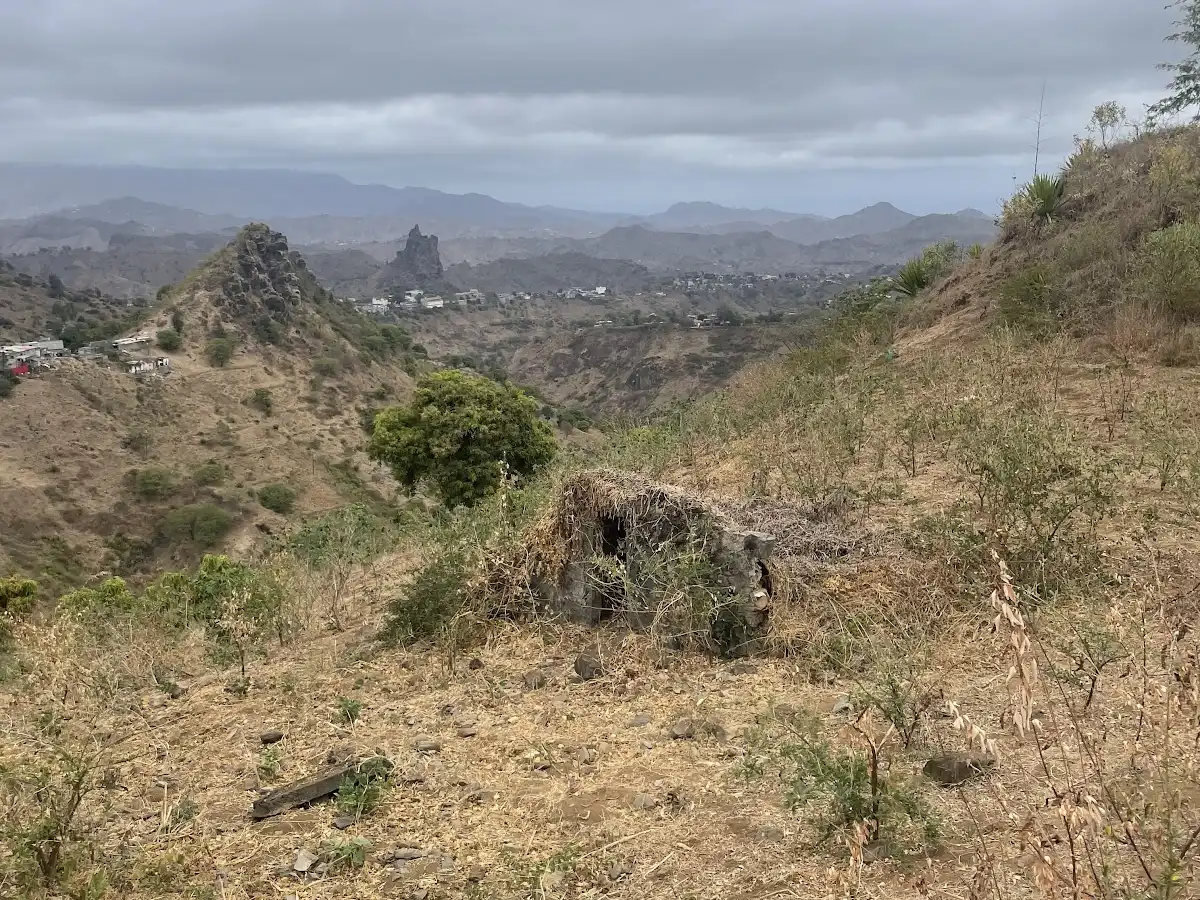
Hikes in Cabo Verde (Cape Verde) are short, steep and volcanic, with trails often cut as stone-paved mule paths between villages. Santo Antão has the lush, famous routes and the crowds. Fogo is a crater and ash. São Nicolau and Santiago stay quiet and cheaper. For independent travel, pick one island by mood first, then book the ferry.

By Johan Kruseman 🇳🇱 | Updated October 19, 2026
Explore the best beaches in Cabo Verde

Why go?Why These hike Stand Out

Cabo Verde is hiking on a young volcanic archipelago, so you climb from sea level to craters and cloud-fed ridges within a single day. Centuries of farming created stone-paved paths that still link villages, which means many walks are practical rather than purely scenic. Each island has its own climate, so wet green valleys and dry, ash-covered slopes sit a short flight or ferry apart.

Before you commit, know that trails are steep, exposed and often poorly marked, and there is almost no mountain-hut network. Distances look small on a map but descents are knee-hammering, and sun and wind are strong. Local guides are common, affordable and often worth hiring. Islands connect by inter-island ferries and short flights that can be delayed or cancelled, so build in slack. Bring cash in escudos, since many villages have no card machines.
Our Approach to Ranking
The list of best hikes in Cabo Verde is created based on scenery, challenge, trail quality, landmarks, and overall enjoyment. If you feel a hike is missing in this list, please let us know.

When to go?Optimal Periods for Travel

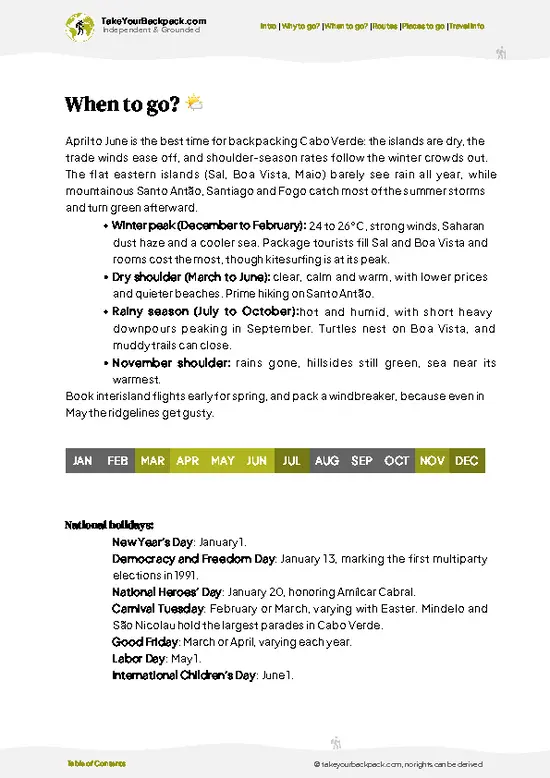
Best months and weather: The best months are November to January, when temperatures sit around 22 to 27°C and the humid, green slopes of the northwest are at their best after the rains. Rain falls mostly August to October, usually in short, heavy bursts, with totals that stay low across the archipelago (often under 300 mm a year). That spell makes trails slippery, but it is when the highlands turn greenest.
Shoulder seasons and prices: February to May is dry and clear with mild days, though dust haze (the harmattan) can dull views. Prices for guesthouses rise at Christmas and New Year, then ease off by March. June to July is hot (up to about 30°C on the coast) but quiet, and a good time for high, cooler summits. Start walking by 7 am; clouds often settle in by midday on the northern islands.

hike hoppingTips for Visiting Multiple Destinations

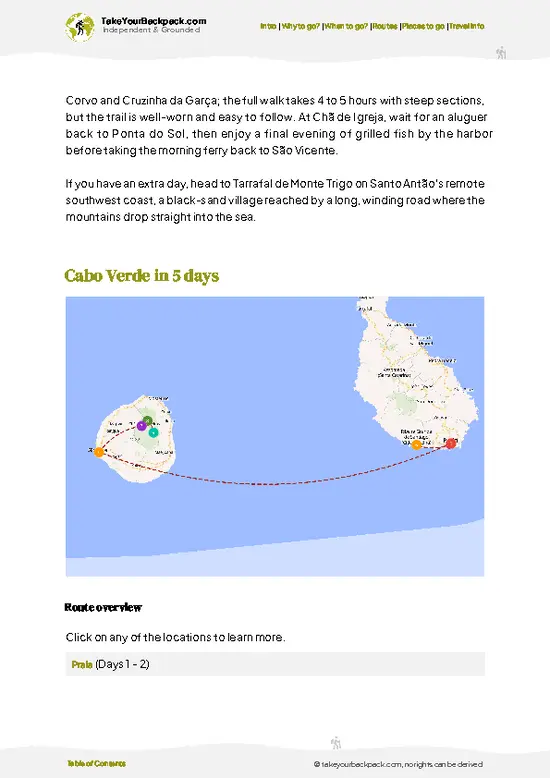
How many days and where to start: A trip combining several hikes in Cabo Verde needs 10 to 14 days. Pair islands that connect easily: Santo Antão and São Vicente share a ferry from Mindelo (about 1 hour 15 minutes), while Santiago and Fogo link through Praia by a ferry or short flight. Moving between those two clusters means a flight, usually via Praia or Sal, so plan a full travel day.
Pace and common errors: Allow 3 to 4 nights per island, and a day to rest between big walks. The usual mistake is trying to cover four or five islands in a week, which burns time at airports. Another is booking tight same-day connections, since ferries and small flights get cancelled in wind. Instead, keep a spare day before any flight home, and start with the hardest island while your legs are fresh.

The ListHighly Recommended hikes of Cabo Verde

1 Pico do Fogo

active volcano, black lava fields, crater villages

Trek across stark volcanic landscapes, navigating recent lava flows and remote settlements perched on the rim of Fogo’s dramatic caldera.

2 Ponta do Sol to Chã de Igreja

coastal cliffs, cobbled footpaths, terraced valleys, ocean views

Follow a historic mule track along steep cliffs and lush valleys, with the Atlantic always in sight and small communities along the way.

cabo-verde-hike-ponta-do-sol-to-cha-de-igreja
© Google |

3 Monte Verde

wind-swept summit, agricultural terraces, island-wide vistas

Climb to São Vicente’s highest point, where cultivated slopes give way to a breezy peak overlooking Mindelo and the Atlantic horizon.

cabo-verde-hike-monte-verde
© Google |

4 Pico da Antónia

volcanic slopes, stone-walled fields, central highlands

Traverse rugged volcanic terrain and cultivated plateaus, encountering traditional farming life and expansive views across Santiago’s mountainous heart.

cabo-verde-hike-pico-da-antonia
© Google |
Loading the map 🌍

Expert viewPro Tips for Exploring the Best

How many hikes to plan: I would advise four to six hikes across two or three islands. That is enough to see both the green northwest and the volcanic landscapes, without spending half your trip in transit. More than that, and you pay for extra flights and ferries in both money and rest days. Fewer, and you miss how different the islands feel.
Which kind to prioritize: If you want classic scenery and have a limited budget, choose the green valley and coastal path walks in the northwest, which are easy to reach and guesthouse-rich. If you want something stark and dramatic, volcanic crater routes give the most for a day, though they are exposed and often require a guide. Quieter islands suit those who want solitude, but transport takes longer and costs more in waiting time.
What it costs: Plan … read more 👉
How many hikes to plan: I would advise four to six hikes across two or three islands. That is enough to see both the green northwest and the volcanic landscapes, without spending half your trip in transit. More than that, and you pay for extra flights and ferries in both money and rest days. Fewer, and you miss how different the islands feel.
Which kind to prioritize: If you want classic scenery and have a limited budget, choose the green valley and coastal path walks in the northwest, which are easy to reach and guesthouse-rich. If you want something stark and dramatic, volcanic crater routes give the most for a day, though they are exposed and often require a guide. Quieter islands suit those who want solitude, but transport takes longer and costs more in waiting time.
What it costs: Plan on US$35 to 60 a day (about 3,500 to 6,000 escudos) for guesthouse, meals and shared minibuses (aluguers). Local guides usually run US$25 to 50 a day, and a crater-area guide or park fee can add US$5 to 15. Inter-island ferries are about US$20 to 35 each way and flights US$60 to 120. For a ten-day visit, budget roughly US$500 to 900 excluding international flights. A guide pays for itself on poorly marked routes.
Safety and etiquette: Trails are steep with sheer drops, so wear boots with real grip, carry 2 to 3 liters of water, and set off early because villages rarely sell supplies. Clouds can drop visibility fast on the higher ridges. Strong winds sometimes close ferries. Greet villagers with a “bom dia” and ask before photographing people or their homes. Hiring a local guide or buying lunch in a village puts money directly into the community, which is where it makes the most difference.

✈️ The backpacker research shortcutCabo Verde Travel Guide

An offline-friendly backpacking guide with optimized travel routes, ranked highlights, transport advice, and the best areas to stay.
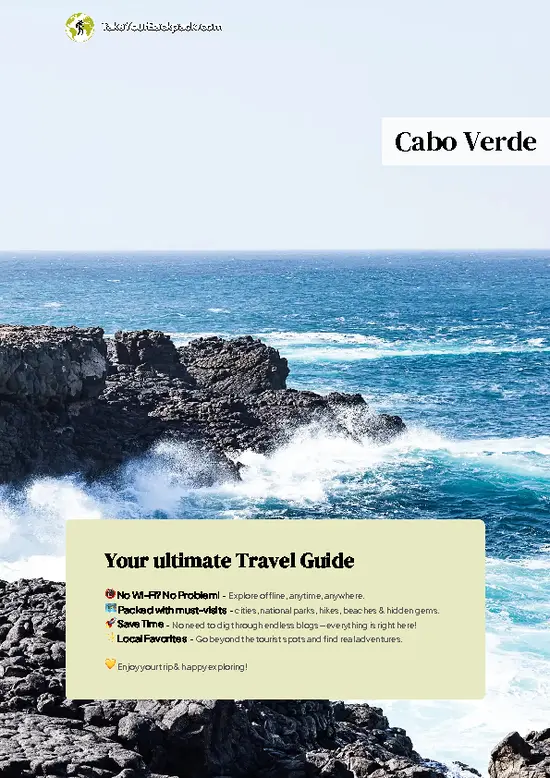
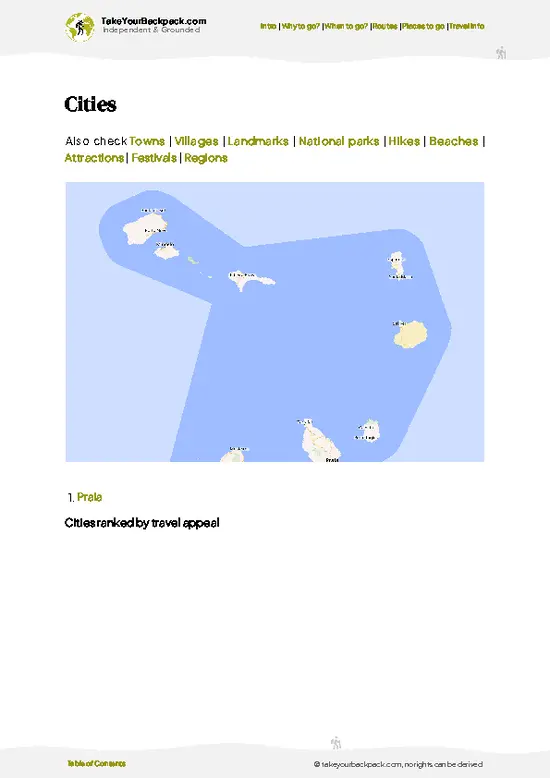
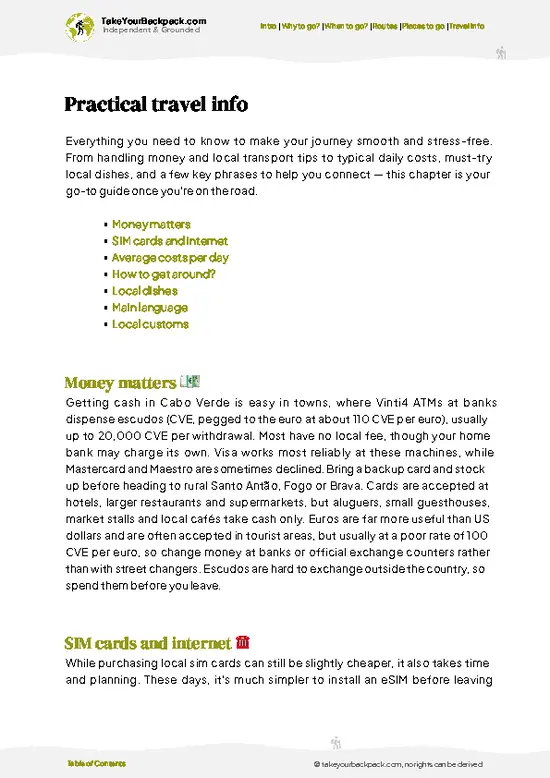
example page 0 from our offline Travel Guide for Cabo Verde
example page 1 from our offline Travel Guide for Cabo Verde
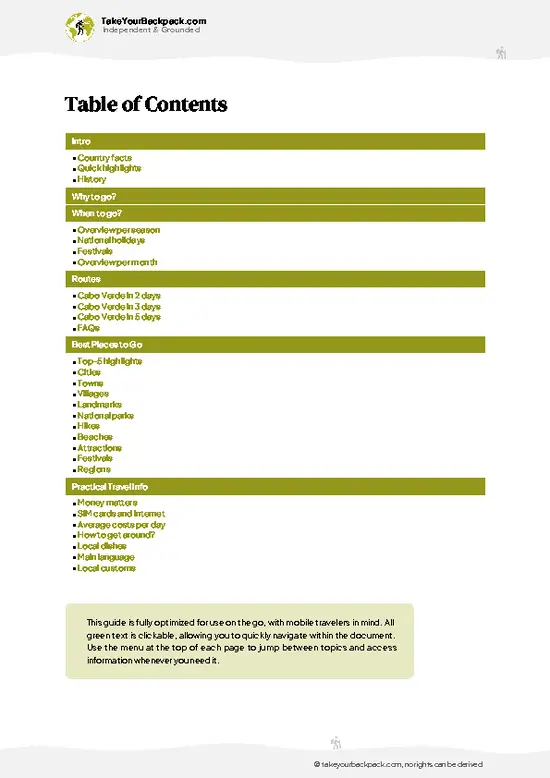
example page 2 from our offline Travel Guide for Cabo Verde
example page 3 from our offline Travel Guide for Cabo Verde
example page 4 from our offline Travel Guide for Cabo Verde
example page 5 from our offline Travel Guide for Cabo Verde
example page 6 from our offline Travel Guide for Cabo Verde
example page 7 from our offline Travel Guide for Cabo Verde
The digital guide (234 pages) contains:
✅ 57 highlights, ranked by travel appeal
✅ Optimized 2, 3 & 5-day travel routes
✅ Cities, national parks, landmarks, beaches
✅ How to get around
✅ Offline-friendly for travel without Wi-Fi
👉 Click to see all 30+ guide features

📅 Plan smarter in minutes, not weeks
✅ Month by month travel advice
✅ Festivals & national holidays
✅ Budget expectations

🗺️ Go to the right places, skip the overrated ones
✅ Honest pros & cons of destinations
✅ Top hikes, parks & viewpoints
✅ Lesser-known places most travelers miss
✅ Clear “worth it vs skip it” guidance

🛏️ Travel smoothly without rookie mistakes
✅ Best areas to stay
✅ Transport systems explained simply
✅ Common scams & safety advice
✅ SIM cards, money & practical tips

🌍 Understand the country, not just visit it
✅ Culture & traditions
✅ 52 Essential phrases & customs
✅ Festivals worth planning around
✅ Traveler-friendly historical context
✅ Insights that make places more meaningful

📱 Built for real travel conditions
✅ Fully downloadable PDF
✅ Works completely offline
✅ Optimized for phone use
✅ Useful in remote areas & buses
✅ Everything in one place
Stop searching, start planning
Get instant access to your full guide. 30‑day money-back guarantee.
+ Add another guide for just

By proceeding you agree to our terms.
Sent to your inbox immediately after payment • 100% Secure Checkout
Best Backpacking Travel Advisor 2025 tourism awardBest Backpacking
Travel Advisor
2025
What others say about Take Your Backpack Guides:
⭐⭐⭐⭐⭐
Fantastic, amazing amount of information!
⭐⭐⭐⭐⭐
My goodness this is amazing, it's what I've been looking for hats off too you!
⭐⭐⭐⭐⭐
I think this is absolutely BRILLIANT
⭐⭐⭐⭐
Very complete and informative. It's still missing places, but I gotta to commend you
⭐⭐⭐⭐⭐
This is truly amazing, thank you, can't wait to explore it with my kids!
⭐⭐⭐⭐⭐
Awesome resource, thank you!
⭐⭐⭐⭐⭐
This is amazing! Can't wait to explore the ones I haven't seen
⭐⭐⭐⭐
I love this! Well done, great idea.
⭐⭐⭐⭐⭐
Thanks for taking the time to make this gem!
⭐⭐⭐⭐⭐
This might be the best website I've ever seen.
⭐⭐⭐⭐⭐
Congratulations, and thank you so much for your work; it's incredibly valuable.
⭐⭐⭐⭐
In all seriousness I think you did a great job pointing out the important spots
⭐⭐⭐⭐⭐
10/10 very good
⭐⭐⭐⭐⭐
As someone who's only just starting to visit regularly this is awesome, thank you.
⭐⭐⭐⭐
Thank you very much! I'm going to visit my dad, it's going to be very useful!
⭐⭐⭐⭐⭐
This is really cool! We'll be travelling for the first time and this definitely come in handy.
⭐⭐⭐⭐⭐
You are now our minister of culture, congratulations 👨‍💼
⭐⭐⭐⭐⭐
Just wanted to tell you that this is a pearl! Going to follow your recommendations.
⭐⭐⭐⭐⭐
This is so cool. I'll definitely be using the resource for my travels soon.
⭐⭐⭐⭐⭐
This is very impressive! Good work.
⭐⭐⭐⭐⭐
This is an amazing and informative site. Very well done!

🛏️ Where to stay?Where to Stay: Cabo Verde Edition

Cabo Verde has a small but growing hostel scene, though most budget beds are in family-run pensões, residenciais and private rooms at roughly 2,000 to 4,500 CVE (€18 to 40) a night. In Mindelo on São Vicente, the streets around the center put you within walking distance of live-music bars and the ferry to Santo Antão, but weekend nights get loud. In Praia, the historic Plateau is cheapest and handy for markets and minibuses yet goes quiet and dim after dark, while Prainha and Quebra Canela cost more but sit by the beaches and restaurants. On Sal, Santa Maria has the most budget options on the beach and an easy nightlife strip, though prices run higher than anywhere else in the islands.

If you … read more 👉
Cabo Verde has a small but growing hostel scene, though most budget beds are in family-run pensões, residenciais and private rooms at roughly 2,000 to 4,500 CVE (€18 to 40) a night. In Mindelo on São Vicente, the streets around the center put you within walking distance of live-music bars and the ferry to Santo Antão, but weekend nights get loud. In Praia, the historic Plateau is cheapest and handy for markets and minibuses yet goes quiet and dim after dark, while Prainha and Quebra Canela cost more but sit by the beaches and restaurants. On Sal, Santa Maria has the most budget options on the beach and an easy nightlife strip, though prices run higher than anywhere else in the islands.

If you enjoy meeting fellow travelers, consider choosing hostels with high ratings for atmosphere. On the other hand, if you prefer having your own space, a hotel might be a better option.

Cabo VerdeExplore Beyond This Category

👋 Meet the founderWho’s Behind Take Your Backpack?

Johan, backpacker and founder of TakeYourBackpackHi, I’m Johan (Netherlands 🇳🇱), the creator of TakeYourBackpack. Over the past 3 decades, I’ve backpacked through 90+ countries across six continents, gaining extensive experience with independent travel, long-term trips, and overland routes.

This site is built on a combination of firsthand travel experience and carefully curated insights from other backpackers. Many guides are based on places I’ve personally visited, while others bring together tips, observations, and practical advice shared by trusted travelers I’ve met along the way.

The goal is to provide realistic, experience-driven guidance — not generic itineraries — so you can explore destinations with better context, clearer expectations, and more confidence.