

×

Cameroon🇨🇲 | townsDschangBamileke chefferie, hillside campus, cool Grassfields air | things to do and best time to go

Explore YokadoumaExplore Tiko

Backpacking in Dschang
🏆 Top picktown ranked #1
By Johan Kruseman 🇳🇱 | Updated October 22, 2026

Dschang started life as a German colonial post and later a cool-air retreat for Europeans escaping the lowland heat, and some of that hill-station calm still hangs around. Today the town of Dschang sits in the West Region of Cameroon, at about 1,400 meters, and travelers meet a working university town rather than a resort. Tin roofs rattle in the rain, motorbike taxis whine up red-dirt hills, and woodsmoke mixes with eucalyptus. The air is cool enough that you will want a light jacket by evening. Charm is real but modest: a chief’s compound, a small museum, a lake and a market, not a checklist. It works best as a base for the Bamboutos highlands and waterfalls nearby, or as a slow stop on the Bafoussam to Douala corridor. Roads in are paved but slow. Hostels are few, guesthouses are simple, and students keep cafés and bars lively without any party scene. Meeting other backpackers takes luck. Meeting locals is easy. Early morning, women set out pyramids of tomatoes and mountain avocados along the roadside, and the green of the hills behind them is almost loud.

Discover everything you want to know in the 📖 Cameroon Travel Guide.


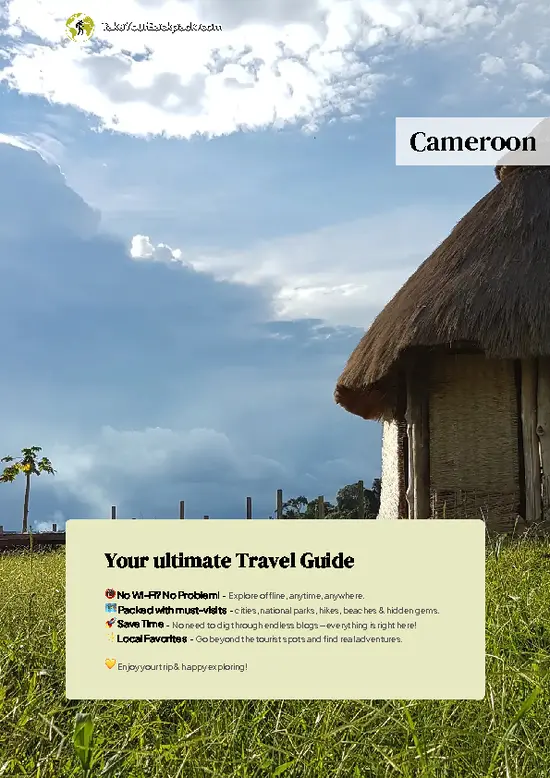
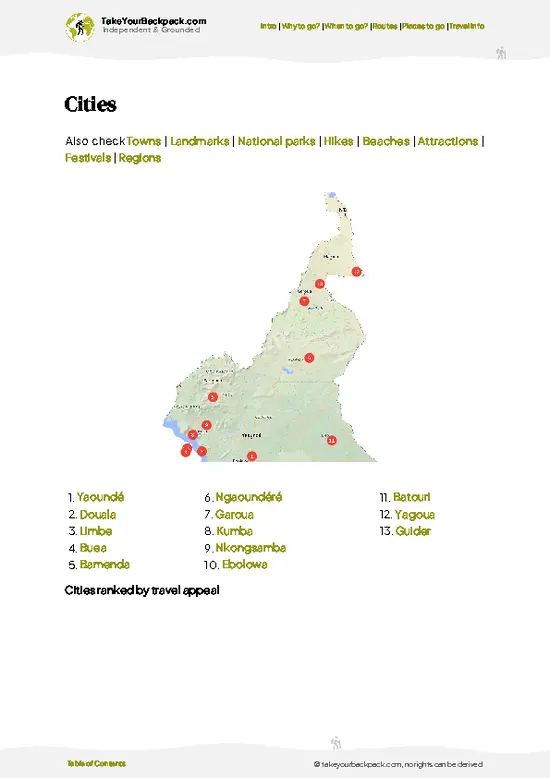
example page 0 from our offline Travel Guide for Cameroon
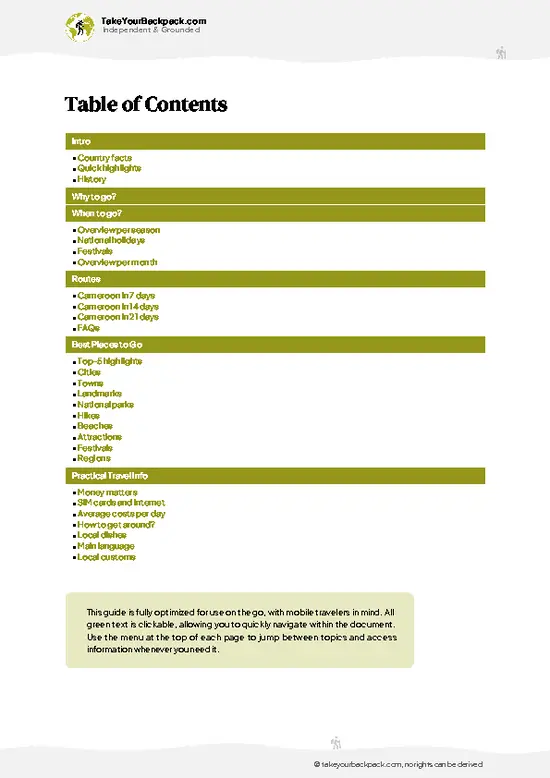
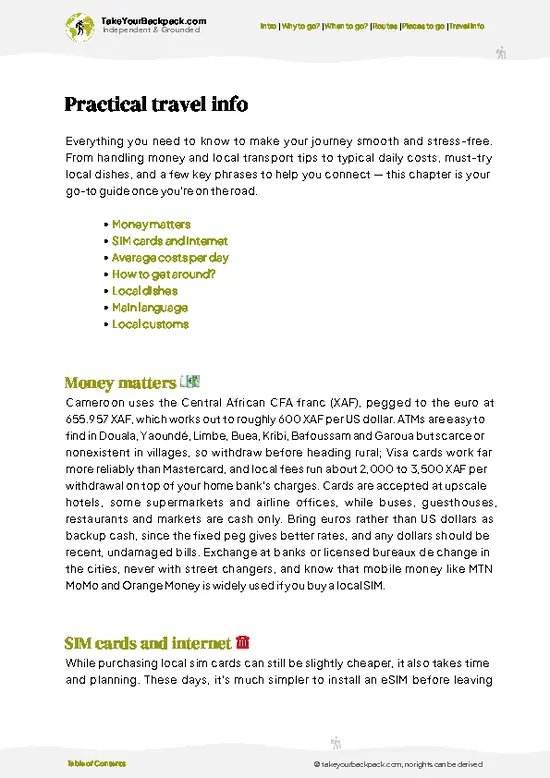
example page 1 from our offline Travel Guide for Cameroon
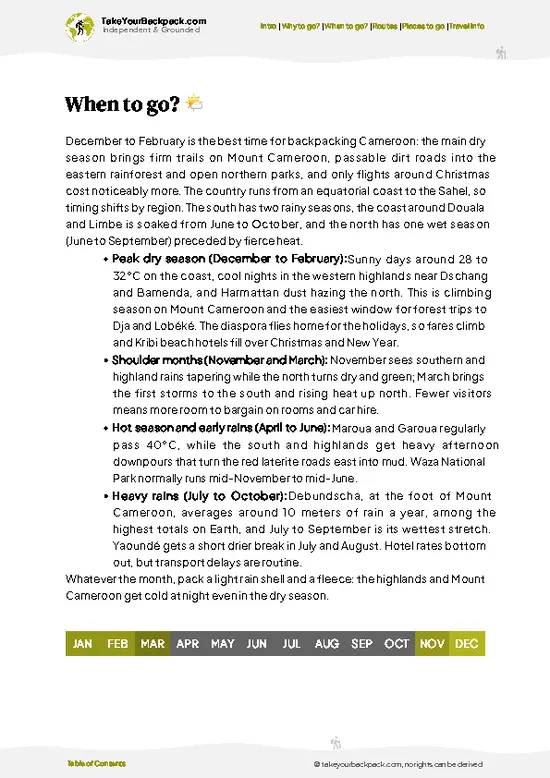
example page 2 from our offline Travel Guide for Cameroon
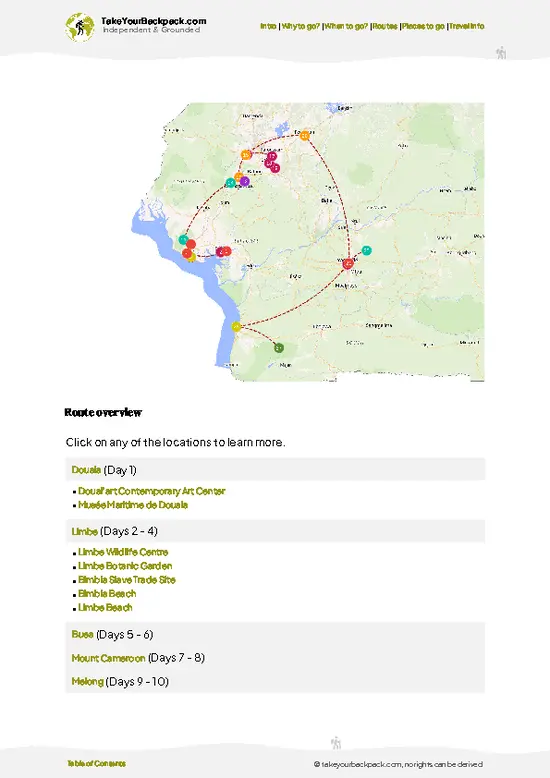
example page 3 from our offline Travel Guide for Cameroon
example page 4 from our offline Travel Guide for Cameroon
example page 5 from our offline Travel Guide for Cameroon
example page 6 from our offline Travel Guide for Cameroon
example page 7 from our offline Travel Guide for Cameroon
Loading the map 🌍
CLICK TO FILTER
cities
towns
landmarks
national parks
hikes
beaches
attractions
festivals
regions
SHOW COUNTRY’S BESTSHOW ALL

✨ Why go?
Ranked #1 town in Cameroon
Why visitors keep coming back

Dschang earns its place on a Cameroon route because it hands you highland air, hiking and Bamileke culture in one compact town, without the crowds of Foumban or the sprawl of Bafoussam. Most travelers stay two or three nights. The first is spent recovering from a long bus day, and the rest go to walks and chiefdom visits. The best reason is the access to Mont Bamboutos, a high volcanic massif where you can hike through grassland and farm terraces with a local guide, and be back for dinner. The second is the Foréké-Dschang chefferie, where traditional architecture and a living chieftaincy are part of daily life, not a museum display. A third draw is a student population from the University of Dschang, which means cheap grilled fish, cold drinks and people curious enough to start conversations. … read more 👉
Dschang earns its place on a Cameroon route because it hands you highland air, hiking and Bamileke culture in one compact town, without the crowds of Foumban or the sprawl of Bafoussam. Most travelers stay two or three nights. The first is spent recovering from a long bus day, and the rest go to walks and chiefdom visits. The best reason is the access to Mont Bamboutos, a high volcanic massif where you can hike through grassland and farm terraces with a local guide, and be back for dinner. The second is the Foréké-Dschang chefferie, where traditional architecture and a living chieftaincy are part of daily life, not a museum display. A third draw is a student population from the University of Dschang, which means cheap grilled fish, cold drinks and people curious enough to start conversations. Slow travelers, hikers and solo visitors with some French will get the most out of it. Nightlife is low-key, nothing like a backpacker circuit, and you should not expect a hostel crowd. If you want a cool break between the coast and the north, linger. If you only want ticking boxes, a night is enough.

💡 HighlightsThe experiences that define the visit

  1. Chefferie Foréké-Dschang: The seat of the Fondjomekwet chiefdom is the sight Dschang is best known for. Carved wooden posts, thatched and tin-roofed halls and a courtyard of ritual objects show how a Bamileke chiefdom still organizes itself. A guide explains the symbols, and a donation of about €2 to 4 is expected. Go in the morning, when the compound is calmer. Allow 1 to 1.5 hours.
  2. Musée des Civilisations: This museum holds masks, beaded thrones, ceremonial dress and tools from the Grassfields region, so it makes sense of what you see at the chiefdom. Entry is roughly €1 to 3. Late morning is a good slot. Allow about 1 hour.
  3. Lac Municipal: A small lake ringed by trees at the edge of the center, with local anglers, students and a quiet bench or two. It is free, and best in the late afternoon
… read more 👉
  1. Chefferie Foréké-Dschang: The seat of the Fondjomekwet chiefdom is the sight Dschang is best known for. Carved wooden posts, thatched and tin-roofed halls and a courtyard of ritual objects show how a Bamileke chiefdom still organizes itself. A guide explains the symbols, and a donation of about €2 to 4 is expected. Go in the morning, when the compound is calmer. Allow 1 to 1.5 hours.
  2. Musée des Civilisations: This museum holds masks, beaded thrones, ceremonial dress and tools from the Grassfields region, so it makes sense of what you see at the chiefdom. Entry is roughly €1 to 3. Late morning is a good slot. Allow about 1 hour.
  3. Lac Municipal: A small lake ringed by trees at the edge of the center, with local anglers, students and a quiet bench or two. It is free, and best in the late afternoon when the air cools. A slow walk around it takes 30 to 45 minutes.
  4. Marché Central: The main market is where the surrounding farmland shows up: potatoes, cabbage, avocados, coffee, plantains, and cheap secondhand clothes in the back lanes. Arrive before 10:00 for the best produce. Entry is free, buying a snack costs under €1, and 1 to 1.5 hours is plenty.
  5. University of Dschang campus and hillside: The grounds climb over a green hillside, with views over the town’s rooftops and the farmland beyond. Walking in is usually free during the day. Student cafés outside the gate are where you can eat cheaply and chat. Allow 1 hour.
Dschang is also a launch point for day trips to Mont Bamboutos, the Metché Falls near Santchou, and the chiefdom villages around Bafoussam and Foumban. Together, the five town sights fill about one full day at an easy pace.
Spotted a mistake or missing something? Contact us.

🏘️ NeighborhoodsWhere things are and how it's laid out

Dschang is a hillside town of about 1,400 meters, and its areas are close enough to cover on foot or by a short moto ride, though the slopes will find your calves.
  • Centre Ville and the Marché A: The market is the loudest, most crowded corner, with red mud on the stalls after rain, sizzling beignets, piles of avocados, plantains and Arabica coffee beans. Everything else in town radiates from here, and it is flat enough to walk. You leave with a bag of fruit for a few cents and a sense of where the town’s food comes from.
  • Foto and the university district: Downhill from the center, students fill the streets with motos, copy shops and cheap grill stands. Evenings smell of charcoal and grilled fish, with music leaking from small bars. Distances are longer and the hills steeper, so take a moto back
… read more 👉
Dschang is a hillside town of about 1,400 meters, and its areas are close enough to cover on foot or by a short moto ride, though the slopes will find your calves.
  • Centre Ville and the Marché A: The market is the loudest, most crowded corner, with red mud on the stalls after rain, sizzling beignets, piles of avocados, plantains and Arabica coffee beans. Everything else in town radiates from here, and it is flat enough to walk. You leave with a bag of fruit for a few cents and a sense of where the town’s food comes from.
  • Foto and the university district: Downhill from the center, students fill the streets with motos, copy shops and cheap grill stands. Evenings smell of charcoal and grilled fish, with music leaking from small bars. Distances are longer and the hills steeper, so take a moto back up. You get the cheapest plate of rice and sauce in town, plus easy conversation.
  • Chefferie de Foto and the Bamiléké quarters: A short ride out, the chiefdom has carved wooden doors, beaded objects and a quiet courtyard feel. Paths are dusty in the dry months and slick in the rains. You come away with a real look at Grassfields tradition, ideally with a local guide.
  • Dschang Mountain Park and the old colonial heights: Above the town, eucalyptus and old administrative buildings sit in cool, damp air with mist that rolls in by afternoon. It is mostly walkable but steep, and quiet after dark. The reward is a wide view over the green valley and the Menoua hills.
  • Route de Fongo-Tongo: A strip of roadside bars, palm wine sellers and small restaurants. It is lively on weekends with loud music and the smell of roasted corn. Walk only in a group at night. You get a convivial night out with cold beer and suya-style grilled meat.

⌛️ 1 day1-day itinerary for Dschang

The town is compact enough to cover on foot, with a motorbike taxi for the uphill stretches, and the cool climate means you can walk through midday without a long break.
8:00 AM, Marché Central: Start with breakfast at a market stall: fried doughnuts, beans and sweet coffee. Wander the produce rows while farmers are still unloading baskets of avocados and cabbages. It is the freshest, most colorful hour, and the vendors have time to chat.
9:30 AM, Chefferie Foréké-Dschang: Take a short motorbike taxi to the chiefdom. Hire a guide at the entrance to explain the carved posts, courtyards and ritual spaces. Spend about an hour here and leave a donation when you finish.
11:00 AM, Musée des Civilisations: The museum is close enough for a short ride. Masks, beaded stools and ceremonial dress now make … read more 👉
The town is compact enough to cover on foot, with a motorbike taxi for the uphill stretches, and the cool climate means you can walk through midday without a long break.
8:00 AM, Marché Central: Start with breakfast at a market stall: fried doughnuts, beans and sweet coffee. Wander the produce rows while farmers are still unloading baskets of avocados and cabbages. It is the freshest, most colorful hour, and the vendors have time to chat.
9:30 AM, Chefferie Foréké-Dschang: Take a short motorbike taxi to the chiefdom. Hire a guide at the entrance to explain the carved posts, courtyards and ritual spaces. Spend about an hour here and leave a donation when you finish.
11:00 AM, Musée des Civilisations: The museum is close enough for a short ride. Masks, beaded stools and ceremonial dress now make sense after the chiefdom, and the quiet rooms are a relief from the street noise.
12:30 PM, University of Dschang: Walk or ride to the campus gates for lunch. Cheap plates of grilled fish with plantains and spicy sauce are served at the student cafés, and you can wander up the hillside afterward for a view over the roofs.
2:30 PM, Quartier Lac Municipal: Stroll around the lake, where anglers cast from the bank and students sit on benches with textbooks. It is a slow, easy walk.
4:00 PM, Back lanes of the old administrative quarter: Few visitors bother with this part. Follow the quiet streets past old colonial-era buildings, small churches and neighborhood workshops, where carpenters and tailors work in open doorways and will often invite you to watch.
6:00 PM, Roadside grills: Finish with brochettes or grilled fish and a cold drink at a street-side grill as the air cools and generators start humming.

🌤️ When to go?Best time to visit Dschang

The dry months from November to February are easiest for hiking and moving around Dschang. Days reach about 25 to 28°C (77 to 82°F), nights drop to 12 to 15°C (54 to 59°F), and the hills look sharp and green.
  • Dry Season (November to February): Clear skies, cool mornings with a light haze from harmattan dust, and roads that stay passable. Accommodation is a little pricier around Christmas and when the university is busy.
  • Transition (March to April): Warmer at 26 to 30°C (79 to 86°F), with the first storms rolling in by late afternoon. Crowds are thin and prices steady.
  • Rainy Season (May to October): Heavy daily downpours, cloud over the hills and highs of 21 to 25°C (70 to 77°F). Mud closes some tracks, though waterfalls run strongest and rooms are cheapest. Pack a proper rain jacket.
  • Daylight:
… read more 👉
The dry months from November to February are easiest for hiking and moving around Dschang. Days reach about 25 to 28°C (77 to 82°F), nights drop to 12 to 15°C (54 to 59°F), and the hills look sharp and green.
  • Dry Season (November to February): Clear skies, cool mornings with a light haze from harmattan dust, and roads that stay passable. Accommodation is a little pricier around Christmas and when the university is busy.
  • Transition (March to April): Warmer at 26 to 30°C (79 to 86°F), with the first storms rolling in by late afternoon. Crowds are thin and prices steady.
  • Rainy Season (May to October): Heavy daily downpours, cloud over the hills and highs of 21 to 25°C (70 to 77°F). Mud closes some tracks, though waterfalls run strongest and rooms are cheapest. Pack a proper rain jacket.
  • Daylight: Close to the equator, days stay around 12 hours all year, so plan hikes to finish before dusk.
Aim for late November, when the rains have cleared and the coffee harvest is under way.


source: climatestotravel.comJANJanuary: excellent for travelingFEBFebruary: excellent for travelingMARMarch: good for travelingAPRApril: fair for travelingMAYMay: fair for travelingJUNJune: fair for travelingJULJuly: fair for travelingAUGAugust: fair for travelingSEPSeptember: good for travelingOCTOctober: good for travelingNOVNovember: highly recommended for travelingDECDecember: excellent for traveling
when-to-go

✈️ The backpacker research shortcutCameroon Travel Guide

An offline-friendly backpacking guide with optimized travel routes, ranked highlights, transport advice, and the best areas to stay.
example page 0 from our offline Travel Guide for Cameroon
example page 1 from our offline Travel Guide for Cameroon
example page 2 from our offline Travel Guide for Cameroon
example page 3 from our offline Travel Guide for Cameroon
example page 4 from our offline Travel Guide for Cameroon
example page 5 from our offline Travel Guide for Cameroon
example page 6 from our offline Travel Guide for Cameroon
example page 7 from our offline Travel Guide for Cameroon
The digital guide (351 pages) contains:
✅ 84 highlights, ranked by travel appeal
✅ Optimized 7, 14 & 21-day travel routes
✅ Cities, national parks, landmarks, beaches
✅ How to get around
✅ Offline-friendly for travel without Wi-Fi
👉 Click to see all 30+ guide features

📅 Plan smarter in minutes, not weeks
✅ Month by month travel advice
✅ Festivals & national holidays
✅ Budget expectations

🗺️ Go to the right places, skip the overrated ones
✅ Honest pros & cons of destinations
✅ Top hikes, parks & viewpoints
✅ Lesser-known places most travelers miss
✅ Clear “worth it vs skip it” guidance

🛏️ Travel smoothly without rookie mistakes
✅ Best areas to stay
✅ Transport systems explained simply
✅ Common scams & safety advice
✅ SIM cards, money & practical tips

🌍 Understand the country, not just visit it
✅ Culture & traditions
✅ 52 Essential phrases & customs
✅ Festivals worth planning around
✅ Traveler-friendly historical context
✅ Insights that make places more meaningful

📱 Built for real travel conditions
✅ Fully downloadable PDF
✅ Works completely offline
✅ Optimized for phone use
✅ Useful in remote areas & buses
✅ Everything in one place
Stop searching, start planning
Get instant access to your full guide. 30‑day money-back guarantee.
+ Add another guide for just

By proceeding you agree to our terms.
Sent to your inbox immediately after payment • 100% Secure Checkout
Best Backpacking Travel Advisor 2025 tourism awardBest Backpacking
Travel Advisor
2025
What others say about Take Your Backpack Guides:
⭐⭐⭐⭐⭐
Fantastic, amazing amount of information!
⭐⭐⭐⭐⭐
My goodness this is amazing, it's what I've been looking for hats off too you!
⭐⭐⭐⭐⭐
I think this is absolutely BRILLIANT
⭐⭐⭐⭐
Very complete and informative. It's still missing places, but I gotta to commend you
⭐⭐⭐⭐⭐
This is truly amazing, thank you, can't wait to explore it with my kids!
⭐⭐⭐⭐⭐
Awesome resource, thank you!
⭐⭐⭐⭐⭐
This is amazing! Can't wait to explore the ones I haven't seen
⭐⭐⭐⭐
I love this! Well done, great idea.
⭐⭐⭐⭐⭐
Thanks for taking the time to make this gem!
⭐⭐⭐⭐⭐
This might be the best website I've ever seen.
⭐⭐⭐⭐⭐
Congratulations, and thank you so much for your work; it's incredibly valuable.
⭐⭐⭐⭐
In all seriousness I think you did a great job pointing out the important spots
⭐⭐⭐⭐⭐
10/10 very good
⭐⭐⭐⭐⭐
As someone who's only just starting to visit regularly this is awesome, thank you.
⭐⭐⭐⭐
Thank you very much! I'm going to visit my dad, it's going to be very useful!
⭐⭐⭐⭐⭐
This is really cool! We'll be travelling for the first time and this definitely come in handy.
⭐⭐⭐⭐⭐
You are now our minister of culture, congratulations 👨‍💼
⭐⭐⭐⭐⭐
Just wanted to tell you that this is a pearl! Going to follow your recommendations.
⭐⭐⭐⭐⭐
This is so cool. I'll definitely be using the resource for my travels soon.
⭐⭐⭐⭐⭐
This is very impressive! Good work.
⭐⭐⭐⭐⭐
This is an amazing and informative site. Very well done!

🛏️ Where to stay?Choosing the right base

Most budget travelers sleep in or just below the center, where basic guesthouses and a few cheap hostel-style rooms cluster within walking distance of the market and the motor park. Dorm beds are rare in Dschang, so expect a private room with shared or private bathroom at roughly €8 to 15 a night.
The central streets give you easy access to food stalls, ATMs and the morning buses, which matters when departures start at dawn. Noise is the trade-off, since motos and market loudspeakers begin early, so bring earplugs and ask for a room at the back. Streets are lit in the middle of town, and walking … read more 👉
Most budget travelers sleep in or just below the center, where basic guesthouses and a few cheap hostel-style rooms cluster within walking distance of the market and the motor park. Dorm beds are rare in Dschang, so expect a private room with shared or private bathroom at roughly €8 to 15 a night.
The central streets give you easy access to food stalls, ATMs and the morning buses, which matters when departures start at dawn. Noise is the trade-off, since motos and market loudspeakers begin early, so bring earplugs and ask for a room at the back. Streets are lit in the middle of town, and walking back after dinner is generally fine in a group.
The second option is the university district at Foto, downhill and on the way to the chiefdom. Rooms there run about €6 to 12, there are plenty of cheap eateries, and students keep the place lively late into the evening. The drawback is the climb back to the center, so you will rely on a moto after dark, but it is cheaper and often quieter than the market area. In both areas, check that hot water works and that the room has a mosquito net or screen, as nights are cool but not insect-free.

🚌 Getting aroundHow to get around Dschang

Dschang is a place where a shared moto ride within town costs about €0.20 to 0.50, paid in cash to the driver at the end, and you should agree the price before you climb on. The town is compact but hilly, so walking works in the center and gets tiring on the slopes. Traffic is light apart from market mornings, and public transport means informal vehicles rather than timetables.
  • Walking: Free and best for the market, main street and nearby shops. Pavements are patchy, and the red dust turns to mud after rain. You smell wood smoke and frying dough as you pass each corner, and you see the real rhythm of the town.
  • Moto-taxis (benskin): The fastest way up the hills, running from about 6 am to 9 pm at €0.20 to 0.50 for most hops, €1 to 2 for outlying spots like the chiefdom. Wear the helmet if offered
… read more 👉
Dschang is a place where a shared moto ride within town costs about €0.20 to 0.50, paid in cash to the driver at the end, and you should agree the price before you climb on. The town is compact but hilly, so walking works in the center and gets tiring on the slopes. Traffic is light apart from market mornings, and public transport means informal vehicles rather than timetables.
  • Walking: Free and best for the market, main street and nearby shops. Pavements are patchy, and the red dust turns to mud after rain. You smell wood smoke and frying dough as you pass each corner, and you see the real rhythm of the town.
  • Moto-taxis (benskin): The fastest way up the hills, running from about 6 am to 9 pm at €0.20 to 0.50 for most hops, €1 to 2 for outlying spots like the chiefdom. Wear the helmet if offered and hold the back handle tight. You get the wind in your face and views down over the valley.
  • Shared taxis: Yellow cars run fixed routes along the main roads for about €0.30 to 0.50 per seat, and they leave when full, so they usually go until early evening. They are crammed, with four people in the back, but you meet locals fast.
  • Intercity buses and minibuses: Services to Bafoussam take 1 to 1.5 hours for about €1.50 to 2.50, and to Douala around 4 to 5 hours for €5 to 8. Departures begin at dawn from the main motor park and thin out after mid-afternoon. Expect a slow start while the vehicle fills, then a winding road lined with banana groves and tea slopes.
  • Private hire: A negotiated car with a driver for a day costs roughly €30 to 50, useful for waterfalls and villages with poor road links. You gain flexibility and a driver who knows which tracks wash out.

👛 Costs (as of 22 October 2026)Travel costs and budget guide for Dschang

Dschang costs about €28 to 37 a day for a backpacker, and local prices are low even for food and rides.
CategoryBudget RangeLocal Reality
Dorm accommodation€8 to 15Private rooms in guesthouses, since dorms are rare; high season is December and January
Meals€5 to 10Rice or plantain with sauce for €1.50 to 3; grilled fish and a beer around €4 to 6
Local transport€1 to 3Moto rides at €0.20 to 0.50; shared taxis a little more
Basic activities/entry fees€2 to 5Chiefdom visit with guide; waterfalls cost little beyond the ride
Miscellaneous expenses€2 to 4Water, SIM data, small tips
Total Daily Budget€28 to 37Based on high-season accommodation
Eat where students do in the Foto district, where a full plate costs less than half of what the main road restaurants charge. Carry small cash, as ATMs can be unreliable.
⚠️ Prices can change and everyone travels differently, so take this as a rough guide. Hope it helps you plan your adventure!

🚌 Day tripsShort trips worth adding

Dschang sits in the Menoua highlands, so waterfalls, chiefdoms and crater lakes are all reachable in a few hours with shared transport, and you are back by evening.
Foto Chiefdom:
Only 10 to 15 minutes by moto, this Bamiléké palace has carved doors, a small museum and a guide who explains the hierarchy. Entry and guide cost about €2 to 5, and a round trip by moto is under €3. Go in the morning, and dress modestly, as first-timers often show up in shorts or without a gift for the notables.

Lake Wum area and the Menoua waterfalls: Ngwa and Mengong falls:
Small cascades hide in the hills around Dschang, with paths through coffee and banana plots. Rides take 30 to 60 minutes by moto, about €3 to 8 return. They are best from June to October when water is full, but tracks are slippery, so wear shoes … read more 👉
Dschang sits in the Menoua highlands, so waterfalls, chiefdoms and crater lakes are all reachable in a few hours with shared transport, and you are back by evening.
Foto Chiefdom:
Only 10 to 15 minutes by moto, this Bamiléké palace has carved doors, a small museum and a guide who explains the hierarchy. Entry and guide cost about €2 to 5, and a round trip by moto is under €3. Go in the morning, and dress modestly, as first-timers often show up in shorts or without a gift for the notables.

Lake Wum area and the Menoua waterfalls: Ngwa and Mengong falls:
Small cascades hide in the hills around Dschang, with paths through coffee and banana plots. Rides take 30 to 60 minutes by moto, about €3 to 8 return. They are best from June to October when water is full, but tracks are slippery, so wear shoes with grip.

Bafoussam:
The regional capital is 1 to 1.5 hours away by shared car or minibus, €1.50 to 2.50 each way. The big market and the Bamiléké museum fill a half day. Leave before 2 pm so you are not hunting transport back in the dark.

Baham and Bandjoun:
Bandjoun’s monumental chiefdom, with its huge conical-roofed buildings, is about 2 hours by road via Bafoussam, costing around €5 to 8 for the day with bush taxis. Entry is about €3 to 5. Go on a weekday, since ceremonies sometimes close the gates to visitors.

🛡️ SafetyTraveler Safety Guide

Dschang is calm and friendly by Cameroonian standards, and most problems are petty. Take care in the crowded market on busy mornings, where pickpockets work, so keep your phone and cash in a front pocket. Moto-taxi drivers may quote foreigner prices, so agree the fare first and carry small notes. Solo travelers, including women, generally walk the center without trouble in daylight. After dark, stick to the main lit streets, take a moto for hills and the Fongo-Tongo bars, and do not carry valuables. Police checkpoints on roads outside town are routine, so keep a photocopy of your passport and visa handy. Hikers should go with a local guide, since paths are unmarked and fog can arrive fast. Avoid political demonstrations, and check the latest advice on the Northwest and Southwest regions before traveling up toward them.

FAQCommon questions from travelers

Dschang is worth visiting in its own right, particularly for its cool climate, the Foto chiefdom and the nearby waterfalls. The market is one of the most productive in the western highlands, with coffee, avocados and fresh vegetables priced at just a few cents. It also makes a good break from the heat of Douala, about 4 to 5 hours by road.
Dschang rewards two to three days. One day covers the market, the town and Dschang Mountain Park, a second takes in the Foto chiefdom and a waterfall, and a third can add Bafoussam or Bandjoun. Budget about €28 to 40 a day.
Dschang is a feasible day trip from Bafoussam, 1 to 1.5 hours by shared car for about €1.50 to 2.50, but from Douala the 4 to 5 hour road makes it tiring in a single day. Staying at least one night lets you see the market and chiefdom without rushing. Buses and shared taxis leave early, so aim to depart before 8 am.
⚠️ Things can change over time, so always validate details locally before you go.

Other Cameroonian towns near Dschang

Explore more nearby:

  • Mbouda—Grassfields farm market, Bamessingue chiefdom, hill lookouts| 30 km away
  • Melong—Weekly produce market, coffee-and-cocoa tracks, palm wine bars| 37 km away
  • Mamfe—German iron bridge, Cross River canoes, Manyu chiefdoms| 88 km away

💡 Not sure where to go next?
Create a personalized itinerary for Cameroon including Dschang and the places that fit your trip.

Generate my itinerary

👉 Discover all towns

Or checkout all Cameroon has to offer (think cities, towns, villages, national parks, hikes, beaches, festivals)
Country photo of Cameroon

We 💚 feedbackSumming up the experience

Dschang rewards people who look past the main sights, and first-timers often skip the roadside fruit stalls. The avocados and passion fruit here, grown in the cool highlands, are some of the best I know in Cameroon. I would buy a bag early, bring a light jacket for the evening chill, and ask your guesthouse host about any chiefdom ceremony coming up.

✍️ Help improve this page!
The information on this page is based on in-depth research, insights shared by experienced travelers, and feedback from the local travel community in Cameroon. While every effort is made to keep the information accurate and current, conditions can change — so if you spot anything incorrect or outdated, please get in touch.


🙋‍♂️ Give feedback

👋 Meet the founderWho’s Behind Take Your Backpack?

Johan, backpacker and founder of TakeYourBackpackHi, I’m Johan (Netherlands 🇳🇱), the creator of TakeYourBackpack. Over the past 3 decades, I’ve backpacked through 90+ countries across six continents, gaining extensive experience with independent travel, long-term trips, and overland routes.

This site is built on a combination of firsthand travel experience and carefully curated insights from other backpackers. Many guides are based on places I’ve personally visited, while others bring together tips, observations, and practical advice shared by trusted travelers I’ve met along the way.

The goal is to provide realistic, experience-driven guidance — not generic itineraries — so you can explore destinations with better context, clearer expectations, and more confidence.