×

Canada🇨🇦 | regionsCanadian RockiesTurquoise lakes, glacier hikes, Berg Lake, fossil beds | things to do and best time to go

Explore Canadian PrairiesExplore Cape Breton Island

Backpacking in Canadian Rockies
🏆 Top pickregion ranked #1
By Johan Kruseman 🇳🇱 | Updated October 22, 2026

The choice that shapes a trip here is whether to sleep in Banff or Jasper, and it tips on crowds: Banff has more buses, bars and restaurants, while Jasper is quieter, with elk grazing on the lawns. The Canadian Rockies run along the Alberta and British Columbia border in western Canada, and everything is far apart because the valleys are long and the highways follow them. That is why experienced travelers pick one town per few days instead of racing the whole chain. I stopped at the Parks Canada desk in Jasper and read the trail and wildlife board before choosing a walk, and you can do the same, because closures after floods or bear activity change often. Expect glacier-milk lakes the color of mouthwash, the resin smell of spruce, and gravel crunching underfoot. Mosquitoes and wildfire smoke come with summer. A good first day: grab a coffee, check that board, then walk a short lakeside loop before the afternoon crowds.

Discover everything you want to know in the 📖 Canada Travel Guide.


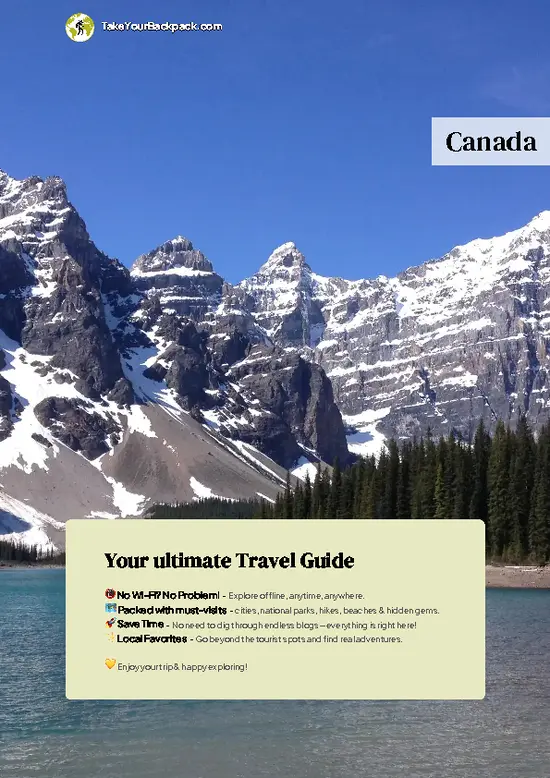
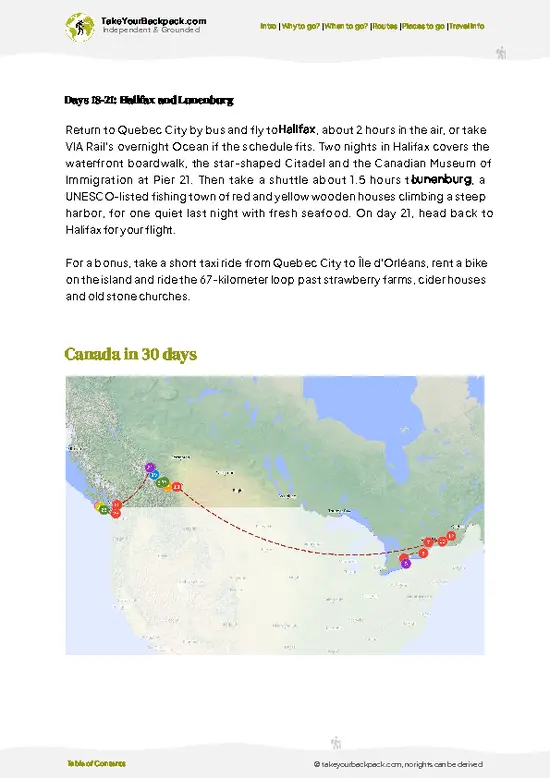
example page 0 from our offline Travel Guide for Canada
example page 1 from our offline Travel Guide for Canada
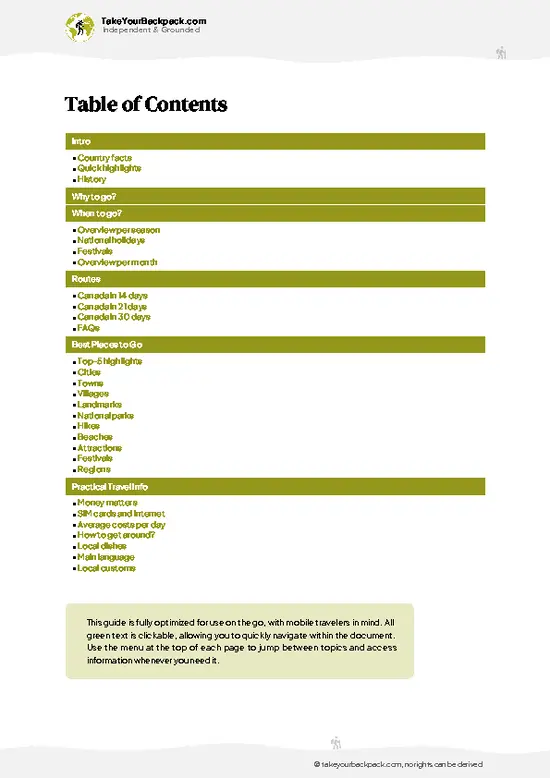
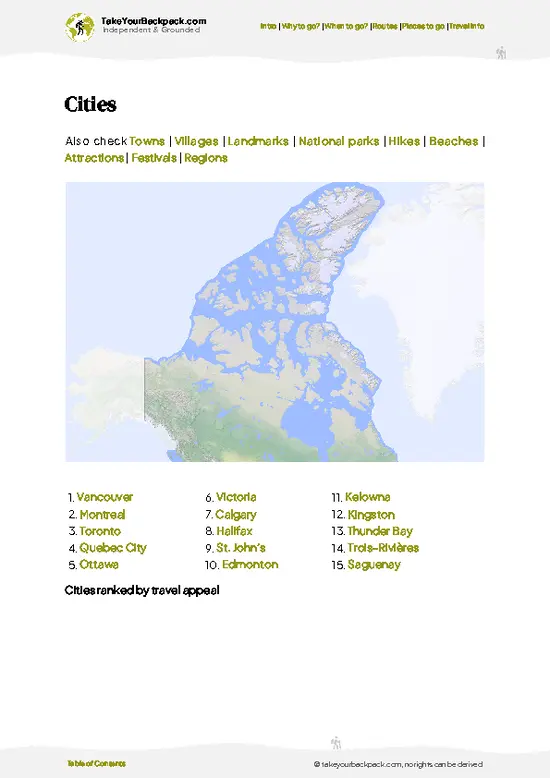
example page 2 from our offline Travel Guide for Canada
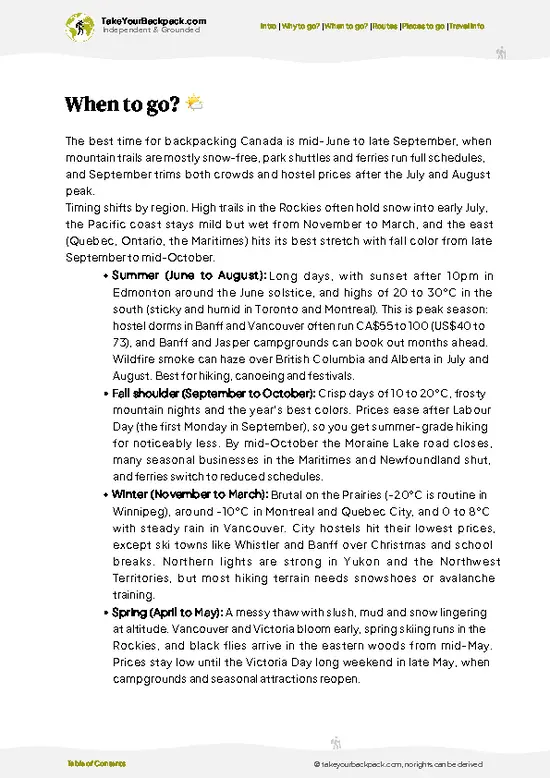
example page 3 from our offline Travel Guide for Canada
example page 4 from our offline Travel Guide for Canada
example page 5 from our offline Travel Guide for Canada
example page 6 from our offline Travel Guide for Canada
example page 7 from our offline Travel Guide for Canada
Loading the map 🌍
CLICK TO FILTER
cities
towns
villages
landmarks
national parks
hikes
beaches
attractions
festivals
regions
SHOW COUNTRY’S BESTSHOW ALL

✨ Why go?
Ranked #1 region in Canada
Why visitors keep coming back

The Canadian Rockies pack several national parks into one connected mountain corridor, so you can swap a glacier for a hot spring without repacking your whole life. The Icefields Parkway is the spine of it: one road past glaciers, waterfalls and turquoise lakes, with hostels and campgrounds spaced along it so you can sleep close to the trailheads. That matters, because the best light on the water is early, before the tour buses roll in. The second reason is range. In a single week you can scramble toward Mount Robson, the highest peak in the range, then soak in a hot pool as snow falls, then sit in a Banff pub with other hikers comparing blisters. Trails go from flat lakeshore boardwalks to multi-day routes, so first-timers and seasoned trekkers can share a base and split up for the day. Shuttles … read more 👉
The Canadian Rockies pack several national parks into one connected mountain corridor, so you can swap a glacier for a hot spring without repacking your whole life. The Icefields Parkway is the spine of it: one road past glaciers, waterfalls and turquoise lakes, with hostels and campgrounds spaced along it so you can sleep close to the trailheads. That matters, because the best light on the water is early, before the tour buses roll in. The second reason is range. In a single week you can scramble toward Mount Robson, the highest peak in the range, then soak in a hot pool as snow falls, then sit in a Banff pub with other hikers comparing blisters. Trails go from flat lakeshore boardwalks to multi-day routes, so first-timers and seasoned trekkers can share a base and split up for the day. Shuttles and seasonal buses cover the famous spots if you lack a car, and hostel boards work as a ride-share exchange. Slow travel works well here: one valley, two or three nights, and you stop feeling rushed.

💡 HighlightsEssential experiences to have while visiting Canadian Rockies

  1. Lake Louise: the glacier-fed lake under Victoria Glacier is the postcard image. Walk the shore early, then climb to the Lake Agnes Tea House for a quieter view and a pot of tea.
  2. Moraine Lake: a jagged ring of peaks over bright blue water. Access is by Parks Canada shuttle or similar non-private transport, so plan around it.
  3. Icefields Parkway: the road between Lake Louise and Jasper, with pullouts for waterfalls, viewpoints and wildlife like bighorn sheep and the occasional black bear.
  4. Athabasca Glacier at the Columbia Icefield: you can stand at the toe of an ice tongue that is shrinking year by year; markers show how far it has retreated.
  5. Mount Robson and Kinney Lake: the tallest peak in the Canadian Rockies, reached by an easy, flat trail to a jade lake. Berg Lake beyond it needs a backcountry
… read more 👉
  1. Lake Louise: the glacier-fed lake under Victoria Glacier is the postcard image. Walk the shore early, then climb to the Lake Agnes Tea House for a quieter view and a pot of tea.
  2. Moraine Lake: a jagged ring of peaks over bright blue water. Access is by Parks Canada shuttle or similar non-private transport, so plan around it.
  3. Icefields Parkway: the road between Lake Louise and Jasper, with pullouts for waterfalls, viewpoints and wildlife like bighorn sheep and the occasional black bear.
  4. Athabasca Glacier at the Columbia Icefield: you can stand at the toe of an ice tongue that is shrinking year by year; markers show how far it has retreated.
  5. Mount Robson and Kinney Lake: the tallest peak in the Canadian Rockies, reached by an easy, flat trail to a jade lake. Berg Lake beyond it needs a backcountry permit and several days.
  6. Maligne Lake: Jasper’s largest lake, with a boat trip to Spirit Island and kayak rentals for anyone who wants a quieter paddle.
  7. Johnston Canyon: catwalks bolted to limestone walls lead to two waterfalls. Go at opening time or late evening to avoid shoulder-to-shoulder crowds.
  8. Mistaya Canyon: a short walk from the parkway to a slot canyon where water has carved smooth, curved rock. Most drivers roll past it.
  9. Miette Hot Springs: Jasper’s hottest springs, in a quiet side valley off the main road. Soak after a long hike and watch the evening light fade on the ridges.
  10. Takakkaw Falls: one of the tallest waterfalls in Canada, in Yoho National Park, with a short walk from the parking lot and the sound of roaring water the whole way.
For a first visit, the Canadian Rockies deliver most when you drive the Icefields Parkway with stops at Mistaya Canyon and the Athabasca Glacier.
Spotted a mistake or missing something? Contact us.

Things to do around Canadian Rockies

Ratings based on Tripadvisor reviews. When you book through this link, you support our work at no extra cost to you.

⌛️ 5 daysA smart one-week plan

Distances between towns are long and public transport is thin, so a rental car or booked shuttle sets the pace, with one big outing per day. Day 1-2: Banff: Start in Banff because it has the most hostels, the biggest grocery stores and bus connections. Spend the first morning at Johnston Canyon before crowds, then use a shuttle to reach Lake Louise and Moraine Lake on day two. Reserve shuttle spots ahead, since walk-up capacity is limited.Day 3: Icefields Parkway: Drive north on the parkway, stopping at Peyto viewpoint, Mistaya Canyon and the Athabasca Glacier. Keep a full tank and food, because services are sparse. The slow pace pays off: wildlife often appears at dawn and dusk.Day 4: Jasper: Jasper is calmer, so use it for Maligne Lake and an evening soak at Miette Hot Springs. Book the … read more 👉
Distances between towns are long and public transport is thin, so a rental car or booked shuttle sets the pace, with one big outing per day. Day 1-2: Banff: Start in Banff because it has the most hostels, the biggest grocery stores and bus connections. Spend the first morning at Johnston Canyon before crowds, then use a shuttle to reach Lake Louise and Moraine Lake on day two. Reserve shuttle spots ahead, since walk-up capacity is limited.Day 3: Icefields Parkway: Drive north on the parkway, stopping at Peyto viewpoint, Mistaya Canyon and the Athabasca Glacier. Keep a full tank and food, because services are sparse. The slow pace pays off: wildlife often appears at dawn and dusk.Day 4: Jasper: Jasper is calmer, so use it for Maligne Lake and an evening soak at Miette Hot Springs. Book the lake cruise early in the day, before wind picks up.Day 5: Mount Robson: Continue west to Mount Robson. Walk the flat trail to Kinney Lake, then stay for lunch lakeside. This extends the trip without adding another hub.Detour: Yoho National Park, just west of Lake Louise, adds Takakkaw Falls and Emerald Lake with only a short hop off the main highway.My pick: Day 3 on the Icefields Parkway is the one that justifies the whole trip, because the road itself is the experience.

🌤️ When to go?Weather, crowds, and seasonal trade-offs

July and August are the safest months for the Canadian Rockies, with daytime highs of 20 to 25°C (68 to 77°F) and trails mostly snow-free by early July. Here is how the year breaks down.
  • Summer (July to August): Long light, warm days and the busiest crowds. Lodging peaks at US$150 to 300 for a basic room in Banff and Jasper, and campgrounds book out months ahead.
  • Fall (September to mid-October): Highs of 8 to 16°C (46 to 61°F), golden larches in late September, thinner crowds and lower prices. Snow can hit high passes.
  • Winter (December to March): Highs of -10 to 0°C (14 to 32°F), lows can plunge below -25°C (-13°F). Skiing at Lake Louise, Sunshine and Marmot Basin; days are short, so plan activities around daylight.
  • Spring (April to June): Muddy, unpredictable, 5 to 15°C (41 to 59°F). Lakes stay
… read more 👉
July and August are the safest months for the Canadian Rockies, with daytime highs of 20 to 25°C (68 to 77°F) and trails mostly snow-free by early July. Here is how the year breaks down.
  • Summer (July to August): Long light, warm days and the busiest crowds. Lodging peaks at US$150 to 300 for a basic room in Banff and Jasper, and campgrounds book out months ahead.
  • Fall (September to mid-October): Highs of 8 to 16°C (46 to 61°F), golden larches in late September, thinner crowds and lower prices. Snow can hit high passes.
  • Winter (December to March): Highs of -10 to 0°C (14 to 32°F), lows can plunge below -25°C (-13°F). Skiing at Lake Louise, Sunshine and Marmot Basin; days are short, so plan activities around daylight.
  • Spring (April to June): Muddy, unpredictable, 5 to 15°C (41 to 59°F). Lakes stay frozen into June, but wildlife is active and rooms are cheap.
Book summer campsites the day reservations open, usually in January.


source: climatestotravel.comJANJanuary: below average for travelingFEBFebruary: below average for travelingMARMarch: below average for travelingAPRApril: fair for travelingMAYMay: good for travelingJUNJune: highly recommended for travelingJULJuly: excellent for travelingAUGAugust: excellent for travelingSEPSeptember: highly recommended for travelingOCTOctober: fair for travelingNOVNovember: below average for travelingDECDecember: below average for traveling
canada-region-canadian-rockies v1
© Google |

✈️ The backpacker research shortcutCanada Travel Guide

An offline-friendly backpacking guide with optimized travel routes, ranked highlights, transport advice, and the best areas to stay.
example page 0 from our offline Travel Guide for Canada
example page 1 from our offline Travel Guide for Canada
example page 2 from our offline Travel Guide for Canada
example page 3 from our offline Travel Guide for Canada
example page 4 from our offline Travel Guide for Canada
example page 5 from our offline Travel Guide for Canada
example page 6 from our offline Travel Guide for Canada
example page 7 from our offline Travel Guide for Canada
The digital guide (385 pages) contains:
✅ 125 highlights, ranked by travel appeal
✅ Optimized 14, 21 & 30-day travel routes
✅ Cities, national parks, landmarks, beaches
✅ How to get around
✅ Offline-friendly for travel without Wi-Fi
👉 Click to see all 30+ guide features

📅 Plan smarter in minutes, not weeks
✅ Month by month travel advice
✅ Festivals & national holidays
✅ Budget expectations

🗺️ Go to the right places, skip the overrated ones
✅ Honest pros & cons of destinations
✅ Top hikes, parks & viewpoints
✅ Lesser-known places most travelers miss
✅ Clear “worth it vs skip it” guidance

🛏️ Travel smoothly without rookie mistakes
✅ Best areas to stay
✅ Transport systems explained simply
✅ Common scams & safety advice
✅ SIM cards, money & practical tips

🌍 Understand the country, not just visit it
✅ Culture & traditions
✅ Local customs
✅ Festivals worth planning around
✅ Traveler-friendly historical context
✅ Insights that make places more meaningful

📱 Built for real travel conditions
✅ Fully downloadable PDF
✅ Works completely offline
✅ Optimized for phone use
✅ Useful in remote areas & buses
✅ Everything in one place
Stop searching, start planning
Get instant access to your full guide. 30‑day money-back guarantee.
+ Add another guide for just

By proceeding you agree to our terms.
Sent to your inbox immediately after payment • 100% Secure Checkout
Best Backpacking Travel Advisor 2025 tourism awardBest Backpacking
Travel Advisor
2025
What others say about Take Your Backpack Guides:
⭐⭐⭐⭐⭐
Fantastic, amazing amount of information!
⭐⭐⭐⭐⭐
My goodness this is amazing, it's what I've been looking for hats off too you!
⭐⭐⭐⭐⭐
I think this is absolutely BRILLIANT
⭐⭐⭐⭐
Very complete and informative. It's still missing places, but I gotta to commend you
⭐⭐⭐⭐⭐
This is truly amazing, thank you, can't wait to explore it with my kids!
⭐⭐⭐⭐⭐
Awesome resource, thank you!
⭐⭐⭐⭐⭐
This is amazing! Can't wait to explore the ones I haven't seen
⭐⭐⭐⭐
I love this! Well done, great idea.
⭐⭐⭐⭐⭐
Thanks for taking the time to make this gem!
⭐⭐⭐⭐⭐
This might be the best website I've ever seen.
⭐⭐⭐⭐⭐
Congratulations, and thank you so much for your work; it's incredibly valuable.
⭐⭐⭐⭐
In all seriousness I think you did a great job pointing out the important spots
⭐⭐⭐⭐⭐
10/10 very good
⭐⭐⭐⭐⭐
As someone who's only just starting to visit regularly this is awesome, thank you.
⭐⭐⭐⭐
Thank you very much! I'm going to visit my dad, it's going to be very useful!
⭐⭐⭐⭐⭐
This is really cool! We'll be travelling for the first time and this definitely come in handy.
⭐⭐⭐⭐⭐
You are now our minister of culture, congratulations 👨‍💼
⭐⭐⭐⭐⭐
Just wanted to tell you that this is a pearl! Going to follow your recommendations.
⭐⭐⭐⭐⭐
This is so cool. I'll definitely be using the resource for my travels soon.
⭐⭐⭐⭐⭐
This is very impressive! Good work.
⭐⭐⭐⭐⭐
This is an amazing and informative site. Very well done!

🛏️ Where to stay?Where staying makes the most sense

Banff is the easiest base in the Canadian Rockies for most backpackers, with the densest choice of social hostels, a walkable center, and a free-to-cheap shuttle network to Lake Louise and Johnston Canyon. Dorm beds run about US$40 to 90 in summer, so book weeks ahead. Nights are lively on Banff Avenue, and solo travelers meet people easily at trail-planning boards and shared kitchens.
Jasper, about 3 hours north, is quieter and cheaper, with dorms around US$35 to 70. It has a small-town feel, elk wandering the streets, and access to Maligne Lake, Pyramid Lake and Mount Edith Cavell. It suits travelers … read more 👉
Banff is the easiest base in the Canadian Rockies for most backpackers, with the densest choice of social hostels, a walkable center, and a free-to-cheap shuttle network to Lake Louise and Johnston Canyon. Dorm beds run about US$40 to 90 in summer, so book weeks ahead. Nights are lively on Banff Avenue, and solo travelers meet people easily at trail-planning boards and shared kitchens.
Jasper, about 3 hours north, is quieter and cheaper, with dorms around US$35 to 70. It has a small-town feel, elk wandering the streets, and access to Maligne Lake, Pyramid Lake and Mount Edith Cavell. It suits travelers who prefer starry skies to nightlife, and it is a natural endpoint for the Icefields Parkway.
Canmore, 25 minutes from Banff, offers lower prices and a local feel, with climbing and mountain biking communities and easy hiking on the Three Sisters side. Beds are fewer, so it suits travelers who like a calmer pace.
Lake Louise village is small and pricey, but a basic hostel stay puts you near Moraine Lake and the Plain of Six Glaciers before the crowds arrive. Campgrounds around all four towns run roughly US$20 to 35 a night and are the cheapest option, but need early reservations.

🚌 Getting aroundMoving around without the hassle

Renting nothing and assuming a bus will reach every trailhead is the mistake that burns the most time and money in the Canadian Rockies. Public transit is thin outside the main towns, and the big sights sit 30 to 60 minutes apart along highways lined with spruce and the smell of resin and diesel. Most backpackers combine a few scheduled shuttles with hitching, carpooling or a shared rental, and it works well if you plan a day ahead.
  • Intercity shuttles and buses: Brewster Express and Banff Airporter-style services link Calgary Airport, Banff and Lake Louise for roughly US$60 to 90 each way, and Greyhound no longer runs here, so the privately operated routes fill the gap. Seats sell out in summer, so book early rather than turning up at the depot.
  • Parks Canada and town shuttles: Roam Transit in
… read more 👉
Renting nothing and assuming a bus will reach every trailhead is the mistake that burns the most time and money in the Canadian Rockies. Public transit is thin outside the main towns, and the big sights sit 30 to 60 minutes apart along highways lined with spruce and the smell of resin and diesel. Most backpackers combine a few scheduled shuttles with hitching, carpooling or a shared rental, and it works well if you plan a day ahead.
  • Intercity shuttles and buses: Brewster Express and Banff Airporter-style services link Calgary Airport, Banff and Lake Louise for roughly US$60 to 90 each way, and Greyhound no longer runs here, so the privately operated routes fill the gap. Seats sell out in summer, so book early rather than turning up at the depot.
  • Parks Canada and town shuttles: Roam Transit in Banff costs about US$2 to 5 a ride, and the Lake Louise and Moraine Lake shuttles run roughly US$8 to 10 because roadside parking at the lakes fills before dawn. Experienced travelers book the shuttle instead of arriving at 5 a.m. hoping for a space.
  • Rental car or camper: Roughly US$60 to 120 a day in summer from Calgary. Sharing among four people makes it the cheapest way to reach the Icefields Parkway, a 230 km (143 mile) route with glaciers on either side and silence broken only by the wind.
  • Hitching and ride boards: Common between Banff, Lake Louise and Jasper. Hostel boards and Facebook groups match riders, and splitting fuel at US$10 to 25 each beats waiting on a gravel shoulder with thin signal.
  • Guided Icefields tours: A day tour runs about US$100 to 180. Worth it for one person without wheels, since the Parkway has no regular public bus.
Fill your tank and buy food in Banff, Lake Louise or Jasper, because stations along the Parkway are scarce and pricey.

🍲 FoodLocal Cuisine & Drinks

Alberta beef is the headline in the Canadian Rockies, so a bison burger or elk sausage with a char-edged crust and juniper smoke is worth a splurge, usually US$15 to 25. Down in the valleys, poutine arrives as crisp fries, squeaky cheese curds and hot gravy, a fine refuel after a cold hike. Sweet tooth? Try a BeaverTail, a fried pastry dusted with cinnamon sugar, or a Nanaimo bar from a bakery case.
For a backpacker, the best savings are grocery stores in Banff, Canmore and Jasper, where you can build trail lunches of bagels, cheese, jerky and fruit for US$8 to 12. Hostel kitchens are social, and many travelers cook together. Cafés smell of dark roast and cinnamon, and a coffee and pastry runs US$6 to 9. Pubs pour Alberta craft beer from local breweries, a pint at roughly US$7 to 9, often alongside … read more 👉
Alberta beef is the headline in the Canadian Rockies, so a bison burger or elk sausage with a char-edged crust and juniper smoke is worth a splurge, usually US$15 to 25. Down in the valleys, poutine arrives as crisp fries, squeaky cheese curds and hot gravy, a fine refuel after a cold hike. Sweet tooth? Try a BeaverTail, a fried pastry dusted with cinnamon sugar, or a Nanaimo bar from a bakery case.
For a backpacker, the best savings are grocery stores in Banff, Canmore and Jasper, where you can build trail lunches of bagels, cheese, jerky and fruit for US$8 to 12. Hostel kitchens are social, and many travelers cook together. Cafés smell of dark roast and cinnamon, and a coffee and pastry runs US$6 to 9. Pubs pour Alberta craft beer from local breweries, a pint at roughly US$7 to 9, often alongside live music after dark.
Tipping 15 to 20 percent is expected in sit-down restaurants, and prices on menus exclude tax, so the bill climbs. Tap water is safe and tastes of glacier melt, so carry a bottle. Store food in bear-proof lockers or your vehicle, never in a tent, and expect restaurants to fill early in summer, so eat before 6 p.m. or book ahead.

FAQCommon questions from travelers

Plan on 5 to 7 days for the main national parks of the Canadian Rockies, which is enough for Banff, Lake Louise, the Icefields Parkway and Jasper. Banff and Lake Louise fill 2 to 3 days with hikes like Johnston Canyon and Plain of Six Glaciers, and the 230 kilometer Icefields Parkway between Lake Louise and Jasper deserves a full day with stops. Add 2 days around Jasper for Maligne Lake and Athabasca Falls, plus a day for Yoho or Kootenay if you have time.
Without a car, the Canadian Rockies work through a mix of intercity shuttles, local buses and tours. Brewster Express and Rider Express run between Calgary Airport, Banff and Lake Louise (roughly US$55 to 85 one way, 1.5 to 2 hours to Banff), and Banff has Roam public transit for about US$2 to 5 per ride, including routes to Lake Louise in summer. Between Banff and Jasper, seasonal shuttles and guided tours cover the Icefields Parkway, since regular buses are limited, while hitchhiking at trailheads is common but slow in the shoulder seasons.
The Canadian Rockies are known for turquoise glacial lakes such as Moraine Lake and Peyto Lake, jagged peaks, and a chain of national parks (Banff, Jasper, Yoho, Kootenay) that make up a UNESCO World Heritage Site. Wildlife like elk, bighorn sheep, black bears and grizzlies roam the valleys, and the Icefields Parkway passes the Columbia Icefield and Athabasca Glacier. Expect hiking from June to September, skiing at Lake Louise and Sunshine Village from roughly November to May, and hot springs at Banff Upper Hot Springs for about US$14.
⚠️ Things can change over time, so always validate details locally before you go.

Other Canadian regions near Canadian Rockies

Explore more nearby:

  • Icefields Parkway—Athabasca toe, roadside canyons, Wilcox Pass, Weeping Wall| 164 km away
  • Okanagan Valley—Kettle Valley trestles, lakeside vineyards, semi-desert, rock climbing| 359 km away
  • Vancouver Island—Old-growth groves, Pacific surf, Broken Group, Cape Scott| 588 km away

💡 Not sure where to go next?
Create a personalized itinerary for Canada including Canadian Rockies and the places that fit your trip.

Generate my itinerary

👉 Discover all regions

Or checkout all Canada has to offer (think cities, towns, villages, national parks, hikes, beaches, festivals)
Country photo of Canada

We 💚 feedbackParting advice and final tips

The Canadian Rockies suit hikers, photographers and road-trippers who like big landscapes more than nightlife, and they are rough on anyone who needs a spontaneous schedule in July. Shuttles, permits and campgrounds fill early. I would book those first and leave the rest loose, and I would carry bear spray, a warm layer and snacks, since services are sparse and the weather can turn quickly.

✈️ When did I visit Canada?
As part of my 1.5 year travel around the world trip, I visited Canada in 2016.

✍️ Help improve this page!
The information on this page is based on my own backpacking experience in Canada, supplemented with up-to-date research and feedback from other travelers. Travel details can change, so if you notice anything outdated or incomplete, feel free to let me know.


🙋‍♂️ Give feedback

👋 Meet the founderWho’s Behind Take Your Backpack?

Johan, backpacker and founder of TakeYourBackpackHi, I’m Johan (Netherlands 🇳🇱), the creator of TakeYourBackpack. Over the past 3 decades, I’ve backpacked through 90+ countries across six continents, gaining extensive experience with independent travel, long-term trips, and overland routes.

This site is built on a combination of firsthand travel experience and carefully curated insights from other backpackers. Many guides are based on places I’ve personally visited, while others bring together tips, observations, and practical advice shared by trusted travelers I’ve met along the way.

The goal is to provide realistic, experience-driven guidance — not generic itineraries — so you can explore destinations with better context, clearer expectations, and more confidence.