×

Central African Republic🇨🇫 | townsBouarStanding megaliths, Cameroon road plateau, Mbororo cattle, Sango hymns | things to do and best time to go

Explore BriaExplore Bozoum

Backpacking in Bouar
🏆 Top picktown ranked #2
By Johan Kruseman 🇳🇱 | Updated October 22, 2026

The megaliths scattered across the hills around Bouar are the reason anyone detours here, and they are worth it: several thousand years old, free to wander, and almost never crowded. What matters just as much is that Bouar is a working garrison and trade town, so your plans depend on the day’s security picture, not on a guidebook. It sits in the west of the Central African Republic, on the plateau along the main road to Cameroon. Because that road carries trucks and the military, transport is limited and irregular. Ask at the diocese or a trusted local contact before you commit to any onward move. Hostels barely exist, so lodging means a handful of simple guesthouses and mission-run rooms, and evenings are quiet. Skip any idea of nightlife. Meeting other backpackers is unlikely, so lean on locals and aid workers. Start your first day at the central market, then hire a local guide for the megaliths.

Discover everything you want to know in the 📖 Central African Republic Travel Guide.
Safety warning

The current risk level for Central African Republic is high. Check the advice before going.


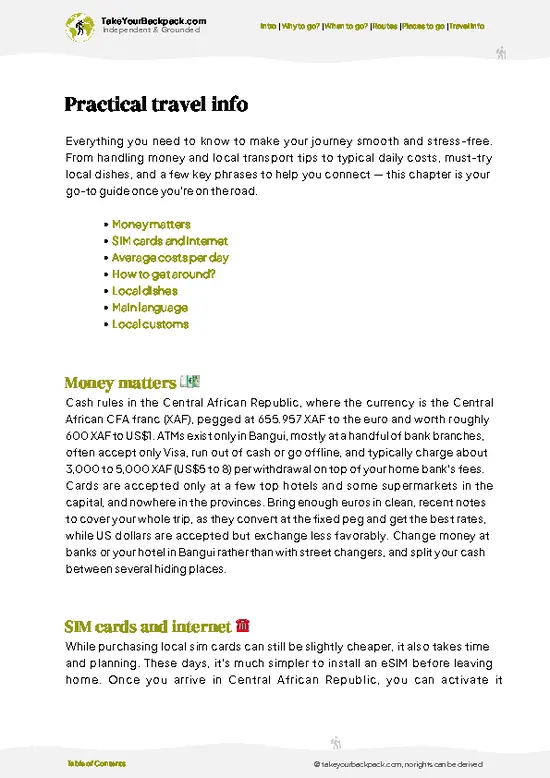
example page 0 from our offline Travel Guide for Central African Republic
example page 1 from our offline Travel Guide for Central African Republic
example page 2 from our offline Travel Guide for Central African Republic
example page 3 from our offline Travel Guide for Central African Republic
example page 4 from our offline Travel Guide for Central African Republic
example page 5 from our offline Travel Guide for Central African Republic
example page 6 from our offline Travel Guide for Central African Republic
example page 7 from our offline Travel Guide for Central African Republic
Loading the map 🌍
CLICK TO FILTER
cities
towns
landmarks
national parks
hikes
attractions
regions
SHOW COUNTRY’S BESTSHOW ALL

✨ Why go?
Ranked #2 town in Central African Republic
Reasons people choose to visit here

Bouar earns a place on a route for one reason that no other town in the west can match: the megalithic sites, standing stones and slab alignments that sit within reach of town, with a plateau climate that feels cooler than the lowlands. That is what pulls the traveler who likes archaeology and walking among stones with no ticket booth or fence. The second draw is access to everyday life. The central market, the Mbororo cattle trade and the mission community give you a view of western CAR that Bangui cannot. Most people who come stay two or three nights, since the stones need a slow morning and a guide, and the town itself is small enough to cover on foot. It suits experienced, self-reliant travelers, preferably with a contact in the Diocese of Bouar, who are comfortable with basic rooms, patchy … read more 👉
Bouar earns a place on a route for one reason that no other town in the west can match: the megalithic sites, standing stones and slab alignments that sit within reach of town, with a plateau climate that feels cooler than the lowlands. That is what pulls the traveler who likes archaeology and walking among stones with no ticket booth or fence. The second draw is access to everyday life. The central market, the Mbororo cattle trade and the mission community give you a view of western CAR that Bangui cannot. Most people who come stay two or three nights, since the stones need a slow morning and a guide, and the town itself is small enough to cover on foot. It suits experienced, self-reliant travelers, preferably with a contact in the Diocese of Bouar, who are comfortable with basic rooms, patchy electricity and early nights. If you need a social scene, cafés or a backpacker crowd, this is the wrong stop. Treat it as a deliberate, quiet detour.

💡 HighlightsThe experiences that define the visit

  1. Bouar Megaliths: The reason to come. Hundreds of upright stones and slabs, many of them arranged in groups, stand on hills around town, and they are among the oldest monuments of their kind in Central Africa. Go in the early morning, when the grass is cool and the light is flat and clear. Plan 2 to 4 hours, and expect to pay a local guide roughly €3 to 8.
  2. Central Market: Cassava, peanuts, dried fish, caterpillars in season, secondhand clothes and motorbike parts, all packed into one dusty grid. Go before 10:00, when the stalls are full and the heat is mild. It is free to enter, and 1 hour is plenty.
  3. Cathedral of Bouar: The seat of the Catholic diocese, and a quiet place where the mission community gathers on Sundays. Morning Mass is the best moment to see it in use, with long hymns in Sango.
… read more 👉
  1. Bouar Megaliths: The reason to come. Hundreds of upright stones and slabs, many of them arranged in groups, stand on hills around town, and they are among the oldest monuments of their kind in Central Africa. Go in the early morning, when the grass is cool and the light is flat and clear. Plan 2 to 4 hours, and expect to pay a local guide roughly €3 to 8.
  2. Central Market: Cassava, peanuts, dried fish, caterpillars in season, secondhand clothes and motorbike parts, all packed into one dusty grid. Go before 10:00, when the stalls are full and the heat is mild. It is free to enter, and 1 hour is plenty.
  3. Cathedral of Bouar: The seat of the Catholic diocese, and a quiet place where the mission community gathers on Sundays. Morning Mass is the best moment to see it in use, with long hymns in Sango. Entry is free, a small offering is welcome, and you need 30 to 45 minutes.
  4. Mbororo Cattle Gathering: Herders bring zebu cattle through the edges of town, and the trade here ties Bouar to markets across the border. It is lively and informal. Ask a local before photographing anyone. Early morning works best, it costs nothing, and 45 minutes is enough.
Bouar makes a good base for the farm towns of Baoro and Baboua, and for further stone sites on the surrounding plateau. Pair the megaliths in the early morning with the central market once the day warms up.
Spotted a mistake or missing something? Contact us.

🏘️ NeighborhoodsWhere things are and how it's laid out

Bouar is small enough that you can learn it in an afternoon, and the useful parts sit within a few kilometers of each other. Distances look short on a map, but unpaved side streets turn to mud in the rains, so wear closed shoes.
  • Town center and main market: This is where you will spend most of your time. Stalls sell cassava, peanuts, grilled meat, fruit and phone credit, and small restaurants nearby serve rice, stew and grilled fish. It is fully walkable. Go in the morning, since trade thins out by mid-afternoon, and skip the evening unless you want a cold drink at a simple bar.
  • Military and administrative quarter: Bouar hosts a large garrison, so parts of town are official ground. There is nothing to see and photographing buildings or uniforms invites questions. Walk through, do not linger,
… read more 👉
Bouar is small enough that you can learn it in an afternoon, and the useful parts sit within a few kilometers of each other. Distances look short on a map, but unpaved side streets turn to mud in the rains, so wear closed shoes.
  • Town center and main market: This is where you will spend most of your time. Stalls sell cassava, peanuts, grilled meat, fruit and phone credit, and small restaurants nearby serve rice, stew and grilled fish. It is fully walkable. Go in the morning, since trade thins out by mid-afternoon, and skip the evening unless you want a cold drink at a simple bar.
  • Military and administrative quarter: Bouar hosts a large garrison, so parts of town are official ground. There is nothing to see and photographing buildings or uniforms invites questions. Walk through, do not linger, and keep your camera down.
  • Road-side district toward Garoua-Boulaï and Bangui: Transport parks and minibuses load along the main road, so this is where you sort out onward travel. It is noisy and dusty from early morning. Fine for an hour of asking prices, not for wandering.
  • Residential outskirts and the Tounbi area: Quieter, with sprawling compounds and views of the surrounding granite hills. A walk here gives you the best sense of the highland landscape. Cover long distances by moto-taxi, because shade is scarce and the sun is strong.

⌛️ 1 dayHow to make the most of one day

7:00 AM: Bouar Central Market
Start where the town starts its day, because the stalls are fullest and the air is coolest before the sun climbs. Walk the lanes between cassava, peanuts, smoked fish and piles of tomatoes, and buy a bread roll and sweet tea from a vendor for breakfast. Greet people first; it changes every exchange.

9:00 AM: The megaliths on the edge of town
Bouar is known for its prehistoric standing stones, and the best-known group lies a short motorcycle-taxi ride from the center. The slabs are roughly two to three meters tall and sit in open grassland. Take your time, walk around them, and look for the carved or worn faces of the stones. Hire your driver to wait, since there is no regular transport back.

11:30 AM: Colline de la Mission area
Head back toward town and climb the … read more 👉
7:00 AM: Bouar Central Market
Start where the town starts its day, because the stalls are fullest and the air is coolest before the sun climbs. Walk the lanes between cassava, peanuts, smoked fish and piles of tomatoes, and buy a bread roll and sweet tea from a vendor for breakfast. Greet people first; it changes every exchange.

9:00 AM: The megaliths on the edge of town
Bouar is known for its prehistoric standing stones, and the best-known group lies a short motorcycle-taxi ride from the center. The slabs are roughly two to three meters tall and sit in open grassland. Take your time, walk around them, and look for the carved or worn faces of the stones. Hire your driver to wait, since there is no regular transport back.

11:30 AM: Colline de la Mission area
Head back toward town and climb the rising ground near the old mission buildings. The view over tin roofs and green hills explains why this plateau has a cooler feel than the lowlands. This is the part of the day that rarely appears on a standard itinerary, and you will likely have it to yourself.

1:00 PM: Lunch at a local maquis
Sit down at a simple open-air eatery for grilled chicken or fish with cassava or rice. Ask what is fresh that day and eat what the locals are eating. Order a cold drink and let the midday heat pass.

3:00 PM: Walk the Nana-Mambéré neighborhoods
Stroll the residential lanes at an easy pace, past mud-brick homes, small workshops and football games on dusty pitches. Keep your camera away unless someone invites a photo. People will stop to talk, and a few words of French go a long way.

5:30 PM: Evening on the main road
Finish with a drink at a roadside bar as the town cools and the streets fill with people heading home. Plan to be back at your lodging before full dark.

🌤️ When to go?Choosing the right time of year

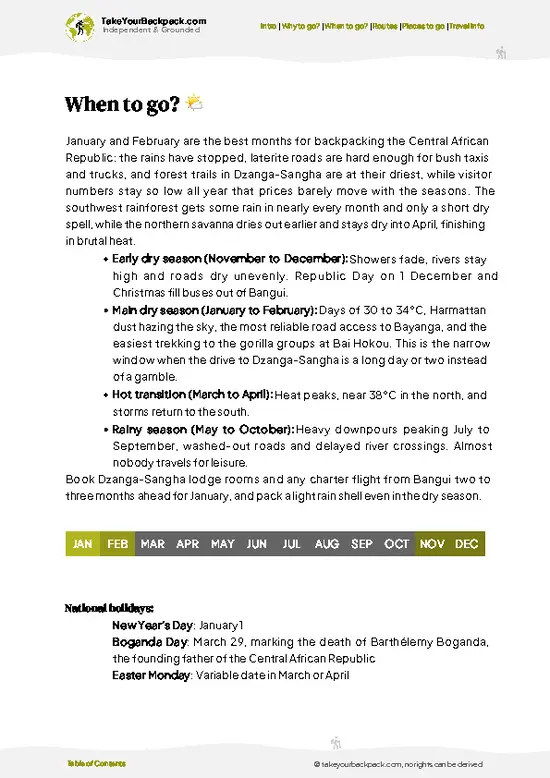
The dry months from roughly November to March are easiest for backpacking Bouar, with dirt roads firm and skies clearer.
  • Dry Season (November to March): Days reach 28 to 32°C (82 to 90°F), nights cool to 15 to 18°C (59 to 64°F) at this 1,000 meter altitude. Dust and harmattan haze can dull views in December and January. Roads are fastest and transport fares are most stable.
  • Transition (April to May): Heat builds toward 33°C (91°F) with early storms. Roads begin to soften.
  • Rainy Season (June to October): Highs of 25 to 29°C (77 to 84°F), heavy afternoon downpours and muddy tracks. Trips to villages slow down and fares rise when vehicles struggle on the road.
Daylight stays close to twelve hours all year, so plan any road leg to arrive before dark, and add a spare day in the rains.

source: climatestotravel.comJANJanuary: excellent for travelingFEBFebruary: excellent for travelingMARMarch: excellent for travelingAPRApril: highly recommended for travelingMAYMay: good for travelingJUNJune: fair for travelingJULJuly: fair for travelingAUGAugust: fair for travelingSEPSeptember: fair for travelingOCTOctober: good for travelingNOVNovember: highly recommended for travelingDECDecember: excellent for traveling
when-to-go

✈️ The backpacker research shortcutCentral African Republic Travel Guide

An offline-friendly backpacking guide with optimized travel routes, ranked highlights, transport advice, and the best areas to stay.
example page 0 from our offline Travel Guide for Central African Republic
example page 1 from our offline Travel Guide for Central African Republic
example page 2 from our offline Travel Guide for Central African Republic
example page 3 from our offline Travel Guide for Central African Republic
example page 4 from our offline Travel Guide for Central African Republic
example page 5 from our offline Travel Guide for Central African Republic
example page 6 from our offline Travel Guide for Central African Republic
example page 7 from our offline Travel Guide for Central African Republic
The digital guide (210 pages) contains:
✅ 42 highlights, ranked by travel appeal
✅ Optimized 5, 10 & 15-day travel routes
✅ Cities, national parks, landmarks, beaches
✅ How to get around
✅ Offline-friendly for travel without Wi-Fi
👉 Click to see all 30+ guide features

📅 Plan smarter in minutes, not weeks
✅ Month by month travel advice
✅ Festivals & national holidays
✅ Budget expectations

🗺️ Go to the right places, skip the overrated ones
✅ Honest pros & cons of destinations
✅ Top hikes, parks & viewpoints
✅ Lesser-known places most travelers miss
✅ Clear “worth it vs skip it” guidance

🛏️ Travel smoothly without rookie mistakes
✅ Best areas to stay
✅ Transport systems explained simply
✅ Common scams & safety advice
✅ SIM cards, money & practical tips

🌍 Understand the country, not just visit it
✅ Culture & traditions
✅ 52 Essential phrases & customs
✅ Festivals worth planning around
✅ Traveler-friendly historical context
✅ Insights that make places more meaningful

📱 Built for real travel conditions
✅ Fully downloadable PDF
✅ Works completely offline
✅ Optimized for phone use
✅ Useful in remote areas & buses
✅ Everything in one place
Stop searching, start planning
Get instant access to your full guide. 30‑day money-back guarantee.
+ Add another guide for just

By proceeding you agree to our terms.
Sent to your inbox immediately after payment • 100% Secure Checkout
Best Backpacking Travel Advisor 2025 tourism awardBest Backpacking
Travel Advisor
2025
What others say about Take Your Backpack Guides:
⭐⭐⭐⭐⭐
Fantastic, amazing amount of information!
⭐⭐⭐⭐⭐
My goodness this is amazing, it's what I've been looking for hats off too you!
⭐⭐⭐⭐⭐
I think this is absolutely BRILLIANT
⭐⭐⭐⭐
Very complete and informative. It's still missing places, but I gotta to commend you
⭐⭐⭐⭐⭐
This is truly amazing, thank you, can't wait to explore it with my kids!
⭐⭐⭐⭐⭐
Awesome resource, thank you!
⭐⭐⭐⭐⭐
This is amazing! Can't wait to explore the ones I haven't seen
⭐⭐⭐⭐
I love this! Well done, great idea.
⭐⭐⭐⭐⭐
Thanks for taking the time to make this gem!
⭐⭐⭐⭐⭐
This might be the best website I've ever seen.
⭐⭐⭐⭐⭐
Congratulations, and thank you so much for your work; it's incredibly valuable.
⭐⭐⭐⭐
In all seriousness I think you did a great job pointing out the important spots
⭐⭐⭐⭐⭐
10/10 very good
⭐⭐⭐⭐⭐
As someone who's only just starting to visit regularly this is awesome, thank you.
⭐⭐⭐⭐
Thank you very much! I'm going to visit my dad, it's going to be very useful!
⭐⭐⭐⭐⭐
This is really cool! We'll be travelling for the first time and this definitely come in handy.
⭐⭐⭐⭐⭐
You are now our minister of culture, congratulations 👨‍💼
⭐⭐⭐⭐⭐
Just wanted to tell you that this is a pearl! Going to follow your recommendations.
⭐⭐⭐⭐⭐
This is so cool. I'll definitely be using the resource for my travels soon.
⭐⭐⭐⭐⭐
This is very impressive! Good work.
⭐⭐⭐⭐⭐
This is an amazing and informative site. Very well done!

🛏️ Where to stay?Best areas to stay in Central African Republic

The center near the main market is the best area for a budget bed in Bouar, because everything you need is within a short walk. Choices are limited and there are no true backpacker hostels, so expect basic guesthouses and simple hotels with private rooms, often at €10 to 25 a night. Dorms are essentially nonexistent. Book ahead by phone where possible, as the number of rooms is small and the garrison and aid workers fill the better ones.

Staying close to the center helps after dark. Street lighting is weak and power cuts are common, so a short walk home beats a moto-taxi ride through unlit streets. … read more 👉
The center near the main market is the best area for a budget bed in Bouar, because everything you need is within a short walk. Choices are limited and there are no true backpacker hostels, so expect basic guesthouses and simple hotels with private rooms, often at €10 to 25 a night. Dorms are essentially nonexistent. Book ahead by phone where possible, as the number of rooms is small and the garrison and aid workers fill the better ones.

Staying close to the center helps after dark. Street lighting is weak and power cuts are common, so a short walk home beats a moto-taxi ride through unlit streets. Choose a room away from the main road if you are a light sleeper, because trucks and minibuses start loading before dawn and the noise carries.

The road-side district toward the Cameroon border is the second option if you have an early departure. You can step straight to the loading point and avoid arranging a ride at 5 am. Expect dust, engine noise and fewer places to eat nearby. Check that your room has a working fan or window screen, a fixed lock and a water supply, and bring a mosquito net, as many rooms lack one.

🚌 Getting aroundTransportation options and practical tips

Bouar’s center is walkable in under 20 minutes end to end, but walking stops making sense once you head for the outskirts, the hills or anywhere after dark. Traffic is light and consists mostly of motorbikes. There is no public bus network, so you rely on moto-taxis and shared vehicles, and long-distance departures are informal.
  • Walking: Free and best for the market, restaurants and the main road. Pavement is patchy, and rain makes side streets slippery. Skip long walks at midday because the sun is harsh.
  • Moto-taxi: The standard way to cover short distances, usually €0.40 to 1.50 per ride. Agree the price before you climb on, since there are no meters. Ask for a helmet, though not every rider has a spare. Not worth using at night.
  • Shared taxi or minibus on the main road: Used for the road toward
… read more 👉
Bouar’s center is walkable in under 20 minutes end to end, but walking stops making sense once you head for the outskirts, the hills or anywhere after dark. Traffic is light and consists mostly of motorbikes. There is no public bus network, so you rely on moto-taxis and shared vehicles, and long-distance departures are informal.
  • Walking: Free and best for the market, restaurants and the main road. Pavement is patchy, and rain makes side streets slippery. Skip long walks at midday because the sun is harsh.
  • Moto-taxi: The standard way to cover short distances, usually €0.40 to 1.50 per ride. Agree the price before you climb on, since there are no meters. Ask for a helmet, though not every rider has a spare. Not worth using at night.
  • Shared taxi or minibus on the main road: Used for the road toward Baoro and Bangui in one direction and Garoua-Boulaï in Cameroon in the other. Vehicles leave when full, usually early in the morning, so turn up by 6 am. Expect long, uncertain trips on rough roads, with fares from roughly €10 to 30 depending on destination and season. Confirm your seat with the driver, and expect checkpoints.
  • Hired motorbike or car with driver: The only practical option for village visits or hill viewpoints. A motorbike with a driver for a half day costs roughly €8 to 15, a car considerably more. Fuel is expensive, so negotiate firmly and agree the return leg first.
Bring small bills in local currency, since drivers rarely have change. Euros are not used for fares, but they are useful to exchange.

👛 Costs (as of 22 October 2026)Typical daily expenses

Bouar costs roughly €28 to 55 a day for a backpacker, with a total of €42 at high-season rates. Prices run above neighboring countries because goods arrive over difficult roads.
CategoryBudget RangeLocal Reality
Dorm accommodation€10 to 25 (private basic room, high season)No real dorms exist. A simple guesthouse room is the cheapest bed, and rates rise a bit in the dry season.
Meals€5 to 10Rice, cassava, stew and grilled fish at small restaurants and market stalls cost little. Western-style food is rare and pricier.
Local transport€2 to 5Moto-taxis cost €0.40 to 1.50 a ride. Fares increase after dark and in rain.
Basic activities/entry fees€3 to 8Few sites charge fees. You mainly pay a driver or local guide for the megalith visits.
Miscellaneous expenses€2 to 5Water, phone credit, mosquito repellent
… read more 👉
Bouar costs roughly €28 to 55 a day for a backpacker, with a total of €42 at high-season rates. Prices run above neighboring countries because goods arrive over difficult roads.
CategoryBudget RangeLocal Reality
Dorm accommodation€10 to 25 (private basic room, high season)No real dorms exist. A simple guesthouse room is the cheapest bed, and rates rise a bit in the dry season.
Meals€5 to 10Rice, cassava, stew and grilled fish at small restaurants and market stalls cost little. Western-style food is rare and pricier.
Local transport€2 to 5Moto-taxis cost €0.40 to 1.50 a ride. Fares increase after dark and in rain.
Basic activities/entry fees€3 to 8Few sites charge fees. You mainly pay a driver or local guide for the megalith visits.
Miscellaneous expenses€2 to 5Water, phone credit, mosquito repellent and small tips for guides.
Total Daily Budget€42Longer onward trips and tours cost extra.
Bring cash in euros to exchange, since cards and ATMs are unreliable. Eat where locals do at the market to keep food costs lowest.


source: worldbank.org
⚠️ Prices can change and everyone travels differently, so take this as a rough guide. Hope it helps you plan your adventure!

🚌 Day tripsShort trips worth adding

Bouar works as a base for short outings, but there is little organized tourism, so you arrange everything yourself with a hired motorbike or driver.
Megalithic sites around Bouar: Hundreds of standing stones and tumuli lie in the countryside around town, some dating back over 2,000 years. They are the area’s real draw. Allow half a day, hire a local motorbike driver for roughly €8 to 15, and ask a local guide for the best-preserved groups. Go in the dry season, because tracks flood in the rains. First-timers often forget water and shade.

Baoro: This town lies on the road toward Bangui and makes a straightforward outing by shared vehicle, usually about €3 to 8 each way. It gives you a look at highland farmland and a bigger market. Leave early so you can return before the last vehicles fill. … read more 👉
Bouar works as a base for short outings, but there is little organized tourism, so you arrange everything yourself with a hired motorbike or driver.
Megalithic sites around Bouar: Hundreds of standing stones and tumuli lie in the countryside around town, some dating back over 2,000 years. They are the area’s real draw. Allow half a day, hire a local motorbike driver for roughly €8 to 15, and ask a local guide for the best-preserved groups. Go in the dry season, because tracks flood in the rains. First-timers often forget water and shade.

Baoro: This town lies on the road toward Bangui and makes a straightforward outing by shared vehicle, usually about €3 to 8 each way. It gives you a look at highland farmland and a bigger market. Leave early so you can return before the last vehicles fill. Many visitors mistakenly leave too late and get stuck overnight.

Granite hills and viewpoints near Bouar: Rocky outcrops rise above town and reward a morning walk with wide views across the plateau. Total cost is minimal if you walk or pay a short moto-taxi fare of €1 to 3. Go at dawn, as haze builds later, and wear sturdy shoes because rock surfaces get slick after rain. Tell someone at your guesthouse where you are going.

🛡️ SafetyStaying Safe: What Travelers Should Know

Bouar is calmer than much of the country, but the Central African Republic has an unstable security situation and conditions can change, so check with your embassy and local contacts before you arrive. Armed groups remain active in parts of the region, and travel on roads outside town carries real risk, especially after dark. Move only in daylight and avoid long overland legs at night. Checkpoints are frequent. Carry your passport and a photocopy, stay polite and keep documents ready. Photographing military sites, uniforms or officials is a quick way to cause trouble, so ask first or put the camera away. Inside town, petty theft is uncommon but keep valuables out of sight. Solo travelers should not walk unlit streets at night and are better off arranging a known driver. Quote prices are often … read more 👉
Bouar is calmer than much of the country, but the Central African Republic has an unstable security situation and conditions can change, so check with your embassy and local contacts before you arrive. Armed groups remain active in parts of the region, and travel on roads outside town carries real risk, especially after dark. Move only in daylight and avoid long overland legs at night. Checkpoints are frequent. Carry your passport and a photocopy, stay polite and keep documents ready. Photographing military sites, uniforms or officials is a quick way to cause trouble, so ask first or put the camera away. Inside town, petty theft is uncommon but keep valuables out of sight. Solo travelers should not walk unlit streets at night and are better off arranging a known driver. Quote prices are often set higher for foreigners, so agree fares in advance. Local contacts are your best protection.

FAQTraveler FAQ

Bouar rewards a short, curious visit more than a long one, though it is a working garrison and trading town rather than a sightseeing hub. The main draws are the Toumbou megalithic sites on the surrounding plateau, which are among the oldest standing stone alignments in Central Africa, plus the busy central market and cool highland evenings at roughly 1,000 meters. Budget travelers should expect basic services, cash only, and a need to arrange transport and security updates locally before heading out.
Plan on 2 days in Bouar: one for the town, its market and the Catholic mission area, and one for a trip to the megalithic stone sites on the plateau, which are 10 to 20 km away by moto-taxi or hired motorbike. Add a third day only if you want to walk the countryside or wait out a road delay, since onward transport west toward Cameroon or east toward Bangui leaves irregularly. Daily costs stay low, around €25 to 45 including a basic room and simple meals.
Bouar is not practical as a day trip from a nearby city, because the closest large town, Bossembélé, is several hours away, and the road to Bangui (roughly 450 km) takes a full day or more depending on conditions and checkpoints. Bouar sits on the main route toward the Cameroon border at Garoua-Boulaï, about 150 km west, which makes it better as an overnight stop on that corridor. Spend at least one night, and check current security and road conditions before you travel.
⚠️ Things can change over time, so always validate details locally before you go.

Other Central African towns near Bouar

Explore more nearby:

  • Bozoum—river valley, agricultural fields, mission schools| 96 km away
  • Carnot—diamond mining, colonial-era buildings, forest edge| 115 km away
  • Mokolo—remote location, border proximity, river crossing| 158 km away

💡 Not sure where to go next?
Create a personalized itinerary for Central African Republic including Bouar and the places that fit your trip.

Generate my itinerary

👉 Discover all towns

Or checkout all Central African Republic has to offer (think cities, towns, villages, national parks, hikes, beaches, festivals)
Country photo of Central African Republic

We 💚 feedbackSumming up the experience

Bouar’s quiet is the detail first-timers overlook: the plateau air is noticeably cooler than most of the country, so evenings are comfortable and sleep comes easily. I would bring a light layer, stay a night longer than planned, and spend the extra morning talking to market sellers. Skip rushing the stones and give them a slow hour.

✍️ Help improve this page!
The information on this page is based on in-depth research, insights shared by experienced travelers, and feedback from the local travel community in Central African Republic. While every effort is made to keep the information accurate and current, conditions can change — so if you spot anything incorrect or outdated, please get in touch.


🙋‍♂️ Give feedback

👋 Meet the founderWho’s Behind Take Your Backpack?

Johan, backpacker and founder of TakeYourBackpackHi, I’m Johan (Netherlands 🇳🇱), the creator of TakeYourBackpack. Over the past 3 decades, I’ve backpacked through 90+ countries across six continents, gaining extensive experience with independent travel, long-term trips, and overland routes.

This site is built on a combination of firsthand travel experience and carefully curated insights from other backpackers. Many guides are based on places I’ve personally visited, while others bring together tips, observations, and practical advice shared by trusted travelers I’ve met along the way.

The goal is to provide realistic, experience-driven guidance — not generic itineraries — so you can explore destinations with better context, clearer expectations, and more confidence.