×

Central African Republic🇨🇫 | townsCarnotDiamond comptoirs, Mambéré washing spots, caterpillar market, drum-led Sunday Mass | things to do and best time to go

Explore BiraoExplore Ouadda

Backpacking in Carnot
🌟 Highlighttown ranked #6
By Johan Kruseman 🇳🇱 | Updated October 22, 2026

Carnot is a diamond-buying town, and that shapes everything from the pickup trucks to the cash in people’s pockets. It sits in the southwest of the Central African Republic, in Mambéré-Kadéï prefecture, on the main western road toward Berbérati. Don’t come for sights. There is no old quarter, no museum and no trail network, and a day of hunting for monuments is wasted. What works is the central market, the river and the slow evening talk with traders, drivers and miners. Transport is irregular and the roads are rough, so experienced travelers ask at the market or the motor park for a seat on a truck or minibus, then keep the schedule loose. Hostels do not exist, so you rely on small guesthouses or mission hospitality. Meeting other backpackers is unlikely. Compared with Berbérati, a larger regional hub, Carnot is quieter and smaller.

Discover everything you want to know in the 📖 Central African Republic Travel Guide.
Safety warning

The current risk level for Central African Republic is high. Check the advice before going.


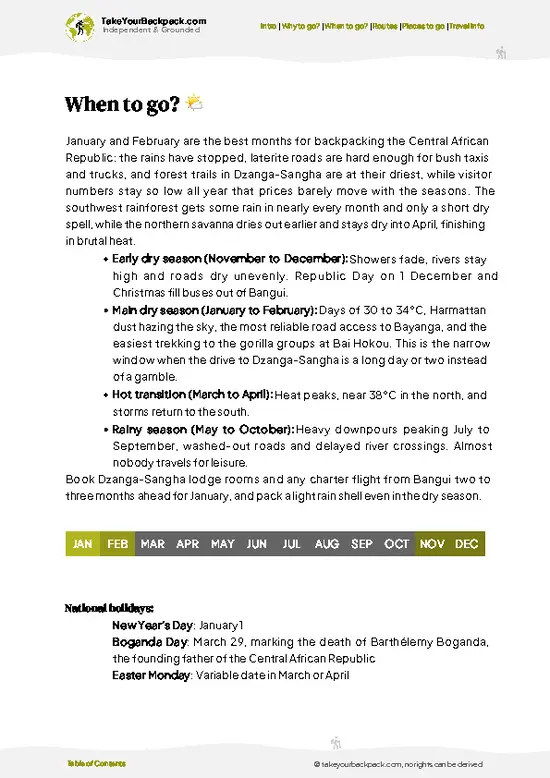
example page 0 from our offline Travel Guide for Central African Republic
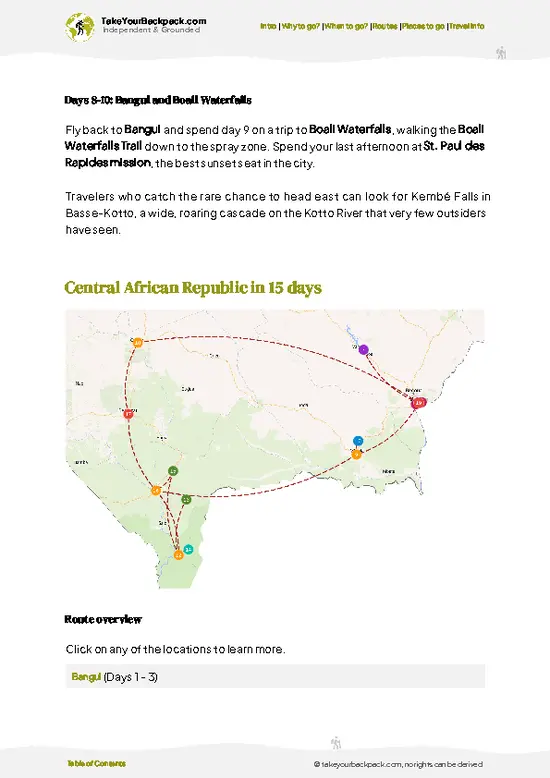
example page 1 from our offline Travel Guide for Central African Republic
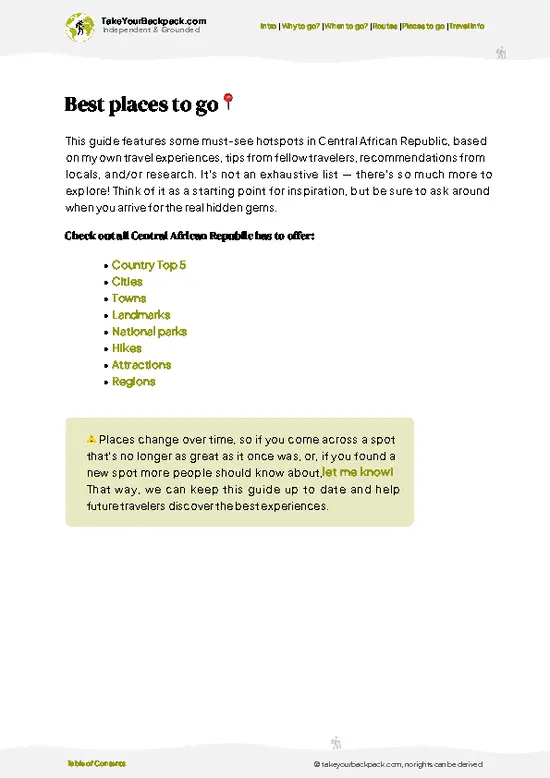
example page 2 from our offline Travel Guide for Central African Republic
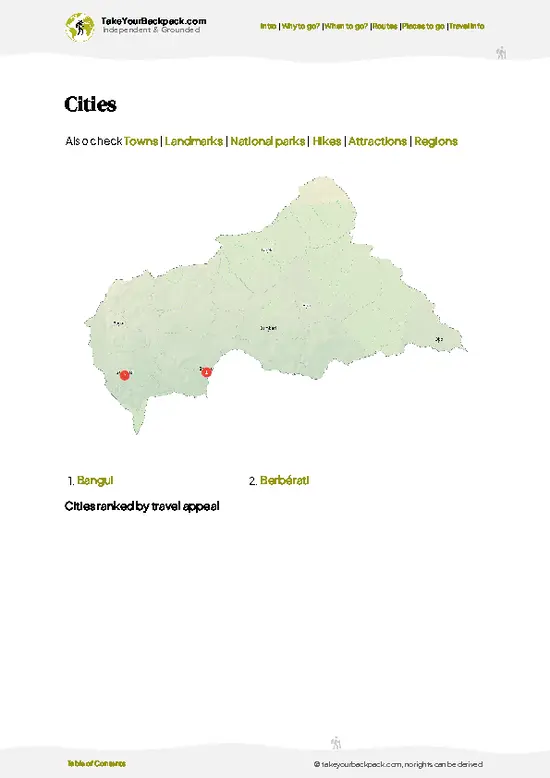
example page 3 from our offline Travel Guide for Central African Republic
example page 4 from our offline Travel Guide for Central African Republic
example page 5 from our offline Travel Guide for Central African Republic
example page 6 from our offline Travel Guide for Central African Republic
example page 7 from our offline Travel Guide for Central African Republic
Loading the map 🌍
CLICK TO FILTER
cities
towns
landmarks
national parks
hikes
attractions
regions
SHOW COUNTRY’S BESTSHOW ALL

✨ Why go?
Ranked #6 town in Central African Republic
What makes it a must-see town

Carnot gives you a look at a working diamond and coffee town in western Central African Republic, with no tour groups and no performance for visitors. The draw is access to everyday life: the central market, where produce, cassava, smoked fish and bush goods change hands, and the Mambéré River area, where people wash, fish and trade. Walk everywhere, since the center is compact. Conversation matters here, and French or Sango opens doors far faster than anything else. Most people pass through in a night or two because of limited transport. Slow travelers with patience, a flexible plan and local contacts get the most from it. Hikers, party seekers and anyone wanting a polished hostel scene should skip it. Treat it as a place to understand how the region’s economy works, then move on along the RN3 corridor.

💡 HighlightsEssential experiences to have while visiting Carnot

  1. Carnot Central Market: This is the town’s best hour. Expect cassava, peanuts, smoked fish, palm oil and caterpillars in season, plus motorbike parts and cloth. Go early, around 7 to 10 am, when stocks are fullest. Entry is free, and 1 to 2 hours is plenty. Ask before photographing anyone.
  2. Mambéré River banks: Women wash clothes, boys fish and canoes cross at the water’s edge. It is the calmest spot in town, best in the late afternoon. Free, and 45 minutes to an hour covers it. Stay on the paths locals use.
  3. Diamond buying offices (comptoirs): These are the reason Carnot exists. Licensed buyers deal with diggers in small offices near the center. Visiting is by invitation only, so do not walk in uninvited. Cost is free if you are introduced, and about 30 minutes is typical. A local guide or guesthouse
… read more 👉
  1. Carnot Central Market: This is the town’s best hour. Expect cassava, peanuts, smoked fish, palm oil and caterpillars in season, plus motorbike parts and cloth. Go early, around 7 to 10 am, when stocks are fullest. Entry is free, and 1 to 2 hours is plenty. Ask before photographing anyone.
  2. Mambéré River banks: Women wash clothes, boys fish and canoes cross at the water’s edge. It is the calmest spot in town, best in the late afternoon. Free, and 45 minutes to an hour covers it. Stay on the paths locals use.
  3. Diamond buying offices (comptoirs): These are the reason Carnot exists. Licensed buyers deal with diggers in small offices near the center. Visiting is by invitation only, so do not walk in uninvited. Cost is free if you are introduced, and about 30 minutes is typical. A local guide or guesthouse owner can sometimes make the introduction.
  4. Catholic mission church: The mission is one of the town’s oldest institutions and the center of its Sunday life. Services are lively, with choirs and drums. Go on Sunday morning, dress modestly and stay for an hour or so. There is no fee, though a small donation is welcome (€1 to 2).
Beyond town, you can reach Berbérati for its larger market and cathedral, and the diamond and gold digging villages along the Mambéré-Kadéï rivers, but only with a local guide. Carnot has nothing that needs a ticket or advance booking.
Spotted a mistake or missing something? Contact us.

🏘️ NeighborhoodsKey areas and districts to know

Carnot is a small diamond-and-coffee trading town on the Mambéré River, and its areas sit within a short walk of each other. Here is how they differ and what to do with each.
  • Town center and main market: This is where the town works. Stalls sell cassava, groundnuts, grilled fish, caterpillars in season and basic goods, and morning is best because trade thins by early afternoon, so go before noon. Small bars serve beer and grilled meat after dark. It is fully walkable, and it is the one area worth real time.
  • Riverside and Mambéré banks: Fishing canoes and washing spots make for easy people-watching, and the water is the reason Carnot exists as a trading post. Photograph only after asking, since people here dislike being shot without consent. A hour is plenty.
  • Diamond-buying quarter: Comptoirs
… read more 👉
Carnot is a small diamond-and-coffee trading town on the Mambéré River, and its areas sit within a short walk of each other. Here is how they differ and what to do with each.
  • Town center and main market: This is where the town works. Stalls sell cassava, groundnuts, grilled fish, caterpillars in season and basic goods, and morning is best because trade thins by early afternoon, so go before noon. Small bars serve beer and grilled meat after dark. It is fully walkable, and it is the one area worth real time.
  • Riverside and Mambéré banks: Fishing canoes and washing spots make for easy people-watching, and the water is the reason Carnot exists as a trading post. Photograph only after asking, since people here dislike being shot without consent. A hour is plenty.
  • Diamond-buying quarter: Comptoirs (buying offices) cluster here, and the trade explains the tension around strangers with cameras. Skip lingering, and do not ask about stones. Nothing here is a sight.
  • Outer residential quarters: Mud-brick compounds, mango trees and church services on Sunday mornings give a feel for ordinary life. Paths turn muddy in the rains, and there is no lighting at night, so walk them only in daylight and with a local guide or host.

⌛️ 1 dayWhat you can realistically do in a day

This is a river-and-market day, slow by design, because Carnot is a small diamond-trading town in the west of the country and the best of it happens outdoors.
7:00 AM, Central market: Start where the town starts. Traders set out cassava, dried fish, caterpillars in season, peanuts and cheap basins of tomatoes before the heat builds. Buy a bag of roasted peanuts, eat breakfast from a street vendor (bread and sweet coffee is the usual), and walk slowly. Greet people first. A short stroll east takes you to the next stop.
9:00 AM, Diamond-buying quarter: Carnot’s identity is built on alluvial diamonds, and the small buying offices and dealers’ houses show it. Do not photograph anyone handling stones, and do not ask to see gems. Watching the comings and goings from a café table is enough, and it … read more 👉
This is a river-and-market day, slow by design, because Carnot is a small diamond-trading town in the west of the country and the best of it happens outdoors.
7:00 AM, Central market: Start where the town starts. Traders set out cassava, dried fish, caterpillars in season, peanuts and cheap basins of tomatoes before the heat builds. Buy a bag of roasted peanuts, eat breakfast from a street vendor (bread and sweet coffee is the usual), and walk slowly. Greet people first. A short stroll east takes you to the next stop.
9:00 AM, Diamond-buying quarter: Carnot’s identity is built on alluvial diamonds, and the small buying offices and dealers’ houses show it. Do not photograph anyone handling stones, and do not ask to see gems. Watching the comings and goings from a café table is enough, and it explains why the town has money in odd corners.
11:00 AM, Mambéré riverbank: Follow a footpath down to the water, where women wash clothes and boys fish with hand nets. Sit in the shade for an hour. It is the quietest stretch of the day and the best place to chat with locals who speak some French or Sango.
1:00 PM, Lunch at a maquis: Find a simple open-air restaurant for grilled fish or chicken with manioc and a spicy sauce. Eat early, since kitchens run out by mid-afternoon.
3:00 PM, Old mission quarter and church: Most visitors never walk here, which is exactly why it is worth the detour. Quiet lanes, old brick buildings and a church with a small school give a view of colonial-era Carnot that the main road hides.
5:30 PM, Back by the road junction: Finish where transport gathers, with a cold drink and grilled skewers as the town winds down and the market stalls turn into evening lamps.

🌤️ When to go?When to go for the best experience

The dry months from roughly December to February are easiest for Carnot, when roads are firmest and mud is minimal.
  • Dry Season (Dec to Feb): Days reach 30 to 34°C (86 to 93°F), nights cool to about 18 to 20°C (64 to 68°F), and harmattan dust can haze the air. Roads are at their best, and transport fares are steadier.
  • Shoulder Months (Mar to May): Heat builds to 33 to 36°C (91 to 97°F) with the first storms, and humidity climbs.
  • Rainy Season (Jun to Oct): Expect 24 to 30°C (75 to 86°F), heavy downpours and rutted laterite tracks that can strand vehicles for a day or more. Fares for rides rise when roads are bad.
  • Daylight: Days stay close to 12 hours all year, so plan travel for the morning.
Start any overland leg at dawn, because afternoon storms are the main cause of delays.

source: climatestotravel.comJANJanuary: excellent for travelingFEBFebruary: excellent for travelingMARMarch: excellent for travelingAPRApril: highly recommended for travelingMAYMay: good for travelingJUNJune: fair for travelingJULJuly: fair for travelingAUGAugust: fair for travelingSEPSeptember: fair for travelingOCTOctober: good for travelingNOVNovember: highly recommended for travelingDECDecember: excellent for traveling
when-to-go

✈️ The backpacker research shortcutCentral African Republic Travel Guide

An offline-friendly backpacking guide with optimized travel routes, ranked highlights, transport advice, and the best areas to stay.
example page 0 from our offline Travel Guide for Central African Republic
example page 1 from our offline Travel Guide for Central African Republic
example page 2 from our offline Travel Guide for Central African Republic
example page 3 from our offline Travel Guide for Central African Republic
example page 4 from our offline Travel Guide for Central African Republic
example page 5 from our offline Travel Guide for Central African Republic
example page 6 from our offline Travel Guide for Central African Republic
example page 7 from our offline Travel Guide for Central African Republic
The digital guide (210 pages) contains:
✅ 42 highlights, ranked by travel appeal
✅ Optimized 5, 10 & 15-day travel routes
✅ Cities, national parks, landmarks, beaches
✅ How to get around
✅ Offline-friendly for travel without Wi-Fi
👉 Click to see all 30+ guide features

📅 Plan smarter in minutes, not weeks
✅ Month by month travel advice
✅ Festivals & national holidays
✅ Budget expectations

🗺️ Go to the right places, skip the overrated ones
✅ Honest pros & cons of destinations
✅ Top hikes, parks & viewpoints
✅ Lesser-known places most travelers miss
✅ Clear “worth it vs skip it” guidance

🛏️ Travel smoothly without rookie mistakes
✅ Best areas to stay
✅ Transport systems explained simply
✅ Common scams & safety advice
✅ SIM cards, money & practical tips

🌍 Understand the country, not just visit it
✅ Culture & traditions
✅ 52 Essential phrases & customs
✅ Festivals worth planning around
✅ Traveler-friendly historical context
✅ Insights that make places more meaningful

📱 Built for real travel conditions
✅ Fully downloadable PDF
✅ Works completely offline
✅ Optimized for phone use
✅ Useful in remote areas & buses
✅ Everything in one place
Stop searching, start planning
Get instant access to your full guide. 30‑day money-back guarantee.
+ Add another guide for just

By proceeding you agree to our terms.
Sent to your inbox immediately after payment • 100% Secure Checkout
Best Backpacking Travel Advisor 2025 tourism awardBest Backpacking
Travel Advisor
2025
What others say about Take Your Backpack Guides:
⭐⭐⭐⭐⭐
Fantastic, amazing amount of information!
⭐⭐⭐⭐⭐
My goodness this is amazing, it's what I've been looking for hats off too you!
⭐⭐⭐⭐⭐
I think this is absolutely BRILLIANT
⭐⭐⭐⭐
Very complete and informative. It's still missing places, but I gotta to commend you
⭐⭐⭐⭐⭐
This is truly amazing, thank you, can't wait to explore it with my kids!
⭐⭐⭐⭐⭐
Awesome resource, thank you!
⭐⭐⭐⭐⭐
This is amazing! Can't wait to explore the ones I haven't seen
⭐⭐⭐⭐
I love this! Well done, great idea.
⭐⭐⭐⭐⭐
Thanks for taking the time to make this gem!
⭐⭐⭐⭐⭐
This might be the best website I've ever seen.
⭐⭐⭐⭐⭐
Congratulations, and thank you so much for your work; it's incredibly valuable.
⭐⭐⭐⭐
In all seriousness I think you did a great job pointing out the important spots
⭐⭐⭐⭐⭐
10/10 very good
⭐⭐⭐⭐⭐
As someone who's only just starting to visit regularly this is awesome, thank you.
⭐⭐⭐⭐
Thank you very much! I'm going to visit my dad, it's going to be very useful!
⭐⭐⭐⭐⭐
This is really cool! We'll be travelling for the first time and this definitely come in handy.
⭐⭐⭐⭐⭐
You are now our minister of culture, congratulations 👨‍💼
⭐⭐⭐⭐⭐
Just wanted to tell you that this is a pearl! Going to follow your recommendations.
⭐⭐⭐⭐⭐
This is so cool. I'll definitely be using the resource for my travels soon.
⭐⭐⭐⭐⭐
This is very impressive! Good work.
⭐⭐⭐⭐⭐
This is an amazing and informative site. Very well done!

🛏️ Where to stay?Where staying makes the most sense

The center near the main market is the best area to sleep in Carnot, because beds, food and moto-taxis are all within a few minutes. Dedicated hostels do not exist, so budget travelers rely on basic guesthouses and mission-run lodgings, typically €8 to 20 a night, often with a fan and bucket shower. Rooms are limited, so ask ahead when you can.

The quieter streets just off the center are a good second choice. They cost about the same, with less noise from bars and generators, but electricity is irregular everywhere, so bring a power bank and a headlamp. Avoid sleeping on the far edges of town, … read more 👉
The center near the main market is the best area to sleep in Carnot, because beds, food and moto-taxis are all within a few minutes. Dedicated hostels do not exist, so budget travelers rely on basic guesthouses and mission-run lodgings, typically €8 to 20 a night, often with a fan and bucket shower. Rooms are limited, so ask ahead when you can.

The quieter streets just off the center are a good second choice. They cost about the same, with less noise from bars and generators, but electricity is irregular everywhere, so bring a power bank and a headlamp. Avoid sleeping on the far edges of town, where unlit paths, no taxis after dark and little help nearby make late arrivals harder. Choose a place with a lockable door and a walled yard, and check that your room has a working lock before paying. Prices are firm for foreigners, but a stay of several nights can bring a small reduction.

🚌 Getting aroundMoving around without the hassle

Carnot is small enough that its center, market and riverbank are all reachable on foot in under 20 minutes, and walking stops making sense only when you head to outlying quarters after dark or in heavy rain. Traffic is light, but public transport is informal and unscheduled. Fuel is scarce and pricey, so fares are negotiated and vary with road conditions.
  • Walking: Free, and the best way to see the market and river. Go by day, since streets have almost no lighting, and carry a headlamp.
  • Moto-taxi: The default for short hops, usually €0.50 to 1.50 within town and €3 to 8 to nearby villages. Agree the price first because there are no meters, and hold on tight on mud tracks.
  • Shared vehicles to Berbérati: Pickups and minibuses run the road east toward Berbérati, roughly €6 to 15 depending on season
… read more 👉
Carnot is small enough that its center, market and riverbank are all reachable on foot in under 20 minutes, and walking stops making sense only when you head to outlying quarters after dark or in heavy rain. Traffic is light, but public transport is informal and unscheduled. Fuel is scarce and pricey, so fares are negotiated and vary with road conditions.
  • Walking: Free, and the best way to see the market and river. Go by day, since streets have almost no lighting, and carry a headlamp.
  • Moto-taxi: The default for short hops, usually €0.50 to 1.50 within town and €3 to 8 to nearby villages. Agree the price first because there are no meters, and hold on tight on mud tracks.
  • Shared vehicles to Berbérati: Pickups and minibuses run the road east toward Berbérati, roughly €6 to 15 depending on season and seat. They leave when full, usually early morning, so be at the lot by 6 am and expect 3 to 6 hours or much longer in the rains.
  • Long-distance to Bangui: Overland journeys west to the capital take well over a day and conditions vary a lot. Fares run about €20 to 40 on trucks and buses. Many travelers fly out of Berbérati instead because the road is slow and risky, which is not worth the savings.
Carry small bills, since drivers rarely have change, and ask your host or a trusted local to find a driver rather than accepting the first offer.

👛 Costs (as of 22 October 2026)What things cost and how to budget

Carnot costs about €8 to 20 a day for a backpacker, with the total daily budget at €52 in high season, and almost everything paid in cash.
CategoryBudget RangeLocal Reality
Dorm accommodation€8 to 20No dorms exist, so you pay for a basic private room in a guesthouse or mission lodging. High season is the dry months.
Meals€5 to 12Cassava, rice, beans, grilled fish and street snacks are cheap, and imported items cost much more.
Local transport€3 to 10Moto-taxis within town cost €0.50 to 1.50 a ride, and trips to villages cost more.
Basic activities/entry fees€0 to 8Few formal sights, but a local guide for river or forest walks costs a small fee.
Miscellaneous expenses€5 to 10Water, phone credit, power bank charging and small tips at checkpoints or to helpers.
Total Daily Budget€52Per person, one day
… read more 👉
Carnot costs about €8 to 20 a day for a backpacker, with the total daily budget at €52 in high season, and almost everything paid in cash.
CategoryBudget RangeLocal Reality
Dorm accommodation€8 to 20No dorms exist, so you pay for a basic private room in a guesthouse or mission lodging. High season is the dry months.
Meals€5 to 12Cassava, rice, beans, grilled fish and street snacks are cheap, and imported items cost much more.
Local transport€3 to 10Moto-taxis within town cost €0.50 to 1.50 a ride, and trips to villages cost more.
Basic activities/entry fees€0 to 8Few formal sights, but a local guide for river or forest walks costs a small fee.
Miscellaneous expenses€5 to 10Water, phone credit, power bank charging and small tips at checkpoints or to helpers.
Total Daily Budget€52Per person, one day in high season.
Buy bottled water and fruit in the market in the morning, when prices are lowest and bargaining is easiest.


source: worldbank.org
⚠️ Prices can change and everyone travels differently, so take this as a rough guide. Hope it helps you plan your adventure!

🚌 Day tripsShort trips worth adding

Carnot works as a base for short village and nature outings, but there are few formal tours, so you arrange everything yourself through moto-taxis and local contacts.
Mambéré River Villages:
Fishing hamlets along the river reward a half-day by moto-taxi, around €5 to 12 return with waiting time. You see canoe-building, cassava processing and small farms. Go in the dry season, and ask permission before photographing anyone, since first-timers often skip this.

Berbérati:
The region's largest town has a bigger market, more food choices and a small airport. The shared ride takes 3 to 6 hours each way, so leaving at dawn is essential, and the round trip costs about €12 to 30. The usual mistake is starting too late and getting caught on the road after dark.
👉 Explore Berbérati
Gadzi Forest Edge:
Forest … read more 👉
Carnot works as a base for short village and nature outings, but there are few formal tours, so you arrange everything yourself through moto-taxis and local contacts.
Mambéré River Villages:
Fishing hamlets along the river reward a half-day by moto-taxi, around €5 to 12 return with waiting time. You see canoe-building, cassava processing and small farms. Go in the dry season, and ask permission before photographing anyone, since first-timers often skip this.

Berbérati:
The region's largest town has a bigger market, more food choices and a small airport. The shared ride takes 3 to 6 hours each way, so leaving at dawn is essential, and the round trip costs about €12 to 30. The usual mistake is starting too late and getting caught on the road after dark.
👉 Explore Berbérati
Gadzi Forest Edge:
Forest patches and farmland around nearby villages make for walks with a local guide, about €5 to 10 for the day including a moto ride. Birds and butterflies are best in the early morning, and the rainy months turn tracks to mud.

🛡️ SafetySafety Tips and Common Scams in Carnot

Carnot is a small, mostly calm town, but the Central African Republic has armed groups and unrest in parts of the country, so check current conditions with locals, your embassy and the nearest UN presence before traveling. Inside town, the main issues are petty theft in the market and unwelcome attention around cameras, especially near diamond offices. Keep a low profile, carry only small cash, and ask before photographing anyone. After dark, streets are unlit, so stay in, or move only with someone you trust. Solo travelers, women especially, do better arriving in daylight and staying with a known host. Officials sometimes ask for papers or small fees at checkpoints. Keep photocopies of your passport and visa, stay polite, and stay patient. Do not discuss diamonds or buy stones.

FAQTraveler FAQ

Carnot is worth a short visit if you want a quiet diamond-trading town on the Mambéré River with little tourism. The market, the riverbank and nearby villages are the draw, and a first stop for the area's coffee and diamond trade is easy. Expect basic guesthouses at roughly €8 to 20 a night and limited services.
Carnot needs one to two days, which covers the market, the river and a village trip by moto-taxi. Add a third day if you want a guided forest walk or a trip to Berbérati, which takes 3 to 6 hours each way. Rainy months can extend your stay because roads become impassable.
Carnot can be done as a day trip from Berbérati only if roads are dry, since the ride takes 3 to 6 hours each way and costs about €6 to 15. That leaves little time on the ground, so staying a night is better. Shared vehicles leave early and fill slowly, which makes a same-day return unreliable.
⚠️ Things can change over time, so always validate details locally before you go.

Other Central African towns near Carnot

Explore more nearby:

  • Mokolo—remote location, border proximity, river crossing| 92 km away
  • Bouar—megalithic sites, highland plateau, transport hub| 115 km away
  • Yaloke—hilly terrain, cattle markets, Fulani communities| 141 km away

💡 Not sure where to go next?
Create a personalized itinerary for Central African Republic including Carnot and the places that fit your trip.

Generate my itinerary

👉 Discover all towns

Or checkout all Central African Republic has to offer (think cities, towns, villages, national parks, hikes, beaches, festivals)
Country photo of Central African Republic

We 💚 feedbackIs it worth it?

Carnot catches out travelers who arrive with a fixed schedule and no local contact. Reverse that. Get an introduction to a guesthouse owner or mission staff first, ask about the road ahead and the day’s transport, and keep a spare day in hand. I would also carry small cash, since change is scarce.

✍️ Help improve this page!
The information on this page is based on in-depth research, insights shared by experienced travelers, and feedback from the local travel community in Central African Republic. While every effort is made to keep the information accurate and current, conditions can change — so if you spot anything incorrect or outdated, please get in touch.


🙋‍♂️ Give feedback

👋 Meet the founderWho’s Behind Take Your Backpack?

Johan, backpacker and founder of TakeYourBackpackHi, I’m Johan (Netherlands 🇳🇱), the creator of TakeYourBackpack. Over the past 3 decades, I’ve backpacked through 90+ countries across six continents, gaining extensive experience with independent travel, long-term trips, and overland routes.

This site is built on a combination of firsthand travel experience and carefully curated insights from other backpackers. Many guides are based on places I’ve personally visited, while others bring together tips, observations, and practical advice shared by trusted travelers I’ve met along the way.

The goal is to provide realistic, experience-driven guidance — not generic itineraries — so you can explore destinations with better context, clearer expectations, and more confidence.