×

Central African Republic🇨🇫 | townsMbaïkiRobusta groves, Lobaye market, cathedral choirs, red soil | things to do and best time to go

Explore Kaga-BandoroExplore Mokolo

Backpacking in Mbaïki
🌟 Highlighttown ranked #7
By Johan Kruseman 🇳🇱 | Updated October 22, 2026

Mbaïki is one of the few places in the south of the country where a coffee farm, a forest edge and a working market sit within a short walk of one another. It lies southwest of Bangui, in the Lobaye prefecture of the Central African Republic. The town is a regional administrative center and the heart of the country’s robusta growing, which is why the soil is red, the plantations are shaded and the pace is calm. It is not a sightseeing town, so skip hunting for monuments and spend your time at the market and out among the coffee groves. Hostels do not exist, and evenings are quiet, with a few simple bars and almost no other foreign travelers, so go in with a local contact who can arrange a bed. Before going, arrange current security information and a trusted driver in Bangui, because road conditions and checkpoints change.

Discover everything you want to know in the 📖 Central African Republic Travel Guide.
Safety warning

The current risk level for Central African Republic is high. Check the advice before going.


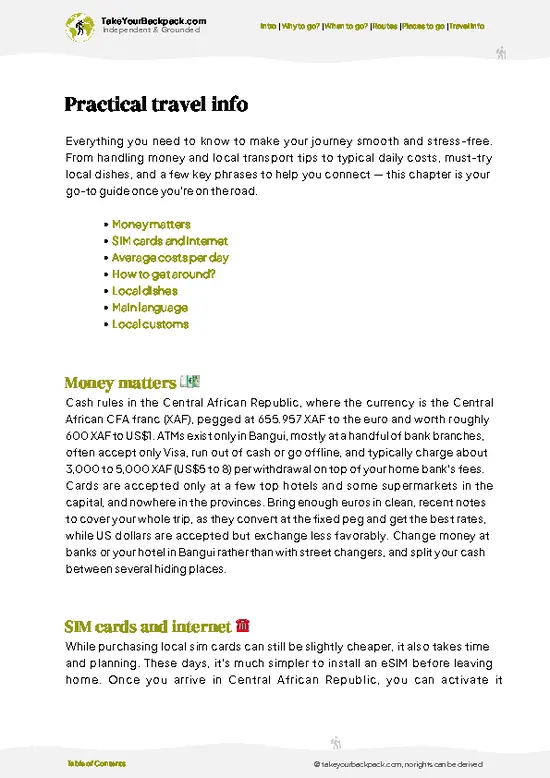
example page 0 from our offline Travel Guide for Central African Republic
example page 1 from our offline Travel Guide for Central African Republic
example page 2 from our offline Travel Guide for Central African Republic
example page 3 from our offline Travel Guide for Central African Republic
example page 4 from our offline Travel Guide for Central African Republic
example page 5 from our offline Travel Guide for Central African Republic
example page 6 from our offline Travel Guide for Central African Republic
example page 7 from our offline Travel Guide for Central African Republic
Loading the map 🌍
CLICK TO FILTER
cities
towns
landmarks
national parks
hikes
attractions
regions
SHOW COUNTRY’S BESTSHOW ALL

✨ Why go?
Ranked #7 town in Central African Republic
Why visitors keep coming back

Mbaïki suits the traveler who wants to see where Central African robusta coffee actually comes from, rather than tick off sights. The town sits at the edge of the Lobaye forest, so the market sells forest produce alongside cassava, peanuts and coffee, and you see how the two worlds meet. Plantation owners and cooperative members are usually happy to explain the harvest, drying and sorting if you arrive with respect and a little French. Most people stay one night or two, since there is little to fill more than a day, but that suits slow travelers who like talking over a shared meal more than moving on. It is a poor fit for nightlife seekers or anyone who needs reliable comforts. Independent, patient, French-speaking travelers who value local contact will get the most out of it.

💡 HighlightsMust-see experiences and standout moments

  1. Marché de Mbaïki: The main market is the best place to understand the town. Coffee beans, cassava, smoked fish, forest leaves and caterpillars in season are laid out in rows, and prices are bargained in Sango and French. Go in the morning when stocks are fresh. Entry is free, and an hour or two is plenty. Bring small notes and ask before photographing anyone.
  2. Coffee plantations around Mbaïki: Robusta groves surround the town, and walking through one with a farmer shows you the shade trees, the red cherries and the drying mats. The harvest season brings the most activity, though the groves are pleasant to see at any time. Expect to give a small thank-you of about €3 to 8 to your host, and allow two to three hours.
  3. Catholic cathedral and mission quarter: Mbaïki is the seat of a Catholic diocese,
… read more 👉
  1. Marché de Mbaïki: The main market is the best place to understand the town. Coffee beans, cassava, smoked fish, forest leaves and caterpillars in season are laid out in rows, and prices are bargained in Sango and French. Go in the morning when stocks are fresh. Entry is free, and an hour or two is plenty. Bring small notes and ask before photographing anyone.
  2. Coffee plantations around Mbaïki: Robusta groves surround the town, and walking through one with a farmer shows you the shade trees, the red cherries and the drying mats. The harvest season brings the most activity, though the groves are pleasant to see at any time. Expect to give a small thank-you of about €3 to 8 to your host, and allow two to three hours.
  3. Catholic cathedral and mission quarter: Mbaïki is the seat of a Catholic diocese, and the cathedral grounds are a calm place to see how deeply the church shapes local life. Sunday morning Mass, with choirs singing in Sango, is the most memorable time to visit. Entry is free, though a modest offering is appreciated. Stay an hour, dress modestly and ask permission before taking photos.
Beyond the town, the Boukoko area and its old coffee research station, the Lobaye River and the surrounding forest villages can be explored on day trips from Mbaïki, ideally with a local guide. For a first visit, the market is the best choice, because it shows you the town’s trade, its languages and its people in a single morning.
Spotted a mistake or missing something? Contact us.

🏘️ NeighborhoodsKey areas and districts to know

Mbaïki is small enough to cover on foot or by moto-taxi in a day, and the areas differ mainly by function. Pick by what you need, not by sights, because there are few formal ones.
  • Town center and main market: This is where the town works. Cassava, peanuts, caterpillars in season, fresh fish and fabric stalls fill the stalls from early morning, and it is calm by mid-afternoon. Go early for food and prices, and bargain politely. Walkable in 15 minutes, so skip a moto here.
  • Mission and church quarter: Quieter, with older buildings and shaded lanes. Worth a short stroll, not a long visit. Ask permission before photographing anyone or any official building, since officials expect it and can be touchy.
  • Coffee and plantation edges: Mbaïki sits in a coffee and timber area, and the outskirts hold plantations
… read more 👉
Mbaïki is small enough to cover on foot or by moto-taxi in a day, and the areas differ mainly by function. Pick by what you need, not by sights, because there are few formal ones.
  • Town center and main market: This is where the town works. Cassava, peanuts, caterpillars in season, fresh fish and fabric stalls fill the stalls from early morning, and it is calm by mid-afternoon. Go early for food and prices, and bargain politely. Walkable in 15 minutes, so skip a moto here.
  • Mission and church quarter: Quieter, with older buildings and shaded lanes. Worth a short stroll, not a long visit. Ask permission before photographing anyone or any official building, since officials expect it and can be touchy.
  • Coffee and plantation edges: Mbaïki sits in a coffee and timber area, and the outskirts hold plantations and rainforest edge. Hire a moto with a driver for the day, because distances are too far to walk and paths turn muddy. Tracks are not signed.
  • Riverside and outer neighborhoods: Residential, with small bars serving beer and grilled meat after dark. Fine for a drink early, but nightlife is minimal and unlit streets make walking back a poor idea. Take a moto instead.

⌛️ 1 dayHow to make the most of one day

Mbaïki is a town for walking in the cool of the morning, then waiting out the midday heat in the shade, so the day below follows that pattern, with motorcycle taxis only for the longer hops on the edge of town.
7:00 AM: Central Market
Start on foot while the air is still mild. Stalls fill early with cassava, peanuts, smoked fish, bushmeat, palm oil and fresh produce from the surrounding forest farms. Buy a few bananas and a hot beignet for breakfast, and greet people before you point a camera at anything. Walk the main road north when you finish.
9:00 AM: Coffee and Cocoa Zone
Mbaïki sits in the Lobaye, the country's forest and plantation belt, and small coffee and cocoa plots lie along the tracks around town. Hire a motorcycle taxi for an hour and ask to be taken to a smallholder who dries beans … read more 👉
Mbaïki is a town for walking in the cool of the morning, then waiting out the midday heat in the shade, so the day below follows that pattern, with motorcycle taxis only for the longer hops on the edge of town.
7:00 AM: Central Market
Start on foot while the air is still mild. Stalls fill early with cassava, peanuts, smoked fish, bushmeat, palm oil and fresh produce from the surrounding forest farms. Buy a few bananas and a hot beignet for breakfast, and greet people before you point a camera at anything. Walk the main road north when you finish.
9:00 AM: Coffee and Cocoa Zone
Mbaïki sits in the Lobaye, the country's forest and plantation belt, and small coffee and cocoa plots lie along the tracks around town. Hire a motorcycle taxi for an hour and ask to be taken to a smallholder who dries beans in the open. Seeing the beans on racks tells you more about local livelihoods than any building does. Agree on the fare before you climb on.
11:30 AM: Riverside and Forest Edge
Have the rider drop you where tracks meet the green wall of forest, which is not on the usual route. Walk slowly, listen for hornbills and watch for butterflies gathering on damp soil. This is a place to sit rather than to push on.
1:00 PM: Lunch and Rest
Return to town for grilled fish or chicken with cassava at a roadside eatery. Stay in the shade through the hottest hours, and drink plenty of water.
4:00 PM: Town Walk
When the heat eases, stroll the main streets, stopping at the church and small shops where residents gather. Chat with people over a cold drink.
6:00 PM: Evening Meal
Finish with a simple dinner and head to your lodging before full dark.

🌤️ When to go?Seasonal considerations and timing

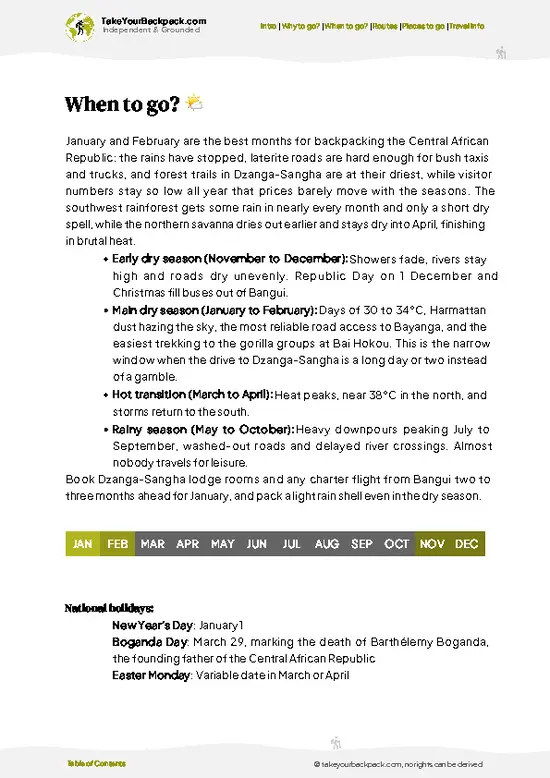
The dry months from roughly December to February are easiest for Mbaïki, with tracks firm and sky clearer.
  • Dry Season (Dec to Feb): Days reach 30 to 33°C (86 to 91°F), nights 20 to 22°C (68 to 72°F). Roads are passable, though dusty from harmattan haze. Transport is most reliable and prices for rides stay steadiest.
  • Early Rains (Mar to May): Humid, 29 to 32°C (84 to 90°F), with afternoon storms that soften side roads.
  • Peak Rains (Jun to Oct): Around 27 to 30°C (81 to 86°F), frequent downpours, mud, and slower, pricier travel on forest tracks.
  • Daylight: Close to the equator, days run about 12 hours all year, so plan travel for the morning.
Crowds are never an issue, but check security conditions before any trip and leave early each day.

source: climatestotravel.comJANJanuary: excellent for travelingFEBFebruary: highly recommended for travelingMARMarch: highly recommended for travelingAPRApril: highly recommended for travelingMAYMay: fair for travelingJUNJune: fair for travelingJULJuly: fair for travelingAUGAugust: fair for travelingSEPSeptember: fair for travelingOCTOctober: fair for travelingNOVNovember: excellent for travelingDECDecember: excellent for traveling
when-to-go

✈️ The backpacker research shortcutCentral African Republic Travel Guide

An offline-friendly backpacking guide with optimized travel routes, ranked highlights, transport advice, and the best areas to stay.
example page 0 from our offline Travel Guide for Central African Republic
example page 1 from our offline Travel Guide for Central African Republic
example page 2 from our offline Travel Guide for Central African Republic
example page 3 from our offline Travel Guide for Central African Republic
example page 4 from our offline Travel Guide for Central African Republic
example page 5 from our offline Travel Guide for Central African Republic
example page 6 from our offline Travel Guide for Central African Republic
example page 7 from our offline Travel Guide for Central African Republic
The digital guide (210 pages) contains:
✅ 42 highlights, ranked by travel appeal
✅ Optimized 5, 10 & 15-day travel routes
✅ Cities, national parks, landmarks, beaches
✅ How to get around
✅ Offline-friendly for travel without Wi-Fi
👉 Click to see all 30+ guide features

📅 Plan smarter in minutes, not weeks
✅ Month by month travel advice
✅ Festivals & national holidays
✅ Budget expectations

🗺️ Go to the right places, skip the overrated ones
✅ Honest pros & cons of destinations
✅ Top hikes, parks & viewpoints
✅ Lesser-known places most travelers miss
✅ Clear “worth it vs skip it” guidance

🛏️ Travel smoothly without rookie mistakes
✅ Best areas to stay
✅ Transport systems explained simply
✅ Common scams & safety advice
✅ SIM cards, money & practical tips

🌍 Understand the country, not just visit it
✅ Culture & traditions
✅ 52 Essential phrases & customs
✅ Festivals worth planning around
✅ Traveler-friendly historical context
✅ Insights that make places more meaningful

📱 Built for real travel conditions
✅ Fully downloadable PDF
✅ Works completely offline
✅ Optimized for phone use
✅ Useful in remote areas & buses
✅ Everything in one place
Stop searching, start planning
Get instant access to your full guide. 30‑day money-back guarantee.
+ Add another guide for just

By proceeding you agree to our terms.
Sent to your inbox immediately after payment • 100% Secure Checkout
Best Backpacking Travel Advisor 2025 tourism awardBest Backpacking
Travel Advisor
2025
What others say about Take Your Backpack Guides:
⭐⭐⭐⭐⭐
Fantastic, amazing amount of information!
⭐⭐⭐⭐⭐
My goodness this is amazing, it's what I've been looking for hats off too you!
⭐⭐⭐⭐⭐
I think this is absolutely BRILLIANT
⭐⭐⭐⭐
Very complete and informative. It's still missing places, but I gotta to commend you
⭐⭐⭐⭐⭐
This is truly amazing, thank you, can't wait to explore it with my kids!
⭐⭐⭐⭐⭐
Awesome resource, thank you!
⭐⭐⭐⭐⭐
This is amazing! Can't wait to explore the ones I haven't seen
⭐⭐⭐⭐
I love this! Well done, great idea.
⭐⭐⭐⭐⭐
Thanks for taking the time to make this gem!
⭐⭐⭐⭐⭐
This might be the best website I've ever seen.
⭐⭐⭐⭐⭐
Congratulations, and thank you so much for your work; it's incredibly valuable.
⭐⭐⭐⭐
In all seriousness I think you did a great job pointing out the important spots
⭐⭐⭐⭐⭐
10/10 very good
⭐⭐⭐⭐⭐
As someone who's only just starting to visit regularly this is awesome, thank you.
⭐⭐⭐⭐
Thank you very much! I'm going to visit my dad, it's going to be very useful!
⭐⭐⭐⭐⭐
This is really cool! We'll be travelling for the first time and this definitely come in handy.
⭐⭐⭐⭐⭐
You are now our minister of culture, congratulations 👨‍💼
⭐⭐⭐⭐⭐
Just wanted to tell you that this is a pearl! Going to follow your recommendations.
⭐⭐⭐⭐⭐
This is so cool. I'll definitely be using the resource for my travels soon.
⭐⭐⭐⭐⭐
This is very impressive! Good work.
⭐⭐⭐⭐⭐
This is an amazing and informative site. Very well done!

🛏️ Where to stay?Best areas and accommodation options

Stay near the town center and main market, since that is the only area with a realistic concentration of budget beds. Mbaïki has no hostel scene, so rooms are basic guesthouses and small lodgings, usually €8 to 20 a night, and you should expect fans or limited electricity rather than dorms. Being central means you can walk to food stalls and the market, and moto-taxis wait nearby for the Bangui road.

The quarter around the mission is a second option if you want calm. It is quieter at night with less traffic noise, though it is a bit farther from eating spots and you will want a moto after dark. … read more 👉
Stay near the town center and main market, since that is the only area with a realistic concentration of budget beds. Mbaïki has no hostel scene, so rooms are basic guesthouses and small lodgings, usually €8 to 20 a night, and you should expect fans or limited electricity rather than dorms. Being central means you can walk to food stalls and the market, and moto-taxis wait nearby for the Bangui road.

The quarter around the mission is a second option if you want calm. It is quieter at night with less traffic noise, though it is a bit farther from eating spots and you will want a moto after dark. Avoid the unlit outer edges, where lodging is scarce and getting back late is awkward.

Book ahead by phone or ask in person on arrival, and check that water and power are available before paying. Carry cash, because cards are not used.

🚌 Getting aroundHow to get from A to B

A moto-taxi ride inside Mbaïki costs about €0.25 to 0.75, paid in cash in local francs, and you should agree the fare before climbing on. Mbaïki is compact, roads are mostly unpaved or patchy, and traffic is light, so most people walk or hop on a motorbike. Formal public transport does not exist.
  • Walking: The center and market are within 15 to 20 minutes of each other. Do it in the morning, since heat and rain make afternoons slower. Not worth hiring a ride for short hops.
  • Moto-taxi: The default for everything farther, and drivers wait near the market. Short rides cost about €0.25 to 0.75, longer ones to plantations €2 to 5 each way. Carry small notes because change is scarce. Ask for a helmet, though it may not exist.
  • Shared minibus or truck to Bangui: Vehicles run toward the capital, roughly
… read more 👉
A moto-taxi ride inside Mbaïki costs about €0.25 to 0.75, paid in cash in local francs, and you should agree the fare before climbing on. Mbaïki is compact, roads are mostly unpaved or patchy, and traffic is light, so most people walk or hop on a motorbike. Formal public transport does not exist.
  • Walking: The center and market are within 15 to 20 minutes of each other. Do it in the morning, since heat and rain make afternoons slower. Not worth hiring a ride for short hops.
  • Moto-taxi: The default for everything farther, and drivers wait near the market. Short rides cost about €0.25 to 0.75, longer ones to plantations €2 to 5 each way. Carry small notes because change is scarce. Ask for a helmet, though it may not exist.
  • Shared minibus or truck to Bangui: Vehicles run toward the capital, roughly 80 to 100 km away, for about €4 to 8 and 2 to 4 hours depending on the road and checkpoints. Depart early, since they leave when full and rarely run after midday. Keep your ID handy at checkpoints.
  • Private car with driver: Costs about €50 to 90 a day, more for fuel-heavy trips. It is the sensible option for plantation and forest visits in the rains, when motos struggle. Arrange it through your accommodation and agree the full price first.
Do not count on taxis, apps, or timetables. Plan with a local driver you trust, and expect delays.

👛 Costs (as of 22 October 2026)How expensive it really is

Mbaïki costs about €17 to 45 a day for a backpacker, with lodging and transport to Bangui the biggest items. Prices are in local francs, cash only.
CategoryBudget RangeLocal Reality
Dorm accommodation€8 to 20No dorms; simple private guesthouse rooms, often with limited power.
Meals€4 to 8Market stalls serve cassava, grilled fish and stews; restaurant choice is small.
Local transport€1 to 4Moto-taxis cost €0.25 to 0.75 per short ride, more for plantations.
Basic activities/entry fees€2 to 8Mostly free; budget for a moto driver or guide on outings.
Miscellaneous expenses€2 to 5Bottled water, phone credit and small tips at checkpoints or for guides.
Total Daily Budget€17 to 45About €37 for a typical day with mid-range lodging.
Buy food at the morning market and carry small notes, because change is hard … read more 👉
Mbaïki costs about €17 to 45 a day for a backpacker, with lodging and transport to Bangui the biggest items. Prices are in local francs, cash only.
CategoryBudget RangeLocal Reality
Dorm accommodation€8 to 20No dorms; simple private guesthouse rooms, often with limited power.
Meals€4 to 8Market stalls serve cassava, grilled fish and stews; restaurant choice is small.
Local transport€1 to 4Moto-taxis cost €0.25 to 0.75 per short ride, more for plantations.
Basic activities/entry fees€2 to 8Mostly free; budget for a moto driver or guide on outings.
Miscellaneous expenses€2 to 5Bottled water, phone credit and small tips at checkpoints or for guides.
Total Daily Budget€17 to 45About €37 for a typical day with mid-range lodging.
Buy food at the morning market and carry small notes, because change is hard to find and meals cost less than at any restaurant.


source: worldbank.org
⚠️ Prices can change and everyone travels differently, so take this as a rough guide. Hope it helps you plan your adventure!

🚌 Day tripsBest day trips from Mbaïki

Mbaïki works as a base for short forest and river outings, but expect to arrange everything by moto or hired car, and check local conditions first.
Coffee and Timber Plantations:
The surrounding hills hold coffee farms and logging areas where you can see beans dried and sorted. A moto with a driver costs about €5 to 10 for the day and the trip takes 30 to 60 minutes each way. Dry months are best, since tracks flood in the rains. First-timers often go without a guide and get lost on unmarked paths.

Lobaye River Banks:
The Lobaye drains the region and offers quiet banks, fishing canoes and shade. Allow half a day, with moto fares of about €3 to 6 return. Go early to catch fishermen and avoid midday heat. Do not swim without local advice about currents.

Boukoko Forest Area:
To the southwest, … read more 👉
Mbaïki works as a base for short forest and river outings, but expect to arrange everything by moto or hired car, and check local conditions first.
Coffee and Timber Plantations:
The surrounding hills hold coffee farms and logging areas where you can see beans dried and sorted. A moto with a driver costs about €5 to 10 for the day and the trip takes 30 to 60 minutes each way. Dry months are best, since tracks flood in the rains. First-timers often go without a guide and get lost on unmarked paths.

Lobaye River Banks:
The Lobaye drains the region and offers quiet banks, fishing canoes and shade. Allow half a day, with moto fares of about €3 to 6 return. Go early to catch fishermen and avoid midday heat. Do not swim without local advice about currents.

Boukoko Forest Area:
To the southwest, rainforest near Boukoko is known for butterflies, birds and forest edge walks. Reaching it takes 1 to 2 hours by hired vehicle, costing about €40 to 70 round trip shared. December to February is easiest. Many arrive late and run out of daylight, so leave by 7 am.

🛡️ SafetyScams, Hazards, and Annoyances

Mbaïki is calm in daily life, but the Central African Republic has an unstable security situation, so check current conditions with locals and your embassy before arriving. Stay in the center during daylight, keep valuables out of sight in the market, and watch for pickpockets in crowds. After dark, avoid walking unlit streets and take a moto from a driver you know. Solo travelers should tell their guesthouse where they are going. Checkpoints are common on the road to Bangui, so carry your passport and visa copies, stay polite, and expect small unofficial requests for money, which you can decline calmly. Ask before photographing people or officials. Do not travel on forest tracks late in the day.

FAQCommon questions from travelers

Mbaïki is worth a short visit if you want to see coffee country and forest edge life away from any tourist circuit. It sits in the Lobaye region, with a lively morning market, plantations nearby and the Lobaye River close by. Facilities are basic and security needs checking, so it suits experienced travelers more than first-timers.
Mbaïki needs about 1 to 2 days. One day covers the market, town center and a moto trip to a plantation, while a second allows the river or forest edge near Boukoko. Add a day each way if road conditions toward Bangui slow you down.
Mbaïki can be done as a day trip from Bangui, since it lies roughly 80 to 100 km away, about 2 to 4 hours by shared minibus or hired car depending on the road. A shared seat costs about €4 to 8 each way, and a private car about €50 to 90. Leave very early and return before dark, as vehicles rarely run in the evening.
⚠️ Things can change over time, so always validate details locally before you go.

Other Central African towns near Mbaïki

Explore more nearby:

  • Mongoumba—Ubangi River, riverine villages, fishing communities| 72 km away
  • Boda—diamond trade, local crafts, central crossroads| 77 km away
  • Yaloke—hilly terrain, cattle markets, Fulani communities| 189 km away

💡 Not sure where to go next?
Create a personalized itinerary for Central African Republic including Mbaïki and the places that fit your trip.

Generate my itinerary

👉 Discover all towns

Or checkout all Central African Republic has to offer (think cities, towns, villages, national parks, hikes, beaches, festivals)
Country photo of Central African Republic

We 💚 feedbackKey takeaways before you go

Mbaïki’s best moments happen in the courtyards and drying yards behind the main road, where families spread coffee on mats in the sun. I would walk there with a local host rather than alone, greet everyone first, and bring small bills to buy a bag of beans.

✍️ Help improve this page!
The information on this page is based on in-depth research, insights shared by experienced travelers, and feedback from the local travel community in Central African Republic. While every effort is made to keep the information accurate and current, conditions can change — so if you spot anything incorrect or outdated, please get in touch.


🙋‍♂️ Give feedback

👋 Meet the founderWho’s Behind Take Your Backpack?

Johan, backpacker and founder of TakeYourBackpackHi, I’m Johan (Netherlands 🇳🇱), the creator of TakeYourBackpack. Over the past 3 decades, I’ve backpacked through 90+ countries across six continents, gaining extensive experience with independent travel, long-term trips, and overland routes.

This site is built on a combination of firsthand travel experience and carefully curated insights from other backpackers. Many guides are based on places I’ve personally visited, while others bring together tips, observations, and practical advice shared by trusted travelers I’ve met along the way.

The goal is to provide realistic, experience-driven guidance — not generic itineraries — so you can explore destinations with better context, clearer expectations, and more confidence.