×

Central African Republic🇨🇫 | townsOuaddaHaute-Kotto diamonds, market lanes, stream-bank miners, northeast outpost | things to do and best time to go

Explore CarnotExplore Zemio

Backpacking in Ouadda
👀 For curious travelerstown ranked #20
By Johan Kruseman 🇳🇱 | Updated October 22, 2026

Ouadda lets you see everyday life in Haute-Kotto’s diamond country with no tourist crowds at all. It sits in the northeast of the Central African Republic, far from the capital and well off any backpacker circuit. Getting there is slow and needs current security advice. Skip any plan built around monuments, because there are none to speak of. The market and the surrounding river country deserve your time. Evenings are quiet and social only with locals. A first day could run from market to riverbank, ending in dusk conversations.

Discover everything you want to know in the 📖 Central African Republic Travel Guide.
Safety warning

The current risk level for Central African Republic is high. Check the advice before going.


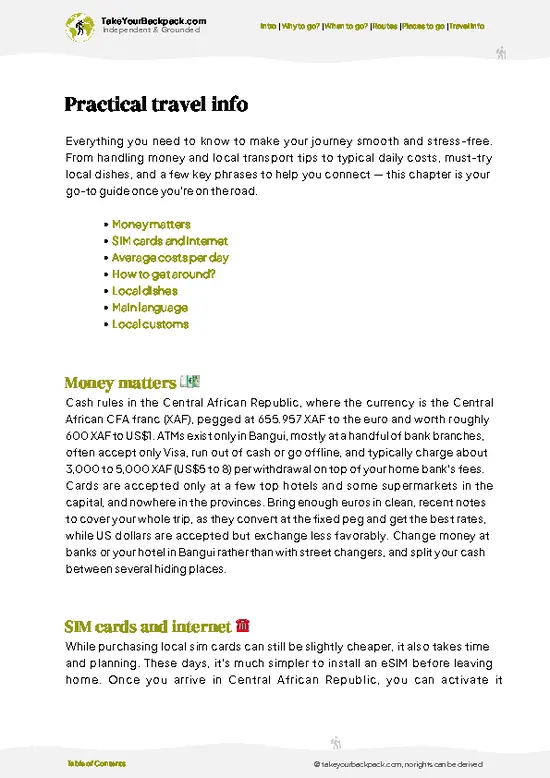
example page 0 from our offline Travel Guide for Central African Republic
example page 1 from our offline Travel Guide for Central African Republic
example page 2 from our offline Travel Guide for Central African Republic
example page 3 from our offline Travel Guide for Central African Republic
example page 4 from our offline Travel Guide for Central African Republic
example page 5 from our offline Travel Guide for Central African Republic
example page 6 from our offline Travel Guide for Central African Republic
example page 7 from our offline Travel Guide for Central African Republic
Loading the map 🌍
CLICK TO FILTER
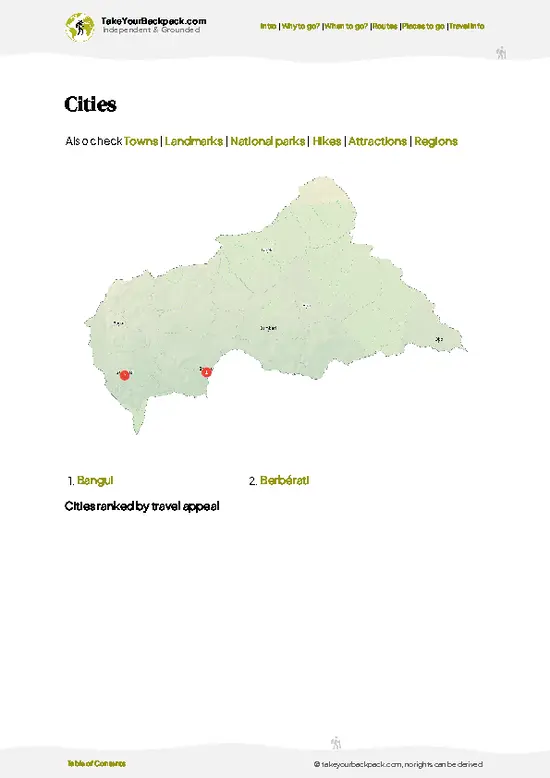
cities
towns
landmarks
national parks
hikes
attractions
regions
SHOW COUNTRY’S BESTSHOW ALL

✨ Why go?
Ranked #20 town in Central African Republic
Why Ouadda should be on your travel list

Ouadda suits the traveler who values access over attractions: a working Haute-Kotto town where artisanal diamond trading shapes conversation, prices and the pace of the week. Nobody here is set up for visitors, so every exchange is real, and you will be noticed. Stays are short and shaped by logistics and security rather than sightseeing. Experienced, self-reliant slow travelers who speak some French or Sango will get the most from it. Hostel-style socializing does not exist.

💡 HighlightsKey sights and experiences for travelers

  1. Ouadda central market: The best window onto the town, with cassava, dried fish, vegetables, cloth and household goods laid out by local sellers. Go in the morning when stocks are fresh and the crowd is thickest. Entry is free, and an hour or two is enough. Greet people before taking any photo, and ask first.
  2. Riverside and stream banks around town: Short walks to the water show where people wash, fish and cross, and where small-scale mining activity shapes the landscape. Early morning or late afternoon is coolest. It costs nothing and takes about an hour. Go with a local guide who knows which areas are fine to enter.
  3. Town streets and the diamond-buying quarter: Walking the main lanes shows where buyers and sellers meet and how the local economy runs. Mornings are busiest. It is free and takes
… read more 👉
  1. Ouadda central market: The best window onto the town, with cassava, dried fish, vegetables, cloth and household goods laid out by local sellers. Go in the morning when stocks are fresh and the crowd is thickest. Entry is free, and an hour or two is enough. Greet people before taking any photo, and ask first.
  2. Riverside and stream banks around town: Short walks to the water show where people wash, fish and cross, and where small-scale mining activity shapes the landscape. Early morning or late afternoon is coolest. It costs nothing and takes about an hour. Go with a local guide who knows which areas are fine to enter.
  3. Town streets and the diamond-buying quarter: Walking the main lanes shows where buyers and sellers meet and how the local economy runs. Mornings are busiest. It is free and takes about an hour. Keep cameras and valuables out of sight, and do not photograph transactions.
Ouadda is best started at the market, since it introduces you to people who can advise on safe walks, and the Kotto River valley and the town of Bria are the nearest places to consider for longer excursions.
Spotted a mistake or missing something? Contact us.

🏘️ NeighborhoodsKey areas and districts to know

Ouadda is a small town in Vakaga prefecture, and you can walk all of it in under an hour. Skip the idea of sightseeing districts; there are only a few areas, and they differ mainly in how much is going on.
  • Central market and main road: The one area worth your time. Traders sell cassava, groundnuts, dried fish and basic goods, and you can eat grilled meat or manioc with sauce from small stalls. Go in the morning.
  • Mission and church quarter: Quiet, shaded and good for a slow walk. Nothing to tick off, but people here are the easiest to talk to.
  • Airstrip edge and outskirts: Open and dusty with little to see. Skip it unless you are arriving or leaving by air.
There is no nightlife. After dark the town is silent and dim.

⌛️ 1 dayWhat you can realistically do in a day

7:00 AM Central market: Begin where the town starts its day, since stalls fill early and people are most open to a greeting. Buy fruit and bread for breakfast, then walk on.

9:30 AM Main lanes and trading quarter: Stroll slowly through the center to see how the diamond economy sits among ordinary shops and homes. Keep a low profile and your camera away.

12:00 PM Midday meal: Eat a simple plate of cassava, fish or stew at a local eatery, then rest through the hottest hours.

3:30 PM Stream banks off the main road: Few outsiders ever see this side of town. Walk with a local guide to watch washing, fishing and small-scale digging, and keep to paths you are shown.

5:30 PM Neighborhood evening: Return to your lodging and sit out with neighbors as the heat fades, which is when conversation comes easiest.

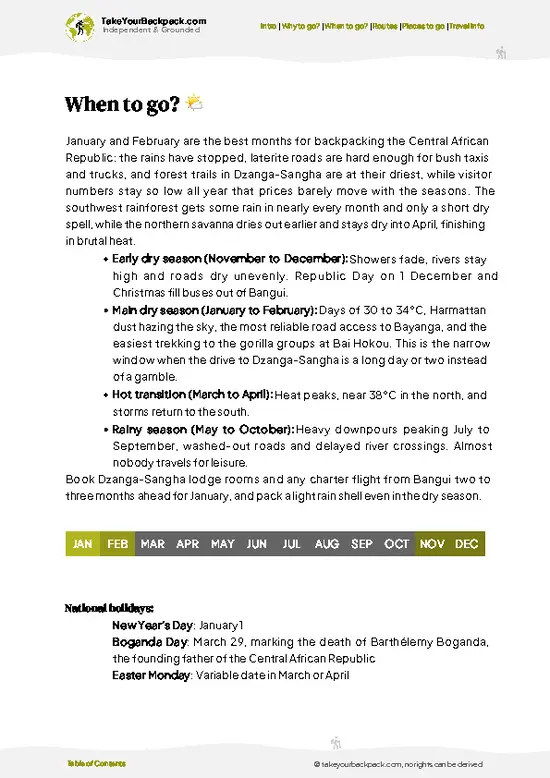
🌤️ When to go?Seasonal considerations and timing

  • Dry season (November to March): Days reach about 33 to 36°C (91 to 97°F), nights 18 to 22°C (64 to 72°F), and the harmattan haze can cloud the sky. Tracks are passable, so this is the practical window.
  • Wet season (May to October): Highs sit near 28 to 31°C (82 to 88°F). Heavy rain turns tracks to mud and cuts access, and prices for transport rise.
  • Shoulder months (April and November): Storms build or fade, with mixed road conditions.
Arrive in December or January, when roads are firmest and daylight runs long enough to travel safely.

source: climatestotravel.comJANJanuary: excellent for travelingFEBFebruary: excellent for travelingMARMarch: good for travelingAPRApril: good for travelingMAYMay: fair for travelingJUNJune: fair for travelingJULJuly: below average for travelingAUGAugust: below average for travelingSEPSeptember: fair for travelingOCTOctober: fair for travelingNOVNovember: excellent for travelingDECDecember: excellent for traveling
when-to-go

✈️ The backpacker research shortcutCentral African Republic Travel Guide

An offline-friendly backpacking guide with optimized travel routes, ranked highlights, transport advice, and the best areas to stay.
example page 0 from our offline Travel Guide for Central African Republic
example page 1 from our offline Travel Guide for Central African Republic
example page 2 from our offline Travel Guide for Central African Republic
example page 3 from our offline Travel Guide for Central African Republic
example page 4 from our offline Travel Guide for Central African Republic
example page 5 from our offline Travel Guide for Central African Republic
example page 6 from our offline Travel Guide for Central African Republic
example page 7 from our offline Travel Guide for Central African Republic
The digital guide (210 pages) contains:
✅ 42 highlights, ranked by travel appeal
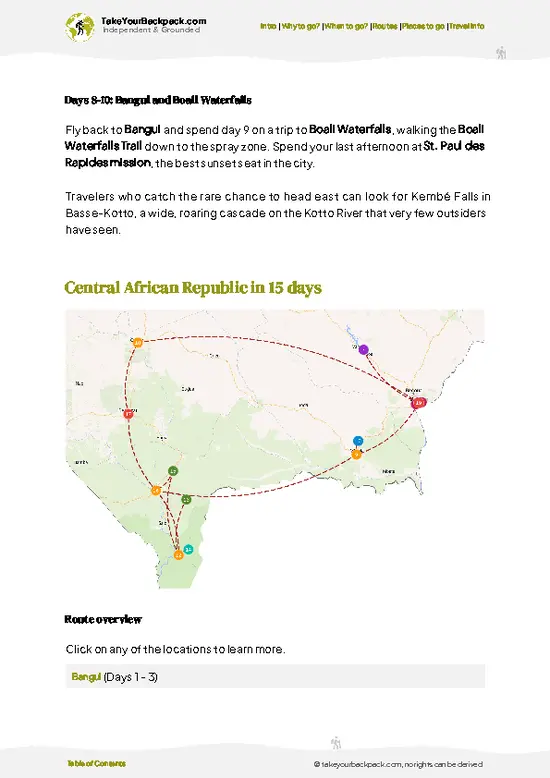
✅ Optimized 5, 10 & 15-day travel routes
✅ Cities, national parks, landmarks, beaches
✅ How to get around
✅ Offline-friendly for travel without Wi-Fi
👉 Click to see all 30+ guide features

📅 Plan smarter in minutes, not weeks
✅ Month by month travel advice
✅ Festivals & national holidays
✅ Budget expectations

🗺️ Go to the right places, skip the overrated ones
✅ Honest pros & cons of destinations
✅ Top hikes, parks & viewpoints
✅ Lesser-known places most travelers miss
✅ Clear “worth it vs skip it” guidance

🛏️ Travel smoothly without rookie mistakes
✅ Best areas to stay
✅ Transport systems explained simply
✅ Common scams & safety advice
✅ SIM cards, money & practical tips

🌍 Understand the country, not just visit it
✅ Culture & traditions
✅ 52 Essential phrases & customs
✅ Festivals worth planning around
✅ Traveler-friendly historical context
✅ Insights that make places more meaningful

📱 Built for real travel conditions
✅ Fully downloadable PDF
✅ Works completely offline
✅ Optimized for phone use
✅ Useful in remote areas & buses
✅ Everything in one place
Stop searching, start planning
Get instant access to your full guide. 30‑day money-back guarantee.
+ Add another guide for just

By proceeding you agree to our terms.
Sent to your inbox immediately after payment • 100% Secure Checkout
Best Backpacking Travel Advisor 2025 tourism awardBest Backpacking
Travel Advisor
2025
What others say about Take Your Backpack Guides:
⭐⭐⭐⭐⭐
Fantastic, amazing amount of information!
⭐⭐⭐⭐⭐
My goodness this is amazing, it's what I've been looking for hats off too you!
⭐⭐⭐⭐⭐
I think this is absolutely BRILLIANT
⭐⭐⭐⭐
Very complete and informative. It's still missing places, but I gotta to commend you
⭐⭐⭐⭐⭐
This is truly amazing, thank you, can't wait to explore it with my kids!
⭐⭐⭐⭐⭐
Awesome resource, thank you!
⭐⭐⭐⭐⭐
This is amazing! Can't wait to explore the ones I haven't seen
⭐⭐⭐⭐
I love this! Well done, great idea.
⭐⭐⭐⭐⭐
Thanks for taking the time to make this gem!
⭐⭐⭐⭐⭐
This might be the best website I've ever seen.
⭐⭐⭐⭐⭐
Congratulations, and thank you so much for your work; it's incredibly valuable.
⭐⭐⭐⭐
In all seriousness I think you did a great job pointing out the important spots
⭐⭐⭐⭐⭐
10/10 very good
⭐⭐⭐⭐⭐
As someone who's only just starting to visit regularly this is awesome, thank you.
⭐⭐⭐⭐
Thank you very much! I'm going to visit my dad, it's going to be very useful!
⭐⭐⭐⭐⭐
This is really cool! We'll be travelling for the first time and this definitely come in handy.
⭐⭐⭐⭐⭐
You are now our minister of culture, congratulations 👨‍💼
⭐⭐⭐⭐⭐
Just wanted to tell you that this is a pearl! Going to follow your recommendations.
⭐⭐⭐⭐⭐
This is so cool. I'll definitely be using the resource for my travels soon.
⭐⭐⭐⭐⭐
This is very impressive! Good work.
⭐⭐⭐⭐⭐
This is an amazing and informative site. Very well done!

🛏️ Where to stay?Best areas to stay in Central African Republic

Stay in the center, close to the main road and market, since Ouadda has very few places to sleep and no hostels or dorm beds. Basic rooms or a spot with a host family are the realistic budget options, usually costing about €5 to 12 a night. The center is the safest choice at night because people are around, neighbors notice strangers, and you can reach food and water on foot. Noise is low apart from roosters and early market activity. Avoid the outskirts, where lighting is poor and help is far. Arrange your bed before dark and carry cash, as there are no online bookings.

🚌 Getting aroundTransportation options and practical tips

Walking is the easiest way to get around Ouadda, because the town is compact and everything sits within a 20 to 30 minute stroll. Traffic is almost nonexistent and there is no public transport network. Getting in and out is the real challenge, not moving around town.
  • Walking: Free and the best option for the market, church and surrounding paths. Go early or late, as midday heat passes 33°C (91°F).
  • Motorbike taxi: Informal riders take you around town or to nearby villages for about €1 to 3 per short trip. Agree the price first and expect rough tracks.
  • Shared truck or pickup: The usual way to reach other towns in Vakaga, with seats or space on cargo costing roughly €10 to 30 depending on distance. Departures are irregular and trips can take a day or more, especially in the wet season.
  • Charter or
… read more 👉
Walking is the easiest way to get around Ouadda, because the town is compact and everything sits within a 20 to 30 minute stroll. Traffic is almost nonexistent and there is no public transport network. Getting in and out is the real challenge, not moving around town.
  • Walking: Free and the best option for the market, church and surrounding paths. Go early or late, as midday heat passes 33°C (91°F).
  • Motorbike taxi: Informal riders take you around town or to nearby villages for about €1 to 3 per short trip. Agree the price first and expect rough tracks.
  • Shared truck or pickup: The usual way to reach other towns in Vakaga, with seats or space on cargo costing roughly €10 to 30 depending on distance. Departures are irregular and trips can take a day or more, especially in the wet season.
  • Charter or humanitarian flights: Ouadda has an airstrip, but flights are irregular and mostly serve aid organizations. Not something to count on, and not worth planning around.

👛 Costs (as of 22 October 2026)How expensive it really is

Ouadda costs about €32 a day for a backpacker in high season, mostly because everything must be brought in by road.
CategoryBudget RangeLocal Reality
Dorm accommodation€5 to 12No dorms; basic room or host family
Meals€4 to 8Cassava, rice, grilled meat from stalls
Local transport€2 to 6Motorbike taxis, shared pickups for farther trips
Basic activities/entry fees€3 to 8Guides for walks and village visits
Miscellaneous expenses€2 to 5Water, phone credit, small gifts
Total Daily Budget€32Cash only, no ATMs
Buy staples at the market in the morning, when prices are lowest.

source: worldbank.org
⚠️ Prices can change and everyone travels differently, so take this as a rough guide. Hope it helps you plan your adventure!

🚌 Day tripsBest day trips from Ouadda

Ouadda works as a base only for short, local outings, because roads are poor and services are scarce. Plan each trip with a local guide and a motorbike.Nearby Villages: Villages around Ouadda show farming life, with cassava fields, small markets and shared meals. Allow half a day by motorbike for about €5 to 15 including a guide. Go in the dry season, from December to March. First-timers often set out without a local contact, which makes visits awkward.
Savanna and River Walks: The savanna and seasonal streams around town suit a morning walk with a local guide for about €3 to 8. Birdlife is best at dawn. Carry more water than you expect to need, since shade is scarce.
Weekly Market Day Visit: Neighboring communities gather to trade when markets run. Trips take one to two hours each way by motorbike … read more 👉
Ouadda works as a base only for short, local outings, because roads are poor and services are scarce. Plan each trip with a local guide and a motorbike.Nearby Villages: Villages around Ouadda show farming life, with cassava fields, small markets and shared meals. Allow half a day by motorbike for about €5 to 15 including a guide. Go in the dry season, from December to March. First-timers often set out without a local contact, which makes visits awkward.
Savanna and River Walks: The savanna and seasonal streams around town suit a morning walk with a local guide for about €3 to 8. Birdlife is best at dawn. Carry more water than you expect to need, since shade is scarce.
Weekly Market Day Visit: Neighboring communities gather to trade when markets run. Trips take one to two hours each way by motorbike for roughly €5 to 12 return. Ask in town for the day.

🛡️ SafetyScams, Hazards, and Annoyances

Ouadda is a small, quiet town, but the wider Vakaga region has armed group activity and unreliable security, so check current conditions with locals and aid workers before arriving. Petty theft is uncommon. Register with the local authorities, travel with a trusted guide and avoid roads after dark. Solo travelers will draw attention, so stay near your host at night. Keep cash discreet and photograph only with permission, especially near officials or uniformed men.

FAQTraveler FAQ

Ouadda is worth it only if you want remote northern Central African Republic with almost no tourism. You will find a small market, a mission area and savanna landscapes, though getting there takes serious planning and a day or more over rough roads. Few travelers pass through, so you need local contacts and cash.
Two to three days is enough in Ouadda. One day covers the market and town walk, and a second allows a village or savanna outing with a guide costing about €5 to 15. Add a buffer day because transport out is irregular.
Ouadda cannot realistically be done as a day trip from any nearby city. The nearest sizable town, Birao, is far by rough track, and journeys take many hours or more than a day. Plan to spend at least two nights, with transport costing roughly €10 to 30 each way.
⚠️ Things can change over time, so always validate details locally before you go.

Other Central African towns near Ouadda

Explore more nearby:

  • Bria—mineral resources, displaced communities, central market| 176 km away
  • Ndélé—northern crossroads, market square, ethnic diversity| 196 km away
  • Birao—remote outpost, Sahel edge, military presence| 251 km away

💡 Not sure where to go next?
Create a personalized itinerary for Central African Republic including Ouadda and the places that fit your trip.

Generate my itinerary

👉 Discover all towns

Or checkout all Central African Republic has to offer (think cities, towns, villages, national parks, hikes, beaches, festivals)
Country photo of Central African Republic

We 💚 feedbackSumming up the experience

Ouadda is best in the dry months and in the cool hours of early morning, when the market is lively and the walking easy. Bring French phrases, patience and a trusted local contact. I would skip arriving late in the day.

✍️ Help improve this page!
The information on this page is based on in-depth research, insights shared by experienced travelers, and feedback from the local travel community in Central African Republic. While every effort is made to keep the information accurate and current, conditions can change — so if you spot anything incorrect or outdated, please get in touch.


🙋‍♂️ Give feedback

👋 Meet the founderWho’s Behind Take Your Backpack?

Johan, backpacker and founder of TakeYourBackpackHi, I’m Johan (Netherlands 🇳🇱), the creator of TakeYourBackpack. Over the past 3 decades, I’ve backpacked through 90+ countries across six continents, gaining extensive experience with independent travel, long-term trips, and overland routes.

This site is built on a combination of firsthand travel experience and carefully curated insights from other backpackers. Many guides are based on places I’ve personally visited, while others bring together tips, observations, and practical advice shared by trusted travelers I’ve met along the way.

The goal is to provide realistic, experience-driven guidance — not generic itineraries — so you can explore destinations with better context, clearer expectations, and more confidence.