×

Central African Republic🇨🇫 | townsBiraoSahel trade market, airstrip life, mud-brick compounds, sweet tea stalls | things to do and best time to go

Explore NolaExplore Carnot

Backpacking in Birao
👍 Recommendedtown ranked #11
By Johan Kruseman 🇳🇱 | Updated October 22, 2026

Birao suits overland purists and humanitarian-minded veterans who accept that logistics come before sightseeing. Casual backpackers will find it less rewarding: there are no hostels, no cafés worth a detour and no organized sights. It sits in the far northeast of the Central African Republic, near the Sudan and Chad borders. Streets are sandy tracks lined with mud-brick compounds, and the small market gives you a plate of grilled meat or millet and a look at Sahel trade. Reaching it takes real planning, and security is unstable, so meeting other travelers is rare, mostly aid workers. Unlike Bangui, a river city with hotels and restaurants, Birao is a remote desert-edge outpost.

Discover everything you want to know in the 📖 Central African Republic Travel Guide.
Safety warning

The current risk level for Central African Republic is high. Check the advice before going.


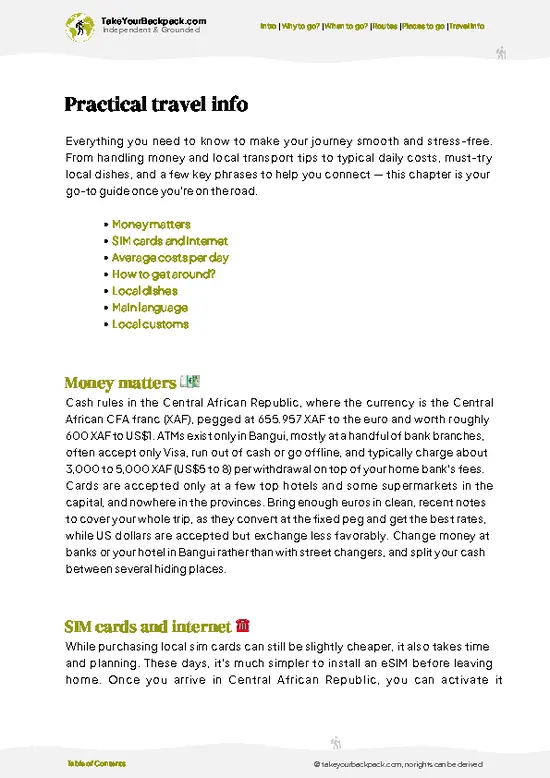
example page 0 from our offline Travel Guide for Central African Republic
example page 1 from our offline Travel Guide for Central African Republic
example page 2 from our offline Travel Guide for Central African Republic
example page 3 from our offline Travel Guide for Central African Republic
example page 4 from our offline Travel Guide for Central African Republic
example page 5 from our offline Travel Guide for Central African Republic
example page 6 from our offline Travel Guide for Central African Republic
example page 7 from our offline Travel Guide for Central African Republic
Loading the map 🌍
CLICK TO FILTER
cities
towns
landmarks
national parks
hikes
attractions
regions
SHOW COUNTRY’S BESTSHOW ALL

✨ Why go?
Ranked #11 town in Central African Republic
What sets this place apart

Birao matters only to a very particular traveler: someone tracing the Sahel frontier where savanna gives way to sand. You come for the Vakaga region, a sparsely populated corner few outsiders ever see, and for the market where Sudanese, Chadian and local traders meet. Stays are short, usually a night or two, and sleeping means a basic guesthouse or an arrangement through an aid organization. Evenings are quiet, with generator hum and tea at roadside stalls. The people you meet are mostly humanitarian staff, drivers and traders, so conversation is real but travelers are scarce. This suits experienced, self-sufficient, flexible adventurers with local contacts. Anyone wanting trails, nightlife or easy social circles should look elsewhere.

💡 HighlightsMust-see experiences and standout moments

  1. Birao Central Market: The best-known place in town, with sacks of millet, dried fish, spices, cloth and goods hauled from Sudan and Chad. Go early morning, when the stalls are busiest. Entry is free; allow 1 to 2 hours.
  2. Birao Airstrip: The town’s lifeline, where cargo and humanitarian flights land and half the town seems to gather. Watching a plane arrive explains the place better than any sign. Visit mornings; free to watch from a distance, 30 minutes. Photography near it can cause trouble, so ask first.
  3. Ouadda-style quarters on foot, the Muslim neighborhoods: Walk the compounds near the mosque, where Goula and Arab traders live in mud-brick courtyards. Late afternoon is cooler. Free; about 1 hour.
  4. Tea stalls along the main track: Sweet tea and conversation in Arabic or Sango with traders. Evenings
… read more 👉
  1. Birao Central Market: The best-known place in town, with sacks of millet, dried fish, spices, cloth and goods hauled from Sudan and Chad. Go early morning, when the stalls are busiest. Entry is free; allow 1 to 2 hours.
  2. Birao Airstrip: The town’s lifeline, where cargo and humanitarian flights land and half the town seems to gather. Watching a plane arrive explains the place better than any sign. Visit mornings; free to watch from a distance, 30 minutes. Photography near it can cause trouble, so ask first.
  3. Ouadda-style quarters on foot, the Muslim neighborhoods: Walk the compounds near the mosque, where Goula and Arab traders live in mud-brick courtyards. Late afternoon is cooler. Free; about 1 hour.
  4. Tea stalls along the main track: Sweet tea and conversation in Arabic or Sango with traders. Evenings are best. A glass costs well under €0.50; allow an hour.
  5. Seasonal river bed at the town edge: Dry sand channels where herders water cattle after rains. Visit at dawn for the livestock. Free; 1 hour.
Around Birao, the Manovo-Gounda St Floris park to the southwest and the Vakaga plains are the nearest wild areas, though access depends on security and permission. The market, airstrip walk and river bed are free, and tea is the cheapest paid treat.
Spotted a mistake or missing something? Contact us.

🏘️ NeighborhoodsWhere things are and how it's laid out

Birao is small enough to cover on foot in an afternoon, and the useful areas sit within a couple of kilometers of each other.
  • Town center and market: A scatter of dusty lanes around the main market, where you find tea, flatbread, dried goods and basic supplies. Walk it in the morning before the heat builds. You come away with a feel for the trade with nearby Sudan and Chad.
  • Administrative quarter: Low government buildings and offices along wide sandy tracks. Nothing to see, so skip it unless you must register or check in. Dull, but it is where paperwork gets done.
  • Airstrip area: Flat, open ground to the edge of town, where the arrival of a flight draws a crowd. Worth a short stroll for the huge open sky at dusk, though not for any sights.
  • Residential neighborhoods: Mud-brick and thatched compounds
… read more 👉
Birao is small enough to cover on foot in an afternoon, and the useful areas sit within a couple of kilometers of each other.
  • Town center and market: A scatter of dusty lanes around the main market, where you find tea, flatbread, dried goods and basic supplies. Walk it in the morning before the heat builds. You come away with a feel for the trade with nearby Sudan and Chad.
  • Administrative quarter: Low government buildings and offices along wide sandy tracks. Nothing to see, so skip it unless you must register or check in. Dull, but it is where paperwork gets done.
  • Airstrip area: Flat, open ground to the edge of town, where the arrival of a flight draws a crowd. Worth a short stroll for the huge open sky at dusk, though not for any sights.
  • Residential neighborhoods: Mud-brick and thatched compounds with goats and children in the lanes. Walk through respectfully and greet people. Evenings are quiet, with no nightlife, only tea stalls and conversation under the stars.

⌛️ 1 day1-day itinerary for Birao

7:00 AM, Birao Airstrip: Start where the town’s lifeline lands, watching cargo and passengers come in, and talk to drivers about the road conditions. Walk back along the main track toward the market, about 15 minutes.
8:30 AM, Central Market: Browse at its busiest, buying water, bread and fruit. Look for goods trucked in from Sudan and Chad. Wander slowly and greet stallholders; it earns smiles.
11:00 AM, Muslim quarters: Walk the shaded alleys among mud-brick compounds near the mosque. This is the quiet side of town most visitors never see, so keep voices low and ask before photographing anyone.
1:00 PM, Midday meal and rest: Eat grilled meat with millet or rice at a market stall, then rest through the hottest hours indoors.
4:30 PM, Dry river bed: Head to the sandy channel on the edge of town, … read more 👉
7:00 AM, Birao Airstrip: Start where the town’s lifeline lands, watching cargo and passengers come in, and talk to drivers about the road conditions. Walk back along the main track toward the market, about 15 minutes.
8:30 AM, Central Market: Browse at its busiest, buying water, bread and fruit. Look for goods trucked in from Sudan and Chad. Wander slowly and greet stallholders; it earns smiles.
11:00 AM, Muslim quarters: Walk the shaded alleys among mud-brick compounds near the mosque. This is the quiet side of town most visitors never see, so keep voices low and ask before photographing anyone.
1:00 PM, Midday meal and rest: Eat grilled meat with millet or rice at a market stall, then rest through the hottest hours indoors.
4:30 PM, Dry river bed: Head to the sandy channel on the edge of town, where herders bring cattle and goats as the heat fades. Great for open sky and quiet conversation.
6:30 PM, Tea stalls: Finish with sweet tea on a low stool, trading stories with traders and drivers before returning before dark.

🌤️ When to go?Best time to visit Birao

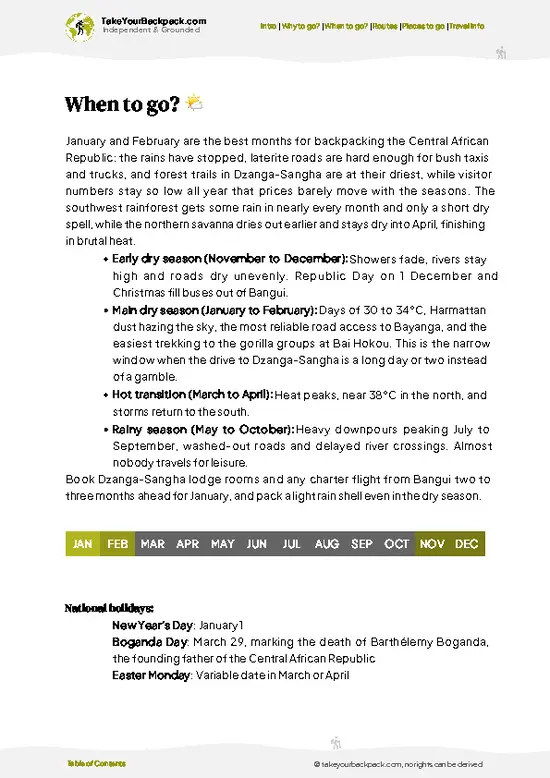
  • Dry season (November to February): Days reach about 32 to 36°C (90 to 97°F), nights cool to 15 to 20°C (59 to 68°F), and harmattan dust can haze the sky. Roads are most passable, so this is the practical window.
  • Hot season (March to May): Afternoons often exceed 40°C (104°F). Slow, tiring and best avoided.
  • Rainy season (June to October): Highs of 30 to 35°C (86 to 95°F), with storms that turn tracks to mud and cut off access. Transport prices rise and flights are less certain.
Aim for December or January, when mornings are cool and daylight is steady.

source: climatestotravel.comJANJanuary: excellent for travelingFEBFebruary: excellent for travelingMARMarch: excellent for travelingAPRApril: highly recommended for travelingMAYMay: good for travelingJUNJune: fair for travelingJULJuly: fair for travelingAUGAugust: fair for travelingSEPSeptember: fair for travelingOCTOctober: good for travelingNOVNovember: highly recommended for travelingDECDecember: excellent for traveling
when-to-go

✈️ The backpacker research shortcutCentral African Republic Travel Guide

An offline-friendly backpacking guide with optimized travel routes, ranked highlights, transport advice, and the best areas to stay.
example page 0 from our offline Travel Guide for Central African Republic
example page 1 from our offline Travel Guide for Central African Republic
example page 2 from our offline Travel Guide for Central African Republic
example page 3 from our offline Travel Guide for Central African Republic
example page 4 from our offline Travel Guide for Central African Republic
example page 5 from our offline Travel Guide for Central African Republic
example page 6 from our offline Travel Guide for Central African Republic
example page 7 from our offline Travel Guide for Central African Republic
The digital guide (210 pages) contains:
✅ 42 highlights, ranked by travel appeal
✅ Optimized 5, 10 & 15-day travel routes
✅ Cities, national parks, landmarks, beaches
✅ How to get around
✅ Offline-friendly for travel without Wi-Fi
👉 Click to see all 30+ guide features

📅 Plan smarter in minutes, not weeks
✅ Month by month travel advice
✅ Festivals & national holidays
✅ Budget expectations

🗺️ Go to the right places, skip the overrated ones
✅ Honest pros & cons of destinations
✅ Top hikes, parks & viewpoints
✅ Lesser-known places most travelers miss
✅ Clear “worth it vs skip it” guidance

🛏️ Travel smoothly without rookie mistakes
✅ Best areas to stay
✅ Transport systems explained simply
✅ Common scams & safety advice
✅ SIM cards, money & practical tips

🌍 Understand the country, not just visit it
✅ Culture & traditions
✅ 52 Essential phrases & customs
✅ Festivals worth planning around
✅ Traveler-friendly historical context
✅ Insights that make places more meaningful

📱 Built for real travel conditions
✅ Fully downloadable PDF
✅ Works completely offline
✅ Optimized for phone use
✅ Useful in remote areas & buses
✅ Everything in one place
Stop searching, start planning
Get instant access to your full guide. 30‑day money-back guarantee.
+ Add another guide for just

By proceeding you agree to our terms.
Sent to your inbox immediately after payment • 100% Secure Checkout
Best Backpacking Travel Advisor 2025 tourism awardBest Backpacking
Travel Advisor
2025
What others say about Take Your Backpack Guides:
⭐⭐⭐⭐⭐
Fantastic, amazing amount of information!
⭐⭐⭐⭐⭐
My goodness this is amazing, it's what I've been looking for hats off too you!
⭐⭐⭐⭐⭐
I think this is absolutely BRILLIANT
⭐⭐⭐⭐
Very complete and informative. It's still missing places, but I gotta to commend you
⭐⭐⭐⭐⭐
This is truly amazing, thank you, can't wait to explore it with my kids!
⭐⭐⭐⭐⭐
Awesome resource, thank you!
⭐⭐⭐⭐⭐
This is amazing! Can't wait to explore the ones I haven't seen
⭐⭐⭐⭐
I love this! Well done, great idea.
⭐⭐⭐⭐⭐
Thanks for taking the time to make this gem!
⭐⭐⭐⭐⭐
This might be the best website I've ever seen.
⭐⭐⭐⭐⭐
Congratulations, and thank you so much for your work; it's incredibly valuable.
⭐⭐⭐⭐
In all seriousness I think you did a great job pointing out the important spots
⭐⭐⭐⭐⭐
10/10 very good
⭐⭐⭐⭐⭐
As someone who's only just starting to visit regularly this is awesome, thank you.
⭐⭐⭐⭐
Thank you very much! I'm going to visit my dad, it's going to be very useful!
⭐⭐⭐⭐⭐
This is really cool! We'll be travelling for the first time and this definitely come in handy.
⭐⭐⭐⭐⭐
You are now our minister of culture, congratulations 👨‍💼
⭐⭐⭐⭐⭐
Just wanted to tell you that this is a pearl! Going to follow your recommendations.
⭐⭐⭐⭐⭐
This is so cool. I'll definitely be using the resource for my travels soon.
⭐⭐⭐⭐⭐
This is very impressive! Good work.
⭐⭐⭐⭐⭐
This is an amazing and informative site. Very well done!

🛏️ Where to stay?How to pick the right area

Stay in or near the town center and market area, where the few basic guesthouses and simple lodgings are concentrated. This is the practical choice for a budget traveler because you are within walking distance of food, water, and the people who can help with onward movement. Expect no hostel scene; beds are simple rooms, often with shared facilities and limited power, typically €8 to 20 a night. Availability is thin, so arrange something before arrival if you can. The center is quiet after dark, mostly tea stalls and conversation, and noise is minor apart from roosters and the odd generator. Staying … read more 👉
Stay in or near the town center and market area, where the few basic guesthouses and simple lodgings are concentrated. This is the practical choice for a budget traveler because you are within walking distance of food, water, and the people who can help with onward movement. Expect no hostel scene; beds are simple rooms, often with shared facilities and limited power, typically €8 to 20 a night. Availability is thin, so arrange something before arrival if you can. The center is quiet after dark, mostly tea stalls and conversation, and noise is minor apart from roosters and the odd generator. Staying near the airstrip is an alternative if you have an early flight, but it is more exposed and has fewer services nearby. Avoid wandering the outskirts at night, and keep a flashlight handy because lighting is limited.

🚌 Getting aroundGetting around like a local

Birao has no bus or train station; the airstrip is the arrival point, and the center is a flat, sandy walk of roughly 1 to 2 km, or a short motorbike ride. Most travelers walk, because the town is compact and traffic is a handful of motorbikes and the occasional 4x4. Public transport is essentially nonexistent, so expect to arrange things informally.
  • Walking: Free and the best way to see the market, tea stalls and compounds. Go early or after 4 pm, as midday sun on open sand is punishing. You meet people and see how the town works.
  • Motorbike taxi: Usually €0.50 to 2 for a trip within town, negotiated before you climb on. Fast and handy with luggage, but dusty and bumpy. Skip it for anything you can walk in ten minutes.
  • Shared pickup trucks: Used for trips toward other settlements, with prices
… read more 👉
Birao has no bus or train station; the airstrip is the arrival point, and the center is a flat, sandy walk of roughly 1 to 2 km, or a short motorbike ride. Most travelers walk, because the town is compact and traffic is a handful of motorbikes and the occasional 4x4. Public transport is essentially nonexistent, so expect to arrange things informally.
  • Walking: Free and the best way to see the market, tea stalls and compounds. Go early or after 4 pm, as midday sun on open sand is punishing. You meet people and see how the town works.
  • Motorbike taxi: Usually €0.50 to 2 for a trip within town, negotiated before you climb on. Fast and handy with luggage, but dusty and bumpy. Skip it for anything you can walk in ten minutes.
  • Shared pickup trucks: Used for trips toward other settlements, with prices and departures set by the driver and loads. Expect uncomfortable seats on top of cargo and long waits. Roads are rough, especially in the rainy season, so only go if you have a firm reason.
  • Humanitarian or private 4x4 hire: Costs vary widely, often €100 or more a day with fuel. Costly, but it is the only realistic option for reaching remote areas, such as parkland to the south. Worth it only with proper security advice.

👛 Costs (as of 22 October 2026)How expensive it really is

Birao costs most backpackers about €8 to 20 a day, but limited supply keeps prices higher than elsewhere in the country, and the Total Daily Budget below comes to €55.
CategoryBudget RangeLocal Reality
Dorm accommodation€8 to 20No dorms; a basic private room, often with shared bathroom and limited power.
Meals€5 to 12Rice, beans, flatbread and stews from simple stalls; imported goods cost more.
Local transport€2 to 8Motorbike taxis for short rides; vehicle hire is far costlier.
Basic activities/entry fees€0 to 5Walking and the market are free; guides cost extra.
Miscellaneous expenses€10 to 15Water, phone credit, supplies and small gifts or fees.
Total Daily Budget€55Realistic daily total for one traveler.
Buy water and supplies in the market in bulk rather than in small amounts to save money. Carry … read more 👉
Birao costs most backpackers about €8 to 20 a day, but limited supply keeps prices higher than elsewhere in the country, and the Total Daily Budget below comes to €55.
CategoryBudget RangeLocal Reality
Dorm accommodation€8 to 20No dorms; a basic private room, often with shared bathroom and limited power.
Meals€5 to 12Rice, beans, flatbread and stews from simple stalls; imported goods cost more.
Local transport€2 to 8Motorbike taxis for short rides; vehicle hire is far costlier.
Basic activities/entry fees€0 to 5Walking and the market are free; guides cost extra.
Miscellaneous expenses€10 to 15Water, phone credit, supplies and small gifts or fees.
Total Daily Budget€55Realistic daily total for one traveler.
Buy water and supplies in the market in bulk rather than in small amounts to save money. Carry small euro notes or local cash, since change is hard to find.


source: worldbank.org
⚠️ Prices can change and everyone travels differently, so take this as a rough guide. Hope it helps you plan your adventure!

🚌 Day tripsWhere to go beyond the main area

Birao is a remote base, and day trips are limited by rough tracks, security conditions and the need for a hired vehicle.Surrounding villages: Short drives or long walks out along the sandy tracks reach small farming and herding settlements. A motorbike costs about €5 to 15 for the day, and the dry season from November to February is easiest. First-timers often go without a local guide and struggle to be welcomed.
Sahel plains at dusk: The open grassland and scrub just beyond the edge of town make a quiet half-day outing. It costs nothing on foot, takes one to two hours, and is best in the cooler evening. Many first-timers head out at midday and regret the heat.
Vassako-Bolo area: The wildlife area to the south is a long, demanding journey and only feasible with a hired 4x4 and proper security … read more 👉
Birao is a remote base, and day trips are limited by rough tracks, security conditions and the need for a hired vehicle.Surrounding villages: Short drives or long walks out along the sandy tracks reach small farming and herding settlements. A motorbike costs about €5 to 15 for the day, and the dry season from November to February is easiest. First-timers often go without a local guide and struggle to be welcomed.
Sahel plains at dusk: The open grassland and scrub just beyond the edge of town make a quiet half-day outing. It costs nothing on foot, takes one to two hours, and is best in the cooler evening. Many first-timers head out at midday and regret the heat.
Vassako-Bolo area: The wildlife area to the south is a long, demanding journey and only feasible with a hired 4x4 and proper security advice. Costs run high, often over €100 for the vehicle, so treat it as an organized expedition rather than a casual outing.

🛡️ SafetyStaying Safe: What Travelers Should Know

Birao sits in a region where armed groups and instability have affected security, so check current conditions with local authorities or aid agencies before and during your stay. In town, petty crime is not the main worry; the bigger issue is movement outside it, where tracks can be unsafe. Do not travel beyond town without local advice and a trusted driver. Walking alone after dark is unwise because lighting is minimal; stay near your lodging. Carry a copy of your documents, as checkpoints and registration are routine. Dress modestly, ask before photographing people or officials, and avoid photographing military sites. Prices for foreigners may be inflated, so agree costs up front.

FAQFrequently asked questions about Birao

Birao is worth visiting only for travelers with a specific reason and solid security planning, since it is remote and hard to reach. The reward is a rarely seen Sahel border town with a market trading across the Sudan and Chad borders. Access is mainly by flight, and facilities are very basic, with rooms typically €8 to 20 a night.
Birao needs about two to three days if you are able to get there. That gives time to see the market, walk the town and arrange any onward movement, which can take longer than expected due to irregular flights and road conditions. Allow extra days in the rainy season from June to October.
Birao is not realistic as a day trip from a nearby city, because it lies in the far northeast of the country and the roads are rough and often unsafe. Flights are the practical route, and schedules are irregular. Plan an overnight stay of at least two nights rather than a same-day return.
⚠️ Things can change over time, so always validate details locally before you go.

Other Central African towns near Birao

Explore more nearby:

  • Ouadda—eastern trade route, market stalls, arid surroundings| 251 km away
  • Ndélé—northern crossroads, market square, ethnic diversity| 314 km away
  • Bria—mineral resources, displaced communities, central market| 427 km away

💡 Not sure where to go next?
Create a personalized itinerary for Central African Republic including Birao and the places that fit your trip.

Generate my itinerary

👉 Discover all towns

Or checkout all Central African Republic has to offer (think cities, towns, villages, national parks, hikes, beaches, festivals)
Country photo of Central African Republic

We 💚 feedbackIs it worth it?

Birao is best in the early morning, when the market wakes up and the air is cool, and in the dry months when tracks are passable. I would arrive with a local contact, carry cash and water, and be indoors by dusk.

✍️ Help improve this page!
The information on this page is based on in-depth research, insights shared by experienced travelers, and feedback from the local travel community in Central African Republic. While every effort is made to keep the information accurate and current, conditions can change — so if you spot anything incorrect or outdated, please get in touch.


🙋‍♂️ Give feedback

👋 Meet the founderWho’s Behind Take Your Backpack?

Johan, backpacker and founder of TakeYourBackpackHi, I’m Johan (Netherlands 🇳🇱), the creator of TakeYourBackpack. Over the past 3 decades, I’ve backpacked through 90+ countries across six continents, gaining extensive experience with independent travel, long-term trips, and overland routes.

This site is built on a combination of firsthand travel experience and carefully curated insights from other backpackers. Many guides are based on places I’ve personally visited, while others bring together tips, observations, and practical advice shared by trusted travelers I’ve met along the way.

The goal is to provide realistic, experience-driven guidance — not generic itineraries — so you can explore destinations with better context, clearer expectations, and more confidence.