×

Colombia🇨🇴 | citiesMedellínMetro and Metrocable, Comuna 13, Botero bronzes, Laureles bars | things to do and best time to go

Explore CartagenaExplore Santa Marta

Backpacking in Medellín
🏆 Top pickcity ranked #2
By Johan Kruseman 🇳🇱 | Updated October 19, 2026

Medellín sits at about 1,500 meters in a valley, and the Metro, with cable cars bolted onto it, is the cheapest way to see the whole city. That is the fact that changes how you plan. The city lies in the northwest of Colombia, in the Aburrá Valley. I arrived at the Poblado station at dusk, stepped out to a wall of motorbike noise and sizzling arepa carts, and felt the place click within ten minutes. It suits social travelers, digital nomads and anyone who likes a hostel with a rooftop. It does not suit people who want quiet colonial charm, and the clubs of Parque Lleras are not worth your evening or your money when a bar in Laureles costs less and has better company. Book a Poblado or Laureles bed, since the extra minutes by Metro cost little. Your first day could be a Metro ride up to Santo Domingo by cable car, then dinner in Laureles.

Discover everything you want to know in the 📖 Colombia Travel Guide.


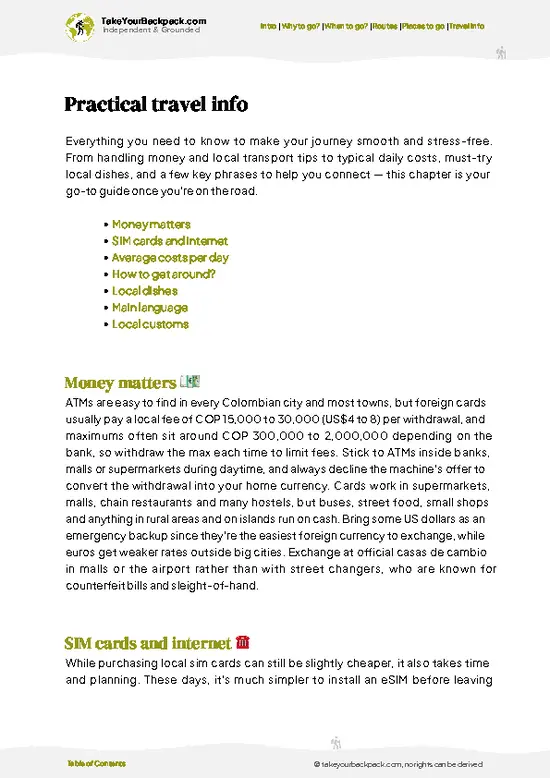
example page 0 from our offline Travel Guide for Colombia
example page 1 from our offline Travel Guide for Colombia
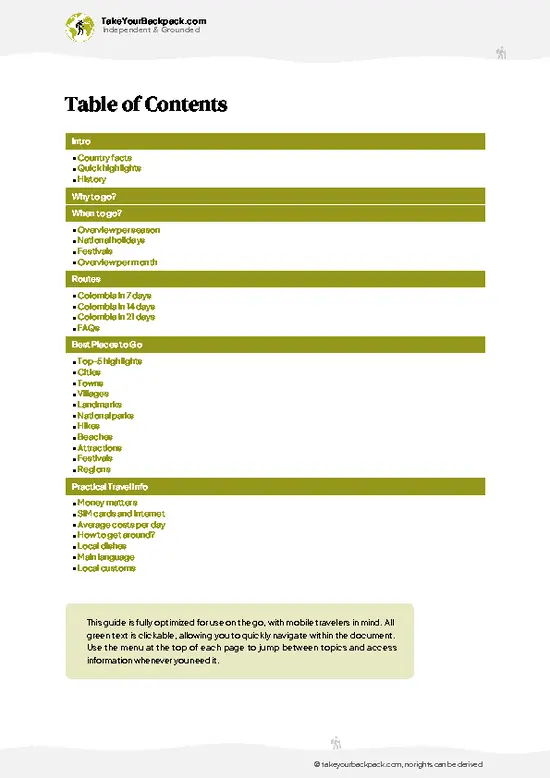
example page 2 from our offline Travel Guide for Colombia
example page 3 from our offline Travel Guide for Colombia
example page 4 from our offline Travel Guide for Colombia
example page 5 from our offline Travel Guide for Colombia
example page 6 from our offline Travel Guide for Colombia
example page 7 from our offline Travel Guide for Colombia
Loading the map 🌍
CLICK TO FILTER
cities
towns
villages
landmarks
national parks
hikes
beaches
attractions
festivals
regions
SHOW COUNTRY’S BESTSHOW ALL

✨ Why go?
Ranked #2 city in Colombia
Why visitors keep coming back

Medellín earns its place on a Colombian route because it packs a lot into one valley with very little friction. The Metro and Metrocable turn the hillside barrios into sights you reach on public transit, so you can fill three or four days without hiring a driver. The hostel scene in El Poblado and Laureles is among the most social in the country, which makes it the place where travel groups form and plans for the coast or the coffee region get made over a shared bandeja paisa. Walks, free tours and street art make it easy to learn the city's recent history from people who lived it, and the year-round spring-like climate means rain is the only real planning variable. It also works as a hub, with a big airport, long-distance bus terminals and plenty of day trip options. The downside is that … read more 👉
Medellín earns its place on a Colombian route because it packs a lot into one valley with very little friction. The Metro and Metrocable turn the hillside barrios into sights you reach on public transit, so you can fill three or four days without hiring a driver. The hostel scene in El Poblado and Laureles is among the most social in the country, which makes it the place where travel groups form and plans for the coast or the coffee region get made over a shared bandeja paisa. Walks, free tours and street art make it easy to learn the city's recent history from people who lived it, and the year-round spring-like climate means rain is the only real planning variable. It also works as a hub, with a big airport, long-distance bus terminals and plenty of day trip options. The downside is that Poblado can feel like a gringo bubble, and some travelers stay a week and never leave it. Treat it as a four to five day stop, longer if you want to work remotely or take Spanish classes.

💡 HighlightsThe experiences that define the visit

  1. Comuna 13: The hillside neighborhood known for its outdoor escalators, graffiti murals and hip-hop dance crews, and for its transformation after years of conflict. Go with a local guide (about US$15 to 25) for the history, ideally in the morning before the crowds. Allow 2 to 3 hours.
  2. Metrocable to Parque Arví: Line K connects to Line L, climbing over the city roofs into a forested park. Rides cost around US$1 to 2 each way on the Metro system fare, plus park entry for trails. Go early on a weekday and plan 3 to 5 hours.
  3. Plaza Botero: Over twenty large bronze sculptures by Fernando Botero stand in the open plaza. It is free and open all day, best in the morning. The adjacent Museo de Antioquia has more of his work for roughly US$6 to 8. Allow 1 to 2 hours.
  4. Museo Casa de la Memoria: A museum on
… read more 👉
  1. Comuna 13: The hillside neighborhood known for its outdoor escalators, graffiti murals and hip-hop dance crews, and for its transformation after years of conflict. Go with a local guide (about US$15 to 25) for the history, ideally in the morning before the crowds. Allow 2 to 3 hours.
  2. Metrocable to Parque Arví: Line K connects to Line L, climbing over the city roofs into a forested park. Rides cost around US$1 to 2 each way on the Metro system fare, plus park entry for trails. Go early on a weekday and plan 3 to 5 hours.
  3. Plaza Botero: Over twenty large bronze sculptures by Fernando Botero stand in the open plaza. It is free and open all day, best in the morning. The adjacent Museo de Antioquia has more of his work for roughly US$6 to 8. Allow 1 to 2 hours.
  4. Museo Casa de la Memoria: A museum on the armed conflict and its victims in Colombia and Antioquia. Entry is free, and the exhibits are sobering but well put together. Plan 1.5 to 2 hours, and go on a weekday morning.
  5. Pueblito Paisa: A replica village on top of Cerro Nutibara with wide views over the valley. Entry is free, and it is best in late afternoon. Allow about 1 hour, plus the climb or a short taxi ride.
  6. Jardín Botánico: Free gardens with an orchid house and a lazy iguana population, a peaceful break from the street noise. Open daily, best in the morning, about 1 to 2 hours.
  7. Parque Explora: A hands-on science museum with an aquarium, popular with families. Tickets run about US$8 to 12, and it takes 2 to 3 hours. Skip it if you are short on time.
Beyond the city, Guatapé with its giant El Peñol rock, Santa Fe de Antioquia with its colonial streets and the coffee towns around Jardín make good day trips or short overnights. For a first visit, Comuna 13 is the one to pick, because it shows the city's past and present in a single walk.
Spotted a mistake or missing something? Contact us.

Things to do in Medellín

Ratings based on Tripadvisor reviews. When you book through this link, you support our work at no extra cost to you.

🏘️ NeighborhoodsHow different areas shape the experience

Medellín spreads along a narrow valley, and three or four areas are worth your time. The rest is residential sprawl you can skip.
  • El Poblado is the polished southern district, with Parque Lleras for bars and clubs and Provenza for restaurants and coffee. It is the easiest area for meeting other travelers and the most expensive, and Lleras itself is loud and touristy, so go for one night and eat elsewhere. Walkable, with steep side streets.
  • Laureles is flat, leafy and local, with a ring of bars and cafés around Calle 70 and Avenida Primera de Mayo. Meals cost noticeably less than in Poblado and the nightlife feels less staged. For most backpackers it gives the best balance, though sights are a metro ride away.
  • Centro holds Plaza Botero, Parque Berrío and the Museo de Antioquia. Visit in daylight
… read more 👉
Medellín spreads along a narrow valley, and three or four areas are worth your time. The rest is residential sprawl you can skip.
  • El Poblado is the polished southern district, with Parque Lleras for bars and clubs and Provenza for restaurants and coffee. It is the easiest area for meeting other travelers and the most expensive, and Lleras itself is loud and touristy, so go for one night and eat elsewhere. Walkable, with steep side streets.
  • Laureles is flat, leafy and local, with a ring of bars and cafés around Calle 70 and Avenida Primera de Mayo. Meals cost noticeably less than in Poblado and the nightlife feels less staged. For most backpackers it gives the best balance, though sights are a metro ride away.
  • Centro holds Plaza Botero, Parque Berrío and the Museo de Antioquia. Visit in daylight for a half day, because the crowds thin out and the area gets rough after dark. Cheap lunches here are excellent.
  • Envigado and Sabaneta are southern suburbs with traditional plazas and weekend food scenes. Worth an afternoon, not a base, since nothing here saves you time.
  • Comuna 13 is the hillside neighborhood known for murals and outdoor escalators. A guided walking tour costs more than going alone, but a local guide explains the history and is the better choice.

⌛️ 1 dayA smart one-day plan

8:30 AM, Plaza Botero: Start with the sculptures while the plaza is quiet. Walk around the fat bronze horses and figures, then step into the Museo de Antioquia if you want more Botero. Keep an eye on your phone in this area, then take the Metro to San Antonio.
10:30 AM, Metro to Parque de los Deseos: Ride north to Universidad, where the science park and the planetarium sit beside a lawn. Walk through for a few minutes, then continue by Metro toward Acevedo.
11:30 AM, Metrocable to Santo Domingo: From Acevedo take Line K up the hillside. You glide over brick rooftops and see the neighborhoods that the cable car was built to connect. At the top, the rebuilt library, reopened in 2026 as the Biblioteca Santo Domingo, offers views. Take the same line back down.
1:30 PM, Lunch in Laureles: Take the … read more 👉
8:30 AM, Plaza Botero: Start with the sculptures while the plaza is quiet. Walk around the fat bronze horses and figures, then step into the Museo de Antioquia if you want more Botero. Keep an eye on your phone in this area, then take the Metro to San Antonio.
10:30 AM, Metro to Parque de los Deseos: Ride north to Universidad, where the science park and the planetarium sit beside a lawn. Walk through for a few minutes, then continue by Metro toward Acevedo.
11:30 AM, Metrocable to Santo Domingo: From Acevedo take Line K up the hillside. You glide over brick rooftops and see the neighborhoods that the cable car was built to connect. At the top, the rebuilt library, reopened in 2026 as the Biblioteca Santo Domingo, offers views. Take the same line back down.
1:30 PM, Lunch in Laureles: Take the Metro to Estadio and walk to the restaurants along the streets near Calle 70. Order a bandeja paisa or a set lunch at a local spot. Rest for an hour.
3:30 PM, Cerro Nutibara: Taxi or bus to the hill for the Pueblito Paisa and the valley view. It is a short stop, and the lookout is a good place to watch the afternoon clouds roll in.
5:30 PM, Barrio Manila and Provenza: Walk the leafy streets, past rooftop bars and craft coffee shops. Away from the main tourist circuit, the quiet side streets and small bakeries give a local feel. Have a drink, then head to dinner.
8:00 PM, Parque Lleras: Finish with a quick look if you want the nightlife, then return before it gets too late.

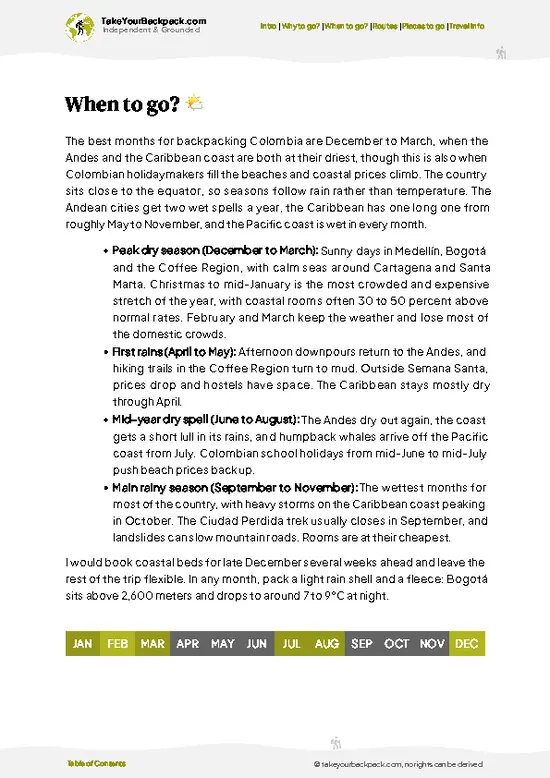
🌤️ When to go?Best time to visit Medellín

Medellín stays mild in every month, so timing is about rain and crowds rather than temperature.
  • Dry Spells (December to February, plus late June to August): The sunniest stretches, with daytime highs near 28°C (82°F) and cooler nights around 17°C (63°F). Daylight stays close to 12 hours all year. December and January bring Colombian holidaymakers, and hostel and flight prices climb.
  • Rainy Seasons (March to May, September to November): Afternoon downpours are common, often starting after 2 pm, with temperatures only a degree or two cooler. Mornings are usually clear, and beds are easier to find at lower rates.
  • Flower Festival (early August): The Feria de las Flores fills the city with parades and parties. Dorm prices rise and rooms sell out weeks ahead.
  • Christmas Lights (December): The river and
… read more 👉
Medellín stays mild in every month, so timing is about rain and crowds rather than temperature.
  • Dry Spells (December to February, plus late June to August): The sunniest stretches, with daytime highs near 28°C (82°F) and cooler nights around 17°C (63°F). Daylight stays close to 12 hours all year. December and January bring Colombian holidaymakers, and hostel and flight prices climb.
  • Rainy Seasons (March to May, September to November): Afternoon downpours are common, often starting after 2 pm, with temperatures only a degree or two cooler. Mornings are usually clear, and beds are easier to find at lower rates.
  • Flower Festival (early August): The Feria de las Flores fills the city with parades and parties. Dorm prices rise and rooms sell out weeks ahead.
  • Christmas Lights (December): The river and city center are covered with light displays that draw big local crowds.
Book early for August and the holidays, or arrive in April or October for the quietest dorms.


source: climatestotravel.comJANJanuary: excellent for travelingFEBFebruary: excellent for travelingMARMarch: highly recommended for travelingAPRApril: highly recommended for travelingMAYMay: good for travelingJUNJune: good for travelingJULJuly: good for travelingAUGAugust: highly recommended for travelingSEPSeptember: fair for travelingOCTOctober: fair for travelingNOVNovember: highly recommended for travelingDECDecember: excellent for traveling
colombia-city-medellin
© Google | Victor

✈️ The backpacker research shortcutColombia Travel Guide

An offline-friendly backpacking guide with optimized travel routes, ranked highlights, transport advice, and the best areas to stay.
example page 0 from our offline Travel Guide for Colombia
example page 1 from our offline Travel Guide for Colombia
example page 2 from our offline Travel Guide for Colombia
example page 3 from our offline Travel Guide for Colombia
example page 4 from our offline Travel Guide for Colombia
example page 5 from our offline Travel Guide for Colombia
example page 6 from our offline Travel Guide for Colombia
example page 7 from our offline Travel Guide for Colombia
The digital guide (349 pages) contains:
✅ 115 highlights, ranked by travel appeal
✅ Optimized 7, 14 & 21-day travel routes
✅ Cities, national parks, landmarks, beaches
✅ How to get around
✅ Offline-friendly for travel without Wi-Fi
👉 Click to see all 30+ guide features

📅 Plan smarter in minutes, not weeks
✅ Month by month travel advice
✅ Festivals & national holidays
✅ Budget expectations

🗺️ Go to the right places, skip the overrated ones
✅ Honest pros & cons of destinations
✅ Top hikes, parks & viewpoints
✅ Lesser-known places most travelers miss
✅ Clear “worth it vs skip it” guidance

🛏️ Travel smoothly without rookie mistakes
✅ Best areas to stay
✅ Transport systems explained simply
✅ Common scams & safety advice
✅ SIM cards, money & practical tips

🌍 Understand the country, not just visit it
✅ Culture & traditions
✅ 52 Essential phrases & customs
✅ Festivals worth planning around
✅ Traveler-friendly historical context
✅ Insights that make places more meaningful

📱 Built for real travel conditions
✅ Fully downloadable PDF
✅ Works completely offline
✅ Optimized for phone use
✅ Useful in remote areas & buses
✅ Everything in one place
Stop searching, start planning
Get instant access to your full guide. 30‑day money-back guarantee.
+ Add another guide for just

By proceeding you agree to our terms.
Sent to your inbox immediately after payment • 100% Secure Checkout
Best Backpacking Travel Advisor 2025 tourism awardBest Backpacking
Travel Advisor
2025
What others say about Take Your Backpack Guides:
⭐⭐⭐⭐⭐
Fantastic, amazing amount of information!
⭐⭐⭐⭐⭐
My goodness this is amazing, it's what I've been looking for hats off too you!
⭐⭐⭐⭐⭐
I think this is absolutely BRILLIANT
⭐⭐⭐⭐
Very complete and informative. It's still missing places, but I gotta to commend you
⭐⭐⭐⭐⭐
This is truly amazing, thank you, can't wait to explore it with my kids!
⭐⭐⭐⭐⭐
Awesome resource, thank you!
⭐⭐⭐⭐⭐
This is amazing! Can't wait to explore the ones I haven't seen
⭐⭐⭐⭐
I love this! Well done, great idea.
⭐⭐⭐⭐⭐
Thanks for taking the time to make this gem!
⭐⭐⭐⭐⭐
This might be the best website I've ever seen.
⭐⭐⭐⭐⭐
Congratulations, and thank you so much for your work; it's incredibly valuable.
⭐⭐⭐⭐
In all seriousness I think you did a great job pointing out the important spots
⭐⭐⭐⭐⭐
10/10 very good
⭐⭐⭐⭐⭐
As someone who's only just starting to visit regularly this is awesome, thank you.
⭐⭐⭐⭐
Thank you very much! I'm going to visit my dad, it's going to be very useful!
⭐⭐⭐⭐⭐
This is really cool! We'll be travelling for the first time and this definitely come in handy.
⭐⭐⭐⭐⭐
You are now our minister of culture, congratulations 👨‍💼
⭐⭐⭐⭐⭐
Just wanted to tell you that this is a pearl! Going to follow your recommendations.
⭐⭐⭐⭐⭐
This is so cool. I'll definitely be using the resource for my travels soon.
⭐⭐⭐⭐⭐
This is very impressive! Good work.
⭐⭐⭐⭐⭐
This is an amazing and informative site. Very well done!

🛏️ Where to stay?Best areas and accommodation options

El Poblado and Laureles are the two best areas for a budget bed, and the choice comes down to how much you want social life.
El Poblado has the densest concentration of hostels in the city, so dorm beds are easy to find even at short notice and you will meet travelers the moment you check in. The metro station at Poblado puts you on the line that runs the length of the valley, and the streets around Provenza are lit and busy until late, so walking back at night feels comfortable. Noise is the cost. Rooms near Parque Lleras get thumping bass until the early hours, so ask for a room away from the … read more 👉
El Poblado and Laureles are the two best areas for a budget bed, and the choice comes down to how much you want social life.
El Poblado has the densest concentration of hostels in the city, so dorm beds are easy to find even at short notice and you will meet travelers the moment you check in. The metro station at Poblado puts you on the line that runs the length of the valley, and the streets around Provenza are lit and busy until late, so walking back at night feels comfortable. Noise is the cost. Rooms near Parque Lleras get thumping bass until the early hours, so ask for a room away from the street or bring earplugs. Prices are the highest in the city.
Laureles is flatter, quieter and noticeably cheaper, with fewer hostels but plenty of small guesthouses and private rooms at modest rates. Evenings are calmer, and the neighborhood has lively bars for when you want them. Stadium metro station is a short walk or a cheap taxi ride away, and most nightlife streets are walkable. If you plan to stay a week or more, Laureles saves money and feels like real Medellín.
Avoid the center for sleeping. Cheap rooms exist, but the streets empty after dark.

🚌 Getting aroundHow to get around Medellín

Taking a taxi from the airport (about an hour away, near Rionegro) at a negotiated price instead of the fixed-rate bus or app is the mistake that drains the most money, and hailing street cabs without agreeing the fare or using an app is a close second. The city is long and hilly, so walking works within a neighborhood but not between them. Public transport is clean and reliable.
  • Metro and Metrocable: The metro runs north to south roughly from 4:30 am to 11 pm (later on some days), and a single ride costs about US$0.80 to 0.90 with a reloadable Cívica card. Metrocable cable cars connect to hillside barrios and cost a little extra, with views worth the fare. This is the best value by far, fast and cool, and it avoids the traffic that clogs the valley.
  • Buses: Cheap at about US$0.70 to 0.80 a ride,
… read more 👉
Taking a taxi from the airport (about an hour away, near Rionegro) at a negotiated price instead of the fixed-rate bus or app is the mistake that drains the most money, and hailing street cabs without agreeing the fare or using an app is a close second. The city is long and hilly, so walking works within a neighborhood but not between them. Public transport is clean and reliable.
  • Metro and Metrocable: The metro runs north to south roughly from 4:30 am to 11 pm (later on some days), and a single ride costs about US$0.80 to 0.90 with a reloadable Cívica card. Metrocable cable cars connect to hillside barrios and cost a little extra, with views worth the fare. This is the best value by far, fast and cool, and it avoids the traffic that clogs the valley.
  • Buses: Cheap at about US$0.70 to 0.80 a ride, but routes are confusing and crowded. Skip them unless the metro does not reach where you need to go.
  • Taxis and ride apps: Short hops in the city cost US$2 to 6, and Poblado to Laureles runs about US$4 to 7. Use inDrive, Uber or Cabify since the price is fixed up front. Worth it at night and in rain.
  • Walking: Poblado, Laureles and Centro are each pleasant on foot, and it costs nothing. Climbing the steep streets in the afternoon heat is slow, so ride between areas and walk once you arrive.
  • Airport transfer: Buses from the main terminal to Rionegro airport cost about US$3 to 4 and take around an hour, far cheaper than a US$25 to 35 taxi.

👛 Costs (as of 19 October 2026)Money, prices, and spending tips

Backpacking in Medellín costs about US$45 to 60 a day, and the total below comes to US$51 with a high-season dorm bed.
CategoryBudget RangeLocal Reality
Dorm accommodation (high season)US$10 to 16Poblado dorms cost the most; Laureles beds are a few dollars cheaper.
Dorm accommodation (off-season)US$8 to 12April to May and October offer the lowest rates.
MealsUS$10 to 16A set lunch costs US$3 to 5; dinner in Poblado costs US$8 to 12.
Local transportUS$2 to 5Metro rides under US$1; ride apps for late nights.
City transport passUS$3 to 5A Cívica card costs about US$1 to 2 to buy, then you load credit; Metrocable adds a little.
Basic activities/entry feesUS$5 to 12Museo de Antioquia is about US$4; tours of Comuna 13 cost more.
MiscellaneousUS$4 to 8SIM card, laundry, a few beers or coffee.
Total Daily
… read more 👉
Backpacking in Medellín costs about US$45 to 60 a day, and the total below comes to US$51 with a high-season dorm bed.
CategoryBudget RangeLocal Reality
Dorm accommodation (high season)US$10 to 16Poblado dorms cost the most; Laureles beds are a few dollars cheaper.
Dorm accommodation (off-season)US$8 to 12April to May and October offer the lowest rates.
MealsUS$10 to 16A set lunch costs US$3 to 5; dinner in Poblado costs US$8 to 12.
Local transportUS$2 to 5Metro rides under US$1; ride apps for late nights.
City transport passUS$3 to 5A Cívica card costs about US$1 to 2 to buy, then you load credit; Metrocable adds a little.
Basic activities/entry feesUS$5 to 12Museo de Antioquia is about US$4; tours of Comuna 13 cost more.
MiscellaneousUS$4 to 8SIM card, laundry, a few beers or coffee.
Total Daily BudgetUS$51Using a high-season dorm bed, a mid-range of other costs.
Lunch is the main money-saver: eat the big menú del día at midday and keep dinner light.
⚠️ Prices can change and everyone travels differently, so take this as a rough guide. Hope it helps you plan your adventure!

🚌 Day tripsShort trips worth adding

Medellín works well as a base because the surrounding mountains hold several easy outings, all reachable by bus or metro within a few hours.
Guatapé and El Peñol:
The giant granite rock rises above a lake of islands and requires climbing 740 steps for wide views. Buses from the Terminal del Norte take about two hours and cost around US$5 to 7 each way, with the entry fee about US$4 to 5. Go midweek and start early, since weekends are packed and the cloud often covers the view by afternoon. Many first-timers book a pricey tour when the bus is easy. Total cost about US$20 to 30.
👉 Explore Guatapé
Santa Elena and Parque Arví:
A metro and Metrocable combination climbs to a cool forest park above the valley, with walking trails and a market selling silletero flower crafts. Allow about 90 minutes each … read more 👉
Medellín works well as a base because the surrounding mountains hold several easy outings, all reachable by bus or metro within a few hours.
Guatapé and El Peñol:
The giant granite rock rises above a lake of islands and requires climbing 740 steps for wide views. Buses from the Terminal del Norte take about two hours and cost around US$5 to 7 each way, with the entry fee about US$4 to 5. Go midweek and start early, since weekends are packed and the cloud often covers the view by afternoon. Many first-timers book a pricey tour when the bus is easy. Total cost about US$20 to 30.
👉 Explore Guatapé
Santa Elena and Parque Arví:
A metro and Metrocable combination climbs to a cool forest park above the valley, with walking trails and a market selling silletero flower crafts. Allow about 90 minutes each way, and expect to pay US$3 to 6 for transport plus a small entry fee for the park. It is best on dry mornings, and the mistake is arriving without a jacket, since temperatures drop sharply.

Jardín:
This colorful coffee town in the southwest has a plaza lined with chairs and hillsides full of farms and a cloud forest with cock-of-the-rock birds. Buses take about four hours each way, so it is a long day, and many travelers make it an overnight instead. Fares run US$10 to 15 each way. Visit between December and March for drier trails.
👉 Explore Jardín
Santa Fe de Antioquia:
The old colonial town sits in a hot, dry valley about 90 minutes from the city, with a historic bridge and stone streets that feel like a different climate. Buses cost around US$4 to 6 each way. Leave early to avoid midday heat.
👉 Explore Santa Fe de Antioquia

🍲 FoodWhat to Eat & Drink

Medellín’s signature plate is the bandeja paisa, a huge platter of beans, rice, chicharrón, ground beef, fried egg, plantain and avocado. It is a Paisa creation, and here it comes in portions made for field workers, so share it or skip dinner. Look for arepas that are thin and white, grilled over charcoal and topped with cheese, plus mondongo (tripe soup) and sancocho antioqueño on weekends. Fresh jugos made from lulo, mora or guanábana come cheap, and aguardiente antioqueño, the anise spirit, is drunk in shots with friends. Coffee from the surrounding hills is excellent, and cafés in Poblado and Laureles serve it carefully brewed.
For cheap eating, lunch spots in Centro and Laureles serve the menú del día (soup, main plate, juice), usually at US$3 to 5. Street carts sell empanadas and buñuelos … read more 👉
Medellín’s signature plate is the bandeja paisa, a huge platter of beans, rice, chicharrón, ground beef, fried egg, plantain and avocado. It is a Paisa creation, and here it comes in portions made for field workers, so share it or skip dinner. Look for arepas that are thin and white, grilled over charcoal and topped with cheese, plus mondongo (tripe soup) and sancocho antioqueño on weekends. Fresh jugos made from lulo, mora or guanábana come cheap, and aguardiente antioqueño, the anise spirit, is drunk in shots with friends. Coffee from the surrounding hills is excellent, and cafés in Poblado and Laureles serve it carefully brewed.
For cheap eating, lunch spots in Centro and Laureles serve the menú del día (soup, main plate, juice), usually at US$3 to 5. Street carts sell empanadas and buñuelos near metro stations. Plaza Minorista is the big local market where you can eat from stalls among piles of tropical fruit. Evenings in Provenza and Laureles bring craft beer and cocktails, with Parque Lleras the loud choice.

🛡️ SafetyScams, Hazards, and Annoyances

Medellín is much safer than its reputation, and most trouble is petty theft rather than violence. Phone snatching is the main issue, especially in Centro, around Parque Lleras and on busy metro platforms. Keep your phone in a front pocket, avoid using it at the curb, and don’t wear flashy jewelry. In Poblado, be careful with strangers who approach you at night offering drugs or company, since this is where drink spiking and robbery happen. Decline politely, keep your drink in hand and never leave a bar with someone you just met. Use a ride app rather than walking late between districts, especially solo. Women and solo travelers will find Laureles and Poblado easy by day. Avoid Centro after dark and stay out of the hills away from tour routes. The phrase “no dar papaya” (don’t make yourself … read more 👉
Medellín is much safer than its reputation, and most trouble is petty theft rather than violence. Phone snatching is the main issue, especially in Centro, around Parque Lleras and on busy metro platforms. Keep your phone in a front pocket, avoid using it at the curb, and don’t wear flashy jewelry. In Poblado, be careful with strangers who approach you at night offering drugs or company, since this is where drink spiking and robbery happen. Decline politely, keep your drink in hand and never leave a bar with someone you just met. Use a ride app rather than walking late between districts, especially solo. Women and solo travelers will find Laureles and Poblado easy by day. Avoid Centro after dark and stay out of the hills away from tour routes. The phrase “no dar papaya” (don’t make yourself an easy target) is the local rule of thumb, and it works.

FAQCommon questions from travelers

Three full days cover Medellín’s main sights: one for Centro and Plaza Botero, one for Comuna 13 and the Metrocable, and one for the food and cafés of Poblado and Laureles. Add a fourth day for Guatapé, which is about two hours by bus and costs roughly US$20 to 30 round trip. Stay five to seven days if you want Jardín or a slower pace.
Medellín is safe for solo backpackers if you use common sense, and most problems are phone snatching or drink spiking in Parque Lleras and Centro. Stay in Poblado or Laureles, use ride apps such as inDrive or Uber at night (US$2 to 7 for most trips), and avoid Centro after dark. Solo women commonly report feeling comfortable in those two districts by day.
Medellín is known for its dramatic transformation from the 1990s into an innovative city, with a clean metro, Metrocable cable cars and the Comuna 13 murals. It is also famous for the bandeja paisa, spring-like weather year-round (highs near 28°C, 82°F) and the August Feria de las Flores. Plaza Botero, with its 23 bronze sculptures by Fernando Botero, is the top free sight.
⚠️ Things can change over time, so always validate details locally before you go.

Other Colombian cities near Medellín

Explore more nearby:

  • Manizales—Neo-Gothic cathedral tower, cable car, ridge-top cafés| 132 km away
  • Quibdó—Atrato riverfront, Afro-Colombian culture, Chocó rain, borojó| 135 km away
  • Pereira—Bolívar Desnudo, Otún river park, Megacable, coffee-axis base| 161 km away

💡 Not sure where to go next?
Create a personalized itinerary for Colombia including Medellín and the places that fit your trip.

Generate my itinerary

👉 Discover all cities

Or checkout all Colombia has to offer (think cities, towns, villages, national parks, hikes, beaches, festivals)
Country photo of Colombia

We 💚 feedbackKey takeaways before you go

Medellín is best on a clear morning, when the sky over the valley is bright and the Metro is quiet, and by season, December to March and the July to August stretch tend to be drier. I would plan one big outing at dawn and leave the afternoons loose, since the rain often arrives after lunch.

✈️ When did I visit Colombia?
Did a good 3-week trip around Colombia in August 2014.

✍️ Help improve this page!
The information on this page is based on my own backpacking experience in Colombia, supplemented with up-to-date research and feedback from other travelers. Travel details can change, so if you notice anything outdated or incomplete, feel free to let me know.


🙋‍♂️ Give feedback

👋 Meet the founderWho’s Behind Take Your Backpack?

Johan, backpacker and founder of TakeYourBackpackHi, I’m Johan (Netherlands 🇳🇱), the creator of TakeYourBackpack. Over the past 3 decades, I’ve backpacked through 90+ countries across six continents, gaining extensive experience with independent travel, long-term trips, and overland routes.

This site is built on a combination of firsthand travel experience and carefully curated insights from other backpackers. Many guides are based on places I’ve personally visited, while others bring together tips, observations, and practical advice shared by trusted travelers I’ve met along the way.

The goal is to provide realistic, experience-driven guidance — not generic itineraries — so you can explore destinations with better context, clearer expectations, and more confidence.