×

Colombia🇨🇴 | best citiesEssential 10 cities to Explore in Colombia

Cities in Colombia are not interchangeable, and treating them that way wastes money and days. The country splits by altitude and coast. Andean highland cities sit at 1,500 to 2,600 meters, with cool nights, spring-like days, good transit, and the best food and nightlife for the price. Caribbean coastal cities are hot and humid, with walled old towns, higher costs and the biggest crowds, especially around holidays. Smaller colonial towns in the interior are quieter and cheaper but take buses of several hours to reach. The Pacific side is wet, remote and rarely worth building a city itinerary around. Roads wind through three mountain ranges, so distances look short on a map and run long on the ground, which makes domestic flights a normal part of independent travel. If you want atmosphere and value, prioritize the highlands. If you want heat and photogenic streets, accept the coastal premium. Skip anything that needs a 10-hour bus for a single afternoon.

By Johan Kruseman 🇳🇱 | Updated October 20, 2026
Explore the best towns in Colombia

Why go?Why Travelers Love These Spots

Colombia is a country of regional capitals rather than one dominant city, and the Andes explain why. Three cordilleras split the interior into separate valleys and plateaus, so each major city grew as its own center with its own climate, food, accent and economy. A traveler who picks Colombia for its cities gets real variety. Someone expecting a compact, connected circuit will be disappointed.

Altitude sets the weather more than the calendar does. Cities between 1,500 and 2,600 meters sit in mild, spring-like air at roughly 14 to 24°C all year. Caribbean coastal cities are hot and humid, usually 28 to 33°C, and feel very different even though the flight is about 90 minutes. Pack for both, or choose one climate and skip the other.

History adds a second layer. Spanish colonial grids and fortified … read more 👉
Colombia is a country of regional capitals rather than one dominant city, and the Andes explain why. Three cordilleras split the interior into separate valleys and plateaus, so each major city grew as its own center with its own climate, food, accent and economy. A traveler who picks Colombia for its cities gets real variety. Someone expecting a compact, connected circuit will be disappointed.

Altitude sets the weather more than the calendar does. Cities between 1,500 and 2,600 meters sit in mild, spring-like air at roughly 14 to 24°C all year. Caribbean coastal cities are hot and humid, usually 28 to 33°C, and feel very different even though the flight is about 90 minutes. Pack for both, or choose one climate and skip the other.

History adds a second layer. Spanish colonial grids and fortified ports survive in the old quarters, while the modern districts around them are sprawling, concrete and loud. Many cities also rebuilt their public image after the violent decades of the 1980s and 1990s, with metro lines, cable cars linked to hillside neighborhoods, cycle routes and public libraries. That investment makes some cities easier to use than their reputation suggests.

Getting between cities is the main limit. Mountain roads are slow, and an overland leg of 8 to 12 hours is normal for distances that look short on a map. Domestic flights of 50 to 90 minutes are often the better use of time and can cost as little as US$30 to 80 when booked ahead.

Before committing, know that petty theft and phone snatching are the main urban risks, and that certain districts are not worth visiting after dark. Nightlife, street food and public transport reward travelers who take local advice on where to go. Colombia suits travelers who value contrast between cities. It does not suit anyone trying to tick off six places in a week.
Why These Made the Cut
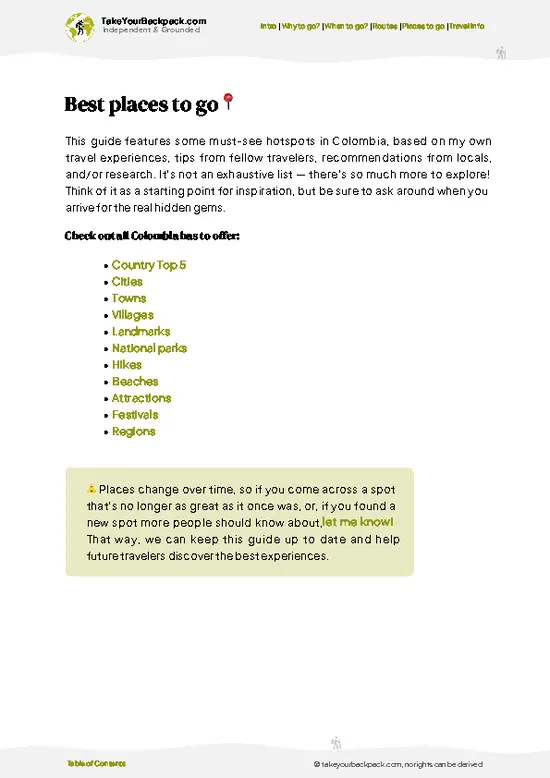
The list of best cities in Colombia is created based on culture, vibe, attractions, transport ease, and local charm. If you feel a city is missing in this list, please let us know.

When to go?When to Plan Your Trip

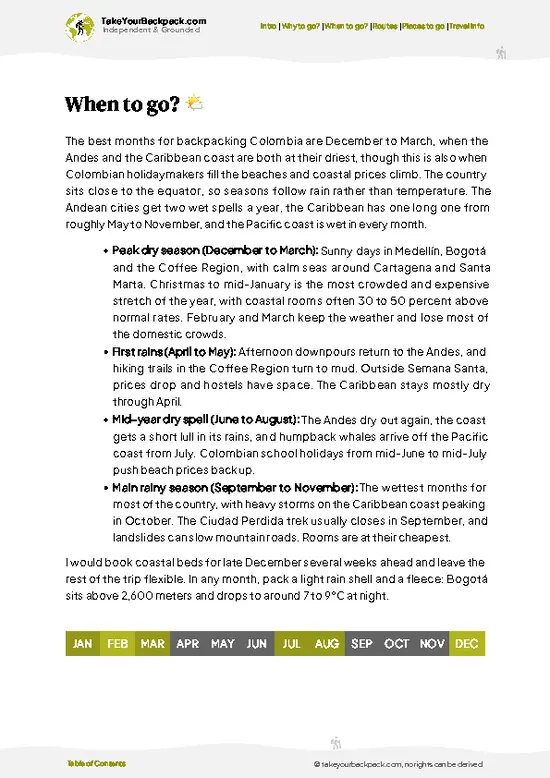
Best months for Colombian cities: The best months are December to March, plus July and August, when most of the country is in its drier season and roads, flights and city walking are at their most reliable. Colombia has no summer or winter in the usual sense. Temperature follows altitude, so rainfall and crowds decide the calendar.

Weather by region: In the Andean highlands, days sit around 14 to 24°C and nights can drop to 6 to 10°C in the higher cities. Rain falls in two wet seasons, roughly April to May and October to November, usually as afternoon downpours rather than all-day gloom. Highland cities are comfortable any month, so the dry spells simply make them easier.

On the Caribbean coast, expect 28 to 34°C with high humidity. The driest stretch runs December to April. September to … read more 👉
Best months for Colombian cities: The best months are December to March, plus July and August, when most of the country is in its drier season and roads, flights and city walking are at their most reliable. Colombia has no summer or winter in the usual sense. Temperature follows altitude, so rainfall and crowds decide the calendar.

Weather by region: In the Andean highlands, days sit around 14 to 24°C and nights can drop to 6 to 10°C in the higher cities. Rain falls in two wet seasons, roughly April to May and October to November, usually as afternoon downpours rather than all-day gloom. Highland cities are comfortable any month, so the dry spells simply make them easier.

On the Caribbean coast, expect 28 to 34°C with high humidity. The driest stretch runs December to April. September to November brings the heaviest rain and occasional street flooding, and the heat is hardest to take around midday year-round. Plan sightseeing for early morning and late afternoon.

The Pacific side is wet nearly all year and is a poor choice for a city-focused trip in any month.

Peak periods and prices: Peak demand hits mid-December to mid-January, Holy Week (March or April), and the long holiday weekends (puentes) that Colombians take across the year. During those windows, coastal and colonial towns can see room rates rise by 30 to 100 percent, and buses and flights sell out. Book a week or more ahead, or avoid those dates.

Shoulder seasons: April to June and September to November are cheaper and quieter. Rain is a nuisance rather than a barrier in the highlands, and you can often haggle on dorm and private room rates. Skip the Caribbean in the wettest autumn weeks if beach time matters. A few city festivals fill hostels weeks in advance, so check dates before you lock in flights.

city hoppingPlanning Your Route Efficiently

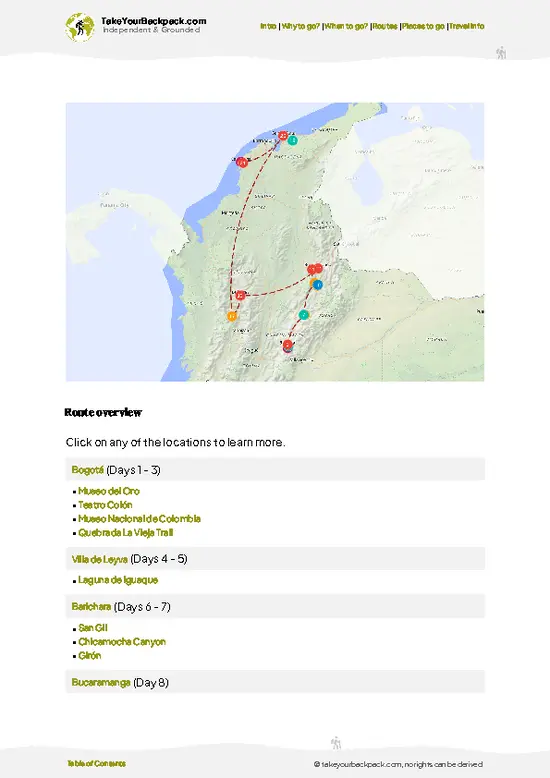
How many days you need: A trip combining several Colombian cities needs 10 to 21 days, and two to three weeks is the realistic range if you want one highland region, the Caribbean coast and a coffee-region stop without rushing. Under 10 days, stick to a single region.

Which regions group together: The Andean highlands cluster well: the main hubs in the central and northwest mountains are linked by frequent flights of about 45 to 60 minutes and buses of 6 to 9 hours. The Caribbean coast forms a second cluster, with cities 1 to 4 hours apart by road. The Coffee Region sits between the two and works as a connecting stop. A sensible direction is to start in the highlands, move through the coffee hills, then finish on the coast, where you can unwind and fly out of a coastal airport. Reverse it … read more 👉
How many days you need: A trip combining several Colombian cities needs 10 to 21 days, and two to three weeks is the realistic range if you want one highland region, the Caribbean coast and a coffee-region stop without rushing. Under 10 days, stick to a single region.

Which regions group together: The Andean highlands cluster well: the main hubs in the central and northwest mountains are linked by frequent flights of about 45 to 60 minutes and buses of 6 to 9 hours. The Caribbean coast forms a second cluster, with cities 1 to 4 hours apart by road. The Coffee Region sits between the two and works as a connecting stop. A sensible direction is to start in the highlands, move through the coffee hills, then finish on the coast, where you can unwind and fly out of a coastal airport. Reverse it if your arrival is on the Caribbean. Either way, avoid doubling back.

Time per stop and transfers: Give each city 2 to 4 nights. Two nights is enough for a compact colonial center. Larger cities need three or four. Between regions, flights take 1 to 1.5 hours and cost roughly US$30 to 90 if booked in advance, while the same journey overland can run 10 to 18 hours.

Planning mistakes to avoid: The biggest error is trusting map distances. A 200-kilometer hop can take 6 hours on winding roads, so check actual bus times before committing. Another is chaining overnight buses, which leaves you tired and wastes hostel nights. Fly the long legs and take buses only for short ones. Many travelers also add too many stops, giving each a single night and spending half their trip in terminals. Cut the list instead. Finally, do not schedule a flight on the same day as a long bus ride. Roadblocks and landslides can delay buses by hours, so leave a buffer of at least 4 hours or travel the day before.

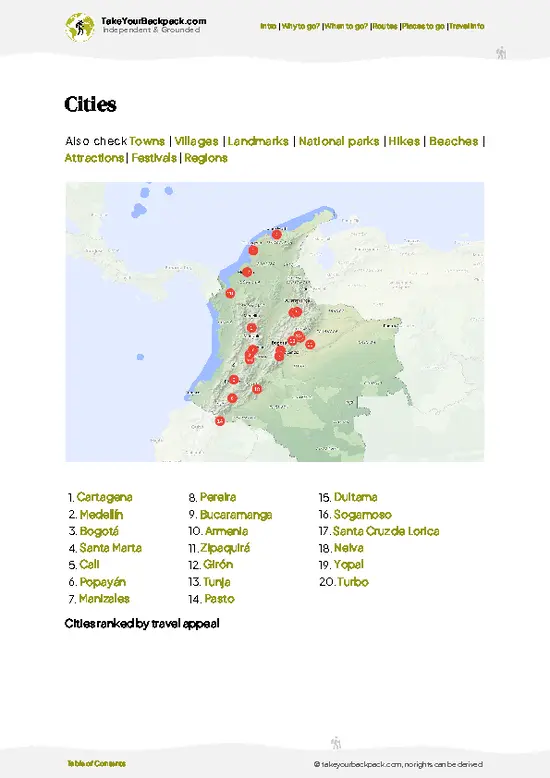
The ListHighly Recommended cities of Colombia

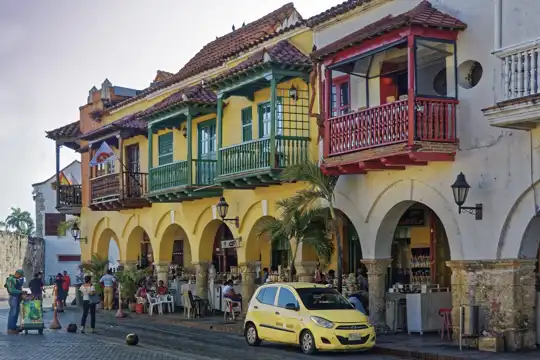
1 Cartagena

Stone ramparts, San Felipe fortress, Getsemaní murals, Caribbean heat

Walk 17th-century walls at sunset, explore fortress tunnels, and eat street food on Getsemaní’s lively Plaza de la Trinidad.

Colombia - Cartagena

2 Medellín

Metro and Metrocable, Comuna 13, Botero bronzes, Laureles bars

Ride cable cars up valley slopes, join a guided walk through Comuna 13, and meet fellow travelers over dinner in Laureles.

colombia-city-medellin
© Google | Victor

3 Bogotá

Gold Museum, Candelaria lanes, Monserrate, Sunday Ciclovía

Climb to a 3,152 meter sanctuary, trace pre-Hispanic gold, and spend Sunday cycling traffic-free avenues across the capital.

colombia-city-bogota
© Google | Elio Guzman

4 Santa Marta

Oldest Spanish city, Taganga dive bay, Sierra Nevada access

Visit the hacienda where Bolívar died, then slip north to Taganga for diving courses and seafood by the bay.

5 Cali

Salsa academies, San Antonio hilltop, Galería Alameda

Take an evening group salsa lesson, then taste lulo juice and cold champús at market stalls in a hot valley city.

6 Popayán

Whitewashed colonial core, Morro de Tulcán, Cauca students

Walk compact whitewashed blocks, climb the pyramid mound for views over red roofs, and eat breakfast among market stalls.

7 Manizales

Neo-Gothic cathedral tower, cable car, ridge-top cafés

Ride the cable car over steep ridges, climb the cathedral tower for rooftop views, and visit orchid houses in cloud forest.

8 Pereira

Bolívar Desnudo, Otún river park, Megacable, coffee-axis base

Ride a gondola above the valley, see the famously bare Bolívar on horseback, and use the city for coffee-country day trips.

9 Bucaramanga

Park-lined Santander base, Chicamocha gateway, grilled meat and coffee

Stay in a relaxed, green city of fountains and hillside lookouts before heading on to Barichara, San Gil and the canyon.

10 Armenia

Coffee-region transit hub, Museo Quimbaya, Quindío fincas

Use the city as a launch point for coffee farms, and spend a morning with Quimbaya gold at the Salmona-designed museum.

colombia-city-armenia
© Google |

11 Zipaquirá

Salt Cathedral, halite mine, Calle Real cafés, Bogotá day trip

Descend into a working salt mountain to see an underground cross, then stroll the colonial plaza for fresh arepas.

12 Girón

Whitewashed lanes, Basílica de San Juan Bautista, Río de Oro promenade

Wander stone-paved streets beneath wooden balconies, then end the afternoon along the river promenade on a short trip from Bucaramanga.

13 Tunja

Painted colonial ceilings, gilded chapels, Boyacá capital, student streets

Compare ornate church interiors and painted ceilings in colonial houses, then end the day among bakeries and students at dusk.

14 Pasto

Andean border city, Galeras volcano, Nariño gold, El Potrerillo

Pair market lunches and a pre-Hispanic gold collection with dusk views toward Galeras before continuing overland toward Ecuador.

15 Duitama

Potato market, Boyacá crossroads, páramo moorland

Shop weekend stalls piled with potato varieties and cheese, then head up to windswept frailejón moorland above town.

16 Sogamoso

Muisca Sun Temple, Sunday market, Lake Tota access

Step through a reconstructed Muisca temple, then browse potatoes and woolen ruanas at a market that fills the streets.

17 Santa Cruz de Lorica

Sinú River canals, iron market hall, caña flecha weaving

Browse woven hats in an early 1900s market hall, then follow the canals and the Sinú waterfront with its small boats.

18 Neiva

Magdalena riverfront, lechona, desert gateway

Break the journey toward San Agustín or the desert with a river walk at dusk.

19 Yopal

Casanare plains edge, Cravo Sur riverside, joropo evenings

Stretch your legs on the river promenade at dusk and watch families gather under shade trees before heading to the Llanos.

20 Turbo

Banana port, Urabá gulf piers, Darién boat departures

Watch launches load at the main pier for the Darién coast, and eat fried fish along the gulf waterfront.

21 Quibdó

Atrato riverfront, Afro-Colombian culture, Chocó rain, borojó

Watch canoes unload along the Malecón at dusk, then try Pacific fish and chontaduro at the central market.

Think you know Colombia?

Prove you’re a true local — uncover 11 lesser-known cities in Colombia that locals tend to keep to themselves.
Loading the map 🌍

Expert viewInsights from Locals and Experts

How many cities to visit: Plan on three to five cities, because the country rewards depth more than checklists and the road times punish ambition. Each stop needs two to four nights to feel like more than a transit point. Add a sixth and you spend more hours in terminals than on streets. Pick one city per region and skip the rest.

Choosing between kinds of cities: Match the type to your travel style. Highland cities suit travelers who want food, nightlife, museums, street art and cool air at lower prices. Coastal colonial cities suit those who want atmosphere and heat, but they are the most expensive and most touristed. Smaller towns suit slower trips and walkers. If you are short on time or money, drop the coastal premium and spend those nights in the highlands. If you hate crowds, avoid … read more 👉
How many cities to visit: Plan on three to five cities, because the country rewards depth more than checklists and the road times punish ambition. Each stop needs two to four nights to feel like more than a transit point. Add a sixth and you spend more hours in terminals than on streets. Pick one city per region and skip the rest.

Choosing between kinds of cities: Match the type to your travel style. Highland cities suit travelers who want food, nightlife, museums, street art and cool air at lower prices. Coastal colonial cities suit those who want atmosphere and heat, but they are the most expensive and most touristed. Smaller towns suit slower trips and walkers. If you are short on time or money, drop the coastal premium and spend those nights in the highlands. If you hate crowds, avoid the walled coastal centers in December and January.

Daily budget: Budget US$25 to 40 a day for dorms, set lunches and public transit, US$45 to 80 for private rooms and a few paid activities, and US$100 or more for comfort. Dorm beds run roughly US$8 to 15 outside the coast and US$12 to 25 in coastal cities in high season. A set lunch (menú del día) costs about US$3 to 5 and is the best-value meal in the country.

Typical visit costs: museum entry US$2 to 8, free walking tours with tips of US$5 to 10, paid guided city tours US$20 to 40, cable cars or metro rides under US$1 to 3. Domestic flights between regions are usually US$30 to 90 if booked early, and last-minute fares can double. Intercity buses run US$10 to 30 depending on distance.

Costs that catch travelers out: Airport taxis charge more than ride apps, so use official taxi counters or an app. Bags on low-cost airlines are often priced separately, and a cheap fare can double once you add a checked bag, so pay for it online beforehand. Coastal hotel prices jump over holidays, and cancellations are rarely free. Cash machines carry fees and daily limits, so withdraw larger amounts less often at bank-branch machines.

Safety in the cities: Petty theft is the main risk, especially phone snatching. Keep your phone out of sight on the street, avoid using it at curbs and near traffic, and do not display jewelry. Use registered taxis or ride apps at night rather than hailing from the street. Stick to well-lit central streets after dark, and ask your hostel which blocks to avoid, since conditions can change from one street to the next. Never accept drinks from strangers, and be wary of unsolicited offers of drugs, which tend to be a setup. Only carry the cash you need for the day and leave your passport copy handy, not the original.

Cultural and practical notes: Colombians are warm and formal at once. Greet people before asking a question and use usted with strangers and elders. Learn basic Spanish, because English is limited outside hostels. Altitude affects the highland cities, so take the first day easy, drink plenty of water and go light on alcohol. Carry a light rain jacket year-round, since afternoon showers arrive fast. Dress is generally casual, but beachwear belongs on the beach, not in colonial streets. Always carry some small bills for buses and street vendors, as large notes often cannot be changed.

✈️ The backpacker research shortcutColombia Travel Guide

An offline-friendly backpacking guide with optimized travel routes, ranked highlights, transport advice, and the best areas to stay.
example page 0 from our offline Travel Guide for Colombia
example page 1 from our offline Travel Guide for Colombia
example page 2 from our offline Travel Guide for Colombia
example page 3 from our offline Travel Guide for Colombia
example page 4 from our offline Travel Guide for Colombia
example page 5 from our offline Travel Guide for Colombia
example page 6 from our offline Travel Guide for Colombia
example page 7 from our offline Travel Guide for Colombia
The digital guide (349 pages) contains:
✅ 115 highlights, ranked by travel appeal
✅ Optimized 7, 14 & 21-day travel routes
✅ Cities, national parks, landmarks, beaches
✅ How to get around
✅ Offline-friendly for travel without Wi-Fi
👉 Click to see all 30+ guide features

📅 Plan smarter in minutes, not weeks
✅ Month by month travel advice
✅ Festivals & national holidays
✅ Budget expectations

🗺️ Go to the right places, skip the overrated ones
✅ Honest pros & cons of destinations
✅ Top hikes, parks & viewpoints
✅ Lesser-known places most travelers miss
✅ Clear “worth it vs skip it” guidance

🛏️ Travel smoothly without rookie mistakes
✅ Best areas to stay
✅ Transport systems explained simply
✅ Common scams & safety advice
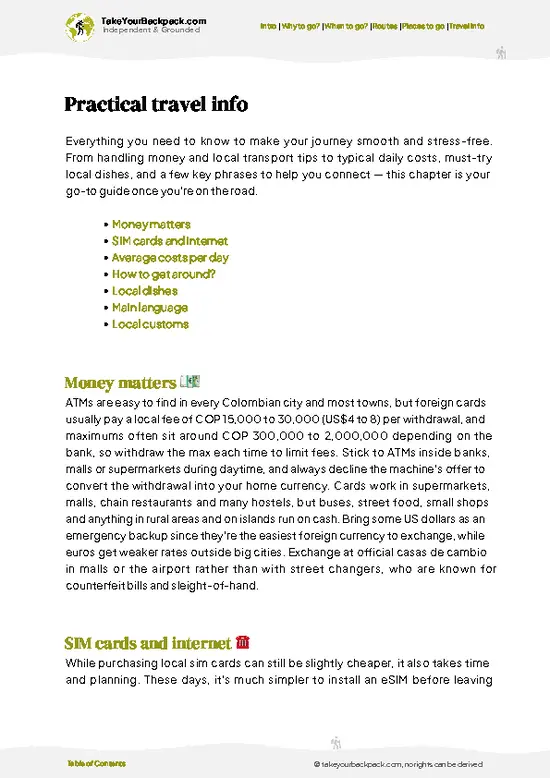
✅ SIM cards, money & practical tips

🌍 Understand the country, not just visit it
✅ Culture & traditions
✅ 52 Essential phrases & customs
✅ Festivals worth planning around
✅ Traveler-friendly historical context
✅ Insights that make places more meaningful

📱 Built for real travel conditions
✅ Fully downloadable PDF
✅ Works completely offline
✅ Optimized for phone use
✅ Useful in remote areas & buses
✅ Everything in one place
Stop searching, start planning
Get instant access to your full guide. 30‑day money-back guarantee.
+ Add another guide for just

By proceeding you agree to our terms.
Sent to your inbox immediately after payment • 100% Secure Checkout
Best Backpacking Travel Advisor 2025 tourism awardBest Backpacking
Travel Advisor
2025
What others say about Take Your Backpack Guides:
⭐⭐⭐⭐⭐
Fantastic, amazing amount of information!
⭐⭐⭐⭐⭐
My goodness this is amazing, it's what I've been looking for hats off too you!
⭐⭐⭐⭐⭐
I think this is absolutely BRILLIANT
⭐⭐⭐⭐
Very complete and informative. It's still missing places, but I gotta to commend you
⭐⭐⭐⭐⭐
This is truly amazing, thank you, can't wait to explore it with my kids!
⭐⭐⭐⭐⭐
Awesome resource, thank you!
⭐⭐⭐⭐⭐
This is amazing! Can't wait to explore the ones I haven't seen
⭐⭐⭐⭐
I love this! Well done, great idea.
⭐⭐⭐⭐⭐
Thanks for taking the time to make this gem!
⭐⭐⭐⭐⭐
This might be the best website I've ever seen.
⭐⭐⭐⭐⭐
Congratulations, and thank you so much for your work; it's incredibly valuable.
⭐⭐⭐⭐
In all seriousness I think you did a great job pointing out the important spots
⭐⭐⭐⭐⭐
10/10 very good
⭐⭐⭐⭐⭐
As someone who's only just starting to visit regularly this is awesome, thank you.
⭐⭐⭐⭐
Thank you very much! I'm going to visit my dad, it's going to be very useful!
⭐⭐⭐⭐⭐
This is really cool! We'll be travelling for the first time and this definitely come in handy.
⭐⭐⭐⭐⭐
You are now our minister of culture, congratulations 👨‍💼
⭐⭐⭐⭐⭐
Just wanted to tell you that this is a pearl! Going to follow your recommendations.
⭐⭐⭐⭐⭐
This is so cool. I'll definitely be using the resource for my travels soon.
⭐⭐⭐⭐⭐
This is very impressive! Good work.
⭐⭐⭐⭐⭐
This is an amazing and informative site. Very well done!

🛏️ Where to stay?Accommodation Highlights

Hostels and budget guesthouses are easy to find across Colombia, with dorm beds typically running COP 40,000 to 80,000 (US$12 to 25) and private rooms from about COP 100,000 (US$31). In Bogotá, La Candelaria puts you within walking distance of the museums and old-town streets but empties out after dark, while Chapinero has better restaurants, bars and a safer evening feel; in Medellín, El Poblado is the party hub with the highest prices and noise, and Laureles is calmer, greener and more local. In Cartagena, Getsemaní has the densest cluster of hostels, street art and plaza nightlife a few minutes from the walled Centro Histórico, which is prettier and quieter but costs noticeably more.

If you … read more 👉
Hostels and budget guesthouses are easy to find across Colombia, with dorm beds typically running COP 40,000 to 80,000 (US$12 to 25) and private rooms from about COP 100,000 (US$31). In Bogotá, La Candelaria puts you within walking distance of the museums and old-town streets but empties out after dark, while Chapinero has better restaurants, bars and a safer evening feel; in Medellín, El Poblado is the party hub with the highest prices and noise, and Laureles is calmer, greener and more local. In Cartagena, Getsemaní has the densest cluster of hostels, street art and plaza nightlife a few minutes from the walled Centro Histórico, which is prettier and quieter but costs noticeably more.

If you enjoy meeting fellow travelers, consider choosing hostels with high ratings for atmosphere. On the other hand, if you prefer having your own space, a hotel might be a better option.

ColombiaSee More of Colombia

👋 Meet the founderWho’s Behind Take Your Backpack?

Johan, backpacker and founder of TakeYourBackpackHi, I’m Johan (Netherlands 🇳🇱), the creator of TakeYourBackpack. Over the past 3 decades, I’ve backpacked through 90+ countries across six continents, gaining extensive experience with independent travel, long-term trips, and overland routes.

This site is built on a combination of firsthand travel experience and carefully curated insights from other backpackers. Many guides are based on places I’ve personally visited, while others bring together tips, observations, and practical advice shared by trusted travelers I’ve met along the way.

The goal is to provide realistic, experience-driven guidance — not generic itineraries — so you can explore destinations with better context, clearer expectations, and more confidence.