×

Costa Rica🇨🇷 | national parksSanta Rosa National ParkNancite arribada, La Casona, dry-forest hikes, Naranjo coast | things to do and best time to go

Explore Carara National ParkExplore Tapantí National Park

Backpacking in Santa Rosa
👌 Worth visitingnational park ranked #14
By Johan Kruseman 🇳🇱 | Updated October 22, 2026

Santa Rosa holds the battlefield where Costa Rica’s army beat William Walker’s filibusters in 1856, and the old hacienda house there is the country’s most symbolic historical site. The park sits in the far northwest of Costa Rica, in Guanacaste, on the road toward the Nicaraguan border. Most people come for the surf at Playa Naranjo and Witch’s Rock, which is why the interior stays so quiet. I stepped off the road into dry forest where cicadas drowned everything and the air smelled of baked leaf litter; the old hacienda stood alone under a huge tree. Access is the hard part: the surf beaches need a 4x4 or a long hike, so experienced travelers go by bus to the highway and arrange a ride in. A first day could mean the hacienda in the morning, a forest loop at midday, and a ride to the coast for dusk.

Discover everything you want to know in the 📖 Costa Rica Travel Guide.


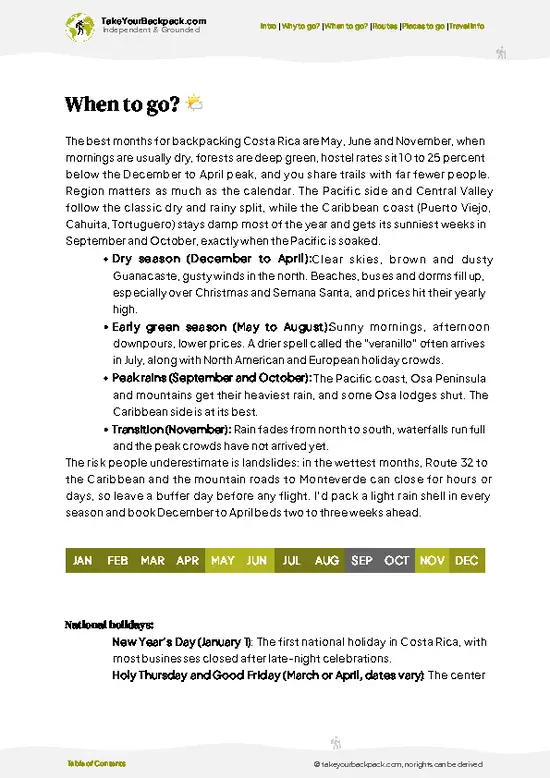
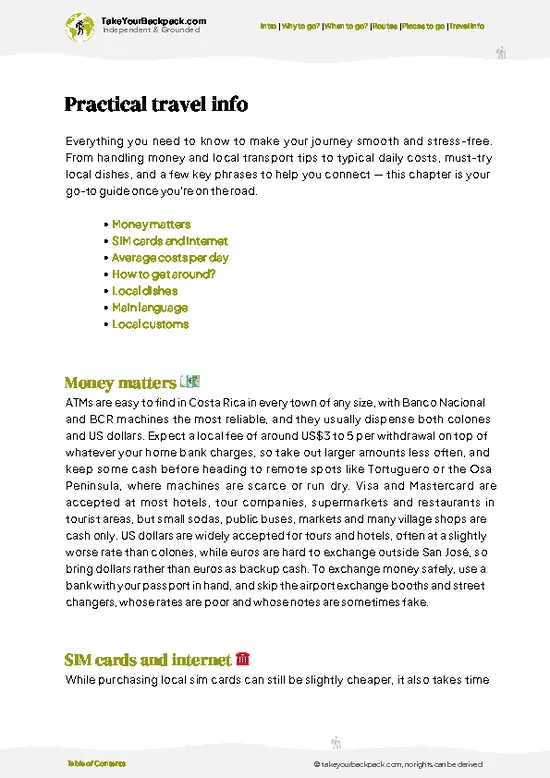
example page 0 from our offline Travel Guide for Costa Rica
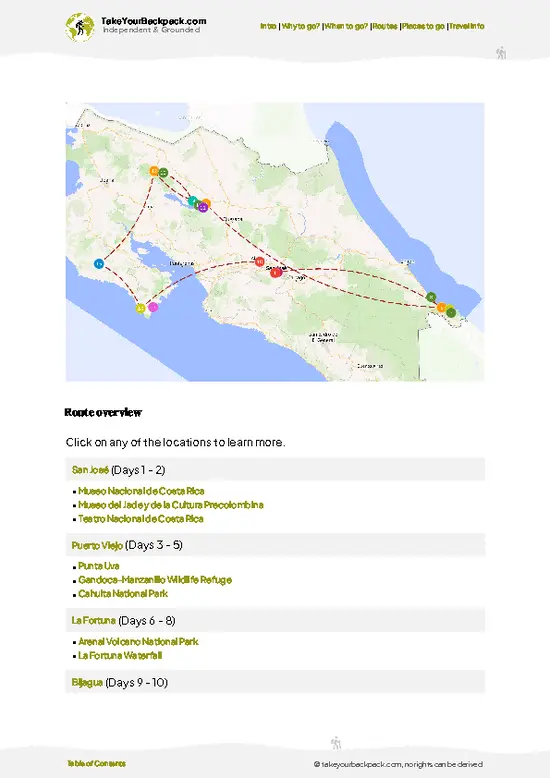
example page 1 from our offline Travel Guide for Costa Rica
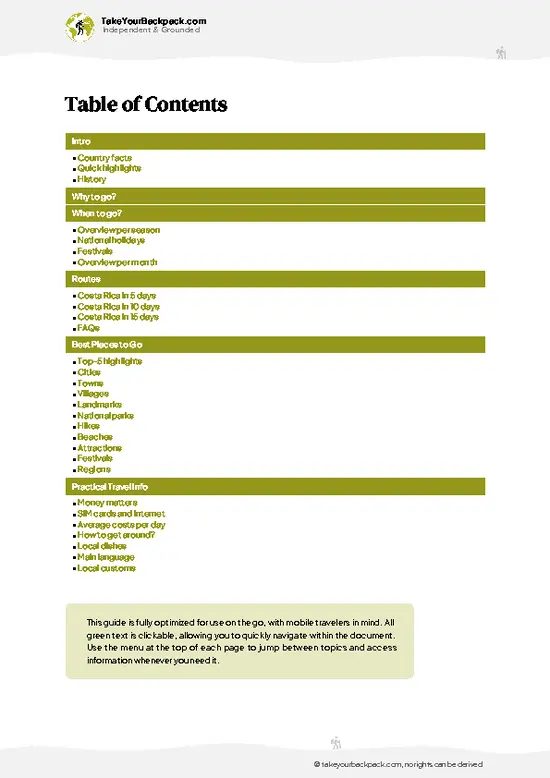
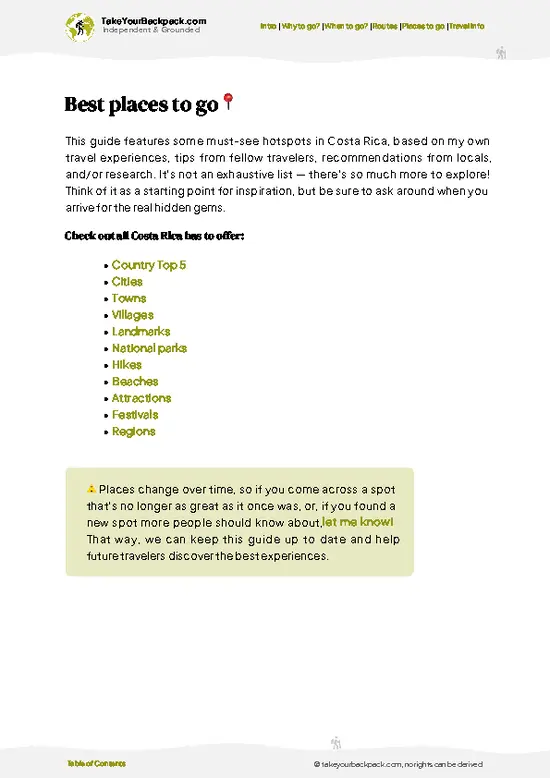
example page 2 from our offline Travel Guide for Costa Rica
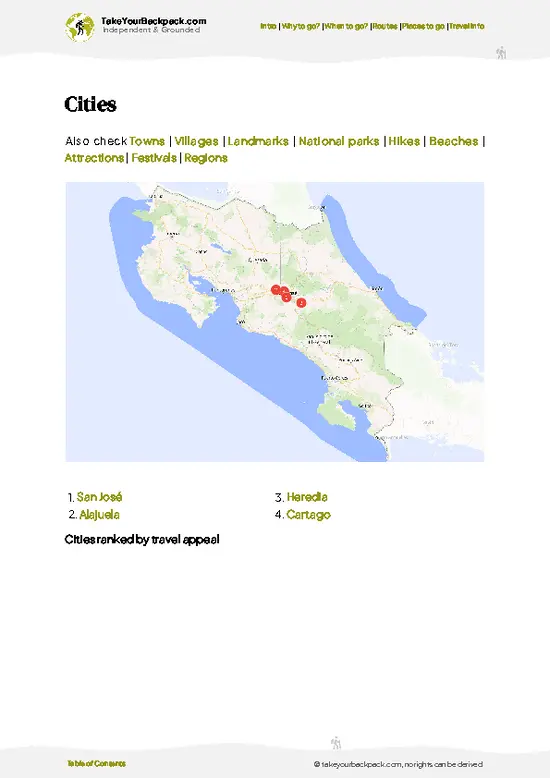
example page 3 from our offline Travel Guide for Costa Rica
example page 4 from our offline Travel Guide for Costa Rica
example page 5 from our offline Travel Guide for Costa Rica
example page 6 from our offline Travel Guide for Costa Rica
example page 7 from our offline Travel Guide for Costa Rica
Loading the map 🌍
CLICK TO FILTER
cities
towns
villages
landmarks
national parks
hikes
beaches
attractions
festivals
regions
SHOW COUNTRY’S BESTSHOW ALL

✨ Why go?
Ranked #14 national park in Costa Rica
The unique appeal for travelers

Santa Rosa National Park suits backpackers who like to work out their own days. The park is part of the Guanacaste Conservation Area, and its tropical dry forest is among the best preserved in Central America, so you see a different Costa Rica from the rain-soaked cloud forest circuit. The trails are self-guided and short enough to do without a tour. Coyotes, white-tailed deer, howler monkeys and white-faced capuchins show up on the forest loops with no guide fee. The big draw for the adventurous is Playa Naranjo and Witch’s Rock, a famous surf break reached by 4x4 or on foot, with simple camping at the coast. Crowds stay thin, which makes it feel earned.

💡 HighlightsTop highlights of Santa Rosa

  1. La Casona: The historic hacienda house, rebuilt after a 2001 fire, where Costa Rican forces defeated Walker’s men in 1856. It is now a museum, with a short interpretive trail around the grounds.
  2. Playa Naranjo and Witch’s Rock: One of the country’s best-known surf breaks, with long right and left waves and a lonely, wild beach.
  3. Playa Nancite: A protected beach where olive ridley turtles nest in huge mass arrivals, mainly in the rainy season. Access is restricted and needs a permit.
  4. Sendero Indio Desnudo: A forest loop through dry forest, with the red, peeling trunks of the gumbo-limbo tree, known locally as the “naked Indian.”
  5. Sendero Naranjo: The long coastal trail toward the beach, good for birds, monkeys and fresh turtle tracks.
  6. Mirador Valle Naranjo: A lookout over the dry forest valley toward
… read more 👉
  1. La Casona: The historic hacienda house, rebuilt after a 2001 fire, where Costa Rican forces defeated Walker’s men in 1856. It is now a museum, with a short interpretive trail around the grounds.
  2. Playa Naranjo and Witch’s Rock: One of the country’s best-known surf breaks, with long right and left waves and a lonely, wild beach.
  3. Playa Nancite: A protected beach where olive ridley turtles nest in huge mass arrivals, mainly in the rainy season. Access is restricted and needs a permit.
  4. Sendero Indio Desnudo: A forest loop through dry forest, with the red, peeling trunks of the gumbo-limbo tree, known locally as the “naked Indian.”
  5. Sendero Naranjo: The long coastal trail toward the beach, good for birds, monkeys and fresh turtle tracks.
  6. Mirador Valle Naranjo: A lookout over the dry forest valley toward the Pacific, best in the early morning, when the forest is quiet and the air cool.
Santa Rosa National Park is best started at La Casona, because its short trail is easy, gives the history, and sets up everything else.
Spotted a mistake or missing something? Contact us.

Things to do around Santa Rosa National Park

Ratings based on Tripadvisor reviews. When you book through this link, you support our work at no extra cost to you.

🌤️ When to go?Best time to explore Santa Rosa

  • Dry Season (December to April): Santa Rosa sits in Guanacaste's tropical dry forest, so expect hot, parched days of 30 to 36°C (86 to 97°F), cooler nights near 22°C (72°F), and trails with almost no mud. Surf swells at Playa Naranjo and Playa Hermosa peak around February and March. Entry stays flat, but nearby lodging rises.
  • Green Season (May to November): Afternoon downpours turn the forest emerald and make dirt roads to the beaches slippery, with temperatures of 26 to 33°C (79 to 91°F). September and October are wettest, and some tracks close. Turtle nesting at Playa Nancite peaks from August to October, and rooms are cheaper.
Start hikes at dawn year-round, since midday heat on the exposed trails is brutal.

source: climatestotravel.comJANJanuary: excellent for travelingFEBFebruary: excellent for travelingMARMarch: excellent for travelingAPRApril: highly recommended for travelingMAYMay: fair for travelingJUNJune: fair for travelingJULJuly: fair for travelingAUGAugust: fair for travelingSEPSeptember: below average for travelingOCTOctober: below average for travelingNOVNovember: good for travelingDECDecember: highly recommended for traveling
when-to-go

✈️ The backpacker research shortcutCosta Rica Travel Guide

An offline-friendly backpacking guide with optimized travel routes, ranked highlights, transport advice, and the best areas to stay.
example page 0 from our offline Travel Guide for Costa Rica
example page 1 from our offline Travel Guide for Costa Rica
example page 2 from our offline Travel Guide for Costa Rica
example page 3 from our offline Travel Guide for Costa Rica
example page 4 from our offline Travel Guide for Costa Rica
example page 5 from our offline Travel Guide for Costa Rica
example page 6 from our offline Travel Guide for Costa Rica
example page 7 from our offline Travel Guide for Costa Rica
The digital guide (287 pages) contains:
✅ 90 highlights, ranked by travel appeal
✅ Optimized 5, 10 & 15-day travel routes
✅ Cities, national parks, landmarks, beaches
✅ How to get around
✅ Offline-friendly for travel without Wi-Fi
👉 Click to see all 30+ guide features

📅 Plan smarter in minutes, not weeks
✅ Month by month travel advice
✅ Festivals & national holidays
✅ Budget expectations

🗺️ Go to the right places, skip the overrated ones
✅ Honest pros & cons of destinations
✅ Top hikes, parks & viewpoints
✅ Lesser-known places most travelers miss
✅ Clear “worth it vs skip it” guidance

🛏️ Travel smoothly without rookie mistakes
✅ Best areas to stay
✅ Transport systems explained simply
✅ Common scams & safety advice
✅ SIM cards, money & practical tips

🌍 Understand the country, not just visit it
✅ Culture & traditions
✅ 52 Essential phrases & customs
✅ Festivals worth planning around
✅ Traveler-friendly historical context
✅ Insights that make places more meaningful

📱 Built for real travel conditions
✅ Fully downloadable PDF
✅ Works completely offline
✅ Optimized for phone use
✅ Useful in remote areas & buses
✅ Everything in one place
Stop searching, start planning
Get instant access to your full guide. 30‑day money-back guarantee.
+ Add another guide for just

By proceeding you agree to our terms.
Sent to your inbox immediately after payment • 100% Secure Checkout
Best Backpacking Travel Advisor 2025 tourism awardBest Backpacking
Travel Advisor
2025
What others say about Take Your Backpack Guides:
⭐⭐⭐⭐⭐
Fantastic, amazing amount of information!
⭐⭐⭐⭐⭐
My goodness this is amazing, it's what I've been looking for hats off too you!
⭐⭐⭐⭐⭐
I think this is absolutely BRILLIANT
⭐⭐⭐⭐
Very complete and informative. It's still missing places, but I gotta to commend you
⭐⭐⭐⭐⭐
This is truly amazing, thank you, can't wait to explore it with my kids!
⭐⭐⭐⭐⭐
Awesome resource, thank you!
⭐⭐⭐⭐⭐
This is amazing! Can't wait to explore the ones I haven't seen
⭐⭐⭐⭐
I love this! Well done, great idea.
⭐⭐⭐⭐⭐
Thanks for taking the time to make this gem!
⭐⭐⭐⭐⭐
This might be the best website I've ever seen.
⭐⭐⭐⭐⭐
Congratulations, and thank you so much for your work; it's incredibly valuable.
⭐⭐⭐⭐
In all seriousness I think you did a great job pointing out the important spots
⭐⭐⭐⭐⭐
10/10 very good
⭐⭐⭐⭐⭐
As someone who's only just starting to visit regularly this is awesome, thank you.
⭐⭐⭐⭐
Thank you very much! I'm going to visit my dad, it's going to be very useful!
⭐⭐⭐⭐⭐
This is really cool! We'll be travelling for the first time and this definitely come in handy.
⭐⭐⭐⭐⭐
You are now our minister of culture, congratulations 👨‍💼
⭐⭐⭐⭐⭐
Just wanted to tell you that this is a pearl! Going to follow your recommendations.
⭐⭐⭐⭐⭐
This is so cool. I'll definitely be using the resource for my travels soon.
⭐⭐⭐⭐⭐
This is very impressive! Good work.
⭐⭐⭐⭐⭐
This is an amazing and informative site. Very well done!

🛏️ Where to stay?Best areas to stay in Costa Rica

The best base is La Cruz, about 20 minutes north of the park entrance, with simple hostels and guesthouses from US$15 to 40 a night and buses along the Pan-American Highway. Inside the park, the campground near the Santa Rosa administrative area (the Casona) has basic sites, cold showers and picnic tables for around US$15 per person. Rustic dorm-style rooms at the research station are sometimes available, and meals can be arranged there if you book ahead. Reaching the beach campsites at Playa Naranjo requires a rough road or long hike. Liberia, roughly 45 minutes south, offers more choice, from … read more 👉
The best base is La Cruz, about 20 minutes north of the park entrance, with simple hostels and guesthouses from US$15 to 40 a night and buses along the Pan-American Highway. Inside the park, the campground near the Santa Rosa administrative area (the Casona) has basic sites, cold showers and picnic tables for around US$15 per person. Rustic dorm-style rooms at the research station are sometimes available, and meals can be arranged there if you book ahead. Reaching the beach campsites at Playa Naranjo requires a rough road or long hike. Liberia, roughly 45 minutes south, offers more choice, from budget hostels to mid-range hotels, plus the airport and bus terminal.

👛 Costs (as of 22 October 2026)What things cost and how to budget

Santa Rosa National Park costs a backpacker roughly US$55 to 65 a day, including a campsite and self-catered food. The table below breaks down typical expenses, with payments made in Costa Rican colones or dollars.
CategoryBudget RangeLocal Reality
Entrance feeUS$15 per dayCharged to foreign adults; children pay less. Payment is accepted by card at the entrance.
CampingUS$15 to 20Basic sites near the Casona with cold showers; beach sites are more rustic.
Lodging in La Cruz (high season)US$20 to 40Budget guesthouses and hostels; more expensive from December to April.
Local transportUS$2 to 10Buses from Liberia to La Cruz are inexpensive, and the park entrance is a taxi ride or hitch away.
Food and suppliesUS$10 to 20Sodas in La Cruz serve filling meals for US$5 to 8; bring all food for camping.
Total
… read more 👉
Santa Rosa National Park costs a backpacker roughly US$55 to 65 a day, including a campsite and self-catered food. The table below breaks down typical expenses, with payments made in Costa Rican colones or dollars.
CategoryBudget RangeLocal Reality
Entrance feeUS$15 per dayCharged to foreign adults; children pay less. Payment is accepted by card at the entrance.
CampingUS$15 to 20Basic sites near the Casona with cold showers; beach sites are more rustic.
Lodging in La Cruz (high season)US$20 to 40Budget guesthouses and hostels; more expensive from December to April.
Local transportUS$2 to 10Buses from Liberia to La Cruz are inexpensive, and the park entrance is a taxi ride or hitch away.
Food and suppliesUS$10 to 20Sodas in La Cruz serve filling meals for US$5 to 8; bring all food for camping.
Total Daily BudgetUS$62Based on entrance, camping, local transport and food.


source: costarica-nationalparks.com
⚠️ Prices can change and everyone travels differently, so take this as a rough guide. Hope it helps you plan your adventure!

🥾 TrailsPlan your hike in Santa Rosa: routes, terrain, and sights

Santa Rosa National Park has a network of short and long walks through dry forest and savanna. Terrain is mostly dry, open and hot, with loose dirt and some rocky sections.
  • Casona trail: Short historical loop around the hacienda. Easy, about 30 minutes, with a few corrals and information boards.
  • Sendero Indio Desnudo: A shaded forest loop of about 1 km, easy, roughly 30 to 40 minutes, with gumbo-limbo trees and good monkey sightings.
  • Sendero Los Patos: A longer forest trail of several kilometers that crosses seasonal streams, with a moderate difficulty and a half-day duration.
  • Sendero Naranjo: A long
… read more 👉
Santa Rosa National Park has a network of short and long walks through dry forest and savanna. Terrain is mostly dry, open and hot, with loose dirt and some rocky sections.
  • Casona trail: Short historical loop around the hacienda. Easy, about 30 minutes, with a few corrals and information boards.
  • Sendero Indio Desnudo: A shaded forest loop of about 1 km, easy, roughly 30 to 40 minutes, with gumbo-limbo trees and good monkey sightings.
  • Sendero Los Patos: A longer forest trail of several kilometers that crosses seasonal streams, with a moderate difficulty and a half-day duration.
  • Sendero Naranjo: A long hike to Playa Naranjo, around 12 km one way. It is hot, exposed and demanding, so start early and carry plenty of water.
  • Mirador Valle Naranjo: A moderate trail to a viewpoint, around 1 to 2 hours, with open views over the valley.
Practical details: the park lies just off the Pan-American Highway, and buses from Liberia can drop you at the entrance. The coastal beaches are far from the gate, so you need your own vehicle, a shared ride or a long hike. Crowds are light, though weekends and surf season bring a few more visitors. An entrance fee applies, and it is paid in dollars or colones at the station.
⚠️ Hiking info can sometimes be outdated or inaccurate. Before you hit the trail, check the latest conditions with locals. If you do spot anything that's off, I'd love to hear from you, so I can update it for fellow travelers.

🛡️ SafetyStaying Safe: What Travelers Should Know

Santa Rosa is straightforward, and the main hazard is heat. Temperatures climb fast on the open dry-forest trails, so carry at least 3 liters of water per person, wear a hat, and walk early or late. Water is limited at remote beach sites. Ticks and mosquitoes are common, so bring repellent. Howler monkeys, coatis and snakes are present but rarely trouble hikers. Keep your distance, never feed animals, and watch where you place hands and feet. Riptides at Playa Naranjo and Playa Hermosa are strong, so swim cautiously. Trails are well marked, though rain can make the backcountry roads impassable, so check conditions at the ranger station before heading out.

FAQCommon questions from travelers

Plan on two days for Santa Rosa National Park. That is enough for the Casona historical site and the short dry-forest trails on day one, with the long track to Playa Naranjo or Playa Hermosa on day two. Surfers and turtle watchers often stay three or four nights camping on the coast.
Yes, though Santa Rosa National Park is easier with a vehicle. Buses on the Pan-American Highway stop at the park entrance, about 35 km north of Liberia, or you can use La Cruz as a base and take a taxi for roughly US$15 to 25. The beaches are 12 to 15 km along a rough road, so you will need a 4x4 shuttle or a long hike.
Yes, Santa Rosa National Park charges foreign adults about US$15 per day, with lower rates for children, and tickets are bought at the entrance station. Camping costs an extra US$15 or so per person. No separate hiking permit is needed for the main trails, but you should register with rangers before heading to remote beaches such as Playa Naranjo.
⚠️ Things can change over time, so always validate details locally before you go.

Other Costa Rican national parks near Santa Rosa

Explore more nearby:


💡 Not sure where to go next?
Create a personalized itinerary for Costa Rica including Santa Rosa and the places that fit your trip.

Generate my itinerary

👉 Discover all national parks

Or checkout all Costa Rica has to offer (think cities, towns, villages, national parks, hikes, beaches, festivals)
Country photo of Costa Rica

We 💚 feedbackIs it worth it?

Santa Rosa National Park works best as a stay of two nights: one for La Casona and the forest loops, one for the coast. Bring far more water than seems sensible, and arrange your 4x4 ride to Playa Naranjo in advance rather than hoping to find one at the gate.

✈️ When did I visit Costa Rica?
Costa Rica I visited during my half year trip through South and Central America back in 2003

✍️ Help improve this page!
The information on this page is based on my own backpacking experience in Costa Rica, supplemented with up-to-date research and feedback from other travelers. Travel details can change, so if you notice anything outdated or incomplete, feel free to let me know.


🙋‍♂️ Give feedback

👋 Meet the founderWho’s Behind Take Your Backpack?

Johan, backpacker and founder of TakeYourBackpackHi, I’m Johan (Netherlands 🇳🇱), the creator of TakeYourBackpack. Over the past 3 decades, I’ve backpacked through 90+ countries across six continents, gaining extensive experience with independent travel, long-term trips, and overland routes.

This site is built on a combination of firsthand travel experience and carefully curated insights from other backpackers. Many guides are based on places I’ve personally visited, while others bring together tips, observations, and practical advice shared by trusted travelers I’ve met along the way.

The goal is to provide realistic, experience-driven guidance — not generic itineraries — so you can explore destinations with better context, clearer expectations, and more confidence.