×

Côte d’Ivoire🇨🇮 | best festivalsExplore the 6 Best festivals in Côte d’Ivoire

Festivals in Côte d’Ivoire are loud, communal and mostly unpolished, built around drums, masks and village squares rather than ticketed grounds. In the west, around Man and Danané, dancers on stilts and Dan masks turn dusty clearings into theater, with little infrastructure and small crowds. The north, around Korhogo, brings Senufo rhythms and cotton-cloth color. Abidjan runs on urban music and humid, late-night energy, with higher prices but easy access. The Baoulé center and the east add royal ceremony and gold regalia. Independent travelers can reach most of them by shared taxi or minibus, though dirt roads and heat slow things down.

By Johan Kruseman 🇳🇱 | Updated October 23, 2026
Explore the best regions in Côte d’Ivoire

Why go?Why These festival Stand Out

Côte d’Ivoire holds more than 60 ethnic groups, and each keeps its own calendar of masquerades, harvest rites and royal ceremonies. That density means the country offers variety within a few hundred kilometers, from forest-edge Dan villages to savanna Senufo towns to lagoon-side Abidjan. Music is the other pillar: the country’s coupé-décalé and zouglou scenes feed a lively urban event culture, with sound systems running into the small hours.

The climate and geography shape what you experience. Heat, humidity and red laterite dust cling to everything, and the southern coast smells of woodsmoke, frying plantain and diesel. Many traditional events follow lunar, agricultural or community timing, so dates shift and are often confirmed only weeks ahead, sometimes only locally. Do not expect fixed … read more 👉
Côte d’Ivoire holds more than 60 ethnic groups, and each keeps its own calendar of masquerades, harvest rites and royal ceremonies. That density means the country offers variety within a few hundred kilometers, from forest-edge Dan villages to savanna Senufo towns to lagoon-side Abidjan. Music is the other pillar: the country’s coupé-décalé and zouglou scenes feed a lively urban event culture, with sound systems running into the small hours.

The climate and geography shape what you experience. Heat, humidity and red laterite dust cling to everything, and the southern coast smells of woodsmoke, frying plantain and diesel. Many traditional events follow lunar, agricultural or community timing, so dates shift and are often confirmed only weeks ahead, sometimes only locally. Do not expect fixed schedules or online ticketing outside Abidjan.

Infrastructure is decent on the main paved axes, such as Abidjan to Yamoussoukro to Bouaké, and weaker on rural roads that turn muddy in the rains. Many ceremonies are sacred first and spectacle second, so you are a guest, not an audience. A local guide or host usually makes the difference between watching from the edge and being welcomed in. French is the working language, and a few phrases open doors.
How the List Was Created
The list of best festivals in Côte d’Ivoire is created based on energy, traditions, crowd experience, activities, and overall excitement. If you feel a festival is missing in this list, please let us know.

When to go?Seasonal Guide to Visiting

Best months: The best months for festivals in Côte d’Ivoire are November to March, when the dry season brings mostly clear skies, passable roads and daytime highs of roughly 28 to 34°C. In the north, the harmattan wind blows from December to February, bringing a dusty haze that softens the light, dries your throat and can push midday temperatures above 35°C in places like Korhogo.
Shoulder seasons: April to June is the main rainy season in the south, with heavy downpours, especially in May and June, when Abidjan can see well over 300 mm a month. Roads in the west turn to red mud and village access becomes slow. A short second rainy season runs roughly from October to November. Humidity stays high at 80 percent or more along the coast, and the air feels thick even at night.
Crowds and prices: … read more 👉
Best months: The best months for festivals in Côte d’Ivoire are November to March, when the dry season brings mostly clear skies, passable roads and daytime highs of roughly 28 to 34°C. In the north, the harmattan wind blows from December to February, bringing a dusty haze that softens the light, dries your throat and can push midday temperatures above 35°C in places like Korhogo.
Shoulder seasons: April to June is the main rainy season in the south, with heavy downpours, especially in May and June, when Abidjan can see well over 300 mm a month. Roads in the west turn to red mud and village access becomes slow. A short second rainy season runs roughly from October to November. Humidity stays high at 80 percent or more along the coast, and the air feels thick even at night.
Crowds and prices: Peak interest clusters around the dry months and the end-of-year holidays, when Abidjan hotels can rise 20 to 40 percent and shared transport fills up as families travel home. Rainy-season months, July to September, are quieter and cheaper, with lodging discounts of around 10 to 25 percent, but outdoor events are less reliable. The north has a single rainy season from about June to September, so it stays easier to visit earlier in the year.

festival hoppingOptimizing Your Multi-Stop Itinerary

How long you need: A trip combining several festivals in Côte d’Ivoire needs 12 to 18 days, because distances are long and roads slow. Treat the country as three clusters: the Abidjan and coast area, the central axis around Yamoussoukro and Bouaké, and the west or north. Moving in one direction avoids doubling back, for example Abidjan, then north through Yamoussoukro and Bouaké to Korhogo, then west toward Man.
Time per stop and between regions: Allow 2 to 4 days at each major base, so you can arrive early, find out what is actually happening and still absorb the atmosphere. Abidjan to Yamoussoukro takes about 3.5 to 4 hours by bus, Yamoussoukro to Bouaké 1.5 to 2 hours, Bouaké to Korhogo 4 to 5 hours, and Korhogo to Man around 8 to 10 hours with a change. Shared taxis and minibuses leave … read more 👉
How long you need: A trip combining several festivals in Côte d’Ivoire needs 12 to 18 days, because distances are long and roads slow. Treat the country as three clusters: the Abidjan and coast area, the central axis around Yamoussoukro and Bouaké, and the west or north. Moving in one direction avoids doubling back, for example Abidjan, then north through Yamoussoukro and Bouaké to Korhogo, then west toward Man.
Time per stop and between regions: Allow 2 to 4 days at each major base, so you can arrive early, find out what is actually happening and still absorb the atmosphere. Abidjan to Yamoussoukro takes about 3.5 to 4 hours by bus, Yamoussoukro to Bouaké 1.5 to 2 hours, Bouaké to Korhogo 4 to 5 hours, and Korhogo to Man around 8 to 10 hours with a change. Shared taxis and minibuses leave when full, so add buffer time. Rural access beyond the towns often means a motorbike or a 4WD on red dirt.
Common planning mistakes: The biggest error is packing in too many stops on tight dates. Ceremonies shift, and a single missed connection can cost a day. Instead, leave one flexible day before each target date and confirm with local hosts. Avoid long night drives, which are tiring and risky on unlit roads. Another error is underestimating the rainy season: in the west, plan fewer stops and keep road days short.

The ListMust-Visit festivals in Côte d’Ivoire

1 Festival of Masks in Man

Dan spirit masks, stilt dancers, western hills, Dent de Man

Stand close to Dan masked figures and stilt walkers in Man’s dusty grounds, then climb the Dent de Man or cool off at the waterfalls.

2 Popo Carnival

Popo masks, Bonoua floats, Miss Popo pageant, Easter pineapples

Squeeze into Bonoua’s main road for masked dancers and floats, then follow Abouré drumming into side courtyards and eat fresh pineapple between parades.

3 MASA

Pan-African performing arts market, Treichville, MASA Off, biennial

Move between showcase sets at the Palais de la Culture and looser MASA Off shows around Abidjan, with late concerts closing each night.

4 Fête de Dipri

Abouré purification rite, kaolin-painted faces, trance dancers, Gomon village

Observe the Abouré cleansing of Gomon from a respectful distance, with trance dancers, white clay, relentless drums and village meals shared afterward.

5 Carnival of Bouaké

Raffia masked dancers, truck-mounted sound systems, roadside attiéké, maquis nights

Watch costumed troupes march through Bouaké’s main avenues, then follow the crowd to open-air bars where coupé-décalé and zouglou run late.

6 Abissa Festival

N’zima new year, nighttime truth-telling, quarter dance contests, Grand-Bassam square

Join open-air drumming in Grand-Bassam, where elders voice the town’s faults in public before quarters compete in dance and a feast closes the week.

Loading the map 🌍

Expert viewPro Tips for Exploring the Best

How many to visit: Two to three festivals in one trip is the right number. Dates shift, roads are slow, and each event deserves a full day of arriving, watching and talking to people. Beyond three, you spend the trip in minibuses and see the country through a window. Two well-chosen events with time around them give you the drumming, the dust and the conversations afterward.
Choosing between kinds: If you want traditional masquerades and rites, head to the west or north, where events are small, sacred and slow to start. Expect long waits in strong sun, then sudden bursts of sound that make it worthwhile. If you prefer music and nightlife, Abidjan is easier: paved roads, late hours, grilled fish and beer on plastic chairs, and the bass reaching you from three streets away. Culture-focused travelers … read more 👉
How many to visit: Two to three festivals in one trip is the right number. Dates shift, roads are slow, and each event deserves a full day of arriving, watching and talking to people. Beyond three, you spend the trip in minibuses and see the country through a window. Two well-chosen events with time around them give you the drumming, the dust and the conversations afterward.
Choosing between kinds: If you want traditional masquerades and rites, head to the west or north, where events are small, sacred and slow to start. Expect long waits in strong sun, then sudden bursts of sound that make it worthwhile. If you prefer music and nightlife, Abidjan is easier: paved roads, late hours, grilled fish and beer on plastic chairs, and the bass reaching you from three streets away. Culture-focused travelers should favor rural events; first-timers and those short on time do better in the south and center, where transport and lodging are simpler.
What it costs: Budget about US$30 to 55 a day (roughly 18,000 to 33,000 CFA francs) for a backpacker using guesthouses, shared taxis and street food. Urban music events usually charge entry of about 3,000 to 15,000 CFA francs (US$5 to 25). Village ceremonies are often free but expect to offer a small gift or contribution, around 2,000 to 10,000 CFA francs. A local guide or fixer costs about US$20 to 40 a day, and a motorbike or private car to remote villages adds US$15 to 50 depending on distance. Carry small notes, since change is scarce.
Safety and etiquette: Crowds are generally friendly, but keep phones and cash secured in dense night events, especially in Abidjan, and avoid walking home alone after dark. Always ask before photographing masks, elders and ritual moments. Some are strictly forbidden to film, and a sudden demand for payment is common if you skip the conversation. Dress modestly, with covered shoulders and knees in villages, and follow your host’s lead on where to stand and what not to touch. Bring water, a hat and sunscreen, since shade can be thin for hours. Check the current security advice for the north near the borders before traveling, and keep a printed copy of your yellow fever certificate.

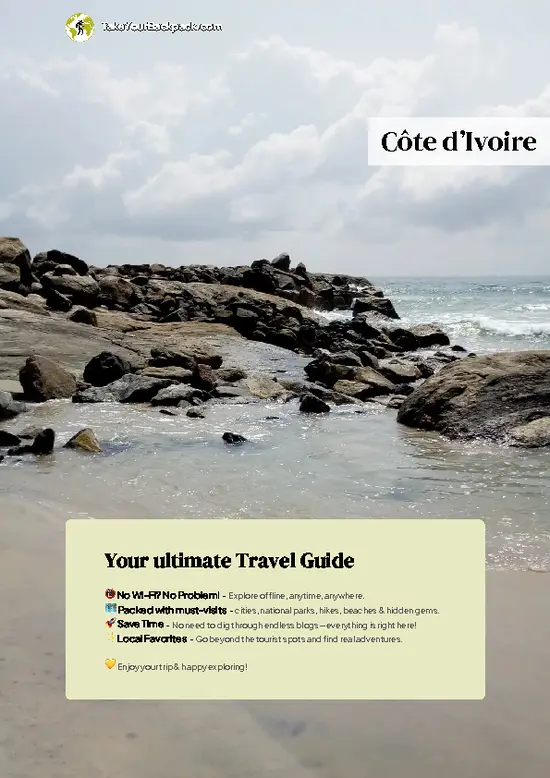
✈️ The backpacker research shortcutCôte d’Ivoire Travel Guide

An offline-friendly backpacking guide with optimized travel routes, ranked highlights, transport advice, and the best areas to stay.
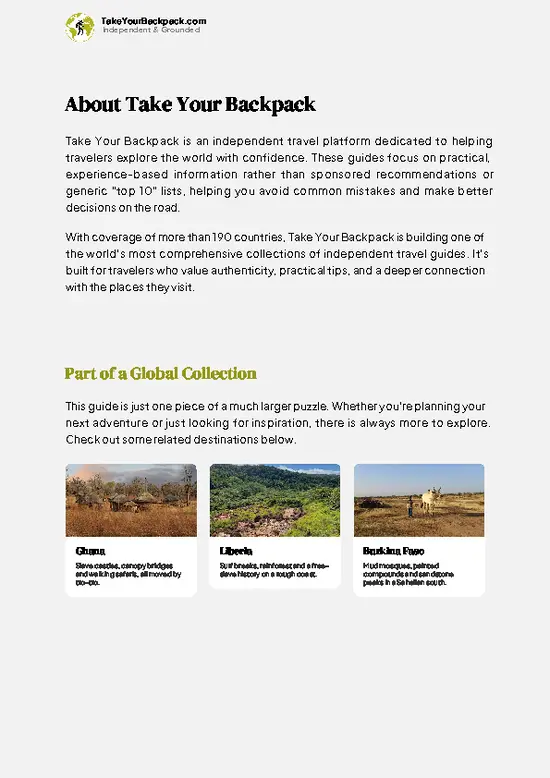
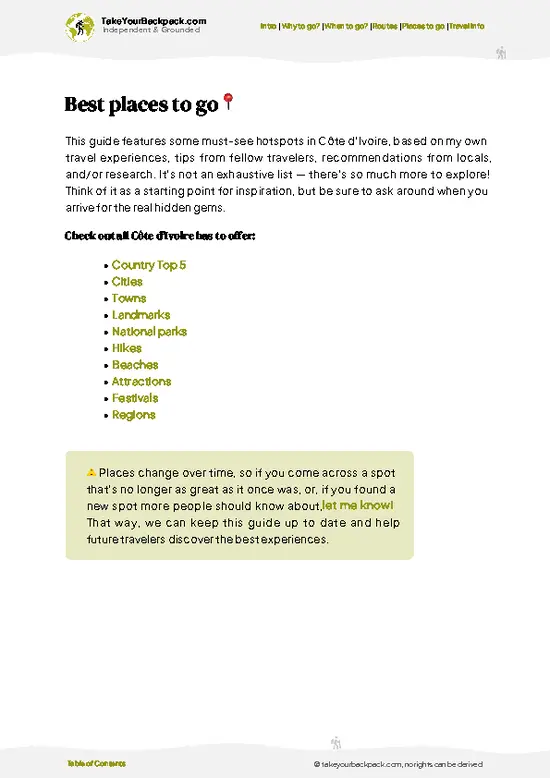
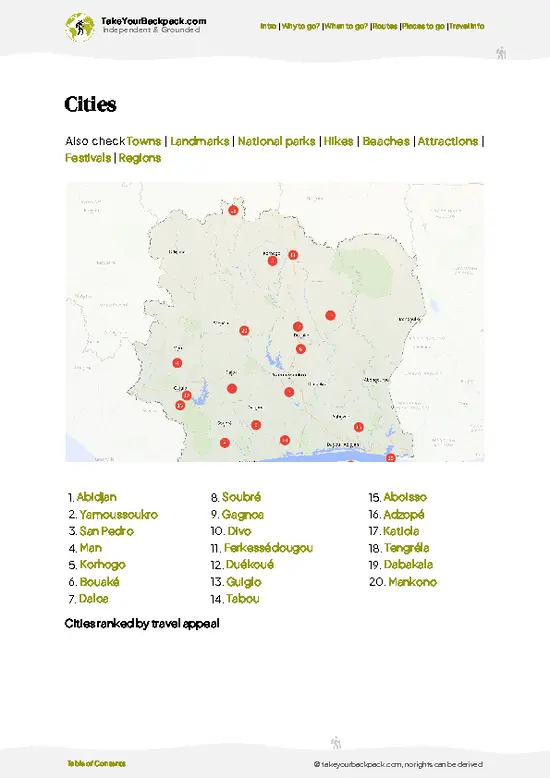
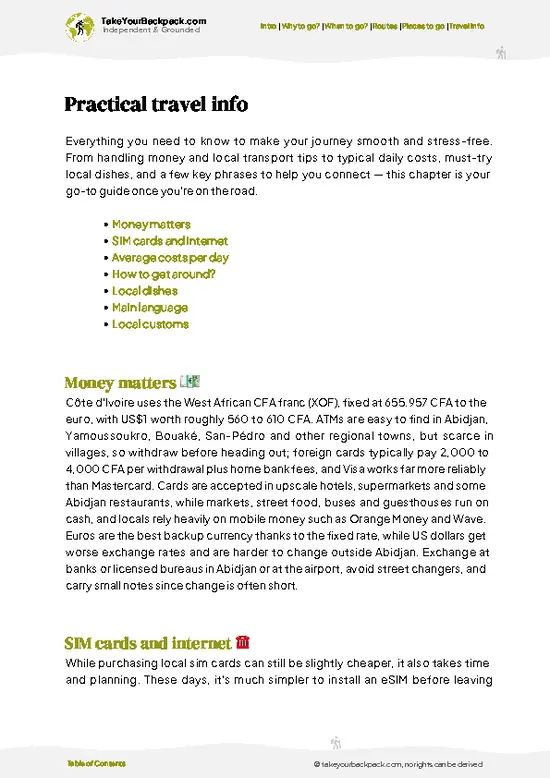
example page 0 from our offline Travel Guide for Côte d’Ivoire
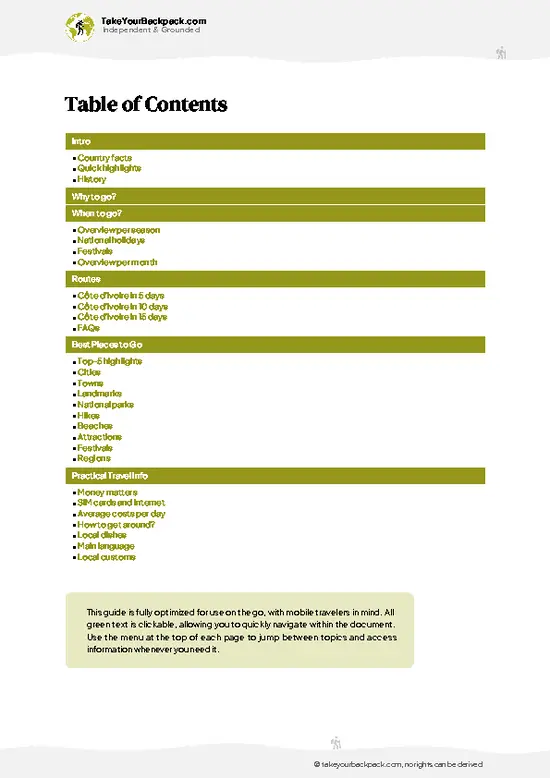
example page 1 from our offline Travel Guide for Côte d’Ivoire
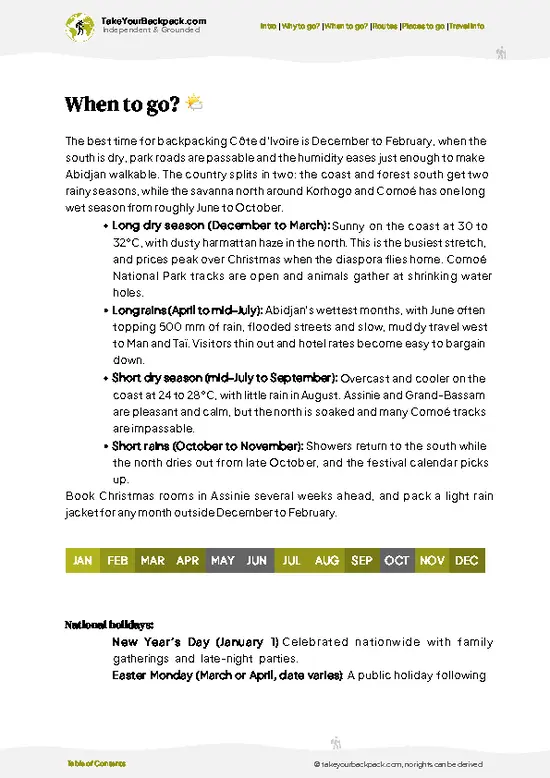
example page 2 from our offline Travel Guide for Côte d’Ivoire
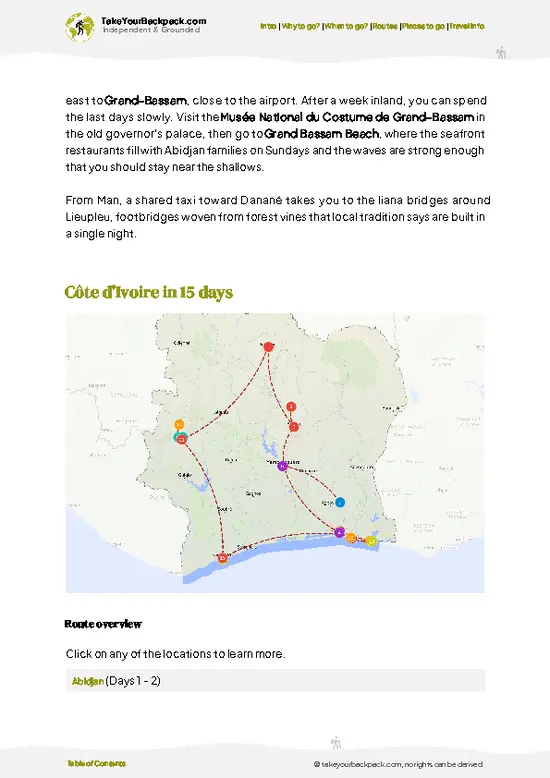
example page 3 from our offline Travel Guide for Côte d’Ivoire
example page 4 from our offline Travel Guide for Côte d’Ivoire
example page 5 from our offline Travel Guide for Côte d’Ivoire
example page 6 from our offline Travel Guide for Côte d’Ivoire
example page 7 from our offline Travel Guide for Côte d’Ivoire
The digital guide (279 pages) contains:
✅ 64 highlights, ranked by travel appeal
✅ Optimized 5, 10 & 15-day travel routes
✅ Cities, national parks, landmarks, beaches
✅ How to get around
✅ Offline-friendly for travel without Wi-Fi
👉 Click to see all 30+ guide features

📅 Plan smarter in minutes, not weeks
✅ Month by month travel advice
✅ Festivals & national holidays
✅ Budget expectations

🗺️ Go to the right places, skip the overrated ones
✅ Honest pros & cons of destinations
✅ Top hikes, parks & viewpoints
✅ Lesser-known places most travelers miss
✅ Clear “worth it vs skip it” guidance

🛏️ Travel smoothly without rookie mistakes
✅ Best areas to stay
✅ Transport systems explained simply
✅ Common scams & safety advice
✅ SIM cards, money & practical tips

🌍 Understand the country, not just visit it
✅ Culture & traditions
✅ 52 Essential phrases & customs
✅ Festivals worth planning around
✅ Traveler-friendly historical context
✅ Insights that make places more meaningful

📱 Built for real travel conditions
✅ Fully downloadable PDF
✅ Works completely offline
✅ Optimized for phone use
✅ Useful in remote areas & buses
✅ Everything in one place
Stop searching, start planning
Get instant access to your full guide. 30‑day money-back guarantee.
+ Add another guide for just

By proceeding you agree to our terms.
Sent to your inbox immediately after payment • 100% Secure Checkout
Best Backpacking Travel Advisor 2025 tourism awardBest Backpacking
Travel Advisor
2025
What others say about Take Your Backpack Guides:
⭐⭐⭐⭐⭐
Fantastic, amazing amount of information!
⭐⭐⭐⭐⭐
My goodness this is amazing, it's what I've been looking for hats off too you!
⭐⭐⭐⭐⭐
I think this is absolutely BRILLIANT
⭐⭐⭐⭐
Very complete and informative. It's still missing places, but I gotta to commend you
⭐⭐⭐⭐⭐
This is truly amazing, thank you, can't wait to explore it with my kids!
⭐⭐⭐⭐⭐
Awesome resource, thank you!
⭐⭐⭐⭐⭐
This is amazing! Can't wait to explore the ones I haven't seen
⭐⭐⭐⭐
I love this! Well done, great idea.
⭐⭐⭐⭐⭐
Thanks for taking the time to make this gem!
⭐⭐⭐⭐⭐
This might be the best website I've ever seen.
⭐⭐⭐⭐⭐
Congratulations, and thank you so much for your work; it's incredibly valuable.
⭐⭐⭐⭐
In all seriousness I think you did a great job pointing out the important spots
⭐⭐⭐⭐⭐
10/10 very good
⭐⭐⭐⭐⭐
As someone who's only just starting to visit regularly this is awesome, thank you.
⭐⭐⭐⭐
Thank you very much! I'm going to visit my dad, it's going to be very useful!
⭐⭐⭐⭐⭐
This is really cool! We'll be travelling for the first time and this definitely come in handy.
⭐⭐⭐⭐⭐
You are now our minister of culture, congratulations 👨‍💼
⭐⭐⭐⭐⭐
Just wanted to tell you that this is a pearl! Going to follow your recommendations.
⭐⭐⭐⭐⭐
This is so cool. I'll definitely be using the resource for my travels soon.
⭐⭐⭐⭐⭐
This is very impressive! Good work.
⭐⭐⭐⭐⭐
This is an amazing and informative site. Very well done!

🛏️ Where to stay?Where to Stay: Côte d’Ivoire Edition

True backpacker hostels with dorm beds are rare in Côte d’Ivoire, so most budget travelers sleep in simple guesthouses, small hotels and rented rooms, typically 10,000 to 25,000 CFA (about US$17 to 42) a night for a private double with a fan or basic air conditioning. In Abidjan, Treichville and Adjamé have the cheapest rooms and the loudest street life but call for extra care after dark, Zone 4 in Marcory sits close to the airport and the city’s densest cluster of bars and restaurants at mid-range prices, and leafy Cocody (especially Deux Plateaux and Riviera) is quieter and safer, with good evening spots around Deux Plateaux but longer taxi rides to the Plateau business district. Outside the … read more 👉
True backpacker hostels with dorm beds are rare in Côte d’Ivoire, so most budget travelers sleep in simple guesthouses, small hotels and rented rooms, typically 10,000 to 25,000 CFA (about US$17 to 42) a night for a private double with a fan or basic air conditioning. In Abidjan, Treichville and Adjamé have the cheapest rooms and the loudest street life but call for extra care after dark, Zone 4 in Marcory sits close to the airport and the city’s densest cluster of bars and restaurants at mid-range prices, and leafy Cocody (especially Deux Plateaux and Riviera) is quieter and safer, with good evening spots around Deux Plateaux but longer taxi rides to the Plateau business district. Outside the city, the beach guesthouses of Grand-Bassam are a calm, affordable weekend base about 45 minutes east of Abidjan, while Yamoussoukro, Man and San-Pédro offer plain, inexpensive hotels near their town centers but very little nightlife.

If you enjoy meeting fellow travelers, consider choosing hostels with high ratings for atmosphere. On the other hand, if you prefer having your own space, a hotel might be a better option.

Côte d’IvoireExplore Beyond This Category

👋 Meet the founderWho’s Behind Take Your Backpack?

Johan, backpacker and founder of TakeYourBackpackHi, I’m Johan (Netherlands 🇳🇱), the creator of TakeYourBackpack. Over the past 3 decades, I’ve backpacked through 90+ countries across six continents, gaining extensive experience with independent travel, long-term trips, and overland routes.

This site is built on a combination of firsthand travel experience and carefully curated insights from other backpackers. Many guides are based on places I’ve personally visited, while others bring together tips, observations, and practical advice shared by trusted travelers I’ve met along the way.

The goal is to provide realistic, experience-driven guidance — not generic itineraries — so you can explore destinations with better context, clearer expectations, and more confidence.