×

Côte d’Ivoire🇨🇮 | best beachesExplore the 3 Best beaches in Côte d’Ivoire

The beaches of Côte d’Ivoire run along roughly 500 kilometers of Gulf of Guinea coast, and the experience changes sharply from east to west. Near Abidjan the sand is wide and pale, backed by coconut palms, with Atlantic swell thudding in and grilled fish smoke drifting from shacks. Weekends bring loud, crowded, music-heavy scenes. Farther west the coast turns to rocky coves and forest-edged sand, with few visitors and fewer facilities. Costs and ease of access drop and rise accordingly, so independent travelers should choose between easy lagoon-side comfort and rougher, quieter stretches that reward patience on bumpy roads.

By Johan Kruseman 🇳🇱 | Updated October 19, 2026
Explore the best attractions in Côte d’Ivoire

Why go?Why These beach Stand Out

Côte d’Ivoire suits beach travel differently from its West African neighbors because of its lagoon coast. A long chain of brackish lagoons sits just behind the ocean shore, so a single day can include salt wind, still green water, pirogue rides and palm-fringed sandbars. That geography is also the main warning. The open Atlantic here has heavy surf, steep shelving sand and strong rip currents, and lifeguards are rare. Many beaches are for walking, eating and watching the waves rather than for swimming, and calmer lagoon water is the safer choice.

History shaped the rest. Abidjan’s status as a major port and business city produced weekend beach culture, with resort-style day passes, sound systems and beach restaurants close to the capital. French colonial influence left a food and hospitality … read more 👉
Côte d’Ivoire suits beach travel differently from its West African neighbors because of its lagoon coast. A long chain of brackish lagoons sits just behind the ocean shore, so a single day can include salt wind, still green water, pirogue rides and palm-fringed sandbars. That geography is also the main warning. The open Atlantic here has heavy surf, steep shelving sand and strong rip currents, and lifeguards are rare. Many beaches are for walking, eating and watching the waves rather than for swimming, and calmer lagoon water is the safer choice.

History shaped the rest. Abidjan’s status as a major port and business city produced weekend beach culture, with resort-style day passes, sound systems and beach restaurants close to the capital. French colonial influence left a food and hospitality scene of grilled fish, attiéké (grated cassava), cold Flag beer and small guesthouses. West of Sassandra, the infrastructure thins out, roads are rougher, and the forest comes right down to the shore.

Travelers should know that the country is not a resort-island or surf-camp circuit. Prices are quoted in CFA francs (XOF), cash is the norm outside Abidjan, and the humid heat of 27 to 32°C is constant. Come for atmosphere, seafood and wild stretches of coast, and plan swimming around local advice.
Behind the Scenes of Selection
The list of best beaches in Côte d’Ivoire is created based on beauty, vibe, water quality, activities, and surrounding scenery. If you feel a beach is missing in this list, please let us know.

When to go?Seasonal Guide to Visiting

Best months for the coast: The best months for beaches in Côte d’Ivoire are December to March, when the main dry season brings the least rain, long sunny stretches and calmer roads. Days are hot at 29 to 33°C, the sea sits around 27 to 28°C, and the air feels thick and salty by midday. From December to February, Harmattan winds from the Sahara can add a dusty haze that softens the light and dulls sunsets.

Shoulder seasons and rains: November and April are decent shoulder months, with more cloud and the occasional heavy afternoon downpour. A shorter dry spell in August and September can be pleasant, though skies are often gray and the sea stays rough. The heavy rains arrive from May to July, peaking in June. Abidjan and the nearby coast can receive 400 to 600 mm in that single month, and sand … read more 👉
Best months for the coast: The best months for beaches in Côte d’Ivoire are December to March, when the main dry season brings the least rain, long sunny stretches and calmer roads. Days are hot at 29 to 33°C, the sea sits around 27 to 28°C, and the air feels thick and salty by midday. From December to February, Harmattan winds from the Sahara can add a dusty haze that softens the light and dulls sunsets.

Shoulder seasons and rains: November and April are decent shoulder months, with more cloud and the occasional heavy afternoon downpour. A shorter dry spell in August and September can be pleasant, though skies are often gray and the sea stays rough. The heavy rains arrive from May to July, peaking in June. Abidjan and the nearby coast can receive 400 to 600 mm in that single month, and sand roads turn to red mud.

The west coast around San-Pédro and Tabou is typically wetter and greener, so dirt tracks to remote coves become slow after storms. Rain can also reduce shack and pirogue operations.

Crowds and prices: Weekends in Abidjan’s beach areas are busy year-round, but Christmas, New Year and Easter push up guesthouse rates by roughly 20 to 50 percent and fill day-pass resorts. Midweek visits in January or February are quieter. In the rainy season, discounts of 20 to 30 percent are common, though some small beach lodges reduce services or close.

beach hoppingOptimizing Your Multi-Stop Itinerary

How many days to plan: A trip linking several beaches in Côte d’Ivoire needs 8 to 14 days, mainly because road travel is slow and the best coastal stretches are far apart. Abidjan is the natural gateway and transport hub, with the main international airport, long-distance bus stations and shared taxis.

Which regions group together: The coast divides into two clusters. The eastern cluster runs from Abidjan toward Grand-Bassam and Assinie, roughly 45 to 100 km away and 1 to 2 hours by shared taxi, minibus or private car. The western cluster includes Grand-Lahou, Sassandra and San-Pédro, spread over 150 to 350 km from Abidjan, with 3 to 7 hours between major stops by coach, depending on traffic, road works and weather. Beyond San-Pédro, Tabou adds another 2 to 3 hours by road.

A sensible direction … read more 👉
How many days to plan: A trip linking several beaches in Côte d’Ivoire needs 8 to 14 days, mainly because road travel is slow and the best coastal stretches are far apart. Abidjan is the natural gateway and transport hub, with the main international airport, long-distance bus stations and shared taxis.

Which regions group together: The coast divides into two clusters. The eastern cluster runs from Abidjan toward Grand-Bassam and Assinie, roughly 45 to 100 km away and 1 to 2 hours by shared taxi, minibus or private car. The western cluster includes Grand-Lahou, Sassandra and San-Pédro, spread over 150 to 350 km from Abidjan, with 3 to 7 hours between major stops by coach, depending on traffic, road works and weather. Beyond San-Pédro, Tabou adds another 2 to 3 hours by road.

A sensible direction is east first, then west, starting with easy sandy beaches and ending in the quieter forest coast. Allow 2 to 3 nights per stop. One night wastes the long transfer, while four or more can feel slow in smaller towns with limited evening options.

Planning mistakes to avoid: The usual error is trying to see east and west in a week. Plan only one long coastal transfer per two days. Traveling at night is another mistake, because potholes, checkpoints and unlit trucks make daylight departures far better. In rainy months, avoid dirt-road detours and instead choose coach routes along the main coastal road. Carry enough XOF cash for the west, where ATMs are sparse and card payments are rare.

The ListMust-Visit beaches in Côte d’Ivoire

1 Assinie Beach

lagoon-side resorts, palm-lined sand, water sports

Swim in calm waters, try jet skiing, or relax under palms where the lagoon meets the Atlantic, away from city noise.

cote-divoire-beach-assinie-beach
© Google |

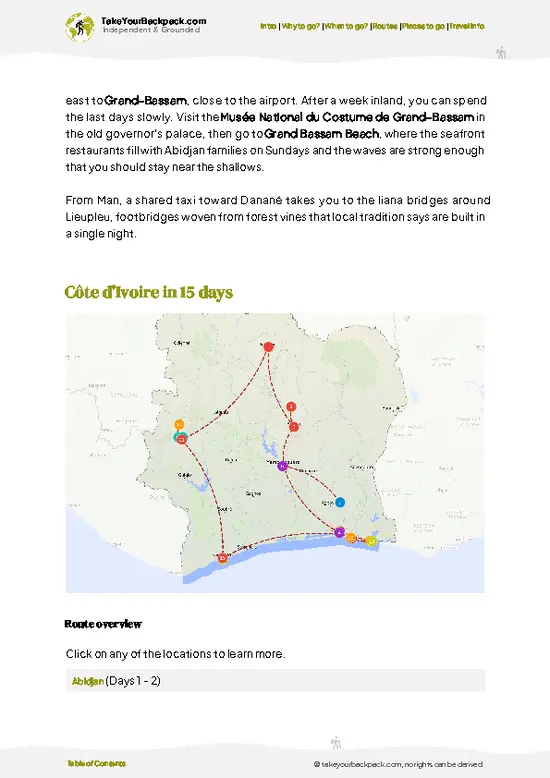
2 Grand Bassam Beach

colonial architecture, artisanal markets, wide shoreline

Stroll past faded colonial facades, browse local crafts, and watch fishermen haul in nets along a broad, sunlit coast.

cote-divoire-beach-grand-bassam-beach
© Google |

3 San Pedro Beach

working port, fishing boats, untamed surf

Watch cargo ships in the distance, see daily catches arrive, and experience strong waves on a less-developed stretch of sand.

cote-divoire-beach-san-pedro-beach
© Google |
Loading the map 🌍

Expert viewPro Tips for Exploring the Best

How many beaches to plan for: Three beaches is the number I would advise, four at the outside, because Côte d’Ivoire rewards staying put. Getting between coastal stretches means shared taxis (gbaka minibuses in towns, woro-woro cars between them), police checkpoints, heat, and roads where a 100 km hop can eat four hours. Spend two or three nights at each stop and you get the part that matters: waking to a Gulf of Guinea sea that smells of salt and woodsmoke, and a plate of grilled fish ready by noon.
Choosing the kind of beach: Beaches here fall into three broad kinds, and your travel style should pick for you. Lagoon-and-resort strips near Abidjan suit short stays and anyone who wants cold Flag beer, a working shower and a sunbed, with weekend crowds of Abidjan families and live music thumping … read more 👉
How many beaches to plan for: Three beaches is the number I would advise, four at the outside, because Côte d’Ivoire rewards staying put. Getting between coastal stretches means shared taxis (gbaka minibuses in towns, woro-woro cars between them), police checkpoints, heat, and roads where a 100 km hop can eat four hours. Spend two or three nights at each stop and you get the part that matters: waking to a Gulf of Guinea sea that smells of salt and woodsmoke, and a plate of grilled fish ready by noon.
Choosing the kind of beach: Beaches here fall into three broad kinds, and your travel style should pick for you. Lagoon-and-resort strips near Abidjan suit short stays and anyone who wants cold Flag beer, a working shower and a sunbed, with weekend crowds of Abidjan families and live music thumping from beach bars on Saturdays and Sundays. Surf-and-fishing villages in the southwest suit independent travelers with time: palm-fringed sand, wooden pirogues dragged up the shore, and quiet most weekdays. Palm-lined western and eastern lagoon-side stretches near the Ghana border fit slow travelers who like stilt villages and calm water you can actually swim in. If you have a week, take one of each kind. With only three or four days, choose one and stay.
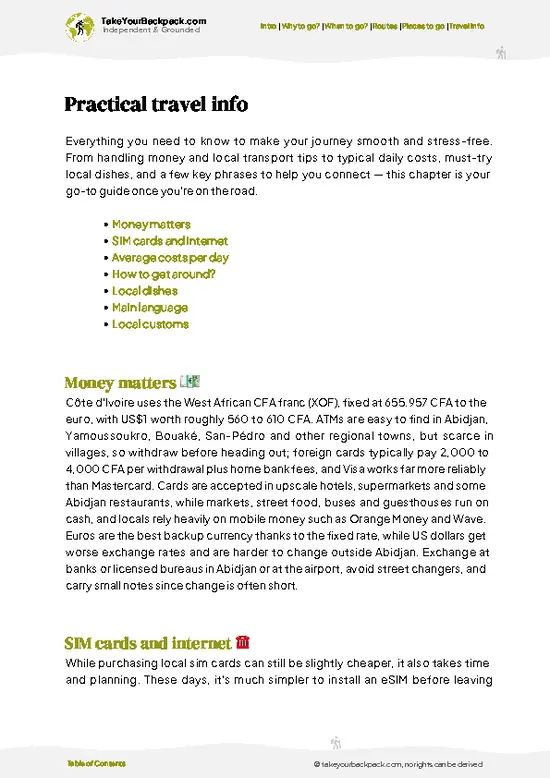
What it costs: Budget US$25 to 45 a day (roughly 15,000 to 27,000 CFA francs) for a backpacker who sleeps in guesthouses and eats local. A simple beach room runs 10,000 to 25,000 CFA francs (US$17 to 42), with bungalows at resort-style spots going higher. Grilled fish or chicken with attiéké (grated cassava, tangy and fluffy) and spicy onion sauce costs 2,500 to 6,000 CFA francs. Many beach clubs near Abidjan charge a day-use entry of about 2,000 to 10,000 CFA francs, sometimes credited toward food, while village beaches are usually free or ask a small fee for parking or a watched bag. Shared taxis between coastal towns cost roughly 1,000 to 5,000 CFA francs; a pirogue crossing to a sandbar or lagoon village is typically 1,000 to 3,000 CFA francs per person, and a private boat costs more. Carry cash, because card machines are rare outside Abidjan.
Safety and local etiquette: The sea is the main danger. Atlantic rip currents and heavy shore break are strong along the open coast, and drownings happen every year. Swim only where locals swim, avoid it alone, and treat red flags as final. Lagoon water is calmer but not always clean near towns, so check before you wade in. Keep valuables out of sight, leave phones and passports in your room, and do not walk empty beaches at night. The pay-off is a sunset with no one around to share it.
Dress modestly away from resort areas: cover up when walking through a village, and ask before photographing people, especially fishermen hauling nets or women smoking fish. Alcohol is widely sold, but Ivorians in the north and in Muslim communities may dress and behave more conservatively. Hawkers sell fruit and carvings and leave when you smile and say no thanks once. Bring reef-safe sunscreen, a hat, and small bills, as change is hard to come by. Yellow fever vaccination proof is required for entry, and malaria prophylaxis is sensible, so put repellent on at dusk when the mosquitoes arrive.

✈️ The backpacker research shortcutCôte d’Ivoire Travel Guide

An offline-friendly backpacking guide with optimized travel routes, ranked highlights, transport advice, and the best areas to stay.
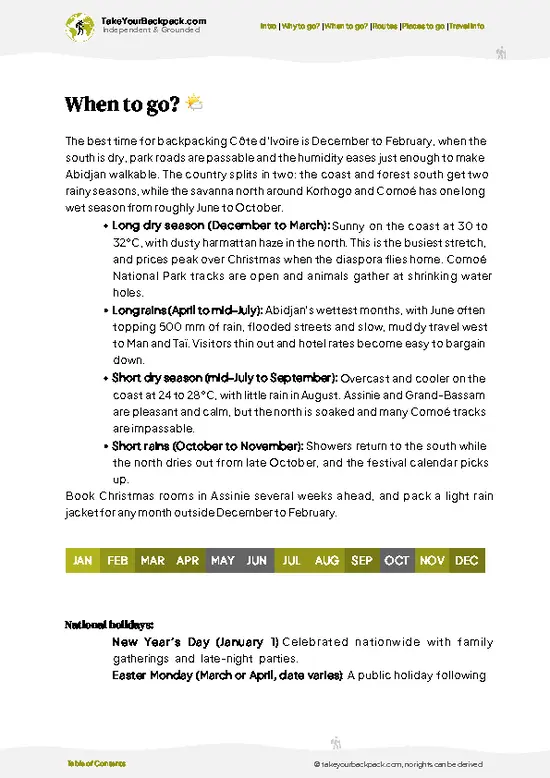
example page 0 from our offline Travel Guide for Côte d’Ivoire
example page 1 from our offline Travel Guide for Côte d’Ivoire
example page 2 from our offline Travel Guide for Côte d’Ivoire
example page 3 from our offline Travel Guide for Côte d’Ivoire
example page 4 from our offline Travel Guide for Côte d’Ivoire
example page 5 from our offline Travel Guide for Côte d’Ivoire
example page 6 from our offline Travel Guide for Côte d’Ivoire
example page 7 from our offline Travel Guide for Côte d’Ivoire
The digital guide (279 pages) contains:
✅ 64 highlights, ranked by travel appeal
✅ Optimized 5, 10 & 15-day travel routes
✅ Cities, national parks, landmarks, beaches
✅ How to get around
✅ Offline-friendly for travel without Wi-Fi
👉 Click to see all 30+ guide features

📅 Plan smarter in minutes, not weeks
✅ Month by month travel advice
✅ Festivals & national holidays
✅ Budget expectations

🗺️ Go to the right places, skip the overrated ones
✅ Honest pros & cons of destinations
✅ Top hikes, parks & viewpoints
✅ Lesser-known places most travelers miss
✅ Clear “worth it vs skip it” guidance

🛏️ Travel smoothly without rookie mistakes
✅ Best areas to stay
✅ Transport systems explained simply
✅ Common scams & safety advice
✅ SIM cards, money & practical tips

🌍 Understand the country, not just visit it
✅ Culture & traditions
✅ 52 Essential phrases & customs
✅ Festivals worth planning around
✅ Traveler-friendly historical context
✅ Insights that make places more meaningful

📱 Built for real travel conditions
✅ Fully downloadable PDF
✅ Works completely offline
✅ Optimized for phone use
✅ Useful in remote areas & buses
✅ Everything in one place
Stop searching, start planning
Get instant access to your full guide. 30‑day money-back guarantee.
+ Add another guide for just

By proceeding you agree to our terms.
Sent to your inbox immediately after payment • 100% Secure Checkout
Best Backpacking Travel Advisor 2025 tourism awardBest Backpacking
Travel Advisor
2025
What others say about Take Your Backpack Guides:
⭐⭐⭐⭐⭐
Fantastic, amazing amount of information!
⭐⭐⭐⭐⭐
My goodness this is amazing, it's what I've been looking for hats off too you!
⭐⭐⭐⭐⭐
I think this is absolutely BRILLIANT
⭐⭐⭐⭐
Very complete and informative. It's still missing places, but I gotta to commend you
⭐⭐⭐⭐⭐
This is truly amazing, thank you, can't wait to explore it with my kids!
⭐⭐⭐⭐⭐
Awesome resource, thank you!
⭐⭐⭐⭐⭐
This is amazing! Can't wait to explore the ones I haven't seen
⭐⭐⭐⭐
I love this! Well done, great idea.
⭐⭐⭐⭐⭐
Thanks for taking the time to make this gem!
⭐⭐⭐⭐⭐
This might be the best website I've ever seen.
⭐⭐⭐⭐⭐
Congratulations, and thank you so much for your work; it's incredibly valuable.
⭐⭐⭐⭐
In all seriousness I think you did a great job pointing out the important spots
⭐⭐⭐⭐⭐
10/10 very good
⭐⭐⭐⭐⭐
As someone who's only just starting to visit regularly this is awesome, thank you.
⭐⭐⭐⭐
Thank you very much! I'm going to visit my dad, it's going to be very useful!
⭐⭐⭐⭐⭐
This is really cool! We'll be travelling for the first time and this definitely come in handy.
⭐⭐⭐⭐⭐
You are now our minister of culture, congratulations 👨‍💼
⭐⭐⭐⭐⭐
Just wanted to tell you that this is a pearl! Going to follow your recommendations.
⭐⭐⭐⭐⭐
This is so cool. I'll definitely be using the resource for my travels soon.
⭐⭐⭐⭐⭐
This is very impressive! Good work.
⭐⭐⭐⭐⭐
This is an amazing and informative site. Very well done!

🛏️ Where to stay?Top Places to Consider Staying

True backpacker hostels with dorm beds are rare in Côte d’Ivoire, so most budget travelers sleep in simple guesthouses, small hotels and rented rooms, typically 10,000 to 25,000 CFA (about US$17 to 42) a night for a private double with a fan or basic air conditioning. In Abidjan, Treichville and Adjamé have the cheapest rooms and the loudest street life but call for extra care after dark, Zone 4 in Marcory sits close to the airport and the city’s densest cluster of bars and restaurants at mid-range prices, and leafy Cocody (especially Deux Plateaux and Riviera) is quieter and safer, with good evening spots around Deux Plateaux but longer taxi rides to the Plateau business district. Outside the … read more 👉
True backpacker hostels with dorm beds are rare in Côte d’Ivoire, so most budget travelers sleep in simple guesthouses, small hotels and rented rooms, typically 10,000 to 25,000 CFA (about US$17 to 42) a night for a private double with a fan or basic air conditioning. In Abidjan, Treichville and Adjamé have the cheapest rooms and the loudest street life but call for extra care after dark, Zone 4 in Marcory sits close to the airport and the city’s densest cluster of bars and restaurants at mid-range prices, and leafy Cocody (especially Deux Plateaux and Riviera) is quieter and safer, with good evening spots around Deux Plateaux but longer taxi rides to the Plateau business district. Outside the city, the beach guesthouses of Grand-Bassam are a calm, affordable weekend base about 45 minutes east of Abidjan, while Yamoussoukro, Man and San-Pédro offer plain, inexpensive hotels near their town centers but very little nightlife.

If you enjoy meeting fellow travelers, consider choosing hostels with high ratings for atmosphere. On the other hand, if you prefer having your own space, a hotel might be a better option.

Côte d’IvoireMore Places Across Côte d’Ivoire

👋 Meet the founderWho’s Behind Take Your Backpack?

Johan, backpacker and founder of TakeYourBackpackHi, I’m Johan (Netherlands 🇳🇱), the creator of TakeYourBackpack. Over the past 3 decades, I’ve backpacked through 90+ countries across six continents, gaining extensive experience with independent travel, long-term trips, and overland routes.

This site is built on a combination of firsthand travel experience and carefully curated insights from other backpackers. Many guides are based on places I’ve personally visited, while others bring together tips, observations, and practical advice shared by trusted travelers I’ve met along the way.

The goal is to provide realistic, experience-driven guidance — not generic itineraries — so you can explore destinations with better context, clearer expectations, and more confidence.