×

Côte d’Ivoire🇨🇮 | best attractionsExplore the 9 Best attractions in Côte d’Ivoire

Côte d’Ivoire hands you attractions in layers: Atlantic beaches where palm fronds clatter in the sea wind, red-earth roads into the western mountains that smell of wet leaves and woodsmoke, and a humid north of dry-season dust and mud-brick mosques. Abidjan is loud, fast and the priciest part of the country. Inland, entry fees are small and crowds are close to nonexistent, but distances are long and shared taxis leave only when full. Independent travelers who like to improvise will do well here, since few sites have fixed schedules and most are reached with a local driver or guide.

By Johan Kruseman 🇳🇱 | Updated October 19, 2026
Explore the best festivals in Côte d’Ivoire

Why go?Why These attraction Stand Out

Côte d’Ivoire sits on the Gulf of Guinea, so the country strings together three climates in one trip: a humid, palm-lined coast, a belt of dense rainforest and cocoa farms in the south and west, and drier savanna in the north. That spread produces attractions you rarely find side by side, from lagoon shorelines to granite peaks to Sudanese-style earthen architecture. Culture adds another layer. More than 60 ethnic groups live here, including the Senufo, Dan, Baoulé and Akan peoples, so masks, drumming, weaving and festivals change noticeably as you cross a region.

Before choosing it, know that this is not a polished tourism circuit. Infrastructure is good on the main highways and in Abidjan, then drops to red-dust tracks that turn to slick mud in the rains. Signage is minimal, English is … read more 👉
Côte d’Ivoire sits on the Gulf of Guinea, so the country strings together three climates in one trip: a humid, palm-lined coast, a belt of dense rainforest and cocoa farms in the south and west, and drier savanna in the north. That spread produces attractions you rarely find side by side, from lagoon shorelines to granite peaks to Sudanese-style earthen architecture. Culture adds another layer. More than 60 ethnic groups live here, including the Senufo, Dan, Baoulé and Akan peoples, so masks, drumming, weaving and festivals change noticeably as you cross a region.

Before choosing it, know that this is not a polished tourism circuit. Infrastructure is good on the main highways and in Abidjan, then drops to red-dust tracks that turn to slick mud in the rains. Signage is minimal, English is rare, and French is the working language everywhere, so basic phrases matter. Many sites are managed by local communities rather than ticket offices, which means a guide, a small fee and a bit of patience are part of the deal. You also need an e-visa and a yellow fever certificate before arrival. In return you get places without queues, where the welcome is real and the chicken grilled over charcoal at dusk is the soundtrack.
Why These Made the Cut
The list of best attractions in Côte d’Ivoire is created based on cultural significance or entertainment value. If you feel a attraction is missing in this list, please let us know.

When to go?Seasonal Guide to Visiting

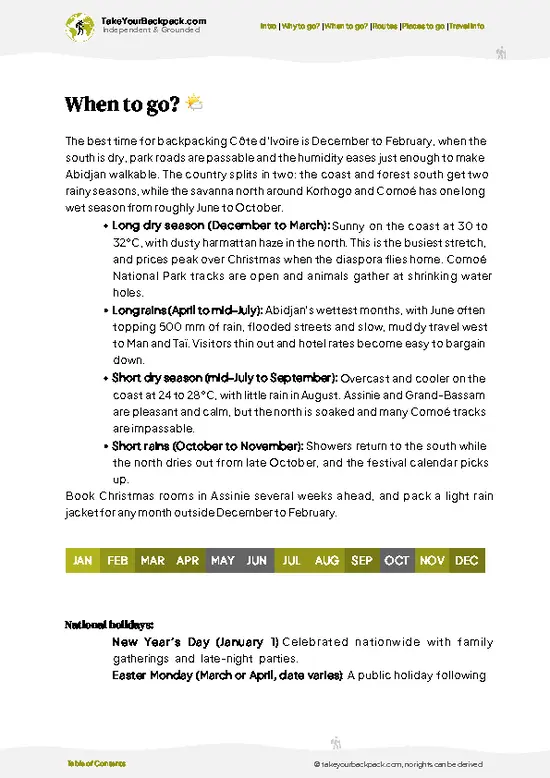
Best months and why: The best months are November to March, when the long rains have ended, skies are clearer and roads are firm enough for the unpaved stretches. Along the coast, including Abidjan and Grand-Bassam, temperatures sit around 27 to 32°C, with humidity thick enough that your shirt is damp by mid-morning. Expect low prices outside Abidjan, though December and January bring a small bump in hotel rates, often 10 to 20 percent, around Christmas and New Year.

The north and the Harmattan: In the north, around Korhogo and Odienné, the dry season brings the Harmattan from roughly December to February. A dusty wind drops visibility, turns the sun into a pale disk and cracks lips, while daytime highs reach 33 to 38°C and nights can fall to about 15 to 20°C. Mountain areas in the west, … read more 👉
Best months and why: The best months are November to March, when the long rains have ended, skies are clearer and roads are firm enough for the unpaved stretches. Along the coast, including Abidjan and Grand-Bassam, temperatures sit around 27 to 32°C, with humidity thick enough that your shirt is damp by mid-morning. Expect low prices outside Abidjan, though December and January bring a small bump in hotel rates, often 10 to 20 percent, around Christmas and New Year.

The north and the Harmattan: In the north, around Korhogo and Odienné, the dry season brings the Harmattan from roughly December to February. A dusty wind drops visibility, turns the sun into a pale disk and cracks lips, while daytime highs reach 33 to 38°C and nights can fall to about 15 to 20°C. Mountain areas in the west, near Man, stay greener and a few degrees cooler.

Shoulder and wet seasons: April to May and October are shoulder months with building heat and short, heavy downpours. June to September is the wettest stretch in the south, with coastal rainfall often passing 300 mm in June, and dirt roads in the west and center can become impassable for hours. Cloud blunts views, but rooms are cheaper and you share sites with almost nobody.

attraction hoppingOptimizing Your Multi-Stop Itinerary

How long you need: A trip linking several attractions needs 10 to 16 days, because distances are long and road speeds are slow. Two or three stops are realistic in 10 days, while 14 to 16 days allows a loop through the west and north without constant packing.

Regions that cluster and direction of travel: Start in Abidjan, which is the main air and bus hub, and combine it with nearby coastal stops east or west, since they are 1 to 2.5 hours apart. Then head inland to Yamoussoukro (about 3 to 4 hours by coach), continue west to Man (roughly 4 to 5 hours further), and finish by turning north toward Korhogo, which is 8 to 10 hours from Abidjan by road. Moving south to north follows the drying landscape and lets you return to Abidjan by a short domestic flight or a long overnight bus.

Time per … read more 👉
How long you need: A trip linking several attractions needs 10 to 16 days, because distances are long and road speeds are slow. Two or three stops are realistic in 10 days, while 14 to 16 days allows a loop through the west and north without constant packing.

Regions that cluster and direction of travel: Start in Abidjan, which is the main air and bus hub, and combine it with nearby coastal stops east or west, since they are 1 to 2.5 hours apart. Then head inland to Yamoussoukro (about 3 to 4 hours by coach), continue west to Man (roughly 4 to 5 hours further), and finish by turning north toward Korhogo, which is 8 to 10 hours from Abidjan by road. Moving south to north follows the drying landscape and lets you return to Abidjan by a short domestic flight or a long overnight bus.

Time per stop and common mistakes: Allow 2 to 3 nights per inland base and 1 to 2 for coastal stops. The common mistake is underestimating road time: a 300 km leg often takes 6 to 8 hours with police checkpoints, market stops and a shared taxi that waits to fill. Another is arriving after dark on rural roads. Travel early, aim to arrive by mid-afternoon, and keep a buffer day before any flight home. Cash in CFA francs is needed away from cities, so withdraw it in larger towns.

The ListMust-Visit attractions in Côte d’Ivoire

1 Musée des Civilisations de Côte d’Ivoire

ethnic diversity, ancestral objects, ritual artifacts, cultural heritage

Gain insight into the country’s many communities by viewing objects that illustrate spiritual beliefs and daily life.

cote-divoire-attraction-musee-des-civilisations-de-cote-divoire
© Google |

2 Musée National du Costume de Grand-Bassam

colonial-era costumes, royal regalia, embroidery, historical textiles

Examine garments and accessories that reveal the intersection of local traditions and colonial influences in Ivorian dress.

cote-divoire-attraction-musee-national-du-costume-de-grand-bassam
© Google |

3 Zoo National d’Abidjan

native wildlife, shaded enclosures, educational tours, animal conservation

Observe a range of West African species and learn about conservation efforts in a setting suited for families and groups.

cote-divoire-attraction-zoo-national-dabidjan
© Google |

4 Palais de la Culture d’Abidjan

performance halls, cultural festivals, exhibition spaces, urban arts center

Attend concerts, dance shows, and exhibitions in a venue that serves as a focal point for the city’s creative scene.

cote-divoire-attraction-palais-de-la-culture-dabidjan
© Google |

5 Centre Artisanal de Grand-Bassam

wood carvings, textile stalls, open-air workshops, local crafts

Browse a lively artisan hub offering hands-on encounters with regional craftsmanship, from weaving demonstrations to sculptors at work.

6 Fondation Donwahi pour l’Art Contemporain

contemporary exhibitions, sculpture garden, artist residencies, modern gallery

Experience rotating exhibitions and installations in a dedicated space supporting emerging and established contemporary artists.

7 Galerie Cécile Fakhoury

modern art, curated shows, minimalist space, regional artists

View curated displays of contemporary works in a sleek gallery setting focused on artists from Côte d’Ivoire and West Africa.

cote-divoire-attraction-galerie-cecile-fakhoury
© Google |

8 Centre Artisanal de la Ville d’Abidjan

urban craft market, beadwork, pottery, souvenir stalls

Discover a bustling city market where artisans display a wide range of handmade goods reflecting diverse Ivorian traditions.

9 Musée Charles et Marguerite Bieth

regional artifacts, Dan masks, ethnographic displays, mountain backdrop

Explore a collection highlighting local cultures and traditions, set against the scenic hills of western Côte d’Ivoire.

Loading the map 🌍

Expert viewPro Tips for Exploring the Best

How many attractions to aim for: Plan on one major attraction every two to three days, so about 5 to 7 in a two-week trip. Roads are slow, heat saps afternoons, and the good moments here come from lingering: a guide’s palm wine under a tree, a mask dance that starts late, a lagoon dinner as the light turns orange. Pack in more and you will mostly see the inside of a shared taxi.

Choosing by travel style: If you want culture and craft, put the north and west first: village visits, weaving and mask traditions, where a local guide transforms a quiet courtyard into a story. If you prefer nature, pick the western mountains and forest parks, where you trade comfort for damp trails, bird calls and wildlife that hides well, so expect patience rather than guaranteed sightings. For beach and food, … read more 👉
How many attractions to aim for: Plan on one major attraction every two to three days, so about 5 to 7 in a two-week trip. Roads are slow, heat saps afternoons, and the good moments here come from lingering: a guide’s palm wine under a tree, a mask dance that starts late, a lagoon dinner as the light turns orange. Pack in more and you will mostly see the inside of a shared taxi.

Choosing by travel style: If you want culture and craft, put the north and west first: village visits, weaving and mask traditions, where a local guide transforms a quiet courtyard into a story. If you prefer nature, pick the western mountains and forest parks, where you trade comfort for damp trails, bird calls and wildlife that hides well, so expect patience rather than guaranteed sightings. For beach and food, stay on the coast, where fried fish, attiéké and cold local beer come with wooden tables and sea breeze. Architecture and history fans can lean on the coastal colonial towns and the capital region.

What it costs: Budget US$30 to 55 a day outside Abidjan (roughly 18,000 to 33,000 CFA francs), covering a simple room at about 10,000 to 20,000 CFA francs, street meals at 1,500 to 3,500 and local transport. Abidjan pushes that to US$50 to 90. Entry fees at most sites run about 1,000 to 5,000 CFA francs, national parks cost more, and a local guide usually asks 5,000 to 15,000 for a half day. A private driver for a day trip is 25,000 to 60,000 depending on distance and road quality, which splits well among travelers. Carry small notes, since change is scarce at village sites.

Safety on the ground: The main risks are road accidents, so avoid night driving and choose coaches or drivers who do not speed. Petty theft happens in Abidjan’s busy markets, so keep phones tucked away. Check current government advice for the far north near the Mali and Burkina Faso borders, where security can change, and stay out of that zone if advised. Malaria is present nationwide, so take prophylaxis and use repellent at dusk, when the air fills with insects.

Cultural manners: Greet before asking anything, with a handshake and a “bonjour”. Ask before photographing people, ceremonies or masks, and expect a small gift or fee at sacred or community sites. Dress modestly in villages and mosques, with shoulders and knees covered. Follow your guide on what is restricted, since some forests and shrines are off limits to outsiders or to women at certain times. The reward is a warm, unhurried welcome that cameras alone never earn.

✈️ The backpacker research shortcutCôte d’Ivoire Travel Guide

An offline-friendly backpacking guide with optimized travel routes, ranked highlights, transport advice, and the best areas to stay.
example page 0 from our offline Travel Guide for Côte d’Ivoire
example page 1 from our offline Travel Guide for Côte d’Ivoire
example page 2 from our offline Travel Guide for Côte d’Ivoire
example page 3 from our offline Travel Guide for Côte d’Ivoire
example page 4 from our offline Travel Guide for Côte d’Ivoire
example page 5 from our offline Travel Guide for Côte d’Ivoire
example page 6 from our offline Travel Guide for Côte d’Ivoire
example page 7 from our offline Travel Guide for Côte d’Ivoire
The digital guide (279 pages) contains:
✅ 64 highlights, ranked by travel appeal
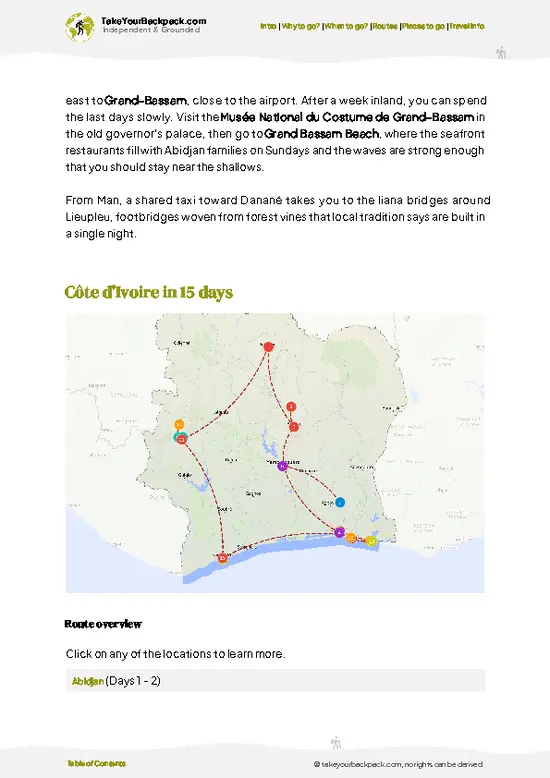
✅ Optimized 5, 10 & 15-day travel routes
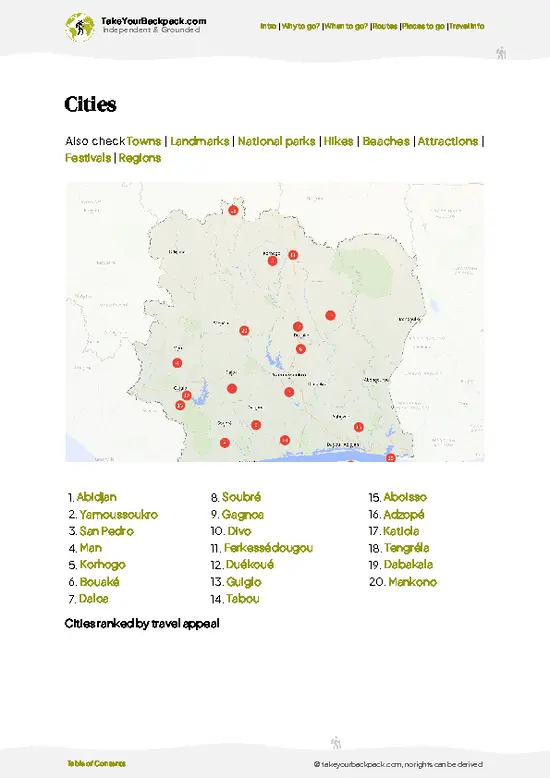
✅ Cities, national parks, landmarks, beaches
✅ How to get around
✅ Offline-friendly for travel without Wi-Fi
👉 Click to see all 30+ guide features

📅 Plan smarter in minutes, not weeks
✅ Month by month travel advice
✅ Festivals & national holidays
✅ Budget expectations

🗺️ Go to the right places, skip the overrated ones
✅ Honest pros & cons of destinations
✅ Top hikes, parks & viewpoints
✅ Lesser-known places most travelers miss
✅ Clear “worth it vs skip it” guidance

🛏️ Travel smoothly without rookie mistakes
✅ Best areas to stay
✅ Transport systems explained simply
✅ Common scams & safety advice
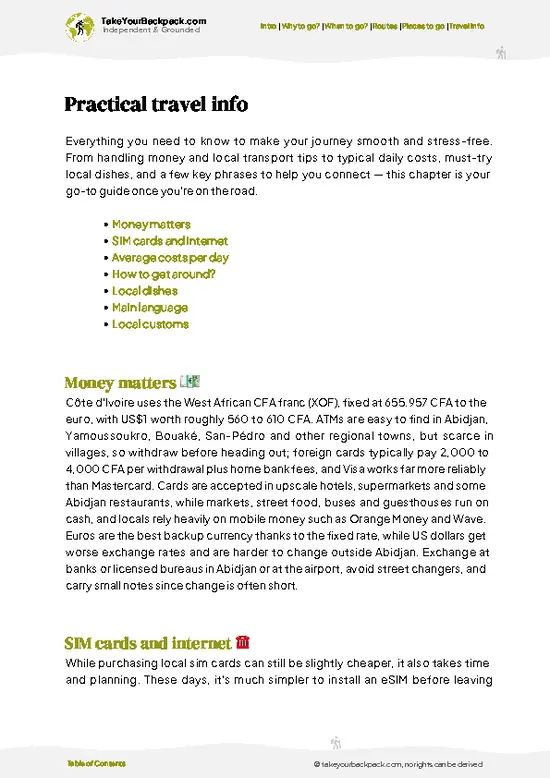
✅ SIM cards, money & practical tips

🌍 Understand the country, not just visit it
✅ Culture & traditions
✅ 52 Essential phrases & customs
✅ Festivals worth planning around
✅ Traveler-friendly historical context
✅ Insights that make places more meaningful

📱 Built for real travel conditions
✅ Fully downloadable PDF
✅ Works completely offline
✅ Optimized for phone use
✅ Useful in remote areas & buses
✅ Everything in one place
Stop searching, start planning
Get instant access to your full guide. 30‑day money-back guarantee.
+ Add another guide for just

By proceeding you agree to our terms.
Sent to your inbox immediately after payment • 100% Secure Checkout
Best Backpacking Travel Advisor 2025 tourism awardBest Backpacking
Travel Advisor
2025
What others say about Take Your Backpack Guides:
⭐⭐⭐⭐⭐
Fantastic, amazing amount of information!
⭐⭐⭐⭐⭐
My goodness this is amazing, it's what I've been looking for hats off too you!
⭐⭐⭐⭐⭐
I think this is absolutely BRILLIANT
⭐⭐⭐⭐
Very complete and informative. It's still missing places, but I gotta to commend you
⭐⭐⭐⭐⭐
This is truly amazing, thank you, can't wait to explore it with my kids!
⭐⭐⭐⭐⭐
Awesome resource, thank you!
⭐⭐⭐⭐⭐
This is amazing! Can't wait to explore the ones I haven't seen
⭐⭐⭐⭐
I love this! Well done, great idea.
⭐⭐⭐⭐⭐
Thanks for taking the time to make this gem!
⭐⭐⭐⭐⭐
This might be the best website I've ever seen.
⭐⭐⭐⭐⭐
Congratulations, and thank you so much for your work; it's incredibly valuable.
⭐⭐⭐⭐
In all seriousness I think you did a great job pointing out the important spots
⭐⭐⭐⭐⭐
10/10 very good
⭐⭐⭐⭐⭐
As someone who's only just starting to visit regularly this is awesome, thank you.
⭐⭐⭐⭐
Thank you very much! I'm going to visit my dad, it's going to be very useful!
⭐⭐⭐⭐⭐
This is really cool! We'll be travelling for the first time and this definitely come in handy.
⭐⭐⭐⭐⭐
You are now our minister of culture, congratulations 👨‍💼
⭐⭐⭐⭐⭐
Just wanted to tell you that this is a pearl! Going to follow your recommendations.
⭐⭐⭐⭐⭐
This is so cool. I'll definitely be using the resource for my travels soon.
⭐⭐⭐⭐⭐
This is very impressive! Good work.
⭐⭐⭐⭐⭐
This is an amazing and informative site. Very well done!

🛏️ Where to stay?Where to Base Yourself

True backpacker hostels with dorm beds are rare in Côte d’Ivoire, so most budget travelers sleep in simple guesthouses, small hotels and rented rooms, typically 10,000 to 25,000 CFA (about US$17 to 42) a night for a private double with a fan or basic air conditioning. In Abidjan, Treichville and Adjamé have the cheapest rooms and the loudest street life but call for extra care after dark, Zone 4 in Marcory sits close to the airport and the city’s densest cluster of bars and restaurants at mid-range prices, and leafy Cocody (especially Deux Plateaux and Riviera) is quieter and safer, with good evening spots around Deux Plateaux but longer taxi rides to the Plateau business district. Outside the … read more 👉
True backpacker hostels with dorm beds are rare in Côte d’Ivoire, so most budget travelers sleep in simple guesthouses, small hotels and rented rooms, typically 10,000 to 25,000 CFA (about US$17 to 42) a night for a private double with a fan or basic air conditioning. In Abidjan, Treichville and Adjamé have the cheapest rooms and the loudest street life but call for extra care after dark, Zone 4 in Marcory sits close to the airport and the city’s densest cluster of bars and restaurants at mid-range prices, and leafy Cocody (especially Deux Plateaux and Riviera) is quieter and safer, with good evening spots around Deux Plateaux but longer taxi rides to the Plateau business district. Outside the city, the beach guesthouses of Grand-Bassam are a calm, affordable weekend base about 45 minutes east of Abidjan, while Yamoussoukro, Man and San-Pédro offer plain, inexpensive hotels near their town centers but very little nightlife.

If you enjoy meeting fellow travelers, consider choosing hostels with high ratings for atmosphere. On the other hand, if you prefer having your own space, a hotel might be a better option.

Côte d’IvoireExpand Your Journey

👋 Meet the founderWho’s Behind Take Your Backpack?

Johan, backpacker and founder of TakeYourBackpackHi, I’m Johan (Netherlands 🇳🇱), the creator of TakeYourBackpack. Over the past 3 decades, I’ve backpacked through 90+ countries across six continents, gaining extensive experience with independent travel, long-term trips, and overland routes.

This site is built on a combination of firsthand travel experience and carefully curated insights from other backpackers. Many guides are based on places I’ve personally visited, while others bring together tips, observations, and practical advice shared by trusted travelers I’ve met along the way.

The goal is to provide realistic, experience-driven guidance — not generic itineraries — so you can explore destinations with better context, clearer expectations, and more confidence.