×

Côte d’Ivoire🇨🇮 | townsTiébissouGare routière, kola market, cashew country, alloco stalls | things to do and best time to go

Explore Grand-LahouExplore Adiaké

Backpacking in Tiébissou
👌 Worth visitingtown ranked #7
By Johan Kruseman 🇳🇱 | Updated October 22, 2026

Minibuses idle at the gare routière with their doors open, drivers shouting destinations over the diesel rattle, and a woman beside you is frying alloco in a blackened pan that spits oil onto the red dust. Tiébissou sits in central Côte d’Ivoire, in the Lacs region on the main road between Yamoussoukro and Bouaké. It is a working market town, not a sightseeing one, so expect little polish and few other backpackers. Hostels are scarce, and evenings mean maquis tables, cold local beer and grilled fish under bare bulbs. Its value is as an easy, real stop on the north-south corridor, with a lively market and the surrounding savanna and cashew country. Buses and shared taxis pass constantly. Carry small cash, because there is no guarantee an ATM works.

Discover everything you want to know in the 📖 Côte d’Ivoire Travel Guide.


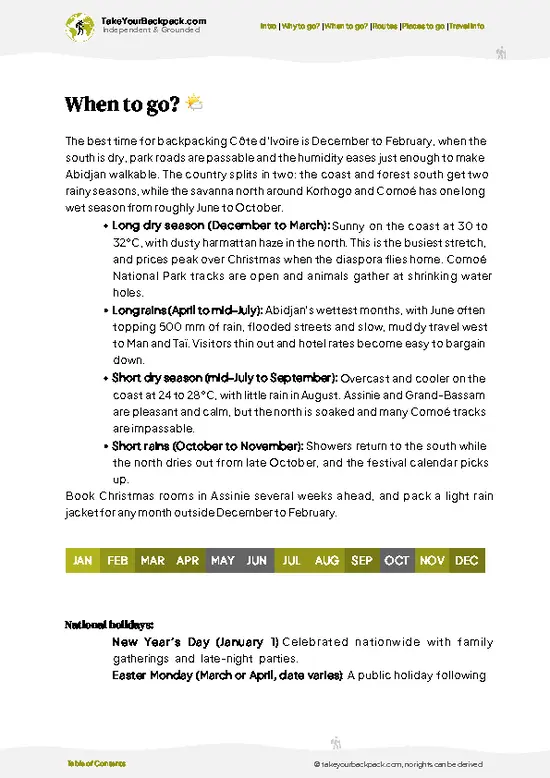
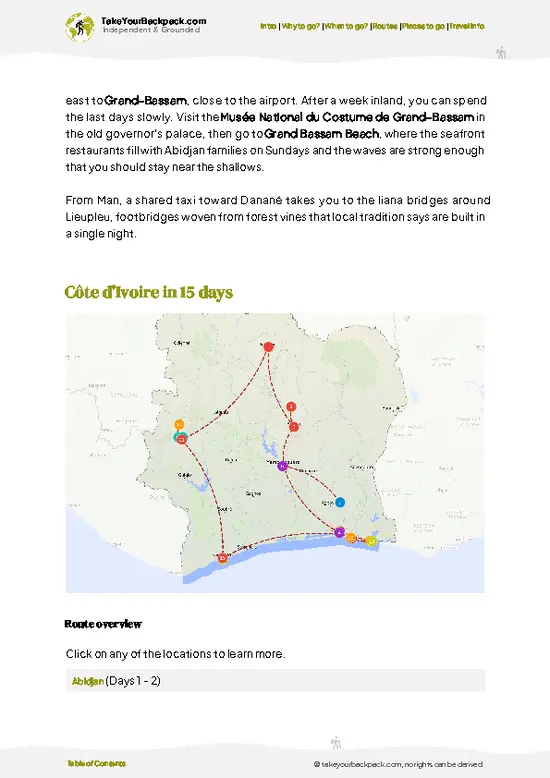
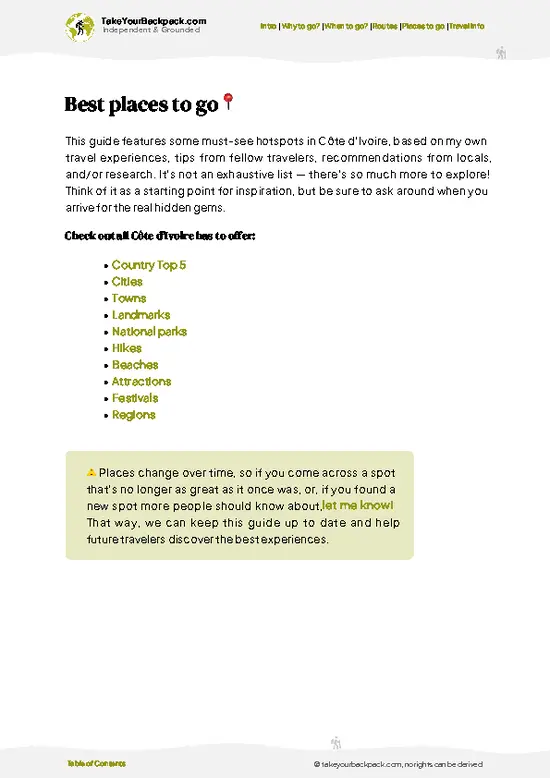
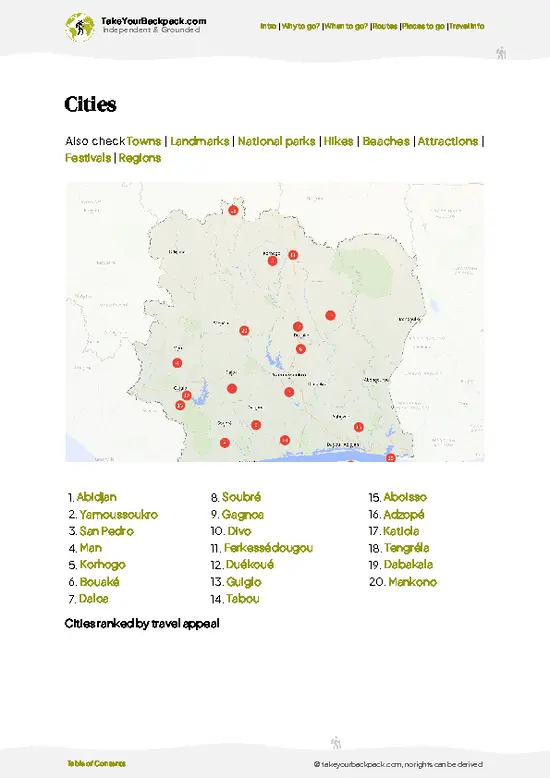
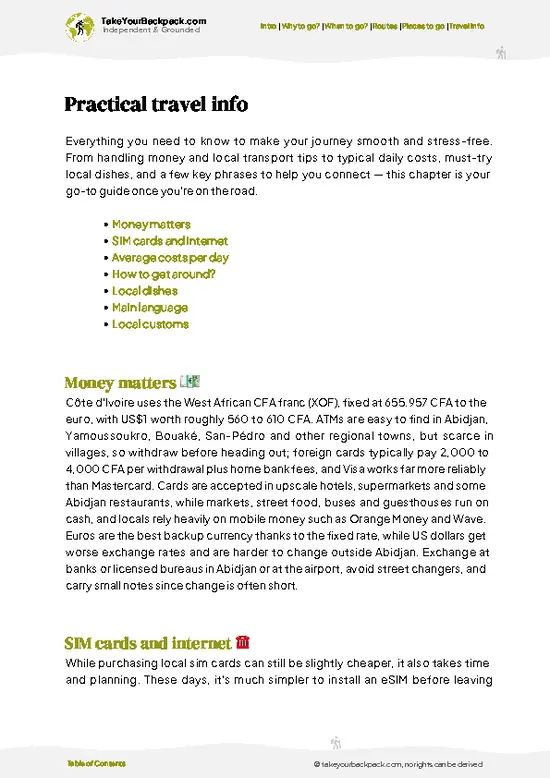
example page 0 from our offline Travel Guide for Côte d’Ivoire
example page 1 from our offline Travel Guide for Côte d’Ivoire
example page 2 from our offline Travel Guide for Côte d’Ivoire
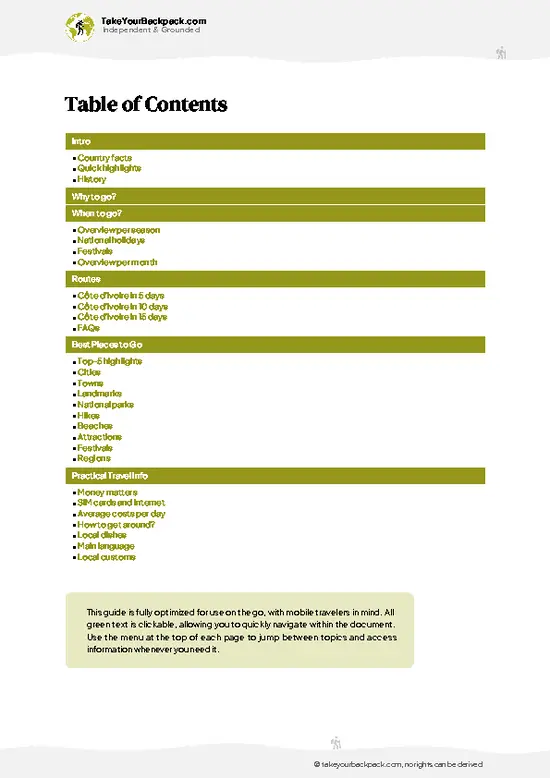
example page 3 from our offline Travel Guide for Côte d’Ivoire
example page 4 from our offline Travel Guide for Côte d’Ivoire
example page 5 from our offline Travel Guide for Côte d’Ivoire
example page 6 from our offline Travel Guide for Côte d’Ivoire
example page 7 from our offline Travel Guide for Côte d’Ivoire
Loading the map 🌍
CLICK TO FILTER
cities
towns
landmarks
national parks
hikes
beaches
attractions
festivals
regions
SHOW COUNTRY’S BESTSHOW ALL

✨ Why go?
Ranked #7 town in Côte d’Ivoire
What makes it a must-see town

Tiébissou suits the traveler who wants a night of ordinary Ivorian life between bigger stops. It sits on the corridor linking the capital area with the north, so you can break a long overland leg here instead of arriving in Bouaké after dark. The town market is the main event, with yams, kola nuts, peppers and cloth sold by women who will happily bargain and chat in French. Evenings are slow and social in the open-air maquis, where grilled chicken or fish with attiéké is the standard order, and locals tend to start the conversation. Most people stay one night, two at most. Solo travelers who speak some French and enjoy unscripted small-town life will get the most out of it. Anyone wanting hostels, guided tours or a busy backpacker scene should keep going.

💡 HighlightsWhat this place is best known for

  1. Tiébissou Central Market: The town’s real center, with produce, kola, smoked fish, spices and fabric under tin roofs. Go in the morning, when stock is fresh and the heat is gentle. Entry is free, and one to two hours is plenty. Buy fruit for the road.
  2. Gare Routière and Main Road Stalls: Where the town’s pulse is easiest to read, with vendors pushing grilled corn, peanuts and cold water through bus windows. Mid-morning is busiest. Free to watch, 30 to 45 minutes.
  3. Maquis Evening Meal: Open-air eateries serve grilled fish or chicken with attiéké and spicy onion sauce. Arrive after dusk, when the grills are lit. A full meal costs about €3 to 6, and the evening can run two hours.
  4. Neighborhood Walk Past the Mosque and Church: Short streets of red earth show the mix of Muslim and Christian communities
… read more 👉
  1. Tiébissou Central Market: The town’s real center, with produce, kola, smoked fish, spices and fabric under tin roofs. Go in the morning, when stock is fresh and the heat is gentle. Entry is free, and one to two hours is plenty. Buy fruit for the road.
  2. Gare Routière and Main Road Stalls: Where the town’s pulse is easiest to read, with vendors pushing grilled corn, peanuts and cold water through bus windows. Mid-morning is busiest. Free to watch, 30 to 45 minutes.
  3. Maquis Evening Meal: Open-air eateries serve grilled fish or chicken with attiéké and spicy onion sauce. Arrive after dusk, when the grills are lit. A full meal costs about €3 to 6, and the evening can run two hours.
  4. Neighborhood Walk Past the Mosque and Church: Short streets of red earth show the mix of Muslim and Christian communities that shape daily life. Early morning or late afternoon is coolest. Free, about one hour. Ask before photographing people.
  5. Cashew and Savanna Edge Walk: Trails and tracks on the town’s edge pass cashew orchards, mango trees and cassava plots. Go early to avoid midday heat. Free, one to two hours, and a local guide can be arranged informally for a few euros.
Tiébissou makes a practical base for day trips to Yamoussoukro’s Basilica of Our Lady of Peace, Lake Kossou and the markets of Bouaké. Start with the market, because it is at its best in the morning and sets the tone for everything else.
Spotted a mistake or missing something? Contact us.

Things to do near Tiébissou

Ratings based on Tripadvisor reviews. When you book through this link, you support our work at no extra cost to you.

🏘️ NeighborhoodsWhere things are and how it's laid out

Tiébissou is a compact market town on the main north-south road, and you can cover every part of it on foot in an afternoon, though the heat makes you slow down anyway.
  • Central market and main road: This is where the town wakes up first. Red dust, motorbike horns and women frying alloco (plantain) and fish under tarps. Stalls sell yams, cassava, peppers and phone credit. Eat a plate of grilled fish with attiéké here and you pay local prices and watch the whole town pass by.
  • Gare routière area: Minibuses and shared taxis load with shouting and slammed doors, and the air smells of diesel and roasted peanuts. It is loud and a little chaotic, but everything you need for onward travel sits within a few hundred meters, and cold drinks are on every corner.
  • Residential quarters and the outskirts: Quiet
… read more 👉
Tiébissou is a compact market town on the main north-south road, and you can cover every part of it on foot in an afternoon, though the heat makes you slow down anyway.
  • Central market and main road: This is where the town wakes up first. Red dust, motorbike horns and women frying alloco (plantain) and fish under tarps. Stalls sell yams, cassava, peppers and phone credit. Eat a plate of grilled fish with attiéké here and you pay local prices and watch the whole town pass by.
  • Gare routière area: Minibuses and shared taxis load with shouting and slammed doors, and the air smells of diesel and roasted peanuts. It is loud and a little chaotic, but everything you need for onward travel sits within a few hundred meters, and cold drinks are on every corner.
  • Residential quarters and the outskirts: Quiet lanes of low concrete houses, mango trees, goats and children playing football on packed earth. Walk here at dusk when the light softens and you will get greetings from every doorway.
  • Evening maquis strip: Open-air bars with plastic chairs, loud coupé-décalé music and grilled chicken smoke. Nightlife is simple and local. You get cold Ivorian beer and easy conversation, with the generator humming behind it.

⌛️ 1 dayA smart one-day plan

This is a market-and-roadside day, slow and sweaty and best done on foot.
7:00 AM: Main market
Start where the town wakes first. Women unload cassava, yams, plantain bunches and peppers from baskets, and the air smells of woodsmoke and frying dough. Buy a bag of fresh bananas and a warm fried snack for breakfast, then wander the stalls for about an hour while the heat is still gentle.
9:00 AM: Grand Mosque and central streets
Walk ten minutes through the center to the mosque, which anchors the town’s large Muslim community. Admire it from outside unless someone invites you in, and dress modestly with covered shoulders and knees. Continue along the main road past tailors, phone-credit kiosks and moto-taxi stands to see how a crossroads town works.
11:00 AM: Cashew and cocoa lanes on the edge of … read more 👉
This is a market-and-roadside day, slow and sweaty and best done on foot.
7:00 AM: Main market
Start where the town wakes first. Women unload cassava, yams, plantain bunches and peppers from baskets, and the air smells of woodsmoke and frying dough. Buy a bag of fresh bananas and a warm fried snack for breakfast, then wander the stalls for about an hour while the heat is still gentle.
9:00 AM: Grand Mosque and central streets
Walk ten minutes through the center to the mosque, which anchors the town’s large Muslim community. Admire it from outside unless someone invites you in, and dress modestly with covered shoulders and knees. Continue along the main road past tailors, phone-credit kiosks and moto-taxi stands to see how a crossroads town works.
11:00 AM: Cashew and cocoa lanes on the edge of town
This is the part that rarely makes a standard itinerary. Follow a dirt track out toward the plantations, where cashew apples lie split in the dust and cocoa pods dry in yards. Farmers are usually happy to show you how beans are fermented and spread out, and a short chat in French goes a long way.
1:00 PM: Maquis lunch
Back in town, find an open-air maquis for grilled chicken or fish with attiéké and a spicy onion sauce. Sit in the shade, drink a cold local beer or a bissap juice, and rest through the hottest hours.
4:00 PM: Railway line and station area
Walk to the tracks as the heat eases. The line shaped the town’s growth, and the platform area is lively with traders and travelers waiting for rides. Photograph with permission only.
6:30 PM: Evening street food
Finish at the roadside grills, where brochettes sizzle over charcoal under bare bulbs. Eat standing up, then call it a night.

🌤️ When to go?Best time to visit Tiébissou

November to February is the easiest window for Tiébissou, with dry skies and the least mud on the roads.
  • Dry season (November to February): Days reach roughly 30 to 34°C (86 to 93°F) and nights cool to about 20 to 22°C (68 to 72°F). The Harmattan wind can bring a dusty haze, and daylight lasts about 11.5 to 12 hours. Prices stay steady since few tourists come.
  • Hot months (March to April): Humid and heavy, often 32 to 36°C (90 to 97°F), with the first storms arriving late in the period.
  • Main rains (May to July): Daily downpours, around 25 to 30°C (77 to 86°F), and dirt tracks turn slippery. Shared transport runs slower.
  • Short rains (September to October): Lighter showers, green fields and fresh mangoes in some years.
Plan day trips for mornings, since afternoon heat or storms can shut down plans.

source: climatestotravel.comJANJanuary: excellent for travelingFEBFebruary: excellent for travelingMARMarch: excellent for travelingAPRApril: fair for travelingMAYMay: fair for travelingJUNJune: fair for travelingJULJuly: fair for travelingAUGAugust: fair for travelingSEPSeptember: fair for travelingOCTOctober: fair for travelingNOVNovember: highly recommended for travelingDECDecember: highly recommended for traveling
when-to-go

✈️ The backpacker research shortcutCôte d’Ivoire Travel Guide

An offline-friendly backpacking guide with optimized travel routes, ranked highlights, transport advice, and the best areas to stay.
example page 0 from our offline Travel Guide for Côte d’Ivoire
example page 1 from our offline Travel Guide for Côte d’Ivoire
example page 2 from our offline Travel Guide for Côte d’Ivoire
example page 3 from our offline Travel Guide for Côte d’Ivoire
example page 4 from our offline Travel Guide for Côte d’Ivoire
example page 5 from our offline Travel Guide for Côte d’Ivoire
example page 6 from our offline Travel Guide for Côte d’Ivoire
example page 7 from our offline Travel Guide for Côte d’Ivoire
The digital guide (279 pages) contains:
✅ 64 highlights, ranked by travel appeal
✅ Optimized 5, 10 & 15-day travel routes
✅ Cities, national parks, landmarks, beaches
✅ How to get around
✅ Offline-friendly for travel without Wi-Fi
👉 Click to see all 30+ guide features

📅 Plan smarter in minutes, not weeks
✅ Month by month travel advice
✅ Festivals & national holidays
✅ Budget expectations

🗺️ Go to the right places, skip the overrated ones
✅ Honest pros & cons of destinations
✅ Top hikes, parks & viewpoints
✅ Lesser-known places most travelers miss
✅ Clear “worth it vs skip it” guidance

🛏️ Travel smoothly without rookie mistakes
✅ Best areas to stay
✅ Transport systems explained simply
✅ Common scams & safety advice
✅ SIM cards, money & practical tips

🌍 Understand the country, not just visit it
✅ Culture & traditions
✅ 52 Essential phrases & customs
✅ Festivals worth planning around
✅ Traveler-friendly historical context
✅ Insights that make places more meaningful

📱 Built for real travel conditions
✅ Fully downloadable PDF
✅ Works completely offline
✅ Optimized for phone use
✅ Useful in remote areas & buses
✅ Everything in one place
Stop searching, start planning
Get instant access to your full guide. 30‑day money-back guarantee.
+ Add another guide for just

By proceeding you agree to our terms.
Sent to your inbox immediately after payment • 100% Secure Checkout
Best Backpacking Travel Advisor 2025 tourism awardBest Backpacking
Travel Advisor
2025
What others say about Take Your Backpack Guides:
⭐⭐⭐⭐⭐
Fantastic, amazing amount of information!
⭐⭐⭐⭐⭐
My goodness this is amazing, it's what I've been looking for hats off too you!
⭐⭐⭐⭐⭐
I think this is absolutely BRILLIANT
⭐⭐⭐⭐
Very complete and informative. It's still missing places, but I gotta to commend you
⭐⭐⭐⭐⭐
This is truly amazing, thank you, can't wait to explore it with my kids!
⭐⭐⭐⭐⭐
Awesome resource, thank you!
⭐⭐⭐⭐⭐
This is amazing! Can't wait to explore the ones I haven't seen
⭐⭐⭐⭐
I love this! Well done, great idea.
⭐⭐⭐⭐⭐
Thanks for taking the time to make this gem!
⭐⭐⭐⭐⭐
This might be the best website I've ever seen.
⭐⭐⭐⭐⭐
Congratulations, and thank you so much for your work; it's incredibly valuable.
⭐⭐⭐⭐
In all seriousness I think you did a great job pointing out the important spots
⭐⭐⭐⭐⭐
10/10 very good
⭐⭐⭐⭐⭐
As someone who's only just starting to visit regularly this is awesome, thank you.
⭐⭐⭐⭐
Thank you very much! I'm going to visit my dad, it's going to be very useful!
⭐⭐⭐⭐⭐
This is really cool! We'll be travelling for the first time and this definitely come in handy.
⭐⭐⭐⭐⭐
You are now our minister of culture, congratulations 👨‍💼
⭐⭐⭐⭐⭐
Just wanted to tell you that this is a pearl! Going to follow your recommendations.
⭐⭐⭐⭐⭐
This is so cool. I'll definitely be using the resource for my travels soon.
⭐⭐⭐⭐⭐
This is very impressive! Good work.
⭐⭐⭐⭐⭐
This is an amazing and informative site. Very well done!

🛏️ Where to stay?Best areas to stay in Côte d’Ivoire

Stay near the central market and main road if you want the easiest budget beds in Tiébissou. This area has the small guesthouses and basic lodgings, a handful of maquis and food stalls within a short walk, and a steady flow of people until late evening, which makes it comfortable to come home after dark. Expect fan or air-conditioned rooms with simple bathrooms rather than traditional dorm hostels, which are rare here. Noise is the main drawback: motorbikes start early and music carries from nearby bars on weekends, so earplugs help.

The quieter residential quarters just back from the highway … read more 👉
Stay near the central market and main road if you want the easiest budget beds in Tiébissou. This area has the small guesthouses and basic lodgings, a handful of maquis and food stalls within a short walk, and a steady flow of people until late evening, which makes it comfortable to come home after dark. Expect fan or air-conditioned rooms with simple bathrooms rather than traditional dorm hostels, which are rare here. Noise is the main drawback: motorbikes start early and music carries from nearby bars on weekends, so earplugs help.

The quieter residential quarters just back from the highway are the second choice. Streets are calmer, nights are darker and sleep is easier, but you walk a bit further for food and transport, so bring a flashlight. Both areas sit within a short walk or cheap motorbike ride of the transport park, which matters if you leave on a morning minibus. Book ahead only on market days or during local festivals, otherwise walking in is normal.

🚌 Getting aroundMoving around without the hassle

Tiébissou is walkable in its center, where the market, the transport park and the main road all sit within about 1 km (0.6 mi), and walking stops making sense once you head to the outskirts or neighboring villages in the midday heat. Traffic is mostly motorbikes and trucks on the busy highway, and public transport means shared vehicles that leave when full.
  • Walking: Free, and the best way to see the market stalls, the smoky grills and the shaded side streets. Streets are dusty and uneven, so wear closed shoes, and expect to be greeted constantly.
  • Motorbike taxis: The standard way to reach outskirts and nearby villages, usually €0.30 to 1 per ride in town. You sit behind the driver with the wind and red dust in your face. Agree the price first and ask for a helmet.
  • Shared taxis (woro-woro): Cars
… read more 👉
Tiébissou is walkable in its center, where the market, the transport park and the main road all sit within about 1 km (0.6 mi), and walking stops making sense once you head to the outskirts or neighboring villages in the midday heat. Traffic is mostly motorbikes and trucks on the busy highway, and public transport means shared vehicles that leave when full.
  • Walking: Free, and the best way to see the market stalls, the smoky grills and the shaded side streets. Streets are dusty and uneven, so wear closed shoes, and expect to be greeted constantly.
  • Motorbike taxis: The standard way to reach outskirts and nearby villages, usually €0.30 to 1 per ride in town. You sit behind the driver with the wind and red dust in your face. Agree the price first and ask for a helmet.
  • Shared taxis (woro-woro): Cars that follow set routes and cost about €0.30 to 0.60 a seat. They fill up fast, so expect snug seating and music, and you will learn who sells what along the way.
  • Minibuses and intercity coaches: Departures to Yamoussoukro (roughly 45 minutes to 1 hour, about €1.50 to 3) and Bouaké (about 1 hour, similar price) leave from the transport park throughout the day, mostly from early morning until late afternoon. Vehicles leave when full, so arriving before 9 am saves waiting. Windows open, bags on the roof, and you get a front-row view of cocoa and yam country.

👛 Costs (as of 22 October 2026)Money, prices, and spending tips

Tiébissou costs roughly €22 to 32 a day for a backpacker, and the total below comes to €27.
CategoryBudget RangeLocal Reality
Dorm accommodation€9 to 14Real dorms are rare, so a basic private room with a fan is the norm. Prices rise slightly in the dry season.
Meals€5 to 9Grilled fish with attiéké, rice with sauce and alloco from market stalls and maquis. Water and a beer cost little.
Local transport€1 to 3Motorbike taxis and shared taxis in town cost small change per trip.
Basic activities/entry fees€2 to 5The town has few paid sights, so most spending goes on day trips to Yamoussoukro.
Miscellaneous expenses€2 to 4Phone credit, bottled water and small tips. Pay in cash, since cards are rarely accepted.
Total Daily Budget€27Based on high-season accommodation.
Eat where the market women cook at lunch, … read more 👉
Tiébissou costs roughly €22 to 32 a day for a backpacker, and the total below comes to €27.
CategoryBudget RangeLocal Reality
Dorm accommodation€9 to 14Real dorms are rare, so a basic private room with a fan is the norm. Prices rise slightly in the dry season.
Meals€5 to 9Grilled fish with attiéké, rice with sauce and alloco from market stalls and maquis. Water and a beer cost little.
Local transport€1 to 3Motorbike taxis and shared taxis in town cost small change per trip.
Basic activities/entry fees€2 to 5The town has few paid sights, so most spending goes on day trips to Yamoussoukro.
Miscellaneous expenses€2 to 4Phone credit, bottled water and small tips. Pay in cash, since cards are rarely accepted.
Total Daily Budget€27Based on high-season accommodation.
Eat where the market women cook at lunch, because the same plate costs about half as much as at a maquis near the highway.


source: cotedivoiretourisme.ci
⚠️ Prices can change and everyone travels differently, so take this as a rough guide. Hope it helps you plan your adventure!

🚌 Day tripsShort trips worth adding

Tiébissou sits on the road between two big hubs, so day trips are easy by shared transport, and you return the same evening.
Yamoussoukro Basilica:
The giant Basilica of Our Lady of Peace rises above the flat plains, with an enormous marble interior and a dome you can see from the highway. Count 45 minutes to 1 hour each way by minibus, and about €10 to 20 in total with the entry fee and lunch. Dress with covered shoulders and knees, a mistake first-timers often make, and go in the morning.
👉 Explore Basilica of Our Lady of Peace
Yamoussoukro Crocodile Lake:
At dusk, the sacred lake behind the presidential palace has caimans fed by hand at feeding time, a loud, muddy and surprising spectacle. Combine it with the Basilica for a full day costing around €12 to 22. Arrive in the late afternoon and … read more 👉
Tiébissou sits on the road between two big hubs, so day trips are easy by shared transport, and you return the same evening.
Yamoussoukro Basilica:
The giant Basilica of Our Lady of Peace rises above the flat plains, with an enormous marble interior and a dome you can see from the highway. Count 45 minutes to 1 hour each way by minibus, and about €10 to 20 in total with the entry fee and lunch. Dress with covered shoulders and knees, a mistake first-timers often make, and go in the morning.
👉 Explore Basilica of Our Lady of Peace
Yamoussoukro Crocodile Lake:
At dusk, the sacred lake behind the presidential palace has caimans fed by hand at feeding time, a loud, muddy and surprising spectacle. Combine it with the Basilica for a full day costing around €12 to 22. Arrive in the late afternoon and agree any guide fee in advance.

Bouaké:
Côte d’Ivoire’s second city has a large, loud central market, textile stalls and strong street food, about an hour away by coach. Budget €8 to 15 including transport and a long lunch. Go on a weekday morning when the market is full, and keep your phone zipped away in the crowds.
👉 Explore Bouaké

🛡️ SafetyScams, Hazards, and Annoyances

Tiébissou is a calm small town where the biggest problems are petty rather than dangerous. Daytime walking is comfortable, and people are curious and friendly. Keep your phone and cash out of sight in the crowded market and at the transport park, where pickpocketing is the likeliest issue, and watch bags at the roof loading. Agree motorbike and taxi prices before you get on, since foreigners are sometimes quoted double. Roadside police and military checkpoints on the highway are routine, so carry a passport copy and stay polite. After dark, streets are poorly lit, so use a flashlight and take a motorbike taxi rather than walking far. Solo travelers, including women, usually find the town relaxed, though dress modestly and expect persistent but friendly attention. Drink bottled or filtered water and carry malaria protection.

FAQFrequently asked questions about Tiébissou

Tiébissou works better as a short stop than as a main destination. It has a lively market, cheap grilled fish and a relaxed pace, but few formal sights, so most travelers pair it with Yamoussoukro (about 45 minutes to 1 hour by minibus) and its Basilica. A night or two costs around €22 to 32 a day.
One night is enough for Tiébissou itself, and two nights lets you add a day trip. Spend the first afternoon in the market and maquis streets, then use a full day for Yamoussoukro or Bouaké, each about an hour away. Longer stays suit only those who want to meet locals and slow down.
Yes, Tiébissou can be done as a day trip from Yamoussoukro or Bouaké, with each about 45 minutes to 1 hour by minibus and fares of roughly €1.50 to 3. A morning departure gives you time for the market and a fish lunch before heading back. Minibuses run mostly until late afternoon, so leave before dusk.
⚠️ Things can change over time, so always validate details locally before you go.

Other Ivorian towns near Tiébissou

Explore more nearby:

  • Bocanda—Yacouba communities, rural crossroads, local festivals| 81 km away
  • Vavoua—cotton fields, roadside stalls, regional bus stop| 140 km away
  • Koun-Fao—cashew orchards, border trade, rural markets| 221 km away

💡 Not sure where to go next?
Create a personalized itinerary for Côte d’Ivoire including Tiébissou and the places that fit your trip.

Generate my itinerary

👉 Discover all towns

Or checkout all Côte d’Ivoire has to offer (think cities, towns, villages, national parks, hikes, beaches, festivals)
Country photo of Côte d’Ivoire

We 💚 feedbackParting advice and final tips

Tiébissou deserves one night, two if you want a slow day of walking the fields. Plan to arrive by early afternoon so you have time for the market before it winds down. I would bring small notes, a few French greetings and a head torch for the dark walk back from the maquis.

✍️ Help improve this page!
The information on this page is based on in-depth research, insights shared by experienced travelers, and feedback from the local travel community in Côte d’Ivoire. While every effort is made to keep the information accurate and current, conditions can change — so if you spot anything incorrect or outdated, please get in touch.


🙋‍♂️ Give feedback

👋 Meet the founderWho’s Behind Take Your Backpack?

Johan, backpacker and founder of TakeYourBackpackHi, I’m Johan (Netherlands 🇳🇱), the creator of TakeYourBackpack. Over the past 3 decades, I’ve backpacked through 90+ countries across six continents, gaining extensive experience with independent travel, long-term trips, and overland routes.

This site is built on a combination of firsthand travel experience and carefully curated insights from other backpackers. Many guides are based on places I’ve personally visited, while others bring together tips, observations, and practical advice shared by trusted travelers I’ve met along the way.

The goal is to provide realistic, experience-driven guidance — not generic itineraries — so you can explore destinations with better context, clearer expectations, and more confidence.