×

Côte d’Ivoire🇨🇮 | best townsExplore the 10 Best towns in Côte d’Ivoire

Towns in Côte d’Ivoire come in two moods. On the humid southern coast, the air smells of woodsmoke, grilled fish and salt, and the streets hum with shared taxis and Zouglou from roadside speakers. Head north into the savanna and the light turns dry and amber, red dust coats everything, and mud-brick and cotton-market life slows the pace. The west brings green mountains, kola and cocoa stalls, and cooler nights. Costs run higher on the coast and drop inland. Roads are good between major hubs and rough on side routes. For backpackers and independent travelers, crowds are rare, so expect curiosity rather than tour groups.

By Johan Kruseman 🇳🇱 | Updated October 19, 2026
Explore the best landmarks in Côte d’Ivoire

Why go?Why These town Stand Out

Côte d’Ivoire suits town-hopping because its climate bands and cultures change within a single day’s drive. Rainforest in the south and west gives way to wooded savanna in the north, and each zone has its own food, building styles and market rhythm. Cocoa, coffee and cashew money has paid for paved intercity roads, fast buses and a dense web of shared taxis, so reaching mid-sized towns is easier than in many neighbors. French is the common language, which helps with directions and haggling, though locals also speak Dioula, Baoulé, Bété and dozens more.

The country also carries a mix of colonial architecture, mosques built in Sudanese mud-brick style, and masks, drums and weaving traditions that stay in daily use. Expect heat, humidity and the smell of diesel and frying plantain at every transport … read more 👉
Côte d’Ivoire suits town-hopping because its climate bands and cultures change within a single day’s drive. Rainforest in the south and west gives way to wooded savanna in the north, and each zone has its own food, building styles and market rhythm. Cocoa, coffee and cashew money has paid for paved intercity roads, fast buses and a dense web of shared taxis, so reaching mid-sized towns is easier than in many neighbors. French is the common language, which helps with directions and haggling, though locals also speak Dioula, Baoulé, Bété and dozens more.

The country also carries a mix of colonial architecture, mosques built in Sudanese mud-brick style, and masks, drums and weaving traditions that stay in daily use. Expect heat, humidity and the smell of diesel and frying plantain at every transport yard. Tourism infrastructure is thin outside the big centers. Many towns have only a handful of guesthouses, cash is king because cards and ATMs are unreliable, and English is rarely spoken. Learning basic French greetings changes how people treat you. Plan around market days, when towns are loudest and most colorful, and accept that sights are often informal and found by asking around rather than following signs.
How the List Was Created
The list of best towns in Côte d’Ivoire is created based on charm, local culture, atmosphere, hidden gems, and visitor appeal. If you feel a town is missing in this list, please let us know.

When to go?Seasonal Guide to Visiting

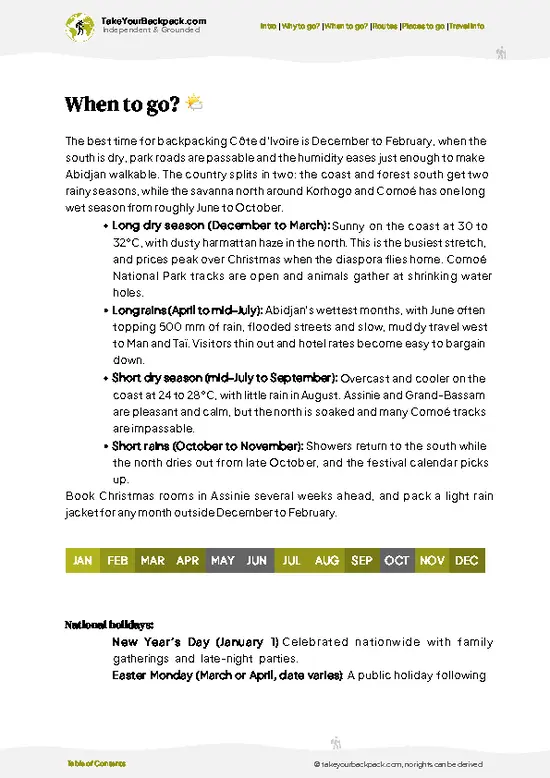
Best months: The best months for towns in Côte d’Ivoire are November to February, when the rains have stopped, humidity eases and skies are clear. Daytime temperatures sit around 28 to 33°C in the south and can reach 35°C or more in the north, while nights are noticeably cooler inland.
Harmattan and shoulder seasons: From December to February the Harmattan wind carries Saharan dust south, turning the northern light hazy and soft, drying throats and sometimes cutting views. The coast stays muggier. March to May is hot, with the north peaking at 38 to 40°C before the rains arrive, so it works only if you slow down and move early in the morning.
Rainy season: The south has two rainy seasons, roughly April to July and October to November, with June often the wettest and monthly rainfall easily above … read more 👉
Best months: The best months for towns in Côte d’Ivoire are November to February, when the rains have stopped, humidity eases and skies are clear. Daytime temperatures sit around 28 to 33°C in the south and can reach 35°C or more in the north, while nights are noticeably cooler inland.
Harmattan and shoulder seasons: From December to February the Harmattan wind carries Saharan dust south, turning the northern light hazy and soft, drying throats and sometimes cutting views. The coast stays muggier. March to May is hot, with the north peaking at 38 to 40°C before the rains arrive, so it works only if you slow down and move early in the morning.
Rainy season: The south has two rainy seasons, roughly April to July and October to November, with June often the wettest and monthly rainfall easily above 300 mm on the coast. Downpours flood streets and turn laterite side roads into slick red mud. The north has a single wet season from about June to October. Rain makes the air green and cooler, but unpaved routes to smaller towns can become slow or impassable. Prices for guesthouses barely move with the seasons, though transport costs can rise during Christmas and Eid, when buses fill days ahead.

town hoppingOptimizing Your Multi-Stop Itinerary

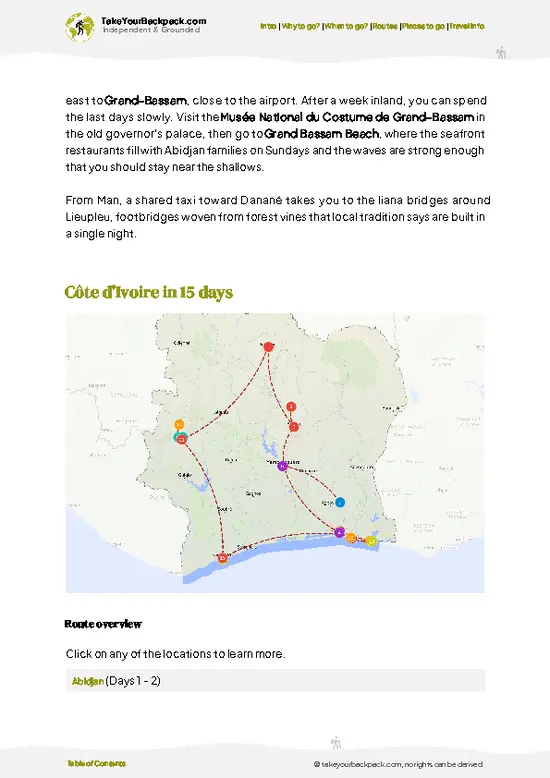
How long you need: A trip combining several towns in Côte d’Ivoire needs 10 to 16 days, because distances are long and road travel is slower than it looks on a map. Give each stop 1 to 3 nights, with a minimum of two if you want a full market day.
Grouping regions: The coast and the nearby lagoon area cluster well together, as do the western highlands with the central belt, and the northern savanna stands apart. A sensible direction is to arrive in Abidjan, work along the coast, then arc inland through the center and west, and finish in the north, since the dry heat is easiest to take late in a trip once you have adapted. Reverse it if you fly out of the north.
Travel times: Abidjan to Yamoussoukro takes about 3 to 4 hours by bus, to Bouaké roughly 5 hours, and to the far north 10 to 12 hours … read more 👉
How long you need: A trip combining several towns in Côte d’Ivoire needs 10 to 16 days, because distances are long and road travel is slower than it looks on a map. Give each stop 1 to 3 nights, with a minimum of two if you want a full market day.
Grouping regions: The coast and the nearby lagoon area cluster well together, as do the western highlands with the central belt, and the northern savanna stands apart. A sensible direction is to arrive in Abidjan, work along the coast, then arc inland through the center and west, and finish in the north, since the dry heat is easiest to take late in a trip once you have adapted. Reverse it if you fly out of the north.
Travel times: Abidjan to Yamoussoukro takes about 3 to 4 hours by bus, to Bouaké roughly 5 hours, and to the far north 10 to 12 hours or more. Western mountain towns are often 7 to 9 hours from the capital, and secondary roads add hours of bouncing in a bush taxi that leaves only when full.
Planning mistakes: The classic error is packing too many towns into too few days and spending the trip in transport yards. Do fewer stops. Another is traveling after dark; leave at dawn, when buses depart reliably and the air is still cool. Also avoid planning around rainy-season dirt roads, and book onward tickets a day early at major bus company counters.

The ListMust-Visit towns in Côte d’Ivoire

1 Grand-Bassam

Colonial facades, Atlantic beaches, artisan workshops

Stroll through faded colonial streets, browse local crafts, and unwind along the coast where the city meets the sea.

cote-divoire-city-grand-bassam
© Google |

2 Assinie-Mafia

lagoon beaches, seafood shacks, weekend retreats

Swim in calm waters, sample fresh-caught fish, and watch city dwellers unwind along the palm-lined Atlantic coast.

3 Grand-Lahou

river delta, fishing villages, colonial ruins

Take a boat through the delta, visit fishing communities, and explore the remains of colonial-era buildings.

4 Adiaké

lagoon islands, boat trips, seafood markets

Arrange a boat ride to nearby islands, sample fresh seafood, and enjoy the laid-back pace of this lagoon-side town.

5 Biankouma

mountain views, Dan culture, traditional houses

Climb to viewpoints, explore Dan villages, and admire the region’s distinctive wooden architecture.

cote-divoire-city-biankouma
© Google |

6 Bocanda

Yacouba communities, rural crossroads, local festivals

Attend a village festival, meet Yacouba residents, and use Bocanda as a gateway to the region’s rural heartland.

cote-divoire-city-bocanda
© Google |

7 Tiébissou

Baoulé villages, yam markets, crossroads town

Shop for yams, meet Baoulé families, and use Tiébissou as a practical stop between major cities.

8 Bangolo

Guéré villages, forested hills, cocoa farms

Travel winding roads, visit Guéré settlements, and observe cocoa farming in the lush hills surrounding Bangolo.

9 Vavoua

cotton fields, roadside stalls, regional bus stop

Stop for snacks at roadside stands, see cotton being processed, and use Vavoua as a break on long bus journeys.

10 Koun-Fao

cashew orchards, border trade, rural markets

Visit cashew farms, observe cross-border commerce, and experience the pace of life in a market town near Ghana.

cote-divoire-city-koun-fao
© Google |
Loading the map 🌍

Expert viewPro Tips for Exploring the Best

How many towns to visit: I advise four to six towns on one trip. Distances are big, bush taxis wait until every seat is taken, and one long day on the road eats the next morning. Four to six lets you stay two or three nights each, long enough to catch a market, eat at the same stall twice and be recognized by the vendor, which is where the best conversations happen.
Choosing between kinds of towns: Coastal and lagoon towns suit travelers who want beaches, seafood and nightlife: grilled fish with attiéké and onions on plastic tables, with waves audible from the bench. Central and western towns suit hikers and culture seekers, with cooler nights, waterfalls, masks and mountain trails. Northern savanna towns suit those chasing craft traditions and mud-brick mosques, and you should expect heat, … read more 👉
How many towns to visit: I advise four to six towns on one trip. Distances are big, bush taxis wait until every seat is taken, and one long day on the road eats the next morning. Four to six lets you stay two or three nights each, long enough to catch a market, eat at the same stall twice and be recognized by the vendor, which is where the best conversations happen.
Choosing between kinds of towns: Coastal and lagoon towns suit travelers who want beaches, seafood and nightlife: grilled fish with attiéké and onions on plastic tables, with waves audible from the bench. Central and western towns suit hikers and culture seekers, with cooler nights, waterfalls, masks and mountain trails. Northern savanna towns suit those chasing craft traditions and mud-brick mosques, and you should expect heat, dust and fewer English speakers. If you have limited time, pick two kinds rather than all three.
What it costs: A frugal backpacker can manage on US$25 to 40 a day, or roughly 15,000 to 25,000 West African CFA francs. Basic guesthouses run about 8,000 to 15,000 CFA francs (US$13 to 25) a night, street meals 1,000 to 2,500 CFA francs, and a maquis (open-air restaurant) plate a little more. Intercity buses cost around 3,000 to 10,000 CFA francs depending on distance. Local guides for waterfalls, villages or mask ceremonies usually charge 5,000 to 15,000 CFA francs per visit (US$8 to 25), and small entry or community fees are often 1,000 to 5,000 CFA francs. Carry plenty of cash in small notes, since ATMs outside bigger towns fail often.
Safety and etiquette: Towns are generally welcoming, but petty theft around bus stations and crowded markets is real, so keep your phone and cash in a front pocket. Avoid walking alone after dark and check current government advice for the northern border areas. Greet people before asking anything. A handshake and “Bonjour, ça va?” changes the tone of every exchange. Ask before photographing people, masks or ceremonies, and expect to pay a small fee or offer a gift. Dress modestly in Muslim-majority northern towns, especially near mosques, and cover shoulders and knees. Tap water is not safe to drink, so buy sealed bottles or use a filter. Cool drinks, a hat and an early start make the heat manageable.

✈️ The backpacker research shortcutCôte d’Ivoire Travel Guide

An offline-friendly backpacking guide with optimized travel routes, ranked highlights, transport advice, and the best areas to stay.
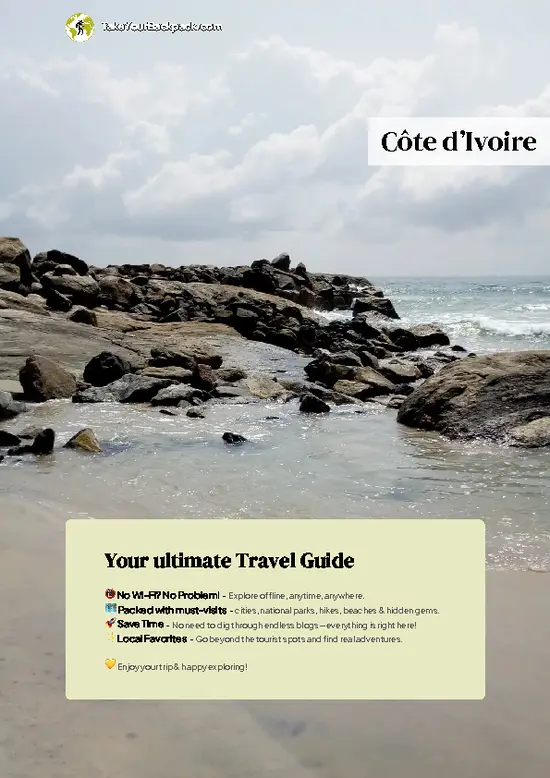
example page 0 from our offline Travel Guide for Côte d’Ivoire
example page 1 from our offline Travel Guide for Côte d’Ivoire
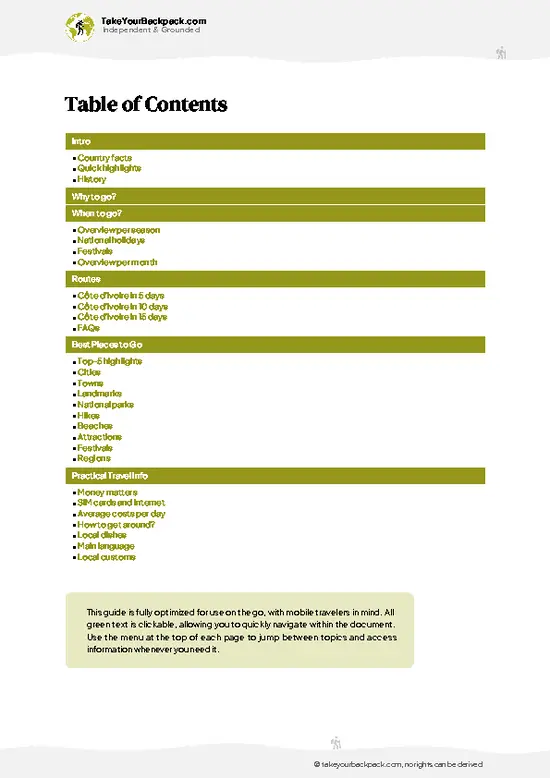
example page 2 from our offline Travel Guide for Côte d’Ivoire
example page 3 from our offline Travel Guide for Côte d’Ivoire
example page 4 from our offline Travel Guide for Côte d’Ivoire
example page 5 from our offline Travel Guide for Côte d’Ivoire
example page 6 from our offline Travel Guide for Côte d’Ivoire
example page 7 from our offline Travel Guide for Côte d’Ivoire
The digital guide (279 pages) contains:
✅ 64 highlights, ranked by travel appeal
✅ Optimized 5, 10 & 15-day travel routes
✅ Cities, national parks, landmarks, beaches
✅ How to get around
✅ Offline-friendly for travel without Wi-Fi
👉 Click to see all 30+ guide features

📅 Plan smarter in minutes, not weeks
✅ Month by month travel advice
✅ Festivals & national holidays
✅ Budget expectations

🗺️ Go to the right places, skip the overrated ones
✅ Honest pros & cons of destinations
✅ Top hikes, parks & viewpoints
✅ Lesser-known places most travelers miss
✅ Clear “worth it vs skip it” guidance

🛏️ Travel smoothly without rookie mistakes
✅ Best areas to stay
✅ Transport systems explained simply
✅ Common scams & safety advice
✅ SIM cards, money & practical tips

🌍 Understand the country, not just visit it
✅ Culture & traditions
✅ 52 Essential phrases & customs
✅ Festivals worth planning around
✅ Traveler-friendly historical context
✅ Insights that make places more meaningful

📱 Built for real travel conditions
✅ Fully downloadable PDF
✅ Works completely offline
✅ Optimized for phone use
✅ Useful in remote areas & buses
✅ Everything in one place
Stop searching, start planning
Get instant access to your full guide. 30‑day money-back guarantee.
+ Add another guide for just

By proceeding you agree to our terms.
Sent to your inbox immediately after payment • 100% Secure Checkout
Best Backpacking Travel Advisor 2025 tourism awardBest Backpacking
Travel Advisor
2025
What others say about Take Your Backpack Guides:
⭐⭐⭐⭐⭐
Fantastic, amazing amount of information!
⭐⭐⭐⭐⭐
My goodness this is amazing, it's what I've been looking for hats off too you!
⭐⭐⭐⭐⭐
I think this is absolutely BRILLIANT
⭐⭐⭐⭐
Very complete and informative. It's still missing places, but I gotta to commend you
⭐⭐⭐⭐⭐
This is truly amazing, thank you, can't wait to explore it with my kids!
⭐⭐⭐⭐⭐
Awesome resource, thank you!
⭐⭐⭐⭐⭐
This is amazing! Can't wait to explore the ones I haven't seen
⭐⭐⭐⭐
I love this! Well done, great idea.
⭐⭐⭐⭐⭐
Thanks for taking the time to make this gem!
⭐⭐⭐⭐⭐
This might be the best website I've ever seen.
⭐⭐⭐⭐⭐
Congratulations, and thank you so much for your work; it's incredibly valuable.
⭐⭐⭐⭐
In all seriousness I think you did a great job pointing out the important spots
⭐⭐⭐⭐⭐
10/10 very good
⭐⭐⭐⭐⭐
As someone who's only just starting to visit regularly this is awesome, thank you.
⭐⭐⭐⭐
Thank you very much! I'm going to visit my dad, it's going to be very useful!
⭐⭐⭐⭐⭐
This is really cool! We'll be travelling for the first time and this definitely come in handy.
⭐⭐⭐⭐⭐
You are now our minister of culture, congratulations 👨‍💼
⭐⭐⭐⭐⭐
Just wanted to tell you that this is a pearl! Going to follow your recommendations.
⭐⭐⭐⭐⭐
This is so cool. I'll definitely be using the resource for my travels soon.
⭐⭐⭐⭐⭐
This is very impressive! Good work.
⭐⭐⭐⭐⭐
This is an amazing and informative site. Very well done!

🛏️ Where to stay?Top Places to Consider Staying

True backpacker hostels with dorm beds are rare in Côte d’Ivoire, so most budget travelers sleep in simple guesthouses, small hotels and rented rooms, typically 10,000 to 25,000 CFA (about US$17 to 42) a night for a private double with a fan or basic air conditioning. In Abidjan, Treichville and Adjamé have the cheapest rooms and the loudest street life but call for extra care after dark, Zone 4 in Marcory sits close to the airport and the city’s densest cluster of bars and restaurants at mid-range prices, and leafy Cocody (especially Deux Plateaux and Riviera) is quieter and safer, with good evening spots around Deux Plateaux but longer taxi rides to the Plateau business district. Outside the … read more 👉
True backpacker hostels with dorm beds are rare in Côte d’Ivoire, so most budget travelers sleep in simple guesthouses, small hotels and rented rooms, typically 10,000 to 25,000 CFA (about US$17 to 42) a night for a private double with a fan or basic air conditioning. In Abidjan, Treichville and Adjamé have the cheapest rooms and the loudest street life but call for extra care after dark, Zone 4 in Marcory sits close to the airport and the city’s densest cluster of bars and restaurants at mid-range prices, and leafy Cocody (especially Deux Plateaux and Riviera) is quieter and safer, with good evening spots around Deux Plateaux but longer taxi rides to the Plateau business district. Outside the city, the beach guesthouses of Grand-Bassam are a calm, affordable weekend base about 45 minutes east of Abidjan, while Yamoussoukro, Man and San-Pédro offer plain, inexpensive hotels near their town centers but very little nightlife.

If you enjoy meeting fellow travelers, consider choosing hostels with high ratings for atmosphere. On the other hand, if you prefer having your own space, a hotel might be a better option.

Côte d’IvoireMore Places Across Côte d’Ivoire

👋 Meet the founderWho’s Behind Take Your Backpack?

Johan, backpacker and founder of TakeYourBackpackHi, I’m Johan (Netherlands 🇳🇱), the creator of TakeYourBackpack. Over the past 3 decades, I’ve backpacked through 90+ countries across six continents, gaining extensive experience with independent travel, long-term trips, and overland routes.

This site is built on a combination of firsthand travel experience and carefully curated insights from other backpackers. Many guides are based on places I’ve personally visited, while others bring together tips, observations, and practical advice shared by trusted travelers I’ve met along the way.

The goal is to provide realistic, experience-driven guidance — not generic itineraries — so you can explore destinations with better context, clearer expectations, and more confidence.