×

Cuba🇨🇺 | attractionsMuseo Nacional de la MúsicaBatá drums, Cuban tres, salon pianos, Obrapía mansion | things to do and best time to go

Explore Che Guevara MausoleumExplore Museo del Tabaco

Backpacking in Museo Nacional de la Música
👌 Worth visitingattraction ranked #12
By Johan Kruseman 🇳🇱 | Updated October 22, 2026

I walked in assuming the guard would let me photograph the glass cases, then watched him wave off my camera while a tres player upstairs warmed up the courtyard. Wrong guess, and the fee for a camera permit was a small surprise. Museo Nacional de la Música belongs to Old Havana, Cuba’s capital: its mansion on Calle Capdevila is closed for restoration, and the collection is shown at Calle Obrapía 509 meanwhile. It is small, quiet, and cheap, with none of the cathedral-square crowds. Skip it if you want interactive displays. Go for the rare drums, guitars, and pianos, and the live son some evenings. Music lovers will get the most from it; anyone hunting big spectacle will not.

Discover everything you want to know in the 📖 Cuba Travel Guide.


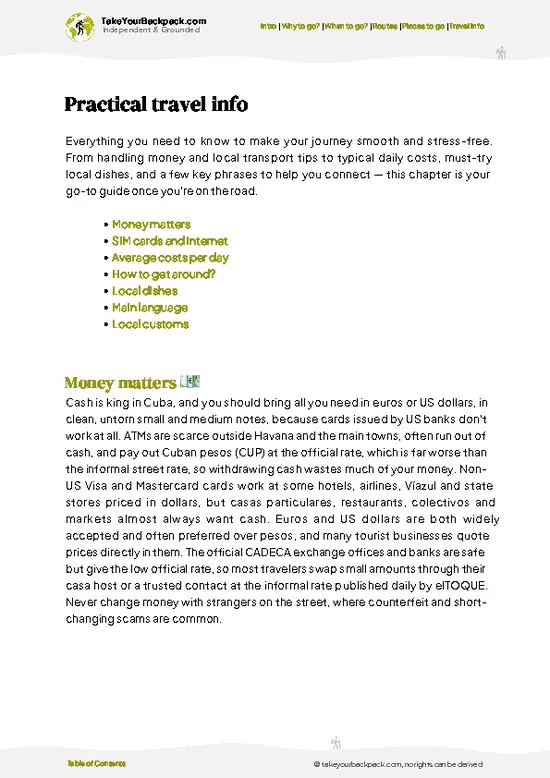
example page 0 from our offline Travel Guide for Cuba
example page 1 from our offline Travel Guide for Cuba
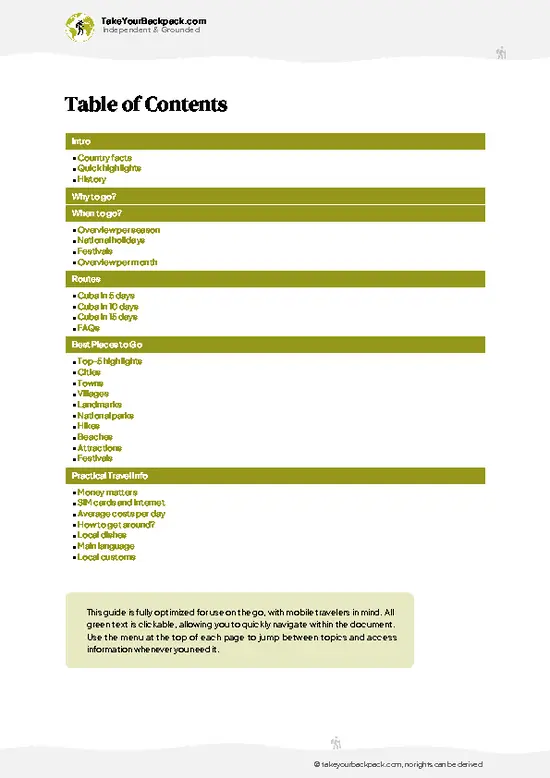
example page 2 from our offline Travel Guide for Cuba
example page 3 from our offline Travel Guide for Cuba
example page 4 from our offline Travel Guide for Cuba
example page 5 from our offline Travel Guide for Cuba
example page 6 from our offline Travel Guide for Cuba
example page 7 from our offline Travel Guide for Cuba
Loading the map 🌍
CLICK TO FILTER
cities
towns
villages
landmarks
national parks
hikes
beaches
attractions
festivals
SHOW COUNTRY’S BESTSHOW ALL

✨ Why go?
Ranked #12 attraction in Cuba
Why Museo Nacional de la Música should be on your travel list

Museo Nacional de la Música is where Cuba’s sound gets explained, and in a country where a son drifts out of every doorway that matters. The collection is shown in a colonial house on Calle Obrapía in Old Havana, so you can pair it with a morning of wandering the old center on foot. You see the instruments behind the rhythms you have been hearing since landing: the drums, guitars and brass that built rumba, son, danzón and mambo.

The museum holds thousands of instruments and a deep archive of scores and photographs, which gives context to the live bands you will meet in plazas and bars. It suits rainy afternoons and slow mornings, and it takes an hour or two at an easy pace.

For route planning, it is a cultural anchor in the Havana leg, the stop that makes your later nights in Trinidad or Santiago make more sense.

💡 HighlightsDon't-miss highlights and experiences

  1. Collection of Cuban instruments: the core of the museum, covering the evolution of Cuban music through the instruments themselves, from folk and street traditions to concert pieces.
  2. Percussion and Afro-Cuban drums: congas, bongos, batá and other drums show how African traditions shaped rumba and the island’s dance rhythms.
  3. Guitars, tres and stringed instruments: the Cuban tres and the guitars behind son and trova are the sound of the countryside and of Havana’s early recording era.
  4. Pianos and salon instruments: parlor pieces recall the nineteenth-century salons where danzón and the contradanza took shape.
  5. Photographs and scores: portraits of musicians and handwritten music put faces and notes to the names you hear on every playlist in Havana.
  6. The colonial house on Calle Obrapía: the museum’s current
… read more 👉
  1. Collection of Cuban instruments: the core of the museum, covering the evolution of Cuban music through the instruments themselves, from folk and street traditions to concert pieces.
  2. Percussion and Afro-Cuban drums: congas, bongos, batá and other drums show how African traditions shaped rumba and the island’s dance rhythms.
  3. Guitars, tres and stringed instruments: the Cuban tres and the guitars behind son and trova are the sound of the countryside and of Havana’s early recording era.
  4. Pianos and salon instruments: parlor pieces recall the nineteenth-century salons where danzón and the contradanza took shape.
  5. Photographs and scores: portraits of musicians and handwritten music put faces and notes to the names you hear on every playlist in Havana.
  6. The colonial house on Calle Obrapía: the museum’s current home between Bernaza and Villegas, with the high ceilings, courtyard feel and cool rooms typical of Old Havana mansions.
  7. Live music and concerts: the museum has hosted performances and talks, so ask at the door whether anything is on during your visit.
Entry to Museo Nacional de la Música is cheap, usually only a few US dollars, and the photographs and courtyard are the most affordable way to enjoy it.
Spotted a mistake or missing something? Contact us.

🌤️ When to go?Seasonal considerations and timing

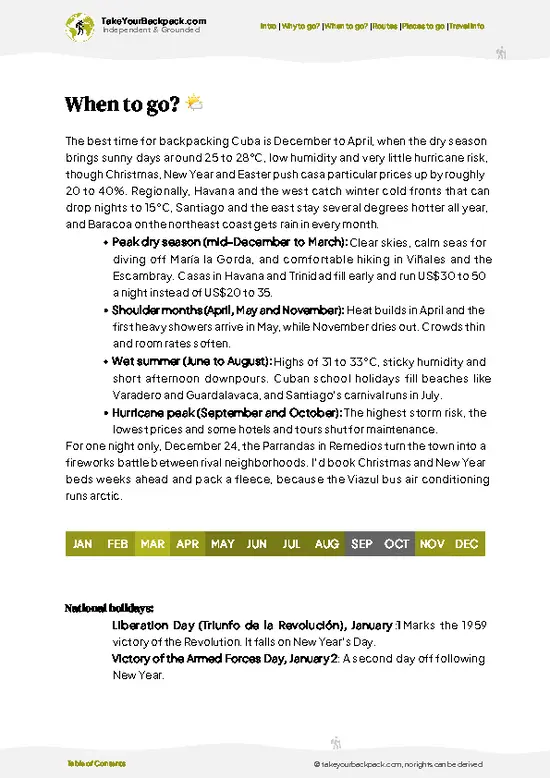
The dry season from November to April is the most comfortable window for Museo Nacional de la Música, with Havana highs of 26 to 29°C (79 to 84°F) and low humidity. The museum sits in Old Havana, so you can walk to it from most sights.
  • Dry Season (Nov to Apr): Lows of 18 to 22°C (64 to 72°F), about 11 to 13 hours of daylight, and the busiest, priciest months for beds, peaking around December and January.
  • Wet Season (May to Oct): Highs of 31 to 33°C (88 to 91°F), heavy humidity, afternoon downpours, and cheaper rooms. The galleries are a welcome refuge from the heat.
  • Hurricane Peak (Aug to Oct): Storms can close sights without notice, and flights get disrupted.
Arrive at opening time on a weekday to have the instrument rooms nearly to yourself.

source: climatestotravel.comJANJanuary: good for travelingFEBFebruary: highly recommended for travelingMARMarch: good for travelingAPRApril: highly recommended for travelingMAYMay: fair for travelingJUNJune: fair for travelingJULJuly: good for travelingAUGAugust: fair for travelingSEPSeptember: highly recommended for travelingOCTOctober: highly recommended for travelingNOVNovember: highly recommended for travelingDECDecember: good for traveling
when-to-go

✈️ The backpacker research shortcutCuba Travel Guide

An offline-friendly backpacking guide with optimized travel routes, ranked highlights, transport advice, and the best areas to stay.
example page 0 from our offline Travel Guide for Cuba
example page 1 from our offline Travel Guide for Cuba
example page 2 from our offline Travel Guide for Cuba
example page 3 from our offline Travel Guide for Cuba
example page 4 from our offline Travel Guide for Cuba
example page 5 from our offline Travel Guide for Cuba
example page 6 from our offline Travel Guide for Cuba
example page 7 from our offline Travel Guide for Cuba
The digital guide (327 pages) contains:
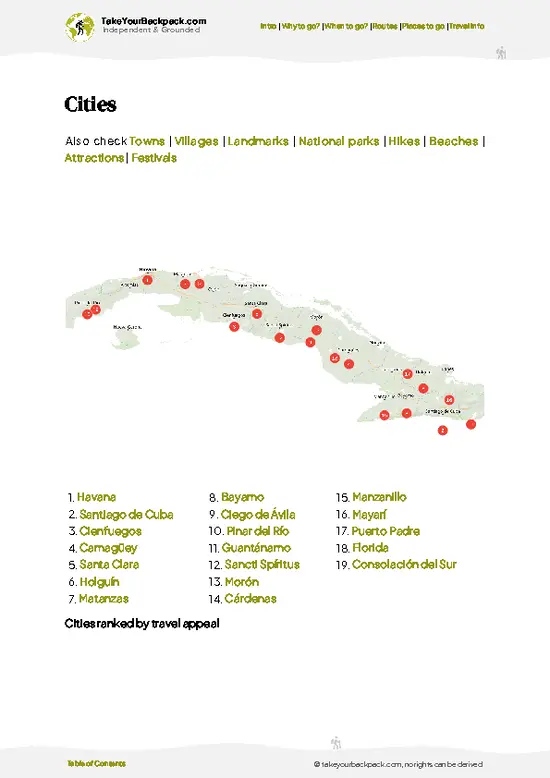
✅ 113 highlights, ranked by travel appeal
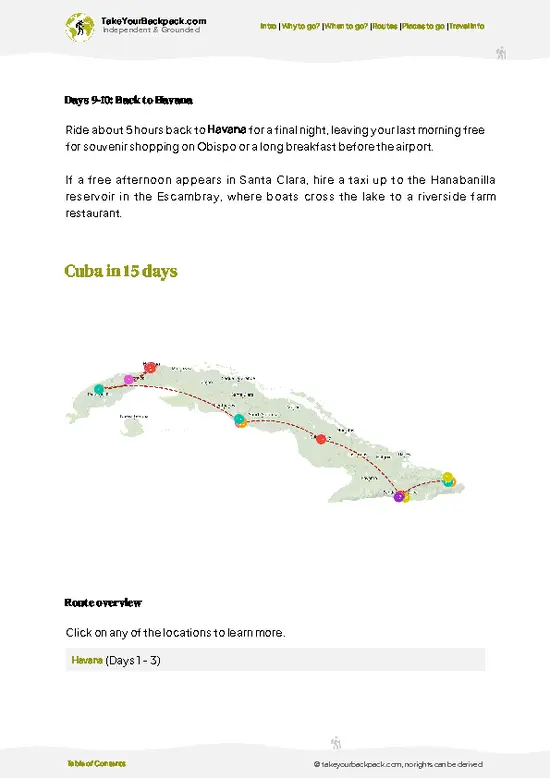
✅ Optimized 5, 10 & 15-day travel routes
✅ Cities, national parks, landmarks, beaches
✅ How to get around
✅ Offline-friendly for travel without Wi-Fi
👉 Click to see all 30+ guide features

📅 Plan smarter in minutes, not weeks
✅ Month by month travel advice
✅ Festivals & national holidays
✅ Budget expectations

🗺️ Go to the right places, skip the overrated ones
✅ Honest pros & cons of destinations
✅ Top hikes, parks & viewpoints
✅ Lesser-known places most travelers miss
✅ Clear “worth it vs skip it” guidance

🛏️ Travel smoothly without rookie mistakes
✅ Best areas to stay
✅ Transport systems explained simply
✅ Common scams & safety advice
✅ SIM cards, money & practical tips

🌍 Understand the country, not just visit it
✅ Culture & traditions
✅ 52 Essential phrases & customs
✅ Festivals worth planning around
✅ Traveler-friendly historical context
✅ Insights that make places more meaningful

📱 Built for real travel conditions
✅ Fully downloadable PDF
✅ Works completely offline
✅ Optimized for phone use
✅ Useful in remote areas & buses
✅ Everything in one place
Stop searching, start planning
Get instant access to your full guide. 30‑day money-back guarantee.
+ Add another guide for just

By proceeding you agree to our terms.
Sent to your inbox immediately after payment • 100% Secure Checkout
Best Backpacking Travel Advisor 2025 tourism awardBest Backpacking
Travel Advisor
2025
What others say about Take Your Backpack Guides:
⭐⭐⭐⭐⭐
Fantastic, amazing amount of information!
⭐⭐⭐⭐⭐
My goodness this is amazing, it's what I've been looking for hats off too you!
⭐⭐⭐⭐⭐
I think this is absolutely BRILLIANT
⭐⭐⭐⭐
Very complete and informative. It's still missing places, but I gotta to commend you
⭐⭐⭐⭐⭐
This is truly amazing, thank you, can't wait to explore it with my kids!
⭐⭐⭐⭐⭐
Awesome resource, thank you!
⭐⭐⭐⭐⭐
This is amazing! Can't wait to explore the ones I haven't seen
⭐⭐⭐⭐
I love this! Well done, great idea.
⭐⭐⭐⭐⭐
Thanks for taking the time to make this gem!
⭐⭐⭐⭐⭐
This might be the best website I've ever seen.
⭐⭐⭐⭐⭐
Congratulations, and thank you so much for your work; it's incredibly valuable.
⭐⭐⭐⭐
In all seriousness I think you did a great job pointing out the important spots
⭐⭐⭐⭐⭐
10/10 very good
⭐⭐⭐⭐⭐
As someone who's only just starting to visit regularly this is awesome, thank you.
⭐⭐⭐⭐
Thank you very much! I'm going to visit my dad, it's going to be very useful!
⭐⭐⭐⭐⭐
This is really cool! We'll be travelling for the first time and this definitely come in handy.
⭐⭐⭐⭐⭐
You are now our minister of culture, congratulations 👨‍💼
⭐⭐⭐⭐⭐
Just wanted to tell you that this is a pearl! Going to follow your recommendations.
⭐⭐⭐⭐⭐
This is so cool. I'll definitely be using the resource for my travels soon.
⭐⭐⭐⭐⭐
This is very impressive! Good work.
⭐⭐⭐⭐⭐
This is an amazing and informative site. Very well done!

🛏️ Where to stay?Best areas to stay in Cuba

Stay in Old Havana itself, ideally on the streets around Calle Obispo and Plaza Vieja, because the museum on Calle Obrapía is a short walk from both. Evenings here are lively and well lit, with live music drifting from open doorways and plenty of other solo travelers at the tables. Dorm-style and private rooms in colonial buildings fill up in winter, so book ahead for December to March.
Old Havana, Obrapía and Plaza Vieja side: The most social choice, with cafes, craft beer spots and easy meetups.
Habana Vieja near the Capitolio and Parque Central: Busier and louder, with more taxis and bus stops, … read more 👉
Stay in Old Havana itself, ideally on the streets around Calle Obispo and Plaza Vieja, because the museum on Calle Obrapía is a short walk from both. Evenings here are lively and well lit, with live music drifting from open doorways and plenty of other solo travelers at the tables. Dorm-style and private rooms in colonial buildings fill up in winter, so book ahead for December to March.
Old Havana, Obrapía and Plaza Vieja side: The most social choice, with cafes, craft beer spots and easy meetups.
Habana Vieja near the Capitolio and Parque Central: Busier and louder, with more taxis and bus stops, handy if you leave town often.
Centro Habana, near the Malecón edge: Cheaper and grittier, with big family-run homes and fewer tourists. Walk back by main streets after dark.
Avoid the quieter, darker blocks toward the harbor late at night, and keep valuables locked in your room.

👛 Costs (as of 22 October 2026)Travel costs and budget guide for Museo Nacional de la Música

Budget about US$38 to 55 a day around Museo Nacional de la Música, including a bed in Old Havana, with US$45 a realistic daily total.
CategoryBudget RangeLocal Reality
Museum entryUS$2 to 5Small fee paid at the door at Calle Obrapía 509. Live music sessions may cost extra.
Accommodation (high season)US$15 to 25A room or bed in a private home in Old Havana. Low season is often US$10 to 20.
FoodUS$10 to 15Paladares and cafes nearby; set lunches are cheapest.
Local transportUS$0 to 3The museum is walkable from most of Old Havana. Shared taxis cost more from Vedado.
Music and drinksUS$3 to 7A mojito and a tip for bands in nearby bars.
Total Daily BudgetUS$45Typical figure for one traveler in high season.
⚠️ Prices can change and everyone travels differently, so take this as a rough guide. Hope it helps you plan your adventure!

FAQCommon questions from travelers

Plan on one to two hours at Museo Nacional de la Música. That is enough to see the instrument collections, from drums to pianos, at an easy pace. Add another hour if a live performance is on, and pair it with a walk through Old Havana in the same half day.
Museo Nacional de la Música is worth its small entry fee, usually about US$1 to 3, if you care about Cuban rhythm. The collection covers instruments and the history behind son, rumba and danzón, which makes the music you hear in bars make more sense. It is cheap, compact and air-conditioning is a bonus on hot afternoons.
Museo Nacional de la Música lies in Old Havana, so you can walk there from most casas in the district. From Vedado, a taxi takes about 10 to 15 minutes and costs roughly US$5 to 10.
⚠️ Things can change over time, so always validate details locally before you go.

Other Cuban attractions near Museo Nacional de la Música

Explore more nearby:


💡 Not sure where to go next?
Create a personalized itinerary for Cuba including Museo Nacional de la Música and the places that fit your trip.

Generate my itinerary

👉 Discover all attractions

Or checkout all Cuba has to offer (think cities, towns, villages, national parks, hikes, beaches, festivals)
Country photo of Cuba

We 💚 feedbackIs it worth it?

Museo Nacional de la Música rewards a look at the small labels beside the batá drums, which most people breeze past. Read them before you hear a rumba on the street. I would go in the afternoon and stay for any music in the courtyard.

✈️ When did I visit Cuba?
As part of my 1.5 year travel around the world trip, I visited Cuba for 6 weeks in February, March 2016, being extremely lucky that that coincided with the free concert of The Rolling Stones.

✍️ Help improve this page!
The information on this page is based on my own backpacking experience in Cuba, supplemented with up-to-date research and feedback from other travelers. Travel details can change, so if you notice anything outdated or incomplete, feel free to let me know.


🙋‍♂️ Give feedback

👋 Meet the founderWho’s Behind Take Your Backpack?

Johan, backpacker and founder of TakeYourBackpackHi, I’m Johan (Netherlands 🇳🇱), the creator of TakeYourBackpack. Over the past 3 decades, I’ve backpacked through 90+ countries across six continents, gaining extensive experience with independent travel, long-term trips, and overland routes.

This site is built on a combination of firsthand travel experience and carefully curated insights from other backpackers. Many guides are based on places I’ve personally visited, while others bring together tips, observations, and practical advice shared by trusted travelers I’ve met along the way.

The goal is to provide realistic, experience-driven guidance — not generic itineraries — so you can explore destinations with better context, clearer expectations, and more confidence.