×

Cuba🇨🇺 | best attractionsDiscover the 10 Best attractions Across Cuba

Attractions in Cuba are mostly colonial cities, tobacco valleys, beaches and Afro-Cuban music, and the experience changes sharply by region. Havana is the densest and busiest, with the most crowds and the most touts. Trinidad is pretty but swamped by day-trippers by 11 a.m. Viñales is easy and social, ideal for independent travelers. The far east, around Santiago and Baracoa, takes long bus rides but gives you real local life at lower prices. Skip the all-inclusive resort strip unless you want a beach bed. It is overpriced and has little to do with the country.

By Johan Kruseman 🇳🇱 | Updated October 23, 2026
Explore the best festivals in Cuba

Why go?What Makes Them Special

Cuba works for attractions because history is layered into the streets. Spanish colonial towns, sugar-era plantations, the 1959 revolution and Afro-Cuban culture all survive in daily life, and decades of limited development mean old centers are intact and not replaced by malls. The island is long and narrow, so mountains, caves, tobacco country and Caribbean coast sit within a few hours of each other.

Know the downsides before you commit. Infrastructure is weak. Fuel shortages, power cuts, patchy internet and aging buses mean plans slip, and opening hours posted at sites are often ignored. Museums are state-run and modest, with little English labeling, so a local guide adds a lot. Tourist spaces are cash-based, foreign cards are unreliable, and ATMs often fail, so bring enough euros or US dollars … read more 👉
Cuba works for attractions because history is layered into the streets. Spanish colonial towns, sugar-era plantations, the 1959 revolution and Afro-Cuban culture all survive in daily life, and decades of limited development mean old centers are intact and not replaced by malls. The island is long and narrow, so mountains, caves, tobacco country and Caribbean coast sit within a few hours of each other.

Know the downsides before you commit. Infrastructure is weak. Fuel shortages, power cuts, patchy internet and aging buses mean plans slip, and opening hours posted at sites are often ignored. Museums are state-run and modest, with little English labeling, so a local guide adds a lot. Tourist spaces are cash-based, foreign cards are unreliable, and ATMs often fail, so bring enough euros or US dollars for the whole trip. Prices for tourists run higher than the low wages suggest, and fancy restaurants and organized tours are poor value compared with a casa particular meal and a private guide. Come for the people, the music and the street life. Do not come expecting polished, well-run sights.
Evaluating the Top Choices
The list of best attractions in Cuba is created based on cultural significance or entertainment value. If you feel a attraction is missing in this list, please let us know.

When to go?Best Time to Visit Cuba for attractions

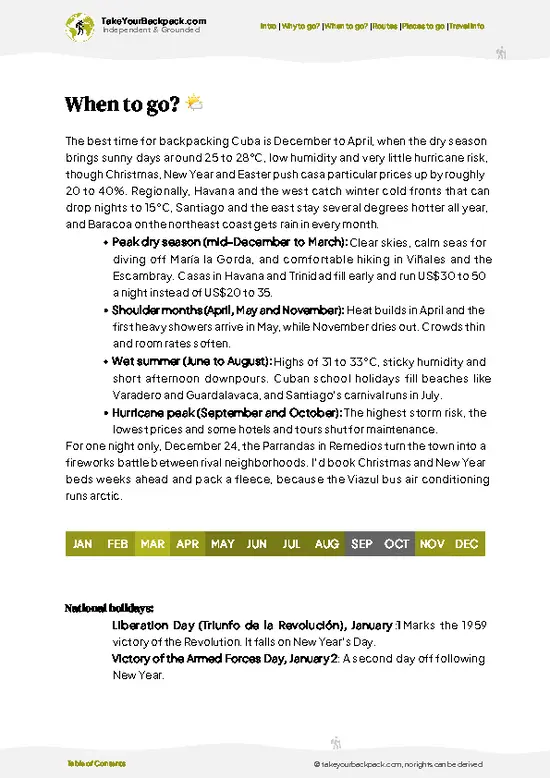
Best months: The best months are December to April, when the dry season brings daytime highs of 25 to 30°C, low humidity and almost no rain, so outdoor sights and long walks are comfortable. Rainfall across most of the island falls mainly from May to October, and Havana gets roughly 1,200 mm a year, with the heaviest downpours in June and September to October.Shoulder and peak seasons: November and May are the shoulder months. Prices drop, crowds thin, and heat is manageable at 28 to 31°C, though humidity starts to climb. Late December to February is peak. Casa rooms in Havana and Trinidad cost US$30 to 50 instead of US$20 to 35 and fill up, so book ahead. Easter week is also busy with Cuban domestic travelers.Weather to avoid: July and August bring 32 to 35°C heat with high humidity, and … read more 👉
Best months: The best months are December to April, when the dry season brings daytime highs of 25 to 30°C, low humidity and almost no rain, so outdoor sights and long walks are comfortable. Rainfall across most of the island falls mainly from May to October, and Havana gets roughly 1,200 mm a year, with the heaviest downpours in June and September to October.Shoulder and peak seasons: November and May are the shoulder months. Prices drop, crowds thin, and heat is manageable at 28 to 31°C, though humidity starts to climb. Late December to February is peak. Casa rooms in Havana and Trinidad cost US$30 to 50 instead of US$20 to 35 and fill up, so book ahead. Easter week is also busy with Cuban domestic travelers.Weather to avoid: July and August bring 32 to 35°C heat with high humidity, and Santiago de Cuba is the hottest region. Hurricane season runs from June to November, with the real risk concentrated in September and October, when roads flood and flights are canceled. Baracoa in the far east is wetter than anywhere else and gets rain nearly all year, heaviest from October to January, so pack a poncho whenever you go. Skip the summer unless prices matter more than comfort.

attraction hoppingHow to Combine attractions Into One Trip

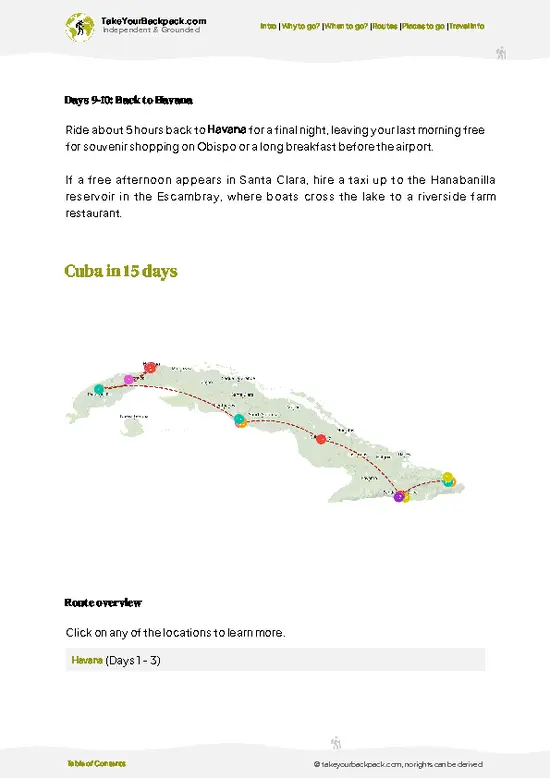
How long you need: A trip linking several attractions in Cuba needs 10 to 14 days. Anything under a week should stay within one region, because distances are long and transport is slow.Direction and grouping: The sensible order is west to east. Start in Havana (3 to 4 days), then take a bus or shared taxi to Viñales (2.5 to 3 hours away, 2 days). Return through Havana and continue to the central cluster of Cienfuegos and Trinidad (5 to 6 hours from Havana, 2 to 3 days). Go on to Santiago de Cuba (about 12 hours by bus from Trinidad) and, if you have time, on to Baracoa (4 to 5 hours from Santiago, 2 days). Fly home from Santiago or Holguín, since a domestic flight to Havana takes about 1.5 hours.Planning mistakes: The biggest error is trying to cover the whole island by road. Havana to Santiago … read more 👉
How long you need: A trip linking several attractions in Cuba needs 10 to 14 days. Anything under a week should stay within one region, because distances are long and transport is slow.Direction and grouping: The sensible order is west to east. Start in Havana (3 to 4 days), then take a bus or shared taxi to Viñales (2.5 to 3 hours away, 2 days). Return through Havana and continue to the central cluster of Cienfuegos and Trinidad (5 to 6 hours from Havana, 2 to 3 days). Go on to Santiago de Cuba (about 12 hours by bus from Trinidad) and, if you have time, on to Baracoa (4 to 5 hours from Santiago, 2 days). Fly home from Santiago or Holguín, since a domestic flight to Havana takes about 1.5 hours.Planning mistakes: The biggest error is trying to cover the whole island by road. Havana to Santiago is 12 to 14 hours by Viazul bus, and delays and breakdowns eat extra time. Fly the longest leg and use buses or colectivos for shorter ones. Another is booking Viazul seats too late, since popular routes sell out days ahead. Do not schedule a flight home the same day as a long bus ride, and leave a buffer day at the end. Skip stops you can only reach in a rush.

The ListHighly Recommended attractions of Cuba

1 Castillo de los Tres Reyes del Morro

Harbor-mouth ramparts, lighthouse climb, dry moat, Old Havana skyline

Climb the lighthouse and walk the rock-cut moat and gun platforms to see how Spanish defenders sealed the channel, with the Malecón curve spread out across the water.

2 Museo de la Revolución

Granma yacht, bullet-marked facade, Salón de los Espejos, tank yard

Trace the guerrilla campaign through the old presidential palace, from the mirrored hall to the cramped yacht that crossed from Mexico in 1956.

cuba-attraction-museo-de-la-revolucion
© Google |

3 Fábrica de Arte Cubano

Former oil factory, Thursday to Sunday nights, galleries and jazz, cinema

Wander a maze of brick halls where changing exhibitions, live bands, film screenings and cocktail bars share one entry fee in Vedado.

4 Gran Teatro de La Habana Alicia Alonso

Neo-baroque facade, horseshoe auditorium, Ballet Nacional, Galician palace

Take a seat in the red-and-gilt hall for ballet, opera or a symphony, after studying the marble angels facing Parque Central.

cuba-attraction-gran-teatro-de-la-habana-alicia-alonso
© Google |

5 Cabaret Tropicana

Open-air floor show, feathered headdresses, live orchestra, Arcos de Cristal

Watch dancers move across raised walkways among palm trees while a full brass and percussion band plays mambo and cha-cha-cha beneath a 1950s glass-arched hall.

cuba-attraction-cabaret-tropicana
© Google |

6 Museo Nacional de Bellas Artes

Wifredo Lam, Cuban art chronology, revolution posters, two buildings

Read the island’s story room by room, from colonial portraits through Lam and Amelia Peláez to contemporary work, with an international collection nearby.

cuba-attraction-museo-nacional-de-bellas-artes
© Google |

7 Museo del Ron Havana Club

Rum tour and tasting, sugar-mill model, copper stills, aging barrels

Follow rum from cane to barrel on a guided hour, then sip an aged pour and sample classic cocktails at the museum bar.

8 Castillo de la Real Fuerza

Giraldilla weathervane, moat and drawbridge, coral-stone walls, harbor rooftop

Cross the moat into a 16th-century fort, climb the tower for harbor views, and look for the bronze figure that became Havana’s emblem.

9 Museo de la Ciudad

Captains General palace, royal palm courtyard, throne room, wood-block street

Pass through the baroque palace courtyard, climb the marble staircase, and tour governors’ salons and carriages above Plaza de Armas’s book market.

cuba-attraction-museo-de-la-ciudad
© Google |

10 Museo Romántico

Plaza Mayor balcony, canopy beds, sugar-family mansion, guided tour

Lean on the first-floor balcony above the square, then tour carved beds, porcelain and salons that show how Trinidad’s sugar families lived.

11 Teatro Tomás Terry

Cane-back seating, painted dome, Italian marble foyer, Parque José Martí

Tip your head back in the upper gallery to take in the ceiling frescoes, then catch a ballet or concert in the tiered wooden hall.

12 Museo Nacional de la Música

Batá drums, Cuban tres, salon pianos, Obrapía mansion

Trace how son, rumba and danzón took shape through congas, guitars, handwritten scores and parlor pianos, shown in a cool colonial house in Old Havana.

13 Museo Nacional de la Lucha Contra Bandidos

Convent bell tower, Escambray campaign, former church nave, Plaza Mayor

Climb the narrow tower for views over Trinidad’s tile roofs and the Escambray hills, then read the official account of the 1960s counterinsurgency.

14 Museo del Tabaco

Cigar bands, rolling tools, Taíno origins, Plaza Vieja

Browse lithographed cigar labels and hand-rolling gear in a colonial house, then walk to Plaza Vieja for a drink among pastel facades.

15 Che Guevara Mausoleum

Crypt with eternal flame, bronze statue, Santa Clara plaza, armored train

Enter the quiet crypt where Che and his fellow fighters lie, then visit the museum below and the derailed train wagons nearby.

cuba-attraction-che-guevara-mausoleum
© Google |

Think you know Cuba?

Prove you’re a true local — uncover 5 lesser-known attractions in Cuba that locals tend to keep to themselves.
Loading the map 🌍

Expert viewWhat You Should Know

How many attractions to plan: Plan 6 to 8 headline sights over two weeks, no more than one or two per stop. Transport eats half of each travel day, power cuts and fuel shortages break schedules, and the heat from 11 a.m. to 4 p.m. makes sightseeing miserable in most months. Cuba is a place where wandering and conversation are half the attraction, so leave blank afternoons. Pack the day more tightly and you pay for it in exhaustion and missed buses.Which kinds to prioritize: If you are on a tight budget, favor street-level attractions: old town walks, live music in plazas, beaches, and rural valleys, all free or nearly so. History and culture travelers should pay for a local guide in the main colonial cities, because museum labeling is thin. Nature and active travelers should put money into … read more 👉
How many attractions to plan: Plan 6 to 8 headline sights over two weeks, no more than one or two per stop. Transport eats half of each travel day, power cuts and fuel shortages break schedules, and the heat from 11 a.m. to 4 p.m. makes sightseeing miserable in most months. Cuba is a place where wandering and conversation are half the attraction, so leave blank afternoons. Pack the day more tightly and you pay for it in exhaustion and missed buses.Which kinds to prioritize: If you are on a tight budget, favor street-level attractions: old town walks, live music in plazas, beaches, and rural valleys, all free or nearly so. History and culture travelers should pay for a local guide in the main colonial cities, because museum labeling is thin. Nature and active travelers should put money into horseback rides, hikes and snorkeling in the west and east, and skip the city museums that charge more than they deliver. Beach seekers do best at the quieter coast of the central region. Avoid the Varadero resort strip unless you want a bed and a buffet.What it costs: A backpacker budget runs US$45 to 70 a day: a casa particular room at US$20 to 35, breakfast and dinner at the casa for US$5 to 12 each, and local transport on top. Museum and fort entry fees run US$1 to 10. Half-day guides cost US$10 to 30, a cave or boat trip US$10 to 25, and a shared taxi between nearby towns US$5 to 15 a seat. Viazul bus tickets for long routes cost roughly US$15 to 50. Tourist sites often take only cash, and card machines and ATMs are unreliable, so carry the entire trip budget in euros or US dollars, ideally in small notes.Safety and etiquette: Violent crime against travelers is rare, but petty theft in Havana and Trinidad is common, so keep phones and cameras out of sight on crowded streets. Touts (jineteros) approach visitors with offers of cigars, restaurants and rides. A firm no and a keep-walking attitude works, and never buy cigars from the street, where fakes are common. Do not photograph military or police buildings, and leave drones at home, since they are restricted. Carry a passport copy. Dress modestly in churches. Tip guides, musicians and casa hosts a dollar or two, and ask before photographing people, because many expect a small payment. Power cuts can leave streets dark at night, so carry a small flashlight and avoid unlit walks.

The reward is rooms of locals dancing after the lights go out, and that costs nothing.

✈️ The backpacker research shortcutCuba Travel Guide

An offline-friendly backpacking guide with optimized travel routes, ranked highlights, transport advice, and the best areas to stay.
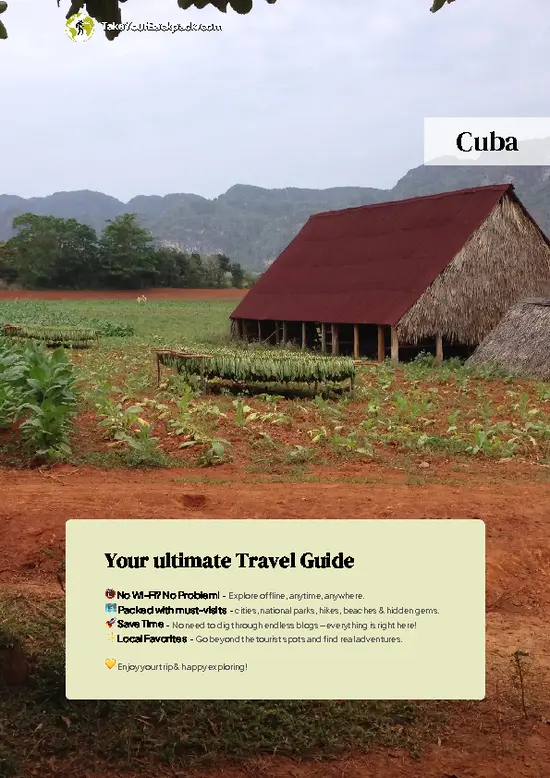
example page 0 from our offline Travel Guide for Cuba
example page 1 from our offline Travel Guide for Cuba
example page 2 from our offline Travel Guide for Cuba
example page 3 from our offline Travel Guide for Cuba
example page 4 from our offline Travel Guide for Cuba
example page 5 from our offline Travel Guide for Cuba
example page 6 from our offline Travel Guide for Cuba
example page 7 from our offline Travel Guide for Cuba
The digital guide (327 pages) contains:
✅ 113 highlights, ranked by travel appeal
✅ Optimized 5, 10 & 15-day travel routes
✅ Cities, national parks, landmarks, beaches
✅ How to get around
✅ Offline-friendly for travel without Wi-Fi
👉 Click to see all 30+ guide features

📅 Plan smarter in minutes, not weeks
✅ Month by month travel advice
✅ Festivals & national holidays
✅ Budget expectations

🗺️ Go to the right places, skip the overrated ones
✅ Honest pros & cons of destinations
✅ Top hikes, parks & viewpoints
✅ Lesser-known places most travelers miss
✅ Clear “worth it vs skip it” guidance

🛏️ Travel smoothly without rookie mistakes
✅ Best areas to stay
✅ Transport systems explained simply
✅ Common scams & safety advice
✅ SIM cards, money & practical tips

🌍 Understand the country, not just visit it
✅ Culture & traditions
✅ 52 Essential phrases & customs
✅ Festivals worth planning around
✅ Traveler-friendly historical context
✅ Insights that make places more meaningful

📱 Built for real travel conditions
✅ Fully downloadable PDF
✅ Works completely offline
✅ Optimized for phone use
✅ Useful in remote areas & buses
✅ Everything in one place
Stop searching, start planning
Get instant access to your full guide. 30‑day money-back guarantee.
+ Add another guide for just

By proceeding you agree to our terms.
Sent to your inbox immediately after payment • 100% Secure Checkout
Best Backpacking Travel Advisor 2025 tourism awardBest Backpacking
Travel Advisor
2025
What others say about Take Your Backpack Guides:
⭐⭐⭐⭐⭐
Fantastic, amazing amount of information!
⭐⭐⭐⭐⭐
My goodness this is amazing, it's what I've been looking for hats off too you!
⭐⭐⭐⭐⭐
I think this is absolutely BRILLIANT
⭐⭐⭐⭐
Very complete and informative. It's still missing places, but I gotta to commend you
⭐⭐⭐⭐⭐
This is truly amazing, thank you, can't wait to explore it with my kids!
⭐⭐⭐⭐⭐
Awesome resource, thank you!
⭐⭐⭐⭐⭐
This is amazing! Can't wait to explore the ones I haven't seen
⭐⭐⭐⭐
I love this! Well done, great idea.
⭐⭐⭐⭐⭐
Thanks for taking the time to make this gem!
⭐⭐⭐⭐⭐
This might be the best website I've ever seen.
⭐⭐⭐⭐⭐
Congratulations, and thank you so much for your work; it's incredibly valuable.
⭐⭐⭐⭐
In all seriousness I think you did a great job pointing out the important spots
⭐⭐⭐⭐⭐
10/10 very good
⭐⭐⭐⭐⭐
As someone who's only just starting to visit regularly this is awesome, thank you.
⭐⭐⭐⭐
Thank you very much! I'm going to visit my dad, it's going to be very useful!
⭐⭐⭐⭐⭐
This is really cool! We'll be travelling for the first time and this definitely come in handy.
⭐⭐⭐⭐⭐
You are now our minister of culture, congratulations 👨‍💼
⭐⭐⭐⭐⭐
Just wanted to tell you that this is a pearl! Going to follow your recommendations.
⭐⭐⭐⭐⭐
This is so cool. I'll definitely be using the resource for my travels soon.
⭐⭐⭐⭐⭐
This is very impressive! Good work.
⭐⭐⭐⭐⭐
This is an amazing and informative site. Very well done!

🛏️ Where to stay?Accommodation Highlights

Cuba has a small number of true hostels (mostly in Havana, Viñales and Trinidad, with dorm beds at roughly US$8 to 15), but most budget travelers stay in casas particulares, licensed private homestays where a double room usually runs US$20 to 35 and breakfast is often available for a few dollars more. In Havana, Habana Vieja puts you within walking distance of the main sights but is loud and touristy, Centro Habana is cheaper and more local but gritty, with more petty theft and blackouts, and Vedado is leafier and quieter, with the city’s best live music and late bars a short taxi ride from the old town. In Trinidad and Viñales, rooms within a few blocks of the central plaza or main street put … read more 👉
Cuba has a small number of true hostels (mostly in Havana, Viñales and Trinidad, with dorm beds at roughly US$8 to 15), but most budget travelers stay in casas particulares, licensed private homestays where a double room usually runs US$20 to 35 and breakfast is often available for a few dollars more. In Havana, Habana Vieja puts you within walking distance of the main sights but is loud and touristy, Centro Habana is cheaper and more local but gritty, with more petty theft and blackouts, and Vedado is leafier and quieter, with the city’s best live music and late bars a short taxi ride from the old town. In Trinidad and Viñales, rooms within a few blocks of the central plaza or main street put you close to the evening music and restaurants, while streets farther out are quieter and slightly cheaper.

If you enjoy meeting fellow travelers, consider choosing hostels with high ratings for atmosphere. On the other hand, if you prefer having your own space, a hotel might be a better option.

CubaSee More of Cuba

👋 Meet the founderWho’s Behind Take Your Backpack?

Johan, backpacker and founder of TakeYourBackpackHi, I’m Johan (Netherlands 🇳🇱), the creator of TakeYourBackpack. Over the past 3 decades, I’ve backpacked through 90+ countries across six continents, gaining extensive experience with independent travel, long-term trips, and overland routes.

This site is built on a combination of firsthand travel experience and carefully curated insights from other backpackers. Many guides are based on places I’ve personally visited, while others bring together tips, observations, and practical advice shared by trusted travelers I’ve met along the way.

The goal is to provide realistic, experience-driven guidance — not generic itineraries — so you can explore destinations with better context, clearer expectations, and more confidence.