×

Curaçao🇨🇼 | best regionsExplore the Best regions in Curaçao

Regions in Curaçao are less a matter of distance than of coastline: the island is only about 60 kilometers long, yet the sheltered south and the wild north feel like different places. The south has the beaches, dive sites and cheaper guesthouses, while the north has the empty cliffs and needs a car. For independent travelers, picking a base first saves money and hassle.

By Johan Kruseman 🇳🇱 | Updated October 23, 2026
Explore the best cities in Curaçao

Why go?Key Factors That Shape the Experience

Curaçao is small, flat and dry, which shapes everything. Sitting south of the hurricane belt, it gets little rain and near-constant trade winds, so the coast is usable almost all year and the sea stays calm on the leeward side. Centuries of Dutch, Spanish and African influence show up in the pastel architecture, Papiamentu language and Sunday food culture, so the island feels different from its Caribbean neighbors. Know before you choose it: this is a dive-and-snorkel island more than a long-hike island, the best beaches are small coves rather than long sand strips, and many sit on private land with entry fees. Since the euro isn’t used here, prices are in Netherlands Antillean guilders, though US dollars are accepted almost everywhere. A rental car opens far more options than buses do.
How the List Was Created
The list of best regions in Curaçao is created based on landscapes, local culture, attractions, vibes, and overall appeal. If you feel a region is missing in this list, please let us know.

When to go?Optimal Periods for Travel

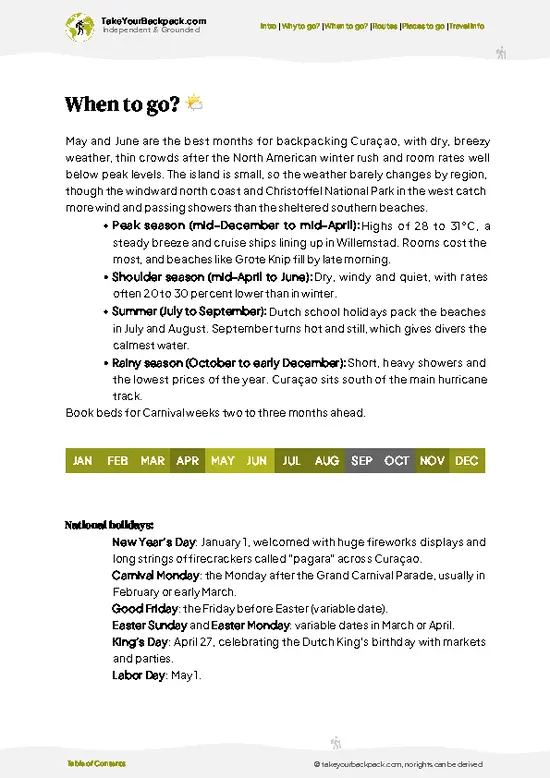
Best months: Aim for April to June or September to early November: it’s dry, hot and calmer on the leeward coast, and you skip the holiday price spike. Temperatures hold at 27 to 32°C all year, and the trade winds take the edge off the heat.Rain and peaks: The wetter stretch runs October to January, though that still means only about 400 to 600 mm of rain for the year, usually in short downpours. December to April is the high season, when rooms and rental cars can cost 30 to 50 percent more, so book early. Over Carnival (January to February) and around the Dutch school holidays, the Willemstad area gets noticeably busier. Expect the best value from late spring.

region hoppingPlanning Your Route Efficiently

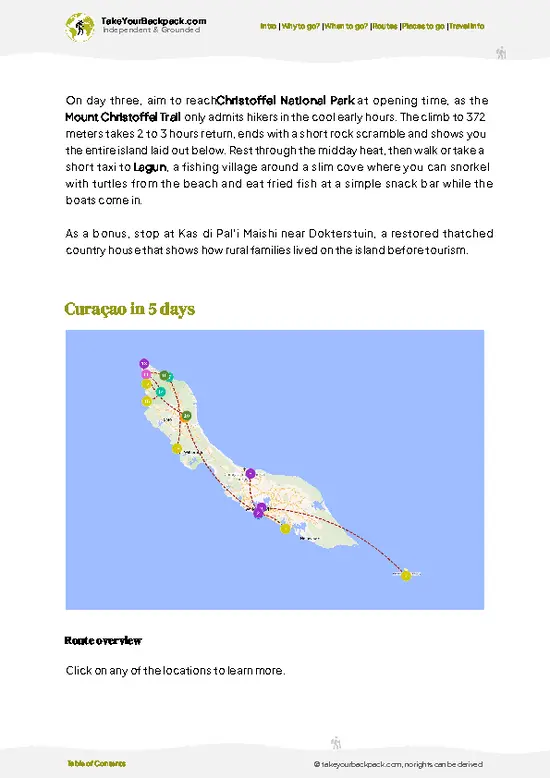
How long to allow: A trip linking several regions needs 5 to 8 days, and Curaçao is small enough that you never need more than 60 to 75 minutes to cross it by car.Direction and pacing: Start near Hato Airport and the Willemstad area, where you can pick up a car and your bearings, then work west and finish with your most relaxed stop. Give each base 2 to 3 nights. The most common mistake is switching hotels every night, which wastes mornings on packing; sleep in two bases and take day trips instead. Another is relying on buses for the west, which run infrequently and not at all on many beach roads. Rent a car for at least three days. Leave beach time for before 11 a.m., before the cruise-ship crowds arrive.

The ListHighly Recommended regions of Curaçao

1 Scharloo

Merchant mansions, saffron and cobalt facades, quiet lanes, guesthouse base

Walk the restored Scharlooweg mansions early, then cross the swaying pontoon bridge to fort views, synagogue sand floors and market lunches nearby.

Loading the map 🌍

Expert viewTips and Advice from Travelers

How many regions: Choose two, three at most. Curaçao is only about 61 kilometers long, so you can reach everything from two bases, and a third mostly adds packing time. Which kind for your style: If you dive or snorkel, prioritize the leeward west coast, where the reef begins steps from the shore. If you want food, nightlife and history, choose the Willemstad area. Budget travelers should sleep in the city, where hostels and guesthouses cost about US$30 to 60 a night, and make day trips out. Resort areas run US$100 and up. What it costs: Plan on US$60 to 110 a day on a shoestring: roughly US$30 to 60 for a bed, US$15 to 25 for food, and US$20 to 40 for a car split between two. This is not a US$20 a day island. Beach entry typically costs US$3 to 10 where it applies, and some include a chair. … read more 👉
How many regions: Choose two, three at most. Curaçao is only about 61 kilometers long, so you can reach everything from two bases, and a third mostly adds packing time. Which kind for your style: If you dive or snorkel, prioritize the leeward west coast, where the reef begins steps from the shore. If you want food, nightlife and history, choose the Willemstad area. Budget travelers should sleep in the city, where hostels and guesthouses cost about US$30 to 60 a night, and make day trips out. Resort areas run US$100 and up. What it costs: Plan on US$60 to 110 a day on a shoestring: roughly US$30 to 60 for a bed, US$15 to 25 for food, and US$20 to 40 for a car split between two. This is not a US$20 a day island. Beach entry typically costs US$3 to 10 where it applies, and some include a chair. Guided snorkel or dive outings run about US$40 to 80 for snorkeling and US$70 to 100 for a two-tank dive. Buses cost around US$1.50 to 3 a ride. Safety and culture: Curaçao is generally safe, but car break-ins at beach lots happen, so leave nothing visible and take your passport out of the car. Cliff-edge swimming spots have strong surf on the northeast, so stick to the leeward coast. Wear reef-safe sunscreen and never stand on coral, since fines and reef damage are real. Greet people with a quick “bon dia” (good morning) and expect shops to close early on Sundays. Water from the tap is safe to drink. Dress up a little in town, away from the beach.

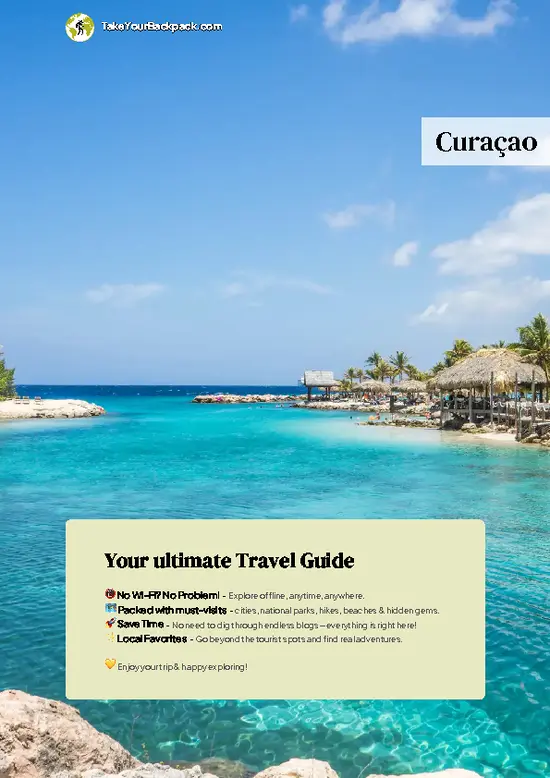
✈️ The backpacker research shortcutCuraçao Travel Guide

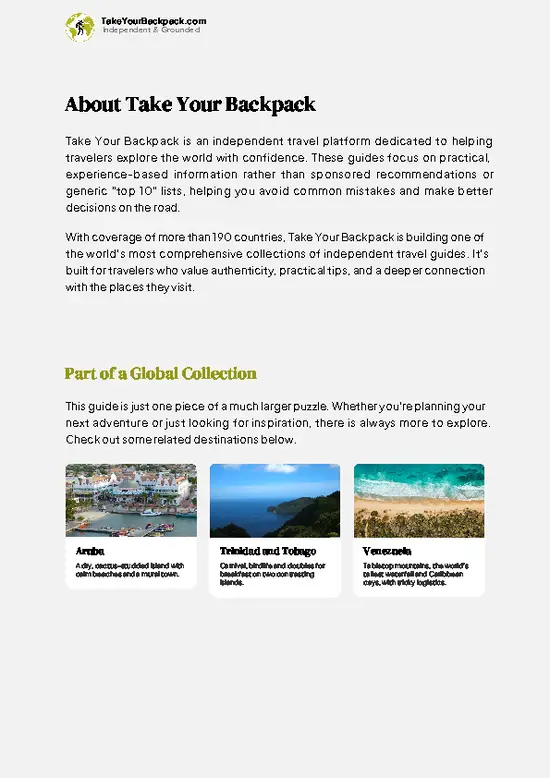
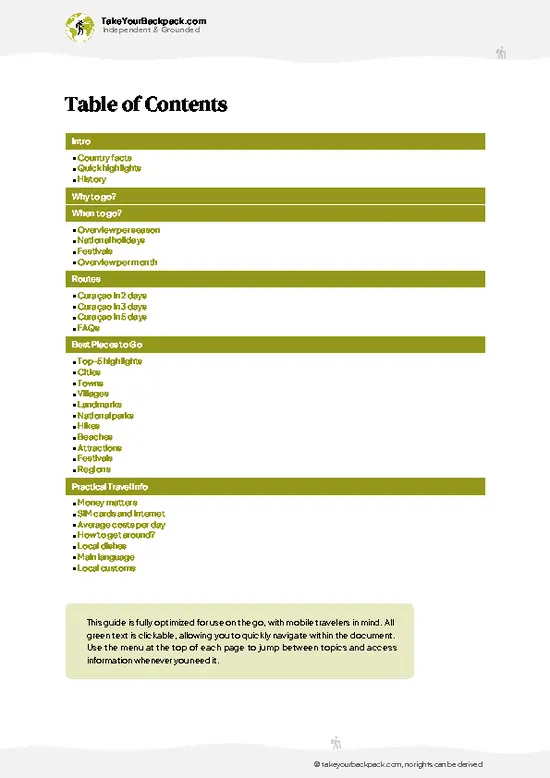
An offline-friendly backpacking guide with optimized travel routes, ranked highlights, transport advice, and the best areas to stay.
example page 0 from our offline Travel Guide for Curaçao
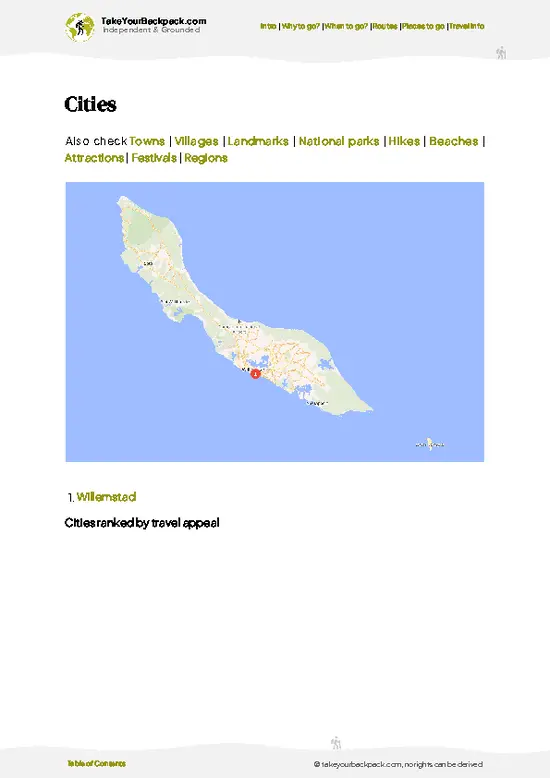
example page 1 from our offline Travel Guide for Curaçao
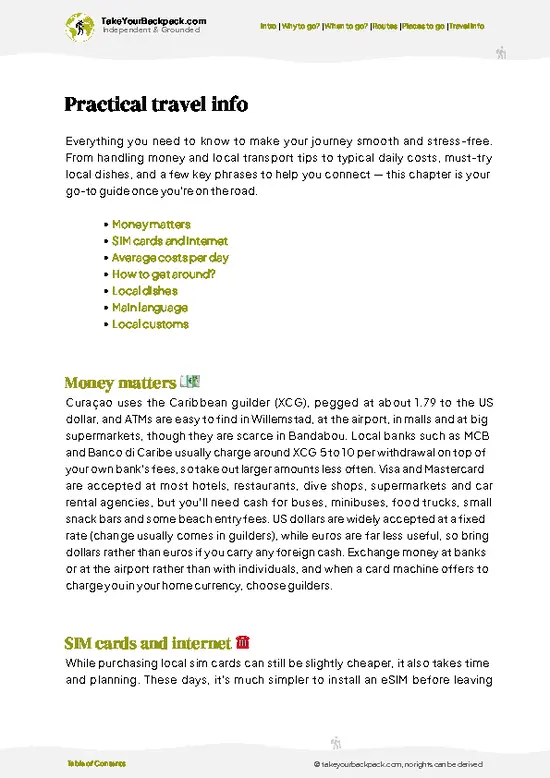
example page 2 from our offline Travel Guide for Curaçao
example page 3 from our offline Travel Guide for Curaçao
example page 4 from our offline Travel Guide for Curaçao
example page 5 from our offline Travel Guide for Curaçao
example page 6 from our offline Travel Guide for Curaçao
example page 7 from our offline Travel Guide for Curaçao
The digital guide (126 pages) contains:
✅ 33 highlights, ranked by travel appeal
✅ Optimized 2, 3 & 5-day travel routes
✅ Cities, national parks, landmarks, beaches
✅ How to get around
✅ Offline-friendly for travel without Wi-Fi
👉 Click to see all 30+ guide features

📅 Plan smarter in minutes, not weeks
✅ Month by month travel advice
✅ Festivals & national holidays
✅ Budget expectations

🗺️ Go to the right places, skip the overrated ones
✅ Honest pros & cons of destinations
✅ Top hikes, parks & viewpoints
✅ Lesser-known places most travelers miss
✅ Clear “worth it vs skip it” guidance

🛏️ Travel smoothly without rookie mistakes
✅ Best areas to stay
✅ Transport systems explained simply
✅ Common scams & safety advice
✅ SIM cards, money & practical tips

🌍 Understand the country, not just visit it
✅ Culture & traditions
✅ 52 Essential phrases & customs
✅ Festivals worth planning around
✅ Traveler-friendly historical context
✅ Insights that make places more meaningful

📱 Built for real travel conditions
✅ Fully downloadable PDF
✅ Works completely offline
✅ Optimized for phone use
✅ Useful in remote areas & buses
✅ Everything in one place
Stop searching, start planning
Get instant access to your full guide. 30‑day money-back guarantee.
+ Add another guide for just

By proceeding you agree to our terms.
Sent to your inbox immediately after payment • 100% Secure Checkout
Best Backpacking Travel Advisor 2025 tourism awardBest Backpacking
Travel Advisor
2025
What others say about Take Your Backpack Guides:
⭐⭐⭐⭐⭐
Fantastic, amazing amount of information!
⭐⭐⭐⭐⭐
My goodness this is amazing, it's what I've been looking for hats off too you!
⭐⭐⭐⭐⭐
I think this is absolutely BRILLIANT
⭐⭐⭐⭐
Very complete and informative. It's still missing places, but I gotta to commend you
⭐⭐⭐⭐⭐
This is truly amazing, thank you, can't wait to explore it with my kids!
⭐⭐⭐⭐⭐
Awesome resource, thank you!
⭐⭐⭐⭐⭐
This is amazing! Can't wait to explore the ones I haven't seen
⭐⭐⭐⭐
I love this! Well done, great idea.
⭐⭐⭐⭐⭐
Thanks for taking the time to make this gem!
⭐⭐⭐⭐⭐
This might be the best website I've ever seen.
⭐⭐⭐⭐⭐
Congratulations, and thank you so much for your work; it's incredibly valuable.
⭐⭐⭐⭐
In all seriousness I think you did a great job pointing out the important spots
⭐⭐⭐⭐⭐
10/10 very good
⭐⭐⭐⭐⭐
As someone who's only just starting to visit regularly this is awesome, thank you.
⭐⭐⭐⭐
Thank you very much! I'm going to visit my dad, it's going to be very useful!
⭐⭐⭐⭐⭐
This is really cool! We'll be travelling for the first time and this definitely come in handy.
⭐⭐⭐⭐⭐
You are now our minister of culture, congratulations 👨‍💼
⭐⭐⭐⭐⭐
Just wanted to tell you that this is a pearl! Going to follow your recommendations.
⭐⭐⭐⭐⭐
This is so cool. I'll definitely be using the resource for my travels soon.
⭐⭐⭐⭐⭐
This is very impressive! Good work.
⭐⭐⭐⭐⭐
This is an amazing and informative site. Very well done!

🛏️ Where to stay?Top Areas to Stay

Curaçao has only a handful of true hostels, with dorm beds around Cg 55 to 80 (US$30 to 45), so most backpackers end up in guesthouses, small apartments or private rooms at Cg 125 to 215 (US$70 to 120) a night. In Willemstad, Pietermaai has the best mix of budget guesthouses, bars and late-night restaurants within walking distance of the old town, while Punda puts you beside the shopping streets and waterfront but goes quiet after dark, and Otrobanda is cheaper and right by the main bus terminal, though some of its back streets feel sketchy at night. Outside the capital, Jan Thiel trades city access for beaches and a calmer, resort-like feel, and Westpunt is the pick for snorkeling and silence … read more 👉
Curaçao has only a handful of true hostels, with dorm beds around Cg 55 to 80 (US$30 to 45), so most backpackers end up in guesthouses, small apartments or private rooms at Cg 125 to 215 (US$70 to 120) a night. In Willemstad, Pietermaai has the best mix of budget guesthouses, bars and late-night restaurants within walking distance of the old town, while Punda puts you beside the shopping streets and waterfront but goes quiet after dark, and Otrobanda is cheaper and right by the main bus terminal, though some of its back streets feel sketchy at night. Outside the capital, Jan Thiel trades city access for beaches and a calmer, resort-like feel, and Westpunt is the pick for snorkeling and silence if you have a rental car, since buses there are infrequent.

If you enjoy meeting fellow travelers, consider choosing hostels with high ratings for atmosphere. On the other hand, if you prefer having your own space, a hotel might be a better option.

CuraçaoDiscover the Country

👋 Meet the founderWho’s Behind Take Your Backpack?

Johan, backpacker and founder of TakeYourBackpackHi, I’m Johan (Netherlands 🇳🇱), the creator of TakeYourBackpack. Over the past 3 decades, I’ve backpacked through 90+ countries across six continents, gaining extensive experience with independent travel, long-term trips, and overland routes.

This site is built on a combination of firsthand travel experience and carefully curated insights from other backpackers. Many guides are based on places I’ve personally visited, while others bring together tips, observations, and practical advice shared by trusted travelers I’ve met along the way.

The goal is to provide realistic, experience-driven guidance — not generic itineraries — so you can explore destinations with better context, clearer expectations, and more confidence.