×

Czechia🇨🇿 | best landmarksYour Guide to the 9 Best landmarks in Czechia

Landmarks in Czechia mostly come in three flavors: Gothic and Baroque castles, whole towns kept so intact they look rented, and the occasional bone-themed oddity. Prague takes the crowds and the prices, with beer cheaper than water in some pubs but entry fees and coffee that follow tourist logic. Bohemia’s countryside offers castles reached by cheap regional trains and almost no queue. Moravia is quieter, with wine cellars and baroque squares where lunch costs half the Prague price. Backpacking here is easy, since distances are small and rail is dense, but you must pick your fights with the tour groups.

By Johan Kruseman 🇳🇱 | Updated October 19, 2026
Explore the best national parks in Czechia

Why go?Key Factors That Shape the Experience

Czechia sits in the middle of Europe, and for a thousand years everybody who wanted to rule the middle passed through. The result is a density of castles, chateaux and walled towns that few countries of ten million people can match. Much of it survived because the 20th century, for all its troubles, spared most Czech cities from heavy wartime bombing. Prague stayed standing while other capitals were rebuilt in concrete.

That history also shapes what you will actually experience. Layers of styles sit on top of one another, so a single street can run from Romanesque cellar to Gothic tower to Art Nouveau facade, and it helps to know which period you are looking at. Sites are often managed by the National Heritage Institute, which means guided tours in set time slots, sometimes in Czech only … read more 👉
Czechia sits in the middle of Europe, and for a thousand years everybody who wanted to rule the middle passed through. The result is a density of castles, chateaux and walled towns that few countries of ten million people can match. Much of it survived because the 20th century, for all its troubles, spared most Czech cities from heavy wartime bombing. Prague stayed standing while other capitals were rebuilt in concrete.

That history also shapes what you will actually experience. Layers of styles sit on top of one another, so a single street can run from Romanesque cellar to Gothic tower to Art Nouveau facade, and it helps to know which period you are looking at. Sites are often managed by the National Heritage Institute, which means guided tours in set time slots, sometimes in Czech only unless you book the English one. Interiors can close from November to March, which surprises people who assumed a castle is a castle.

Infrastructure is a strength. Trains and buses reach even small towns, signage is decent, and a country this compact means you can see a lot without a single long haul. The weak spot is crowd concentration: a handful of famous places absorb most visitors, while equally good ones nearby sit nearly empty. Choose deliberately and the country rewards you.
Evaluating the Top Choices
The list of best unique sites in Czechia is created based on history or culture, wow factor, atmosphere, quirks, and memorability. If you feel a unique site is missing in this list, please let us know.

When to go?Best Time to Visit Czechia for landmarks

Best months for landmarks: May, June and September are the best months, with daytime highs of about 17 to 24°C, long daylight and all castle interiors open. July and August run 24 to 30°C and bring the heaviest crowds in Prague, though it rarely feels punishing outside the capital. Rain peaks in early summer, with showers of 60 to 80 mm a month, so a flexible umbrella is worth more than a rigid plan.

Shoulder seasons and winter: April and October are the shoulder months. Expect 8 to 15°C, cheaper rooms (often 15 to 30 percent below summer rates) and thinner queues. The catch is that many castle interiors open only from April or May and close again by the end of October, so a trip outside those dates may mean admiring exteriors through a fence.

November to March is cold, with temperatures … read more 👉
Best months for landmarks: May, June and September are the best months, with daytime highs of about 17 to 24°C, long daylight and all castle interiors open. July and August run 24 to 30°C and bring the heaviest crowds in Prague, though it rarely feels punishing outside the capital. Rain peaks in early summer, with showers of 60 to 80 mm a month, so a flexible umbrella is worth more than a rigid plan.

Shoulder seasons and winter: April and October are the shoulder months. Expect 8 to 15°C, cheaper rooms (often 15 to 30 percent below summer rates) and thinner queues. The catch is that many castle interiors open only from April or May and close again by the end of October, so a trip outside those dates may mean admiring exteriors through a fence.

November to March is cold, with temperatures from about minus 5 to 5°C, and the Bohemian-Moravian Highlands and areas near the Krkonoše mountains see the most snow. Gray skies are common. Still, Prague in December is crowded around the Christmas markets, and hostel prices jump, while January and February are the cheapest, quietest stretch of the year for anyone who owns a proper coat.

unique site hoppingHow to Combine landmarks Into One Trip

How many days to plan: A trip that combines several landmarks in Czechia needs 7 to 10 days, and 5 is the realistic minimum if you want more than a blur. The country is small, so the temptation is to cram, and that is the first mistake.

Grouping and direction: Prague works best as the hub, since most rail lines radiate from it. Start with 2 to 3 days there, then head out in loops. Central and eastern Bohemia pair well (1 to 2 hours by train from Prague), South Bohemia is a separate 2 to 3 hour trip by bus or train toward the Austrian border, and Moravia sits 2.5 to 4 hours east, with Brno as the natural transport hub. Moving west to east, ending in Moravia, keeps backtracking low, and you can fly out of Vienna or Brno if you prefer not to return.

Pacing and common mistakes: Allow half a … read more 👉
How many days to plan: A trip that combines several landmarks in Czechia needs 7 to 10 days, and 5 is the realistic minimum if you want more than a blur. The country is small, so the temptation is to cram, and that is the first mistake.

Grouping and direction: Prague works best as the hub, since most rail lines radiate from it. Start with 2 to 3 days there, then head out in loops. Central and eastern Bohemia pair well (1 to 2 hours by train from Prague), South Bohemia is a separate 2 to 3 hour trip by bus or train toward the Austrian border, and Moravia sits 2.5 to 4 hours east, with Brno as the natural transport hub. Moving west to east, ending in Moravia, keeps backtracking low, and you can fly out of Vienna or Brno if you prefer not to return.

Pacing and common mistakes: Allow half a day to a full day for a castle or old town, and a full day when guided tours run on set times. Planners often try three towns in one day, then spend most of it in station cafés. Another mistake is relying on day trips from Prague for everything, which costs 3 to 4 hours of travel daily. Sleep in the smaller towns instead, where beds cost less and the evenings are calmer. Regional trains run less often on Sundays, so check timetables on the national rail site first.

The ListTop landmarks of Czechia

1 Karlštejn Castle

Gothic fortress, royal treasury, hilltop views, Charles IV legacy

Walk through fortified halls that once safeguarded royal jewels, surrounded by forested hills and centuries-old legends of Czech kingship.

czechia-unique-site-karlstejn-castle
© Google | Martin Kočí

2 Kroměříž Castle and Gardens

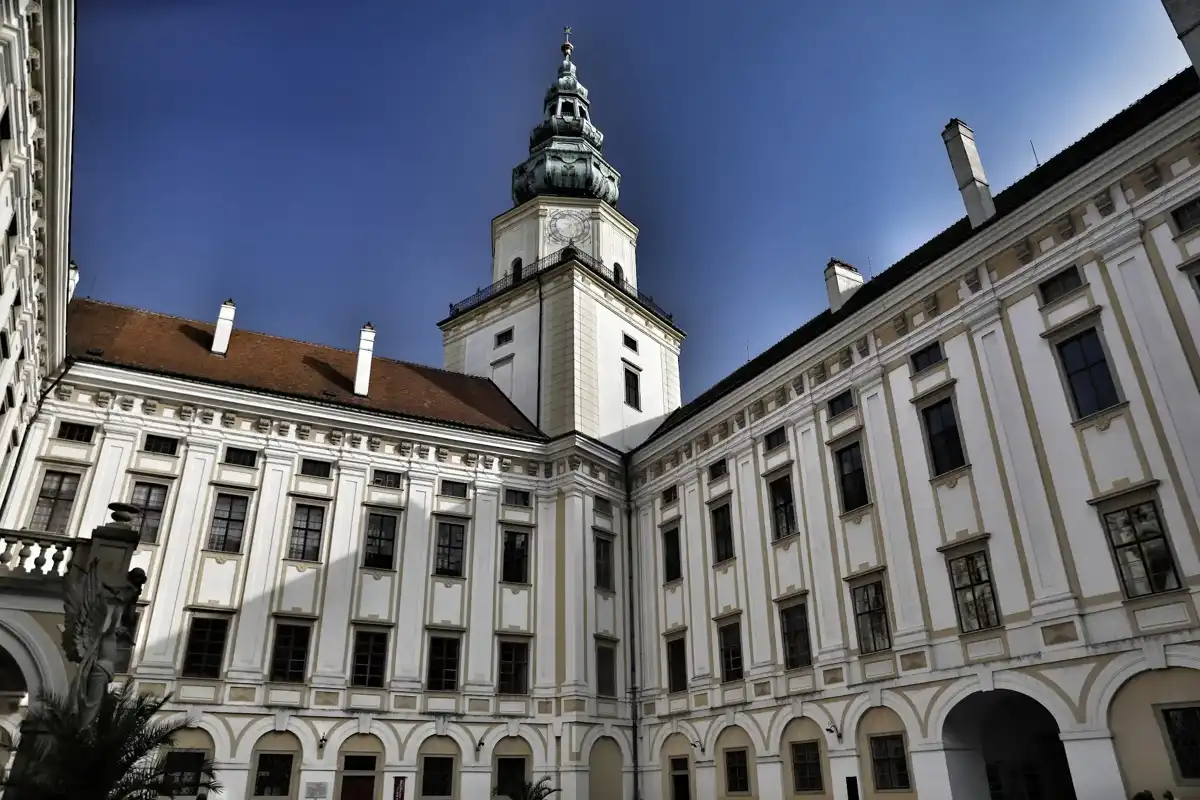
baroque palace, formal gardens, UNESCO site, ornate interiors

Stroll through manicured grounds and lavish halls, experiencing a blend of artistic design and horticultural tradition in Moravia.

czechia-unique-site-kromeriz-castle-and-gardens
© Google | Radim Svoboda

3 Hranice Abyss

deep limestone chasm, subterranean lake, Moravian karst, geological curiosity

Descend into a dramatic natural sinkhole where sheer rock walls and hidden waters reveal the depths of Central Europe’s underground landscapes.

czechia-unique-site-hranice-abyss
© Google | Ondřej Vyskočil

4 Pernštejn Castle

fortified stronghold, labyrinthine corridors, Renaissance details, forested ridge

Navigate twisting stairways and hidden rooms in a well-defended castle rising above wooded slopes in the Vysočina region.

czechia-unique-site-pernstejn-castle
© Google |

5 Loket Castle

river bend, Romanesque walls, prison museum, medieval town

Survey a stone fortress encircled by a looping river, with preserved ramparts and exhibits tracing centuries of borderland history.

czechia-unique-site-loket-castle
© Google | Hrad Loket

6 Kokořín Castle

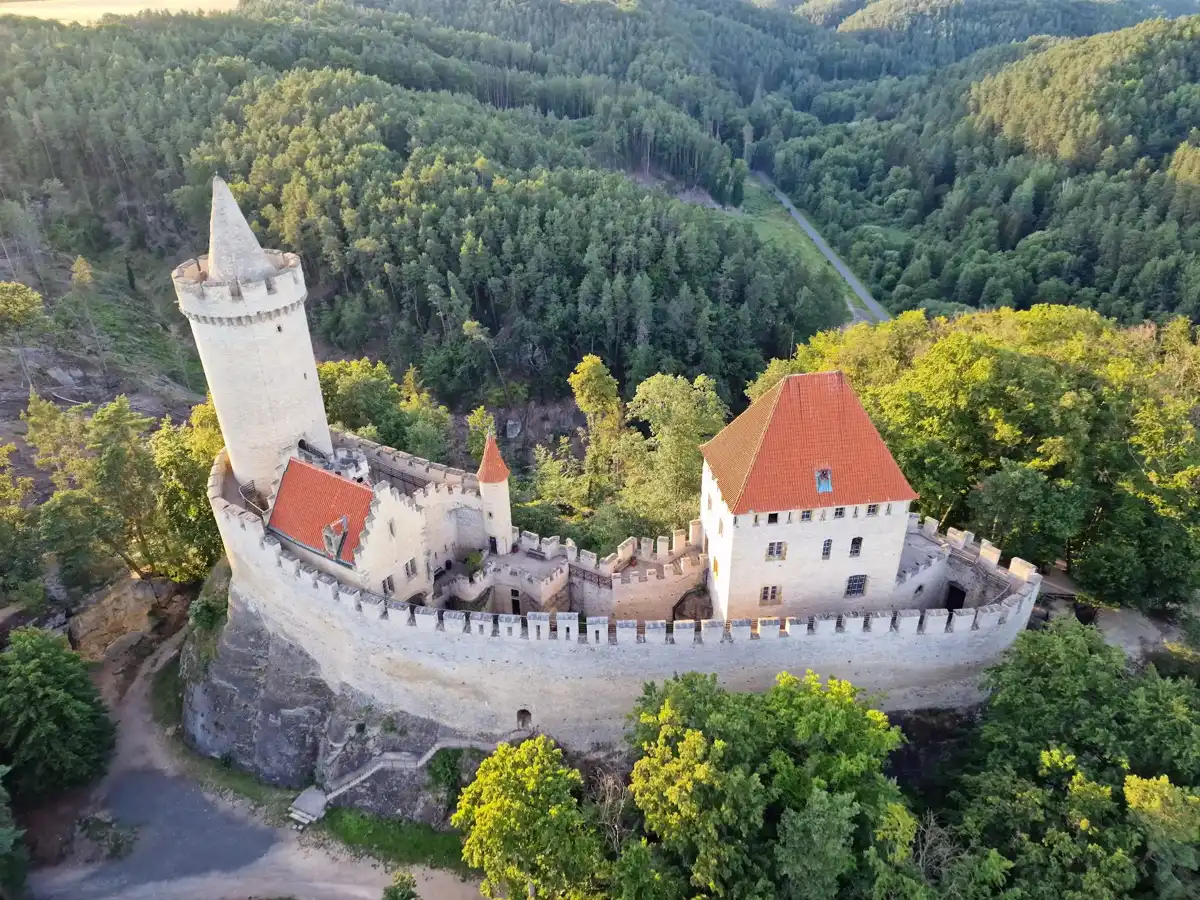
sandstone cliffs, fairy-tale tower, Bohemian forest, medieval architecture

Climb a restored castle perched above winding trails, where stone towers overlook dense woods and sculpted rock formations.

czechia-unique-site-kokorin-castle
© Google | Marek Novák

7 Zelená Hora

pilgrimage church, star-shaped layout, Santini architecture, hilltop sanctuary

Ascend to a uniquely designed church where geometric forms and spiritual symbolism create a striking landmark above the countryside.

8 Vildštejn Castle

moated fortress, Romanesque core, banquet halls, Cheb region

Experience a water-ringed castle with preserved medieval features, now hosting local events and showcasing regional heritage.

czechia-unique-site-vildstejn-castle
© Google |

9 Loreta Starý Hrozňatov

pilgrimage site, baroque chapel, Marian devotion, borderland hills

Visit a serene sanctuary set among rolling hills, where ornate chapels and religious art draw pilgrims and travelers alike.

czechia-unique-site-loreta-stary-hroznatov
© Google |
Loading the map 🌍

Expert viewTips and Advice from Travelers

How many landmarks to see: Aim for 5 to 8 major landmarks across a one-week trip, plus a few free wanders. More than that and you stop seeing and start collecting. Czech sites are rich in detail, and a guided tour often runs 60 to 90 minutes, so two paid interiors in a day is a full day. I would rather you visit fewer places and linger at a square with a beer than tick off a castle you cannot remember by dinner.

What to prioritize: Choose by travel style. If you like history, put castles and chateaux first, because the interiors hold the stories. If you are short on cash, favor old town centers and churches, many of which are free to walk through or cost only a few dollars. If you want quiet, pick small-town sites over the famous ones. The skip list is short and plain: paying extra for the … read more 👉
How many landmarks to see: Aim for 5 to 8 major landmarks across a one-week trip, plus a few free wanders. More than that and you stop seeing and start collecting. Czech sites are rich in detail, and a guided tour often runs 60 to 90 minutes, so two paid interiors in a day is a full day. I would rather you visit fewer places and linger at a square with a beer than tick off a castle you cannot remember by dinner.

What to prioritize: Choose by travel style. If you like history, put castles and chateaux first, because the interiors hold the stories. If you are short on cash, favor old town centers and churches, many of which are free to walk through or cost only a few dollars. If you want quiet, pick small-town sites over the famous ones. The skip list is short and plain: paying extra for the most expensive Prague ticket combo makes little sense unless you plan to use every part of it, and the crowded hourly spectacles in the old center are best watched for a minute from the edge, not planned around.

What it costs: A realistic budget is US$45 to 75 a day (roughly 1,000 to 1,700 CZK), covering a hostel bed (US$15 to 30), meals, local transport and one or two paid entries. Castle tours usually cost 150 to 400 CZK (US$7 to 18), with English or longer routes at the high end, and photo permits sometimes add 50 to 100 CZK. Prague’s big complexes can cost more, with combined tickets reaching about 450 to 600 CZK (US$20 to 27). Regional trains cost 100 to 300 CZK a leg, so a rail pass rarely pays off. Cash helps in small towns, though cards are accepted at most main sites.

Safety and etiquette: Czechia is safe, and the main risk is pickpockets in the Prague tourist core, particularly on trams and around the Old Town. Keep your bag zipped in front. Taxis outside app services can overcharge, so use a ride app. Dress modestly in churches, speak quietly inside, and expect to be told off if you ignore the no-photo signs; staff on guided tours are strict about that. Do not touch frescoes, and do not cross a rope line to get a shot. Many sites close on Mondays, and small towns may close for lunch, so check opening days before you ride out.

✈️ The backpacker research shortcutCzechia Travel Guide

An offline-friendly backpacking guide with optimized travel routes, ranked highlights, transport advice, and the best areas to stay.
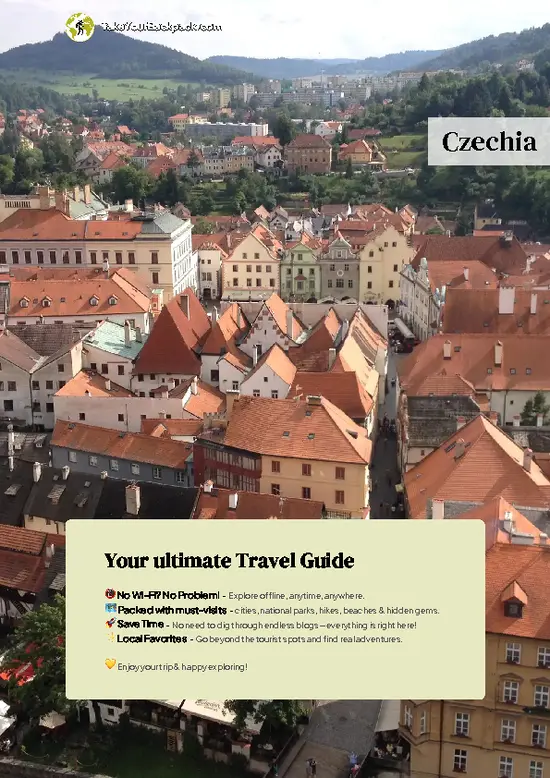
example page 0 from our offline Travel Guide for Czechia
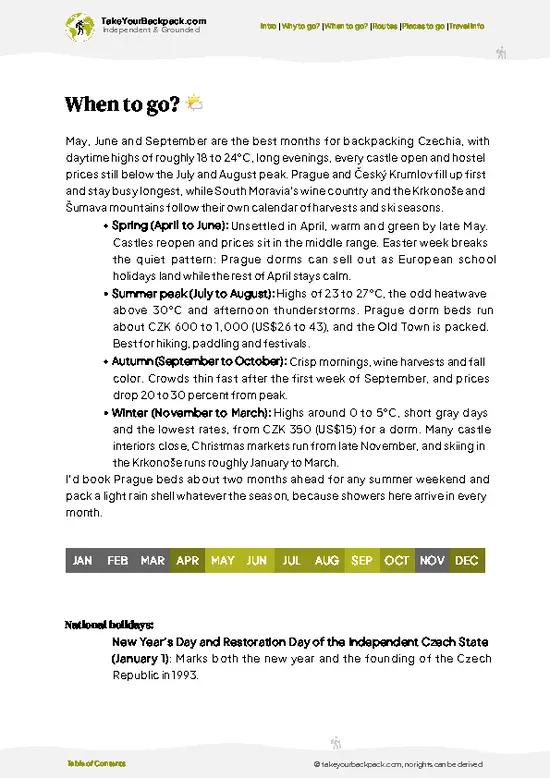
example page 1 from our offline Travel Guide for Czechia
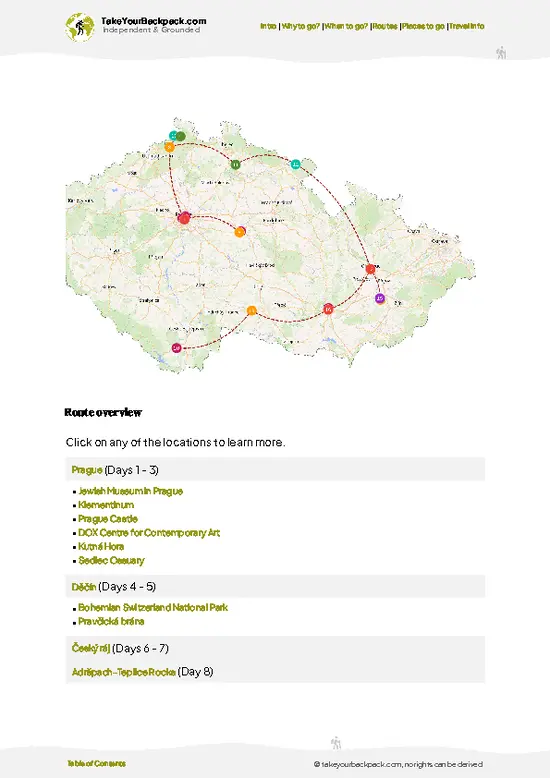
example page 2 from our offline Travel Guide for Czechia
example page 3 from our offline Travel Guide for Czechia
example page 4 from our offline Travel Guide for Czechia
example page 5 from our offline Travel Guide for Czechia
example page 6 from our offline Travel Guide for Czechia
example page 7 from our offline Travel Guide for Czechia
The digital guide (321 pages) contains:
✅ 88 highlights, ranked by travel appeal
✅ Optimized 5, 10 & 15-day travel routes
✅ Cities, national parks, landmarks, beaches
✅ How to get around
✅ Offline-friendly for travel without Wi-Fi
👉 Click to see all 30+ guide features

📅 Plan smarter in minutes, not weeks
✅ Month by month travel advice
✅ Festivals & national holidays
✅ Budget expectations

🗺️ Go to the right places, skip the overrated ones
✅ Honest pros & cons of destinations
✅ Top hikes, parks & viewpoints
✅ Lesser-known places most travelers miss
✅ Clear “worth it vs skip it” guidance

🛏️ Travel smoothly without rookie mistakes
✅ Best areas to stay
✅ Transport systems explained simply
✅ Common scams & safety advice
✅ SIM cards, money & practical tips

🌍 Understand the country, not just visit it
✅ Culture & traditions
✅ 52 Essential phrases & customs
✅ Festivals worth planning around
✅ Traveler-friendly historical context
✅ Insights that make places more meaningful

📱 Built for real travel conditions
✅ Fully downloadable PDF
✅ Works completely offline
✅ Optimized for phone use
✅ Useful in remote areas & buses
✅ Everything in one place
Stop searching, start planning
Get instant access to your full guide. 30‑day money-back guarantee.
+ Add another guide for just

By proceeding you agree to our terms.
Sent to your inbox immediately after payment • 100% Secure Checkout
Best Backpacking Travel Advisor 2025 tourism awardBest Backpacking
Travel Advisor
2025
What others say about Take Your Backpack Guides:
⭐⭐⭐⭐⭐
Fantastic, amazing amount of information!
⭐⭐⭐⭐⭐
My goodness this is amazing, it's what I've been looking for hats off too you!
⭐⭐⭐⭐⭐
I think this is absolutely BRILLIANT
⭐⭐⭐⭐
Very complete and informative. It's still missing places, but I gotta to commend you
⭐⭐⭐⭐⭐
This is truly amazing, thank you, can't wait to explore it with my kids!
⭐⭐⭐⭐⭐
Awesome resource, thank you!
⭐⭐⭐⭐⭐
This is amazing! Can't wait to explore the ones I haven't seen
⭐⭐⭐⭐
I love this! Well done, great idea.
⭐⭐⭐⭐⭐
Thanks for taking the time to make this gem!
⭐⭐⭐⭐⭐
This might be the best website I've ever seen.
⭐⭐⭐⭐⭐
Congratulations, and thank you so much for your work; it's incredibly valuable.
⭐⭐⭐⭐
In all seriousness I think you did a great job pointing out the important spots
⭐⭐⭐⭐⭐
10/10 very good
⭐⭐⭐⭐⭐
As someone who's only just starting to visit regularly this is awesome, thank you.
⭐⭐⭐⭐
Thank you very much! I'm going to visit my dad, it's going to be very useful!
⭐⭐⭐⭐⭐
This is really cool! We'll be travelling for the first time and this definitely come in handy.
⭐⭐⭐⭐⭐
You are now our minister of culture, congratulations 👨‍💼
⭐⭐⭐⭐⭐
Just wanted to tell you that this is a pearl! Going to follow your recommendations.
⭐⭐⭐⭐⭐
This is so cool. I'll definitely be using the resource for my travels soon.
⭐⭐⭐⭐⭐
This is very impressive! Good work.
⭐⭐⭐⭐⭐
This is an amazing and informative site. Very well done!

🛏️ Where to stay?Top Areas to Stay

Czechia has plenty of hostels and budget guesthouses, with Prague dorm beds usually running 400 to 800 CZK (about US$17 to 35) and private rooms in smaller towns often cheaper. In Prague, Staré Město (Old Town) and Nové Město (New Town) put you within walking distance of the main sights and late bars but cost the most and get loud, Žižkov has cheaper beds and dive-bar nightlife a short tram ride out, and leafy Vinohrady or Holešovice trade a 10 to 20 minute commute for quieter streets and local cafés. Outside the capital, Brno has a lively student-driven hostel scene around its compact center, while Český Krumlov fills its small old-town guesthouses fast in summer, so book ahead there.

If you … read more 👉
Czechia has plenty of hostels and budget guesthouses, with Prague dorm beds usually running 400 to 800 CZK (about US$17 to 35) and private rooms in smaller towns often cheaper. In Prague, Staré Město (Old Town) and Nové Město (New Town) put you within walking distance of the main sights and late bars but cost the most and get loud, Žižkov has cheaper beds and dive-bar nightlife a short tram ride out, and leafy Vinohrady or Holešovice trade a 10 to 20 minute commute for quieter streets and local cafés. Outside the capital, Brno has a lively student-driven hostel scene around its compact center, while Český Krumlov fills its small old-town guesthouses fast in summer, so book ahead there.

If you enjoy meeting fellow travelers, consider choosing hostels with high ratings for atmosphere. On the other hand, if you prefer having your own space, a hotel might be a better option.

CzechiaDiscover the Country

👋 Meet the founderWho’s Behind Take Your Backpack?

Johan, backpacker and founder of TakeYourBackpackHi, I’m Johan (Netherlands 🇳🇱), the creator of TakeYourBackpack. Over the past 3 decades, I’ve backpacked through 90+ countries across six continents, gaining extensive experience with independent travel, long-term trips, and overland routes.

This site is built on a combination of firsthand travel experience and carefully curated insights from other backpackers. Many guides are based on places I’ve personally visited, while others bring together tips, observations, and practical advice shared by trusted travelers I’ve met along the way.

The goal is to provide realistic, experience-driven guidance — not generic itineraries — so you can explore destinations with better context, clearer expectations, and more confidence.