×

Democratic Republic of the Congo🇨🇩 | best landmarksThe Top landmarks in DR Congo

Landmarks in DR Congo (the Democratic Republic of the Congo) are mostly natural: volcanoes, rainforest reserves, river rapids and waterfalls. Built heritage is thin, and colonial-era monuments in the cities rarely justify a detour. Skip them unless you are already passing through. The real draw is wildlife and wilderness, and it costs real money. Permits in the east run into hundreds of dollars, and getting there needs flights, vetted guides and flexible dates. The Kivu highlands are the most developed, with ranger infrastructure and cool air, but security there swings sharply. Kinshasa and the lower Congo River are easier to reach and cheaper, though less dramatic. Remote basin and savanna reserves are for expedition-minded travelers with large budgets. Independent travel is possible but never casual. Pick one kind of landmark and do it properly.

By Johan Kruseman 🇳🇱 | Updated October 20, 2026
Explore the best national parks in DR Congo

Why go?Why These unique site Stand Out

DR Congo holds the second-largest rainforest on Earth and a river system that drains much of Central Africa, so its best landmarks are geological and ecological. The country sits on the western branch of the East African Rift, which gives it active volcanoes, deep lakes and mountain forest that few other countries match. Anyone expecting temples, forts or old-town quarters will be disappointed. Centuries of upheaval, from the colonial period through successive wars, left little preserved or restored, and the museums that exist are modest.

The second thing to understand is infrastructure. Paved roads between regions are scarce, the country is roughly the size of Western Europe, and many reserves have no road access at all. Getting to a landmark usually means a domestic flight, then a chartered … read more 👉
DR Congo holds the second-largest rainforest on Earth and a river system that drains much of Central Africa, so its best landmarks are geological and ecological. The country sits on the western branch of the East African Rift, which gives it active volcanoes, deep lakes and mountain forest that few other countries match. Anyone expecting temples, forts or old-town quarters will be disappointed. Centuries of upheaval, from the colonial period through successive wars, left little preserved or restored, and the museums that exist are modest.

The second thing to understand is infrastructure. Paved roads between regions are scarce, the country is roughly the size of Western Europe, and many reserves have no road access at all. Getting to a landmark usually means a domestic flight, then a chartered vehicle, boat or multi-day trek. That is why visits cost more than in Uganda or Rwanda, and why it is not worth coming for a quick, cheap checklist.

Third, security and access decide everything. Parts of the east have been affected by armed groups for decades, and borders, airports and park access can close with little notice. Other regions, such as Kinshasa Province, the Kongo Central lowlands and the far south around Lubumbashi, are calmer but offer fewer headline sights.

Finally, expect permit-based, guide-led access. Parks run their own booking systems, fees are paid in US dollars, and wandering off alone is neither legal nor wise. Come if you want wild places with almost no other visitors. Skip it if you need predictability, polished facilities or a tight schedule.
Behind the Scenes of Selection
The list of best unique sites in DR Congo is created based on history or culture, wow factor, atmosphere, quirks, and memorability. If you feel a unique site is missing in this list, please let us know.

When to go?Best Time to Visit DR Congo for landmarks

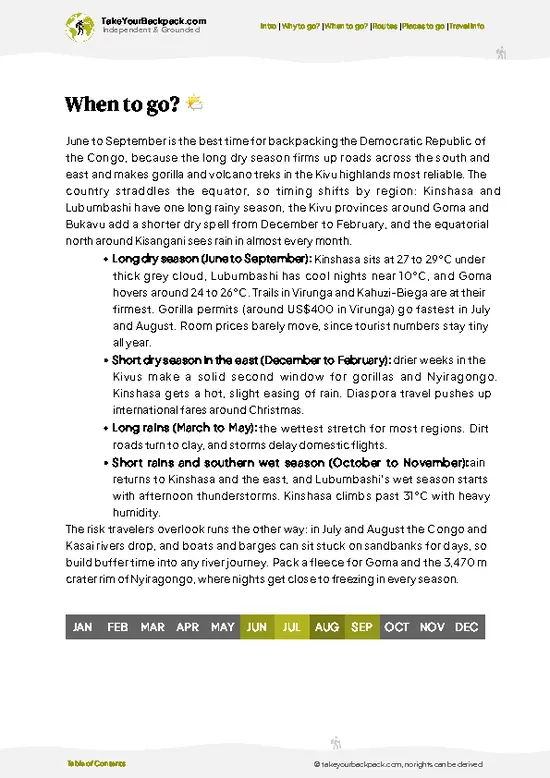
Best months by region: The best months for landmarks in DR Congo are June to August, when the dry season firms up trails and clears the air across the eastern highlands and the south. In the Kivu highlands, mountain trails are slick and cloud-covered for much of the rest of the year, so the dry months make summit and forest hikes far more rewarding. Daytime temperatures there sit around 20 to 26°C, and nights on high ground drop to 5°C or lower.
Shoulder seasons and the wet months: December to February is a shorter dry spell in the east and a workable second choice. March to May and September to November are the wettest stretches, with heavy afternoon downpours, muddy tracks and delayed flights. Kinshasa gets around 1,300 to 1,500 mm of rain a year, mostly between October and May, with a dry … read more 👉
Best months by region: The best months for landmarks in DR Congo are June to August, when the dry season firms up trails and clears the air across the eastern highlands and the south. In the Kivu highlands, mountain trails are slick and cloud-covered for much of the rest of the year, so the dry months make summit and forest hikes far more rewarding. Daytime temperatures there sit around 20 to 26°C, and nights on high ground drop to 5°C or lower.
Shoulder seasons and the wet months: December to February is a shorter dry spell in the east and a workable second choice. March to May and September to November are the wettest stretches, with heavy afternoon downpours, muddy tracks and delayed flights. Kinshasa gets around 1,300 to 1,500 mm of rain a year, mostly between October and May, with a dry season from about June to September. Temperatures there run 22 to 31°C and humidity stays high.
South and equatorial basin: Katanga in the south has a clear dry season from May to September, and roads and tracks there are reliably passable. The equatorial basin around Kisangani and the northern forests are wet nearly year-round, so waterproofs matter more than the calendar. Rivers peak at different times north and south of the equator, which affects boat schedules.
Crowds and prices: Crowds are not a problem anywhere in DR Congo. The dry season brings more flight and permit demand, so book permits and charters weeks ahead for June to August. Fees do not change by season, but wet-season delays add hotel nights, which is where the extra cost appears. Wet months are not worth the gamble for park visits.

unique site hoppingHow to Combine landmarks Into One Trip

How many days to allow: A trip combining several landmarks in DR Congo needs 14 to 21 days, mostly because transport eats time. Anything under 10 days should be limited to one region.
Grouping and direction: Group by region, not by country. The eastern highlands work as one cluster, with lake, volcano and forest stops within a day or two of each other by road or boat. Kinshasa and the lower river form a second cluster that can be covered in 3 to 5 days. The south around Lubumbashi is a separate trip. A sensible direction is to fly into Kinshasa, handle permits, visas and cash there, then fly east and finish in the highlands. Reversing it puts the hardest logistics at the end, when delays hurt most.
Time per stop: Allow 2 to 3 days for a mountain or forest stop, including rest. Gorilla and chimpanzee … read more 👉
How many days to allow: A trip combining several landmarks in DR Congo needs 14 to 21 days, mostly because transport eats time. Anything under 10 days should be limited to one region.
Grouping and direction: Group by region, not by country. The eastern highlands work as one cluster, with lake, volcano and forest stops within a day or two of each other by road or boat. Kinshasa and the lower river form a second cluster that can be covered in 3 to 5 days. The south around Lubumbashi is a separate trip. A sensible direction is to fly into Kinshasa, handle permits, visas and cash there, then fly east and finish in the highlands. Reversing it puts the hardest logistics at the end, when delays hurt most.
Time per stop: Allow 2 to 3 days for a mountain or forest stop, including rest. Gorilla and chimpanzee visits need a day plus a travel buffer. City stops need only a day. Domestic flights between hubs take 1.5 to 3 hours, but schedules are thin and cancellations common. Road legs in the east of 100 km can take 4 to 8 hours, and lake boats are slower still.
Planning mistakes to avoid: The biggest error is stacking stops with zero buffer days. Leave at least one spare day for every two transfers. Another is booking permits before confirming flights and visa dates, which creates nonrefundable fees against shaky travel. Book transport first, permits second. Overland hops across the whole country are not worth the time. A river journey from Kinshasa upstream can take over a week, and unless the journey itself is the goal, fly instead. Do not try to see the whole country in one trip.

The ListMust-Visit landmarks in DR Congo

1 Zongo Falls

misty cascade, rainforest cliffs, natural plunge pool

Stand at the base of a powerful waterfall, surrounded by dense rainforest, and feel the cool spray rising from the deep plunge pool below.

democratic-republic-of-the-congo-unique-site-zongo-falls
© Google |
Loading the map 🌍

Expert viewWhat You Should Know

How many landmarks to aim for: Plan for two or three landmarks on a trip of two to three weeks, and treat a fourth as a bonus. Each one needs a permit, a guide, a transport leg and a weather window, and each can slip a day or two. Four or five stops means you are spending most of the trip in vehicles and waiting rooms. Fewer stops, done well, give you time in the forest or on the mountain, which is the point.
Choosing by travel style: If you want wildlife encounters, put your money into one permit-based park visit and skip the rest. If you prefer hiking and views, prioritize a volcano or highland trek over museums or monuments. If you are mainly curious about daily life and culture, Kinshasa’s music, markets and river front are cheaper and more reliable than any park. Colonial-era monuments … read more 👉
How many landmarks to aim for: Plan for two or three landmarks on a trip of two to three weeks, and treat a fourth as a bonus. Each one needs a permit, a guide, a transport leg and a weather window, and each can slip a day or two. Four or five stops means you are spending most of the trip in vehicles and waiting rooms. Fewer stops, done well, give you time in the forest or on the mountain, which is the point.
Choosing by travel style: If you want wildlife encounters, put your money into one permit-based park visit and skip the rest. If you prefer hiking and views, prioritize a volcano or highland trek over museums or monuments. If you are mainly curious about daily life and culture, Kinshasa’s music, markets and river front are cheaper and more reliable than any park. Colonial-era monuments and statues are not worth a dedicated trip. Remote savanna and basin reserves suit only travelers with a large budget, a charter plan and weeks to spare.
What it costs: Budget US$80 to 150 a day for independent travel with simple hotels, local meals and shared transport, before permits. Kinshasa hotels that meet basic standards often cost US$80 to 150 a night. Add permits on top: mountain and volcano hikes in the Kivu region have cost roughly US$300 or more, and gorilla permits run about US$400 to 450. Chimpanzee or smaller forest visits are cheaper, around US$50 to 150 depending on the park. Guides, porters and ranger escorts add US$10 to 50 a day, and vehicle hire with driver runs US$100 to 200 a day. Domestic flights cost US$150 to 400 one way. Cash in US dollars is the norm, and notes printed before the early 2000s or with tears are routinely refused, so carry crisp, recent bills in small denominations. Card machines are rare outside Kinshasa.
Costs and delays that catch travelers out: The most common surprise is unofficial fees. Checkpoint payments, photo permits and informal “registration” charges appear in towns and on roads. Ask for printed receipts at official sites, and carry copies of your visa, permits and a letter of invitation or booking confirmation, which cuts most of the haggling. A second trap is flight cancellations. Domestic carriers cancel or merge flights, so never schedule a flight home within two days of a domestic leg. Third, permit refunds are limited, so confirm park status before paying.
Safety and conduct: Security in the east shifts quickly, with some zones closed to visitors. Check your government’s travel advice and the park’s own updates within a week of departure, and drop any stop that turns uncertain. Travel only with registered guides and, where required, armed ranger escorts. They are not optional. Avoid all photography of soldiers, police, airports, bridges and government buildings. It can lead to detention, and fines for unofficial offenses are a common shakedown. Always ask before photographing people.
Cultural and health points: Dress modestly and greet people before asking for anything. Greetings matter, and a short “Mbote” in Kinshasa or “Jambo” in the east earns goodwill. Yellow fever vaccination is required for entry, and malaria prophylaxis is essential. Gorilla viewing also requires being free of colds and respiratory illness, and rangers will turn you away if you are sick. Travel insurance that covers medical evacuation is essential, because help outside the main cities is days away by road.

✈️ The backpacker research shortcutDR Congo Travel Guide

An offline-friendly backpacking guide with optimized travel routes, ranked highlights, transport advice, and the best areas to stay.
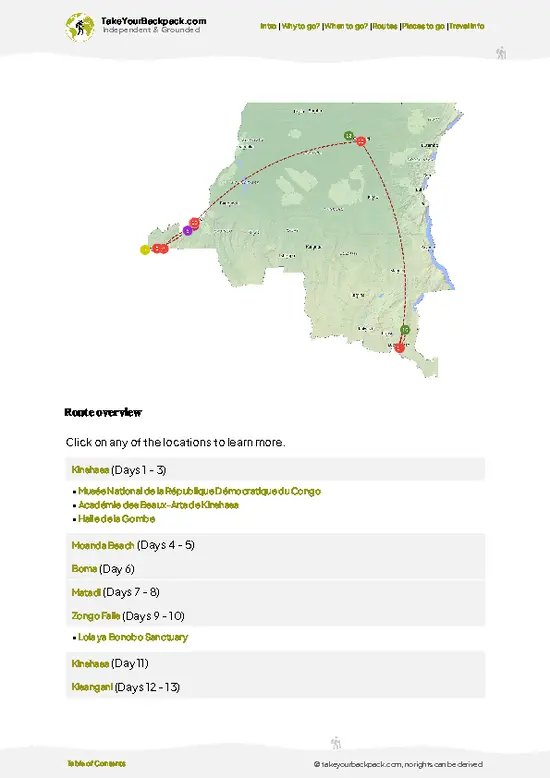
example page 0 from our offline Travel Guide for Democratic Republic of the Congo
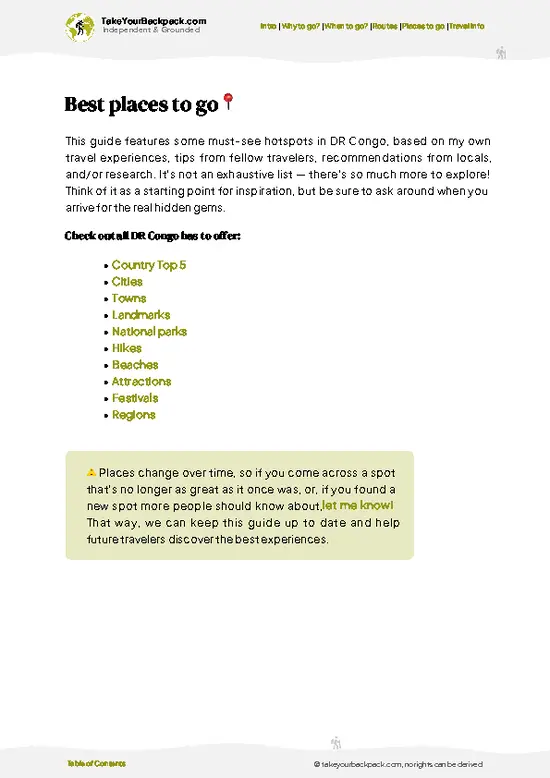
example page 1 from our offline Travel Guide for Democratic Republic of the Congo
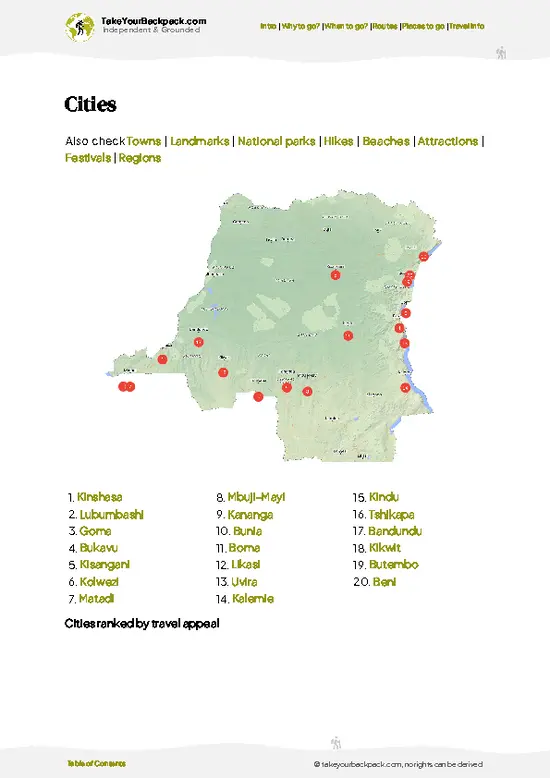
example page 2 from our offline Travel Guide for Democratic Republic of the Congo
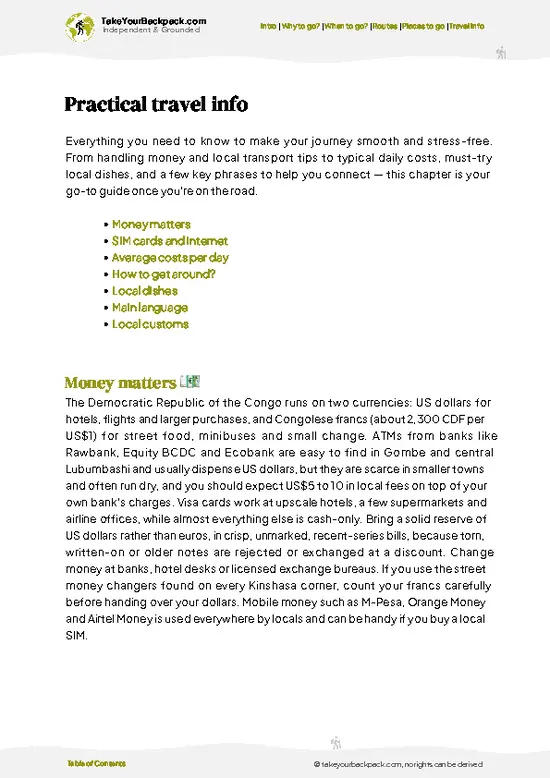
example page 3 from our offline Travel Guide for Democratic Republic of the Congo
example page 4 from our offline Travel Guide for Democratic Republic of the Congo
example page 5 from our offline Travel Guide for Democratic Republic of the Congo
example page 6 from our offline Travel Guide for Democratic Republic of the Congo
example page 7 from our offline Travel Guide for Democratic Republic of the Congo
The digital guide (330 pages) contains:
✅ 76 highlights, ranked by travel appeal
✅ Optimized 7, 14 & 21-day travel routes
✅ Cities, national parks, landmarks, beaches
✅ How to get around
✅ Offline-friendly for travel without Wi-Fi
👉 Click to see all 30+ guide features

📅 Plan smarter in minutes, not weeks
✅ Month by month travel advice
✅ Festivals & national holidays
✅ Budget expectations

🗺️ Go to the right places, skip the overrated ones
✅ Honest pros & cons of destinations
✅ Top hikes, parks & viewpoints
✅ Lesser-known places most travelers miss
✅ Clear “worth it vs skip it” guidance

🛏️ Travel smoothly without rookie mistakes
✅ Best areas to stay
✅ Transport systems explained simply
✅ Common scams & safety advice
✅ SIM cards, money & practical tips

🌍 Understand the country, not just visit it
✅ Culture & traditions
✅ 52 Essential phrases & customs
✅ Festivals worth planning around
✅ Traveler-friendly historical context
✅ Insights that make places more meaningful

📱 Built for real travel conditions
✅ Fully downloadable PDF
✅ Works completely offline
✅ Optimized for phone use
✅ Useful in remote areas & buses
✅ Everything in one place
Stop searching, start planning
Get instant access to your full guide. 30‑day money-back guarantee.
+ Add another guide for just

By proceeding you agree to our terms.
Sent to your inbox immediately after payment • 100% Secure Checkout
Best Backpacking Travel Advisor 2025 tourism awardBest Backpacking
Travel Advisor
2025
What others say about Take Your Backpack Guides:
⭐⭐⭐⭐⭐
Fantastic, amazing amount of information!
⭐⭐⭐⭐⭐
My goodness this is amazing, it's what I've been looking for hats off too you!
⭐⭐⭐⭐⭐
I think this is absolutely BRILLIANT
⭐⭐⭐⭐
Very complete and informative. It's still missing places, but I gotta to commend you
⭐⭐⭐⭐⭐
This is truly amazing, thank you, can't wait to explore it with my kids!
⭐⭐⭐⭐⭐
Awesome resource, thank you!
⭐⭐⭐⭐⭐
This is amazing! Can't wait to explore the ones I haven't seen
⭐⭐⭐⭐
I love this! Well done, great idea.
⭐⭐⭐⭐⭐
Thanks for taking the time to make this gem!
⭐⭐⭐⭐⭐
This might be the best website I've ever seen.
⭐⭐⭐⭐⭐
Congratulations, and thank you so much for your work; it's incredibly valuable.
⭐⭐⭐⭐
In all seriousness I think you did a great job pointing out the important spots
⭐⭐⭐⭐⭐
10/10 very good
⭐⭐⭐⭐⭐
As someone who's only just starting to visit regularly this is awesome, thank you.
⭐⭐⭐⭐
Thank you very much! I'm going to visit my dad, it's going to be very useful!
⭐⭐⭐⭐⭐
This is really cool! We'll be travelling for the first time and this definitely come in handy.
⭐⭐⭐⭐⭐
You are now our minister of culture, congratulations 👨‍💼
⭐⭐⭐⭐⭐
Just wanted to tell you that this is a pearl! Going to follow your recommendations.
⭐⭐⭐⭐⭐
This is so cool. I'll definitely be using the resource for my travels soon.
⭐⭐⭐⭐⭐
This is very impressive! Good work.
⭐⭐⭐⭐⭐
This is an amazing and informative site. Very well done!

🛏️ Where to stay?Top Areas to Stay

Proper backpacker hostels barely exist in the Democratic Republic of the Congo, so budget travelers rely on simple guesthouses and church-run mission lodgings, which typically cost US$30 to 60 a night for a basic private room. In Kinshasa, Gombe has the widest choice and the calmest, best-policed streets close to the river, embassies and cafés, though prices run higher, while Kalamu around Matonge is cheaper and has the city’s liveliest bars and music clubs but is noisy and less comfortable to walk after dark. In Lubumbashi, the grid of streets around the city center keeps you within walking distance of restaurants and banks, with quieter guesthouses spread toward the residential areas.

If you … read more 👉
Proper backpacker hostels barely exist in the Democratic Republic of the Congo, so budget travelers rely on simple guesthouses and church-run mission lodgings, which typically cost US$30 to 60 a night for a basic private room. In Kinshasa, Gombe has the widest choice and the calmest, best-policed streets close to the river, embassies and cafés, though prices run higher, while Kalamu around Matonge is cheaper and has the city’s liveliest bars and music clubs but is noisy and less comfortable to walk after dark. In Lubumbashi, the grid of streets around the city center keeps you within walking distance of restaurants and banks, with quieter guesthouses spread toward the residential areas.

If you enjoy meeting fellow travelers, consider choosing hostels with high ratings for atmosphere. On the other hand, if you prefer having your own space, a hotel might be a better option.

DR CongoDiscover the Country

👋 Meet the founderWho’s Behind Take Your Backpack?

Johan, backpacker and founder of TakeYourBackpackHi, I’m Johan (Netherlands 🇳🇱), the creator of TakeYourBackpack. Over the past 3 decades, I’ve backpacked through 90+ countries across six continents, gaining extensive experience with independent travel, long-term trips, and overland routes.

This site is built on a combination of firsthand travel experience and carefully curated insights from other backpackers. Many guides are based on places I’ve personally visited, while others bring together tips, observations, and practical advice shared by trusted travelers I’ve met along the way.

The goal is to provide realistic, experience-driven guidance — not generic itineraries — so you can explore destinations with better context, clearer expectations, and more confidence.